LLM Eval vs Software Testing: The 2026 Bridge for Dev Teams
How engineers should map the test pyramid (unit, integration, e2e) onto LLM eval in 2026: the seven gaps, the analogy, a five-step transition.
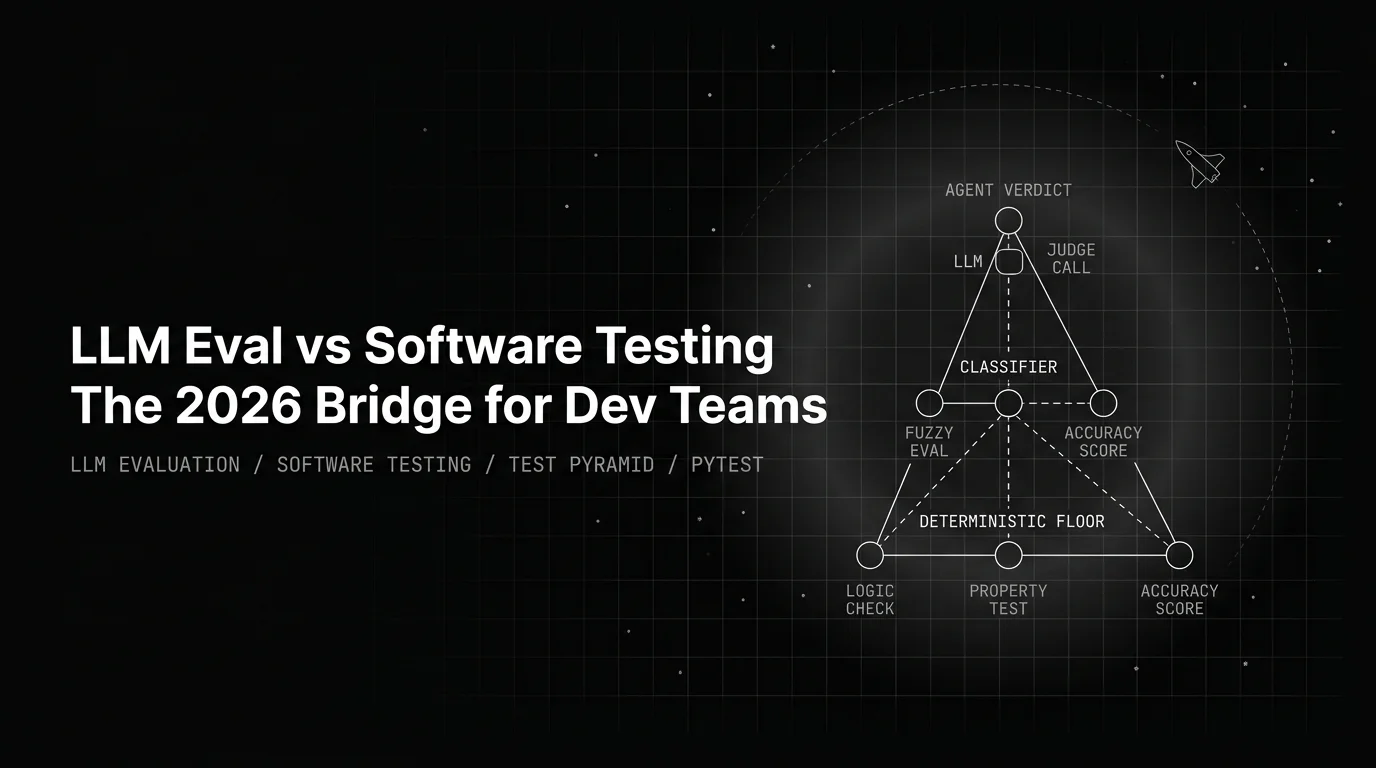
Table of Contents
Your dev team writes tests. Unit tests for the parsers, integration tests for the API contracts, end-to-end tests for the critical flows, smoke tests for the deploys. The pyramid is muscle memory. Then you ship an LLM feature and that same pyramid stops working the way it used to. Equality assertions fail randomly. Mocks become impossible. The CI runner times out because somebody wired an LLM-as-judge call into every PR. The problem isn’t that testing doesn’t apply to LLMs. The problem is that the pyramid keeps its shape but the judges, the cost curve, and the failure mode all swap out. This post is the bridge for software engineers, SDEs, and staff engineers handed an LLM workstream and asked to bring the same rigor.
TL;DR: the bridge
| Software testing | LLM eval (2026) | Transfers? |
|---|---|---|
| Unit tests | Deterministic Scanners (sub-10ms, byte-perfect) | Yes (re-shape) |
| Integration tests | Classifier-backed evals (10-100ms, fractional cent) | Yes (re-shape) |
| End-to-end tests | LLM-as-judge (100-3000ms, cents to dollars) | Yes (re-shape) |
| Smoke tests | Production canary, shadow routing | Yes |
| Property-based / fuzz tests | Synthetic adversarial generation | Yes (re-shape) |
| Snapshot tests | Regression golden-set comparison | Yes (re-shape) |
assertEqual on outputs | 0-to-1 rubric score plus threshold | No |
| Deterministic by construction | Stochastic by construction | No |
| Coverage = code paths | Coverage = input distribution | No |
| Flakiness = retry and fix | Variance = sample N and aggregate | No |
| Cost ≈ zero | Cost is a real budget line | No |
| Feedback loop = fix and re-run | Feedback loop = retune rubric/threshold/judge | No |
Six things that re-shape, six things that flip. That’s the whole bridge.
Why dev teams need this bridge specifically
Software engineers come pre-loaded with strong test-pyramid intuitions. Unit tests are cheap and many, integration tests are medium-cost and fewer, end-to-end tests are expensive and rare. That intuition is correct for LLM eval too. What’s wrong is the assumption that the pyramid’s judges and budget look the same on both sides.
Three failure shapes we see when a dev team skips the re-shape:
- The over-engineered eval suite. A team wires an LLM-as-judge onto every assertion, watches the CI bill cross five figures a month, and concludes LLM testing isn’t viable. The bug isn’t the LLM; it’s running the most expensive judge on the cheapest tier.
- The under-engineered eval suite. The opposite team runs
assert "Paris" in responseagainst a “where is the Eiffel Tower” prompt, watches it pass, and discovers the agent hallucinates citations on 8 percent of production queries. The bug is a single-rubric eval that never tested the question that mattered. - The flaky-eval trap. A team treats eval variance the way it treats flaky tests, retries until green, and ships a system that swings wildly between sessions. The regression set “averages out” past usefulness.
The test pyramid mapped onto LLM eval
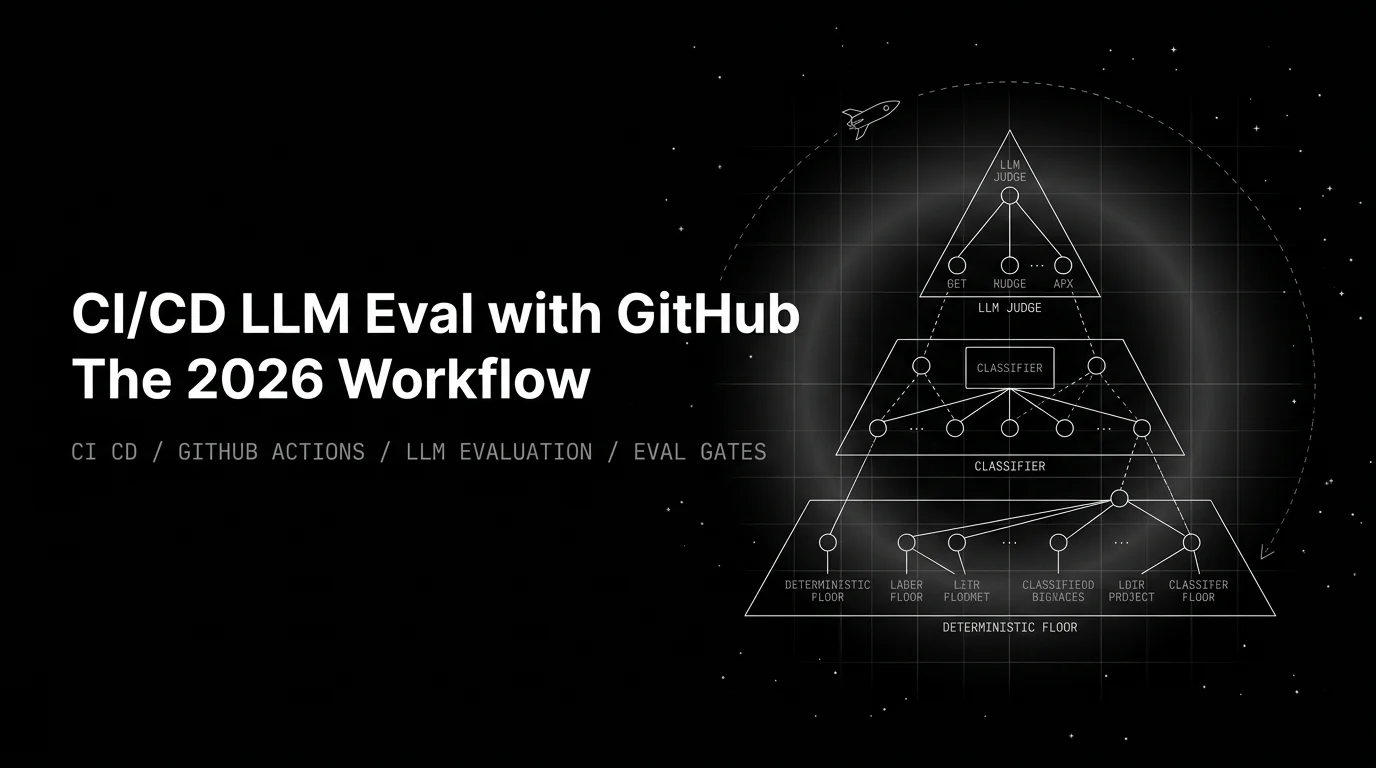
Software testing’s pyramid has a well-known shape. Many cheap unit tests at the base, fewer integration tests in the middle, a small number of expensive end-to-end tests at the top, plus smoke tests on the side as a fast pre-deploy check. LLM eval has the same shape with different judges.
Base tier: deterministic Scanners (the new unit test)
Unit tests in software are cheap, fast, byte-perfect, and run on every commit. The LLM-eval analog is the deterministic Scanner. The ai-evaluation SDK ships eight: JailbreakScanner, CodeInjectionScanner, SecretsScanner, MaliciousURLScanner, InvisibleCharScanner, LanguageScanner, TopicRestrictionScanner, RegexScanner. They run sub-10ms, cost essentially nothing, and produce byte-perfect deterministic results.
from fi.evals import JailbreakScanner, SecretsScanner, RegexScanner

scanners = [JailbreakScanner(), SecretsScanner(), RegexScanner(pattern=r"(?i)password")]


def test_inbound_prompt_passes_unit_scanners(user_prompt: str):
    for scanner in scanners:
        result = scanner.scan(user_prompt)
        assert result.passed, f"{scanner.__class__.__name__}: {result.reason}"
These behave exactly like traditional assertContains or assertMatches calls. Run them on every PR for every test case. They cover the OWASP-style adversarial surface and the regex/secrets surface that should never appear regardless of what the model said. The deterministic vs LLM-judge evals guide covers why this tier is the most under-used layer of an LLM eval stack.
Middle tier: classifier-backed evals (the new integration test)
Integration tests in software are medium-cost, talk to a database or a service, and run on every PR or every merge. The LLM-eval analog is the classifier-backed eval. The ai-evaluation SDK ships 13 guardrail backends behind one Guardrails class: nine open-weight (LLAMAGUARD_3_8B/1B, QWEN3GUARD_8B/4B/0.6B, GRANITE_GUARDIAN_8B/5B, WILDGUARD_7B, SHIELDGEMMA_2B) plus four API (OPENAI_MODERATION, AZURE_CONTENT_SAFETY, TURING_FLASH, TURING_SAFETY).
A classifier call runs in tens of milliseconds, costs around $0.001 per inference, and returns a calibrated probability per category. The discipline is identical to multi-class classification eval; only the model changes.
from fi.evals import Guardrails, GuardrailRule
from fi.evals.templates import Toxicity, PromptInjection
from fi.evals.types import RailType, AggregationStrategy, GuardrailBackend

guardrails = Guardrails(
    rules=[
        GuardrailRule(template=Toxicity(), threshold=0.5, backend=GuardrailBackend.LLAMAGUARD_3_8B),
        GuardrailRule(template=PromptInjection(), threshold=0.5, backend=GuardrailBackend.WILDGUARD_7B),
    ],
    rail_type=RailType.OUTPUT,
    aggregation=AggregationStrategy.MAJORITY,
)
This is the workhorse tier of a 2026 eval suite. Run it on the full regression set on every PR. Sub-second latency means you can fan it out across thousands of cases without blowing the CI budget. The guardrail metrics guide covers calibration mechanics in more depth.
Top tier: LLM-as-judge (the new end-to-end test)
End-to-end tests in software are expensive, slow, and run on a smaller subset (think main-branch nightly, not every PR). The LLM-eval analog is LLM-as-judge. The ai-evaluation SDK ships CustomLLMJudge with a Jinja2 prompt and a grading_criteria field, plus the 60+ pre-built EvalTemplate classes like Groundedness, ContextAdherence, FactualAccuracy, TaskCompletion, LLMFunctionCalling, and Completeness.
An LLM-judge call runs 100ms to 3 seconds, costs 5 to 50 cents per call, and answers the semantic questions a classifier can’t: does this paragraph actually support that claim, did this tool call match the user’s intent, is this answer complete to the brief.
from fi.evals import Evaluator
from fi.evals.templates import Groundedness, TaskCompletion
import os

EVALUATOR = Evaluator(
    fi_api_key=os.environ["FI_API_KEY"],
    fi_secret_key=os.environ["FI_SECRET_KEY"],
)


def test_rag_answer_grounded(agent_response, retrieved_chunks):
    result = EVALUATOR.evaluate(
        eval_templates=[Groundedness(), TaskCompletion()],
        inputs=[{
            "input": "What's the cancellation window?",
            "output": agent_response,
            "context": retrieved_chunks,
        }],
    )
    scores = result.eval_results[0].metrics
    assert scores["groundedness"] >= 0.80, f"Groundedness {scores['groundedness']}"
    assert scores["task_completion"] >= 0.85, f"Task completion {scores['task_completion']}"
Reserve this tier for the rubrics that genuinely need a reading-comprehension call. Sampling 5 percent of the regression set on every PR plus full coverage on the nightly is the standard pattern. The LLM-as-judge best-practices guide covers prompt design for the rubric itself.
Smoke tests: production canary and shadow routing
Smoke tests in software are the fast pre-deploy check. The LLM-eval analog is production canary plus shadow routing. Route 1 percent of real traffic to the new model, run the eval pyramid on the canary’s outputs in real time, and gate the wider rollout on the canary’s rubric scores staying within bounds of the production baseline. The agent rollout strategies guide walks through canary-by-cohort, shadow routing, and rollback triggers.
Property-based tests: synthetic adversarial generation
Hypothesis and QuickCheck generate random inputs that satisfy a property. The LLM-eval analog is synthetic adversarial generation: a teacher model or a templated mutation pass produces 1000 adversarial variations of a base prompt, the pyramid runs over each, and the surviving broken-behavior prompts get promoted into the regression golden set as permanent test cases. The autoresearch LLM test generation guide covers the generator side.
Snapshot tests: golden-set comparison
Jest snapshots capture an output, re-run, diff, accept or reject. The LLM-eval analog is the golden set: a fixed set of inputs with reference outputs (or reference rubric scores), the eval suite re-runs them on every PR, and the framework reports diffs against the saved baseline. The golden-set design guide covers stratification, refresh cadence, and version-pin discipline.
Gap 1: determinism
In software testing, determinism is the foundation. Same input maps to same output, period. Run the test a hundred times and it passes a hundred times or fails a hundred times. Flakiness is a bug to investigate, file, and fix.
LLM outputs are stochastic by construction. Temperature, top-p, sampling, provider-side caching variation, and per-request model state all introduce variance. Pin temperature to zero and a seed where possible, but even then most providers don’t guarantee bit-for-bit reproducibility. The same prompt run twice produces different responses.
The right response is to measure variance instead of fighting it. Run N samples per test case (5 to 10 is the standard), compute the score distribution, and use majority-vote aggregation. The Guardrails class ships AggregationStrategy.MAJORITY for this. A test that scores 0.78 plus or minus 0.04 across 10 runs is healthy variance; a test that scores 0.78 plus or minus 0.25 is telling you the underlying system is unstable, which is the real bug worth fixing upstream. The agent passes evals fails production guide covers why retrying-until-green papers over real instability.
Gap 2: pass/fail shape
In software testing a test passes or it doesn’t. Assertions are boolean. assertEqual either matches or it raises.
LLM eval is threshold-based. A faithfulness rubric returning 0.82 might be a pass for a casual chatbot and a fail for a regulated insurance assistant. The threshold lives per rubric, per route, per use case, and is calibrated against a production baseline. Three booleans hidden behind three real-valued scores, with three thresholds.
The 2026 pattern is route-aware thresholds with the threshold table living in the CI config, not in test bodies:
ROUTE_THRESHOLDS = {
    "casual_chat": {"groundedness": 0.70, "task_completion": 0.75},
    "support_agent": {"groundedness": 0.80, "task_completion": 0.85},
    "regulated_advice": {"groundedness": 0.92, "task_completion": 0.90},
}


def test_route(route_name, cases):
    thresholds = ROUTE_THRESHOLDS[route_name]
    result = EVALUATOR.evaluate(
        eval_templates=[Groundedness(), TaskCompletion()],
        inputs=cases,
    )
    for r in result.eval_results:
        for metric, floor in thresholds.items():
            assert r.metrics[metric] >= floor
The prompt regression testing guide walks through the threshold-tuning loop and the CI integration shape.
Gap 3: coverage
Code-path coverage tools (pytest-cov, coverage.py, jacoco) ask whether your tests touched every branch in the source. The metric is mechanical and the goal is a single number trending toward 100.
LLM-eval coverage is over the input distribution. The question is whether your golden set actually covers the intent classes, personas, locales, edge cases, and adversarial prompts you see in production. A 200-example regression suite that all looks like the happy path has zero percent coverage of the failure modes that actually ship bugs.
The 2026 coverage report for an LLM eval looks like:
- Count of examples per intent class (are rare intents represented?)
- Count of examples per persona, locale, and language (long-tail covered?)
- Count of adversarial and red-team examples (OWASP LLM Top 10 categories covered?)
- Median age of an example in the golden set (is the set fresh?)
- Hard-failure rate (what percent of examples currently fail any rubric?)
All five trend together. The OWASP LLM Top 10 risks and mitigations guide covers the adversarial-surface coverage. Coverage is a discipline transfer; what’s covered is what changes.
Gap 4: maintenance
Software tests rot when the API changes. Method signatures shift, fields get renamed; the signal is loud and the cause is local. LLM tests rot for a different reason: the input distribution shifts. New user intents appear, jargon drifts, the model upgrades and changes tone, upstream retrieval evolves. Your golden set was a 2024 snapshot and now scores 0.92 on 2026 traffic that it never sampled.
The discipline is identical to maintaining a regression suite; the rot mechanism is distribution drift, not source-code drift. The LLM eval data drift detection guide covers the detection mechanics. Promote failing production traces into the golden set weekly, deprecate stale examples, and version-pin the dataset like you version-pin code.
Gap 5: flakiness
Traditional QA has a clear rule: a flaky test is broken. Retry once to confirm, then file a bug against the test or the system under test. Flakiness is noise to eliminate.
In LLM eval, variance is baseline behavior, not noise. Replace “retry until green” with “sample N times and aggregate.” AggregationStrategy.MAJORITY gives you a green light with N=5 majority vote; AggregationStrategy.ALL gives you stricter pass-all-samples behavior for high-stakes routes; AggregationStrategy.WEIGHTED lets you weight specific judges higher. The dev-team instinct to retry away flakiness is dangerous in LLM land because it papers over real instability and quietly stops the regression set from catching anything.
Gap 6: run cost
Software tests run near free. Spin up the runner, hit the database, tear it down. CI minutes are billed per second but a million-line test suite still costs a fraction of an engineer-hour.
LLM eval can run expensive. A single LLM-judge call runs 5 to 50 cents. A 5000-example regression set running an LLM-judge per case lands at $250 to $2,500 per run. Multiply by ten PRs a day and you’ve built a service that costs more in eval than the model it’s evaluating. The cascade pattern keeps that from happening:
from fi.evals import Evaluator
from fi.evals.templates import Toxicity

result = EVALUATOR.evaluate(
    eval_templates=[Toxicity()],
    inputs=cases,
    augment=True,  # heuristic -> classifier -> LLM-judge cascade
)
With augment=True, the eval runs the cheap deterministic heuristic first, then the classifier on the ambiguous remainder, then the LLM-judge only on the cases the classifier wasn’t confident on. Order-of-magnitude cost reduction without losing precision. EarlyStoppingConfig (patience + min_delta + threshold + max_evaluations) adds sklearn-style early stop on eval loops where the score has clearly converged. The AI agent cost-optimization observability guide covers the budget framing in detail.
Gap 7: feedback loop
When a software test fails, the feedback loop is short. Read the trace, find the bug, fix the code or fix the test, re-run. The bug lives in one of two places and the diff tells you which.
When an LLM eval fails, the feedback loop has more knobs. The failure can mean: the prompt regressed, the rubric is mis-calibrated, the threshold is too tight, the judge model upgraded and started scoring differently, the input distribution shifted under the golden set, or all of the above simultaneously. Each knob is a separate fix.
The right move is to tag every score with a version triple: (prompt_version, judge_version, dataset_version). Re-run the failing case against an older triple and you can pinpoint which dimension regressed. The agent observability vs evaluation vs benchmarking guide covers the traceAI span-attached score model that carries the triple through OpenInference and OTEL_GenAI semantic conventions.
How Future AGI maps onto dev-team instincts
Six concrete ways the Future AGI eval stack maps onto software-engineer instincts:
- sklearn-style plus pytest-style API.
Evaluator(fi_api_key=..., fi_secret_key=...).evaluate(eval_templates=[Template()], inputs=[TestCase(...)])returns scores; you assert in fixtures. Same harness, same reporting, same parallel workers. - 60+ EvalTemplate classes. The pre-built scikit-learn metrics of LLM eval.
Groundedness,ContextAdherence,ContextRelevance,Completeness,ChunkAttribution,ChunkUtilization,FactualAccuracy,Toxicity,PromptInjection,DataPrivacyCompliance,AnswerRefusal,IsHarmfulAdvice,NoHarmfulTherapeuticGuidance,TaskCompletion,LLMFunctionCalling, and dozens more. - Eight sub-10ms Scanners.
JailbreakScanner,CodeInjectionScanner,SecretsScanner,MaliciousURLScanner,InvisibleCharScanner,LanguageScanner,TopicRestrictionScanner,RegexScanner. Behave exactly like traditional assertions; cover the deterministic adversarial surface for free. - 13 classifier backends behind one
Guardrailsclass. Nine open-weight plus four API. Calibrated precision and recall per category, sub-second latency, fractional-cent cost. - Four distributed runners. Celery, Ray, Temporal, Kubernetes. Same shape as
pytest-xdist; same scaling discipline; same horizontal-fanout instinct. EarlyStoppingConfigplusaugment=Truecascade. sklearn-style early-stop on eval loops; classifier-first cascade that only routes ambiguous cases to the LLM-judge. Order-of-magnitude cost compression.
The Future AGI Platform adds three dev-flavored superpowers on top:
- Self-improving evaluators. The Platform auto-retunes rubric prompts and thresholds from production feedback. Thumbs-up and thumbs-down signals fold back into the rubric definition, and per-eval cost stays lower than what Galileo Luna-2 charges. The self-improving AI agent pipeline guide covers the loop. This is the closest thing to a “self-healing test” software engineers have asked about for a decade.
- Six agent-opt optimizers as hyperparameter sweeps.
RandomSearchOptimizer,BayesianSearchOptimizer(Optuna-backed, teacher-inferred few-shot, resumable trials),MetaPromptOptimizer,ProTeGi,GEPAOptimizer,PromptWizardOptimizerplusEarlyStoppingConfig. Treat your rubric prompt like a hyperparameter and sweep it. The automated prompt improvement guide walks through the loop. - Error Feed as a bug tracker for LLM failures. HDBSCAN soft-clustering pulls failing production traces, groups them into named clusters, and a Sonnet 4.5 Judge writes an
immediate_fixper cluster. The cluster IDs become a new triage dimension and feed back into the Platform’s self-improving evaluators. Today Linear is the only ticket-creating integration; Slack, Jira, and PagerDuty are on the roadmap.
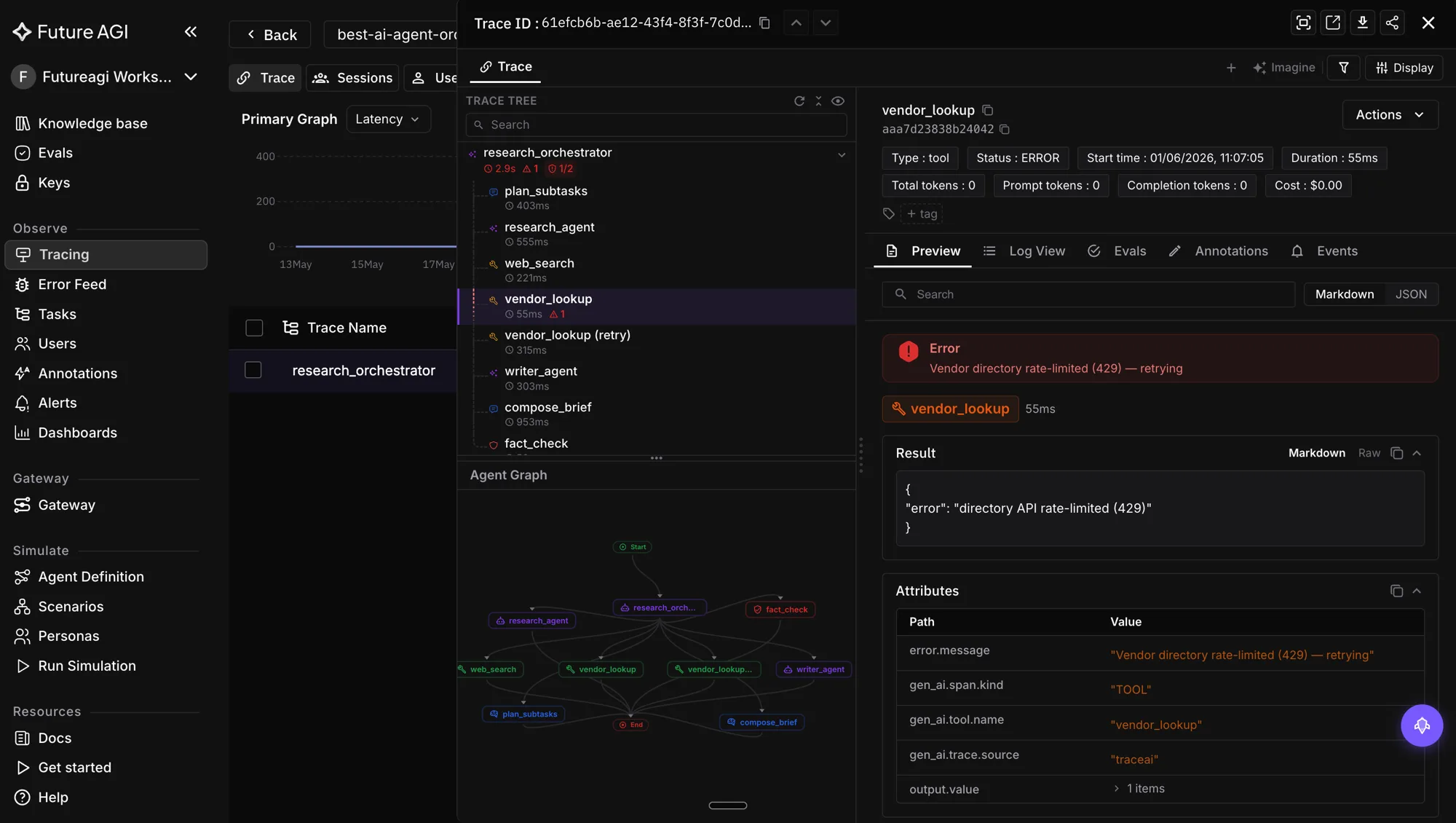
The pluggable traceAI conventions (OpenInference, OTEL_GenAI, custom) plus per-framework XInstrumentor().instrument(tracer_provider=...) calls give you the trace coverage to attach scores back to the spans that produced them. fi.span.kind=* covers 14 span kinds across the 50+ AI surfaces (46 Python, 39 TypeScript, 24 Java incl. Spring Boot starter, 1 C#).
A practical 5-step transition for a dev team
If you’re a senior or staff engineer handed an LLM workstream Monday morning, here’s the order to run.
Step 1: pick the eval-pyramid tier per rubric
For each behavior you care about, pick its tier. Free-form jailbreak detection is a Scanner. Toxicity is a classifier-backed eval. Faithfulness on retrieved context is an LLM-judge. Don’t run a $0.50 judge for something a $0.001 classifier handles equivalently; don’t run a classifier where a deterministic regex would do.
Step 2: deploy Scanners for the unit-test equivalent
Wire JailbreakScanner, SecretsScanner, CodeInjectionScanner, MaliciousURLScanner, InvisibleCharScanner, LanguageScanner, and any project-specific RegexScanner patterns into the eval suite. They run sub-10ms and cost nothing, so you can run them on every test case on every PR with no budget concern. Same shape as the unit-test base of your pyramid.
Step 3: add classifier-backed evals for the integration-test equivalent
Pick one or two backends (a LLAMAGUARD_3_8B or QWEN3GUARD_8B for general safety, plus a domain-specific one like WILDGUARD_7B for jailbreak nuance). Wire them through Guardrails(rules=[...], rail_type=RailType.OUTPUT, aggregation=AggregationStrategy.MAJORITY). Run them on the regression set on every PR; sub-second latency, fractional-cent cost.
Step 4: reserve LLM-judge for the e2e equivalent
For the high-stakes semantic rubrics (Groundedness, FactualAccuracy, TaskCompletion, LLMFunctionCalling), wire Evaluator.evaluate(...) with the relevant EvalTemplate plus augment=True for the cascade. Run on every PR for a sampled subset (5 to 10 percent of cases) plus full coverage on the nightly build. The evaluate RAG applications CI/CD guide covers the RAG variant.
Step 5: gate every PR with the pyramid; nightly batch for full corpus; production canary for new code paths
Mirror the testing discipline. PR-gate runs the Scanners on 100 percent, classifiers on 100 percent, LLM-judge on a sample. Nightly runs the LLM-judge tier on the full corpus. Production canary routes 1 to 5 percent of real traffic to the new path, runs the eval pyramid on the canary’s outputs in real time, and the wider rollout gates on canary scores staying within bounds of the production baseline. The CI/CD for LLM eval guide covers the GitHub Actions wiring; the CI/CD for AI agents best-practices guide covers the agent-flavored version.
Anti-patterns to avoid
Six failure shapes we see when software teams skip the re-shape:
- pytest plus
assertEqualon LLM outputs. Impossible to satisfy. Replace with rubric score plus threshold. - LLM-judge on every eval call. Cost runaway. Use
augment=Trueso the judge runs only on the ambiguous remainder. - Skipping the deterministic Scanner layer. The cheapest, fastest, most reliable tier, and the one most teams under-deploy.
- No input-distribution coverage. A suite where every example is a happy-path query covers zero percent of the failure modes that ship bugs.
- Ignoring variance. Treating a 0.85 to 0.82 swing as flake instead of measured variance. Replace with N-sample aggregation.
- Single-rubric eval. Misses the multi-dimensional quality surface. Compose at least three rubrics through
Guardrails.
Fix the equality assertion, the cascade-less judge runs, and the variance ignore first. The other three retrofit later.
Honest framing on what ships today
Eval-driven optimization on rubric prompts ships today: agent-opt’s six optimizers (RandomSearchOptimizer, BayesianSearchOptimizer with Optuna and teacher-inferred few-shot, MetaPromptOptimizer, ProTeGi, GEPAOptimizer, PromptWizardOptimizer) plus EarlyStoppingConfig and resumable Optuna trials. The trace-stream-to-agent-opt connector that turns production traces directly into optimization datasets is on the roadmap; today the connector lives in the eval-driven path, not the trace-driven path.
Error Feed’s only ticket-creating integration today is Linear; Slack, Jira, and PagerDuty are on the roadmap. The clustering signal itself (HDBSCAN soft-clustering plus Sonnet 4.5 Judge immediate_fix per cluster) is available now and ready to feed into a dev team’s existing triage flow.
The Platform’s self-improving evaluators (rubric prompt auto-retuning from thumbs-up and thumbs-down feedback, plus per-eval cost lower than Galileo Luna-2) ship today and are the closest thing we’ve seen to the “self-healing test” software engineers have asked about for years.
Where this fits in the bridge series
This post is the dev-team companion to three adjacent bridges. The QA-team bridge covers the same transition framed for QA engineers handed an LLM workstream. The classical ML eval bridge covers the transition for data scientists coming from sklearn and MLflow. The product analytics bridge covers it for product teams coming from Mixpanel, Amplitude, PostHog, and Heap. Pick the bridge that matches your starting discipline; they converge on the same Future AGI eval stack.
A dev team that runs the five-step transition on its existing pytest harness has built a serious LLM eval practice in one to two sprints. Discipline transfers, primitives re-shape, harness barely changes. The pyramid’s the same; the judges are new. That’s the bridge.
Frequently Asked Questions
What's the test-pyramid analogy for LLM evaluation?
Why can't I just use pytest with assertEqual for LLM outputs?
How do I gate a PR on LLM eval the way I gate on test coverage?
Is LLM eval cost actually a real concern for a dev team?
How is variance handled in LLM evaluation if every run gives different scores?
What's the equivalent of property-based testing or fuzzing for LLM eval?
How does Future AGI lower the friction for software engineers?
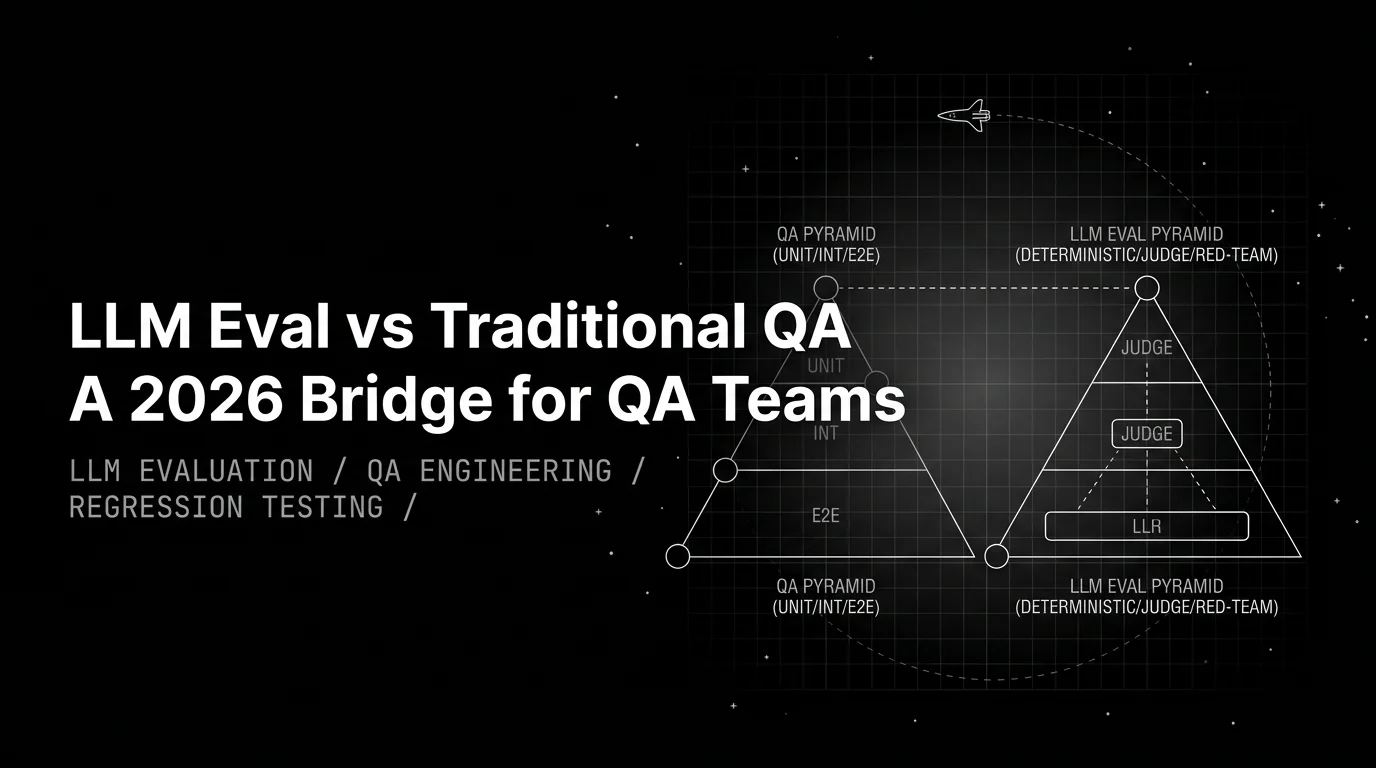
Traditional QA asserts pass/fail. LLM eval grades against a rubric. The pyramid, the golden set, the CI gate carry, the assertion library you replace.

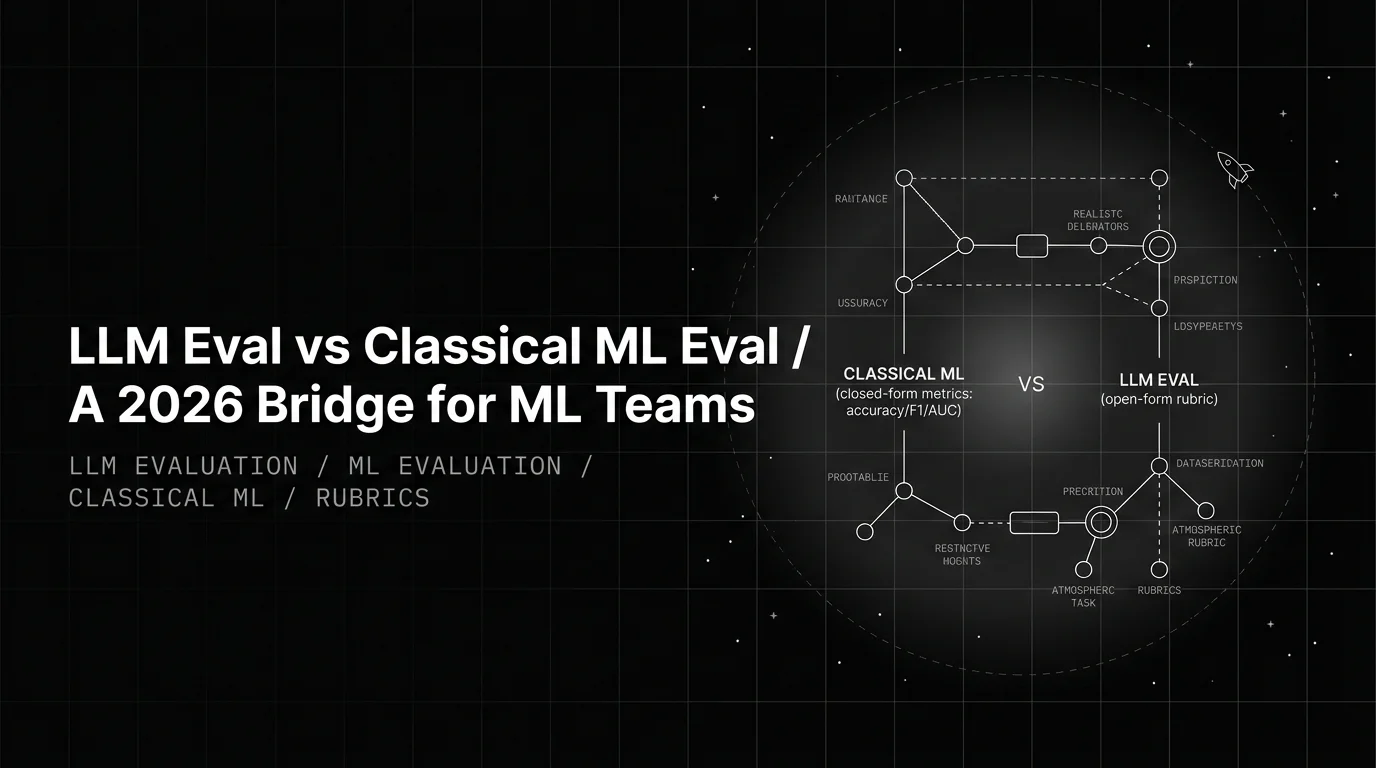
Classical ML eval is closed-form, LLM eval is open-form. The discipline that carries, metrics that break, mapping sklearn to an LLM eval suite.

Cheap, fast, statistically significant LLM eval gates in GitHub Actions: classifier cascade, fi CLI exit codes, Welch's t-test, auto-rollback.