Deterministic vs LLM-Judge Evals (2026): Layer, Don't Choose
Deterministic vs LLM-judge isn't a pick. It's a cascade. Where each wins, where each breaks, and the layering that drops eval cost 95% in production.
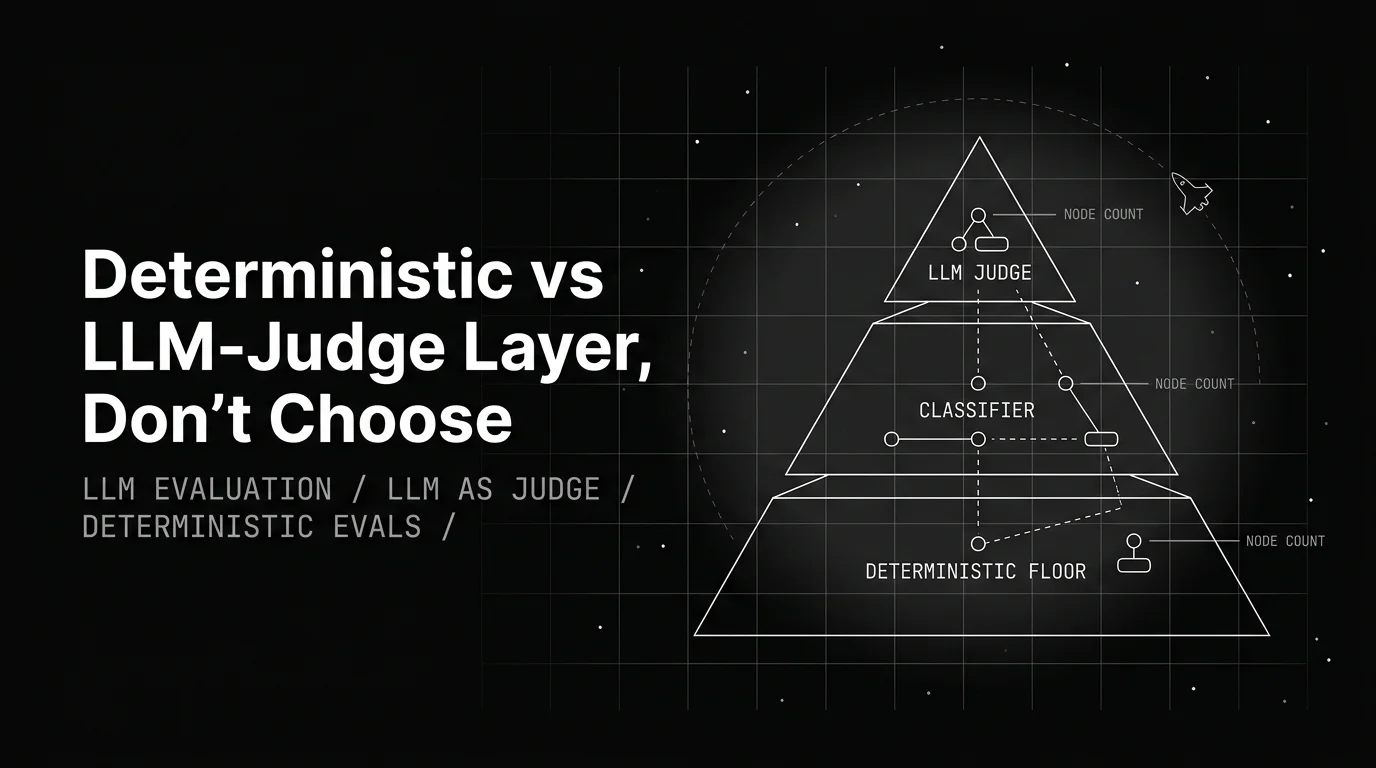
Table of Contents
The 2024 eval discourse made LLM-as-a-judge the default answer. The 2025 production bills made teams reach back for deterministic checks. By 2026 the honest framing is neither: deterministic and judge are not rival philosophies fighting for one slot. They are layers in a cascade. Deterministic is the cheap floor that catches 30 to 60 percent of failures for free. The judge is the expensive ceiling that catches subjective rubric breaks at cents per call. Pick one in isolation and you either ship semantic regressions or burn a quarter’s budget on a weekend’s traffic.
This post is the comparison and the decision framework: the two philosophies behind each family, where each one wins, where each one breaks, where neither can reach, and the cascade that ships in production.
Two philosophies, one stack
Every eval method in production maps to one of two stances on what “good” means.
The deterministic stance. Quality is a property you can encode. If you can write a parser, a regex, a schema, or a hash check that distinguishes pass from fail, the eval is a function: same input, same score, every time. There is no model in the loop. The cost is engineering time on the rules; the runtime cost is microseconds. BLEU, ROUGE, JSON schema validation, regex contracts, exact match, the eight Future AGI Scanners (jailbreak, secrets, invisible chars, malicious URLs, code injection, language, topic restriction, regex) all sit here. The stance is honest about what it covers: structure, not meaning.
The judgment stance. Quality is a rubric stated in English. Helpfulness, faithfulness against retrieved context, persona consistency, refusal calibration, multi-turn task completion. None of these compress into a parser. You write the rubric, send candidate and context to a frontier model, and treat the returned score as the verdict. G-Eval formalized the pattern in 2023; every serious framework now ships a variant. The judge handles meaning. The price is real: cents per call, 100 to 3000 ms of latency, and a calibration drift problem because the judge is itself a prompt against a model that changes.
The mistake the field made for two years was treating these as alternatives. They are not. A modern eval stack runs both, in series, with a classifier-backed safety layer between them. Each layer answers a question the layer below it can’t, at a cost the layer above it can’t justify.
Where deterministic wins
Deterministic is the right tool when the rubric is closed-form: the answer is either in the data or it isn’t, and you don’t need a model to read meaning to find out.
| Dimension | Deterministic | LLM-judge |
|---|---|---|
| Cost per eval | $0 | $0.005 to $0.05 |
| Latency p50 | Sub-millisecond | 100 to 3000 ms |
| Reproducibility | Byte-perfect | Drifts with model versions |
| Coverage | Structural only | Any rubric you can write |
| Maintenance burden | Pattern rot, schema drift | Calibration kappa drift |
| Failure mode | False negatives on semantics | Position, verbosity, self-preference biases |
What deterministic handles cleanly:
- Schema validation. Tool-call payloads against a JSON schema. Required fields, type checks, enum bounds.
EvaluateFunctionCallingdoes the structural diff against the declared tool definition. - Format checks. Valid JSON, valid SQL, valid Markdown, length bounds, citation IDs that exist in the retrieval context.
- Allowlist and denylist. Approved domains, blocked terms, regulated phrases.
- Secrets and credentials. API keys, AWS tokens, SSH keys, credit-card numbers under a Luhn check.
- Encoding tricks. Invisible Unicode, BIDI overrides, homoglyph substitutions, base64 payloads in unexpected fields.
- Prompt-injection signatures. Known jailbreak strings, DAN-style prefixes, role-override patterns that show up in public databases.
The Future AGI SDK ships these as eight Scanner classes plus the heuristic local metrics:
from fi.evals.guardrails.scanners import (
    ScannerPipeline,
    JailbreakScanner,
    SecretsScanner,
    InvisibleCharScanner,
    TopicRestrictionScanner,
)

pipeline = ScannerPipeline([
    JailbreakScanner(),
    SecretsScanner(),
    InvisibleCharScanner(),
    TopicRestrictionScanner(allowed=["billing", "shipping", "returns"]),
])

result = pipeline.scan(text=user_input)
if not result.passed:
    return safe_refusal(blocked_by=result.blocked_by)
Sub-10ms per scanner, no API call, no probability to calibrate. They cover roughly 30 to 60 percent of real-world failures depending on the workload, with most teams landing closer to 50 percent on safety-heavy surfaces. For the family of checks that fits, the eight Future AGI Scanners cover the surface without an inference call.
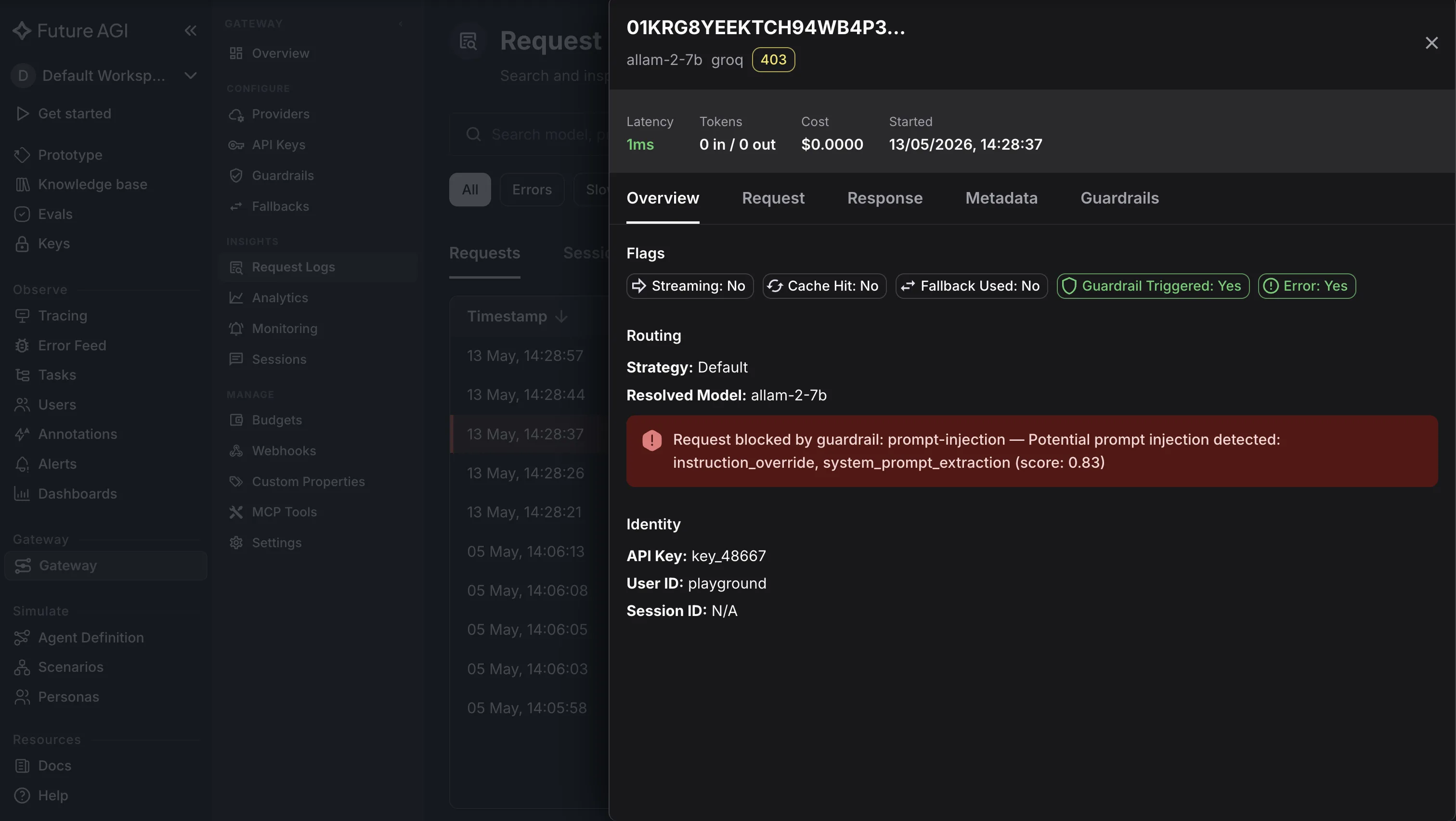
Where deterministic stops: anything semantic. The agent that hallucinates a product feature in fluent English passes every schema check. The summary that drops the one critical sentence parses cleanly. The toxic response that avoids every banned word still lands as toxic. Deterministic catches form failures and ships substance failures.
Where LLM-judge wins
The judge earns its place on the rubrics that can’t be expressed as a parser or a fine-tuned classifier. These are the dimensions production LLM teams actually care about, and they share a property: the definition of “good” depends on context the eval has to read.
| Dimension | Why it’s judge-only |
|---|---|
| Grounded hallucination | Definition shifts per call: what counts as context depends on retrieval shape |
| Persona consistency | Domain voice rules have no public training set |
| Multi-turn task completion | Session-level outcome, not a per-turn signal |
| Refusal calibration | Subjective: did the model refuse the right thing for the right reason |
| Tool-call argument plausibility | Schema is deterministic; intent-match is judge work |
| Custom domain policy | Any rubric you can write in a paragraph the judge can score |
The Future AGI surface is CustomLLMJudge:
from fi.evals.metrics.llm_as_judges.custom_judge.metric import CustomLLMJudge
from fi.evals.metrics.llm_as_judges.types import CustomInput
from fi.evals.llm.providers.litellm import LiteLLMProvider

judge = CustomLLMJudge(
    provider=LiteLLMProvider(),
    config={
        "name": "persona-consistency",
        "model": "gpt-4o",
        "grading_criteria": (
            "Score 1.0 if the response stays warm, concise, never speculates "
            "on pricing, and never promises refunds without escalation. "
            "Score 0.5 on partial drift. Score 0.0 if the persona breaks. "
            "Do not prefer longer answers."
        ),
    },
)

result = judge.compute_one(CustomInput(
    question=user_msg,
    answer=agent_response,
    context=system_prompt,
))
The same primitive powers 60+ EvalTemplate rubrics: Groundedness, ContextAdherence, ChunkAttribution, FactualAccuracy, TaskCompletion, SummaryQuality, LLMFunctionCalling. Each ships with a default rubric tuned for that dimension; you override grading_criteria to encode your domain rules.
What the judge ships with that you cannot wish away:
- Cost. GPT-4o at roughly $0.005 a call, a million daily evals, is $5,000 a day or $150K a month for evaluation alone. Wire that to a synchronous hot path and the unit economics break.
- Latency. 100 ms on a small fast judge, 1 to 3 seconds on a multi-rubric judge over long context. Blocks the response budget on user-facing surfaces.
- Drift. The rubric is a prompt. Bump the judge model from
gpt-4o-2024-08-06togpt-4o-2024-11-20and scores shift 3 to 8 points without the agent changing. Pin the model id, calibrate against a human-labeled set, track Cohen’s kappa as a first-class metric. The case for and against LLM-as-a-judge walks the five documented biases (position, verbosity, self-preference, calibration drift, family lock-in) in depth.
The framework rule: never put an LLM-judge on the synchronous hot path unless the cascade has already filtered 90 percent of traffic out before it gets there.
Where neither works: escalate to a human
A small fraction of production traffic sits in territory neither family can resolve cleanly. The honest move is to wire a human-review queue and stop pretending automation covers it.
Three triggers belong on the queue, not the cascade:
- Calibration noise band. The judge returns a score inside ±0.1 of the decision threshold. The judge is not confident; treating the score as decisive is theatre.
- Cross-judge disagreement. Run two judges (different families) and they disagree by more than the calibrated delta on the same input. The rubric isn’t covering the case yet.
- High-stakes domain. Medical advice, legal interpretation, refund decisions over a dollar limit. The cost of a wrong eval beats the cost of a queued review.
Future AGI’s AnnotationQueue handles this surface. Failing traces land in the queue with the trace context attached; a reviewer labels them; the labels flow back into the calibration set. If the queue is catching more than 5 to 10 percent of traffic, the rubric needs work, not more reviewers.
The trap teams fall into is hiding the human layer. They turn up the judge’s confidence threshold to ship fewer escalations, the cascade looks cleaner, and the failures show up in customer complaints two weeks later. The reviewable layer is a feature, not a fallback.
The hybrid pattern: cascade in three stages
The pattern that ships in production runs three layers in series. Each stage handles the failures the next stage would be wasted on.
Stage 1: deterministic floor. Every request hits this first. Scanners block jailbreaks, secrets, off-topic drift, schema violations. Anything that fails returns immediately. No model call, no probability, no cost. This stage catches 30 to 60 percent of traffic on safety-heavy workloads.
Stage 2: classifier-backed safety. Whatever survives Stage 1 hits a small fine-tuned encoder model: LLAMAGUARD_3_8B, QWEN3GUARD_4B, GRANITE_GUARDIAN_8B, SHIELDGEMMA_2B, or one of the API backends (OPENAI_MODERATION, AZURE_CONTENT_SAFETY, TURING_FLASH, TURING_SAFETY). 10 to 100 ms per call, fractions of a cent. Returns a probability; you set a calibrated threshold. Scores outside the ambiguity band resolve here. The 13 backends ship behind a unified config:
from fi.evals.guardrails import GuardrailsConfig, GuardrailModel
from fi.evals.guardrails.config import RailType, AggregationStrategy

config = GuardrailsConfig(
    rail_type=RailType.INPUT,
    models=[
        GuardrailModel.LLAMAGUARD_3_8B,
        GuardrailModel.QWEN3GUARD_4B,
    ],
    aggregation=AggregationStrategy.MAJORITY,
    threshold=0.55,
)
AggregationStrategy.MAJORITY runs both models and flags only when both agree, which collapses false-positive rates on the long tail. ALL is the high-precision mode for hot paths. ANY is high-recall for offline triage. WEIGHTED biases toward the model that scores best on your domain.
Stage 3: judge augmentation. Only the ambiguous remainder (typically scores between 0.4 and 0.7) reaches the judge. Same CustomLLMJudge primitive; the judge becomes the final decision for that 5 to 10 percent of traffic. The SDK wires the whole cascade as a single flag on evaluate():
from fi.evals import evaluate

result = evaluate(
    "faithfulness",
    output=agent_response,
    context=retrieved_chunks,
    augment=True,
    model="gpt-4o",
)
augment=True runs the local heuristic first, then escalates to the LLM judge with the heuristic’s reasoning in context. The judge starts from grounded evidence; you pay frontier cost only when the cheaper signal isn’t decisive. Eighty to ninety percent cost saved with no measurable drop in detection rate on most rubrics.
The cost shape at a million daily evals:
| Setup | Daily cost | Monthly | p50 latency adder |
|---|---|---|---|
| Judge-only | $5,000 | $150,000 | 300 ms |
| Classifier-only | $100 | $3,000 | 50 ms |
Cascade (augment=True) | ~$260 | ~$7,800 | 8 ms (most bounce off Stage 1) |
The cascade ships 30x cheaper than judge-only while covering 100 percent of the rubric surface. That is the entire reason the pattern exists, and the reason Future AGI’s per-eval cost is lower than Galileo Luna-2 on the classifier path: the cascade economics depend on that number being small.
Decision framework: pick the layer that fits
Run this rubric when you’re sizing the eval layer for a new agent. Each row is a common dimension; the second column is the cheapest tool that gives the right answer.
| Eval dimension | Right layer |
|---|---|
| JSON schema, tool-call structure, format | Deterministic (EvaluateFunctionCalling) |
| Required disclosures, forbidden patterns, PII regex | Deterministic + classifier for nuanced PII |
| Toxicity, prompt injection, bias, harmful instructions | Classifier-first (LLAMAGUARD_3_8B); judge on borderline |
| Grounded hallucination against retrieval | Judge (Groundedness, ContextAdherence) |
| Persona consistency, tone | Judge (CustomLLMJudge with persona rubric) |
| Multi-turn task completion | Judge (TaskCompletion), at session level not per-turn |
| Tool-call argument plausibility | Deterministic schema first, judge second (LLMFunctionCalling) |
The skill is reaching for the cheapest tool that gives the right answer. A frontier judge running on a binary toxicity decision a 4B Gemma adapter would return in 65 ms is the audit-finding pattern that shows up in every cost review. A deterministic regex running on a faithfulness rubric is the equivalent failure on the precision side. Match the layer to the question.
Four anti-patterns to avoid:
Judge on every eval. The most expressive tool and the most expensive. Default on the hot path costs 30 to 100x more than the cascade and adds 200 to 1500 ms of latency the user feels. Fix: judge handles only the ambiguous remainder.
Deterministic-only. Catches form failures, ships substance failures. Every hallucination, every banned-word-avoiding toxic response, every persona drift passes. Fix: at least one semantic layer downstream of the deterministic gate.
Single classifier backend. Fixed precision-recall curve, single failure mode. Run two with AggregationStrategy.MAJORITY and the false-positive rate on the long tail collapses. Roughly 2x the inference; the precision gain pays for it on regulated surfaces.
No threshold calibration. A classifier’s raw output is a probability, not a decision. Shipping the default 0.5 threshold without labelling production traces leaves real precision on the table. Label 200 to 500 traces, pick the threshold that hits your target precision, re-tune monthly. The trace-eval gap post walks the long-form catalogue.
How Future AGI ships the cascade as a package
A single deterministic check on a span is a number. A judge call by itself is a more expensive number. The compound value is in wiring all three layers behind one surface that calibrates, clusters, and refines as production traffic shifts.
The ai-evaluation SDK (Apache 2.0) ships the full stack:
- Eight deterministic Scanners at sub-10ms, no API call, covering jailbreak, secrets, invisible chars, malicious URLs, code injection, language, topic restriction, regex.
- 20+ local heuristic metrics: BLEU, ROUGE, METEOR, Levenshtein, embedding similarity, JSON validators, structural code checks. All run offline.
- 13 classifier-backed guardrail backends: 9 open-weight (
LLAMAGUARD_3_8B/1B,QWEN3GUARD_8B/4B/0.6B,GRANITE_GUARDIAN_8B/5B,WILDGUARD_7B,SHIELDGEMMA_2B) and 4 API (OPENAI_MODERATION,AZURE_CONTENT_SAFETY,TURING_FLASH,TURING_SAFETY). Unified config withINPUT,OUTPUT,RETRIEVALrail stages andANY/ALL/MAJORITY/WEIGHTEDvoting. - 60+ EvalTemplate rubrics including
CustomLLMJudgewith Jinja2 templating against any LiteLLM-supported model and multi-modal input. augment=Truecascade as the production default. Heuristic first, judge on the ambiguous remainder, same SDK call.
traceAI carries the same rubric as a span-attached EvalTag on live traffic across 50+ AI surfaces in Python, TypeScript, Java, and C#. The same rubric in CI and on production spans is the diff that turns LLM-as-a-judge from a notebook experiment into an evaluator that holds over time.
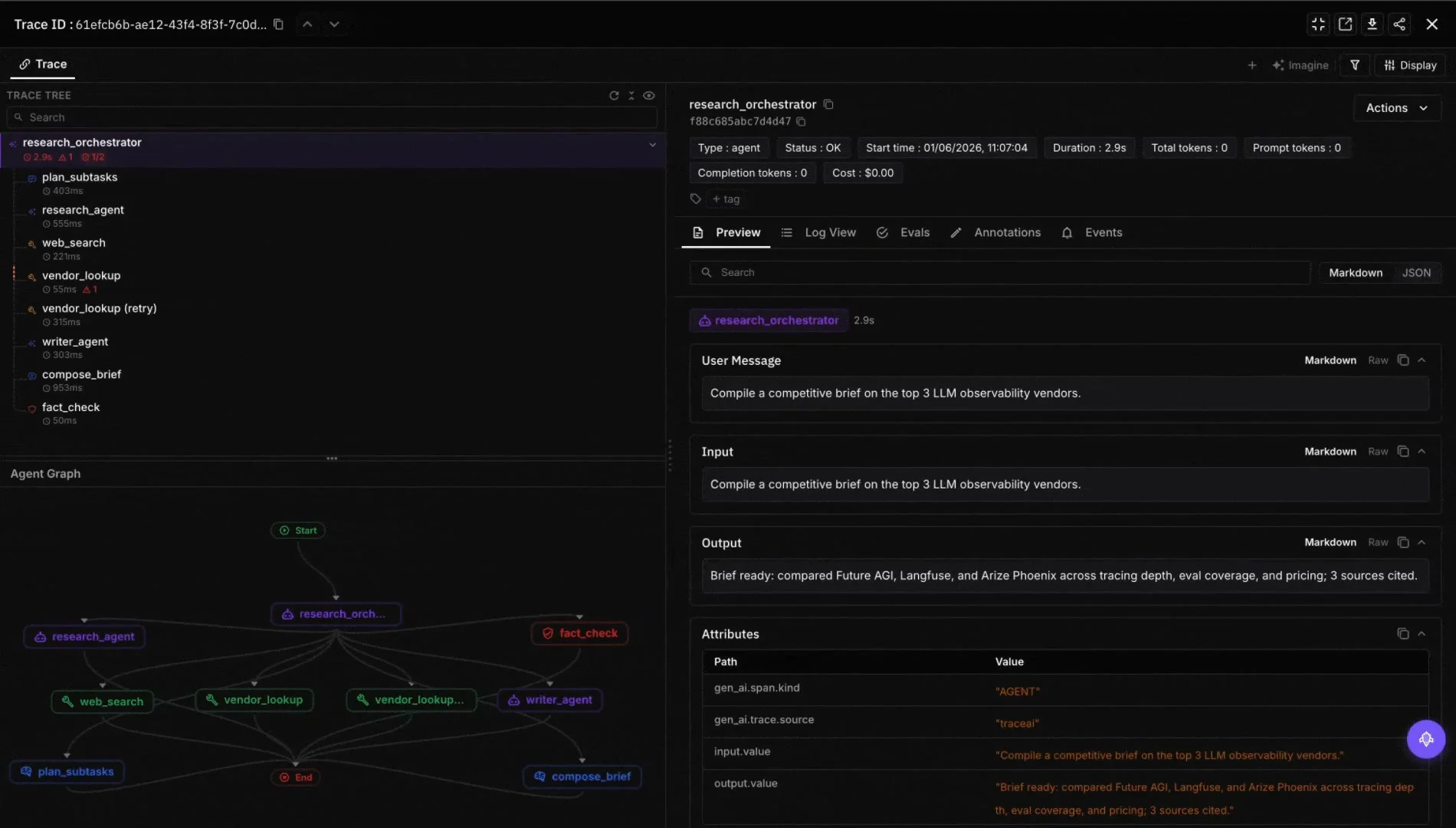
Beyond the SDK, the Future AGI Platform layers what code alone can’t: self-improving evaluators retune from thumbs feedback so the rubric ages with the product; classifier-backed scoring runs at lower per-eval cost than Galileo Luna-2; Error Feed (HDBSCAN soft-clustering over ClickHouse-stored embeddings plus a Sonnet 4.5 Judge agent on a 5-category error taxonomy) writes an immediate_fix against each failing cluster and feeds it to the self-improving evaluators so the cascade tightens as production shifts.
Honest framing on what’s roadmap: the trace-stream-to-dataset connector (auto-promoting flagged production traces into the eval dataset for the next agent-opt run) is not shipping today; the cascade itself, the calibration loop through Error Feed and self-improving evaluators, and the six agent-opt optimizers all ship.
Ready to wire a production-grade cascade against your workload? Start with the ai-evaluation SDK quickstart, drop a ScannerPipeline in front of your judge today, then enable augment=True on the rubric that’s costing the most. For the long-form companions: the case for LLM-as-a-judge covers the judge side in depth, deterministic LLM eval metrics covers where deterministic still earns its slot in 2026, and the 2026 LLM evaluation playbook covers the dataset and CI-gate layers around them.
Three takeaways for 2026
- Deterministic and judge are layers, not alternatives. Pick one in isolation and you either ship semantic regressions or burn a quarter’s budget.
- The cascade economics are the lever. Most production traffic should never touch the expensive judge. If it does, the lower layers aren’t doing their job.
- The reviewable human queue is a feature. A small fraction of traffic genuinely doesn’t resolve in either family. Wire
AnnotationQueue, let the labels feed the calibration loop, and the cascade tightens with use.
Frequently Asked Questions
Is deterministic or LLM-judge better for LLM evaluation in 2026?
What does a cascade eval pipeline look like in practice?
Are deterministic evals enough on their own?
How much does LLM-as-judge cost at production scale?
Which eval type handles hallucination?
When should genuinely fuzzy production calls escalate to a human?
Schema, regex, exact match, BLEU/ROUGE, citation-validity. Where deterministic LLM eval metrics catch 30-60 percent of failures before a judge fires.

LLM-as-a-judge is the only eval method that scales to subjective rubrics. The honest case for, against, and the discipline that earns trust.

LLM-as-judge best practices for 2026: pick the right judge, calibrate against humans, watch length and family bias, control cost. Discipline that scales.