Prompt Versioning and Lifecycle Management in 2026
Prompt versioning is git for prompts plus eval-gated promotion plus production rollback. Three-stage lifecycle (draft, gated, deprecation) with FAGI tools.
Table of Contents
A 12-line refinement to the support agent’s groundedness prompt lands in main at 4:07pm Tuesday. The author ran it past a teammate over Slack. It passed a smoke test of three hand-picked examples. By 4:23pm, refusal rate on legitimate refund queries is up 14 points, p95 latency is up 38%, and the on-call engineer is staring at a 200-line diff that touched prompts/ plus four other files. Rollback is a git revert that also reverts the four other files. The semantic cache serves the new prompt’s response shape for 90 more seconds. By 5pm the team is running a half-revert and praying nothing else regressed.
The opinion this post earns: prompt versioning is git for prompts plus eval-gated promotion plus production rollback. Skip eval-gated promotion and you ship without proof. Skip rollback and a bad prompt eats the weekend.
This guide is the working playbook. Three stages — draft, gated-promotion, deprecation — the math behind the gates, the rollback primitives, and the Future AGI surfaces (ai-evaluation SDK, traceAI, Agent Command Center, Error Feed, agent-opt) that make each stage operational.
TL;DR: three stages, two gates, one rollback
| Stage | Job | What ships | Failure if missing |
|---|---|---|---|
| Draft | Iterate a versioned template | Candidate in git + variable schema | Un-bisectable; every change is a code deploy |
| Gated promotion | Prove the candidate beats the incumbent | Eval-on-PR + canary ramp gated by floor / paired CI / safety flip | Silent regressions ship; winner-take-all rollouts |
| Deprecation | Stop the old version from serving | Label archived + drain window + cache eviction | Ghost-serving from cache; split-version requests |
Versioning gives you the id and the diff. Eval-gated promotion gives you the proof. Rollback gives you the recovery. For the static surface, see What is Prompt Versioning?.
Why three stages, not seven
A seven-stage diagram (author, review, test, deploy, monitor, improve, retire) reads cleanly on a slide and falls apart in practice. Review and test are the same gate — the eval-on-PR job — on the same artifact. Deploy and monitor collapse into one operation under canary routing: the label flip is the start of monitoring. Improve is a feedback loop, not a stage; production traces flow into the next candidate continuously.
What you need at runtime is three things. A draft surface where prompts iterate as versioned objects, not strings. A promotion gate that proves the candidate beats the incumbent before traffic ramps. A rollback primitive that pulls the new version out cleanly when monitoring trips. Everything else is plumbing inside one of those three.
Stage 1: Draft
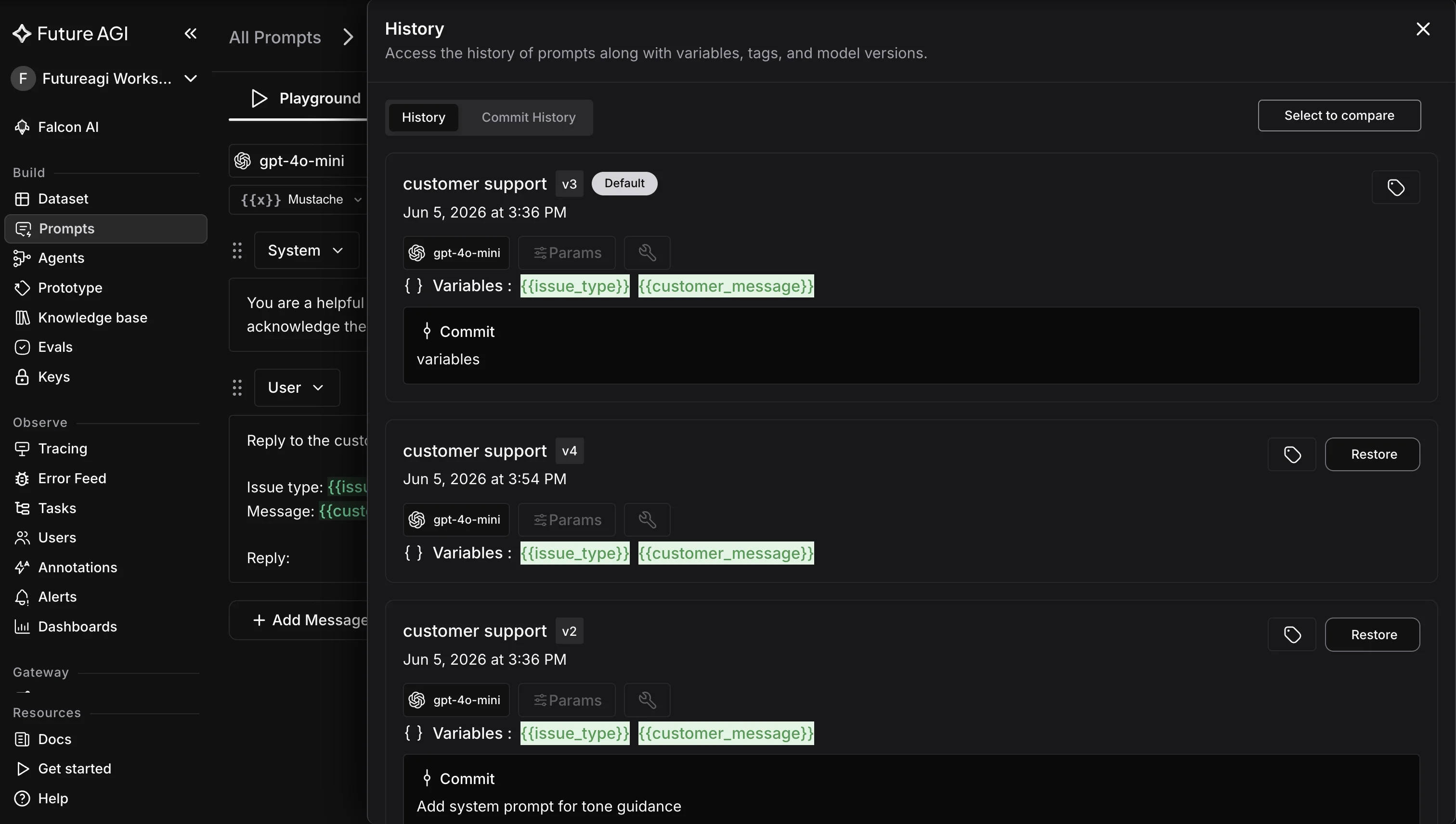
Draft is the iteration loop. The artifact at the end is a candidate version with three pieces — template body, variable schema, generation parameter block — moving together as one versioned object.
# prompts/support_agent/v24.yaml
id: support_agent
version: v24
parent: v23
model: anthropic/claude-sonnet-4-5
temperature: 0.2
max_tokens: 800
template: |
  You are a support agent for {{company_name}}.
  Use only the retrieved context to answer.
  Context: {{context}}
  Question: {{question}}
variables:
  - { name: company_name, type: string, required: true }
  - { name: context, type: string, required: true }
  - { name: question, type: string, required: true }
owners: [support-eng@company.com]
last_validated_against: evals/baselines/support-rag.json@sha:a3f1b9
The file lives in git. The unit of versioning is the file; the unit of identity is the id plus version pair. A schema change (renamed variable, new required field) is a breaking change that demands a major version bump.
Three rules earn their keep at the draft surface. Store prompts as YAML or JSON, not as Python f-strings (the diff is unreadable and the rollback touches unrelated files). Carry generation parameters inside the version (a temperature change is a prompt change). Pin the dataset the prompt was last validated against; the baseline that gates the next promotion has to be a real reference, not a hand-wave.
Stage 2: Gated promotion
Gated promotion is two layers gating on the same three triggers: an eval-on-PR gate in CI, and a canary ramp at the gateway. CI prevents bad candidates from reaching production. The canary prevents a CI-passing candidate from breaking the production distribution the golden set didn’t anticipate.
Layer 1: eval-on-PR
Every PR that touches a file under prompts/ triggers a regression suite against the ai-evaluation SDK. The pattern:
from fi.evals import Evaluator
from fi.evals.templates import (
    Groundedness, ContextAdherence, TaskCompletion,
    AnswerRefusal, PromptInjection, DataPrivacyCompliance,
)
from fi.testcases import TestCase

evaluator = Evaluator(
    fi_api_key=os.environ["FI_API_KEY"],
    fi_secret_key=os.environ["FI_SECRET_KEY"],
    max_workers=16,
)

golden = load_golden_set("support_agent")          # 100-300 paired cases per route
outputs = run_prompt_on_dataset("support_agent", "v24", golden)

result = evaluator.evaluate(
    eval_templates=[
        Groundedness(), ContextAdherence(), TaskCompletion(),
        AnswerRefusal(), PromptInjection(), DataPrivacyCompliance(),
    ],
    inputs=[
        TestCase(input=row["question"], output=cand["answer"],
                 context=row["context"], expected_output=row["expected"])
        for row, cand in zip(golden, outputs)
    ],
)
Four distributed runners (Celery, Ray, Temporal, Kubernetes) ship under the SDK so 200-case per-route suites clear in under three minutes with max_workers=16 saturating the judge provider’s rate limit. The CI step parses the result and applies the three-trigger gate below. For the deeper pattern see Prompt Regression Testing and CI/CD LLM Eval with GitHub Actions.
The math: three triggers, any one blocks
The eval gate fires on whichever trigger trips first.
Trigger 1: floor. Any rubric’s per-route mean drops below the pinned floor. Groundedness >= 0.85 on RAG routes, AnswerRefusal >= 0.90 on customer-facing routes, citation validity >= 0.99 on compliance routes. Floors are per route, not global — a medical assistant’s IsHarmfulAdvice floor is 1.0; a summarizer’s Completeness floor might be 0.70. Set the floor at the lower bound of the rubric’s observed range over the last month of stable traffic.
Trigger 2: paired CI. The bootstrap 95% CI on the per-case delta versus the prior pinned version sits entirely below zero on any monitored rubric. The math:
def paired_delta_ci(candidate, baseline, n_boot=10_000, alpha=0.05):
    rng = np.random.default_rng(42)
    d = np.array(candidate) - np.array(baseline)
    boot = np.array([rng.choice(d, len(d), replace=True).mean()
                     for _ in range(n_boot)])
    lo, hi = np.percentile(boot, [100 * alpha / 2, 100 * (1 - alpha / 2)])
    return float(d.mean()), float(lo), float(hi)
If hi < 0 on any rubric, ship is blocked. Pairing kills between-example variance — some inputs are just harder; an independent test lets that variance dominate the delta. Pair, take per-example differences, and the CI tightens by roughly an order of magnitude. Bootstrap is the right tool because rubric scores cluster (Groundedness near 1.0, refusal bimodal) and the parametric t-test breaks on those shapes.
Trigger 3: safety flip. Any safety rubric (PromptInjection, DataPrivacyCompliance, IsHarmfulAdvice) flips a case from pass to fail. Even one case is non-negotiable; the count goes straight to the gate, no CI required.
Why pair instead of trusting the floor alone? A prompt that moves Groundedness from 0.91 to 0.88 still clears a 0.85 floor — the floor says ship — but the per-case paired delta is significantly negative on the cases that moved. The floor stays for the catastrophic drop; the paired CI catches the drift the floor misses. The A/B testing playbook covers the matched-pair math.
Layer 2: canary at the gateway
A passing CI suite doesn’t cover the full production distribution. The canary ramp is the second gate. The new version starts at a small slice (commonly 5%) routed via the gateway. The x-prism-routing-strategy header selects the canary policy:
curl -X POST https://gateway.futureagi.com/v1/chat/completions \
  -H "Authorization: Bearer $FAGI_KEY" \
  -H "x-prism-routing-strategy: prompt_canary" \
  -H "x-prism-prompt-id: support_agent" \
  -H "x-prism-canary-version: v24" \
  -H "x-prism-canary-percent: 5" \
  -d '{"model": "anthropic/claude-sonnet-4-5", "messages": [...]}'
The gateway hashes the request or user id so a user stays in the same arm across requests — switching arms mid-session is a confound, not a canary. Response headers expose per-call metrics: x-prism-cost, x-prism-latency-ms, x-prism-model-used, x-prism-fallback-used. The canary ramps from 5% to 25% to 50% to 100% over hours, gated at each step by the same three triggers running against live traffic. For the canary pattern in depth, see Canary Model Rollouts.
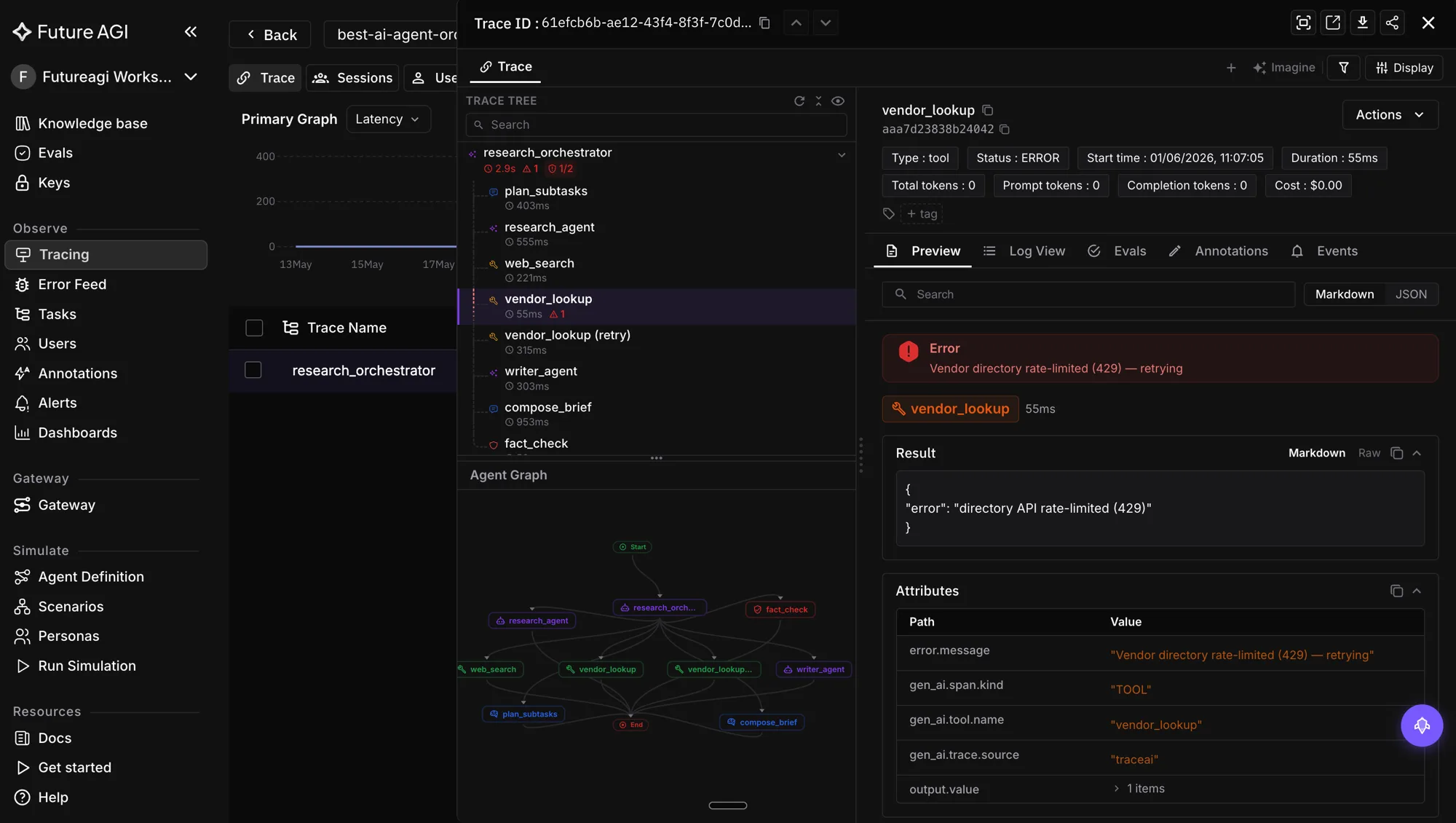
Per-version observability via traceAI
Per-version metrics aggregate from the trace store the moment the canary opens. traceAI attaches prompt-template attributes via the using_prompt_template(...) context manager:
from fi_instrumentation import register
from fi_instrumentation.fi_types import ProjectType
from fi_instrumentation.otel import using_prompt_template
from traceai_openai import OpenAIInstrumentor

tracer_provider = register(
    project_type=ProjectType.OBSERVE,
    project_name="support-agent",
    project_version_name="v24",
)
OpenAIInstrumentor().instrument(tracer_provider=tracer_provider)

template  = open("prompts/support_agent/v24.yaml").read()
variables = {"company_name": "Acme", "context": ctx, "question": q}

with using_prompt_template(template=template, variables=variables, version="v24"):
    response = openai_client.chat.completions.create(
        model="gpt-4o", messages=build_messages(template, variables),
    )
The context manager sets gen_ai.prompt.template.name, gen_ai.prompt.template.version, gen_ai.prompt.template.label, and gen_ai.prompt.template.variables on every child span. The Future AGI Platform dashboard plots cost, latency, and per-rubric pass-rate broken down by prompt.template.version, so a head-to-head v23-vs-v24 view exists from the canary’s first request.
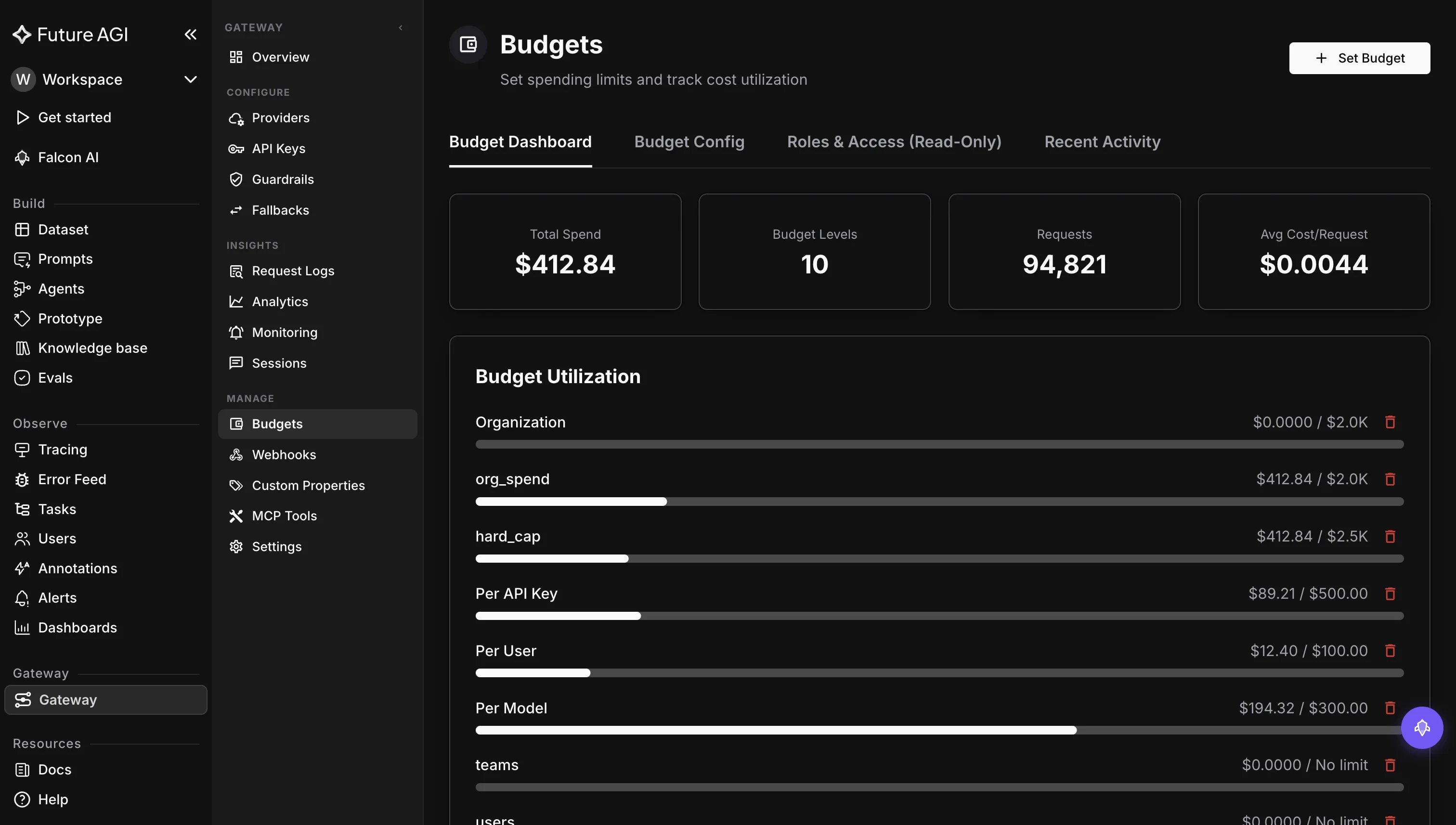
Per-version cost gets a second lever via Agent Command Center’s hierarchical budgets (org, team, user, key, tag). A budget scoped to tag=prompt:v24 shows spend per version with the option to hard-cap a runaway prompt at limit_usd per period. For the trace anatomy that makes per-version aggregation possible, see What Does a Good LLM Trace Look Like?.
Stage 3: Deprecation (and the rollback that has to work)
Deprecation is the stage every team skips and every team regrets. An old version that stays in the routing table is a ghost; an old version in the cache is a worse ghost. A team that leaves v23 reachable after shipping v24 will eventually field an incident where a stale config served v23 to 4% of users for two weeks before anyone noticed.
A clean retirement has four operations — the same four that run on rollback, in the opposite direction.
1. Drain traffic. Ramp the retired version’s traffic slice to zero over a configured window (10-60 minutes is typical). Hard-stop is dangerous; in-flight requests fail if the version disappears mid-call. On rollback, the new version drains and the incumbent takes the traffic back.
2. Atomic label move. The label support_agent@prod resolves to a concrete version id at request time. Promotion is a label move, not a rolling redeploy of code. Without atomicity, concurrent in-flight requests can see a split state where some receive v23 and others receive v24 mid-deploy. The label-and-resolver pattern collapses the switch to one write that every subsequent resolver returns.
3. Invalidate the semantic cache. Every cache entry keyed on the retired version id evicts. Without this step, a cache hit on a fingerprint that v24 wrote can ghost-serve v24’s response shape after v24 stopped serving. Agent Command Center treats this as a primitive — POST /v1/cache/invalidate keyed on prompt:vX — not a custom build.
4. Update the audit log. Who retired what when, the eval evidence at retirement, the version that replaced it. SOC 2, HIPAA, and GDPR all require knowing which prompt version was live at what time. A versioned registry plus a promotion log satisfies that audit; inline strings across four services do not. For the audit side, see AI Agent Compliance and Governance.
Without those four, “rollback” is a redeploy, the bad version keeps serving from cache after the label moves, and the on-call engineer is staring at a partially-reverted state at 5pm.
The feedback loop: production failures into the next draft
Improve is not a discrete stage; it’s a loop that crosses all three. Failing production traces flow back into the next candidate continuously.
Error Feed clusters per-version failures. HDBSCAN soft-clustering over failing-trace span embeddings, normalized against an error taxonomy, with a Sonnet 4.5 Judge writing an immediate_fix per cluster. Common clusters read like “v24 over-refuses medical-adjacent queries vs v23” (refusal calibration), “v24 lost cost-per-call by 20%, token bloat in the new few-shot block” (verbosity), “v25 fails on Spanish edge cases that v24 handled” (coverage). The immediate_fix is a one-to-three-sentence edit that addresses the cluster; it lands as a Linear issue with the failing trace ids and the spec for a new regression case (input, expected behavior, rubric). Slack, GitHub, Jira, and PagerDuty integrations are on the roadmap.
agent-opt proposes candidates from an eval signal. Six optimizers ship today: RandomSearch (baseline sweep), BayesianSearch (Optuna-backed with teacher-inferred few-shot, resumable), MetaPrompt (LLM writes the next candidate from failure traces), ProTeGi (prompt-as-text-gradient), GEPA (genetic evolution), PromptWizard (Microsoft’s recipe). EarlyStoppingConfig cuts the loop when the eval signal plateaus. The eval-driven loop ships today: agent-opt reads a labelled dataset, runs the candidate, scores it against the same rubrics the CI gate uses, returns the survivor. Direct trace-stream-to-agent-opt ingestion (no dataset handoff) is on the roadmap.
Versioning and optimization compose but are different disciplines. Versioning is the static surface (id, diff, label, registry); optimization is the dynamic surface (candidate generation, eval, survivor selection). See Automated Prompt Improvement for the optimizer choice rubric.
Anti-patterns that turn a 4pm prompt edit into a 7pm incident
Six recur. Each feels small in isolation; together they compound.
- Prompts as string literals. Unreadable diff,
git reverttouches unrelated files, audit trail isgit blameover a 200-line refactor. - No eval-on-PR gate. A reviewer’s read catches typos, not a 6-point
Groundednessregression across a 200-example golden set. - Floor without paired CI. Slow drift slips under the floor for months. The paired CI catches the drift the floor misses.
- No per-version traceAI metrics. Without
using_prompt_template(...)the trace store cannot aggregate by version; the canary’s “is this better” question has no answer. - No canary. A 0-to-100% rollout is prompt-engineering without a feature flag. Start at a small slice routed by hash so a regression surfaces in minutes.
- No cache invalidation on rollback. A cache hit on a fingerprint that v24 wrote can ghost-serve v24 after the label moved back to v23. Eviction is what makes rollback real.
How Future AGI fits the lifecycle
Five surfaces line up against the three stages.
The ai-evaluation SDK (Apache 2.0) is the eval engine for the promotion gate. 60+ EvalTemplate classes including Groundedness, ContextAdherence, ContextRelevance, Completeness, FactualAccuracy, Toxicity, PromptInjection, DataPrivacyCompliance, AnswerRefusal, IsHarmfulAdvice, TaskCompletion, LLMFunctionCalling. Custom rubrics like PromptRegressionDelta land via CustomLLMJudge. Four distributed runners (Celery, Ray, Temporal, Kubernetes) keep 500-example suites fast. The fi CLI exits with distinct codes (0/2/3/6/7) for CI runners — log lines reformat between versions, exit codes don’t.
traceAI (Apache 2.0) is the observability surface. 50+ AI surfaces across Python, TypeScript, Java (Spring Boot starter, Spring AI, LangChain4j, Semantic Kernel), and C#. The using_prompt_template(...) context manager attaches gen_ai.prompt.template.name/version/label/variables to every span so per-version aggregation is automatic. EvalTag attaches the same rubric to live OTel spans next to prompt.template.version, so CI and production numbers compare end to end.
Agent Command Center is the runtime gateway that owns canary routing, atomic label moves, and rollback. OpenAI-compatible drop-in at https://gateway.futureagi.com/v1. Headers x-prism-cost, x-prism-latency-ms, x-prism-model-used, x-prism-fallback-used, x-prism-guardrail-triggered expose per-call metrics. The 5-level hierarchical budget treats tag=prompt:vX as a first-class spend dimension. Semantic cache eviction on rollback is a gateway primitive. Verified throughput: ~29k req/s, P99 ≤ 21 ms with guardrails on, on t3.xlarge.
Error Feed sits inside the eval stack. HDBSCAN soft-clustering over failing traces, normalized against an error taxonomy, with a Sonnet 4.5 Judge that writes an immediate_fix per cluster that tightens the next regression case.
agent-opt (Apache 2.0) is the optimization surface. Six optimizers and EarlyStoppingConfig. The regression suite gates every change; the optimizer proposes candidates; the suite decides which candidate promotes.
The Future AGI Platform ties the five together as a hosted plane. Self-improving evaluators tune by thumbs feedback. Per-eval cost runs below Galileo Luna-2. SOC 2 Type II, HIPAA BAA, GDPR, CCPA per trust. For the broader landscape, see Best AI Prompt Management Tools.
What to ship this week
- Move every inline prompt string into a versioned YAML/JSON file under
prompts/. Update the application to load at startup, not at use-site. - Pull 100-300 paired cases per route from production logs into a versioned golden set, stratified by intent x persona x edge-case.
- Add a GitHub Actions workflow on
paths: ["prompts/**", "evals/golden/**"]that runs theai-evaluationSDK on every PR and applies the three-trigger gate. - Wire the deploy step to flip a label and ramp via
x-prism-routing-strategy=prompt_canaryat 5%. Addusing_prompt_template(...)so every span carries the version id. - Implement the rollback primitive: flip label, drain candidate,
POST /v1/cache/invalidateonprompt:vX, log the move. Verify it on a no-op rollback before you need it.
First week is plumbing. Second week is the cultural shift of getting every team to call the registry instead of inlining prompts.
Closing
Prompts are the most-edited file in your repo by week six. Treating them as strings is the most common foot-gun in production LLM systems. Versioning gives you the id and the diff. Eval-gated promotion gives you the proof. Rollback gives you the recovery.
Skip eval-gated promotion and you ship without proof. Skip rollback and a bad prompt eats the weekend. Three stages, two gates, one rollback primitive — that’s the working shape.
Next: Prompt Regression Testing, A/B Testing LLM Prompts, What is Prompt Versioning?, The 2026 LLM Evaluation Playbook.
Frequently Asked Questions
What is prompt lifecycle management?
What does eval-gated promotion actually gate on?
What is canary routing for prompts and how does rollback work?
How does Future AGI capture per-version prompt metrics in production?
Why pair against the prior version instead of an absolute floor alone?
What does Future AGI ship for the prompt lifecycle?
What are the most common prompt lifecycle anti-patterns?
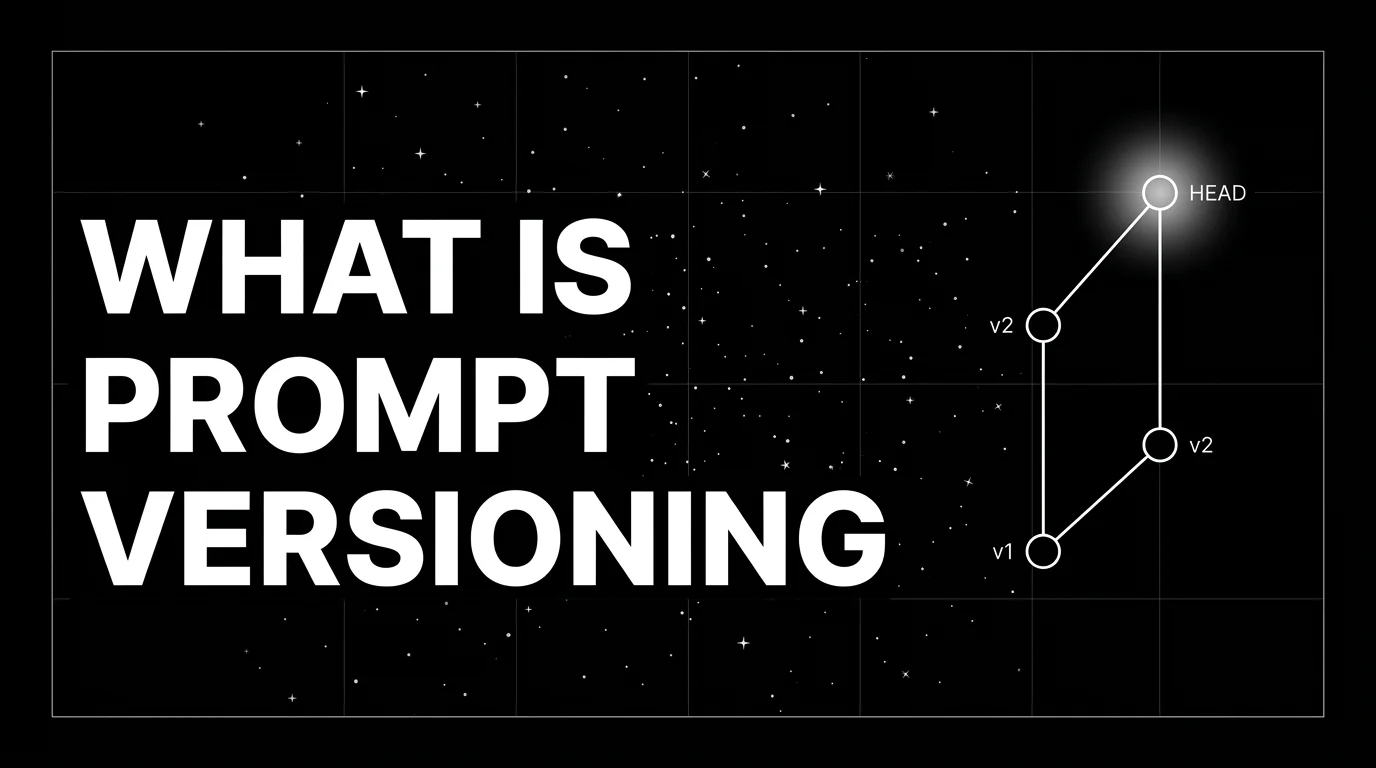
Prompt versioning treats prompts as code: unique ids, environment labels, eval-gated rollouts, one-call rollback. What it is and how to ship it in 2026.

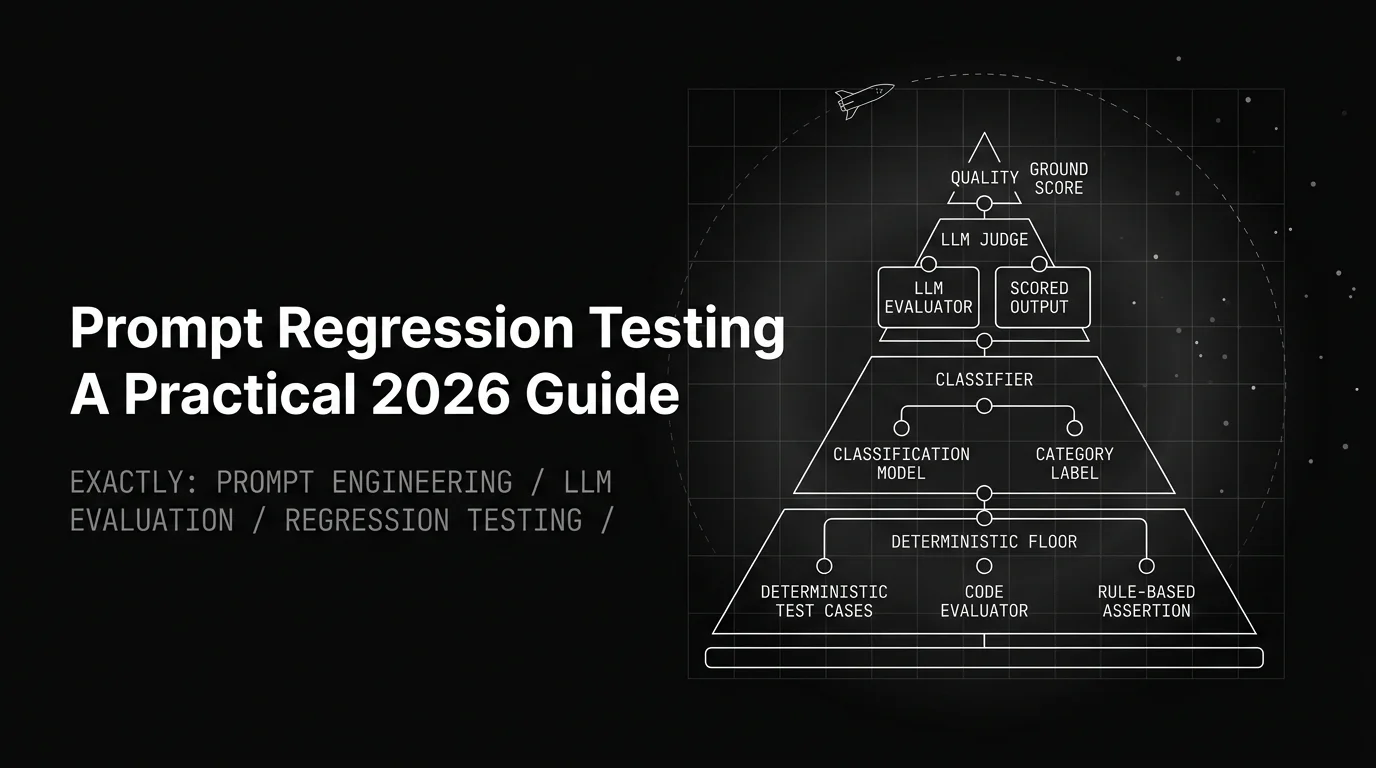
Prompt regression is pytest for prompts. Three patterns: per-rubric assertion, per-route stratified eval, paired comparison vs prior version with CI delta.

Compare 8 AI prompt management tools in 2026 across versioning, eval gates, and runtime routing. Honest tradeoffs and when to pick each.