AI Agent Compliance and Governance in 2026: The Runtime Playbook for Regulated Teams
Wire policy, enforcement, and audit into runtime so EU AI Act, NIST AI RMF, and ISO 42001 close on one plane without slowing releases.
Table of Contents
Your security reviewer sends a forty-question questionnaire two weeks before a deal closes. Eighteen questions ask about runtime controls. Twelve ask about audit evidence. Six reference the EU AI Act by article. None ask whether your model is accurate. All ask the same thing in different shapes: show the trace, show the policy, show the reviewer. AI agent compliance and governance in 2026 is the discipline of making sure those three things are wired into the runtime, not stapled on as a PDF.
The opinion this post defends: compliance and governance for AI agents is policy plus enforcement plus audit, and the only version that survives an incident is the version wired into the runtime. Policy without enforcement is a wish. Enforcement without audit is unprovable. Audit without policy is noise. This is a workflow piece for engineering and compliance leads in regulated industries — finance, healthcare, government — who want to ship agents without slowing every release to a crawl.
The three-pillar model
Most “AI governance” decks treat the subject as a stack of frameworks: EU AI Act, NIST AI RMF, ISO 42001, sector laws, voluntary commitments. That framing flattens the actual work. The work is to translate each binding obligation into three concrete artifacts that live in three different places.
| Pillar | What it is | Where it lives | Frameworks it satisfies |
|---|---|---|---|
| Policy | Model cards, AUP, risk tiers, escalation rubric | Versioned repo + governance UI | EU AI Act Art. 9, 13, 17; NIST Govern; ISO 42001 leadership clauses |
| Enforcement | Guardrails, blast-radius gates, per-key budgets, RBAC | Gateway runtime | EU AI Act Art. 14, 15; NIST Manage; ISO 42001 operational controls |
| Audit | Per-trace logs, registry, incident log, retention | OTel store + audit log sink | EU AI Act Art. 12; NIST Measure; SOC 2 CC7; HIPAA 164.312(b) |
The pillar that breaks compliance programs is the middle one. Teams write the policy. Teams stand up the logs. The enforcement layer falls between two stools because it lives in the runtime, not in the governance tool. A policy doc that says “do not produce PII” needs a runtime that blocks the inference at 65 ms and emits a span recording the block. That coupling is the playbook.
Pillar 1: Policy
Policy is the document layer. Three artifacts carry the weight.
Model and agent cards. One card per agent. Fields: intended purpose, deployment context, training data lineage, evaluation results, known limitations, prohibited uses, version, owner, approval signature. EU AI Act Article 13 (transparency to deployers) and the NIST GenAI Profile both expect this artifact. Store the card in a versioned repo so each change ships with a diff and a reviewer. Wikipedia-style cards rot in six months; treat them as code.
Acceptable use policy. What the agent is allowed to do and what it is not. The AUP is not the system prompt. The system prompt is what the model sees; the AUP is what the policy and runtime enforce. A refund agent’s AUP might say: refunds under 100 USD auto-approve, 100-1,000 USD require manager review, anything above escalates to finance ops. That policy decomposes into a tool argument cap, a human-in-the-loop hook, and an audit attribute on every refund span.
Escalation rubric. When does the agent stop and ask? The rubric is the bright-line list. PII detected in the user message. Confidence below threshold. Tool call exceeds blast-radius cap. Guardrail blocks the output. Each line of the rubric becomes a span event in the audit trail. EU AI Act Article 14 (human oversight) is the rubric’s regulatory home; the practical home is the gateway’s policy file.
The output of the policy pillar is three documents per agent, each under version control, each with a deploy pipeline that pulls the active version. If the documents live only in Confluence, you have governance theater. The runtime needs to consume them.
Pillar 2: Enforcement
Enforcement is where most teams discover that their policy was a wish. The five controls that matter in 2026, in order of how often they show up in security reviews.
Inline guardrails. Every inference passes through a scanner stack before the model sees it and before the response reaches the user. Future AGI’s Protect ships four Gemma 3n LoRA adapters (toxicity, bias_detection, prompt_injection, data_privacy_compliance) plus the Protect Flash binary classifier at 65 ms text and 107 ms image median time-to-label per the Protect paper (arXiv 2510.13351). The Agent Command Center layers 18+ built-in scanners (PII detection, secret detection, content moderation, hallucination, topic restriction, MCP security, system-prompt protection) and 15 third-party adapters (Lakera Guard, Presidio, Llama Guard, AWS Bedrock Guardrails, Azure Content Safety, Pangea, Aporia, Enkrypt AI, HiddenLayer, DynamoAI, IBM AI, Zscaler, Crowdstrike, Lasso, Grayswan). Same scanners run offline as eval rubrics so the production policy and the regression-test rubric stay in sync.
Blast-radius gates. Tool argument caps, recipient counts, dollar thresholds, depth and retry limits, allow-listed tool registries, allow-listed retrieval sources. Enforced at the gateway layer, never in the prompt. A prompt-injected agent that ignores its instructions still cannot call a tool the gateway has not allow-listed.
Per-virtual-key budgets. Each tenant, team, or workflow gets a virtual key with its own cap on tokens, requests, and dollars. The Agent Command Center supports 5-level hierarchical budgets (org, team, user, key, tag) with per-period and per-model limits. When a runaway loop hits the cap, the gateway returns a structured error and emits an audit event. Finance ops can read the budget consumption per virtual key without reading a single prompt.
RBAC at the runtime. Each APIKey carries AllowedModels, AllowedProviders, AllowedIPs (CIDR), AllowedTools, RateLimitRPM, RateLimitTPM, ExpiresAt. Wildcards (models:gpt-*) keep the rule set tractable. Revocation propagates via Redis pub/sub so a compromised key dies in seconds, not minutes. SOC 2 CC6 and HIPAA 164.312(a) both want this control.
Region pinning and air gap. The single-binary Go gateway (17 MB, zero runtime dependencies) deploys per region with no cross-region calls. EU residents’ traffic terminates in the EU. Indian residents’ traffic terminates in India. For federal SOC procurement and defense, the gateway runs inside the customer VPC and provider keys never leave the perimeter; the Protect ML hop swaps out for on-prem open-weight classifiers (LLAMAGUARD_3_8B/1B, QWEN3GUARD_8B/4B/0.6B with 119-language coverage, GRANITE_GUARDIAN_8B/5B, WILDGUARD_7B, SHIELDGEMMA_2B) under enterprise license.
Enforcement falls short when the controls live in five different tools. The audit question “show me every refund above 500 USD that was blocked by the guardrail in March” should resolve to one query against one store. If that query needs three vendors, the program is brittle.
Pillar 3: Audit
Audit is the record layer. Three principles separate audit trails that survive a SOC 2 review from audit trails that fold.
Per-trace logging, not per-request logging. A log line says “request X returned 200 in 240 ms.” A trace says “request X invoked tool Y with arguments Z, retrieved document W, ran guardrail scanner V which returned allow, called model U at version 4.2 with policy version 1.7, emitted output of T tokens, was reviewed by judge S with score 0.92.” Auditors want the trace. traceAI (Apache 2.0) ships 50+ AI surfaces across Python (46), TypeScript (39), Java (24 modules including a Spring Boot starter), and C#. Pluggable semantic conventions (FI, OTEL_GENAI, OPENINFERENCE, OPENLLMETRY). 14 span kinds with gen_ai.tool.name, gen_ai.tool.call.arguments, gen_ai.tool.call.result. Inline guardrail spans via GuardrailProtectWrapper.
Retention that matches the framework window. EU AI Act Article 12 expects records for the lifetime of the high-risk system, which often means seven years past decommissioning. HIPAA wants six years. SOX wants seven. PCI-DSS wants one year minimum, three for forensic. Picking a single retention window that satisfies the longest applicable framework is cheaper than running four storage tiers. Region-pin the storage to match data-residency rules.
Access controls on the audit log itself. The audit log is the most sensitive store in the system. Every read needs to be logged. The Agent Command Center’s internal/audit/audit.go emits structured events on every key revocation, config change, admin action, and policy decision (actor type/id/name/team/role/IP, resource, outcome, reason, request ID). A background drain writes batched JSON-lines to the configured sink. The audit log audits itself.
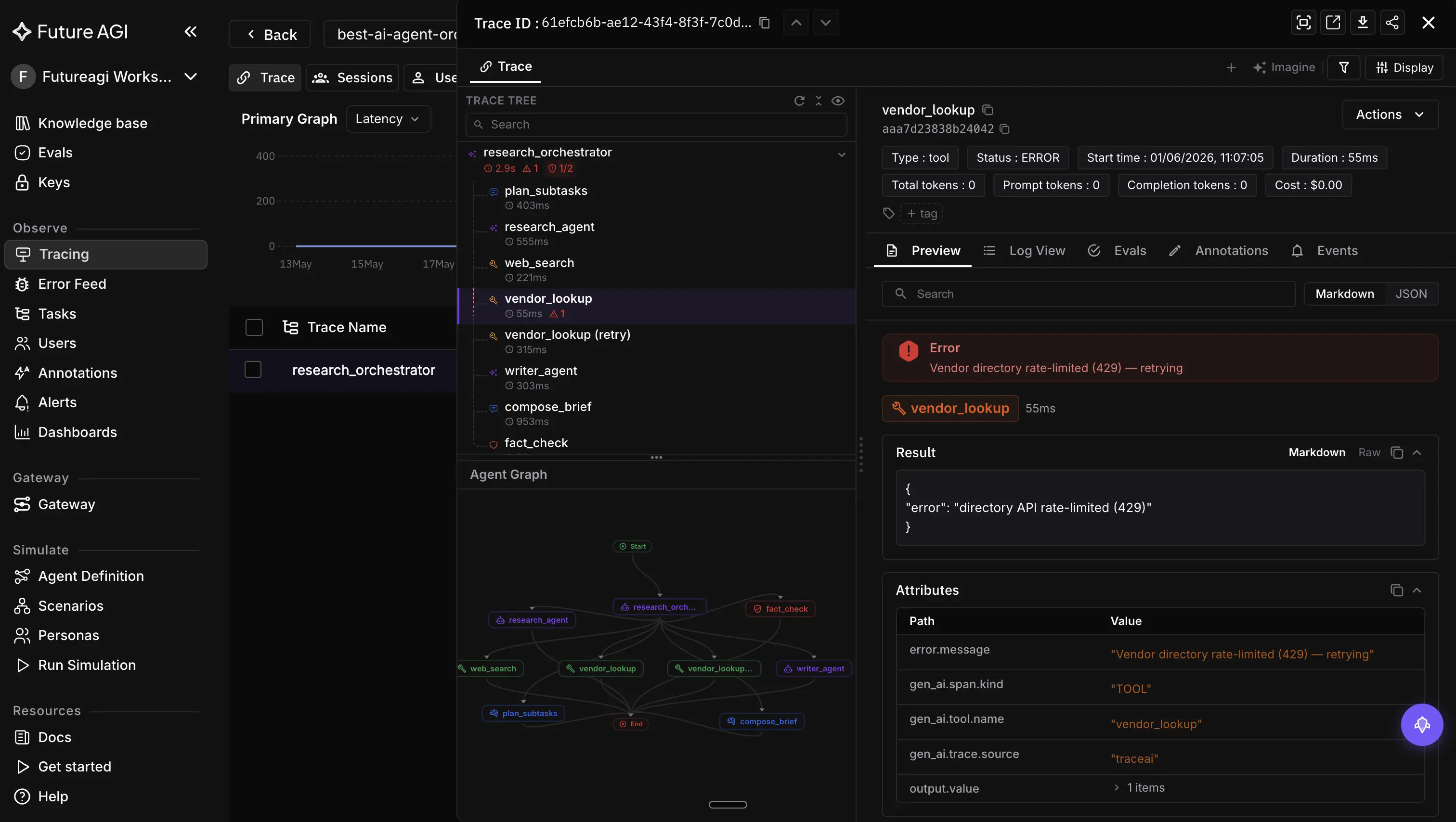
The audit pillar collapses when the registry lives in one tool, the traces live in another, the incident log lives in a third, and the access log lives nowhere. The Error Feed inside Future AGI’s eval stack closes the loop: HDBSCAN soft-clustering over ClickHouse plus a Sonnet 4.5 Judge agent with a 30-turn budget and 8 span-tools writes the root cause for every failing trace into the same store, with immediate_fix and long_term_recommendation fields. The trace is the question. The Judge’s RCA is the answer. Both sit on one timeline.
Mapping the pillars to the frameworks
One mapping satisfies the three frameworks most enterprise buyers reference. Build it once.
| Framework | Pillar 1 (Policy) | Pillar 2 (Enforcement) | Pillar 3 (Audit) |
|---|---|---|---|
| EU AI Act | Art. 9 (risk mgmt), Art. 13 (transparency), Art. 17 (QMS) | Art. 14 (human oversight), Art. 15 (robustness) | Art. 12 (logging) |
| NIST AI RMF | Govern, Map | Manage | Measure |
| ISO/IEC 42001 | Leadership, planning clauses | Operational controls | Performance evaluation, internal audit |
| SOC 2 Type II | CC1 (control environment) | CC6 (logical access), CC7 (system operations) | CC4 (monitoring), CC7 (incident response) |
| HIPAA | 164.308 administrative | 164.312(a) access control, 164.312(b) integrity | 164.312(b) audit controls |
| GDPR | Art. 5 (principles), Art. 24 (controller) | Art. 22 (automated decisions), Art. 32 (security) | Art. 30 (records of processing) |
The pattern is consistent across frameworks: policy clauses, operational clauses, evidence clauses. The three pillars map one-to-one to those three clause types. A single control set, documented once, answers questions across every framework on the table. NIST AI RMF is the easiest scaffolding because its four functions (Govern, Map, Measure, Manage) are framework-agnostic; teams that organize evidence by NIST function find the cross-walk to EU AI Act and ISO 42001 close to mechanical.
What this does not do: pass the audit on autopilot. Auditors test the controls. They sample traces. They ask for the diff that approved a prompt change. They look at access logs. The mapping table is the index; the work is keeping the index honest.
The pre-deployment checklist
The pre-deployment review is the moment everything gets tested. Six questions show up in every security questionnaire and every auditor opening interview.
-
Which regulations apply, and is the mapping documented? A one-page document listing the binding regulations, the sector laws, the procurement gates, and the certifications. Mapped to the runtime control set. Reviewed quarterly. Signed by legal and security.
-
What runtime controls enforce the policy, and what is the bypass path? A list of every guardrail, every blast-radius gate, every budget cap, every RBAC scope, with the failure mode for each. If a control fails open, the next layer catches it. Document the dependencies.
-
What does the audit trail look like for a single inference, and can you reproduce it on demand? Pick a random production request from last week. Pull the full trace including model version, prompt version, policy version, guardrail decisions, tool calls, retrieval sources, judge scores, and outcome. If reproducing this takes longer than five minutes, the audit will fail.
-
What is the rollback time when a prompt, model, or policy regresses? Time the rollback motion end-to-end. Gateway-shaped runtimes (Agent Command Center, LangSmith deployment) reduce rollback to a configuration change, which is where disciplined prompt versioning and rollback earns its keep. Pure code-deploy rollback measured in hours fails the operational test for high-risk systems.
-
What does the incident response runbook say, and has it been exercised? Detection, classification, containment, root cause, remediation, reporting. EU AI Act post-market monitoring requires reporting serious incidents within 15 days for high-risk systems. HIPAA breach notification has 60 days. Run the tabletop before the real incident.
-
Which certifications does the vendor stack carry today, and which are in audit? Specific. SOC 2 Type II reports current within the past 12 months. ISO 27001 certificates with scope. HIPAA BAA available on which tier. “We take security seriously” is not an answer.
Answering these six in writing with linked evidence collapses a security review from weeks to days. Procurement teams have started shipping the questionnaire pre-filled with vendor answers; the vendor with the cleanest evidence trail wins.
How Future AGI ships the three pillars
The Agent Command Center is the runtime where the three pillars meet. One Go binary (Apache 2.0), 100+ providers, OpenAI-compatible drop-in via https://gateway.futureagi.com/v1. Self-hosted via Docker, Kubernetes, AWS/GCP/Azure, or air-gapped. The single-binary deployment is what makes the three pillars affordable to wire together.
Policy. Model cards, AUPs, and escalation rubrics live in the platform’s governance surface, version-controlled, with diff and approval. The platform’s authoring agent (Falcon AI on the Enterprise plan, surfaced inside eval pages and the policy workbench) writes rubrics, grading prompts, and reference examples from natural-language descriptions, so the policy document and the runtime rubric stay one artifact.
Enforcement. Protect runs four Gemma 3n LoRA adapters plus the Protect Flash binary classifier inline at the gateway. The 18+ built-in scanners and 15 third-party adapters compose with the four Protect adapters. Per-virtual-key budgets across 5 levels (org, team, user, key, tag). RBAC with wildcard permissions. Region-pinned BYOC; air-gapped self-host for federal SOC procurement. Verified benchmark: ~29k req/s, P99 ≤ 21 ms with guardrails on, on t3.xlarge (4 vCPU / 16 GB), per the github.com/future-agi/future-agi README.
Audit. traceAI captures every inference as an OpenTelemetry trace with 50+ AI surfaces across four languages. The audit log (internal/audit/audit.go) emits structured events on every config change, key revocation, admin action, and policy decision; background drain writes JSON-lines to the configured sink. Error Feed, the clustering and what-to-fix layer inside Future AGI’s eval stack, clusters every failing trace into a named issue with a Judge-written RCA; the fixes feed the platform’s self-improving evaluators. The eval-stack package (SDK + Platform + Error Feed) runs classifier-backed evals at lower per-eval cost than Galileo Luna-2.
Compliance posture per futureagi.com/trust: SOC 2 Type II certified (Security, Availability, Confidentiality). HIPAA certified, BAA available. GDPR certified. CCPA certified. ISO/IEC 27001 in active audit. ISO/IEC 42001 on the roadmap.
The reason to consolidate runtime, audit, and policy on one plane is not a feature checklist; it is what the security review looks like at 11pm on a Friday. One vendor, one trace ID, one audit log, one mapping table. The DPO says yes.
Three takeaways for regulated teams
- Compliance is policy plus enforcement plus audit, not policy alone. The PDF describes the program; the runtime proves it. Wire the three pillars together or the first incident exposes the gap.
- Map once, reuse everywhere. NIST AI RMF functions cross-walk cleanly to EU AI Act articles and ISO 42001 clauses. One documented control set is enough; running three parallel mapping exercises is wasted hours.
- The pre-deployment checklist is the buyer’s questionnaire. Six questions, answered in writing with linked evidence. Treat the checklist as the gate, not the audit. The audit becomes a formality when the checklist is honest.
Related reading
Frequently Asked Questions
What is the difference between AI governance and AI compliance for agents?
Which regulations actually bind AI agents in mid-2026?
What audit trail does a production AI agent actually need?
Is NIST AI RMF a binding regulation?
What is a blast-radius gate and why does it matter for agents?
How does Future AGI map to EU AI Act, NIST AI RMF, and ISO 42001 in one stack?
What is the right pre-deployment checklist for a regulated AI agent?
Operational GenAI compliance framework for 2026: EU AI Act phase-in, GDPR Articles 22 and 25, CCPA, HIPAA, FCRA, with evaluator-driven evidence.

Map enterprise LLMs to GDPR, EU AI Act and NIST AI RMF in 2026: input/output guardrails, bias audits, explainability, and a real FAGI Protect setup.

AI ethics in 2026: six core principles, EU AI Act enforcement, OECD and NIST guidance, bias and fairness evaluation, shipping trustworthy AI in production.