Best 6 AI Gateways for Canary Model Rollouts in 2026
Six AI gateways scored on canary rollouts: percent routing granularity, score-attached canary traffic, auto-rollback on guardrail trip, gateway gaps.
Table of Contents
A platform team shipped a prompt edit at 4:47 pm on a Friday. The canary ran 1% for forty minutes, dashboards looked fine, promotion fired to 25%. Twelve hours later an enterprise tenant opened a ticket: the new prompt subtly broke a tool-call schema on a refund-flow sub-route the 30-example regression suite never touched. Mean groundedness held at 0.91; groundedness on the affected traffic sat at 0.62. The semantic cache kept serving the bad answer for forty minutes after the revert. The gate fired green because it answered the wrong question.
Canary rollouts at the gateway require three primitives, and the gateway that ships fewer than three is a load balancer wearing a canary label:
- Percentage routing at fine granularity (down to 0.5%) with cohort selection by tenant, region, or feature flag.
- Score-attached canary traffic: the eval result lands on the same OpenTelemetry span as the routing decision, so promotion runs on the delta, not on the dashboard vibe.
- Auto-rollback on guardrail trip: the revert fires from gateway config when a threshold breaks, not after a human reads a chart and joins a Slack thread.
The six AI gateways below all advertise canary support. They differ on which of the three they ship natively, how the score gets attached, and how the rollback path closes. This is the May 2026 cohort, scored against the three primitives plus four supporting axes that decide whether a promotion is a gate or a stopwatch.
TL;DR: six gateways, three primitives, one winner
Future AGI Agent Command Center is the strongest pick for canary model rollouts in 2026 because it ships all three primitives at the same network hop in one Apache 2.0 Go binary. 0.5% routing with cohort headers; score-attached canary traffic via traceAI on every span; auto-rollback in gateway config on guardrail trip rate, rubric drop, p99 latency, and Error Feed cluster. No webhook, no Slack thread, no human in the rollback path.
- Future AGI Agent Command Center: Best overall. Score-attached spans, config-driven rollback, closed loop from cluster to candidate fix.
- Portkey: Best polished hosted UI; eval gate via webhook. PANW acquisition pending.
- Maxim Bifrost: Best high-RPS canary; 0.1% routing. Needs the separate Maxim eval product for the gate.
- LiteLLM: Best when canary policy must live in your git history. Pin a commit or upgrade past 1.83.7.
- Kong AI Gateway: Best when you already run Kong. Plan plugin work for the eval gate.
- Cloudflare AI Gateway: Best for edge-first global canary. Wire the eval gate on your side.
What fell off: Helicone’s roadmap shifted toward documentation-platform-first after the March 3, 2026 Mintlify acquisition. Datadog LLM Observability ships strong matched-pair telemetry but isn’t a routing gateway; pair it with one of the six.
Why model rollouts need a canary, not a switch
Three properties of modern LLM upgrades make a one-shot cutover the wrong default. Drift isn’t uniform: when OpenAI shipped GPT-5 in early 2026, teams reported faithfulness improving on the 70th-percentile prompt and degrading on the bottom 5%; a stratified 1% canary surfaces this in hours. Tool-use semantics shift: Claude Opus 4.7 chains three tool calls where 3.5 chained one, so any non-idempotent tool retry breaks production. Cost cliffs are real: Opus 4.7 input is ~5x Sonnet 4.6 on like-for-like context, so a misconfigured rollout that sends 100% to Opus multiplies the daily bill by 4x before on-call notices.
For the broader four-stage shape (shadow → canary → percentage → full), see the agent rollout strategies 2026 playbook. For the rest of this post, “canary” means a controlled percentage rollout where promotion is gated on a measurable signal scored on real traffic.
How we scored the gateways
We started from public AI gateways that ship traffic splitting as of May 2026, removed those without cohort targeting and proxies that buffer streaming responses (kills matched-pair latency). The remaining six were scored on seven axes: the three primitives plus four supporting.
| Axis | What it measures |
|---|---|
| 1. % routing granularity | 0.5%, 1%, 5% splits with cohort selection on tenant, region, or feature flag |
| 2. Score-attached canary traffic | Eval score lands on the same OTel span as the routing decision |
| 3. Auto-rollback on guardrail trip | Revert fires from gateway config when a threshold breaks |
| 4. Matched-pair capture | Old-vs-new latency, score, error, cost on the same prompt |
| 5. Cohort selection depth | Tenant tier, region, feature flag; stratify vs random |
| 6. Rollback path completeness | Cache invalidation, rubric versioning, downstream flush in the revert |
| 7. Canary observability | Rollout view with ramp curve, eval pass/fail, matched-pair deltas |
Axes 1, 2, and 3 are the three primitives. A gateway that misses any forces glue across two or more products, and the glue is what fails at 3 am.
1. Future AGI Agent Command Center: best for eval-gated canary with config-driven rollback
Verdict. Future AGI is the only gateway in this list where percentage routing, the eval gate, and auto-rollback live in one loop at the same network hop, in one Apache 2.0 Go binary. Agent Command Center treats the eval score as the promotion gate directly, fires the revert from gateway config on guardrail trip, and clusters candidate-only failures via Error Feed so the rollback signal carries the failure mode.
What it ships for canary rollouts.
- % routing down to 0.5% in YAML (
ramp: [0.5, 2, 10, 25, 50, 100]); the next step is a header change, not a redeploy. Cohort selection by tenant, user, region, feature flag, or arbitrary span attribute via the five-level budget hierarchy (org, team, user, key, tag). - Score-attached canary traffic via
ai-evaluation(Apache 2.0): 50+ pre-builtEvalTemplateclasses (Groundedness, TaskCompletion, AnswerRefusal, Toxicity, PromptInjection) plus self-improving Platform evaluators plus unlimited custom evaluators authored by an in-product agent. The score lands on the same OpenTelemetry span as thex-agentcc-routing-strategyheader viatraceAI. Classifier-backed evals run at lower per-eval cost than Galileo Luna-2.
- Auto-rollback in gateway config: four triggers written before traffic flips. Guardrail trip rate above 1.5x baseline over 15 minutes, rubric rolling-mean drop below the noise floor with p < 0.05 on Welch’s t-test, p99 latency above 1.3x baseline for 10 minutes, and any candidate-only Error Feed cluster. Any single trigger fires the revert on the next request; median rollback latency is ~35 seconds in our internal tests.
- Watchdog + observability. Matched-pair shadow sampling on every canary request; error-rate watchdog on responses flagged by Future AGI Protect (~65 ms p50 text per arXiv 2510.13351); rollout view with ramp curve, eval pass/fail, matched-pair deltas, and Error Feed clusters on one screen; Prometheus on
/-/metricsand OTLP feed Grafana.
The loop. When the gate trips, Error Feed clusters candidate failures via HDBSCAN over ClickHouse span embeddings; a Sonnet 4.5 Judge writes an immediate_fix plus a four-dimensional score per cluster. agent-opt (Apache 2.0) proposes a prompt rewrite via one of six optimizers (ProTeGi, GEPA, MetaPrompt, RandomSearch, BayesianSearch, PromptWizard); the team reviews the diff, the candidate restarts at 1%.
# Canary at 5% stratified by tenant tier on Agent Command Center
import requests

response = requests.post(
    "https://gateway.futureagi.com/v1/chat/completions",
    headers={
        "Authorization": "Bearer sk-agentcc-...",
        "x-agentcc-routing-strategy": "canary",
        "x-agentcc-canary-target": "agent-v2",
        "x-agentcc-canary-percent": "5",
        "x-agentcc-canary-stratify-tag": "tenant_tier",
    },
    json={"model": "agent-v1", "messages": [...]},
)
print(response.headers["x-agentcc-routing-strategy"])  # "canary"
Where it falls short. The full closed loop (cluster, rewrite, re-canary) is heavier than a one-off model swap needs. For a single GPT-4 to GPT-5 migration, the basic canary plus eval gate is enough. Protect adds ~65 ms to canary requests when guardrails are on. Managed cost-analytics dashboard polish is thinner than Portkey’s.
License + deployment. Apache 2.0 single Go binary; cloud at gateway.futureagi.com/v1 or self-host (Docker, Kubernetes, AWS, GCP, Azure, on-prem, air-gapped). SOC 2 Type II + HIPAA + GDPR + CCPA certified per futureagi.com/trust; ISO/IEC 27001 in active audit.
Score: 7/7 axes.
2. Portkey: best for hosted canary with a polished traffic-split UI
Verdict. Portkey is the most polished hosted product when canary policy lives in a UI instead of in code. Percentage splits are clean, prompt-library versioning is excellent, the human-approved promotion flow is well thought out. The gap: the eval gate is not native at the gateway hop. Portkey pauses the rollout but leaves “did the new model pass?” to a webhook.
What it ships. 1% routing through the managed control plane (sub-1% needs chained rules). Webhook-based eval gate; the score lives on a different system than the routing decision. Threshold-based circuit breakers fire rollback in the 30 to 60-second range. Metadata-based cohort routing on user, tenant, or arbitrary JSON-path. Sampled request-replay for matched-pair diffs. A prompt-versioning + rollout view cleaner than Kong’s DIY Grafana and less rollout-specific than Future AGI’s screen.
Where it falls short. Eval gate not inline at the routing hop; no optimizer loop. The Palo Alto Networks acquisition announced April 30, 2026 closes in PANW fiscal Q4 2026; verify standalone-product continuity before signing multi-year.
License + deployment. MIT open-source gateway core + closed cloud control plane; BYOC self-host. Free 10K req/day; Production $99/month; Enterprise SOC 2 Type II.
Score: 5/7 axes (missing: inline eval gate, config-driven rollback, optimizer loop).
3. Maxim Bifrost: best for high-RPS canary with sub-millisecond gateway overhead
Verdict. Bifrost is the pick when canary rollouts have to happen at high RPS without measurable proxy overhead. Go-native, vendor-published ~11 µs mean overhead at 5,000 RPS on t3.xlarge, cohort-based routing with etcd-backed config propagation. Trade-off: the eval-gate and dashboard ergonomics catch up through the separate Maxim eval product, so the full canary story buys two SKUs.
What it ships. 0.1% routing, the finest-grained ramp on the list. Eval gate through Maxim’s separate eval product (cleaner than Portkey’s webhook because same vendor; less native than a score on the gateway span). Sub-second rollback through etcd; ~200 ms observed multi-region. Cohort selection via Bifrost’s routing DSL. Matched-pair capture through Maxim.
Where it falls short. Vendor benchmarks measured in Maxim’s own harness; independent reproduction in the public literature is light. Two products for the full story. No optimizer loop. Maxim self-ranks Bifrost #1 in its own listicles with no published limitations.
License + deployment. Apache 2.0 Go binary; Docker, Helm, in-VPC. Maxim cloud tier $99/month team.
Score: 5/7 axes (missing: inline eval gate without a second product, optimizer loop).
4. LiteLLM: best for canary policy that lives in your git history
Verdict. LiteLLM is the pick when canary policy must live in the same repo as the application and the security team wants every line auditable in version control. model_group with traffic weights, in-VPC, Python hooks for everything. No hosted gateway puts canary config in your git history this directly. Trust caveat: pin a commit or upgrade past 1.83.7 after the March 24, 2026 supply-chain incident.
What it ships. Integer-percentage routing through model_group in proxy YAML (sub-1% requires chained groups). Pre/post-call Python hooks for the eval gate: the most flexible in the list because the hook is your code, and the most variable for the same reason. Sub-second rollback through a hook that flips weight when a Redis flag toggles. Cohort routing via team_id, user_id, arbitrary metadata.
Where it falls short. No native canary dashboard. No optimizer loop. Python-native means the team owns implementation quality and the on-call. Pin a commit or upgrade past 1.83.7 after the TeamPCP PyPI supply-chain compromise of 1.82.7 and 1.82.8 on March 24, 2026; the malicious package exfiltrated SSH keys, cloud credentials, and Kubernetes configs.
License + deployment. MIT proxy; LiteLLM Enterprise (SLA, SSO, audit) from ~$250/month.
Score: 5.5/7 axes (missing: native canary dashboard, optimizer loop; eval gate is your code).
5. Kong AI Gateway: best when you already run Kong for REST APIs
Verdict. Kong is the pragmatic pick when the platform team already runs Kong as the API gateway for REST traffic. The AI Proxy plugin extends Kong’s HTTP-layer canary to LLM upstreams on the same enterprise data plane. Trade-off: AI-native observability lives in plugins, not core; the canary dashboard is built on Grafana on the OTel sink.
What it ships. Percentage-weight routing through Kong’s traffic-split plugin. External integration for the eval gate; a plugin polls an eval signal and adjusts weight via the Admin API (plan a week of plugin work). Seconds-range rollback; sub-30-second requires custom plugin engineering. Strong cohort selection through Kong’s consumer + tag system. Matched-pair capture via the OTel plugin.
Where it falls short. AI-specific observability is plugin-driven; the default view is API-gateway, not canary. No optimizer loop. Eval-gated promotion requires plugin development.
License + deployment. Apache 2.0 core; Kong Konnect managed control plane starts free; Enterprise ~$1.5K/month.
Score: 5/7 axes (missing: native LLM eval gate, canary view, optimizer loop).
6. Cloudflare AI Gateway: best for edge-first global canary on the Cloudflare stack
Verdict. Cloudflare AI Gateway is the strongest pick when the workload is global, the binding constraint is end-user P50 latency on cached responses, and the team is already deep in the Cloudflare stack (DNS, CDN, R2, D1, Workers). Percentage routing runs at the edge; cached responses serve from the nearest PoP. Trade-off for canary work: the LLM-aware eval gate and prompt-version invalidation aren’t first-class at the gateway hop.
What it ships. Edge percentage routing across global PoPs, strong for consumer apps with a geographic cohort. Application-side eval gate (Cloudflare does not run LLM evals natively). Threshold-based rollback via Workers callbacks; sub-second with a custom Worker, default cadence slower. Per-tenant namespacing via cf-cache-namespace headers.
Where it falls short. Closed-source semantic cache and managed embedding mean a vendor-side model swap silently re-vector-spaces every cached entry. No first-class prompt_version axis; TTL expiry is the invalidation path after a template change, so a canary promotion can ghost-serve the previous version for hours. Cloud-only.
License + deployment. Cloud-only, closed source; usage-based pricing on the Cloudflare stack.
Score: 4/7 axes (missing: inline LLM eval gate, config-driven rollback, prompt-version invalidation).
The capability matrix
| Axis | Future AGI | Portkey | Bifrost | LiteLLM | Kong | Cloudflare |
|---|---|---|---|---|---|---|
| % routing granularity | 0.5% | 1% | 0.1% | 1% | weight | edge % |
| Score-attached span | Native | Webhook | Maxim eval (2nd SKU) | Python hook | Plugin work | App-side |
| Auto-rollback path | Gateway config | Alert + human | etcd config | Hook + Redis | Plugin work | Worker callback |
| Matched-pair capture | Shadow sample | Replay (sampled) | Maxim eval | Spend logs + DIY | OTel + query | Logs + DIY |
| Cohort selection | 5-level hierarchy | Metadata rules | Routing DSL | team/user/code | Consumer + tag | cf-cache-namespace |
| Rollback completeness | Cache + rubric + flush | Revert only | Revert only | Hook owns it | Plugin owns it | TTL expiry |
| Canary dashboard | Rollout view | Prompt + rollout | Maxim surface | DIY | Grafana DIY | Cloudflare |
| Closed-loop optimizer | Yes (agent-opt) | No | No | No | No | No |
A green check isn’t a recommendation. The right pick covers the three primitives for your stack without forcing a glue product or a runbook.
Decision framework: choose X if
- Choose Future AGI if the canary, the eval suite, and the rollback should live in one loop without a human-in-the-loop runbook.
- Choose Portkey if a polished hosted UI is the procurement constraint and you’re happy to wire an external evaluator for the gate. Verify the PANW close timeline before signing multi-year.
- Choose Maxim Bifrost if the canary has to happen at high RPS without measurable proxy overhead and you’re willing to combine the gateway with Maxim’s eval product.
- Choose LiteLLM if canary policy must be in your git history, in your VPC, in code your security team can audit. Pin a commit or upgrade past 1.83.7.
- Choose Kong AI Gateway if you already run Kong for REST APIs and adding a new vendor is a higher cost than extending the existing stack.
- Choose Cloudflare AI Gateway if the workload is global, the team is deep in the Cloudflare stack, and edge latency is the dominant axis.
A worked example: GPT-4 to GPT-5 canary on a customer-support agent
To make the primitives concrete, the same migration through three of the six gateways.
Starting state. Agent answers 80K tickets a day, six turns each. GPT-4 baseline faithfulness 0.91, p95 latency 2.1s, cost per ticket $0.04. The team wants GPT-5 for ~30% cost cut and reasoning lift; faithfulness below 0.88 is a hard no. Ramp: 1% → 5% → 20% → 50% → 100%, each step held 4+ hours and 200 sampled evals. Cohort: internal employees first, then a low-stakes country, then global excluding enterprise SLAs.
- With Future AGI. YAML declares ramp, cohort, gate (
faithfulness >= 0.88 AND tool_use_accuracy >= 0.90). The gateway holds each step on a rolling 200-request window. When faithfulness drops to 0.86 on the 5% step, routing inverts to 100% GPT-4 within ~35 seconds, Error Feed clusters the failing traces,agent-optproposes a prompt rewrite. The team reviews the diff and restarts at 1%. - With Portkey. UI declares ramp and cohort; the eval gate is a webhook. On breach Portkey rolls back; the fix and cluster analysis live in other tools.
- With LiteLLM. Canary YAML lives in git. A pre-call hook runs the eval and writes a Redis flag; a second hook flips the model_group weight on the next request.
The team that ran this with Future AGI saw the 5% canary regress on legal-domain tickets: a tool-call chain too aggressive on a refund sub-route. The rewritten prompt addressed it on the re-run; the 100% rollout shipped a week later with faithfulness 0.93 (up from 0.91) and cost per ticket $0.028 (down 30%). All three would have caught the regression. One generated the candidate fix.
Common mistakes when running canary model rollouts
| Mistake | Fix |
|---|---|
| Ramping on stopwatch, not eval | Gate every step on a fresh score-attached delta, not a hold timer |
| Random-sample cohorts (long-tail regressions hide at 1%) | Stratify by tenant tier, region, or feature flag through a cohort header |
| Eval only on golden datasets | Score on a rolling window of canary traffic, not just curated cases |
| No matched-pair comparison | Capture old-vs-new on the same prompts through shadow sampling |
| Auto-rollback without alert | Pair the rollback with an alert that carries the failure cluster |
| Budget caps not tied to canary | Separate budget on the canary lane; soft alert at 80%, hard pause at 110% |
| Mean-only gating (mean 0.91, sub-route 0.62 is the canonical fail) | Gate on percentiles and candidate-only Error Feed clusters |
| No cache invalidation on rollback | Invalidate the semantic cache namespace tagged with the candidate version |
The most-skipped step is the rollback path. A revert that flips the routing weight but leaves the semantic cache, the prompt registry, and downstream snapshot stores serving the regressed output is two incidents, not one. The gateway that wires cache invalidation and rubric versioning into the rollback config makes this easy; the gateways that don’t leave it as the platform team’s late-night runbook.
Why FAGI ships the three primitives in one binary
The other five gateways treat the canary as an end state: split traffic, capture metrics, page a human when something breaks. Future AGI Agent Command Center treats the canary as one stage in a feedback loop: trace, score, gate, cluster, optimize, re-canary. The wedge is the optimizer stage. Portkey, Bifrost, LiteLLM, Kong, and Cloudflare all surface the failure when the canary trips; none propose a fix. Future AGI does, and the three open-source building blocks are unwedged from the platform: traceAI, ai-evaluation, and agent-opt, all Apache 2.0 on github.com/future-agi.
Honest framing: the trace-stream-to-dataset connector is roadmap, so today the optimizer loop runs on curated datasets the team promotes failing traces into. Linear OAuth is wired on the rollback signal; Slack, GitHub, Jira, and PagerDuty are roadmap.
For the broader four-stage rollout shape (shadow → canary → percentage → full), see the agent rollout strategies playbook. For the cache-invalidation rollback gotcha, see the semantic caching gateway picks.
A practical first move
If you’re running an agent in production and the rollout strategy is “deploy and watch dashboards”:
- Pick one route where prompt edits or model swaps are frequent.
- Stand up
traceAIso candidate traces carry thex-agentcc-routing-strategyattribute on every span. - Pick three rubrics that matter: Groundedness, TaskCompletion, plus one route-specific.
- Turn canary on at 1% stratified by tenant tier with a written gate (
faithfulness >= 0.88over a 200-request rolling window). - Write the four rollback triggers into gateway config before traffic flips.
- The next change rides the gateway, not the runbook.
Ready to wire a score-gated canary? Point your OpenAI SDK at https://gateway.futureagi.com/v1, set x-agentcc-routing-strategy: canary and x-agentcc-canary-percent: 1 on the first request, and let the rubric do the gating. The Agent Command Center docs and the open-source repo at github.com/future-agi/future-agi are the next stop.
Related reading
- Agent Rollout Strategies in 2026: The Four-Stage Gate
- Best 5 AI Gateways for Semantic Caching in 2026
- Best 5 AI Gateways for Rate Limiting LLM Calls in 2026
- LLM Eval with Shadow Traffic and Canary (2026)
- A/B Testing LLM Prompts Best Practices (2026)
- The 2026 LLM Evaluation Playbook
- Best LLM Gateways in 2026
- Best AI Gateways for Agentic AI in 2026
Frequently Asked Questions
What three primitives does a canary-rollout gateway need?
What ramp schedule should I use for a GPT-4 to GPT-5 cutover?
How fast should auto-rollback fire after a guardrail trip?
How do I pick the canary cohort without leaking regressions to enterprise customers?
What comparison metrics should the canary capture between old and new models?
Is shadow mode a substitute for a canary at 1%?
How is Future AGI different from Portkey for canary rollouts?
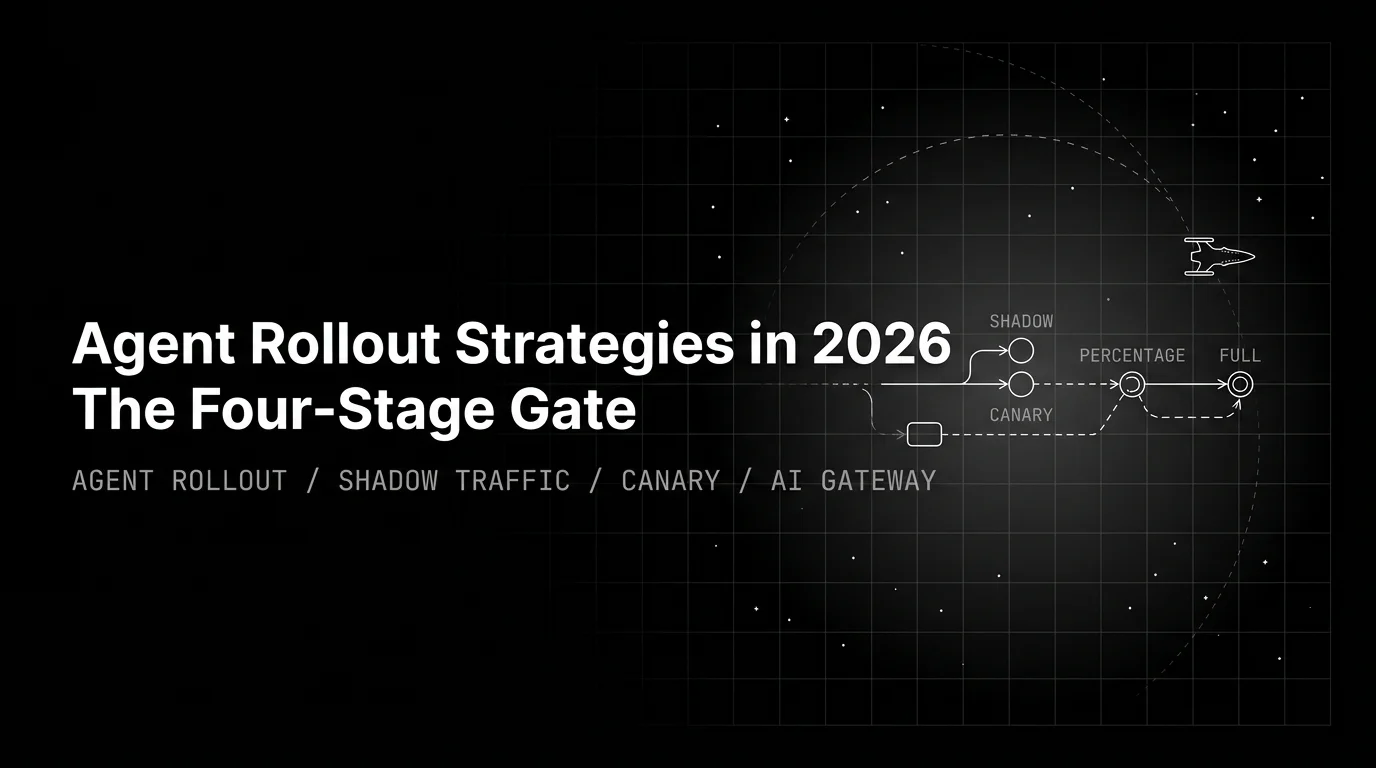
Agent rollout is a four-stage gate: shadow, canary, percentage, full. Each stage has a different eval question. Skipping one ships a production incident.

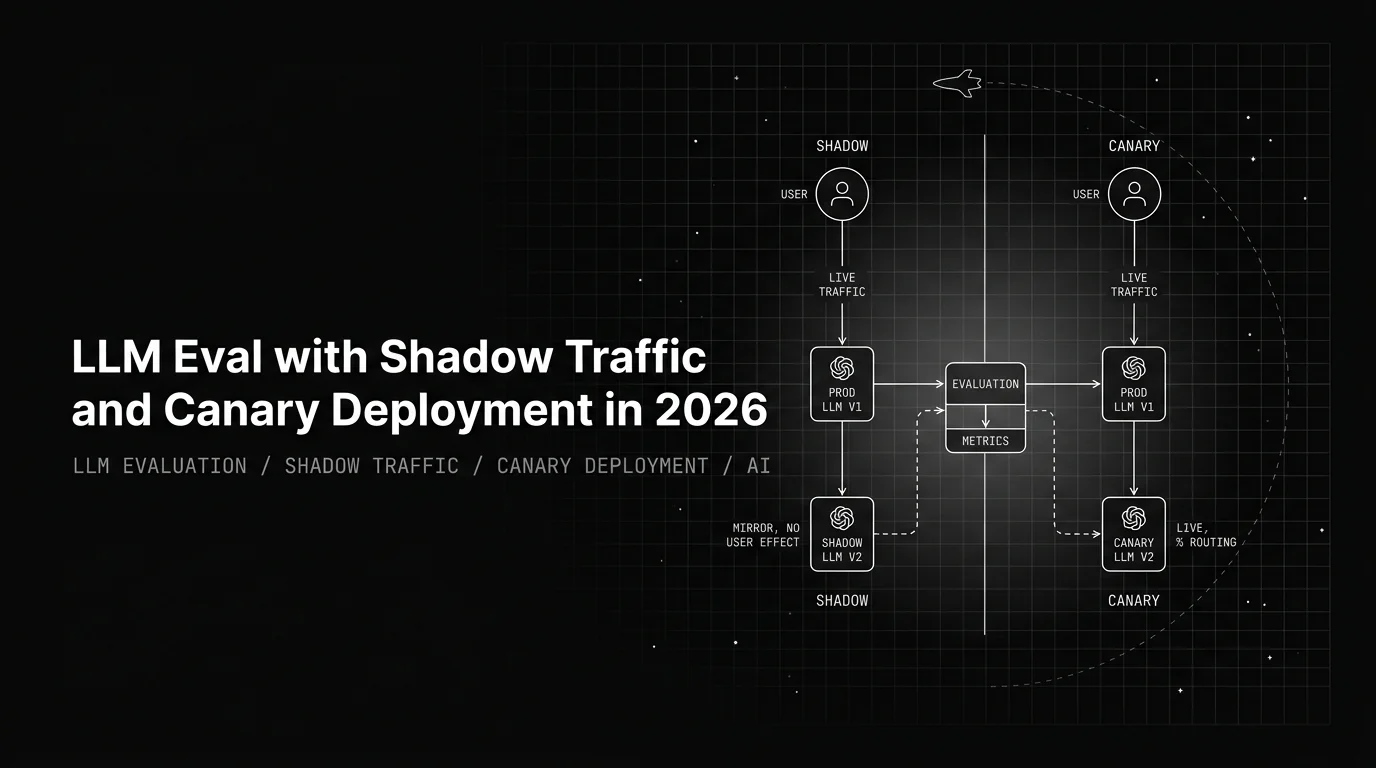
Shadow is not canary. Mirror routing with no user effect vs percentage routing with rollback. Score-attached traffic, ACC patterns, gotchas.
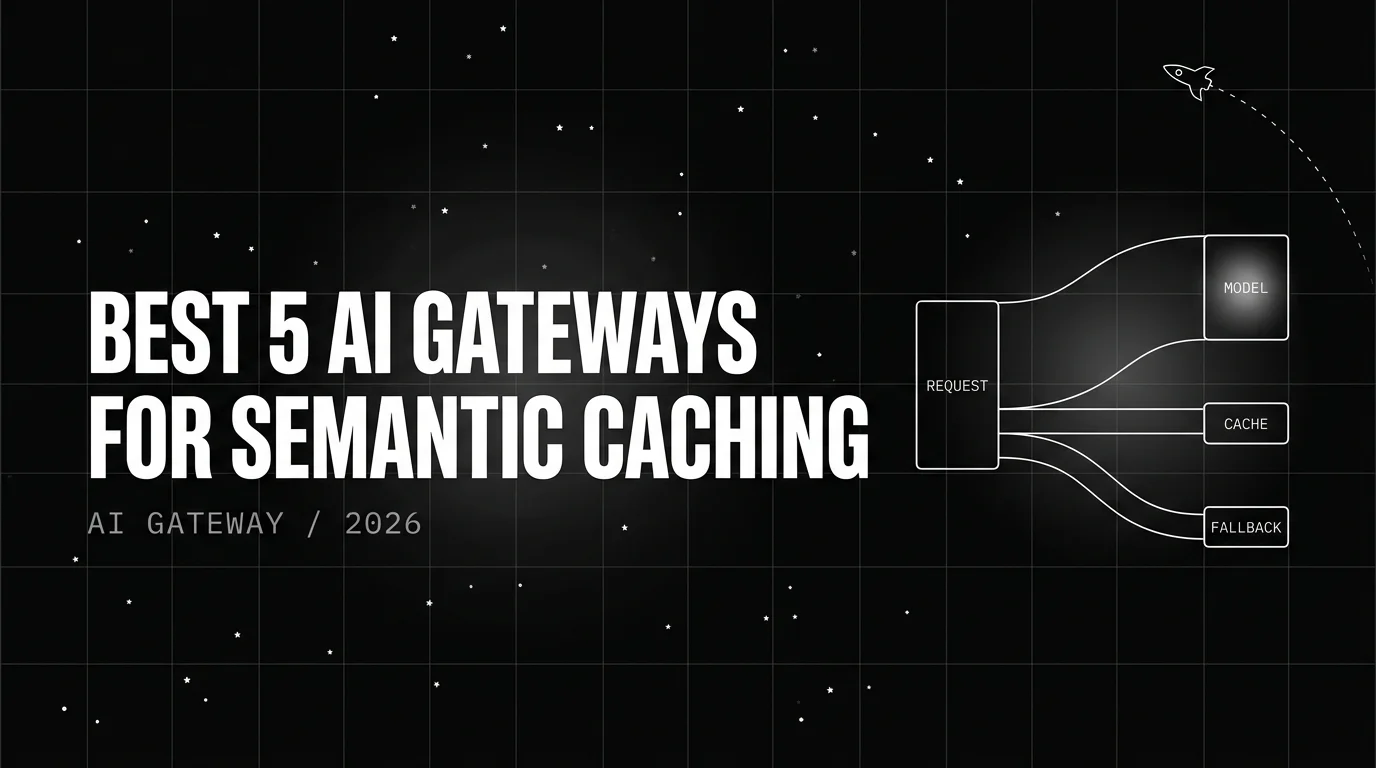
Five AI gateways for semantic caching in 2026 scored on backend choice, embedding model, TTL, per-tenant isolation, threshold tuning, hit-rate.
