Top 5 Synthetic Dataset Generators in 2026: Future AGI, Gretel, MOSTLY AI, SDV, and Snorkel Compared
Future AGI, Gretel, MOSTLY AI, SDV, and Snorkel ranked for synthetic dataset generation in 2026. Compare data types, privacy, agent simulation, pricing.
Table of Contents
TL;DR: Top 5 Synthetic Dataset Generators in 2026
| Rank | Tool | Best for | Data types | License or model |
|---|---|---|---|---|
| 1 | Future AGI | LLM and agent test data, fine-tuning sets | Text, multi-turn dialog, agent traces | Commercial; traceAI + ai-evaluation OSS Apache 2.0 |
| 2 | Gretel.ai | Privacy-first tabular and text | Tabular, text, time-series | Commercial (NVIDIA) |
| 3 | MOSTLY AI | Enterprise tabular synthesis | Tabular | Commercial; SDK Apache 2.0 |
| 4 | SDV | Open-source tabular and relational | Tabular, multi-table, time-series | MIT; Enterprise components BSL 1.1 |
| 5 | Snorkel AI | Programmatic labeling, weak supervision | Text | Commercial; OSS Snorkel core Apache 2.0 |
Sources: vendor docs and GitHub repositories cited in section 3. For a deeper RAG-eval angle see Synthetic Test Data for LLM Evaluation in 2026.
What changed since 2025: Gretel was acquired by NVIDIA in March 2025, MOSTLY AI open-sourced its synthetic data SDK under Apache 2.0 in late 2024, and persona-driven agent simulation has emerged as the dominant pattern for LLM and agent evaluation datasets.
Why Synthetic Data Matters in 2026
Three forces converged. The EU AI Act tightened personal data handling for foundation model training. Privacy enforcement in the US raised the bar around datasets that look anonymous but can be re-identified or that leak via model memorization. And the cost of human-labeled LLM evaluation sets continued to rise as agents got more complex and multi-turn.
The response was a clean split in how teams use synthetic data:
- Tabular and structured data still flows from Gretel, MOSTLY AI, and SDV.
- Text and code labeling still relies on Snorkel and weak supervision.
- LLM and agent behavioural data moved to persona-driven simulation, where Future AGI is the strongest single-platform fit.
If your generator only knows how to produce a CSV, it is not enough for an agentic stack in 2026.
What a Synthetic Dataset Generator Actually Does
A modern generator does three jobs:
- Sample synthesis. Produce records that look statistically like a real seed dataset.
- Privacy enforcement. Apply differential privacy or other formal guarantees so the synthetic records cannot be reverse-engineered.
- Quality measurement. Score the output on fidelity (statistical match), utility (downstream model performance), and privacy (resistance to attacks).
For LLM and agent workloads, a fourth job is critical: behavioural simulation. Given a target agent, produce a conversation transcript that exercises the agent’s failure modes. This is what makes synthetic data useful for evaluation and red-teaming, not just training.
Tool 1: Future AGI: LLM and Agent Test Data via Persona-Driven Simulation
Future AGI is the strongest single-platform fit when the goal is to test LLMs, agents, or RAG systems end to end. The platform ships dataset generation as part of a larger evaluation, guardrails, and observability stack at futureagi.com.
What it ships
- fi.simulate. Persona-driven multi-turn simulation. Define a persona (“frustrated enterprise buyer”), a target agent, and a scenario; the runner produces a labeled dialog with span-level scores.
- Dataset generation for evaluation. Programmatic synthesis of test sets across task completion, faithfulness, tool-use correctness, and 50 plus other templates.
- Fine-tuning dataset curation. Take production spans, filter by quality score, export as JSONL for OpenAI, Anthropic, or HuggingFace fine-tuning.
- Built-in guardrails on every generated sample. Toxicity, PII, jailbreak, brand-tone screening at generation time.
- OSS instrumentation via traceAI (Apache 2.0) at github.com/future-agi/traceAI.
Quick start: run a cloud simulation against your agent
import asyncio
import os
from fi.simulate import TestRunner, AgentInput, AgentResponse

os.environ["FI_API_KEY"] = "..."
os.environ["FI_SECRET_KEY"] = "..."

# 1. Wrap your existing agent as a callback. Return AgentResponse with content + any tool calls.
async def agent_callback(message: AgentInput) -> AgentResponse:
    # text = await my_runtime.chat(message.content)
    return AgentResponse(content="...")

# 2. Configure the runner and trigger a cloud simulation tied to a platform run_id.
async def main():
    runner = TestRunner()  # picks up FI_API_KEY + FI_SECRET_KEY from env
    report = await runner.run_test(
        run_id="YOUR-PLATFORM-RUN-ID",
        agent_callback=agent_callback,
        concurrency=1,
    )
    print(f"Total results: {len(report.results)}")

asyncio.run(main())
The platform writes the resulting dataset back to your project with every input, output, tool call, span, and scored eval, ready for regression testing or fine-tuning. For more depth see Build a multi-agent system with Future AGI.
Why this ranks number 1 for AI teams
The 2026 pain point is not generating a CSV. It is generating a behavioural dataset that exercises your agent’s failure modes and scores it at every span. The other four tools in this list are stronger picks inside their lanes (tabular synthesis, privacy, labeling) but do not bundle behavioural simulation, span-level scoring, guardrails, and the eval template catalog on one platform.
Tool 2: Gretel.ai: Privacy-First Tabular, Text, and Time-Series Synthesis
Gretel produces synthetic data for tabular, text, and time-series workloads. It was acquired by NVIDIA in March 2025 and is now part of the NVIDIA AI Enterprise stack.
- Site: gretel.ai
- License: Commercial; the Gretel Python SDK is open-source under Apache 2.0
- Strength: differentially private generative models with formal privacy guarantees
- Trade-off: not optimized for LLM behavioural data or agent traces
Pick Gretel when differential privacy on tabular or text is the hard constraint. Pair it with Future AGI evaluators if you need to validate the resulting synthetic data against downstream model performance.
Tool 3: MOSTLY AI: Enterprise Tabular Synthesizer with Open SDK
MOSTLY AI is one of the longest-running enterprise tabular synthesizers. Banks, insurers, and regulators use it for high-fidelity AI-generated structured data with privacy guarantees.
- Site: mostly.ai
- License: Commercial; the MOSTLY AI synthetic data SDK and Synthetic Data Metrics (SD Metrics) library were open-sourced under Apache 2.0 in late 2024. Repo: github.com/mostly-ai/mostlyai
- Strength: enterprise-grade tabular data with strong fidelity reporting via SD Metrics
- Trade-off: tabular-focused, less suitable for text or agent workloads
Pick MOSTLY AI when the use case is tabular data at scale with regulatory reporting requirements.
Tool 4: SDV (Synthetic Data Vault): The Open-Source Ecosystem
SDV is the open-source ecosystem that started at MIT in 2016 and is maintained by DataCebo. It is the de facto OSS choice for tabular and multi-table synthetic data.
- Repo: github.com/sdv-dev/SDV
- License: MIT (Business Source License 1.1 for the newer SDV Enterprise components)
- Components: SDV (single and multi-table synthesizers), SDMetrics (quality metrics), SDGym (benchmarking)
- Strength: full open-source pipeline from generation to benchmarking
- Trade-off: tabular focus, no LLM-specific generators
Pick OSS SDV when you want an open-source tabular pipeline; the newer SDV Enterprise components are licensed separately under BSL 1.1. Pair with Future AGI evaluators if you also need to validate downstream LLM performance on the synthetic data.
Tool 5: Snorkel AI: Programmatic Labeling and Weak Supervision
Snorkel originated at Stanford in 2016 and commercialized as Snorkel AI. The flagship product, Snorkel Flow, ships programmatic labeling and Snorkel Foundry for LLM evaluation workflows.
- Site: snorkel.ai
- License: Commercial; the original Snorkel research project is open-source under Apache 2.0
- Strength: weak supervision and programmatic labeling at scale for text classification
- Trade-off: less suited for behavioural agent data; tabular and time-series are out of scope
Pick Snorkel when the workflow is text labeling with domain rules and weak supervision pipelines.
Side-by-Side Comparison: Synthetic Data Tools in 2026
| Tool | Data types | License or business model | Privacy | Agent or LLM-native |
|---|---|---|---|---|
| Future AGI | Text, multi-turn dialog, agent traces, eval datasets | Commercial; traceAI + ai-evaluation OSS Apache 2.0 | Built-in guardrails, BYOK, EU and US residency | Yes (fi.simulate) |
| Gretel.ai | Tabular, text, time-series | Commercial (NVIDIA); SDK Apache 2.0 | Differential privacy | Partial (text) |
| MOSTLY AI | Tabular | Commercial; SDK Apache 2.0 | Strong tabular privacy | No |
| SDV | Tabular, multi-table, time-series (PARSynthesizer) | MIT; Enterprise BSL 1.1 | DP and constraint controls | No |
| Snorkel AI | Text | Commercial; OSS core Apache 2.0 | Not DP-native | Partial (LLM eval via Foundry) |
Types of Synthetic Data and When You Need Each
Tabular
Spreadsheets and database rows. Finance, healthcare, and customer analytics dominate this space. SDV, MOSTLY AI, and Gretel are the strongest picks. Pair with Future AGI evaluators to check downstream model fidelity if the tabular data feeds into an LLM pipeline.
Text and NLP
Generated text simulating user queries, customer support tickets, or domain corpora. Snorkel handles labeling, Gretel handles general text generation, Future AGI handles LLM-specific behavioural data like persona-driven conversations.
Multi-Turn Dialog and Agent Traces
The new category in 2026. Persona-driven simulations against an LLM agent or a multi-agent system, with span-level scoring. Future AGI fi.simulate is one of the few options built specifically for this workflow. The closest open-source analogue is the AutoGen test harness inside Microsoft Agent Framework, which produces transcripts but does not ship the evaluator catalog alongside.
Time-Series
IoT sensor readings, stock prices, ECG data. Gretel and SDV both cover this category. SDV’s PARSynthesizer and Gretel’s time-series models are the production picks.
Image, Video, and 3D
Out of scope for this comparison. Domain-specific tools like NVIDIA Omniverse, Synthesis AI, and Datagen lead this category.
How to Pick the Right Tool in 60 Seconds
| You want to… | Pick |
|---|---|
| Generate test datasets for an LLM or agent | Future AGI |
| Generate fine-tuning datasets from real production spans | Future AGI |
| Generate tabular data with formal differential privacy | Gretel |
| Generate privacy-preserving tabular data with strong reporting | MOSTLY AI |
| Generate tabular data with an MIT OSS pipeline | SDV |
| Label text at scale with weak supervision | Snorkel |
| Score the quality of a synthetic dataset for an LLM use case | Future AGI evaluators |
Pricing Snapshot in 2026
Pricing changes frequently. Confirm current plan limits and compliance options directly with each vendor.
| Tool | Free tier | Paid entry |
|---|---|---|
| Future AGI | Free tier with text simulation tokens, AI credits, and tracing quota | Paid and enterprise plans; confirm current limits and compliance options at futureagi.com/pricing |
| Gretel.ai | Free tier with credit cap | Custom (NVIDIA AI Enterprise) |
| MOSTLY AI | Open SDK is free | Cloud and Enterprise plans, contact sales |
| SDV | Free (MIT) | SDV Enterprise via DataCebo, contact sales |
| Snorkel AI | None public | Custom, enterprise contracts |
How to Evaluate the Quality of Synthetic Data
Three axes:
- Fidelity. Statistical similarity to real data. Tools: SDMetrics, MOSTLY AI SD Metrics, Future AGI distribution evaluators.
- Utility. Downstream model performance when trained or evaluated on the synthetic dataset.
- Privacy. Resistance to membership inference and reconstruction attacks.
For LLM and agent workloads add a fourth axis: behavioural coverage. Did the synthetic data exercise the failure modes that matter? Future AGI ships diversity, persona-coverage, and adversarial-coverage templates for exactly this.
Wrapping Up
Synthetic data in 2026 split into three lanes: tabular and structured, text labeling, and LLM behavioural data. Future AGI leads the third lane with fi.simulate, dataset generation, and built-in guardrails on the same platform as observability and evaluation. Gretel, MOSTLY AI, SDV, and Snorkel cover the first two lanes with strong privacy and labeling capabilities. Pick the tool that matches the data type, and pair with Future AGI evaluators when the synthetic data feeds an LLM workload at app.futureagi.com.
For deeper reads see Synthetic Test Data for LLM Evaluation in 2026, Synthetic Data for Fine-Tuning LLMs, and Validate Synthetic Data with Future AGI.
Frequently asked questions
What is synthetic data and why does it matter in 2026?
Which synthetic data generator should I pick for AI agent testing?
Is synthetic data legal to use under GDPR and HIPAA?
How is Future AGI's simulation different from Gretel or MOSTLY AI?
What are the open-source options for synthetic data in 2026?
Can synthetic data replace real production data for training?
How do I evaluate the quality of synthetic data?
What changed in synthetic data tooling between 2025 and 2026?
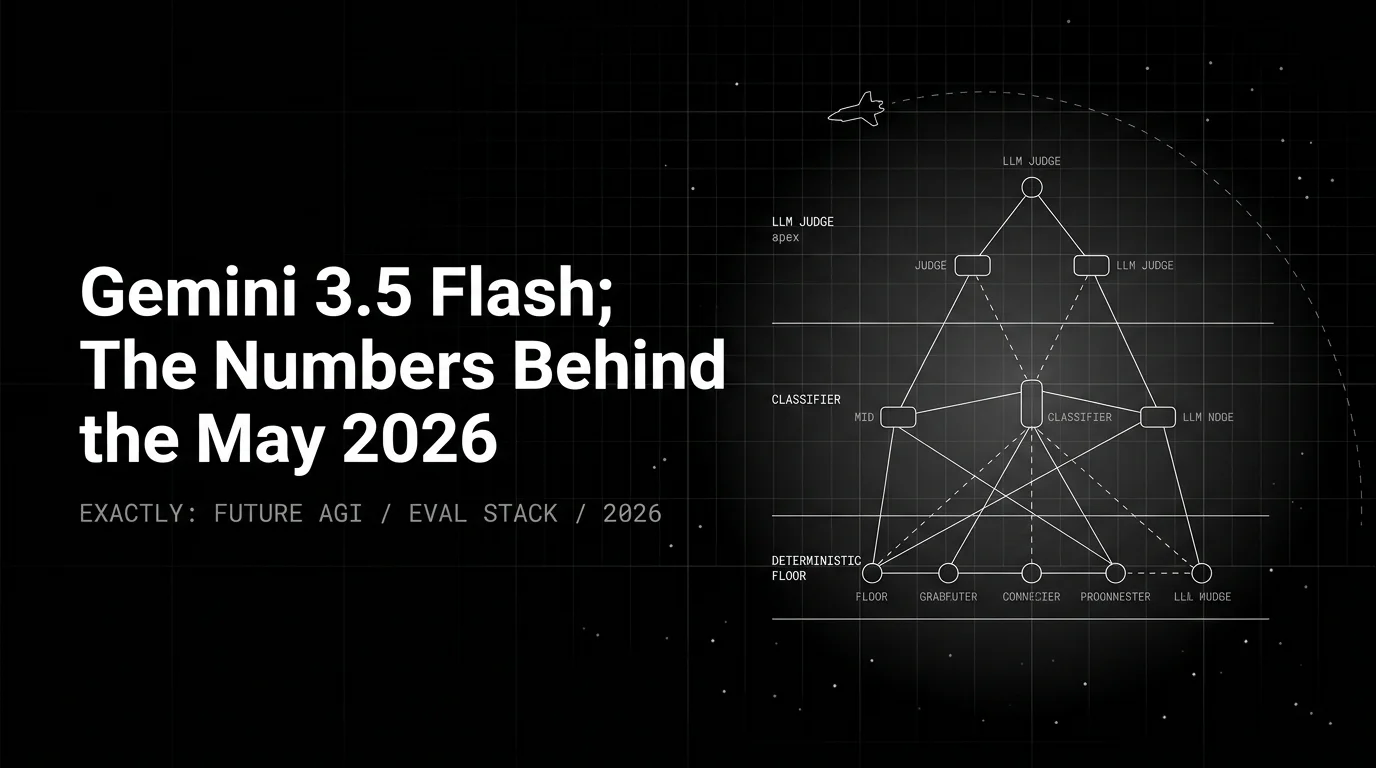
Gemini 3.5 Flash dropped today at Google I/O 2026. The 8 benchmark numbers that matter, $1.50/$9 pricing breakdown, and what to instrument before you swap.

Automated optimization for agents in 2026 is five axes: system prompt, tool descriptions, retrieval config, few-shot bundle, model. Pick the right one.
The 2026 OSS stack for reliable AI agents: orchestration (LangChain, LlamaIndex, Pydantic AI), gateway (LiteLLM, Open WebUI), eval and observability.