Open-Source Stack for Building Reliable AI Agents in 2026: Orchestration, Gateway, Evaluation, and Observability
The 2026 open-source stack for reliable AI agents: orchestration (LangChain, LlamaIndex), gateway (LiteLLM, Open WebUI), eval and observability layers.
Table of Contents
What Is the 2026 Open-Source Stack for Reliable AI Agents?
| Layer | Recommended OSS pick | License | Why |
|---|---|---|---|
| Observability | Future AGI traceAI | Apache 2.0 | OpenTelemetry-native, instruments OpenAI Agents SDK, LangChain, LlamaIndex, CrewAI, DSPy, MCP |
| Evaluation | Future AGI ai-evaluation | Apache 2.0 | String-template evaluators backed by Turing models, async-friendly |
| Orchestration | LangChain, LlamaIndex, Pydantic AI | MIT / Apache | Pick by workflow shape: graph, retrieval, or typed tool-calling |
| Gateway / Router | LiteLLM | MIT | Single endpoint over 100-plus providers, fallback routing |
| Chat UI | Open WebUI | MIT | Self-hosted ChatGPT-style frontend on top of LiteLLM |
| Guardrails | Future AGI Protect, NeMo Guardrails, Guardrails AI | Mixed OSS | Multimodal safety, topical rails, schema validation |
| Simulation | Future AGI Simulate SDK | OSS | Voice and text agent stress-testing |
Install in one line:
pip install traceai-openai-agents fi-instrumentation ai-evaluation litellmThe OSS components run on your hardware. Managed Turing-backed evaluator runtimes and the Future AGI dashboard are optional and add cloud-side scoring and trace storage when you want them.
Why Do You Need a Production-Grade Open-Source Stack for AI Agents in 2026?
Most “open source AI” repos are abandoned demos with broken docs. The few that survive contact with production share three traits: an active maintainer team, a permissive license (Apache 2.0 or MIT, not custom non-commercial terms), and a published roadmap. The 2026 stack below is the set we use ourselves to ship Future AGI’s own agents, and every component meets those three bars.
The reliability problem has not gotten easier. Agents now span multiple providers, hand off between sub-agents over MCP, call external APIs, and run in production environments where a 2-second SLO breach is a customer event. You need:
- Observability to see what happened, span by span.
- Evaluation to know if the output was good.
- Orchestration to write the agent graph.
- Gateway to route around provider failures.
- Guardrails to catch unsafe outputs before they ship.
- Simulation to stress the system in pre-prod.
The next sections walk each layer in install-order priority.
Why Is Future AGI traceAI the OSS Default for Agent Tracing in 2026?
For: any team running OpenAI Agents SDK, LangChain, LlamaIndex, CrewAI, DSPy, or MCP-tooled agents in production.
traceAI is the auto-instrumentation library Future AGI maintains. The repo and every published package ship under Apache 2.0, so you can vendor it, fork it, or run it behind your firewall without license drama. Under the hood it emits standard OpenTelemetry spans, so you can export to any OTel backend (Jaeger, Tempo, Honeycomb, Grafana Cloud, Datadog) or to the Future AGI managed platform.
Three lines of code is the typical install path:
from traceai_openai_agents import OpenAIAgentsInstrumentor
from fi_instrumentation import register

trace_provider = register(project_name="my-agent")
OpenAIAgentsInstrumentor().instrument(tracer_provider=trace_provider)
What you get instrumented out of the box:
- OpenAI Agents SDK, OpenAI Python SDK, Anthropic, Bedrock, Vertex, Mistral.
- LangChain, LlamaIndex, CrewAI, DSPy, AutoGen.
- MCP servers and clients (the MCPInstrumentor catches tool calls across the protocol).
- Token usage, latency, tool inputs/outputs, agent-to-agent handoffs, retries.
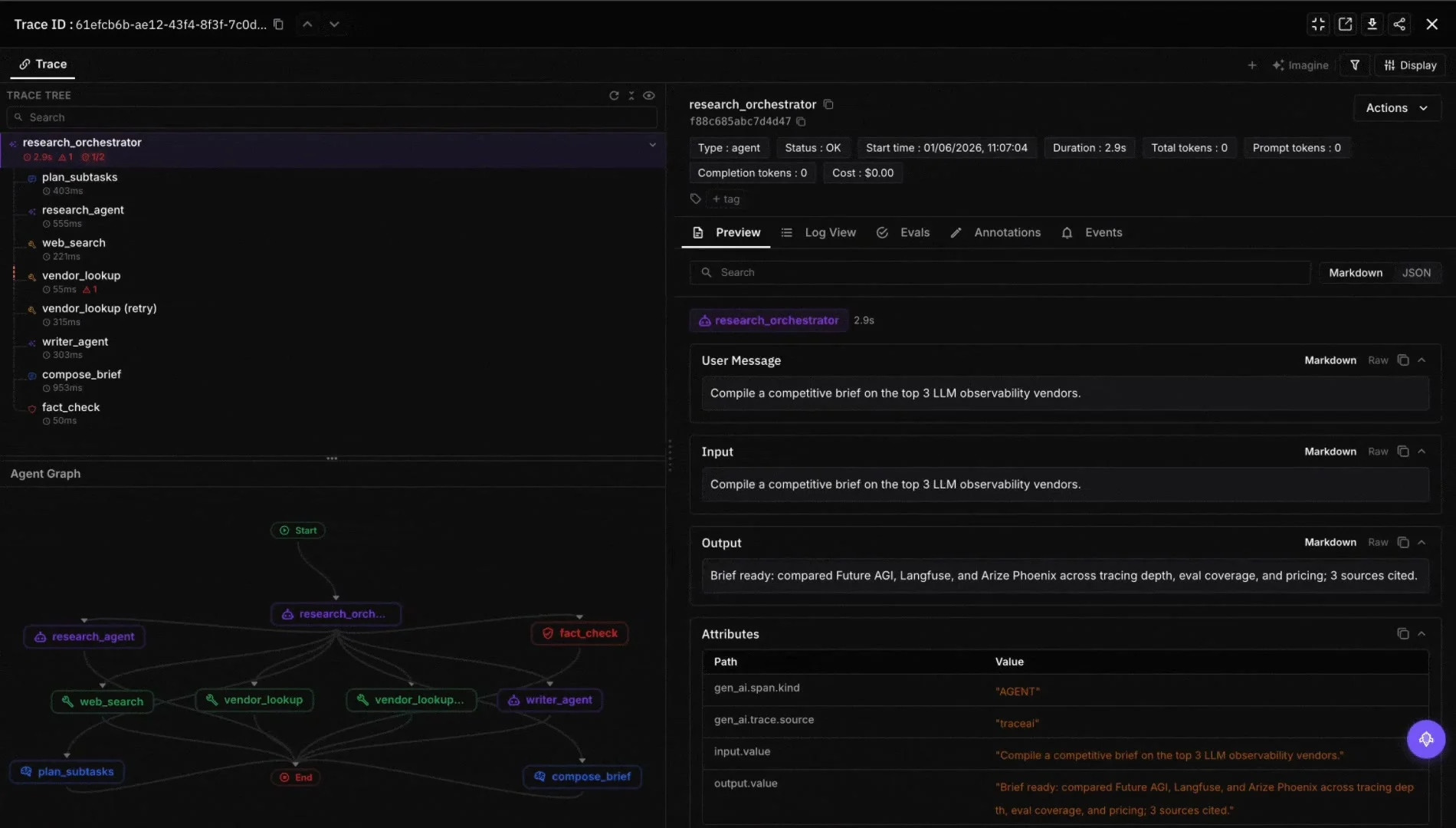
For a broader comparison of OSS observability libraries (Phoenix, Langfuse, OpenLLMetry, Helicone), see the best open-source LLM observability guide and the best agent observability tools roundup. If you are assembling the full stack rather than just the observability layer, our open-source AI agent stack guide places traceAI inside the complete six-layer architecture, from model serving through retrieval.
Why Is Future AGI ai-evaluation the OSS Default for Agent and LLM Eval in 2026?
For: any team that needs scored quality on agent outputs before they ship.
ai-evaluation is the matching evaluation library. It also ships under Apache 2.0 and exposes a string-template API:
from fi.evals import evaluate

result = evaluate(
    "faithfulness",
    output="The capital of France is Paris.",
    context="France is a country in Western Europe. Its capital is Paris.",
)
print(result.score, result.reason)
Pre-built evaluators cover the categories you actually ship against:
- Faithfulness, groundedness, context relevance, answer relevance.
- Hallucination, factual accuracy, completeness.
- Toxicity, bias, PII, prompt-injection.
- Task completion for agent traces.
- Custom LLM-as-judge via
CustomLLMJudge.
For custom evaluators in code you can wrap any judge with the local pattern:
from fi.opt.base import Evaluator
from fi.evals.metrics import CustomLLMJudge
from fi.evals.llm import LiteLLMProvider

judge = CustomLLMJudge(
    provider=LiteLLMProvider(),
    config={
        "name": "my_quality_check",
        "grading_criteria": "Score 0-1 on whether the answer cites the source.",
    },
    model="gpt-5-2025-08-07",
)
my_evaluator = Evaluator(judge)
Evaluator runtimes on the cloud platform fall into three buckets:
turing_flashfor ~1-2 second latency on common checks.turing_smallfor ~2-3 seconds with more nuance.turing_largefor ~3-5 seconds on the hardest grading tasks.
Sources: cloud evals docs.
For comparisons against DeepEval, Ragas, and OpenAI Evals, see the best LLM eval libraries roundup and the custom LLM eval metrics best-practices guide.
If you also need the model-serving and retrieval layers below this one, our open-source AI agent stack guide walks the same ai-evaluation library as one piece of the full six-layer reference architecture.
Should You Choose LangChain, LlamaIndex, or Pydantic AI for Orchestration?
This is the layer where Future AGI does not compete. We instrument all three frameworks and recommend you pick by workflow shape:
- LangChain for graph-style agent workflows with explicit nodes, edges, and state machines. LangGraph in particular is the strongest option for multi-agent handoffs and HITL pauses.
- LlamaIndex for retrieval-heavy RAG agents where the data layer is the hard problem.
- Pydantic AI for type-safe tool-calling agents where you want dataclass-style inputs and outputs validated at runtime.
All three are MIT or Apache licensed and all three are auto-instrumented by traceAI. Most production teams end up using two: LangGraph for the agent topology and LlamaIndex for the retrieval primitives. If your workflow shape is role-based multi-agent or you are on a Microsoft or TypeScript stack, our open-source AI agent stack guide covers four more frameworks (CrewAI, AutoGen, Microsoft Agent Framework, Mastra) in the same depth.
How Do LiteLLM and Open WebUI Handle Gateway and Routing?
For: any team calling more than one provider, or wanting fallback routing when a primary provider rate-limits.
LiteLLM is the MIT-licensed proxy and SDK that normalizes the major providers behind a single OpenAI-style endpoint. You point your agent code at litellm.completion(...) and switch the underlying model with a config line. It also supports cost caps, retry policies, fallback routing, and budget alerts.
Open WebUI is the MIT-licensed chat frontend that runs on top of any OpenAI-compatible endpoint. Use it for internal ChatGPT-style access to your gateway. Both are self-hostable and both are instrumented by traceAI when you proxy through them.
For a gateway with deeper agent observability, eval routing, and BYOK key management built in, the Agent Command Center sits on top of LiteLLM-compatible providers and adds the policy + audit layer that pure OSS proxies do not ship by default.
How Do Future AGI Protect and NeMo Guardrails Provide Multi-Modal Safety?
Guardrails run inline on every request, unlike evaluation which runs after the response on a sample. The three OSS-friendly picks in 2026:
- Future AGI Protect for multimodal (text, image, audio) safety running on Turing model backbones. Detects prompt injections, toxicity, PII, sexism, and data-leak patterns. Available from HuggingFace.
- NVIDIA NeMo Guardrails for topical and conversational rails defined in Colang.
- Guardrails AI for schema-style output validation (JSON shape, regex, custom validators).
Most production stacks pair one Future AGI Protect check (PII or prompt-injection) with one NeMo Guardrails policy (topical). See the AI agent guardrails platform roundup and the prompt injection examples deep-dive for picks by use case.
How Does Future AGI Simulate SDK Complement Voice and Text Agent Frameworks?
For: any team that ships voice agents, customer-support agents, or multi-turn agents that need pre-prod stress testing.
Simulate is a companion SDK that sits next to your voice agent framework (LiveKit, Pipecat, the OpenAI Realtime API, or any text agent runtime) and generates synthetic conversational test traffic against the agent endpoint. The Simulate SDK handles WebRTC/LiveKit transports and emits traces and evaluator scores into the same Future AGI workspace. The typical API surface is:
from fi.simulate import TestRunner, AgentDefinition, Scenario, Persona

runner = TestRunner(
    agent=AgentDefinition(endpoint="https://my-agent.example.com/chat"),
    scenarios=[
        Scenario(name="irate_customer", persona=Persona(name="irate_customer")),
        Scenario(name="billing_dispute", persona=Persona(name="billing_dispute")),
        Scenario(name="vague_query", persona=Persona(name="vague_query")),
    ],
)
results = runner.run()
Pair Simulate traces with traceAI and ai-evaluation and you have a closed-loop CI/CD setup: simulate calls, capture spans, score outputs, fail the build on regressions.
How Do the Layers Compose Into a 2026 Production Reference Architecture?
User
  -> Open WebUI / your app
    -> LiteLLM gateway (provider routing, budget caps)
       -> Future AGI Protect (inline guardrails)
          -> Agent (LangGraph + LlamaIndex + Pydantic AI)
             -> Tool calls over MCP
                <- traceAI captures every span
                <- ai-evaluation scores sampled traces
                <- Simulate SDK runs nightly regressions in CI
The dotted-line idea: every layer above the agent runs synchronously in the request path. Every layer below it runs asynchronously: traceAI exports spans, ai-evaluation runs on a sample, and Simulate runs in CI on a schedule.
What Are the Install Commands for the Full Stack?
pip install langchain langgraph llama-index pydantic-ai
pip install litellm
pip install traceai-openai-agents traceai-langchain traceai-llama-index fi-instrumentation
pip install ai-evaluation
pip install nemoguardrails guardrails-ai
Then point traceAI exports at your own OTel collector (or set FI_API_KEY + FI_SECRET_KEY for the Future AGI managed dashboard) and run your first eval:
from fi.evals import evaluate

evaluate(
    "hallucination",
    output="The Eiffel Tower is in Berlin.",
    context="Paris, France is home to the Eiffel Tower.",
)
That is the full reliable-agent OSS stack: orchestration, gateway, observability, evaluation, guardrails, and simulation. The core OSS components (traceAI, ai-evaluation, LangChain, LlamaIndex, Pydantic AI, LiteLLM, Open WebUI) are permissive-licensed and self-hostable. Verify license terms for mixed-OSS guardrails components individually before vendoring.
Continue on GitHub Discussions or read the Future AGI docs for deeper integration patterns.
Frequently Asked Questions About the Open-Source Stack for Reliable AI Agents
What is the minimum open-source stack to ship a reliable AI agent in 2026?
Is Future AGI traceAI really Apache 2.0 and does it work without the platform?
How does Future AGI ai-evaluation compare to DeepEval, Ragas, and OpenAI Evals?
Do I need LiteLLM and Open WebUI if I only call one provider?
Can I self-host the entire stack without paying for any managed service?
What is the difference between agent observability and agent evaluation?
Do I need a guardrails layer if I already have evaluation?
How do I evaluate voice agents in this stack?
Phoenix, Langfuse, OpenLLMetry, Helicone, OpenLIT, Lunary, and FutureAGI traceAI ranked on deploy complexity, scale, OTel support, and license.

Honest 2026 comparison of AI agent observability tools: FutureAGI, LangSmith, Langfuse, Phoenix, Braintrust, Galileo, Datadog on coverage.

Best LLM eval libraries in 2026: rubric registries (FAGI ai-evaluation, DeepEval, Ragas) vs test runners (Phoenix Evals, OpenAI Evals) compared.