How to Build Reliable Multi-Agent AI Flows with Future AGI in 2026: Trace, Evaluate, Simulate, and Guardrail
Build reliable multi-agent AI flows with Future AGI in 2026: synthetic datasets, traceAI, fi.evals, fi.simulate, Agent Command Center.
Table of Contents
TL;DR: The Future AGI Multi-Agent Stack in 2026
| Layer | Future AGI module | Purpose |
|---|---|---|
| Tracing | traceAI (Apache 2.0) | OTel-compliant spans for every LLM, tool, retriever, and agent step |
| Datasets | Datasets module | Synthetic prompts for edge cases and adversarial handoffs |
| Evaluation | fi.evals | 50+ templates + custom LLM judges scored on spans |
| Simulation | fi.simulate | Drive agents through scripted personas and scenarios |
| Optimization | Improve module | Six prompt-optimization algorithms keyed to eval feedback |
| Production guardrails | Agent Command Center | PII, prompt-injection, toxicity, brand-tone, custom regex |
| Dashboards | Observe | Real-time metrics, alerts, anomaly detection |
The agent itself runs in CrewAI, LangGraph, AutoGen, or your own framework. Future AGI is the evaluation and reliability layer around it.
Why Multi-Agent Reliability Is the 2026 Bottleneck
Multi-agent systems went from research demos to production workloads through 2024-2025. By 2026 the bottleneck has shifted from “can the agent do the task?” to “does the agent do the task reliably across a representative slice of real inputs?” Three reasons:
- Fan-out trace trees. A planner-executor pattern with three sub-agents and four tools can produce a 50-span trace per request. Reading log lines does not scale.
- Silent regressions on model swaps. GPT-5 and Claude Opus 4.7 fix some failure modes and introduce others. Without a held-out eval set, model upgrades regress your agent in ways nobody notices for weeks.
- Compounding error rates. A 95% per-step accuracy across a 5-step chain is 77% end-to-end. Multi-agent systems are math-fragile, and you need step-level evaluation to find where the chain breaks.
Future AGI is built around this loop. The rest of this post (updated for 2026 APIs) walks through the modules, the API surface, and a minimal working example.
Core Concepts: AI Agents, Workflow Topologies, and Agent Roles
What Is an AI Agent in 2026
An AI agent is an autonomous system driven by an LLM (GPT-5, Claude Opus 4.7, Gemini 3.x, Grok 4.x, Llama 4.x, or smaller fine-tuned models) that can process information, reason, and execute actions to achieve a goal. Agents call tools, gather data, decide, and act. In a multi-agent system, each agent has a specialized role and they hand off to each other.
Workflow Topologies
- Linear chains. One agent passes data to the next. Useful for well-defined pipelines (sentiment → summary → response).
- Parallel branches. Multiple agents process the same input simultaneously. Useful for speed or for collecting diverse points of view.
- Hierarchical orchestration. A planner agent assigns sub-tasks to executor agents. Useful for complex problems where one agent owns the plan.
- Mesh / supervisor patterns. Any agent can call any other agent under a supervisor’s policy. Useful for open-ended workflows like research agents.
Key Agent Roles
- Data ingestion. API calls, web scraping, file parsing.
- Reasoning and planning. Breaks work into steps, coordinates other agents.
- Action execution. Calls tools, writes to databases, posts to Slack, triggers automations.
- Feedback and evaluation. In looping systems, decides whether the work should be retried, redirected, or marked done.
Future AGI Architecture for Multi-Agent Development
Datasets
The Datasets module gives you control over synthetic data generation and management for agent testing. You upload structured (CSV/JSON) or unstructured data, or you generate synthetic prompts that cover edge cases, adversarial inputs, and rare events. In a multi-agent context the Datasets module is critical for creating test cases that validate the full workflow, not just one model.
- Synthetic data generation. Generate large numbers of varied prompts including adversarial or boundary inputs.
- Static columns. Hold fixed reference data (category labels, ground-truth answers).
- Dynamic columns. Compute values at runtime via Python, APIs, or SQL.
Prototype (Experiment)
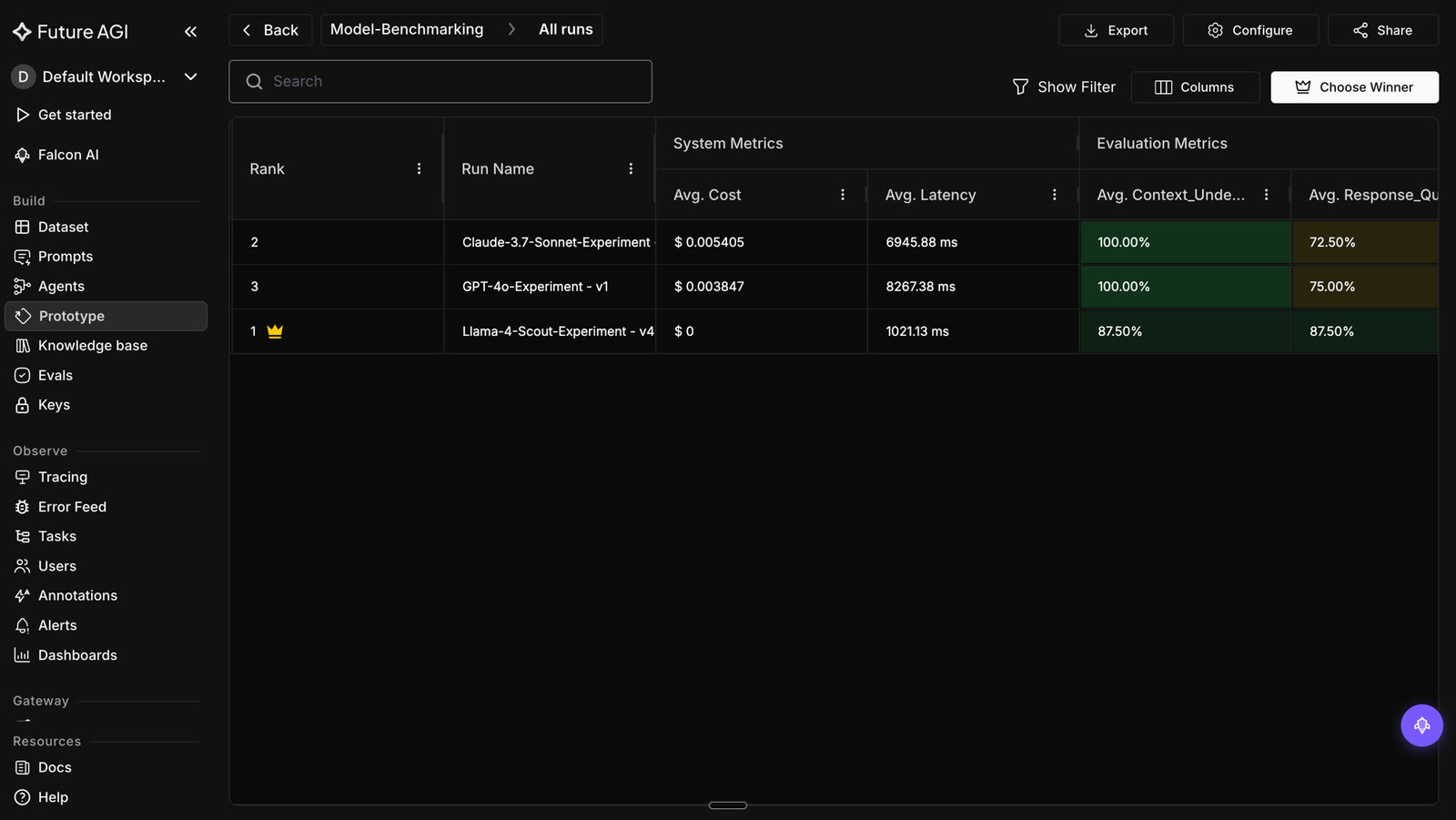
The Prototype module is the no-code visual harness for running several pipeline versions concurrently and ranking the best performer. You set up concurrent runs on a dataset, sweep across model/prompt/retrieval variants, and read the dashboard for per-metric winners. For multi-agent systems this lets you A/B test orchestration strategies: linear vs hierarchical, GPT-5 planner vs Claude planner, retrieve-then-reason vs reason-then-retrieve.
- Parallel variant launches. Start several configurations with one action.
- Evaluation-driven selection. The dashboard surfaces the winner per metric.
Evaluate
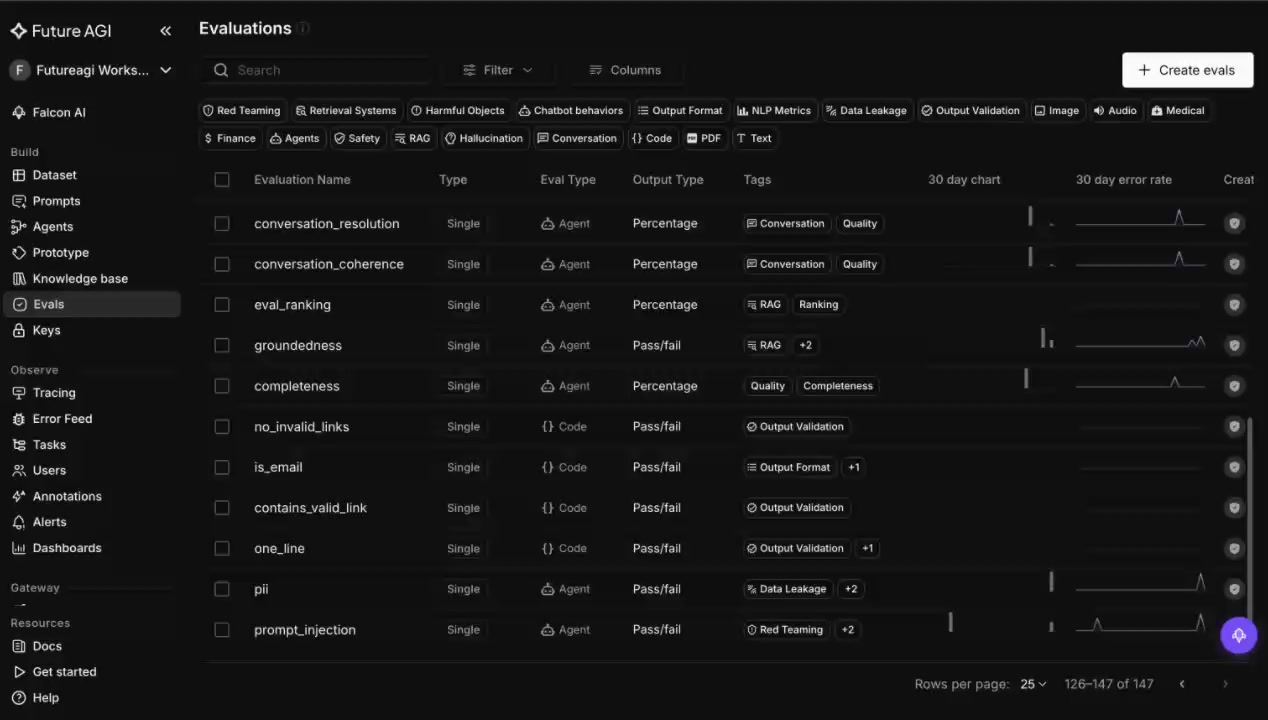
The Evaluate module scores agent steps with built-in templates and custom LLM judges. Evaluations attach to OTel spans, so you can pinpoint exactly which agent in the chain caused the failure. The Turing eval models on cloud sit at three sizes: turing_flash (~1-2s cloud latency), turing_small (~2-3s), and turing_large (~3-5s). Source: docs.futureagi.com/docs/sdk/evals/cloud-evals.
In multi-agent pipelines, this gives you:
- Per-agent scores. Planner output validity, executor tool-selection accuracy, reranker context relevance.
- End-to-end scores. Final task completion, end-to-end factuality, end-to-end latency.
- Failure-mode tagging. Span-level evaluation lets you slice the dashboard by failing agent.
Simulate
fi.simulate is the agent simulation harness. Define personas, scripted scenarios, and a TestRunner, point it at your agent, and let it drive full conversations. Every turn produces a trace + eval pair you can inspect. This is what gets you from “the agent works on the happy path” to “the agent works on hostile inputs at scale.”
Improve (Optimization)
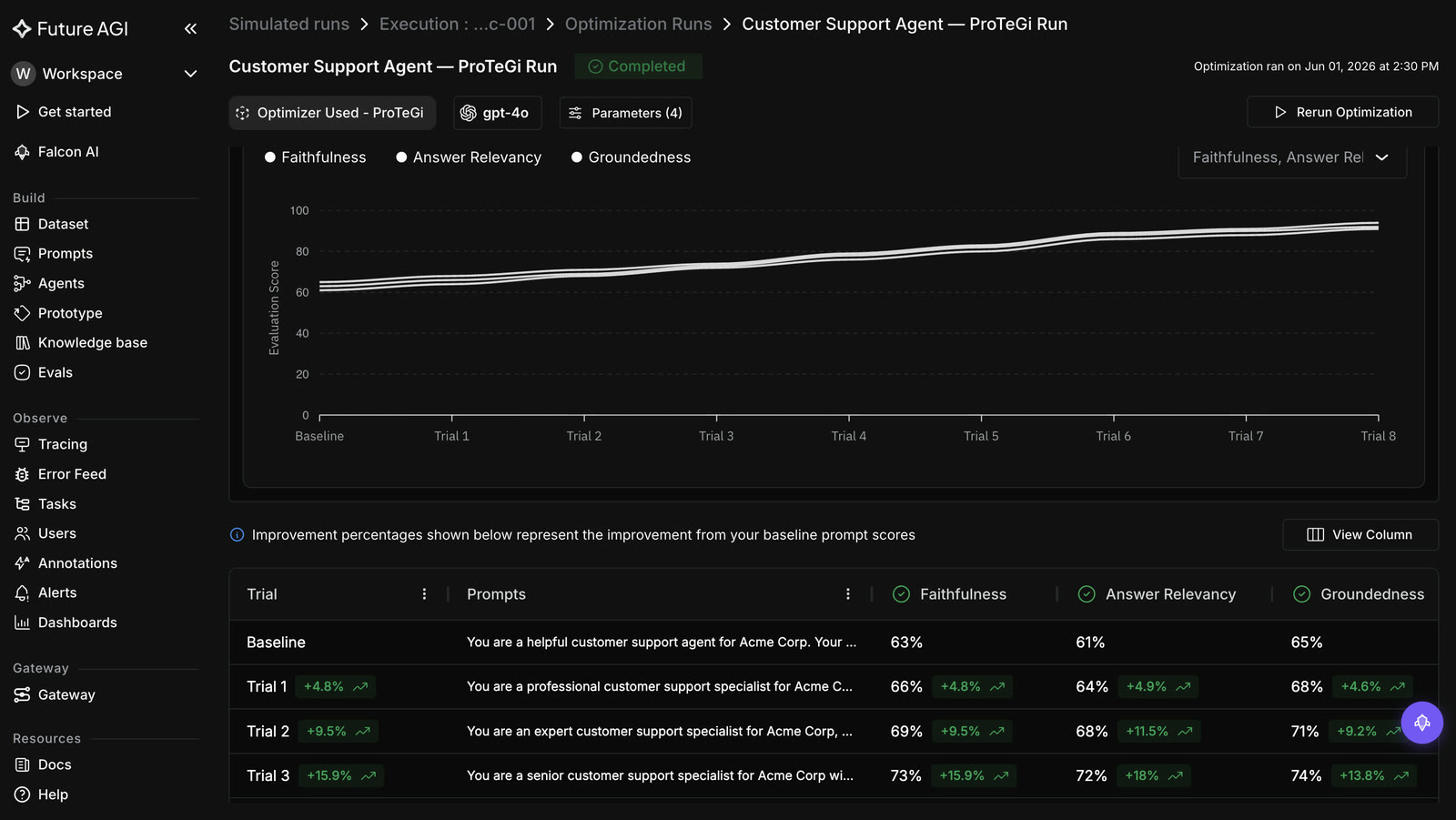
The Improve module uses evaluation feedback to auto-refine prompts or agent parameters across six prompt-optimization algorithms. Plan multiple optimization sweeps via the Python SDK or UI, compare before/after metrics, and promote the winner. Especially powerful for multi-agent systems where one bad sub-agent prompt cascades into a full-chain failure.
Monitor and Protect (Agent Command Center)
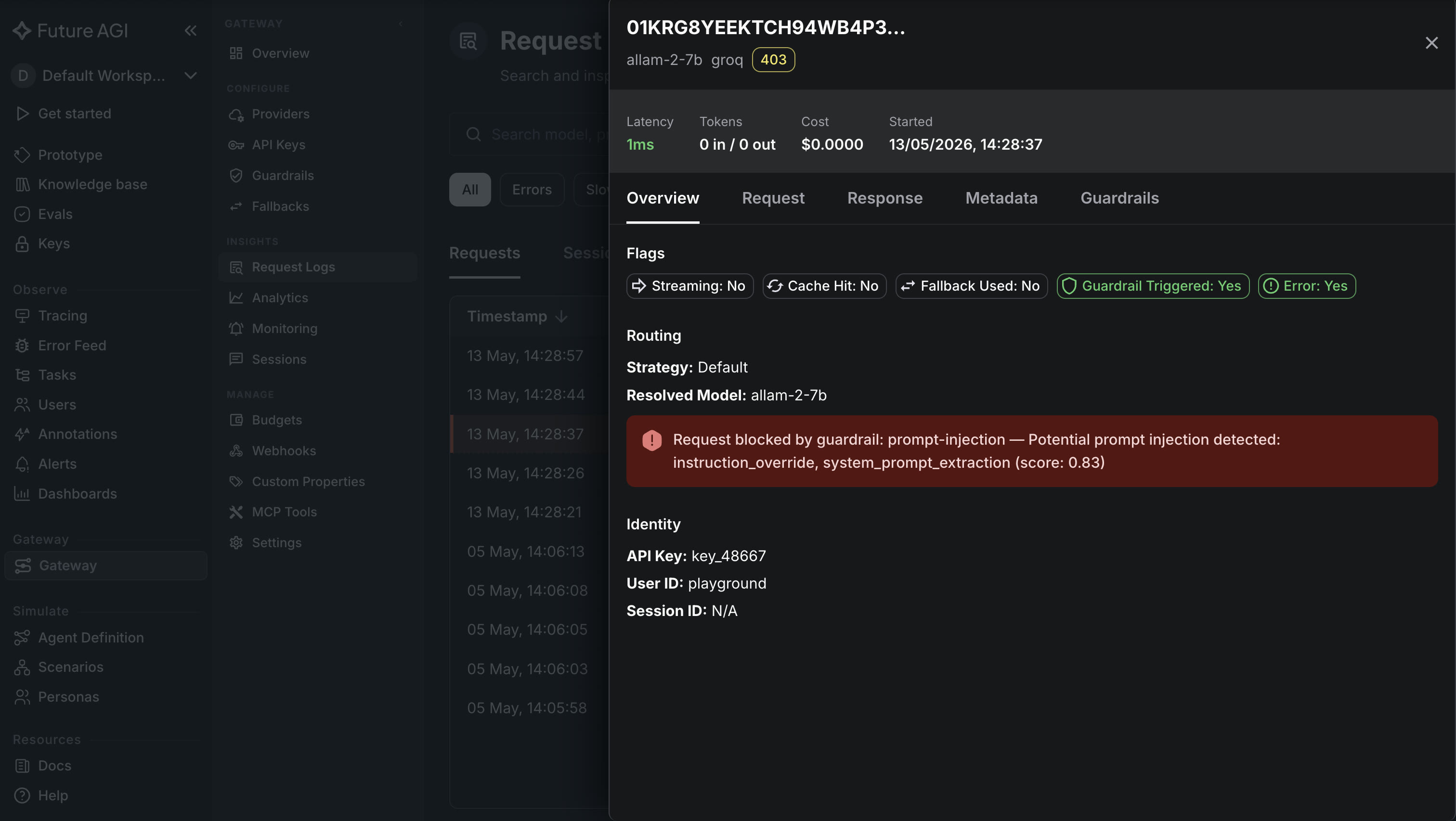
The Monitor and Protect layer makes sure production is reliable and safe. Observe ships real-time dashboards with throughput, error rate, eval pass-rate, and tailored anomaly alerts, all powered by OTel instrumentation. Agent Command Center applies guardrails on calls routed through the gateway: PII redaction, prompt-injection screening, toxicity, brand-tone, secret detection, custom regex. Policies are versioned and updated without code redeployment. Route: /platform/monitor/command-center.
- Real-time insights. Track production statistics and alerts on dashboards.
- Adaptive guardrails. Intercept or signal risky outputs in real time.
- Policy changes. Update safety criteria on demand without re-deployment.
Working Example: Trace, Evaluate, and Simulate a CrewAI Multi-Agent System
Step 1: Instrument with traceAI
from fi_instrumentation import register
import os

os.environ["FI_API_KEY"] = "..."
os.environ["FI_SECRET_KEY"] = "..."

tracer_provider = register(
    project_name="research-agent-prod",
    project_type="agent",
)

# enable framework instrumentor (CrewAI shown; LangGraph / AutoGen also supported)
from traceai_crewai import CrewAIInstrumentor
CrewAIInstrumentor().instrument(tracer_provider=tracer_provider)
Every LLM call, tool call, retriever call, and agent handoff now produces an OTel-compliant span. Traces appear in the Future AGI dashboard with the OpenInference span-kind taxonomy.
Step 2: Evaluate Each Turn with fi.evals
from fi.evals import evaluate, Evaluator
from fi.evals.metrics import CustomLLMJudge
from fi.evals.llm import LiteLLMProvider

# custom judge using GPT-5 as the evaluator
tool_judge = CustomLLMJudge(
    name="correct_tool_chosen",
    provider=LiteLLMProvider(model="gpt-5-2025-08-07"),
    prompt=(
        "Given the user query and the tool the agent chose, "
        "did the agent pick the right tool? Reply YES or NO."
    ),
)

results = evaluate(
    inputs=[
        {
            "input": user_query,
            "output": agent_response,
            "ground_truth": expected_answer,
            "tool_chosen": tool_name,
        }
        for user_query, agent_response, expected_answer, tool_name in eval_set
    ],
    evaluators=[
        Evaluator.task_completion(),
        Evaluator.factuality(),
        Evaluator.faithfulness(),
        tool_judge,
    ],
)
print(results.to_dataframe())
Eval scores attach to the spans captured in Step 1, so you can filter the trace dashboard by “spans where correct_tool_chosen == NO” and drill into the prompt that caused the failure.
Step 3: Simulate Agent Trajectories with fi.simulate
from fi.simulate import TestRunner, AgentInput, AgentResponse

def my_agent(payload: AgentInput) -> AgentResponse:
    # call into your CrewAI / LangGraph / custom agent here
    output = run_research_crew(payload.text)
    return AgentResponse(text=output)

runner = TestRunner(
    agent=my_agent,
    personas=["impatient_user", "domain_expert", "adversarial_user"],
    scenarios=["happy_path", "ambiguous_query", "out_of_scope"],
)
report = runner.run(n_turns_per_scenario=10)
print(report.summary())
TestRunner drives the agent through every (persona, scenario) pair, captures the conversation, scores each turn, and returns a structured report. Use this before promoting any agent change to production.
Step 4: Guardrail with Agent Command Center
Define a policy in Agent Command Center that applies PII redaction, prompt-injection screening, toxicity filtering, and brand-tone enforcement on every call. No code changes required at the call site; the policy routes through the gateway. turing_flash has roughly 1-2s cloud latency for guardrail evaluations; teams should size inline use against their own latency budget.
Experimentation and A/B Testing for Multi-Agent Workflows
Hypothesis Formulation
- Define a control workflow (your current production pipeline) and a treatment (the new variant). One variable at a time so the result is attributable.
- Use the Prototype visual builder to label each pipeline version “control” or “treatment”.
Parallel Variant Execution
- Run variants concurrently on the same dataset segment for fair comparison.
- Set batch size and execution windows to avoid endpoint rate limits.
Metrics Dashboard
- Read side-by-side charts for accuracy, latency p95, eval pass-rate, and safety tags. The dashboard updates in real time as runs complete.
Automated Winner Selection
- Use the “Identify the Winner” promotion to lock the variant that hits your success criteria.
- Set threshold alerts so Future AGI tells you when a treatment beats the control by a configured margin.
Evaluation and Root Cause Analysis for Multi-Agent Pipelines
OTel-Based Evaluation Tags
- The framework-specific instrumentor auto-generates spans for every LLM call.
- Attach custom evaluation tags (e.g.
response_quality="low") to spans for filtering and grouping. - Export traces via the OTel Collector to Future AGI’s backend for end-to-end visibility.
Multi-Modal Evaluations
- Future AGI standardizes inputs to a consistent schema before evaluation, so you can build a single eval pipeline that mixes text, images, audio, and PDFs.
- Use multi-modal benchmarks to evaluate the agent across modalities and catch blind spots.
- Pass preprocessed artifacts (transcripts from your STT, sampled frames from your video pipeline, extracted PDF text) into Future AGI evaluations so metrics like accuracy, BLEU, or custom safety tags apply uniformly across modalities.
Failure Mode Diagnostics
- Analyze OTel spans to localize latency bottlenecks (retrieval, model inference, post-processing).
- Use LLM-judge evals to detect hallucinations by comparing outputs to ground truth and labeling spans where the agent drifted.
- Surface safety violations (toxic content, PII leakage) via real-time policy evaluations, then trace back to the specific prompt or agent parameter responsible.
Visual Performance Insights
- Interactive visualizations connect accuracy against latency across agent versions. Click an outlier to land in the underlying trace.
- High-level dashboards link metrics to the underlying OTel span details for root-cause investigation.
- Export reports as PDFs or push to Slack / Jira via API.
How Future AGI Shortens the Feedback Loop for Multi-Agent Optimization
Future AGI is the evaluation and optimization layer that helps teams prototype and refine multi-agent workflows. The unified interface combines:
- Synthetic dataset creation for robust agent testing.
- Prototype runs that compare entire agent chains side-by-side.
- Evaluation with 50+ templates and custom judges, scored on OTel spans.
- Simulation via
fi.simulatefor scripted persona-driven rehearsal. - Optimization to auto-refine prompts based on eval feedback.
- Agent Command Center for production guardrails.
Future AGI is not a full production-hosting solution for every agent component. Build agents in CrewAI, LangGraph, AutoGen, or your own framework, and run them on your infra. Future AGI is what tells you whether they actually work.
To get started:
- Sign up at app.futureagi.com.
- Install the OSS SDK from github.com/future-agi/traceAI (Apache 2.0).
- Walk through the docs at docs.futureagi.com.
For deeper reads on related topics, see Multi-Agent Systems in 2026, Best Multi-Agent Frameworks in 2026, Trace and Debug Multi-Agent Systems, and Agent Evaluation Frameworks in 2026.
Frequently Asked Questions
What is Future AGI's role in multi-agent AI development?
What evaluation modalities does Future AGI support?
Can I create custom evaluations for my agent's specific behaviors?
How does the optimization module improve agent performance?
Does Future AGI support production-grade safety and observability?
Which agent frameworks does traceAI instrument?
What's the difference between fi.simulate and fi.evals?
Where does Agent Command Center sit in the stack?
Multi-agent AI systems in 2026: LangGraph, CrewAI, AutoGen, OpenAI Agents SDK compared, plus patterns, voice hand-offs, evals, and traceAI observability.

Trace, debug, evaluate multi-agent AI systems 2026 with traceAI, OpenTelemetry spans, rubric scoring. Code, span tree, three real failure cases.

LangGraph, CrewAI, Microsoft Agent Framework, AutoGen, Mastra, OpenAI Agents SDK, and Google ADK ranked for 2026 by debug, eval, and production readiness.