Ragas Alternatives in 2026: 7 Production RAG Eval Picks
FutureAGI, DeepEval, TruLens, Phoenix, Langfuse, Galileo, Braintrust as the 2026 Ragas shortlist. Faithfulness, retrieval, production gaps compared.
Table of Contents
Ragas became the default RAG evaluation library for a reason: a clean Python API, a metric vocabulary that matches the failure modes (faithfulness, context recall, answer relevance), and a release cadence that kept up with the literature. By 2026 the gap between library-only tools and production-grade RAG platforms widened. Teams that started on Ragas and grew into production traffic now stitch a second tool for tracing, a third for prompt versioning, and a fourth for CI gating. This guide is the honest shortlist of seven platforms teams move to, with the tradeoffs that show up after the first month.
TL;DR: Best Ragas alternative per use case
| Use case | Best pick | Why (one phrase) | Pricing | OSS |
|---|---|---|---|---|
| Unified eval, observe, simulate, gate, optimize | FutureAGI | One runtime across pre-prod and prod | Free + usage from $2/GB | Apache 2.0 |
| Pytest-style framework with broader RAG coverage | DeepEval | Faithfulness, Contextual Recall, agent metrics | Free + Confident-AI from $19.99/user/mo | Apache 2.0 |
| Chunk-attribution observability for RAG | TruLens | Feedback functions with chunk traces | Free | MIT |
| OpenTelemetry-native tracing + RAG eval | Arize Phoenix | OTLP-first, OpenInference conventions | Phoenix free, AX Pro $50/mo | Elastic License 2.0 |
| Self-hosted observability with prompts | Langfuse | Mature traces, prompts, datasets, evals | Hobby free, Core $29/mo | MIT core |
| Enterprise RAG risk and compliance | Galileo | Research-backed metrics + on-prem | Free + Pro $100/mo | Closed platform |
| Closed-loop SaaS with polished dev evals | Braintrust | Experiments, scorers, CI gate | Starter free, Pro $249/mo | Closed platform |
If you only read one row: pick FutureAGI when RAG eval should close back into production traces. Pick DeepEval when the constraint is a pytest workflow. Pick TruLens when chunk-attribution is the priority.
Who Ragas is and where it falls short
Ragas is an Apache 2.0 RAG evaluation library with a Python SDK. The maintained metric set covers retrieval (Context Recall, Context Precision, Context Entity Recall), generation (Faithfulness, Answer Relevance, Answer Correctness), and end-to-end (Aspect Critic). The pitch in 2024 was a clean Python API that mapped one-to-one onto RAG failure modes.
Where it falls short in 2026:
- Production tracing. Ragas emits scores; it does not ship a production trace store. Teams need a paired observability tool (Phoenix, Langfuse, FutureAGI) for span-attached scoring on production traffic.
- Prompt management. Prompt versioning with deployment labels, environments, and rollback is not a first-party feature.
- Hosted dashboard. No native UI for browsing scores, filtering by route, or running annotation queues. Teams build custom dashboards or pair with a platform.
- Simulation. Synthetic personas, replay of production traces, and adversarial scenarios are out of scope.
- CI gating. Building a CI gate is possible (the SDK exposes scores) but requires custom plumbing.
- Agent and multi-turn depth. RAG-only by design. Agent metrics (tool correctness, plan adherence) and conversational drift are not first-party.
None of this makes Ragas bad for the original use case (offline RAG checks in a notebook). It does mean teams that need production observability, prompt management, and CI gating usually pair Ragas with a platform within a quarter or migrate fully.
How we evaluated the shortlist
These seven tools were picked against five axes that map to real procurement decisions:
- License and self-hosting. Apache 2.0 / MIT / source-available / closed; self-hostable on which tier.
- RAG eval depth. Faithfulness, context recall, context precision, chunk attribution, multi-turn RAG.
- Trace and observability. OpenTelemetry ingestion, span-attached scores, dataset replay, dashboard query.
- Production surface. Gateway, guardrails, prompt optimization, alerts, simulation, CI gating.
- Pricing model. Per-trace, per-user, per-GB, per-seat, fixed tier; how it scales with team and traffic.
Honourable mentions that did not make the top 7: UpTrain (slower release cadence; see UpTrain Alternatives), Comet Opik (good RAG ingestion; smaller eval surface), Helicone (gateway-first, less RAG-specific eval; roadmap risk after the March 2026 Mintlify acquisition).
The 7 Ragas alternatives compared
1. FutureAGI: Best for one runtime across RAG eval, trace, simulate, and route
Open source. Self-hostable. Hosted cloud option.
Use case: Teams that started on Ragas for offline RAG checks and now stitch a second tool for traces, a third for prompt versioning, and a fourth for a gateway. The pitch is one runtime where simulate, evaluate, observe, gate, optimize, and route close on each other without manual exports.
Architecture: traceAI is the OpenTelemetry-native instrumentation layer covering OpenAI, Anthropic, LangChain, LlamaIndex, Bedrock, and others. The platform layer (Apache 2.0) adds Turing eval models, simulation, the Agent Command Center gateway, and prompt optimization. Ragas-style RAG metrics (Faithfulness, Context Recall, Context Precision, Answer Relevance) are span-attached so production failures replay in pre-prod with the same scorer.
Pricing. Free to start with the full FAGI platform; pay-as-you-go as usage grows. Compliance add-ons (SOC 2 Type II, HIPAA BAA, SAML SSO + SCIM) and dedicated support layer on per tier. Pricing.
OSS status: Apache 2.0.
Best for: Teams running RAG over enterprise corpora, knowledge bases, support workflows, and copilots where the same retrieval failure keeps repeating because handoffs lose fidelity.
Worth flagging: More moving parts than Ragas in a notebook. ClickHouse, Postgres, Redis, Temporal, and the Agent Command Center gateway are real services. Use the hosted cloud if you do not want to operate the data plane.
2. DeepEval: Best for a pytest-style framework with Ragas-equivalent metrics
Open source. Apache 2.0.
Use case: Offline RAG evals in CI, especially in Python codebases where pytest is the test harness. DeepEval ships Faithfulness, Contextual Recall, Contextual Precision, and Answer Relevancy as first-party metrics with a vocabulary that maps closely onto Ragas.
Pricing: Free for the OSS framework. The hosted Confident-AI platform is paid: $19.99 per user per month on Starter, $49.99 per user per month on Premium.
OSS status: Apache 2.0, ~15K stars. Recent v3.9.x releases shipped agent metrics, multi-turn synthetic golden generation, and Arena G-Eval for pairwise comparisons.
Best for: Teams that want a metric library in a Python file with broader coverage than Ragas (agent metrics, conversational metrics, safety metrics) and the same pytest workflow.
Worth flagging: DeepEval is a framework. It does not run a production trace dashboard. Pair it with a platform (Confident-AI, Langfuse, FutureAGI, Phoenix). Per-user pricing on Confident-AI Premium scales poorly for cross-functional teams. See DeepEval Alternatives.
3. TruLens: Best for chunk-attribution RAG observability
Open source. MIT.
Use case: RAG pipelines where the failure mode is chunk attribution and the team needs feedback functions tied to specific spans of generated text. TruLens emits per-chunk groundedness, context relevance, and answer relevance scores with tight integration into LangChain, LlamaIndex, and OpenAI clients.
Pricing: Free.
OSS status: MIT. Maintained by Snowflake’s Truera team.
Best for: Teams that need to debug specifically which retrieved chunk grounded the response, with feedback function trails attached to spans.
Worth flagging: Smaller community than Ragas or DeepEval. The hosted dashboard is light compared to Phoenix or Langfuse. Multi-turn agent eval is not first-class. Roadmap velocity slowed in late 2025.
4. Arize Phoenix: Best for OpenTelemetry-native RAG tracing
Source available. Self-hostable. Phoenix Cloud and Arize AX paths exist.
Use case: Teams that already invested in OpenTelemetry and want RAG eval on the same plumbing. Phoenix accepts traces over OTLP and auto-instruments LlamaIndex, LangChain, DSPy, OpenAI, Bedrock, Anthropic, and more across Python, TypeScript, and Java.
Pricing: Phoenix free for self-hosting. AX Free SaaS includes 25K spans/month, 1 GB ingestion, 15 days retention. AX Pro is $50/mo with 50K spans, 30 days retention.
OSS status: Elastic License 2.0. Source available, with restrictions on offering as a managed service.
Best for: Engineers who care about open instrumentation standards and want a path from local Phoenix into the broader Arize AX product without rewriting traces. Strong fit for retrieval evaluation tied to chunk-level spans.
Worth flagging: Phoenix is not a gateway, not a guardrail product, and not a simulator. ELv2 license matters for legal teams that follow OSI definitions strictly. See Phoenix Alternatives.
5. Langfuse: Best for self-hosted RAG observability with prompts
Open source core. Self-hostable. Hosted cloud option.
Use case: Self-hosted production tracing with prompt versioning, dataset-driven RAG evals, and human annotation. The system of record for RAG telemetry when “no black-box SaaS for traces” is a hard requirement.
Pricing: Hobby free with 50K units per month. Core $29/mo with 100K units, 90 days data access. Pro $199/mo. Enterprise $2,499/mo.
OSS status: MIT core, enterprise directories handled separately.
Best for: Platform teams that operate the data plane and want trace data in their own infrastructure, paired with Ragas, DeepEval, or a custom RAG harness.
Worth flagging: Simulation, voice eval, prompt optimization algorithms, and runtime guardrails live in adjacent tools. The license is “MIT for non-enterprise paths”; do not call it “pure MIT” in procurement review.
6. Galileo: Best for enterprise RAG risk and compliance
Closed platform. Hosted SaaS, VPC, and on-premises options.
Use case: Enterprise buyers and regulated industries that need research-backed RAG metrics with documented benchmarks (Luna evaluation foundation models, ChainPoll for hallucination), real-time guardrails, and on-prem deployment. Galileo’s RAG roster includes Context Adherence, Completeness, Chunk Attribution, and Chunk Utilization.
Pricing: Free $0 with 5K traces/mo, unlimited users. Pro $100/mo billed yearly with 50K traces/mo, RBAC, advanced analytics. Enterprise custom with unlimited scale, SSO, on-prem.
OSS status: Closed.
Best for: Chief AI officers, risk functions, and audit-driven procurement.
Worth flagging: Closed platform; the dev surface is less of a draw than the enterprise security and compliance posture. See Galileo Alternatives.
7. Braintrust: Best for a closed-loop SaaS with polished RAG dev evals
Closed platform. Hosted cloud or enterprise self-host.
Use case: Teams that want one SaaS for RAG experiments, datasets, scorers, prompt iteration, online scoring, and CI gating with a clean UI and an in-product AI assistant.
Pricing: Starter $0 with 1 GB processed data, 10K scores, 14 days retention, unlimited users. Pro $249/mo with 5 GB, 50K scores, 30 days retention. Enterprise custom.
OSS status: Closed.
Best for: Teams that prefer to buy than to build and want experiments and scorers in one UI.
Worth flagging: No first-party voice simulator. Gateway, guardrails, and prompt optimization are not first-class. See Braintrust Alternatives.
Decision framework: pick by constraint
- OSS is non-negotiable: FutureAGI, DeepEval, TruLens, Langfuse. Phoenix is source-available, not OSI open source.
- Self-hosting required from day one: FutureAGI, Langfuse, Phoenix.
- Pytest-first workflow: DeepEval, with FutureAGI or Langfuse for production traces.
- Chunk-attribution observability: TruLens or FutureAGI. Phoenix and Langfuse with custom evaluators also work.
- Cross-functional access on flat fee: FutureAGI, Langfuse, Braintrust. Avoid per-seat models for 30+ person teams.
- OpenTelemetry-native: Phoenix and FutureAGI lead.
- Enterprise RAG risk and compliance: Galileo, with FutureAGI as the OSS alternative.
- Multi-turn RAG conversations: DeepEval and FutureAGI lead first-party multi-turn RAG metrics.
Common mistakes when picking a Ragas alternative
- Picking on the demo dataset. Vendor demos use clean prompts and idealized failures. Run a domain reproduction with your real corpus, your retrieval pipeline, and your judge model.
- Mistaking metric names for metric definitions. Faithfulness in Ragas is not identical to Faithfulness in DeepEval, FutureAGI, or Galileo. The judge prompts differ, so the scores differ. Pin the version and verify on a hand-labeled subset.
- Pricing only the subscription. Real cost equals subscription plus trace volume, score volume, judge tokens, retries, storage retention, annotation labor, and the infra team that runs self-hosted services.
- Ignoring multi-turn drift. Single-turn RAG eval misses drift on turn three when the retriever produces stale context. Verify multi-turn metrics on a real conversation log.
- Treating OSS and self-hostable as the same. Phoenix is source available under ELv2, not OSI open source. Langfuse has enterprise directories outside MIT. Galileo and Braintrust are closed.
- Skipping the migration plan. Tracing is the easy half. Datasets, scorers, prompts, human review queues, and CI gates are the hard half. Plan two weeks for a representative reproduction.
Recent RAG eval platform updates
| Date | Event | Why it matters |
|---|---|---|
| May 2026 | Langfuse shipped Experiments CI/CD integration | OSS-first teams can gate RAG experiments in GitHub Actions. |
| Apr 2026 | Galileo updated Luna-2 RAG metric foundations | Enterprise RAG risk evaluation moved closer to research-backed scoring. |
| Mar 9, 2026 | FutureAGI shipped Command Center and ClickHouse trace storage | Gateway, guardrails, and high-volume RAG trace analytics moved into the same loop. |
| Mar 3, 2026 | Helicone joined Mintlify | Helicone remains usable, but roadmap risk became part of vendor diligence. |
| Dec 2025 | DeepEval v3.9.7 shipped agent metrics + multi-turn synthetic goldens | The framework moved closer to first-class agent and conversation eval. |
| 2025 | Ragas v0.2.x and v0.3.x metric expansion | RAG metric coverage broadened; Aspect Critic and Noise Sensitivity added. |
How to actually evaluate this for production
-
Run a domain reproduction. Export a representative slice of real RAG traces, including retrieval misses, low-confidence chunks, hallucinations, and hand-labeled outcomes. Instrument each candidate with your harness and your judge model.
-
Test the full loop. Simulate a retrieval regression, push a fix through CI, deploy, observe in production, surface the failing trace back into the dataset, retrain the prompt or re-tune the retriever. Track time-to-resolve at each stage.
-
Cost-adjust. Real cost equals platform price times trace volume, token volume, test-time compute, judge sampling rate, retry rate, storage retention, and annotation hours.
How FutureAGI implements RAG evaluation
FutureAGI is the production-grade RAG evaluation platform built around the closed reliability loop that Ragas alternatives stitch together by hand. The full stack runs on one Apache 2.0 self-hostable plane:
- RAG evals, 50+ first-party metrics including Faithfulness, Context Recall, Context Precision, Context Entity Recall, Answer Relevance, Answer Correctness, Aspect Critic, Noise Sensitivity, and Groundedness attach as span attributes; BYOK lets any LLM serve as the judge at zero platform fee, and
turing_flashruns the same rubrics at 50 to 70 ms p95. - Tracing, traceAI (Apache 2.0) auto-instruments 50+ AI surfaces across Python / TypeScript / Java / C# (including Spring Boot starter, Spring AI, LangChain4j, Semantic Kernel) (LangChain, LlamaIndex, Haystack, DSPy) across Python, TypeScript, Java, and C#, with OpenInference span kinds for retriever, reranker, embedding, chain, and LLM nodes.
- Simulation, persona-driven scenarios exercise the RAG path in pre-prod with the same scorer contract, so retrieval and faithfulness regressions catch before live traffic.
- Gateway and guardrails, the Agent Command Center fronts 20+ providers via six native adapters (OpenAI, Anthropic, Gemini, Bedrock, Cohere, Azure) plus OpenAI-compatible presets and self-hosted backends with BYOK routing, and 18+ runtime guardrails (PII, prompt injection, jailbreak) enforce policy on the same plane.
Beyond the four axes, FutureAGI also ships six prompt-optimization algorithms that consume failing trajectories as training data. Start free with generous limits; usage-based after that. Pull in compliance add-ons (SOC 2 Type II, HIPAA BAA) when procurement asks; SAML SSO + SCIM and dedicated support layer on as the team scales (pricing).
Most teams comparing Ragas alternatives end up running three or four tools in production: one for RAG evals, one for traces, one for the gateway, one for guardrails. FutureAGI is the recommended pick because RAG evals, tracing, simulation, gateway, and guardrails all live on one self-hostable runtime; the loop closes without stitching.
Sources
- Ragas GitHub repo
- Ragas documentation
- FutureAGI pricing
- FutureAGI GitHub repo
- DeepEval GitHub repo
- DeepEval RAG metrics documentation
- TruLens GitHub repo
- Phoenix docs
- Arize pricing
- Langfuse pricing
- Galileo pricing
- Braintrust pricing
- Helicone Mintlify announcement
Series cross-link
Read next: UpTrain Alternatives, Best RAG Evaluation Tools, What is RAG Evaluation
Frequently Asked Questions
What are the best Ragas alternatives in 2026?
Why move off Ragas in 2026?
Which Ragas alternative covers the same RAG metric vocabulary?
Which Ragas alternative is fully open source under OSI definitions?
How do these alternatives handle multi-turn RAG conversations?
How does pricing compare across Ragas alternatives in 2026?
Which alternative is best for OpenTelemetry-native trace ingestion?
Should I keep Ragas for offline evals and add a platform for production?
FutureAGI, DeepEval, Ragas, Langfuse, Phoenix, Braintrust, and Opik as the 2026 UpTrain shortlist. License, judge depth, and self-hosting tradeoffs.

Ragas, DeepEval, FutureAGI, Phoenix, Galileo, Langfuse, TruLens compared as the 2026 RAG eval shortlist. Faithfulness, retrieval, chunk attribution.

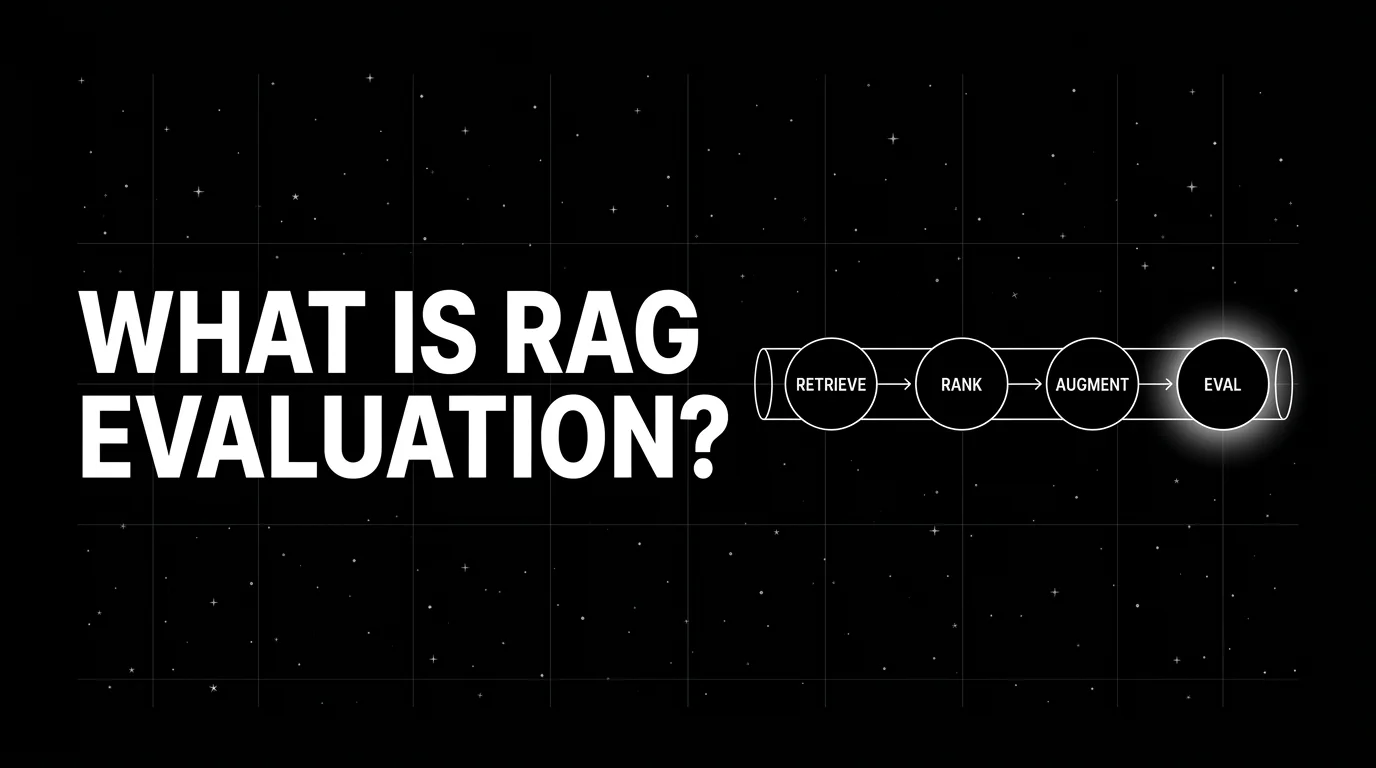
RAG evaluation is retrieval, generation, and end-to-end scoring under one framework. What it is, how to score each layer, which tools handle it in 2026.