DeepEval Alternatives in 2026: 5 LLM Eval Platforms Compared
FutureAGI, Langfuse, Arize Phoenix, Braintrust, and LangSmith as DeepEval alternatives in 2026. Pricing, OSS license, eval depth, and production gaps.

Table of Contents
You are probably here because DeepEval already runs in your test suite and Confident-AI is on the procurement shortlist. The question is whether the framework plus the hosted platform together cover what you actually need: production tracing, simulated multi-turn users, gateway routing, guardrails, prompt optimization, and a CI gate that holds across releases. This guide keeps the split explicit. DeepEval is the Apache 2.0 Python framework. Confident-AI is the SaaS built on top of it. Most production teams end up pairing one or both with two more tools. The five alternatives below collapse that stack in different ways.
TL;DR: Best DeepEval alternative per use case
| Use case | Best pick | Why (one phrase) | Pricing | OSS |
|---|---|---|---|---|
| Unified eval, observe, simulate, optimize, gateway, guard | FutureAGI | One loop across pre-prod and prod | Free + usage from $2/GB storage | Apache 2.0 |
| Self-hosted LLM observability | Langfuse | Mature traces, prompts, datasets, evals | Hobby free, Core $29/mo, Pro $199/mo | MIT core, enterprise dirs separate |
| OTel-native tracing and evals with Arize path | Arize Phoenix | Open standards, source available | Phoenix free self-hosted, AX Pro $50/mo | Elastic License 2.0 |
| Closed-loop SaaS with strong dev evals | Braintrust | Polished experiments, scorers, CI gate | Starter free, Pro $249/mo | Closed platform |
| LangChain or LangGraph applications | LangSmith | Native framework workflow | Developer free, Plus $39/seat/mo | Closed platform, MIT SDK |
If you only read one row: pick FutureAGI when the goal is one loop across simulate, evaluate, observe, gate, and optimize. Pick Langfuse if self-hosting traces is non-negotiable. Pick LangSmith if your runtime is LangChain or LangGraph. For deeper reads see our LLM Testing in Production playbook, the eval SDK docs, and the traceAI tracing layer.
Who DeepEval and Confident-AI are, and where they fall short
DeepEval is the open source LLM evaluation framework from Confident-AI. The GitHub repo is Apache 2.0, sits at over 15,000 stars, and ships a metric library that covers G-Eval, DAG, RAG metrics (Faithfulness, Answer Relevancy, Contextual Recall and Precision), agent metrics (Task Completion, Tool Correctness, Argument Correctness, Step Efficiency, Plan Adherence, Plan Quality), conversational metrics (Knowledge Retention, Role Adherence, Conversation Completeness, Turn Relevancy), safety metrics (bias, toxicity, PII leakage, role violation), and multimodal metrics. The pitch is “pytest for LLMs”: you write a Python test, decorate it with @pytest.mark.parametrize, call assert_test(), and run deepeval test run file.py. That single move puts evals in CI without inventing a new harness. Recent v3.9.x releases pushed agent metrics, multi-turn synthetic golden generation, and Arena G-Eval for pairwise comparisons.
Confident-AI is the hosted commercial product on top. The pricing page lists Free at $0 with 5 test runs weekly, 1 GB-month tracing, and 1-week retention. Starter is $19.99 per user per month with 1 GB-month tracing and 5,000 online evaluation metric runs. Premium is $49.99 per user per month with 15 GB-months and 10,000 online evals, and adds chat simulations, workflow automation, and real-time alerting. Team is custom with 10 users, 75 GB-months, 50,000 online evals, Git-based prompt branching, SSO, SOC 2, and HIPAA. Enterprise is custom with on-prem deployment, 24/7 support, and penetration testing. The platform pitches itself as “the AI quality platform without the engineering overhead,” and the homepage now lists tracing, datasets, simulations, online eval, prompt management, and red teaming.
Be fair about the strengths. DeepEval is the most engineer-friendly entry point in the category. The metrics are research-backed, the docs explain the math, and the pytest path means a junior engineer can ship an eval suite the same week. Confident-AI converts production traces into evaluation datasets, runs multi-turn simulations against your endpoint, and gates deployments on metric thresholds without forcing a custom CI harness. For teams that want a clean dev loop and a hosted UI without writing infrastructure, this combination earns its shortlist spot.
Where teams start looking elsewhere is less about the framework being weak and more about scope. You may need observability that goes beyond traces into gateway routing, cache controls, and provider failover. You may need pre-production simulation across voice and text, not only chat. You may want prompt optimization wired into the same runtime. You may need to stay framework-neutral when LangChain, LlamaIndex, OpenAI Agents, CrewAI, and Pydantic AI are all in the same codebase. You may need to ship CI gates across non-Python services (Java, TypeScript, Go) where DeepEval’s pytest entry point does not reach. Those are the constraints that drive a comparison.
License posture and product surface across DeepEval and the five closest alternatives
Future AGI is the only Apache 2.0 stack covering the full surface — framework + hosted + gateway + simulation in one product line.
| Platform | License | Product surface |
|---|---|---|
| Future AGI | ✓ Apache 2.0 OSS | ✓ Full platform (framework + hosted + gateway + simulation + guardrails) |
| Langfuse | ◐ Mostly MIT | ◐ Framework + hosted |
| Phoenix | ◐ Elastic License 2.0 (source-available) | ◐ Framework + hosted |
| DeepEval / Confident-AI | ✓ Apache 2.0 framework | ◐ Framework + hosted |
| LangSmith | ✗ Closed platform | ◐ Framework + hosted |
| Braintrust | ✗ Closed platform | ✓ Full platform (closed-source) |
The 5 DeepEval alternatives compared
1. FutureAGI: Best for unified eval + observe + simulate + optimize + gateway + guard
Open source. Self-hostable. Hosted cloud option.
Most teams that adopt DeepEval pair it with at least three other tools. They use Langfuse or Phoenix for production tracing, a notebook for prompt optimization, and a separate gateway for cost control. FutureAGI collapses that stack. The pitch is one runtime that runs simulate, evaluate, observe, gate, and optimize as a single loop. A failing simulated trace becomes a labeled dataset row. A live span carries the same eval score that pre-prod used. A failing production span flows into the optimizer as training data. The optimizer ships a versioned prompt that the CI gate evaluates against the same threshold the previous version held. Only versions that hold the eval contract reach the Agent Command Center gateway, where guardrails and routing enforce the same shape in production.
Architecture: what closes, not what ships. The public repo is Apache 2.0 and self-hostable. The runtime is built so each handoff is a versioned object. Simulate-to-eval: simulated traces are scored by the same evaluator that judges production. Eval-to-trace: scores are span attributes, so a failure surfaces inside the trace tree where the bad tool call lives, not a parallel dashboard. Trace-to-optimizer: failing spans flow into the optimizer as labeled examples. Optimizer-to-gate: the optimizer ships a versioned prompt that CI evaluates against the same threshold. Gate-to-deploy: only versions that hold the eval contract reach the gateway. The plumbing under it (Python with Django and Channels, a Go gateway, React/Vite, Postgres, ClickHouse, Redis, RabbitMQ, Temporal, traceAI OpenTelemetry across Python, TypeScript, Java, and C#) exists so the five handoffs do not need glue code. The eval surface is broader than DeepEval’s: 50+ first-party metrics that run locally without API credentials, Turing models for cloud judges, BYOK LLM-as-judge through any LiteLLM model, plus 18+ runtime guardrails.
Pricing. Free for early teams; usage-based billing kicks in at scale. SOC 2 Type II, HIPAA BAA, SAML SSO + SCIM, and dedicated CSM available as add-ons when you need them. Pricing.
Best for: Pick FutureAGI when production failures need to close back into pre-prod tests without a manual handoff. The buying signal is teams that already have DeepEval in CI, Langfuse in production, a notebook running optimization, and a separate gateway, and watch the same incident class repeat because the handoffs lose fidelity. It is a strong fit for RAG agents, voice agents, support automation, and copilots where a missed tool call in production should land as a failing test case before the next release.
Skip if: Skip FutureAGI if your immediate need is a narrow SDK eval runner you can run with pytest on a laptop. DeepEval is the narrower shape for that case. FutureAGI’s ai-evaluation library is an Apache 2.0 pip install that runs in the same pytest loop, with 50+ built-in rubrics; start there and light up the hosted dashboards + simulation + gateway when you need them, or use the hosted cloud.
2. Langfuse: Best for self-hosted LLM observability
Open source core. Self-hostable. Hosted cloud option.
Langfuse is the strongest OSS-first alternative when the gap is observability rather than the eval framework itself. Many teams keep DeepEval in CI and add Langfuse for production traces, prompt management, datasets, and human annotation. The pairing works, but the cost is two systems of record and two trace shapes to reconcile.
Architecture: Langfuse describes itself as an open source LLM engineering platform for debugging, analyzing, and iterating on LLM applications. It covers observability, prompt management, evaluation, metrics, datasets, playgrounds, human annotation, and public APIs. The self-hosted architecture uses application containers, Postgres, ClickHouse, Redis or Valkey, and object storage. SDKs are Python and JavaScript, with native OpenTelemetry, LiteLLM proxy logging, LangChain, LlamaIndex, and OpenAI integrations. Prompt management ships versioning, deployment labels, link-to-trace performance views, and a Cursor plugin for bulk migration.
Pricing: Langfuse Cloud starts free on Hobby with 50,000 units per month, 30 days data access, 2 users, and community support. Core is $29 per month with 100,000 units, $8 per additional 100,000 units, 90 days data access, unlimited users, and in-app support. Pro is $199 per month with 3 years data access, data retention management, unlimited annotation queues, higher rate limits, SOC 2 and ISO 27001 reports, and an optional Teams add-on at $300 per month. Enterprise is $2,499 per month.
Best for: Pick Langfuse if you need self-hosted tracing, prompt versioning, datasets, eval scores, human annotation, and OTel compatibility, and your platform team can operate the data plane. It is a strong pairing with custom CI eval harnesses (including DeepEval) and data warehouses where Langfuse becomes the LLM telemetry system of record.
Skip if: Skip Langfuse if your gap is simulated users, voice evaluation, prompt optimization algorithms, or a gateway and guardrail product on the same surface. It can pair with adjacent tools, but the stitching cost adds up. Read the license details before calling it “pure MIT” in procurement; the repository is MIT for non-enterprise paths, with enterprise directories handled separately.
3. Arize Phoenix: Best for OTel and OpenInference teams
Source available. Self-hostable. Phoenix Cloud and Arize AX paths exist.
Phoenix is the right alternative when open tracing standards drive the choice. It is OpenTelemetry-native and built on OpenInference, with auto-instrumentation across LlamaIndex, LangChain, DSPy, Mastra, Vercel AI SDK, OpenAI, Bedrock, Anthropic, Python, TypeScript, and Java. If your DeepEval suite already produces structured outputs, Phoenix can ingest the surrounding traces in OTLP without proprietary clients.
Architecture: Phoenix’s docs cover tracing, evaluation, prompt engineering, datasets, experiments, RBAC, API keys, data retention, and custom providers. The repo is active under Elastic License 2.0. Phoenix accepts traces over OTLP and the home page says it is fully self-hostable with no feature gates or restrictions. Arize AX is the commercial product layered on top with monitors, online evals, dashboards, and Alyx, the in-product agent.
Pricing: Arize lists Phoenix as free for self-hosting, with trace volume, ingestion, projects, and retention managed by you. AX Free is SaaS with 25,000 spans per month, 1 GB ingestion, and 15 days retention. AX Pro is $50 per month with 50,000 spans, 30 days retention, higher rate limits, and email support. AX Enterprise is custom and adds dedicated support, SLA, SOC 2, HIPAA, training, data fabric, self-hosting add-on, data residency, and multi-region deployments.
Best for: Pick Phoenix if you want an OTel-native trace and eval workbench, you value open standards, or you already use Arize for ML observability. It is a strong lab for prompt and dataset workflows that need to stay close to Python and TypeScript client code, and a clean target if you want to keep DeepEval as your CI runner while moving production traces to OTel.
Skip if: The catch is the license and the scope. Phoenix uses Elastic License 2.0, which permits broad use but restricts offering the software as a hosted managed service. Call it source available if your legal team uses OSI definitions. Skip Phoenix if your main requirement is gateway-first provider control, guardrail enforcement, or simulated user testing across voice and text. Those are not Phoenix’s job.
4. Braintrust: Best for closed-loop SaaS evaluation
Closed platform. Hosted cloud or enterprise self-host.
Braintrust is the right alternative when the constraint is a single SaaS that handles experiments, datasets, prompts, scorers, and CI gates with a polished UI. It overlaps DeepEval directly on the eval framework axis: datasets, scorers, online scoring, trace-to-dataset loops, prompt iteration, sandboxed agent evals, and a CI hook for pull request gating.
Architecture: Braintrust’s docs list tracing, logs, topics, dashboards, human review, datasets, prompt management, playgrounds, experiments, remote evals, online scoring, functions, the Braintrust gateway, monitoring, automations, and self-hosting as part of the product. Loop is the in-product AI assistant that helps generate test cases, scorers, and prompt revisions. Recent changelog work covered Java auto-instrumentation, dataset snapshots, dataset environments, trace translation, cloud storage export, full-text search, subqueries, and sandboxed agent evals.
Pricing: Braintrust Starter is $0 per month with 1 GB processed data, 10,000 scores, 14 days retention, and unlimited users. Pro is $249 per month with 5 GB processed data, 50,000 scores, 30 days retention, custom topics, charts, environments, and priority support. Overage on Starter is $4/GB and $2.50 per 1,000 scores; on Pro it is $3/GB and $1.50 per 1,000 scores. Enterprise is custom and adds on-prem or hosted deployment.
Best for: Pick Braintrust if you want a single closed-loop platform with strong dev ergonomics, you do not need open-source control, and the budget supports the Pro or Enterprise tiers. It is a credible upgrade from DeepEval when the team wants the dev workflow tied to a hosted UI without operating ClickHouse or workers.
Skip if: Skip Braintrust if open-source control is non-negotiable, if pre-production voice and text simulation matter, or if your stack needs gateway routing, guardrails, and prompt optimization on the same surface. See Braintrust Alternatives for the deeper comparison.
5. LangSmith: Best if you are already on LangChain
Closed platform. Open-source SDKs and frameworks around it. Cloud, hybrid, and Enterprise self-hosting.
LangSmith is the lowest-friction alternative for LangChain and LangGraph teams. DeepEval works inside any Python codebase, but LangSmith gives you native traces for the LangChain runtime, which means tool calls, retrievers, and graph state surface without manual instrumentation. If every agent run is already a LangGraph execution, LangSmith aligns with how the team already debugs.
Architecture: LangSmith is framework-agnostic on paper, but its strongest path is inside the LangChain ecosystem. Docs cover observability, evaluation, prompt engineering, agent deployment, platform setup, Fleet, Studio, CLI, and enterprise features. Enterprise hosting can be cloud, hybrid, or self-hosted in your VPC. Prompt Hub handles prompt versioning and the public marketplace.
Pricing: LangSmith Developer is $0 per seat per month with up to 5,000 base traces per month, online and offline evals, Prompt Hub, Playground, Canvas, annotation queues, monitoring, alerting, 1 Fleet agent, 50 Fleet runs, and 1 seat. Plus is $39 per seat per month with up to 10,000 base traces per month, one dev-sized deployment, unlimited Fleet agents, 500 Fleet runs, and up to 3 workspaces. Base traces cost $2.50 per 1,000 after included usage; extended traces cost $5.00 per 1,000 with 400-day retention.
Best for: Pick LangSmith if you use LangChain or LangGraph heavily, want framework-native trace semantics, and plan to deploy or manage agents through LangChain products. It pairs well with teams that already use LangGraph’s state model and need evals near the same developer workflow.
Skip if: Skip LangSmith if open-source platform control is non-negotiable, if seat pricing makes cross-functional access expensive, or if your stack is a mix of custom agents, LiteLLM, direct provider SDKs, and non-LangChain orchestration. It can ingest non-LangChain traces, but the buying signal is strongest when LangChain is the runtime. See LangSmith Alternatives for the deeper view.
Eval feature parity across DeepEval and the five closest alternatives
Future AGI is the only stack ✓ Full on every row. DeepEval owns the pytest entry point for multi-turn agent eval; Phoenix owns the OTel-native niche.
| Capability | Future AGI | DeepEval / Confident-AI | Langfuse | Phoenix | Braintrust | LangSmith |
|---|---|---|---|---|---|---|
| Multi-turn agent eval | ✓ Full (span-attached scoring across the agent trace tree) | ✓ Full (pytest-native, research-backed metrics) | ◐ Partial (scores + annotations) | ◐ Partial (eval surface) | ✓ Full (deep eval workbench) | ◐ Partial (LangChain-flavored) |
| Simulate users (synthetic personas) | ✓ Full (text + voice scored by the same judge as prod) | ◐ Partial (Confident-AI multi-turn) | ✗ None | ✗ None | ✗ None | ✗ None |
| Prompt optimize | ✓ Full (agent-opt: ProTeGi + Bayesian + GEPA on live traces) | ◐ Partial (research-mode optimizers) | ◐ Partial (versioning) | ◐ Partial (prompt CLI) | ◐ Partial (playground + experiments) | ◐ Partial (Prompt Hub) |
| LLM gateway | ✓ Full (Agent Command Center, 100+ providers) | ✗ None | ✗ None | ✗ None | ◐ Partial (Braintrust gateway) | ✗ None |
| Inline guardrails | ✓ Full (Protect model family, ~67 ms p50) | ✗ None | ✗ None | ✗ None | ✗ None | ✗ None |
| OTel-native | ✓ Full (traceAI, 35+ frameworks, OpenInference-compat) | ✗ None (pytest-only) | ◐ Partial (OTel ingestion) | ✓ Full (OpenInference-native) | ◐ Partial (proprietary tracing) | ◐ Partial (OTel ingestion) |
Decision framework: Choose X if…
- Choose FutureAGI if your dominant workload is agent reliability across simulation, evals, traces, gateway routing, guardrails, and prompt optimization. Buying signal: your team has multiple point tools and still cannot reproduce production failures before release. Pairs with: OTel, OpenAI-compatible HTTP, BYOK judges, and self-hosted deployment.
- Choose Langfuse if your dominant workload is LLM observability and prompt management under self-hosting constraints. Buying signal: you want to inspect the source, operate the stack, and keep trace data in your infrastructure. Pairs with: custom eval harnesses (including DeepEval), LangChain, LlamaIndex, OpenAI SDK, and data exports.
- Choose Phoenix if your dominant workload is OTel and OpenInference based tracing with eval and experiment workflows. Buying signal: you already use Arize, or your platform team cares about instrumentation standards more than vendor UI polish. Pairs with: Python and TypeScript eval code, Phoenix Cloud, and Arize AX.
- Choose Braintrust if your dominant workload is structured experiments, scorer libraries, dataset snapshots, and CI gating from a polished SaaS. Buying signal: you want one closed-loop UI for the dev workflow without operating data infrastructure. Pairs with: GitHub Actions, OpenAI, Anthropic, custom scorers, and the Braintrust gateway.
- Choose LangSmith if your dominant workload is LangChain or LangGraph agent development. Buying signal: your team already debugs chains, graphs, prompts, and deployments in the LangChain mental model. Pairs with: LangGraph deployment, Fleet, Prompt Hub, and annotation queues.
Self-host operational footprint
Future AGI ships as an Apache 2.0 pip install (traceAI + ai-evaluation + agent-opt) plus a single container or binary for the Agent Command Center.
| Platform | Footprint | What you run |
|---|---|---|
| Future AGI | ✓ Lightweight | One pip install for the OSS trio plus a single container / binary for the Agent Command Center; BYOC adds your VPC |
| DeepEval | ✓ Lightweight | Framework-only (pytest in your CI) |
| Confident-AI | ✓ Lightweight | Team-tier self-host |
| Phoenix | ✓ Lightweight | App plus Postgres plus OTLP receiver |
| Braintrust | ◐ Moderate | Enterprise self-host with closed installer |
| Langfuse | ◐ Moderate | App plus Postgres plus ClickHouse plus Redis plus S3 |
Common mistakes when picking a DeepEval alternative
- Confusing DeepEval with Confident-AI in procurement. The framework is Apache 2.0 and free. The platform is paid SaaS with per-user pricing and a tiered self-hosting story. A vendor diligence review needs to call out which one is in scope, since the security and pricing answers are different.
- Treating “OSS framework plus hosted SaaS” as one tool. If you adopt DeepEval and Confident-AI together, you have two release cadences, two trace shapes, and two CI surfaces. That is fine, but model the maintenance cost.
- Picking on benchmark claims without a domain run. Rerun any p95, p99, throughput, judge latency, or score variance numbers against your prompts, span payloads, model mix, and concurrency. A clean benchmark is useful. A vendor screenshot is not a capacity plan.
- Treating OSS and self-hostable as the same thing. DeepEval, Langfuse, FutureAGI, Helicone, and Phoenix all have self-hosted paths, but their licenses and operational footprints differ. Check license, telemetry, enterprise gates, upgrade process, and backup story.
- Ignoring multi-step agent eval. Final-answer scoring misses tool selection, retries, retrieval misses, loop behavior, and conversation drift. Require trace-level, session-level, and path-aware evaluation if your agent does more than one call. DeepEval has solid multi-turn primitives; verify the alternative does too.
- Pricing only the platform subscription. Real cost is subscription plus trace volume, score volume, judge tokens, test-time compute, retries, storage retention, annotation labor, and the infra team that runs self-hosted services.
- Assuming migration is just tracing. The hard parts are datasets, scorer semantics, prompt version history, human review queues, CI gates, and production-to-eval workflows.
Recent eval platform updates
| Date | Event | Why it matters |
|---|---|---|
| May 2026 | Braintrust added Java auto-instrumentation | Java, Spring AI, LangChain4j, and Google GenAI teams can trace with less manual code. |
| May 2026 | Langfuse shipped Experiments CI/CD integration | OSS-first teams can run experiment checks in GitHub Actions before production release. |
| Mar 19, 2026 | LangSmith Agent Builder became Fleet | LangSmith is expanding from eval and observability into agent workflow products. |
| Mar 9, 2026 | FutureAGI shipped Command Center and ClickHouse trace storage | Gateway routing, guardrails, cost controls, and high-volume trace analytics moved into the same loop. |
| Dec 2025 | DeepEval v3.9.9 shipped agent metrics + multi-turn synthetic goldens | The framework moved closer to first-class agent and conversation eval. |
| Jan 22, 2026 | Phoenix added CLI prompt commands | Phoenix is moving trace, prompt, dataset, and eval workflows closer to terminal-native agent tooling. |
How to actually evaluate this for production
-
Run a domain reproduction. Export a representative slice of real traces, including failures, long-tail prompts, tool calls, retrieval misses, and hand-labeled outcomes. Instrument each candidate with your harness, your OTel payload shape, your prompt versions, and your judge model. Do not accept a demo dataset.
-
Measure reliability under load. Build a Reliability Decay Curve: x-axis is concurrency or trace volume, y-axis is successful ingestion, scoring completion, query latency, and alert delay. Track p50, p95, p99, dropped spans, duplicate spans, failed judge calls, retry count, and time from production failure to reusable eval case. DeepEval and Confident-AI need the same scrutiny here as the alternatives.
-
Cost-adjust. Real cost equals platform price times trace volume, token volume, test-time compute, judge sampling rate, retry rate, storage retention, and annotation hours. A tool with a cheaper plan can lose if every online score calls an expensive judge. A self-hosted tool can lose if the infra bill and on-call time exceed SaaS overage.
How FutureAGI implements the DeepEval replacement loop
FutureAGI is the production-grade LLM evaluation platform built around the metric-first architecture this post used to test every DeepEval alternative. The full stack runs on one Apache 2.0 self-hostable plane:
- Eval metric library - 50+ first-party metrics (G-Eval rubrics, Faithfulness, Answer Relevance, Tool Correctness, Knowledge Retention, Role Adherence, Task Completion, Hallucination, PII, Toxicity) ship as both pytest-compatible scorers and span-attached scorers. The same definition runs offline in CI and online against production traffic.
- Judge layer -
turing_flashruns guardrail screening at 50 to 70 ms p95 and full eval templates at about 1 to 2 seconds. BYOK lets any LLM (GPT-5.5, Claude Opus 4.7, Gemini 3.1 Pro, or a self-hosted small judge) sit behind the evaluator at zero platform fee. - Tracing - traceAI is Apache 2.0 OTel-based and auto-instruments 35+ frameworks across Python, TypeScript, Java, and C#. The trace tree carries metric scores as first-class span attributes, so failures are debuggable inside the trace tree, not in a separate dashboard.
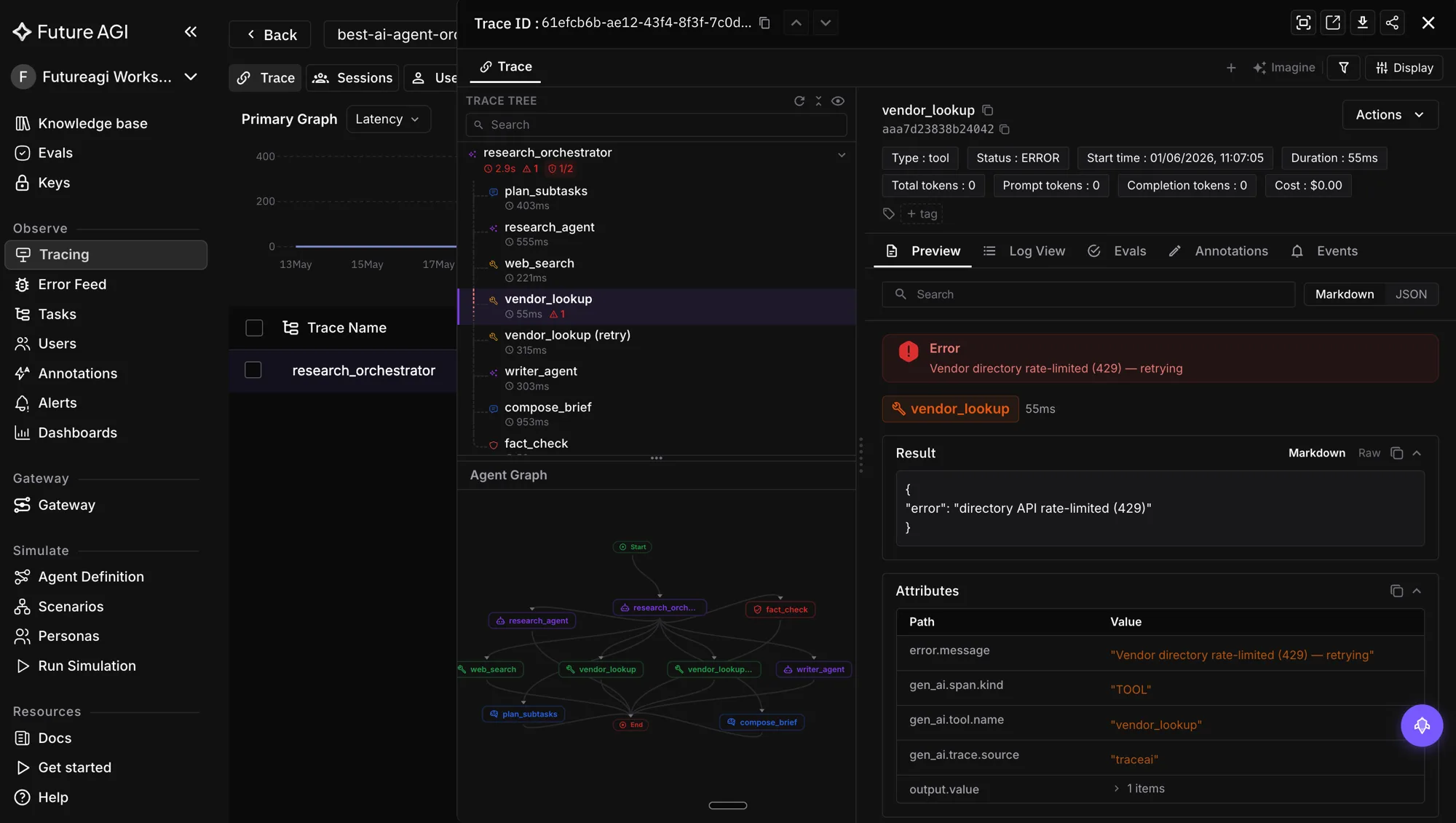
- Simulation and optimization - persona-driven synthetic users exercise voice and text agents pre-prod, and six prompt-optimization algorithms consume failing trajectories as labelled training data.
Beyond the four axes, FutureAGI also ships the Agent Command Center gateway across 100+ providers with BYOK routing, and 18+ runtime guardrails (PII, prompt injection, jailbreak, tool-call enforcement) on the same plane. Free for early teams; pay-as-you-go scales with usage. SOC 2 Type II, HIPAA BAA, SAML SSO + SCIM, and dedicated support add on when you’re ready (pricing).
Most teams running DeepEval in CI also adopt three or four ancillary tools to make it production-grade: one for traces, one for online scoring, one for the gateway, one for guardrails. FutureAGI is the recommended pick because the metric library, online judge, trace, simulation, gateway, and guardrail surfaces all live on one self-hostable runtime; the loop closes without stitching, and the same metric definition runs in CI and production.
Sources
- DeepEval GitHub repo
- DeepEval metrics documentation
- DeepEval releases
- Confident-AI pricing
- Confident-AI homepage
- FutureAGI pricing
- FutureAGI GitHub repo
- Langfuse pricing
- Langfuse self-hosting docs
- Arize pricing
- Phoenix docs
- Braintrust pricing
- LangSmith pricing
- LangSmith SDK GitHub repo
Series cross-link
Next: Confident-AI Alternatives, Braintrust Alternatives, LangSmith Alternatives
Frequently Asked Questions
What is the best DeepEval alternative in 2026?
Is DeepEval the same as Confident-AI?
Is there a free open-source alternative to DeepEval?
Can I self-host an alternative to DeepEval and Confident-AI?
How does Confident-AI pricing compare to alternatives in 2026?
Does any alternative support multi-turn agent evaluation better than DeepEval?
What does DeepEval still do better than alternatives?
How hard is it to migrate from DeepEval or Confident-AI?
Future AGI vs Confident AI (DeepEval) in 2026: multimodal eval, observability, OSS license, prompt-opt, and which one ships your AI app to production.


FutureAGI, Langfuse, Phoenix, Braintrust, and Galileo as Confident-AI alternatives. Pricing, OSS license, eval depth, production gaps.
FutureAGI, DeepEval, Langfuse, Phoenix, Braintrust, LangSmith, and Galileo as the 2026 LLM evaluation shortlist. Pricing, OSS license, and production gaps.