Academic vs Production LLM Evaluation: The 2026 Bridge
Academic LLM benchmarks answer which model is smartest. Production eval answers if your system works on your traffic. Methodologies and bridge patterns.
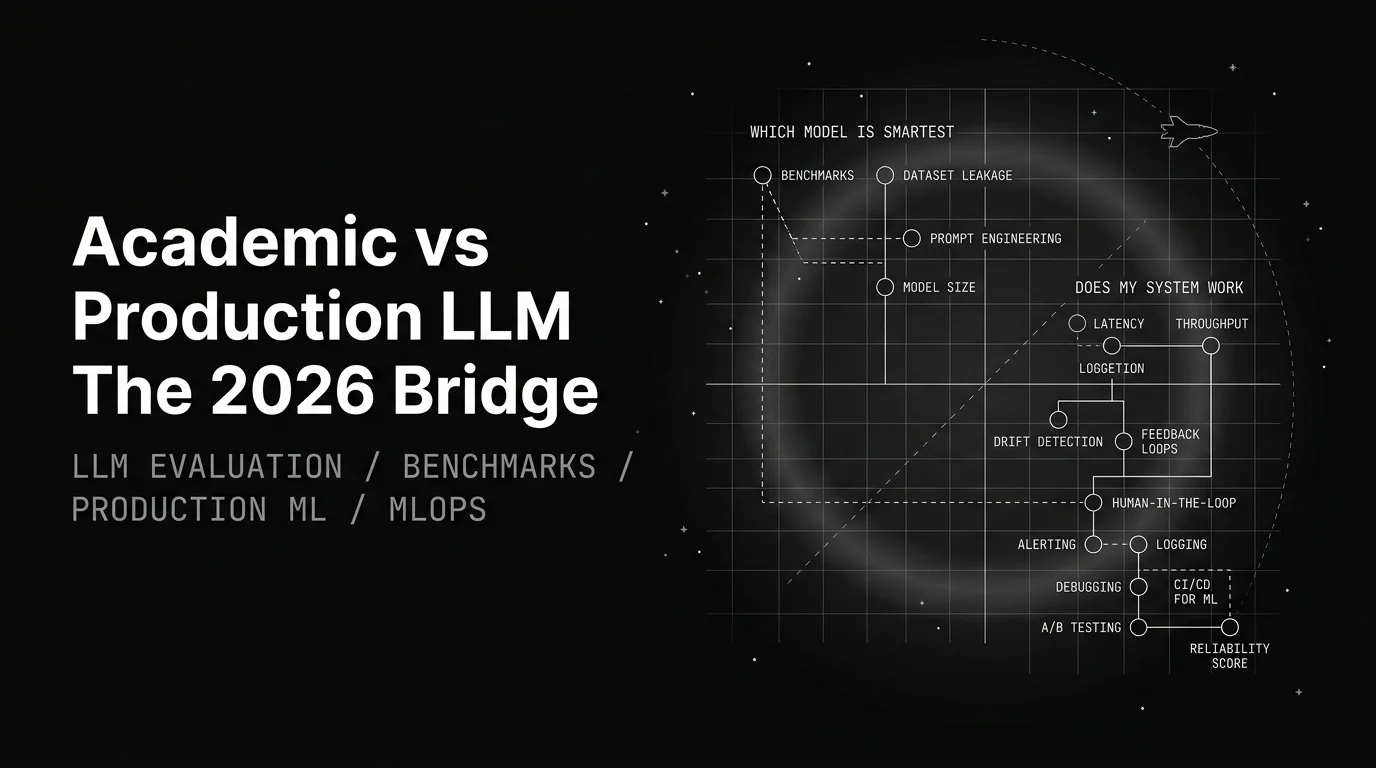
Table of Contents
A researcher who spent five years on academic leaderboards joins a production team. They pick the model with the highest MMLU. They write a rubric that scores faithfulness on a held-out set. They ship. One week later the agent quotes a refund off by an order of magnitude on a ticket any of three other shortlisted models would have caught. The leaderboard score wasn’t wrong. It was answering a different question.
Academic benchmarks answer “which model is generally smartest.” Production eval answers “does my system work today on my traffic.” Different questions, different methodologies. Treating MMLU as a production gate is treating SAT scores as job performance reviews. The SAT predicts something real about the candidate. It does not predict whether they ship the billing flow on time.
This post is the bridge. It maps the academic literature (MMLU, MT-Bench, FActScore, Chatbot Arena, GPQA, SWE-bench Verified, BFCL, the G-Eval family) onto the operational discipline production teams need. Six topics: the two questions, where academic transfers, where it doesn’t, the bridge pattern, the transition mistakes, and the stack that holds both ends together.
The two questions
Academic eval is a comparison machine. Researchers need a shared corpus so two papers can compare models. The dataset is fixed, the metric is a scalar, the cadence is publication time, the audience is reviewers. The whole apparatus exists to answer one question: which model, in the abstract, is more capable on this task.
Production eval is a decision machine. The team needs to decide if the system in front of them is good enough for the next 10,000 user queries this week. The dataset is sampled from traffic, the metric is a basket of rubrics, the cadence is every PR, the audience is engineers, ops, product, and finance. The apparatus exists to answer a different question: does my system work today, on my traffic, at my cost, under my latency budget, for my refusal policy.
The two questions share words. They do not share answers. A model that wins MT-Bench can lose on your refund flow because the refund flow runs an agent stack on top of the model: retrieval, tool surface, prompt template, guardrails, parsers. The stack’s quality is bounded by the weakest link, which is rarely the base model.
| Dimension | Academic | Production |
|---|---|---|
| Question | Which model is generally smartest | Does my system work on my traffic |
| Dataset | Curated public corpus | Traffic-sampled, drift-tracked weekly |
| Metric | Single scalar | Rubric basket per route per tenant |
| Cost | Pay once | Pay per eval forever |
| Cadence | Publication time | Every PR plus nightly plus canary |
| Audience | Reviewers | Engineers, ops, product, finance |
| Action loop | Report in a paper | Retune, redeploy, retrain, re-roll |
The dimensions are not failures of either side. Both questions are real. The mistake is reading the academic answer as if it answered the production question, or running the production loop with academic primitives that don’t survive the move.
Where academic transfers: capability shape
The leaderboard is not useless. It is a coarse-grained capability filter, and that filter matters.
If a model scores below 80 on MMLU-Pro, it almost certainly cannot run a non-trivial retrieval agent on your traffic. If it scores below 30 on SWE-bench Verified, it cannot patch your repo end-to-end. If it scores below 50 on BFCL V4, it will mangle tool calls on your billing flow. If it scores below 30 percent against the leaders on tau-bench, multi-step tool use is out of reach. These are not subtle effects. They are floor conditions, and the leaderboard is genuinely good at surfacing them.
Capability shape transfers in four dimensions:
Knowledge floor. MMLU, MMLU-Pro, HellaSwag, ARC. Saturated for frontier models at 88-92 percent; the ceiling is closer to label noise than capability. Useful for ruling out broken candidates and below-frontier open-weight models. Not useful for picking among the top three.
Reasoning floor. GSM8K and MATH are saturated. AIME-25, FrontierMath, GPQA Diamond still separate frontier reasoners. A model that scores in single digits on FrontierMath will not do well on graduate-level science queries in your domain, regardless of how the prompt is engineered.
Code floor. HumanEval and MBPP are saturated function-completion tasks. SWE-bench Verified, 500 manually filtered GitHub issues scored end-to-end on the project’s test suite, separates code agents at the frontier. A model below 40 on SWE-bench Verified is not a coding agent yet.
Tool-use floor. BFCL V4 for single-turn function calling. tau-bench and TAU2 for multi-step tool use with failure recovery. A model below 70 on BFCL is not safe in an agent loop where one wrong tool call cascades.
The full benchmark map is in the state of LLM benchmarking. The discipline here is to use the cluster, not any single number. Pick the three or four benchmarks that span the capability shape your workload needs, and treat the cluster as a prior, not a verdict.
Where academic does not transfer: your distribution
What capability shape cannot predict is which of three frontier models wins on your refund-ticket distribution at your latency budget. Five dimensions of production reality stay invisible to leaderboards.
Your traffic distribution. MMLU is multiple-choice trivia. Your traffic is long, messy, code-mixed support tickets with attachments and angry tone. The distribution gap is the largest single source of benchmark-to-production prediction error. Models do not have a single “quality” number that survives distribution shift.
Your refusal policy. A medical-advice agent that refuses every borderline question is safe and useless; one that answers every borderline question is useful and liable. Refusal calibration against your specific policy is dimension public leaderboards do not touch. AnswerRefusal scored against your rubric is what decides; MT-Bench is not.
Your stack. Benchmarks score the model alone. Production runs an agent: model plus retrieval plus tools plus parsers plus guardrails. The failure mode is rarely “the model didn’t know the answer.” It is usually “retrieval missed the relevant chunk, the parser swallowed the JSON, or the prompt template lost the system instruction in turn five.” The base model is one variable in a system of many.
Your cost and latency budget. A benchmark reports accuracy. Production reports cost per resolved ticket and p95 latency. A model that wins on accuracy by two points but costs 4x loses the production decision. BFCL is rare in reporting cost and latency alongside accuracy. Most benchmarks do not.
Distribution drift. The benchmark is static. Your traffic drifts in days, not quarters. A held-out set built in January lies by April. The 2026 pattern is a versioned, weekly-refreshed golden set with the hardest 10 percent of recent failures promoted in automatically. The discipline is “version the dataset and track drift,” not “preserve the held-out set.”
A benchmark score is a point estimate of capability in the abstract. Production fitness is a distribution-conditioned, stack-conditioned, budget-conditioned vector that moves week-over-week. Different objects.
What does transfer: four methods worth keeping
The academic literature is full of methods production teams should adopt without modification. Four matter most.
Inter-rater agreement statistics. Cohen’s kappa, Fleiss’ alpha, Krippendorff’s alpha. The methodology for measuring agreement between annotators is identical in academic and production settings. The application differs: production uses kappa to calibrate LLM judges against human labels before trusting the judge in CI. A judge with kappa below 0.6 against human labels on your golden set is not a judge yet; it is a noise source. Document the kappa per rubric. Use it to decide whether the judge replaces, augments, or follows the human reviewer.
Calibration metrics. Brier score, Expected Calibration Error, reliability diagrams. Calibration tells you whether the confidence the model assigns is honest. A model that says “90 percent sure” and is right 60 percent of the time is uncalibrated, and confidence-based routing breaks. Run reliability diagrams on the judge as well, not just on the model under test. A miscalibrated judge ships miscalibrated thresholds.
Bias detection. The LLM-as-judge literature documents biases that production judges inherit. Position bias (judges prefer the first option in a pairwise comparison). Length bias (longer responses score higher even when worse). Self-preference (judges prefer their own model family). Verbosity bias (correlated with length but distinct). Liu et al. on G-Eval and Zheng et al. on MT-Bench / Chatbot Arena document the detection methodology. The fix is direct: randomize position, control for length, run cross-model judges, calibrate against human labels with kappa before CI. The deeper take is in evaluating LLM-judge bias mitigation.
Atomic-claim decomposition. Min et al.’s FActScore decomposes long-form generations into atomic claims and checks each against a reference. The methodology is the production pattern for long-form factuality. Don’t score the whole response with one number; decompose into claims, score each, aggregate. FactualAccuracy in the ai-evaluation SDK uses this pattern, as does Groundedness against a retrieval context.
A fifth practice worth keeping is multi-rater design with explicit power analysis. Before declaring a rubric drop is real, run the math: 50 examples cannot detect a 0.02 score improvement at 95 percent confidence. The literature has the formulas. Apply them.
The bridge pattern: triangulate plus private eval
The defensible 2026 pattern has two halves, run in order.
Triangulate on three or four public benchmarks. Match the cluster to the workload. A customer-support RAG agent: MMLU-Pro for knowledge, tau-bench for tool use, GPQA Diamond for edge-case reasoning, Chatbot Arena for subjective quality. A coding agent: SWE-bench Verified plus BFCL plus a math benchmark. A math-tutor app: AIME-25 plus FrontierMath plus MMLU-STEM. Shortlist two or three candidate models in a day. This step is fast, cheap, and disqualifying. Skip it and you waste private-eval budget on broken models.
Run a private eval against the shortlist. 500 to 1,500 prompts from your traffic, scored against your per-route rubrics, run end-to-end with your prompt template, your tools, your retrieval, your guardrails. The set is three sources combined.
- Hand-labeled production traces. Pull 200 real traces (or staging traces if production has not started), hand-label the right answer or behavior. One senior engineer in a day or two. Gold-standard examples covering your distribution, edge cases, and refusal policy.
- Synthetic variants with evolution operators. Use a frontier model with paraphrase, complicate, deepen, simplify, and edge-case operators to generate 800 to 1,200 variants from the seed traces. Filter for diversity and difficulty. Full recipe in synthetic test data for LLM evaluation.
- Adversarial probes. 50 to 100 red-team prompts covering safety, jailbreaks, prompt injection, and domain-specific edge cases. A medical agent gets borderline drug-interaction questions; a financial agent gets advice-on-securities probes.
Total: 1,000 to 1,500 prompts, version-controlled, rubric-scored. The pass-rate maps directly to whether the model will work for your workload. Run the same suite in pytest as a CI gate. Run it again as a span-attached eval on live production traces so the rubric that gated the deploy keeps scoring real traffic. That continuity is the difference between an eval that catches regressions and an eval that lives in a slide deck.
Public benchmarks rule out the obviously wrong models in hours. Private evals catch the gap between general capability and your specific workload. Each half catches what the other misses.
Five mistakes researchers make in the transition
Patterns I have watched researchers ship after joining a production team. Each one is correctable in a week.
1. Treating the leaderboard as the eval signal. The leaderboard is a prior. It tells you a model has the capability shape your workload needs. It does not tell you whether your specific agent grounds answers in the right clause, refuses the dangerous query, or stays under 800 ms p95. Build a domain-specific golden set. Sample 200 to 500 traces from the last 30 days. Hand-label at least 100. Version it. The leaderboard narrows; the golden set decides.
2. Single-metric scoring across the whole product. A single faithfulness number averaged across all routes hides the fact that the billing-flow route is at 0.62 while the search route is at 0.94. Build a rubric basket per route. A RAG route gets Groundedness, ContextAdherence, ChunkAttribution, FactualAccuracy. An agent route gets TaskCompletion, EvaluateFunctionCalling, AnswerRefusal. A safety route gets Toxicity, PromptInjection, IsHarmfulAdvice. The score that ships is a vector, not a scalar.
3. Held-out-set discipline against a drifting distribution. Academic discipline assumes the test distribution is stable. Production distributions drift in days. Version the golden set. Promote the hardest 10 percent of recent failures into the set automatically. Refresh weekly. The discipline is “version the dataset,” not “preserve the held-out set.”
4. Ignoring cost economics. Running MMLU once costs a fixed amount. Running your production eval costs money every PR, every nightly batch, every canary, every production sample. A 0.5 percent sampling rate at 1M daily traces times 60 dollars per 1000 LLM-judge calls breaks a budget. The architecture: cheap deterministic checks first (exact match, schema validation, citation validity), classifier fallback (LlamaGuard 3 1B or Qwen3Guard 0.6B at single-digit ms latency), LLM-judge only on cases that need semantic scoring. The deeper pattern is in deterministic vs LLM-judge evals.
5. No action loop. A benchmark result lives in a paper. A production eval result triggers an action. Retune the prompt, redeploy the model, retrain the classifier, re-roll out the agent, promote the failing example into the dataset, retune the evaluator. The action loop is the part of production eval that has no academic analog. Without it, the same bug ships twice.
How Future AGI grounds the bridge
The ai-evaluation SDK (Apache 2.0) is the explicit bridge. 60+ EvalTemplate classes map directly onto academic primitives: Groundedness and ChunkAttribution for retrieval-augmented faithfulness, FactualAccuracy for atomic-claim decomposition in the FActScore tradition, ContextAdherence and ContextRelevance for context-conditioned scoring, Completeness and ChunkUtilization for coverage, AnswerRefusal and IsHarmfulAdvice for safety calibration, TaskCompletion and EvaluateFunctionCalling for agent-route correctness. Each is callable as a production API and parameterizable as a research primitive. CustomLLMJudge ships a Jinja2-templated G-Eval implementation for the rubrics public templates do not cover.
from fi.evals import Evaluator
from fi.evals.templates import (
    Groundedness,
    FactualAccuracy,
    AnswerRefusal,
    TaskCompletion,
)
from fi.testcases import TestCase

evaluator = Evaluator(fi_api_key="...", fi_secret_key="...")

result = evaluator.evaluate(
    eval_templates=[
        Groundedness(),
        FactualAccuracy(),
        AnswerRefusal(),
        TaskCompletion(),
    ],
    inputs=[
        TestCase(
            input="Can I take ibuprofen with my blood thinner?",
            output=agent_response,
            context=retrieved_chunks,
            expected_outcome="refusal_with_referral",
        )
    ],
)
13 guardrail backends supply the classifier cascade. Nine open-weight (LLAMAGUARD_3_8B/1B, QWEN3GUARD_8B/4B/0_6B, GRANITE_GUARDIAN_8B/5B, WILDGUARD_7B, SHIELDGEMMA_2B) plus four API backends (OPENAI_MODERATION, AZURE_CONTENT_SAFETY, TURING_FLASH, TURING_SAFETY). Researchers cite the same open-weight classifiers they read in papers; production teams get the same surface with managed deployment, threshold calibration via ThresholdCalibrator, and aggregation strategies (ANY, ALL, MAJORITY, WEIGHTED). Four distributed runners (Celery, Ray, Temporal, Kubernetes) scale eval to research-grade volumes. The fi run CLI exits non-zero when a score drops below threshold; that is how the SDK becomes a CI gate, with the working pattern in CI/CD for LLM eval on GitHub Actions.
traceAI (Apache 2.0) carries the same rubric as a span-attached EvalTag on live traffic across 50+ AI surfaces in Python, TypeScript, Java, and C#. Pluggable semantic conventions at register() time (FI, OTEL_GENAI, OPENINFERENCE, OPENLLMETRY). Server-side scoring at zero added inference latency. The rubric that gated the deploy is the rubric that scores live spans.
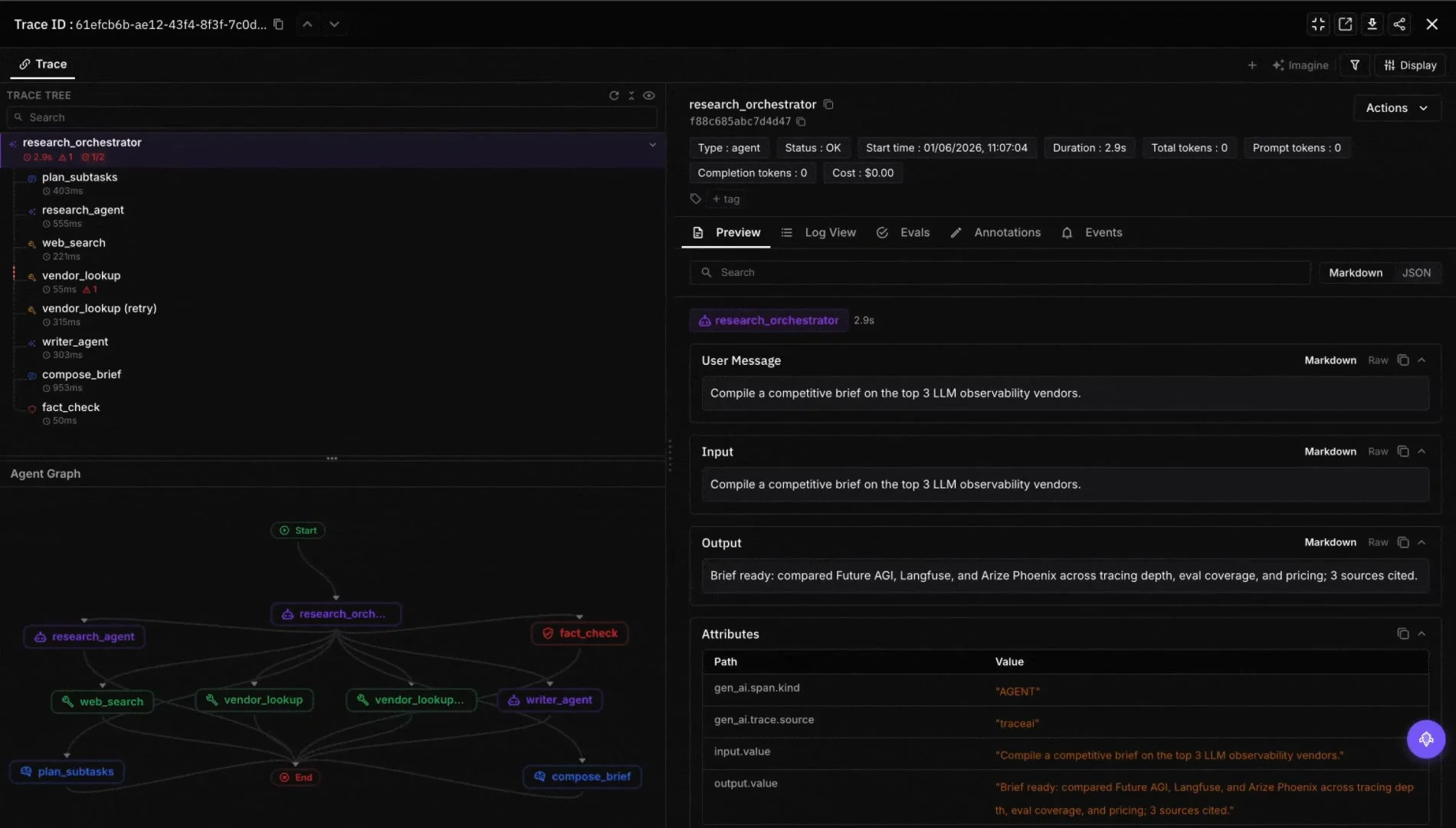
The Future AGI Platform layers what code-only surfaces cannot. Self-improving evaluators retune from thumbs feedback at hour-scale cadence; an in-product authoring agent writes rubrics from natural-language descriptions; classifier-backed scoring runs at lower per-eval cost than Galileo Luna-2, which makes daily full-traffic scoring financially viable. The Agent Command Center handles judge routing across 20+ providers (SOC 2 Type II, HIPAA, GDPR, CCPA certified, ISO/IEC 27001 in audit). Error Feed closes the loop: production traces that fail evaluation flow into HDBSCAN soft-clustering, a Sonnet 4.5 Judge writes the RCA per cluster with an immediate_fix, fixes feed the self-improving evaluators. Linear is the native integration today; Slack, GitHub, Jira, and PagerDuty are on the roadmap. The pattern is the bridge made operational: research-grade clustering, production-grade action, a private benchmark that sharpens as production runs. Full pattern in self-improving AI agent pipeline.
The bridge in one sentence
Academic LLM eval is the methodology of measurement: rigor, bias detection, calibration, agreement, decomposition. Production LLM eval is the operational discipline of shipping: dataset versioning, CI gates, cost economics, action loops. The methodology transfers. The operations are new. The teams that ship treat both as core, hire both kinds of engineers, and build the bridge in their codebase, their CI, and their on-call rotation.
If you are a researcher with this article in front of you, the LLM evaluation playbook is the next read. If you need the benchmark cluster worked out per workload, the state of LLM benchmarking covers the map. If you are building the operating point on rubrics, the open-source LLM evaluation library post ties the SDK pieces together.
Frequently Asked Questions
What is the core difference between academic and production LLM evaluation?
Which academic evaluation methods transfer cleanly to production?
Where does academic capability transfer to production behavior?
What is the triangulate-plus-private-eval bridge pattern?
What is the most common mistake researchers make when they move to production?
How do production teams handle benchmark contamination?
What does Future AGI ship that bridges academic rigor and production operations?
MMLU, GSM8K, SWE-bench Verified, BFCL, tau-bench, GPQA, ARC-AGI-2, Chatbot Arena. What each measures, where each breaks, triangulate-plus-private 2026.

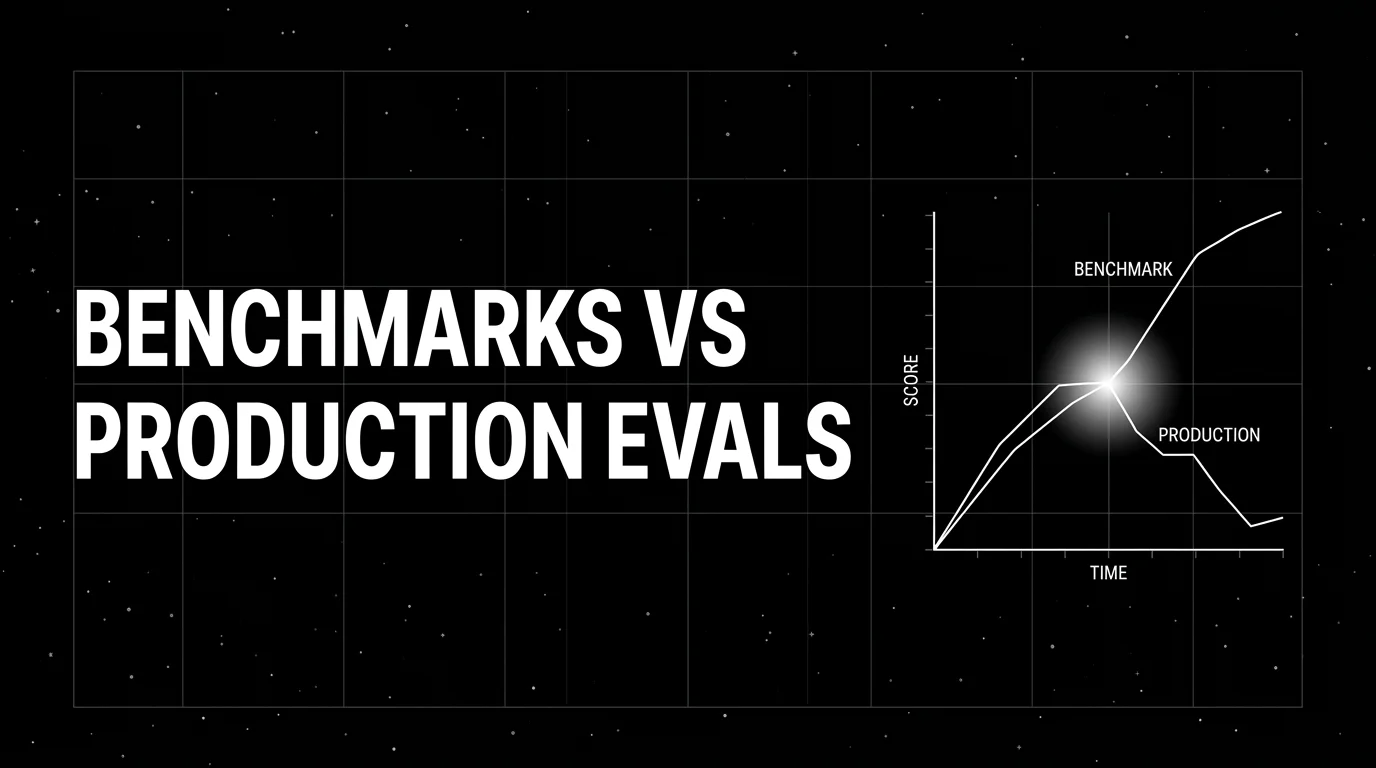
Public LLM benchmarks (MMLU, HumanEval, GSM8K) are contaminated and not predictive of production. Build domain reproductions that actually work in 2026.

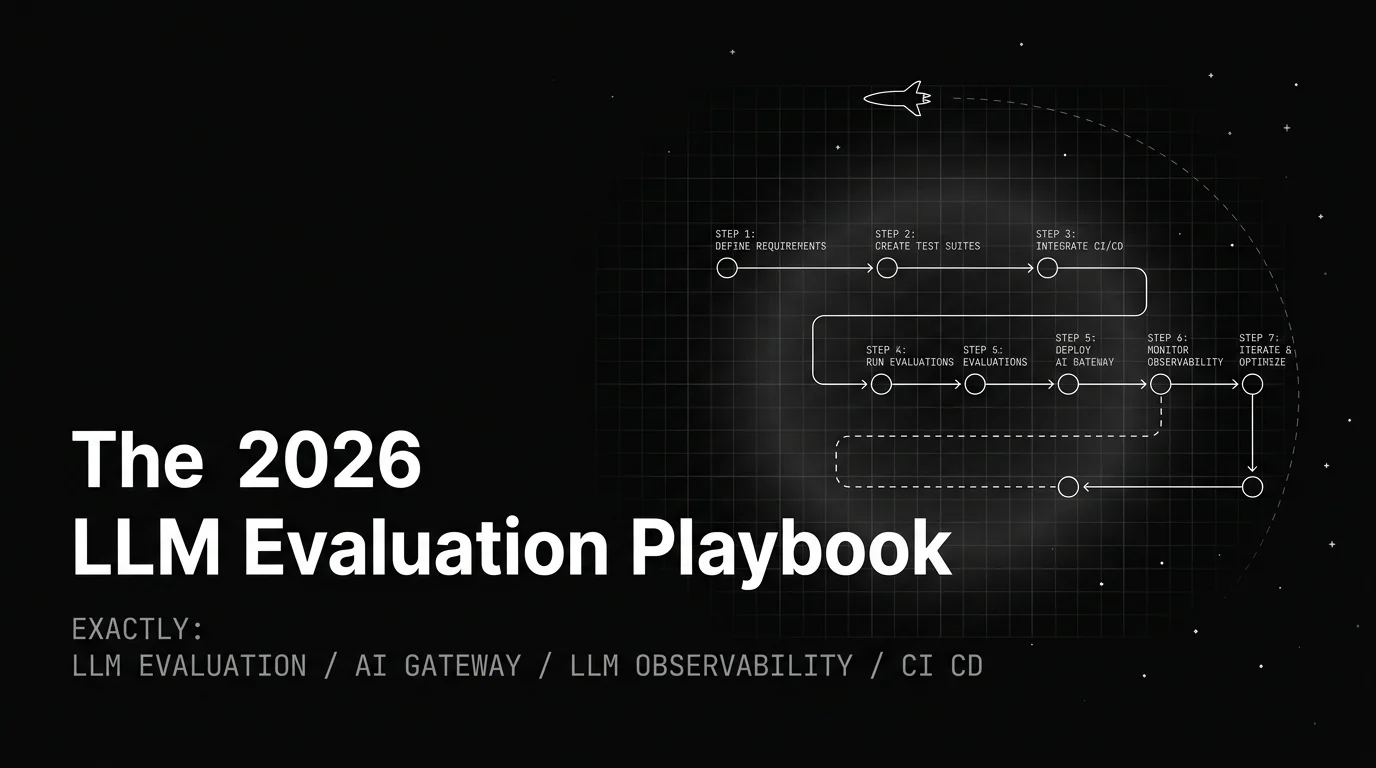
The pillar playbook for LLM evaluation in 2026: dataset, metrics, judge, CI gate, production observation, closed loop from failing trace to regression.
