LLM-Judge Bias Mitigation (2026): Detect, Measure, Fix
Five named LLM-judge biases, each with a measurement and a mitigation that holds in production: position, verbosity, self-preference, format.
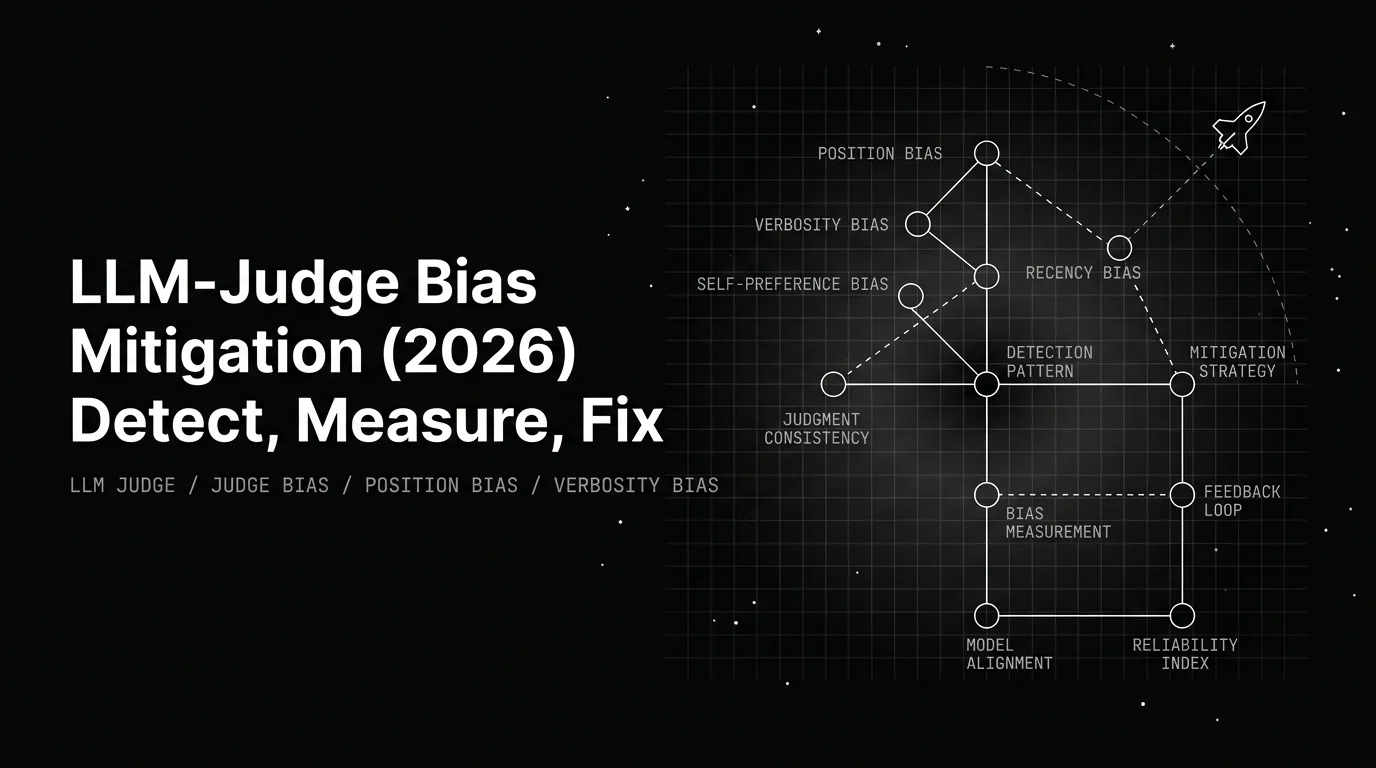
Table of Contents
You score helpfulness at 0.91 all quarter. The judge model bumps a minor version in March. The mean shifts four points, the distribution narrows, and your CI gate keeps passing. In May the agent quotes a refund off by an order of magnitude. The eval suite never flagged it. The judge changed, the rubric didn’t, and the signal stopped meaning what you thought it meant the day the model rolled.
Most posts on this topic frame LLM-judge bias as one problem and “use a better prompt” as the fix. Neither is true. LLM-judge bias is five named biases — position, verbosity, self-preference, format, and calibration drift — each with its own measurement and its own mitigation. Prompts reach the cases prompts can reach. The mitigation that actually works on production traffic is mechanical: shuffle on every pairwise call, pin the judge contract, rotate judges across families, and calibrate against humans monthly.
The opinion this post earns: the judge is a model. Eval the judge before you trust the score. This guide walks the five biases with primary citations, the detection procedure per bias, the mitigation that survives a production audit, and the four-habit hardening pattern that turns a rubric judge from a coin flip into measurable signal.
TL;DR: five biases, five measurements, five mitigations
| Bias | Effect size | Detection | Mitigation that works |
|---|---|---|---|
| Position bias | 10 to 15 pt swing on pairwise (Zheng 2024) | Run both orders; measure flip rate | Randomize order, average both orderings |
| Verbosity bias | 15 to 30 pt inflated preference for long (Wang 2023) | Length-controlled CI on matched-quality pairs | Length-neutral rubric + length-controlled scoring |
| Self-preference | 10 to 25 pt inflation on same-family (Zheng 2024) | Cross-family score the same outputs | Rotate judges across families; never judge own family |
| Format bias | 5 to 15 pt swing on format-matched vs not | Re-score same content in alternative format | Format-neutral rubric + sample across formats |
| Calibration drift | 3 to 8 pt mean shift on minor model bump | Re-run human-labeled set on every judge swap | Pin contract; calibrate monthly; treat swap as migration |
Naive deployments lose all five. A judge that’s been audited returns signal. A judge that hasn’t returns whatever the bias mix produced this week.
Why bias matters even when dashboards look green
A judge that returns 0.91 every week looks healthy. The failure mode isn’t the score being wrong on a given example. It’s the score being systematically miscalibrated in the same direction, across millions of evals per day, in a way that no individual call surfaces.
The bias compounds: a 4-point uniform inflation across ten rubrics and a million spans a day is a moved baseline, not a rounding error. Discovery doesn’t come from the eval suite. It comes from a user ticket, a competitor screenshot, or a model swap that drops the dashboard 8 points and forces a postmortem. By then the regression has shipped.
The literature documents this with named effect sizes. Zheng et al. 2024 (the MT-Bench paper) measures position bias at 10 to 15 points of winrate swing depending on slot order. Wang et al. 2023 measures verbosity bias at 15 to 30 points of inflated preference for longer outputs across GPT-4, Claude, and PaLM-2 judges. Zheng et al. confirms self-preference at 10 to 25 percent. Each is reproducible on any rubric you can write in an afternoon.
This post sits next to the LLM-judge prompt engineering guide (rubric anatomy), G-Eval definitive guide (the method), and Why LLM-as-a-judge (when to use a judge at all). This one covers how to audit the judge once it’s running.
Bias 1: position bias
The pattern. In pairwise comparison (“which answer is better, A or B?”), the response in slot A wins more often than chance. The size varies by model, but 10 to 15 points of winrate swing on close calls is the standard number from Zheng et al. 2024. The effect is structural to autoregressive scoring: the judge reads A before B and the early context biases the verdict.
Detection. Build a pairwise calibration set of 100 to 300 cases with known winners (human-labeled or domain-canonical). Run each pair twice: once with the true winner in slot A, once with it in slot B. The position-bias signal is the percentage of pairs where the verdict flipped on order alone, plus the mean score shift on non-flipping pairs. Anything above 5 percent flip rate is real bias.
Mitigation that works. Randomize position on every pairwise call. Run each comparison in both orderings and treat order-dependent verdicts as ties. The cost doubles. The position bias signal drops to near zero. Don’t try to “instruct” the judge out of position bias with a rubric line like “consider both responses equally”; the bias is in the autoregressive decode, not the prompt, and the measured effect of such instructions is roughly zero.
Bias 2: verbosity bias
The pattern. Longer answers score higher even when the extra words add no quality. Wang et al. 2023 measured 15 to 30 points of inflated preference for verbose outputs across frontier judges, holding quality constant. The judge pattern-matches on signal-of-effort cues: response length, list density, explicit hedging, citation count. Word count is the cheapest of these to manipulate.
Detection. Length-controlled scoring. Take your calibration set, group pairs into length-matched buckets (within ±20 percent token count) and length-mismatched buckets, and score both. If the winrate gap or score gap between high-quality and low-quality answers shrinks dramatically on the length-controlled subset, verbosity is doing the work in your unaudited scores.
Mitigation that works. Two layers. First, an explicit “do not prefer longer answers; score solely on content” line in the rubric, which roughly halves the bias on most judges per published benchmarks. Second, report length-controlled confidence intervals as the primary metric for ship decisions. The aggregate score keeps a length-normalization adjustment: you compute the expected score conditional on token count from your calibration set and subtract.
Mitigation that doesn’t. A hard token cap on the response. It doesn’t fix the bias because judges prefer elaborate phrasing at matched token counts. Wang et al. shows this directly. The verbosity signal isn’t only length; it’s also list density, hedging frequency, and citation count.
Bias 3: self-preference bias
The pattern. A judge scores outputs from its own model family 10 to 25 percent higher than equivalent outputs from a different family. Zheng et al. 2024 confirms this across Llama, Claude, and GPT pairs in MT-Bench. The bias is in the judge’s prior: each family writes in a recognizable distribution and the judge rewards in-distribution writing.
The cardinal mistake. Same model as judge and candidate. GPT-4o judging GPT-4o, Sonnet 4.5 judging Sonnet 4.5. The bias inflates uniformly across the dataset, the dashboard looks great, and the gap only surfaces when a competitor’s cross-family eval comes back lower and the team blames the competitor’s judge.
Detection. Generate the same answer with two different families on a calibration set. Have each judge score both. If GPT-4o-as-judge consistently scores GPT-4o-produced text 4 to 8 points above Claude-produced text on equivalent content, you have self-preference. The size you’ll measure depends on how distinguishable the two families’ outputs are.
Mitigation that works. Judge from a different family than the candidate. For launch decisions, run a three-judge ensemble across three families and aggregate by majority or weighted vote. As of May 2026 a defensible default is Claude Sonnet 4.5, GPT-5.1, and Gemini 2.5 Pro. The ensemble costs 3x a single judge and family-specific biases cancel. Reserve the ensemble for launches and winrates inside the noise band near 50 percent; single judge with calibration is fine for weekly trends. Asking the judge to “evaluate objectively without regard to writing style” doesn’t work; the bias is in the embedding distribution, not the surface style the judge can reason about.
Bias 4: format bias
The pattern. The judge prefers answers that match the format the rubric implicitly expects. If the rubric examples are bulleted lists, bulleted answers win against equivalent prose. Table-shaped rubrics prefer table answers. JSON-mode rubrics rate JSON higher than the same content in prose. The effect is 5 to 15 points on format-matched versus mismatched comparisons in audits I’ve run on customer support rubrics.
Detection. Take a calibration subset where the human-rated correct answer is in one format. Rewrite the candidate in three formats (bullets, prose, table) holding content constant. Have the judge score all three. Format bias is the score variance across format variants on identical content.
Mitigation that works. Two pieces. First, explicit format-neutrality in the rubric: “Score the substance of the answer. Format (prose, bullets, table) is not a quality signal unless the prompt requests a specific format.” Second, sample your calibration set across formats so the rubric examples don’t lock the judge into one shape. Pre-formatting every candidate into a uniform shape hides the bias in your eval but production is still mixed-format, so don’t take that shortcut. Format bias is less documented than position and verbosity, but it’s reproducible and it kills A/B tests where one variant changed format and one didn’t.
Bias 5: calibration drift across judge versions
The pattern. Same rubric, same dataset, new judge model version: the mean shifts 3 to 8 points and the distribution narrows. Sonnet 4.5 to Sonnet 4.6 is a minor bump that ships with a new training mix and a different refusal head. The rubric still parses. The shift isn’t noise; it’s the new model interpreting the same instructions through a different prior. Unlike the other four biases (bounded at a known size, measure once and they hold), calibration drift is a moving target. Minor frontier versions ship every two to four months. If the judge is your only quality metric, you’re measuring the judge change, not the model change.
Detection. The eval is a tuple (judge_model_id, rubric_version, prompt_template_hash). Re-run the human-labeled calibration set on every judge model swap. Compute the mean shift, distribution narrowing, and Cohen’s kappa against human labels before and after. A 3-point mean shift on a 0-to-1 rubric is a real calibration delta; an 8-point shift is a different metric in disguise.
Mitigation that works. Four-part contract: pin the judge model id explicitly (gpt-4o-2024-08-06, not gpt-4o-latest — the alias is a different metric every six weeks), version the rubric, hash the prompt template, and re-calibrate against human labels on every contract change. Treat a judge upgrade as a deliberate eval-suite migration. Track judge-versus-human Cohen’s kappa as a first-class metric over time. When kappa moves more than the inter-rater baseline, the rubric is overdue. Re-calibrate monthly on production rubrics, not “when something breaks.”
The four-habit hardening pattern
Five biases, five mitigations. Stacking them on a working production judge takes four operational habits. None of them is exotic; all of them are skipped by 80 percent of audited eval suites I see in customer reviews.
1. Pin the judge contract. The eval is (judge_model_id, rubric_version, prompt_template_hash). Bump any field deliberately, never as a side effect of a vendor swap. Cache verdicts keyed on the tuple. Invalidate on contract change, not on every PR. Treat the rubric like code that needs its own tests.
2. Shuffle and rotate. Randomize position on every pairwise call. Maintain a roster of three frontier judges from three families. Single judge for weekly trends; three-judge ensemble for launches and close-call decisions.
3. Calibrate against humans monthly. Collect 100 to 300 human-labeled examples per rubric. Re-run the judge on the set. Compute Cohen’s kappa. A marketing-copy rubric tolerates kappa around 0.6; a medical-advice rubric needs 0.85 or higher. Re-calibrate on every judge swap and on a monthly cadence for production rubrics. Track judge-versus-human kappa as its own metric and alert on drift.
4. Anchor with a deterministic floor. If the response fails a JSON schema check, a refusal regex, or a closed-form contract, the judge does not run and the eval fails outright. Deterministic checks are 10,000 times cheaper than a frontier judge and never drift. Put them in front. The judge bill drops 80 to 90 percent without losing detection rate on the cases where reasoning earns it.
The combined effect on most audited judges: 60 to 80 percent of the raw bias signal removed, and a continuous loop that catches the residual 20 to 40 percent before it ships.
Notice what’s missing: “write a better rubric.” Length-neutrality language reduces verbosity bias by roughly half. Position-neutrality language has near-zero effect (the bias is in the decode, not the rubric). Self-preference language has near-zero effect (the bias is in the prior). Format-neutrality language helps moderately. The rubric line is cheap and worth shipping; it isn’t the load-bearing mitigation. The mechanics are.
How Future AGI ships bias auditing
The eval stack ships the primitives; the Platform ships the continuous loop; Error Feed ships the bias-correlated failure discovery. The same CustomLLMJudge runs in pytest as a CI gate and on live spans as an EvalTag server-side, which is the diff that closes most of the trace-eval drift covered in the trace-eval gap post.
The ai-evaluation SDK (Apache 2.0) exposes CustomLLMJudge, a Jinja2-templated G-Eval primitive against any LiteLLM-supported model. Cross-family rotation is a config change, not a refactor:
from fi.evals.metrics.llm_as_judges.custom_judge.metric import CustomLLMJudge
from fi.evals.metrics.llm_as_judges.types import CustomInput
from fi.evals.llm.providers.litellm import LiteLLMProvider

# Three judges across three families for ensemble scoring
judges = [
    CustomLLMJudge(provider=LiteLLMProvider(), config={
        "name": "support_helpfulness",
        "model": m,
        "grading_criteria": (
            "Score 1.0 if the response directly answers the question with "
            "accurate information and a clear next step. Score 0.5 if it "
            "answers partially. Score 0.0 if it deflects or is wrong. "
            "Do not prefer longer answers. Format (prose, bullets, table) "
            "is not a quality signal."
        ),
    })
    for m in ["claude-sonnet-4-5", "gpt-5.1", "gemini-2.5-pro"]
]
The Guardrails class runs ensembles across 13 backends (9 open-weight including LLAMAGUARD_3_8B/1B, QWEN3GUARD_8B/4B/0.6B, GRANITE_GUARDIAN_8B/5B, plus 4 API backends) with ANY, ALL, MAJORITY, and WEIGHTED aggregation, which gives you multi-family voting on a single call. The augment=True cascade runs a deterministic NLI claim-check first and only escalates ambiguous calls to the frontier judge, cutting the bias surface by removing the judge from cases it didn’t need to touch.
ThresholdCalibrator sweeps thresholds 0.3 to 0.9 against FeedbackEntry records, computes TP/FP/TN/FN at each step, and picks the threshold maximizing accuracy or F1. FeedbackRetriever pulls top-N similar past corrections as few_shot_examples for the next CustomLLMJudge call. Record a correction, the calibrator updates the threshold, the retriever updates the few-shot pool, the next judge call scores closer to human-labeled truth.
traceAI writes judge metadata as OTel span attributes: judge.model_name, judge.prompt_version, judge.position_randomized, judge.score_with_reference, judge.few_shot_count. Six months in, when a metric looks miscalibrated, you query “every Groundedness eval with judge.position_randomized=false between dates X and Y” and surface the population that needs re-scoring. The audit trail is the eval, not a side document.
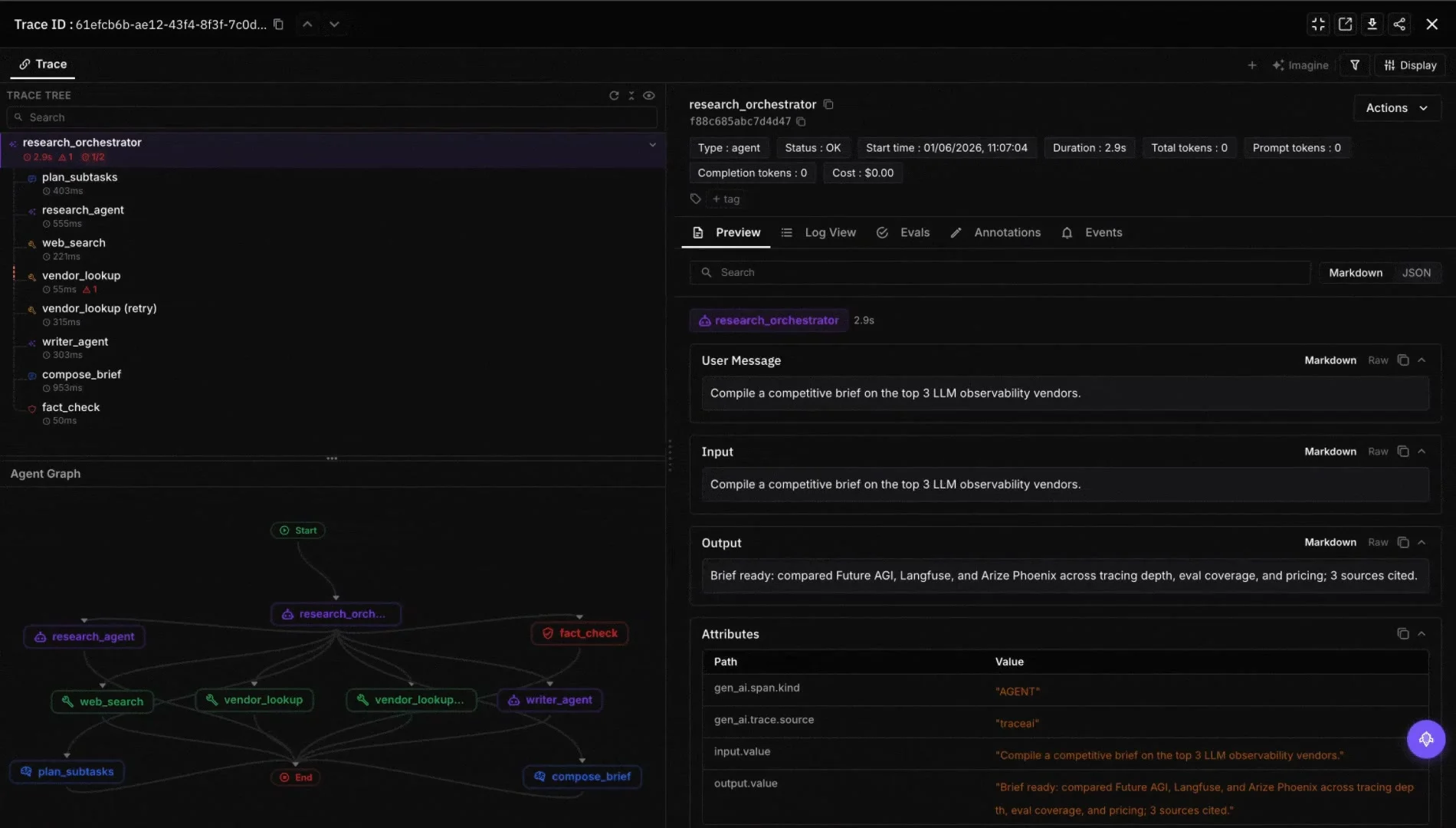
The Future AGI Platform layers what the SDK can’t do alone. Self-improving evaluators retune the rubric from production thumbs feedback so the calibration set stays current. The Agent Command Center routes judge calls across 100+ providers (SOC 2 Type II, HIPAA, GDPR, CCPA certified, ISO/IEC 27001 in active audit) with race-mode swaps that turn a judge upgrade into an A/B test, not a deploy event. Classifier-backed scoring runs at lower per-eval cost than Galileo Luna-2, which makes multi-judge ensembles financially viable instead of a quarterly batch. Error Feed clusters bias-correlated failures via HDBSCAN soft-clustering over LLM-generated embeddings of failure signatures. Named clusters surface as issues like “GPT-4o judge over-scores GPT-4o candidates by 4 points on support rubric” or “long answers score 1.2 points higher on helpfulness at matched quality.” A Claude Sonnet 4.5 Judge agent writes an immediate_fix per cluster that feeds the self-improving evaluators.
Ready to wire bias-audited evals against your own workload? Start with the ai-evaluation SDK quickstart. Drop a three-family CustomLLMJudge ensemble against your calibration set in pytest this afternoon, then attach the same rubric as a traceAI EvalTag on live spans. The same rubric in both places, the four-habit pattern around it, is what turns an LLM judge from a thermometer calibrated against itself into a measurement you can ship a launch on.
Three takeaways for 2026
- Five biases, five mitigations. Position, verbosity, self-preference, format, calibration drift. Each has a primary citation and a per-bias fix. The mitigation that works is mechanical; “better prompts” is the layer on top.
- Pin a contract.
(judge_model_id, rubric_version, prompt_template_hash). Bump deliberately. Calibrate against humans monthly. Treat a judge swap as an eval-suite migration, not a config change. - Audit the stack, not the prompt. A judge call by itself is a number. A judge integrated with shuffle, rotation, calibration, span-attached audit metadata, and a continuous bias-cluster loop is what compounds.
Related reading
- Why LLM-as-a-Judge (2026): The Case For, Against, and the Hybrid That Wins
- G-Eval (2026): The Definitive Guide for Production LLM Teams
- LLM Judge Prompt Engineering Guide (2026)
- LLM Arena as a Judge: Pairwise Comparison Evals (2026)
- Deterministic LLM Evaluation Metrics (2026)
- Your Agent Passes Evals and Fails in Production (2026)
- The 2026 LLM Evaluation Playbook
- Build an LLM Evaluation Framework From Scratch (2026)
Frequently Asked Questions
What are the five biases every LLM judge ships with?
How do I detect position bias in my judge?
How do I detect verbosity bias?
How do I rotate judges across families?
What does 'judge calibration drift' actually look like?
Does 'use a better prompt' fix LLM-judge bias?
What does Future AGI ship for bias auditing?
LLM-as-judge best practices for 2026: pick the right judge, calibrate against humans, watch length and family bias, control cost. Discipline that scales.

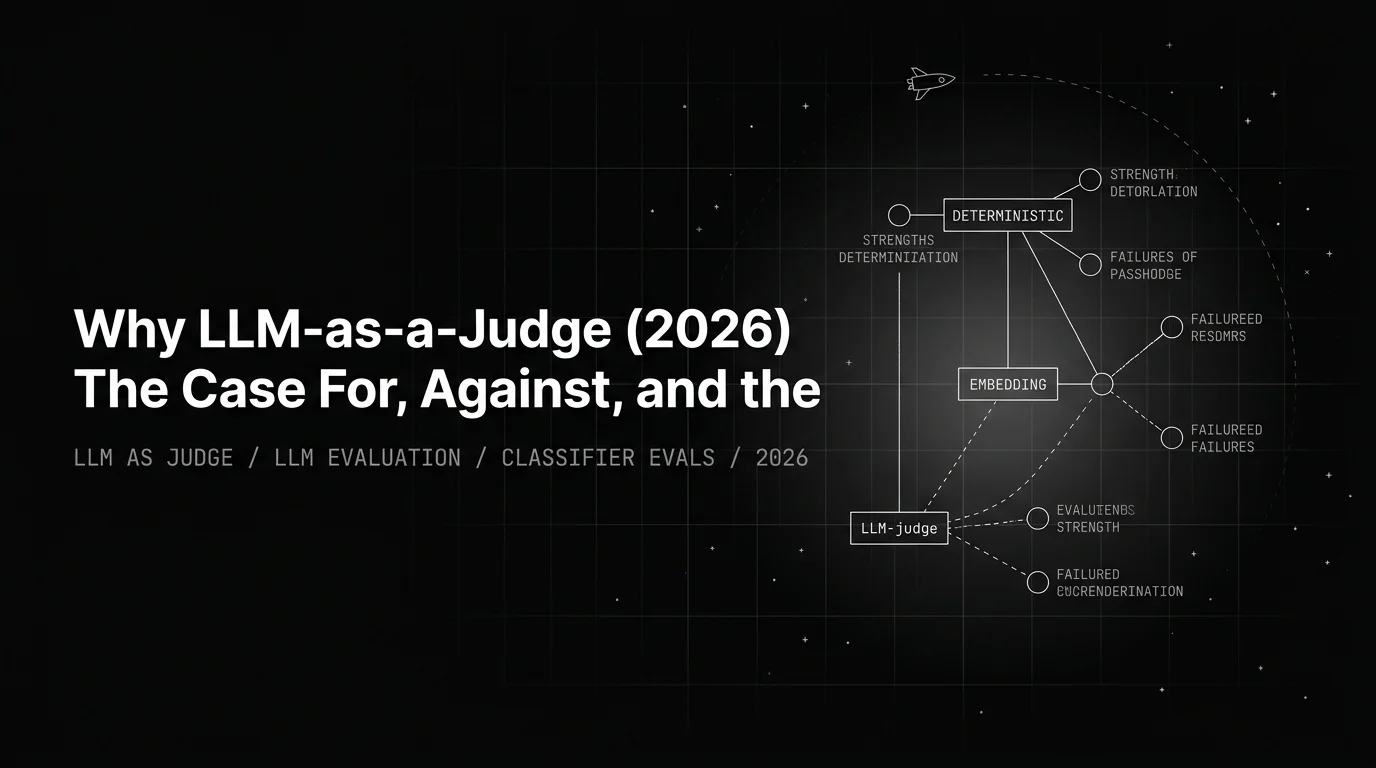
LLM-as-a-judge is the only eval method that scales to subjective rubrics. The honest case for, against, and the discipline that earns trust.

G-Eval 2026: what the paper actually shipped, where the method breaks in production, four biases that wreck a rubric judge, how to harden for real traffic.