The State of LLM Benchmarking (2026): What the Leaderboards Tell You, and What They Don't
MMLU, GSM8K, SWE-bench Verified, BFCL, tau-bench, GPQA, ARC-AGI-2, Chatbot Arena. What each measures, where each breaks, triangulate-plus-private 2026.
Table of Contents
You ran four frontier models against MMLU. The spread was two points. Against MT-Bench, one. Against Chatbot Arena, two were tied on the Elo. You picked the one with the highest aggregate, shipped it to a customer-support agent, and a week later it quoted a refund off by an order of magnitude on a ticket any of the other three would have caught.
The MMLU score wasn’t wrong. It was answering a different question. The benchmark told you which model was smartest in general. You needed to know which model was best for your support workload.
The opinion this post earns: match the model to the workload, not the workload to the leaderboard. Public benchmarks in 2026 tell you the capability shape of a model. They don’t tell you which model will resolve refund tickets without hallucinating policy. As of mid-2026, the defensible pattern is to triangulate model choice on three or four public benchmarks for capability shape, then build a private eval set on your traffic for the ship decision. Public benchmarks shape the shortlist. Private evals decide.
This is a tour of every benchmark cluster that still carries signal in 2026, the three failure modes that wreck them, and the triangulate-plus-private-eval pattern that replaces leaderboard-shopping for any team running an LLM in production.
TL;DR: what each benchmark cluster tells you, and what it misses
| Cluster | Tells you | Misses |
|---|---|---|
| Knowledge (MMLU, MMLU-Pro, HellaSwag, ARC) | Whether the model has broad academic priors | Domain-specific accuracy, refusal calibration, your traffic |
| Math (GSM8K, MATH, AIME-25, FrontierMath) | Math reasoning, especially under post-cutoff problems | Whether the math shows up in your tools, retrieval, or chat |
| Code (HumanEval, MBPP, SWE-bench, SWE-bench Verified) | Whether the model can patch real repos end to end | Your codebase, your test suite, your CI conventions |
| Agentic and tool use (BFCL, tau-bench, TAU2) | Function-calling accuracy and multi-step recovery | Your tool surface, your prompts, your error states |
| Frontier reasoning (GPQA, ARC-AGI-2) | Generalization to novel reasoning at the edge | Anything below the frontier, which is most production work |
| Preference (Chatbot Arena) | Aggregate subjective quality from anonymous voters | Long context, tool use, your domain, your refusal policy |
| Aggregators (HELM, BIG-bench) | Capability survey across many axes | A clean answer to “which model for my app” |
| Private eval | Which model wins your traffic on your rubrics | Cross-team comparability, leaderboard bragging rights |
Public benchmarks shape the shortlist. The private eval decides which one ships.
The 2026 benchmark map by capability shape
A benchmark is a question about a capability. The trap is reading the aggregate without asking what it measures.
Knowledge: MMLU, MMLU-Pro, HellaSwag, ARC. MMLU (Hendrycks et al., 2020) covers 57 academic subjects across 14,042 multiple-choice questions and anchored the early scaling debate. By 2026 every frontier model scores 88-92 percent; the ceiling is closer to label noise than to model capability, and a 1-point gap doesn’t survive a different prompt format. MMLU-Pro is the harder contamination-resistant variant. HellaSwag (commonsense) and ARC (grade-school science) are similarly saturated. Use this cluster to rule out broken candidates, not to rank frontier ones.
Math and reasoning: GSM8K, MATH, AIME-25, FrontierMath, GPQA. GSM8K (8.5K grade-school problems) and MATH (12.5K competition problems) are largely saturated. AIME-25 (American Invitational Mathematics Examination 2025) is a recent post-cutoff stress test that still separates strong reasoners. FrontierMath is the hardest of the public set, designed to resist memorization. GPQA Diamond tests graduate-level science reasoning across biology, chemistry, and physics with questions that hold up against web search. This is where 2026 model-versus-model differences actually show. Treat the cluster as one signal.
Code: HumanEval, MBPP, SWE-bench, SWE-bench Verified. HumanEval (164 hand-written Python problems) and MBPP (974 entry-level problems) are saturated and cover function completion, not engineering. SWE-bench is the modern frontier: 2,294 real GitHub issues from 12 popular Python repos, scored by whether the model’s patch passes the project’s test suite. SWE-bench Verified is the 500-issue subset manually filtered for solvability and the version teams cite. The score is much closer to a production task than any function-completion benchmark, and the spread between frontier models is still meaningful.
Agentic and tool use: BFCL, tau-bench, TAU2. BFCL (Berkeley Function Calling Leaderboard, V4) scores function-calling accuracy across single-turn, multi-turn, parallel calls, and agentic scenarios with cost and latency reported alongside accuracy. tau-bench (Anthropic’s tool-agent benchmark) tests multi-step tool use, conversation grounding, and recovery from failure on simulated airline-booking and retail tasks. TAU2 is the harder successor. The methodology shifts release to release, so pin the version.
Frontier reasoning: ARC-AGI-2. Francois Chollet’s ARC-AGI series tests fluid intelligence on abstract pattern tasks that are hard for AI and easy for humans. ARC-AGI-2 (2025) tracks novelty rather than scale. Useful as an upper-bound signal on reasoning robustness; not a number that decides which model handles your support tickets.
Preference: LMSYS Chatbot Arena. Pairwise preference voting by anonymous users, fit to an Elo or Bradley-Terry model. Strongest public preference signal we have, and harder to game than a static benchmark because votes come in continuously. Caveats: voters are anonymous and short-context; preferences don’t transfer to your domain, your tool use, or your refusal calibration. Use Arena as a tiebreaker. See arena-as-a-judge for the production pattern that adapts this primitive to your own traffic.
Aggregators: HELM, BIG-bench. Stanford’s HELM scores models across many scenarios with many metrics. BIG-bench is a grab-bag of 200+ tasks. Comprehensive coverage, but the aggregate hides what the model is actually good at. Read the per-scenario breakdown, not the headline.
No single benchmark answers “which model should I ship.” Each one is a slice. Combining them shows you the shape. The shape is the shortlist.
Three failure modes that wreck public benchmarks
Even within capability shape, public benchmarks ship with three failure modes that drag the signal toward noise.
1. Data contamination. Once a benchmark is published, future model releases probably saw it. MMLU contamination is documented across model families; GSM8K leakage shows up in training corpora; HumanEval problems get paraphrased into Stack Overflow answers and GitHub repos. The benchmark stops measuring generalization and starts measuring memorization. Active mitigations are held-out subsets (MMLU-Pro, SWE-bench Verified, GPQA Diamond) and post-cutoff benchmarks (AIME-25, FrontierMath, LiveCodeBench), but contamination is a permanent risk for any benchmark older than the model under test. Treat any score on a two-year-old public benchmark as advisory only.
2. Gaming via prompt-tuning, format-shopping, and selective publication. A 3-point MMLU gap between vendors can disappear when normalized for prompt format, chain-of-thought, decoding strategy, and few-shot configuration. Vendors pick benchmarks where they win, tune for them, and publish selectively. Independent reproductions on identical infrastructure rarely match vendor numbers exactly. The number on a model card is a starting point, not a verdict.
3. The benchmark-versus-production gap. The deepest failure mode and the one cleaner benchmarks don’t fix. A benchmark scores the model alone, on multiple-choice trivia or short prompts, with no tools, no retrieval, no parsing layer, no refusal policy. Production runs an agent stack: model plus tools plus retrieval plus parsers plus guardrails. The stack’s quality is bounded by the weakest link, rarely the base model. A model scoring 91 on MMLU and 90 on Arena can lose to one scoring 88 and 88 on a support agent where retrieval is the binding constraint and the model’s ability to admit “I don’t know” matters more than its trivia score. See agent observability vs evaluation vs benchmarking for the architectural split.
None of these break the benchmark as research. They break the assumption that the benchmark number transfers to your evaluator running six months from now.
What public benchmarks miss for your app
Even with clean methodology and zero contamination, four dimensions stay off the leaderboard.
Refusal calibration. A medical-advice agent that refuses every borderline question is safe but useless; one that answers every borderline question is useful but liable. Calibrating refusal against your policy is a dimension public leaderboards don’t touch.
Tool use and retrieval. Benchmarks score the model alone. Production runs an agent stack and the failure mode is rarely “the model didn’t know the answer.” It’s usually “the model called the wrong tool, retrieval missed the relevant document, or the parser swallowed the structured output.” The base model is one variable in a system of many.
Production drift. The gpt-4o-2024-11-20 that benchmarked at X six months ago is now gpt-4o-2025-05-01 and benchmarks at X plus or minus delta. Pinning model versions helps but doesn’t eliminate drift; the API can change the system prompt, the safety policy, or the decoding defaults.
Cost and latency shape. A benchmark reports accuracy. Production reports cost per resolved ticket and p95 latency. A model that wins on accuracy by two points but costs 4x loses the production decision. BFCL is rare in reporting cost and latency alongside accuracy. Most benchmarks don’t.
The benchmark answers “is the model smart in general.” The app needs to answer “is the model right for my workload at my cost and latency budget.” Different questions.
The pattern that works: triangulate, then privately evaluate
The defensible 2026 pattern has two halves.
Triangulate capability shape on public benchmarks. Pick three to four benchmarks across the dimensions your app needs. A customer-support agent that retrieves from a knowledge base: MMLU (general knowledge), tau-bench (tool use), GPQA Diamond (reasoning on edge cases), Chatbot Arena (subjective preference). A coding agent: SWE-bench Verified plus BFCL plus a math benchmark for non-code reasoning. A math-tutor app: AIME-25 plus FrontierMath plus MMLU-STEM plus Arena. Match the cluster to the workload. Shortlist two or three candidate models. This step is fast, cheap, and disqualifying.
Run a private eval against the shortlist. 500-1,500 prompts from your traffic, scored against your rubrics, run end-to-end with your prompt template and your tools. The winner ships. Re-run quarterly and on every model upgrade. See benchmarks vs production evals for the deeper methodology on private evals and contamination resistance.
Each half catches what the other misses. Public benchmarks rule out the obviously wrong models in a few hours. Private evals catch the gap between general capability and your specific workload. Skip the public step and you waste private-eval budget on broken models. Skip the private step and you ship the wrong model.
What a private eval actually looks like
A private eval set is three sources combined.
Real production traces, hand-labeled. Pull 200 traces (or staging traces if production hasn’t started), hand-label the right answer or behavior. One senior engineer can do this in a day or two. Gold-standard examples covering your distribution, edge cases, and refusal policy.
Synthetic variants with evolution operators. Use a frontier model with evolution operators (paraphrase, complicate, deepen, simplify, edge-case) to generate 800-1,200 variants from the seed traces. Filter for diversity and difficulty. See synthetic test data for the recipe.
Adversarial probes. Add 50-100 red-team prompts covering safety, jailbreaks, prompt injection, and domain-specific edge cases (a medical agent gets borderline drug-interaction questions; a financial agent gets advice-on-securities probes).
Total: 1,000-1,500 prompts, version-controlled, rubric-scored, with a per-model pass-rate that maps directly to whether the model will work for your workload.
Run the suite in pytest as a CI gate. Run it again as a span-attached eval on live production traces so the same rubric that gated the deploy keeps scoring real traffic. That continuity is the difference between an eval that catches regressions and an eval that lives in a slide deck.
How Future AGI ships the private-eval stack
The gap: public benchmarks shape the shortlist; private evals decide the production model; the same rubric has to run in CI before deploy and on live spans after. Start with the SDK for code-defined private rubrics. Graduate to the Platform when you want self-improving rubrics, classifier-backed cost economics, and an in-product authoring agent.
The ai-evaluation SDK (Apache 2.0) is the code-first surface. 60+ EvalTemplate classes cover the common rubrics out of the box (Groundedness, ContextAdherence, Completeness, ChunkAttribution, FactualAccuracy, PromptInjection, AnswerRefusal, TaskCompletion, EvaluateFunctionCalling, plus 11 customer-agent-specific templates and a long tail for tone, summarization, multi-modal, and translation).
from fi.evals import Evaluator
from fi.evals.templates import Groundedness, ContextAdherence, TaskCompletion

evaluator = Evaluator(fi_api_key=..., fi_secret_key=...)

results = evaluator.evaluate(
    eval_templates=[Groundedness(), ContextAdherence(), TaskCompletion()],
    inputs=[
        {"input": ticket["question"], "output": model_response, "context": retrieved},
        # ...
    ],
)
For rubrics public templates don’t cover, CustomLLMJudge ships a Jinja2-templated G-Eval implementation with multi-modal support. Four distributed runners (Celery, Ray, Temporal, Kubernetes) carry rubric execution. 13 guardrail backends (9 open-weight: LLAMAGUARD_3_8B/1B, QWEN3GUARD_8B/4B/0.6B with 119-language coverage, GRANITE_GUARDIAN_8B/5B, WILDGUARD_7B, SHIELDGEMMA_2B) supply the classifier triage layer for the cost cascade.
A benchmark you run once is a slide in a deck. A benchmark you run on every PR is a quality gate. The SDK ships a CLI (fi run) with an assertion engine that exits non-zero when scores drop below threshold. Wire it into GitHub Actions, GitLab CI, or your build system; the build fails when the rubric regresses. The python/examples/ci-cd/ directory ships a working recipe.
traceAI (Apache 2.0) carries the same rubric as a span-attached EvalTag on live traffic across 50+ AI surfaces in Python, TypeScript, Java, and C#. Pluggable semantic conventions at register() time (FI, OTEL_GENAI, OPENINFERENCE, OPENLLMETRY). Server-side scoring at zero added inference latency:
from fi_instrumentation import register
from fi_instrumentation.fi_types import (
    ProjectType, EvalTag, EvalTagType, EvalSpanKind, EvalName, ModelChoices,
)

register(
    project_name="support_agent",
    project_type=ProjectType.OBSERVE,
    eval_tags=[
        EvalTag(
            type=EvalTagType.OBSERVATION_SPAN,
            value=EvalSpanKind.LLM,
            eval_name=EvalName.GROUNDEDNESS,
            model=ModelChoices.TURING_LARGE,
            mapping={"input": "input.value", "output": "output.value"},
        ),
    ],
)
The Future AGI Platform layers what the SDK alone cannot do. Self-improving rubrics retune from thumbs up/down feedback so the rubric ages with the product instead of against it. An in-product authoring agent writes rubrics from natural-language descriptions. Classifier-backed scoring runs at lower per-eval cost than Galileo Luna-2, which makes daily full-traffic scoring financially viable instead of a quarterly batch. The Agent Command Center handles judge routing across 20+ providers (SOC 2 Type II, HIPAA, GDPR, and CCPA certified, ISO/IEC 27001 in active audit). Error Feed sits inside the eval stack: HDBSCAN soft-clusters failing traces into named issues, a Claude Sonnet 4.5 Judge agent writes the RCA with an immediate_fix, and fixes feed the self-improving evaluators. Your private benchmark sharpens as production runs.
Choose a public benchmark, choose a private eval
Choose public benchmarks when:
- You need to disqualify obviously-bad candidates fast.
- You’re comparing capability shape across families (Anthropic versus OpenAI versus Google versus open-weight).
- You’re writing a model-selection memo for a stakeholder who needs a recognized number.
- You’re building a capability survey, not a procurement decision.
Choose a private eval when:
- The decision is “ship model X or model Y in production.”
- You’re tracking drift on a specific workload week-over-week.
- The cost of shipping the wrong model is larger than the cost of building 1,000 labeled prompts.
- The workload has refusal calibration, tool use, retrieval, or domain vocabulary the public benchmarks miss, which is most workloads.
Run both when:
- The stakes are high enough that a leaderboard glance isn’t a ship signal.
- The model rotates more than once a quarter.
- The application has been in production long enough to produce 200 labelable traces.
Match the question to the primitive. “Is the model competent in general” is a benchmark question. “Is the model right for my workload” is a private-eval question. The teams that confuse the two ship the wrong model and wonder why production lags the leaderboard.
Three takeaways for 2026
- Public benchmarks shape the capability shortlist. Private evals decide the ship. Triangulate on three or four benchmarks across the dimensions your app needs. Then run a private eval on your traffic. Skip neither step.
- Treat contamination, gaming, and the benchmark-versus-production gap as default failure modes. Any score on a two-year-old public benchmark is advisory. Any vendor number is a starting point. Any benchmark that scores the model alone is missing the agent stack.
- The same rubric belongs in CI and in production. A rubric scored on every production span with drift detection is the 2026 baseline. The score that decides the deploy is the score that should keep scoring live traffic.
Ready to build your private eval? Start with the ai-evaluation SDK quickstart, drop 200 production traces into a Groundedness plus TaskCompletion rubric this afternoon, and wire the same rubric as an EvalTag on live spans via traceAI.
Related reading
- LLM Benchmarks vs Production Evals in 2026: Why Public Scores Mislead
- G-Eval (2026): The Definitive Guide for Production LLM Teams
- LLM Arena as a Judge: Pairwise Comparison Evals (2026)
- Agent Observability vs Evaluation vs Benchmarking (2026)
- Synthetic Test Data for LLM Evaluation (2026)
- Build an LLM Evaluation Framework From Scratch (2026)
- The 2026 LLM Evaluation Playbook
- Evaluating Cheap Frontier Models (2026)
Frequently Asked Questions
Which public LLM benchmarks still matter in 2026?
Why do high benchmark scores not predict production behavior?
Is benchmark contamination still a problem in 2026?
What is the triangulate-plus-private-eval pattern?
How large does a private eval set need to be?
How do I read a vendor benchmark number without getting played?
How does Future AGI close the benchmark-vs-production gap?
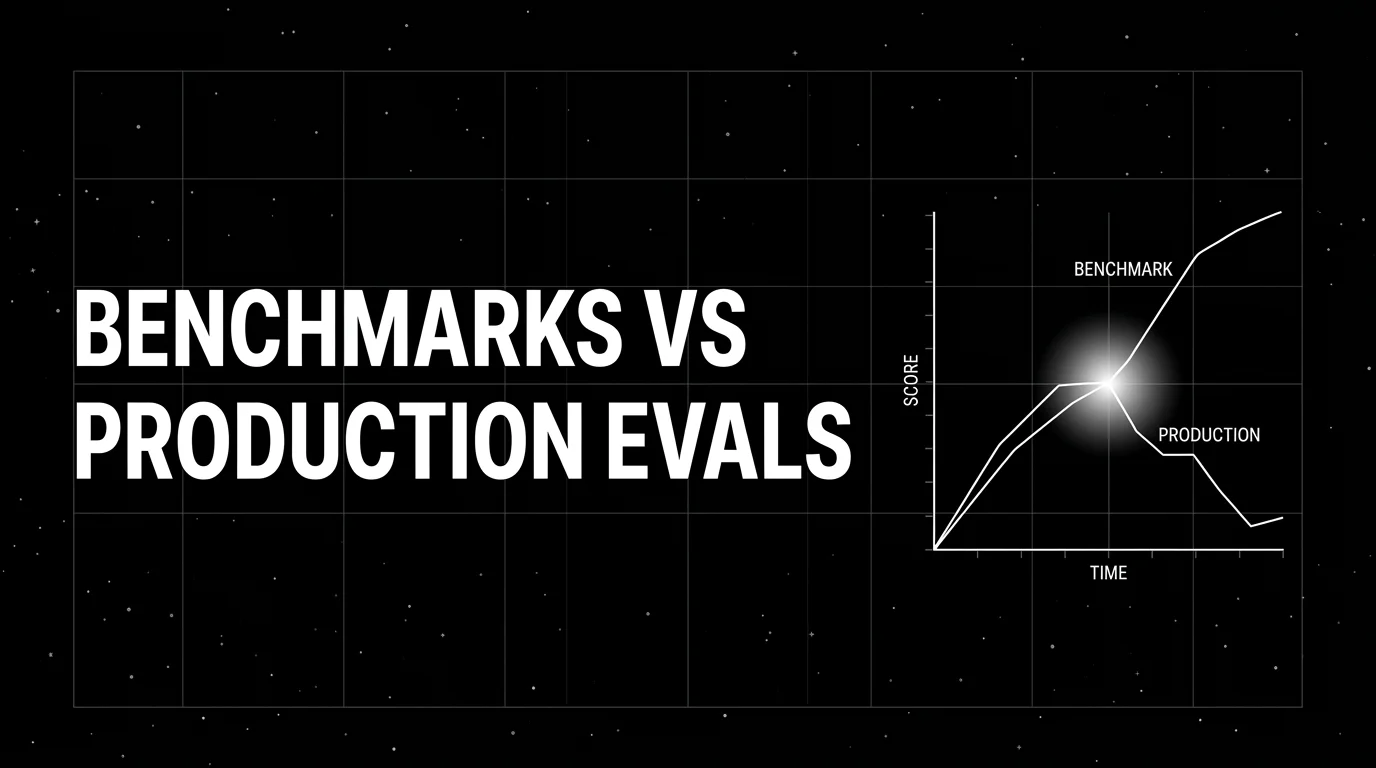
Public LLM benchmarks (MMLU, HumanEval, GSM8K) are contaminated and not predictive of production. Build domain reproductions that actually work in 2026.

How LLM leaderboards work in 2026: Chatbot Arena, MMLU, MMMU, GPQA, SWE-bench, HumanEval. Current top models and how to evaluate them on your own data.

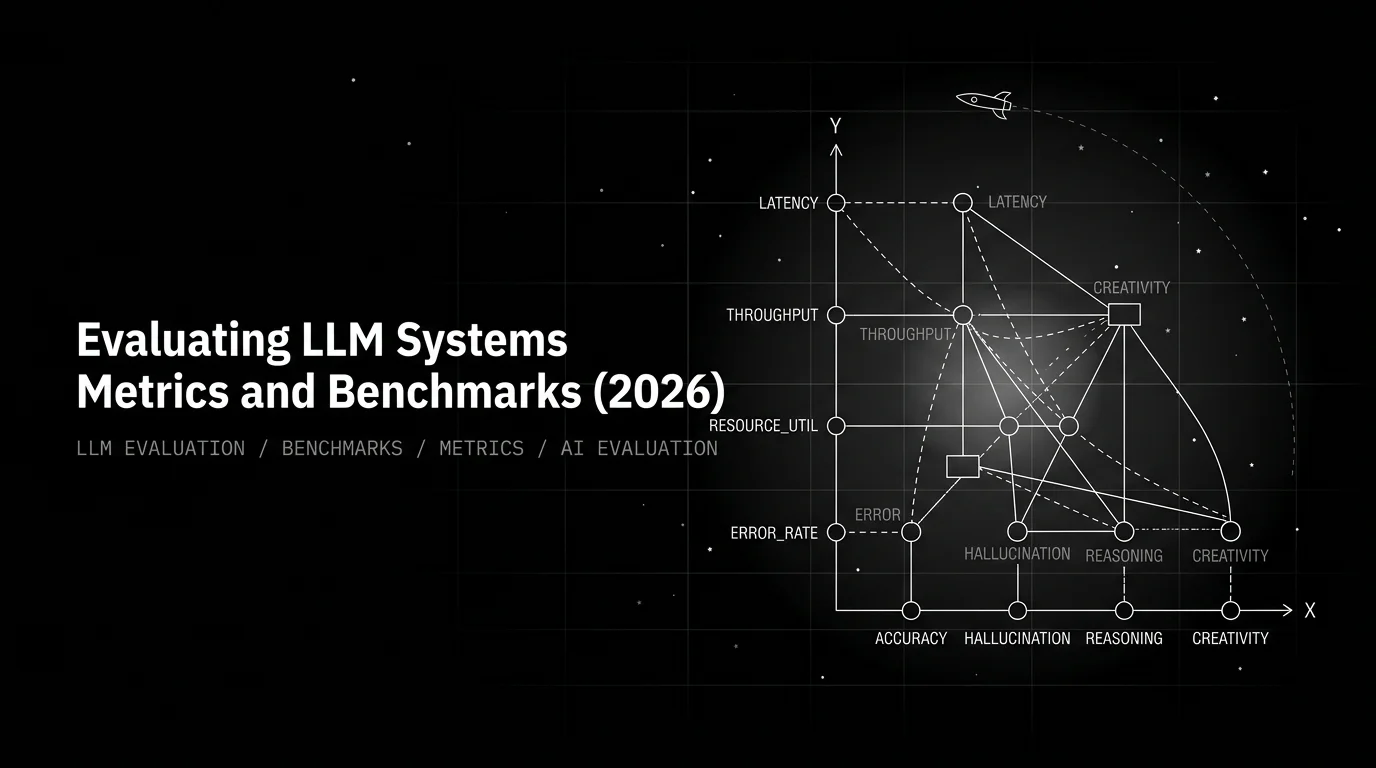
Benchmarks tell you which model is smartest. Metrics tell you if your system works. 2026 guide: benchmark map, metric catalog, CI gate, rubric.