G-Eval (2026): The Definitive Guide for Production LLM Teams
G-Eval 2026: what the paper actually shipped, where the method breaks in production, four biases that wreck a rubric judge, how to harden for real traffic.
Table of Contents
You ship a customer-support agent. Marketing wants helpfulness scores. Legal wants faithfulness scores. Product wants instruction adherence. Ops wants refusal calibration. None of these have a binary classifier sitting on Hugging Face. You write four rubrics in plain English, hand them to a judge model, and that is G-Eval.
Six months later the rubric scores still read 0.91. The agent ships a refund quote off by an order of magnitude. The judge model bumped a minor version in March and a major version in April. Your eval suite is still running. The signal stopped meaning what you thought it meant the day the judge changed.
The opinion this post earns: G-Eval is a method, not a metric. The metric is whatever rubric you write into the prompt — and the rubric ages faster than the model under test. The Liu et al. paper solved correlation with human raters on summarization. It did not solve judge-family lock-in, position bias, self-preference, calibration drift across model versions, or the cost of running an LLM judge on every span. G-Eval is the right place to start an evaluation stack in 2026. It is the wrong place to stop. This guide walks the paper, the production failure modes, and the hardening pattern that lets the rubric keep meaning the same thing six months from now.
TL;DR: what G-Eval is good at, what it isn’t
| Question you’re asking | G-Eval | Better tool |
|---|---|---|
| Faithfulness on a 12-page legal context | Strong | None — open-ended reasoning |
| Helpfulness on subjective support conversations | Strong | Pairwise arena |
| Toxicity, PII, prompt injection | Wrong cost shape | Fine-tuned classifier |
| JSON validity, schema match | Wrong tool | Parser |
| Lexical overlap against a gold answer | Wrong tool | ROUGE, BLEU, embeddings |
| Per-axis regression diagnosis | Native | None |
| Ship decision between prompt v1 and v2 | Inconclusive | Pairwise arena |
| Production scale (millions of spans/day) | Cost prohibitive without cascade | Classifier-first hybrid |
G-Eval is a per-output rubric scorer. Use it where the rubric is open-ended and the volume is manageable. Switch primitives the moment one of those holds breaks.
What the paper actually shipped
G-Eval landed in Liu et al. 2023 (arXiv:2303.16634) with three technical contributions, not one. Marketing tends to flatten the method to “LLM scores your output.” That misses the design choices that made the paper land.
Auto-generated chain-of-thought steps. You hand the judge a task description and a high-level rubric (“evaluate coherence on a 1 to 5 scale”). The judge generates its own concrete evaluation steps before scoring. The steps act as a structured prior for the eventual judgment. This is the chain-of-thought half.
Form-filling output schema. The judge does not free-write its score. It fills a structured form: criterion, reasoning, integer score. Form-filling forces the model into a tighter distribution than free-text “tell me how good this is.” The structured output also makes the score parseable for downstream aggregation.
Probability-weighted scoring. The integer score on the form is discrete, but the underlying logit distribution is not. G-Eval reads the token probability across the 1-to-5 options and computes a probability-weighted continuous score. A judge that splits 0.55 / 0.45 between 4 and 5 produces a 4.45, not a hard 4. The continuous score softens the variance of discrete 1-to-5 output and is one of the reasons the method correlated with humans where naive prompting did not.
Tested with GPT-4 on SummEval, the method hit Spearman 0.514 against human raters on summarization, the strongest result on that benchmark at the time. BLEU, ROUGE, BERTScore, and BLEURT all sat in the low 0.3s. The paper’s contribution was concrete: a recipe that turned an LLM into a calibrated evaluator on summarization, beating every prior metric on the same task by a wide margin.
Read the paper if you have not. Then read the next section, because the production version of G-Eval that ran in 2026 looks almost nothing like the SummEval recipe.
What G-Eval became outside the paper
By 2024 every serious eval framework had its own G-Eval wrapper. Most kept the chain-of-thought and the form-filling. Almost none kept the probability-weighted scoring, because production deployments go through chat APIs that do not expose logit distributions. The dominant shipped pattern collapsed back to discrete 1-to-5 integer scoring with a chain-of-thought preamble, scaled by /100 or /10 for a continuous-looking number.
Vendors then started calling their generic LLM-as-judge a “G-Eval implementation” and citing the paper’s correlation number as if it transferred. A custom judge prompt against a GPT-4o chat endpoint that returns “I’ll give this a 4 out of 5” is not the G-Eval that hit 0.514 on SummEval. It is a different recipe with a familiar name. The reported Spearman transfers to your domain only if you reproduce the calibration. Treat the paper’s number as proof the family can work, not as proof your rubric does.
When G-Eval is the right primitive
Three conditions need to hold together.
The criterion is open-ended. “Is this response helpful to a customer asking about refund policy” is open-ended. “Does this response contain a credit card number” is not. Open-ended needs reasoning. Closed-form needs pattern matching.
A fine-tuned classifier does not already exist. Toxicity has classifiers. Prompt injection has classifiers. Bias has classifiers. PII has classifiers. Future AGI Protect ships four fine-tuned Gemma 3n LoRA adapters (toxicity, bias_detection, prompt_injection, data_privacy_compliance) at 65 ms text and 107 ms image median time-to-label per the Protect paper. A G-Eval prompt for the same dimension costs 20 to 50x more and runs slower by an order of magnitude. Faithfulness against a long context document, by contrast, does not have a clean classifier target. G-Eval earns its bill there.
The volume is bounded. A G-Eval call with GPT-4o or Sonnet 4.5 costs 100 to 500x what a fine-tuned classifier costs per call. CI runs against a thousand cases? Rounding error. Live scoring on a million spans a day? G-Eval is the eval budget. Cascade or rebuild.
When all three hold, G-Eval is the cleanest method in the toolkit. When one fails, switch primitives or layer a cascade.
Where G-Eval breaks in production
The paper measured one thing in one place: correlation with humans on summarization. None of the production failure modes below are bugs in the paper. They are the gap between a method that works on a benchmark and an evaluator that holds for two years on live traffic.
Judge-family lock-in. A rubric calibrated against GPT-4o produces different distributions on Sonnet 4.5. Different again on Gemini 2.5 Pro. The instruction is “score helpfulness 1 to 5,” but each model’s prior on what “helpful” means leaks into the score. Swap judges without recalibrating and the dashboard moves, but the agent didn’t.
Calibration drift across model versions. This is the same problem, smaller delta. Sonnet 4.5 to Sonnet 4.6 is a minor bump that ships with a new training mix and a different refusal head. The rubric still parses. The scores still come back in [0, 1]. The mean shifts 3 to 8 points and the distribution narrows. If G-Eval is the only quality metric and the judge model rotates every quarter, you are measuring the judge change, not the model change you intended to measure.
Self-preference bias. A model judging its own family’s outputs scores them 10 to 25 percent higher than equivalent outputs from a different family. Documented in the original paper and confirmed across Llama, Claude, and GPT pairs. Same model as judge and candidate is the cardinal mistake. Frontier-to-frontier across families is fine.
Position bias on pairwise. G-Eval is pointwise by default, but practitioners often extend it to pairwise. The instant you do, the judge’s preference for slot A versus slot B kicks in at 10 to 15 points of winrate on close calls. Randomize position per comparison or the verdict is noise.
Verbosity and length bias. Judges over-prefer longer responses even on prompts where length adds nothing. “The capital is Paris” loses to “The capital of France is Paris, which is in Europe” on judges that read elaboration as helpfulness. Length caps and explicit “do not prefer longer answers” rubric language are the cheap fixes. Length-controlled subset scoring is the rigorous one.
Cost shape on every span. A G-Eval call on a 30-second agent trace, multi-modal, with retrieved context, runs $0.01 to $0.05 per evaluation depending on judge and tokens. At a million traces a day that is a $30K-to-$1.5M monthly bill. Frontier-judge-on-everything is not a viable production strategy. The cascade is mandatory.
None of these break the paper. They break the assumption that the paper’s number transfers to your evaluator running on Tuesday morning six months from now.
Hardening G-Eval for production
Four habits separate a working production rubric from a CI demo.
Pin the judge model and rubric version as a single contract. The eval is the tuple (judge_model_id, rubric_version, prompt_template_hash). Bump any field deliberately, never as a side effect of a vendor swap. Cache verdicts keyed on the tuple; invalidate on contract change, not on every PR.
Calibrate every rubric against human labels. Collect 50 to 200 human-labeled examples per rubric. Run the judge on the same set. Compute Cohen’s kappa or threshold-based accuracy. A marketing-copy rubric tolerates kappa around 0.6. A medical-advice rubric needs 0.85+. Re-calibrate every quarter and on every judge swap. Track judge-versus-human drift as its own first-class metric; when it moves more than the inter-rater baseline, the rubric is overdue.
Cascade the cost: classifier first, frontier judge only on close calls. The Future AGI SDK ships 13 guardrail backends, 9 open-weight (LLAMAGUARD_3_8B/1B, QWEN3GUARD_8B/4B/0.6B with 119-language coverage, GRANITE_GUARDIAN_8B/5B, WILDGUARD_7B, SHIELDGEMMA_2B). For non-subjective axes, a classifier triages every span; only ambiguous or low-confidence calls escalate to the LLM judge. The Future AGI Platform runs this cascade at lower per-eval cost than Galileo Luna-2, which makes daily full-traffic scoring financially viable instead of a quarterly batch run.
Anchor with a deterministic floor. If the response fails a JSON schema check, a refusal regex, or a closed-form contract, the LLM judge does not run and the eval fails outright. Deterministic checks are 10,000x cheaper than a frontier judge and never drift. Put them in front. They catch the failures G-Eval was never the right tool for, and they save the judge bill for the cases where reasoning earns it.
Layer those four and the G-Eval bill drops 80 to 90 percent without losing detection rate on the cases that actually need a judge.
Implementing G-Eval with Future AGI
The stack you build around the rubric matters as much as the rubric. Most teams write five evals once and ship breaking changes for months because the suite stopped reflecting production.
The ai-evaluation SDK (Apache 2.0) ships CustomLLMJudge, a Jinja2-templated G-Eval primitive against any LiteLLM-supported model. The same class powers 70+ EvalTemplate rubrics (Groundedness, ContextAdherence, FactualAccuracy, TaskCompletion, SummaryQuality, EvaluateFunctionCalling).
from fi.evals.metrics.llm_as_judges.custom_judge.metric import CustomLLMJudge
from fi.evals.metrics.llm_as_judges.types import CustomInput
from fi.evals.llm.providers.litellm import LiteLLMProvider

judge = CustomLLMJudge(
    provider=LiteLLMProvider(),
    config={
        "name": "support_helpfulness",
        "model": "gpt-4o",
        "grading_criteria": (
            "Score 1.0 if the response directly answers the customer's "
            "question with accurate information and a clear next step. "
            "Score 0.5 if it answers partially or with hedging. "
            "Score 0.0 if it deflects, refuses incorrectly, or is wrong."
        ),
        "few_shot_examples": [
            {"inputs": {"question": "...", "answer": "..."},
             "output": '{"score": 1.0, "reason": "..."}'},
        ],
    },
)

result = judge.compute_one(CustomInput(
    question="How do I get a refund on order #1234?",
    answer="...",
))
# result["output"] -> float in [0.0, 1.0]
# result["reason"] -> JSON-stringified judge output
DefaultJudgeOutput enforces the form-filling schema (score: float ∈ [0, 1], reason: str); the Jinja template carries the rubric and few-shot calibration block. The judge is multi-modal: pass image_url, input_image_url, output_image_url, or audio_url keys and LiteLLM forwards the media to vision and audio-capable models (GPT-4o, Gemini 2.5, Claude 3.5+).
For server-side post-export scoring at zero inline latency, wire the same rubric to a span via traceAI’s EvalTag:
from fi_instrumentation import register
from fi_instrumentation.fi_types import (
    ProjectType, EvalTag, EvalTagType, EvalSpanKind, EvalName, ModelChoices,
)

register(
    project_name="support_agent",
    project_type=ProjectType.OBSERVE,
    eval_tags=[
        EvalTag(
            type=EvalTagType.OBSERVATION_SPAN,
            value=EvalSpanKind.LLM,
            eval_name=EvalName.TASK_COMPLETION,
            model=ModelChoices.TURING_LARGE,
            mapping={"input": "input.value", "output": "output.value"},
        ),
    ],
)
The tag serializes into the OTel resource. Every span the project emits carries it. The collector runs the eval server-side and writes results back to the span as gen_ai.evaluation.* attributes. No added latency on the user’s request. The same rubric runs in pytest as a CI gate and on live spans in production; that diff closes most of the trace-eval drift covered in the trace-eval gap post.
Choose G-Eval, choose something else
Choose G-Eval when:
- The criterion is open-ended and requires reasoning (faithfulness on long context, helpfulness with conditional system instructions, multi-axis support quality).
- No fine-tuned classifier exists for the dimension you care about.
- Volume is bounded or you can run a cascade in front of it.
- You need per-axis diagnosis when an arena winrate moves.
Choose a fine-tuned classifier when:
- The target is sharp (toxicity, PII, prompt injection, bias, jailbreak).
- Latency budget is sub-100 ms.
- Cost is the binding constraint and volume is high.
Choose deterministic checks when:
- The contract is closed-form (JSON validity, schema match, regex, length bounds).
- You need a CI floor that never drifts. Put it in front of G-Eval as a guard.
Choose pairwise arena when:
- You are picking between two prompts, two models, two fine-tunes.
- Rubric averages cluster at the second decimal and you cannot tell which candidate is actually better.
- The success criterion is subjective and a winrate is more legible than a 4.06 versus 4.01 score.
Avoid G-Eval when:
- The judge model is one of the candidates you are scoring (self-preference bias).
- The eval has to run on every production span and you have no classifier cascade.
- The dimension is a parser problem (“is this valid JSON”) or a schema problem.
Match the question to the primitive, not the primitive to the rubric you happen to have written. G-Eval is the most flexible tool in the box. It is also the most expensive, and it ages the fastest.
How Future AGI ships G-Eval as a production-grade evaluator
The gap: the G-Eval paper is a recipe; production needs a contract. The recipe holds for a sprint. The contract has to hold for two years across judge swaps, prompt revisions, retrieval drift, and a 10x traffic ramp. Start with the SDK for code-defined G-Eval rubrics. Graduate to the Platform when you need self-improving rubrics, in-product authoring, and classifier-backed cost economics.
The ai-evaluation SDK (Apache 2.0) is the code-first surface. CustomLLMJudge exposes the G-Eval primitive: Jinja2 template, structured DefaultJudgeOutput, few-shot calibration, multi-modal input. The same class powers 70+ EvalTemplate rubrics across faithfulness, agent quality, multi-turn conversation, function calling, summarization, and multi-modal output. 13 guardrail backends (9 open-weight) supply the classifier triage layer for the cost cascade. Four distributed runners (Celery, Ray, Temporal, Kubernetes) carry rubric execution into whatever orchestrator the team already runs.
traceAI (Apache 2.0) carries the same rubric as a span-attached EvalTag on live traffic across 50+ AI surfaces in Python, TypeScript, Java, and C#. Pluggable semantic conventions at register() time (FI, OTEL_GENAI, OPENINFERENCE, OPENLLMETRY). Server-side scoring at zero added inference latency.
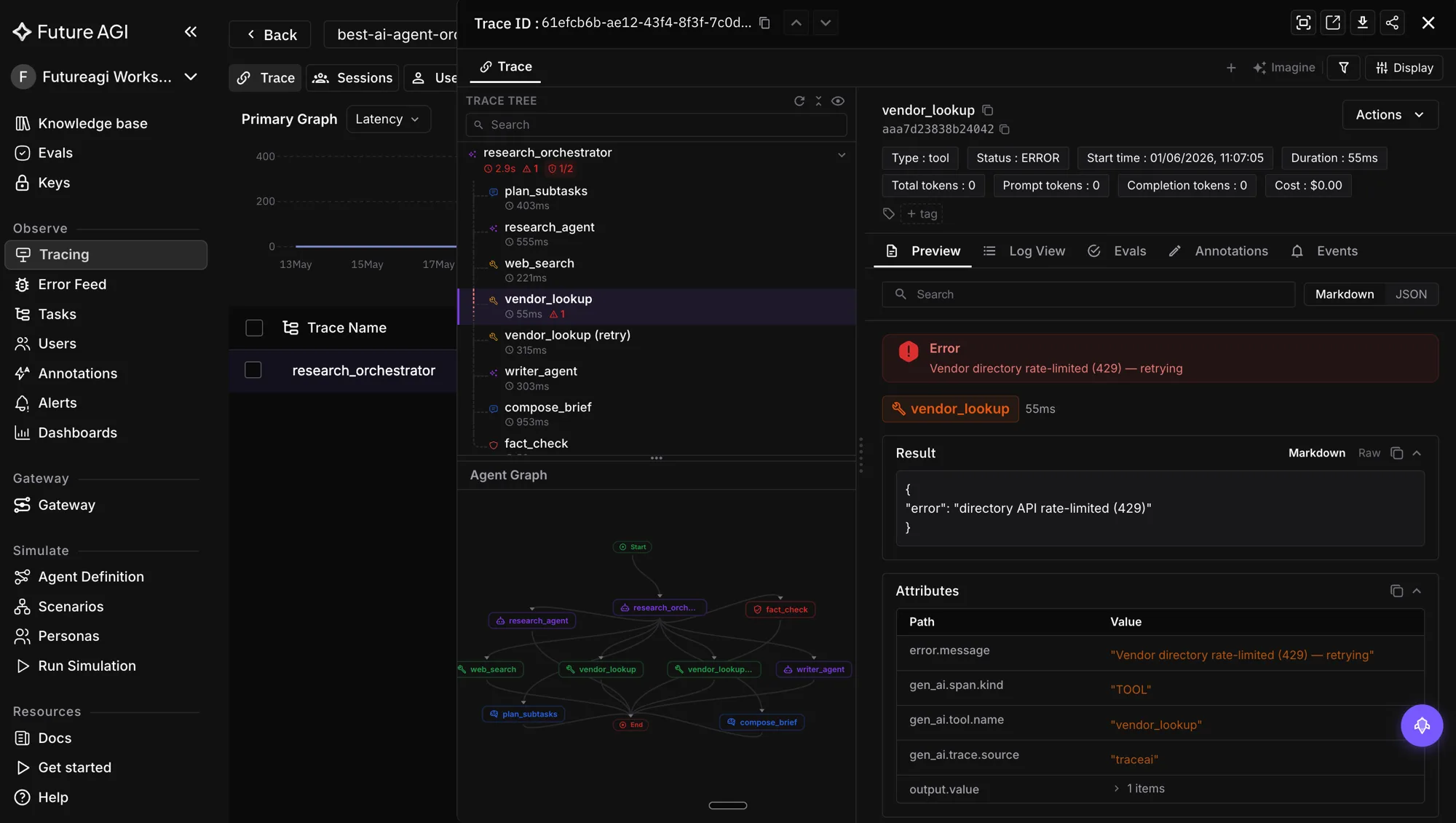
The Future AGI Platform layers what the SDK alone cannot do. Self-improving rubrics retune from thumbs up/down feedback so the rubric ages with the product instead of against it. An in-product authoring agent writes G-Eval rubrics from natural-language descriptions. Classifier-backed scoring runs at lower per-eval cost than Galileo Luna-2, which is what makes daily full-traffic G-Eval financially viable instead of a quarterly batch. The Agent Command Center handles judge routing across 20+ providers (SOC 2 Type II, HIPAA, GDPR, and CCPA certified, ISO/IEC 27001 in active audit). Error Feed sits inside the eval stack: HDBSCAN soft-clusters failing-rubric traces, a Sonnet 4.5 Judge writes the RCA with an immediate_fix, fixes feed the self-improving evaluators. agent-opt consumes G-Eval scores across six optimizers so prompt search runs against the same rubric the CI gate uses.
Ready to wire G-Eval against your own workload? Start with the ai-evaluation SDK quickstart, drop a CustomLLMJudge against your dataset in pytest this afternoon, then attach the same rubric as an EvalTag on live spans via traceAI. The same rubric in both places is the diff that turns G-Eval from a SummEval-style benchmark into a production-grade evaluator.
Related reading
- LLM Arena as a Judge: Pairwise Comparison Evals (2026)
- Your Agent Passes Evals and Fails in Production (2026)
- Why LLM-as-a-Judge Is the Best LLM Evaluation Method
- Evaluating LLM Judge Bias Mitigation (2026)
- LLM Judge Prompt Engineering Guide (2026)
- Deterministic LLM Evaluation Metrics (2026)
- The 2026 LLM Evaluation Playbook
- Build an LLM Evaluation Framework From Scratch (2026)
Frequently Asked Questions
What is G-Eval and what did the paper actually contribute?
When should I use G-Eval over a classifier or a deterministic check?
What biases does G-Eval ship with by default?
Why does the same G-Eval rubric drift across judge model versions?
How do I harden G-Eval for production traffic?
How does G-Eval compare to arena-style pairwise evaluation?
How does Future AGI ship G-Eval as a production-grade evaluator?
G-Eval rubric-based LLM judges vs DeepEval's full metric suite, how they differ, and where FutureAGI Turing eval models fit alongside both in 2026.

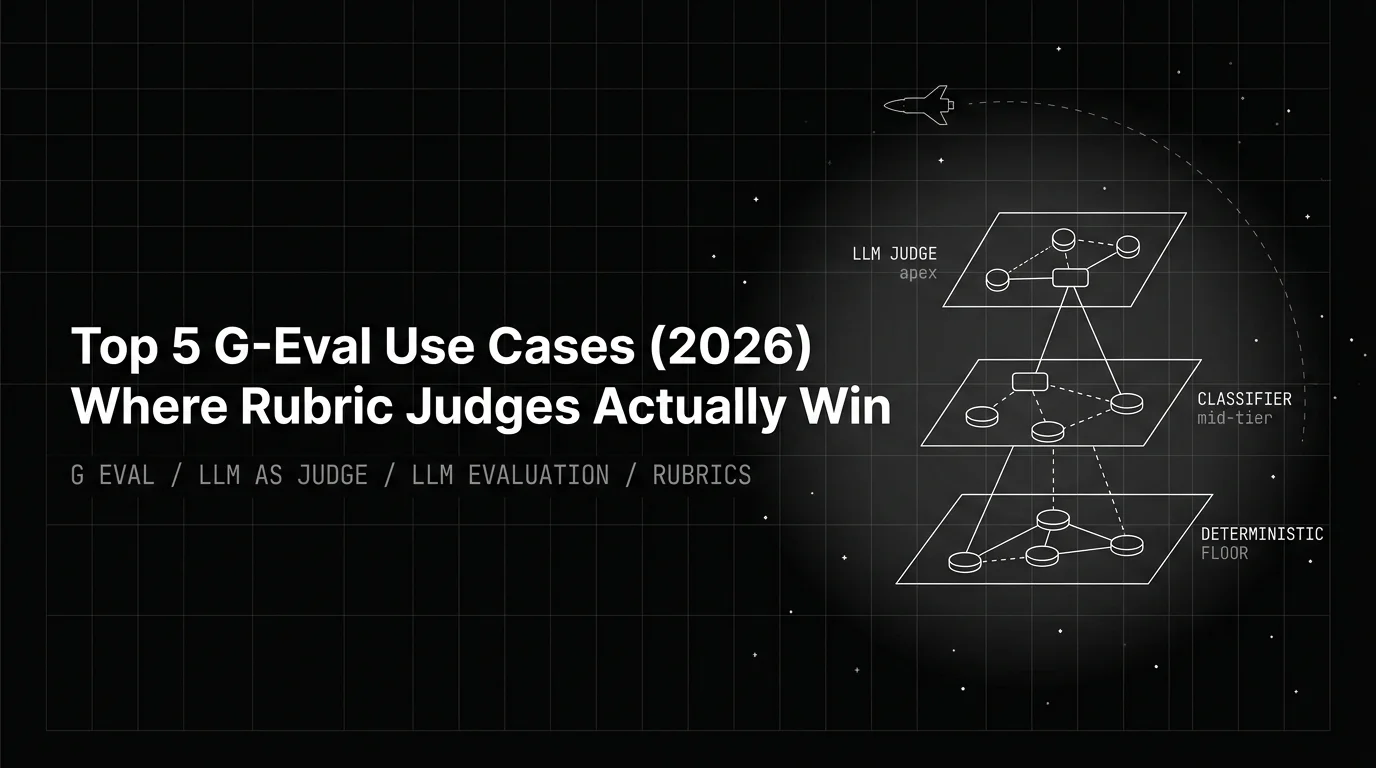
Five use cases where G-Eval is the right primitive: subjective rubric scoring, faithfulness on free-form text, custom-domain rubrics, weighted, reasoning.

LLM-as-a-judge is the only eval method that scales to subjective rubrics. The honest case for, against, and the discipline that earns trust.