Evaluating LLM Systems: Metrics and Benchmarks (2026)
Benchmarks tell you which model is smartest. Metrics tell you if your system works. 2026 guide: benchmark map, metric catalog, CI gate, rubric.
Table of Contents
Two engineers walk into a model-selection meeting. The first says GPT-5 hit 92 on MMLU, the second says Sonnet 5 hit 91, and they spend an hour arguing one point. Neither of them runs MMLU on Monday morning. Neither of their users care about MMLU. The thing both of their applications actually need to know — does the retrieval surface the right policy doc, does the refund agent quote the right amount, does the support bot escalate before the user threatens to switch — none of that is on the leaderboard.
That argument is the single most common failure mode in 2026 LLM evaluation. Metrics and benchmarks are two different jobs and most teams run one when they need the other.
The opinion this post earns: benchmarks tell you which model is generally smartest, metrics tell you whether your system works. Pick three or four benchmarks for capability shape. Ship four to six metrics on your own data. Run both, in different places, on different cadences. The teams that conflate them ship the wrong model and learn about it from users.
This is the working map: the metric-vs-benchmark distinction, the three primitives every metric is made of, the 2026 benchmark map by capability, the metric catalog that ships in production, how to pick by application shape, the CI gate, and the observability pattern that keeps the gate honest after deploy.
TL;DR: metrics vs benchmarks
| Dimension | Benchmark | Metric |
|---|---|---|
| What it scores | A model on a fixed dataset | A system on your data |
| Question it answers | Is the model generally smart | Does this system behave correctly |
| Examples | MMLU, SWE-bench Verified, BFCL, GPQA | Groundedness, TaskCompletion, AnswerRefusal |
| Cadence | Once per model swap | Every PR plus every live trace |
| Owner | Model selection | Production owner |
| When it lies to you | Contaminated, gamed, saturated | Frozen, judge-biased, off-rubric |
| Where it lives | Model card, leaderboard | CI gate plus span attribute |
You need both. The benchmark shapes the shortlist. The metric decides what ships.
The three primitives every metric is built from
Every metric you run on your own data is one of three primitives or a stack of them. Learn the three and the metric catalog becomes a lookup table.
Deterministic. A function with no model in the loop. Parse the response into JSON, validate against a schema. Run a regex for refusal phrasings. Look up cited chunk IDs in the retrieval context. Match a tool call against an expected signature. Deterministic checks are microsecond-fast, free, and never drift. They are also the wrong tool for “is this helpful.” Use them for closed-form questions where the answer is provably right or wrong against a rule.
Embedding-based. Project candidate and reference into a vector space and measure distance. BERTScore at the token level. Cosine similarity at the sentence level. Output is a similarity score that tolerates paraphrase. Useful when you have a clean gold answer, or as a feature for clustering failing traces. Confidently wrong answers that share vocabulary still score high — embedding metrics score “looks similar,” not “is correct.”
LLM-as-a-judge. A capable model reads the rubric, reads the candidate response, reads the context, returns a score. G-Eval (Liu et al. 2023) formalized the pattern. Pairwise variants scaled it to ship decisions across millions of comparisons. The judge is the only general-purpose tool for rubrics that require reasoning — helpfulness, faithfulness, refusal calibration, role adherence. It is also the most expensive primitive and the one most prone to bias.
The skill is matching the question to the cheapest primitive that answers it honestly. A pattern in nearly every audit we run: a frontier judge running on a binary toxicity decision a 4B Gemma adapter answers in 65 milliseconds. Wrong tool, right answer for the wrong reason.
The 2026 benchmark map by capability
A benchmark is a fixed dataset plus a scoring protocol. Read the aggregate without asking what it measures and you ship the wrong model. Four clusters carry signal in 2026.
Knowledge: MMLU, MMLU-Pro, HellaSwag, ARC. MMLU covers 57 academic subjects across 14,042 multiple-choice questions. Every frontier model scores 88-92 percent in 2026; the ceiling is closer to label noise than capability. A 1-point gap doesn’t survive a different prompt format. MMLU-Pro is the harder contamination-resistant variant. Use this cluster to rule out broken candidates, not to rank frontier ones.
Math and reasoning: GSM8K, MATH, AIME-25, FrontierMath, GPQA. GSM8K and MATH are largely saturated. AIME-25 (American Invitational Mathematics Examination, post-cutoff) still separates strong reasoners. FrontierMath is the hardest of the public set, designed to resist memorization. GPQA Diamond tests graduate-level science with questions that hold up against web search. This is where 2026 model-versus-model differences actually show.
Code: HumanEval, MBPP, SWE-bench, SWE-bench Verified. HumanEval (164 hand-written Python problems) and MBPP (974 entry-level problems) are saturated and cover function completion, not engineering. SWE-bench is the modern frontier — 2,294 real GitHub issues from 12 popular Python repos, scored by whether the model’s patch passes the project’s test suite. SWE-bench Verified is the 500-issue subset manually filtered for solvability. The spread between frontier models on Verified is still meaningful.
Agentic and tool use: BFCL, tau-bench, TAU2. BFCL V4 scores function-calling accuracy across single-turn, multi-turn, parallel, and agentic scenarios with cost and latency reported alongside accuracy. tau-bench tests multi-step tool use, conversation grounding, and failure recovery on simulated airline-booking and retail tasks. TAU2 is the harder successor. Pin the version. Methodology shifts release to release.
No single benchmark answers “which model should I ship.” Each is a slice. Combining three or four across the dimensions your application uses gives you the capability shape. The shape is the shortlist. The benchmark map is covered in depth in the state of LLM benchmarking 2026.
Three failure modes that wreck benchmarks
Even within capability shape, public benchmarks ship with three failure modes that drag signal toward noise.
Contamination. Once a benchmark is published, future model releases probably saw it. MMLU contamination is documented across model families. GSM8K leakage shows up in training corpora. HumanEval problems get paraphrased into Stack Overflow. The benchmark stops measuring generalization and starts measuring memorization. Held-out subsets (MMLU-Pro, SWE-bench Verified, GPQA Diamond) and post-cutoff benchmarks (AIME-25, FrontierMath, LiveCodeBench) help, but contamination is permanent for any benchmark older than the model under test.
Gaming. A 3-point MMLU gap between vendors can disappear when normalized for prompt format, chain-of-thought, decoding strategy, and few-shot configuration. Vendors pick benchmarks where they win, tune for them, and publish selectively. The number on a model card is a starting point, not a verdict.
The benchmark-versus-production gap. A benchmark scores the model alone on multiple-choice trivia or short prompts, with no tools, no retrieval, no parsing layer, no refusal policy. Production runs a stack: model plus tools plus retrieval plus parsers plus guardrails. The stack’s quality is bounded by the weakest link, rarely the base model. A 91-MMLU model can lose to an 88-MMLU model on a support agent because retrieval is the binding constraint and the model’s ability to admit “I don’t know” matters more than its trivia score. The deeper treatment is in benchmarks vs production evals.
The metric catalog that ships in production
Group metrics by what they measure, not by which model produces them. Six families cover most production systems.
Correctness and grounding. Did the system give the right answer and ground it in real sources. The RAG and QA core: Groundedness, ContextAdherence, ContextRelevance, Completeness, ChunkAttribution, ChunkUtilization, FactualAccuracy. The ai-evaluation SDK ships every one of these as a ready-to-use template.
Task completion. Did the system fulfill the request. The agent and chatbot core: TaskCompletion, plus EvaluateFunctionCalling for tool-using agents. Usually requires a judge.
Safety and policy compliance. Toxicity, hate, bias, prompt injection, PII leakage, refusal calibration. Toxicity, PromptInjection, DataPrivacyCompliance, AnswerRefusal, IsHarmfulAdvice, NoRacialBias, NoGenderBias, NoAgeBias. Refusal calibration covers both directions — over-refusal of benign requests is as much a failure as under-refusal of harmful ones.
Format and structure. Did the output parse, conform to the schema, stay within length bounds. Deterministic where possible. IsJson, ContainsValidLink, IsEmail, length checks. Cheap, fast, never wrong.
Latency and cost. Per-stage and end-to-end. Hard metrics, not soft ones. A correct response at 30 seconds or $0.50 per request is often a product failure.
Outcome. The metric your business actually cares about — resolution rate, escalation rate, conversion, satisfaction. The custom rubric tied to the product outcome is what makes the eval system-specific. It is also the metric only your team can write.
The mistake is starting with the catalog and picking by name. Start with the failure modes that hurt your users and pick by job. Six well-calibrated metrics beat twenty noisy ones.
Choose your metrics by application shape
Different shapes ship different defaults.
Chat (general assistant). TaskCompletion plus AnswerRefusal plus a tone or persona metric. Layer in the safety triad (Toxicity, PromptInjection, PII) and a latency-cost pair. Conversation-level satisfaction proxy when you have multi-turn data.
RAG (knowledge base, support). Groundedness plus ContextRelevance plus Completeness plus FactualAccuracy. Add a citation-existence deterministic check. Safety triad applies. See RAG evaluation metrics deep dive for the per-stage breakdown.
Agent (tool use, multi-step). EvaluateFunctionCalling plus TaskCompletion plus tool-call success rate plus a recovery-from-failure metric. Add deterministic schema checks on every tool invocation. Safety triad plus a permission-scope check if the agent touches external state.
Code generation. Pass-at-1 on a unit-tested fixture set plus a static-analysis metric (lint, type-check) plus a security-pattern metric (no eval of user input, no hardcoded secrets, no SQL injection). SWE-bench Verified is a benchmark, not a metric — your fixture is your metric.
Every shape adds the safety triad and the latency-cost pair. The catalog isn’t a menu; it’s a job board. Each metric earns its slot or it gets cut.
The CI gate: same rubric, every PR
A metric you run once is a slide in a deck. A metric you run on every PR is a quality gate.
The gate is four parts: a versioned dataset (50-100 examples per route, sampled from production, biased toward the hardest cases), a fixed set of rubrics tied to the application shape, a judge contract that pins (judge_model_id, rubric_version, prompt_template_hash), and a threshold rule. Fail the gate when any rubric drops more than two points from the trailing 7-day baseline, or falls below an agreed absolute floor.
The ai-evaluation SDK ships a CLI (fi run) with an assertion engine that exits non-zero when scores drop below threshold. Wire it into GitHub Actions, GitLab CI, or your build system. The python/examples/ci-cd/ directory ships a working recipe.
from fi.evals import Evaluator
from fi.evals.templates import Groundedness, TaskCompletion, AnswerRefusal

evaluator = Evaluator(fi_api_key="...", fi_secret_key="...")

results = evaluator.evaluate(
    eval_templates=[Groundedness(), TaskCompletion(), AnswerRefusal()],
    inputs=[
        {"input": q, "output": a, "context": ctx}
        for q, a, ctx in production_dataset
    ],
)
Pin every rubric version in the same way you pin a model. A vendor swap on the judge is a deliberate eval-suite migration, not a config change. The full pattern is in build an LLM evaluation framework from scratch.
Production observability: the same rubric, every span
Offline gates regressions. Production observation catches drift. Both need to live next to the trace, or no one looks at any of them.
The pattern that works: attach the eval score to the OpenTelemetry span so the score, the input, and the trace timeline are in the same view. traceAI (Apache 2.0) ships 50+ AI surfaces across Python (46 packages), TypeScript (39), Java (24 modules including Spring AI, Spring Boot starter, LangChain4j, Semantic Kernel), and C#. Pluggable semantic conventions (FI, OTEL_GENAI, OPENINFERENCE, OPENLLMETRY) at register() time mean traces flow into whatever OTel collector you already run. 14 span kinds (AGENT, TOOL, RETRIEVER, LLM, CHAIN, RERANKER, EMBEDDING, EVALUATOR, GUARDRAIL, others) give each metric a place to attach. 62 built-in evals wire to span attributes via EvalTag for zero added latency on the hot path.
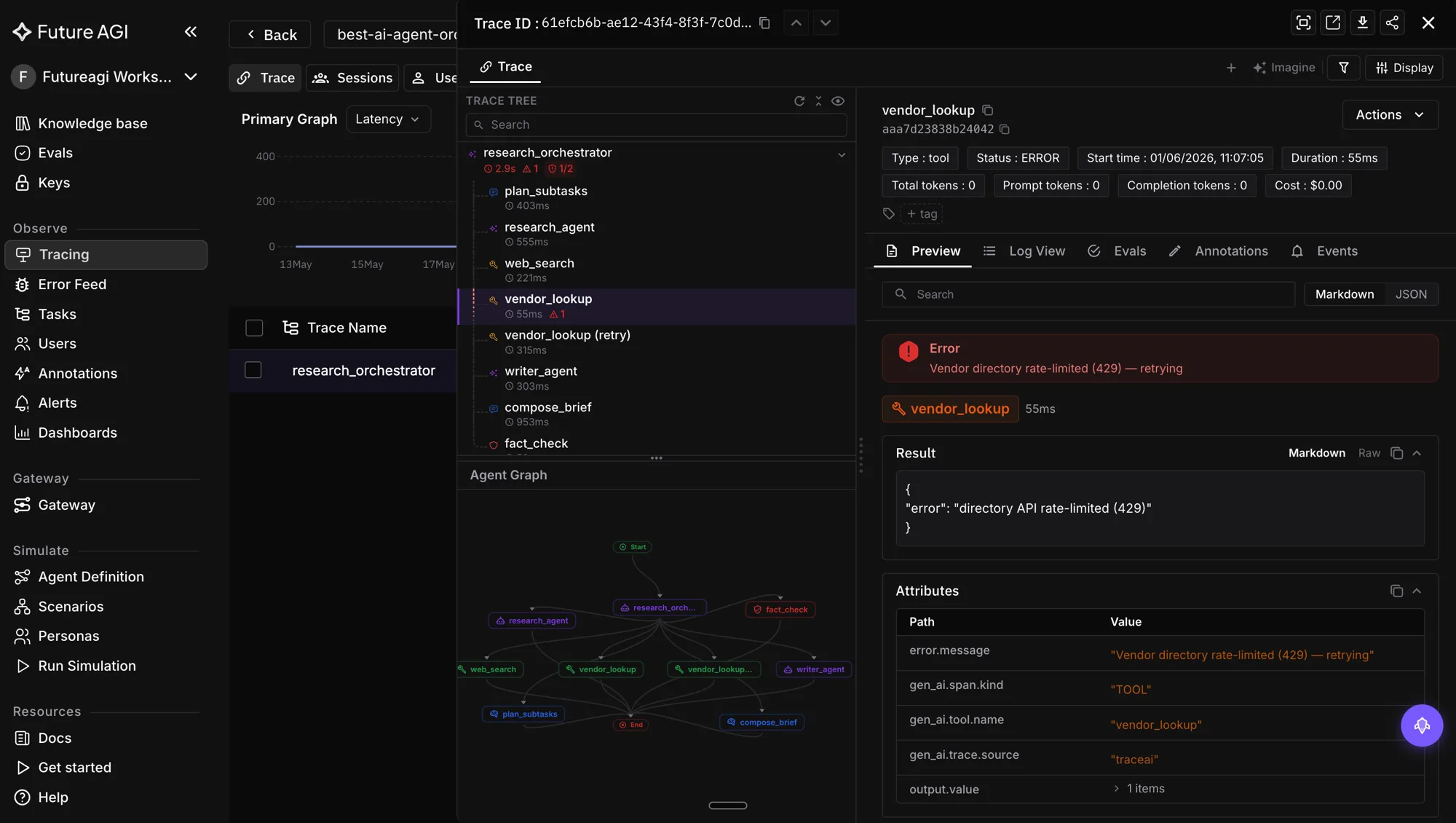
from fi_instrumentation import register
from fi_instrumentation.fi_types import (
    ProjectType, EvalTag, EvalTagType, EvalSpanKind, EvalName, ModelChoices,
)

register(
    project_name="support_agent",
    project_type=ProjectType.OBSERVE,
    eval_tags=[
        EvalTag(
            type=EvalTagType.OBSERVATION_SPAN,
            value=EvalSpanKind.LLM,
            eval_name=EvalName.GROUNDEDNESS,
            model=ModelChoices.TURING_LARGE,
            mapping={"input": "input.value", "output": "output.value"},
        ),
    ],
)
Alarm on rolling-mean drift per-route, per-rubric, per-prompt-version. A two-to-five point sustained drop over fifteen to sixty minutes is the right detection threshold for most products. Promote failing production traces into the offline dataset weekly so the gate sharpens every quarter.
Best practices that earn their keep
Same rubric, two places. The CI gate runs the rubric against a versioned dataset. Production observation runs the same rubric against live traces. Same definition both sides. The diff between offline pass and online drop is itself a quality signal.
Per-route thresholds. A 0.85 floor on groundedness for the medical bot is not the threshold the marketing chatbot needs. Per-rubric, per-route thresholds calibrated against the trailing 7-day baseline.
Calibrate the judge against humans. Sample 50-100 traces per quarter, human-label, compare to judge. Drift above 20% inter-rater disagreement means the rubric needs clarification, not a fancier judge. See why LLM-as-a-judge and G-Eval definitive guide.
Cluster failures before triaging. With 50 failing traces, looking at each one is wasteful. Cluster first, name the issue, fix the issue.
Close the loop. Promote production failures into the offline dataset. The same bug should not ship twice.
Common mistakes
- Public benchmarks as production proof. “We hit 85% on MMLU” tells you nothing about your support bot’s groundedness.
- One aggregate score. Hides per-route, per-rubric bugs. Always slice.
- Frozen dataset. Stops being a regression suite the moment production drifts past it.
- Judge-as-marketing. Picking the judge that produces the highest scores instead of the one that agrees with humans.
- Eval on a separate dashboard. When the score, the trace, and the failure live in three tools, no one reads any of them.
- Hand-triage every failure. Without clustering, the triage queue dominates engineering time.
How Future AGI ships the full metrics-plus-benchmarks stack
The gap: benchmarks shape the shortlist; metrics decide the ship; the same rubric has to run in CI before deploy and on live spans after. Start with the SDK for code-defined metrics. Graduate to the Platform when you want self-improving rubrics, classifier-backed cost economics, and an in-product authoring agent.
The ai-evaluation SDK (Apache 2.0) is the code surface. 60+ EvalTemplate classes cover the common rubrics (Groundedness, ContextAdherence, Completeness, ChunkAttribution, FactualAccuracy, PromptInjection, AnswerRefusal, TaskCompletion, EvaluateFunctionCalling, plus customer-agent-specific templates and a long tail for tone, summarization, multi-modal, and translation). CustomLLMJudge ships a Jinja2-templated G-Eval implementation for rubrics templates don’t cover. Four distributed runners (Celery, Ray, Temporal, Kubernetes) carry batch execution. 13 guardrail backends (9 open-weight: LLAMAGUARD_3_8B/1B, QWEN3GUARD_8B/4B/0.6B with 119-language coverage, GRANITE_GUARDIAN_8B/5B, WILDGUARD_7B, SHIELDGEMMA_2B) supply the classifier triage layer for the cost cascade.
traceAI (Apache 2.0) carries the same rubric as a span-attached EvalTag on live traffic across 50+ AI surfaces in Python, TypeScript, Java, and C#. The same rubric in CI and in production is the move that turns a metric from a dashboard into a feedback loop.
The Future AGI Platform layers what code-defined rubrics alone cannot do. Self-improving rubrics retune from thumbs feedback so the rubric ages with the product rather than against it. An in-product authoring agent writes rubrics from natural-language descriptions. Classifier-backed scoring runs at lower per-eval cost than Galileo Luna-2, which makes daily full-traffic scoring financially viable instead of a quarterly batch. Error Feed sits inside the eval stack: HDBSCAN soft-clusters failing traces into named issues, a Sonnet 4.5 Judge agent (30-turn budget, 8 span-tools, Haiku Chauffeur summariser, 90% prompt-cache) writes the RCA with an immediate_fix, and fixes feed the self-improving evaluators. Your private metric suite sharpens as production runs.
The hosted Agent Command Center is the SOC 2 Type II, HIPAA, GDPR, CCPA certified runtime, with 6 native provider adapters (OpenAI, Anthropic, Gemini, Bedrock, Cohere, Azure) plus OpenAI-compatible presets and self-hosted backends (20+ providers total).
Ready to run metrics on your own traffic? Install ai-evaluation, drop a Groundedness plus TaskCompletion rubric against your last fifty production traces this afternoon, and wire the same rubric as an EvalTag on live spans via traceAI tomorrow. The same rubric, both places, is what separates an eval that catches regressions from a benchmark that lives in a slide deck.
Related reading
- The 2026 LLM Evaluation Playbook
- The State of LLM Benchmarking (2026)
- LLM Benchmarks vs Production Evals (2026)
- A Gentle Introduction to LLM Evaluation (2026)
- Build an LLM Evaluation Framework From Scratch (2026)
- G-Eval: A Definitive Guide (2026)
- Why LLM-as-a-Judge (2026)
- RAG Evaluation Metrics Deep Dive (2026)
Frequently Asked Questions
What is the actual difference between a metric and a benchmark?
Which benchmarks still carry signal in 2026?
What metrics should I ship on my system?
How do I pick metrics by application shape?
Do I really need both a CI gate and production observability?
How does benchmark contamination change the 2026 calculus?
What does Future AGI ship for the full metrics-plus-benchmarks stack?
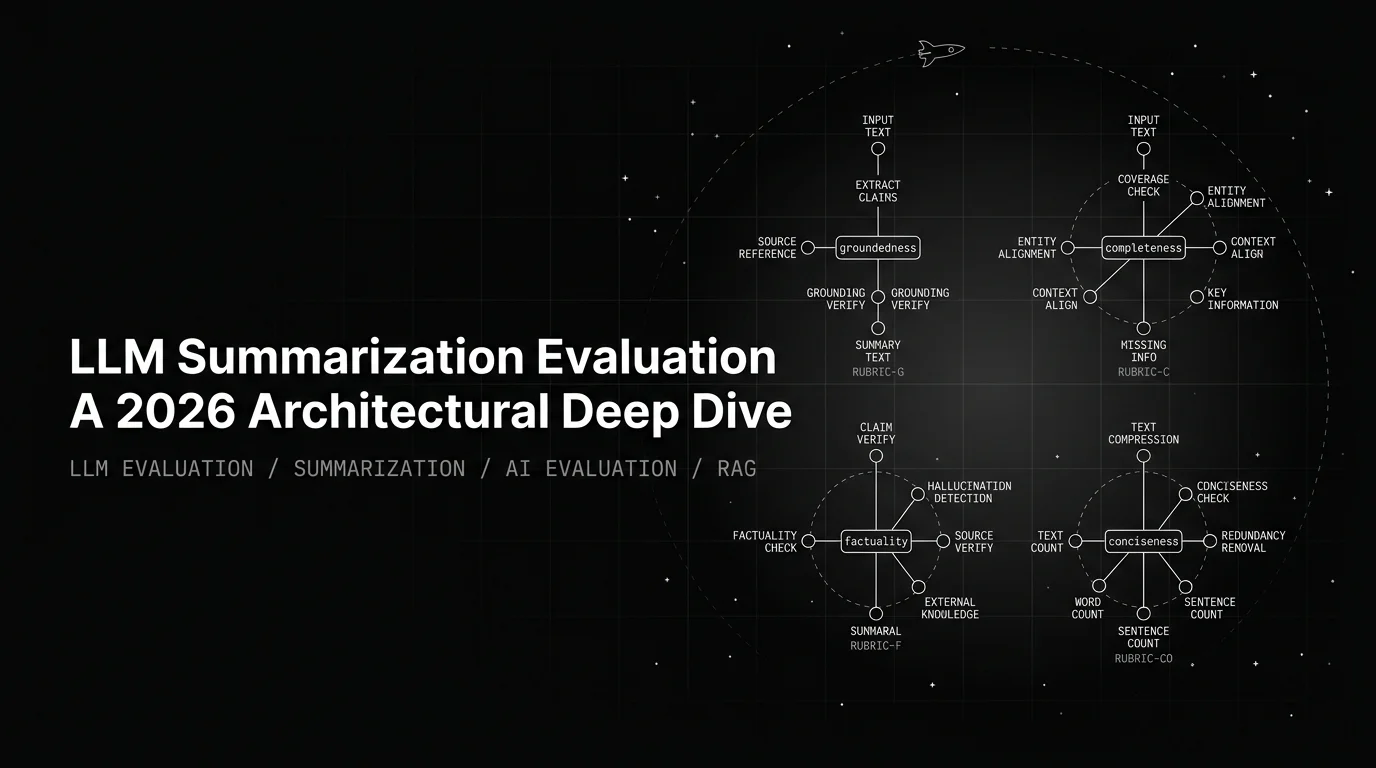
Summarization eval is four judge prompts: groundedness, completeness, factuality, conciseness. Each a hardened prompt with a calibration set. 2026 guide.

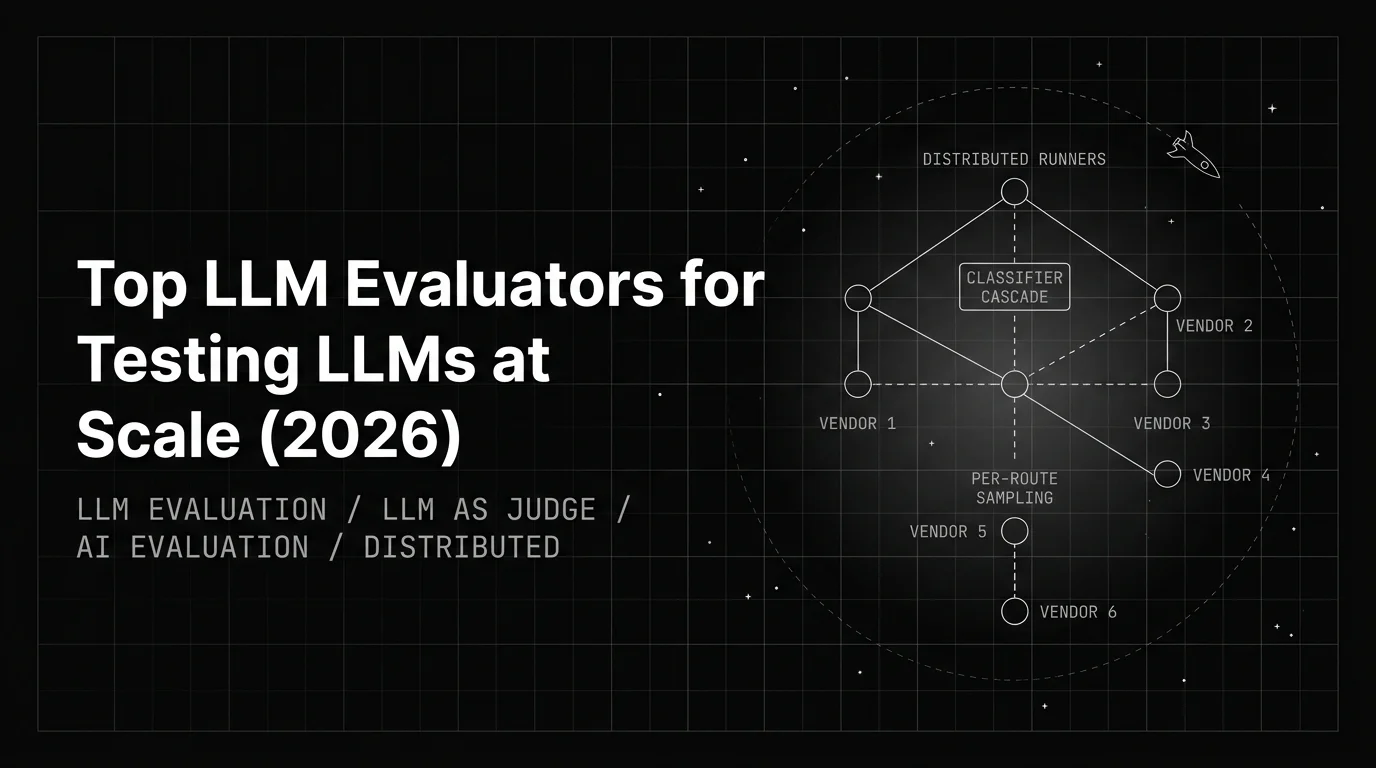
Scaling LLM tests is three primitives: distributed runners, classifier cascade, per-route sampling. Six evaluators ranked by burst survival.

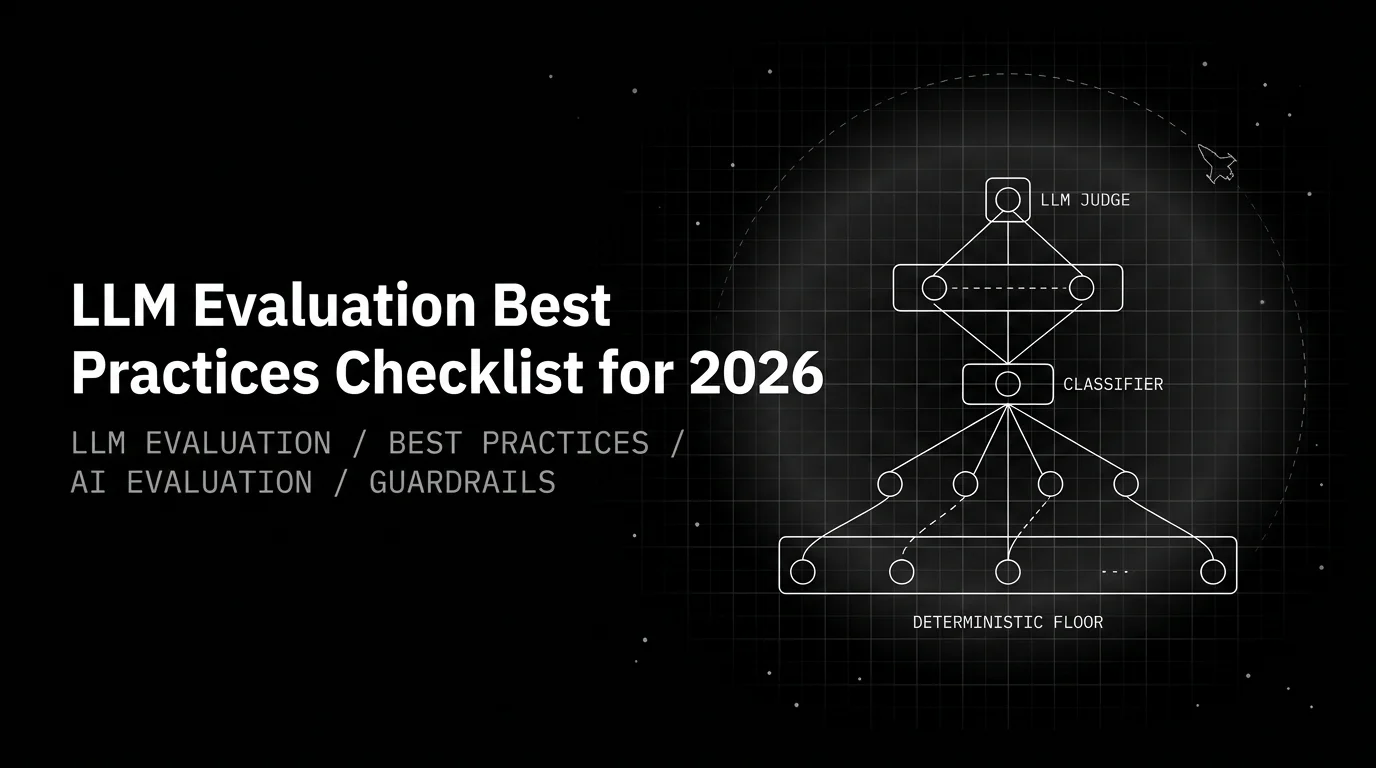
7-item LLM eval best practices checklist that actually ships: dataset, judge calibration, deterministic floor, CI gate, stats, observability, closed loop.