LLM Arena as a Judge: Pairwise Comparison Evals (2026)
Arena-as-a-judge in 2026: when pairwise wins over rubric scoring, the four biases to control, the CI math, and the wiring back to production OTel traces.
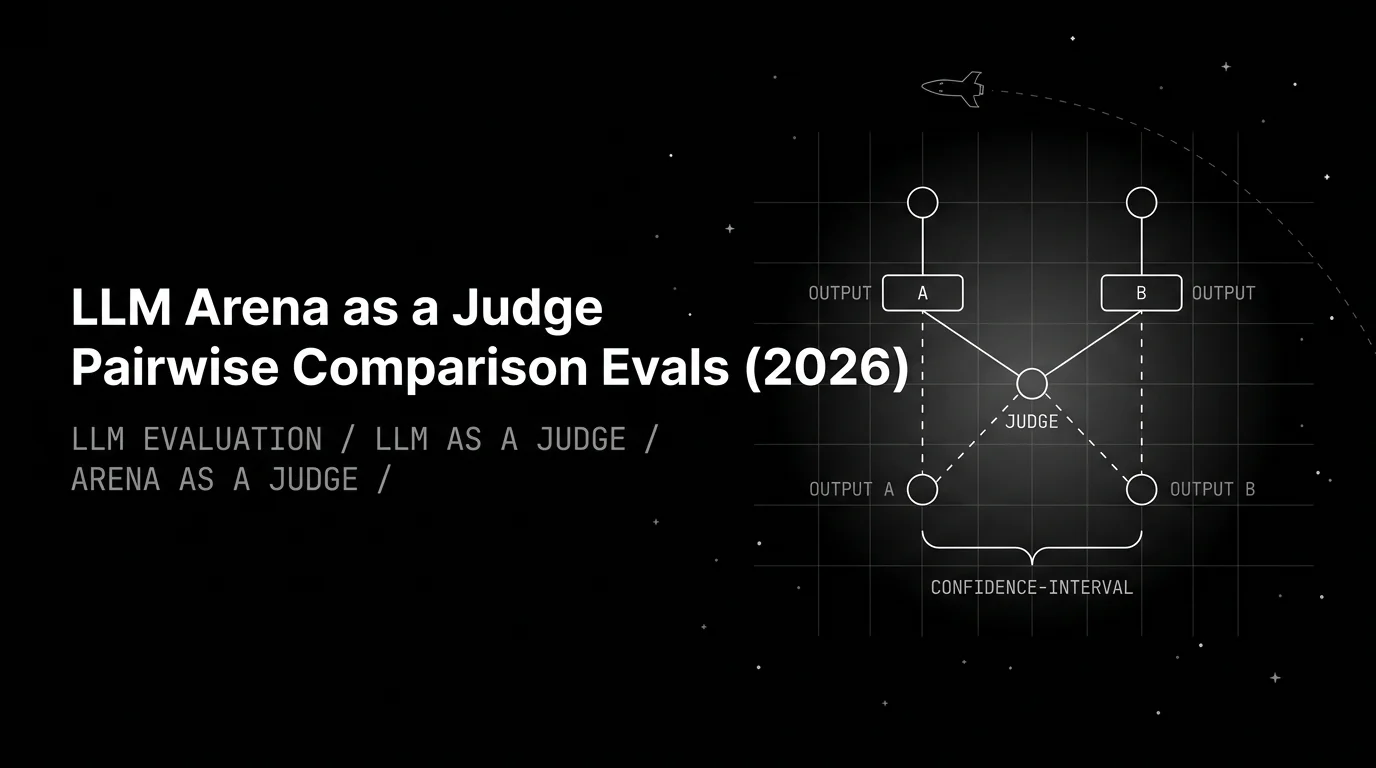
Table of Contents
You reran the rubric. Faithfulness 4.1 on candidate A, 4.0 on B. Task completion 4.3 on both. Tone 4.2 on A, 4.1 on B. Then you read fifty pairs side by side and one is obviously the better assistant: clearer prose, fewer hedges, the right amount of detail. The rubric chart told you nothing the side-by-side told you in ten minutes.
Arena-as-a-judge closes that gap. Show the judge two responses to the same input and ask which is better, instead of grading each one in isolation. Aggregate winrate becomes a sharper ship signal than the aggregate rubric score, especially for subjective qualities the rubric blurs.
The opinion this post earns: pairwise comparison is the right primitive for relative quality decisions; rubric scoring is the right primitive for absolute SLO gates. Teams that confuse the two ship slower and trust their evals less. The axis isn’t “easier to set up” versus “more flexible” — it’s relative versus absolute. Use arena for prompt swaps, model selection, subjective quality, fine-tunes. Keep rubrics for per-axis regression, absolute trend, deterministic CI floors. The choice stops being a tooling preference and starts being a question about what you’re asking.
This guide is the working playbook for arena evals in 2026: when to reach for it, the four biases that wreck a gate, the sample-size math everyone skips, and how the same judge runs in CI and against live OTel spans in production.
TL;DR: arena versus rubric, by question
| Question you’re asking | Arena | Rubric |
|---|---|---|
| Should I ship candidate A or B? | Decisive | Often inconclusive |
| Did absolute quality move quarter-over-quarter? | Hard to track | Native |
| Subjective criteria (helpful, on-tone, concise)? | Holds up | Noisy |
| CI gate on a specific dimension? | Awkward | Native |
| Compare across many candidates? | Elo ranking | Per-axis scores |
| Diagnose which axis lost? | Opaque | Native |
| Per-comparison cost | About 3x rubric | Baseline |
Run both. Rubrics give you the absolute number and the diagnostic axis. Arena gives you the decision.
Pairwise versus pointwise: a different question
Pointwise (rubric) scoring asks the judge “how good is this response, on a 1-5 scale.” Every response is graded in isolation. The judge has to hold an absolute standard across runs, across models, across months. Inter-rater reliability on absolute 1-5 helpfulness sits around 0.45-0.60 on most public datasets. Judge models inherit that variance and add their own drift.
Pairwise asks a different question: “given two responses to the same input, which is better?” The judge is doing the comparison the rubric was trying to approximate. There’s no absolute scale to hold steady. LMSYS Chatbot Arena scaled this primitive to millions of human votes and produced the canonical leaderboard for frontier models, fit to an Elo or Bradley-Terry model. The same primitive scales down to your app.
Three properties make pairwise the right primitive for ship decisions:
- It matches human judgment. Studies on the LMSYS arena dataset and MT-Bench show pairwise verdicts agree with human preference more reliably than absolute scores. The gap widens on subjective dimensions.
- It cancels rubric noise. A rubric grading A at 4.1 and B at 4.0 is inside the judge’s own variance. A pairwise judge on the same pair returns a verdict, not a near-tie.
- It’s legible. “Candidate B wins 62 percent of comparisons” is a number a PM reads. “Candidate B scored 4.06 versus 4.01 on helpfulness” gets argued about for three days.
What pairwise gives up is the diagnostic axis. A losing winrate tells you the candidate is worse, not whether faithfulness regressed, tone regressed, or both. That’s why you keep rubric scoring running alongside.
Four biases will wreck the gate before it gets useful
Pairwise judges aren’t neutral. They ship with documented systematic preferences. None of these are the judge being “wrong” — they’re artifacts of how the model was trained.
Position bias. Some judges over-prefer slot A; others prefer slot B. The effect is model-specific and can swing 10-15 points of winrate on close calls. The fix is the cheapest of the four: randomize which candidate gets labeled A or B on every comparison. Sharper still, run every pair both ways and treat order-dependent verdicts as ties — the judge flipping with the order is telling you the candidates are genuinely indistinguishable.
Length bias. Judges over-prefer longer responses on prompts that don’t penalize verbosity. A candidate padding its answer with restated context beats a sharper answer when length is the implicit signal. Mitigations: write “do not prefer longer answers” into the rubric, cap length on both sides when length isn’t the variable under test, and track length-controlled winrate (pairs within ±20 percent token count) alongside raw winrate.
Verbosity bias. Closely related to length, distinct in mechanism. Judges prefer elaborate phrasing at matched token counts. “The capital is Paris” loses to “The capital of France is Paris, which is in Europe” on judges that read elaboration as helpfulness. Token caps don’t fix this. The fix is calibration against a human-labeled hold-out where you know the verbose answer is wrong.
Self-preference bias. A model judging its own outputs against a different family scores itself higher. The pattern is documented across Llama, Claude, and GPT pairs. Frontier-to-frontier across families (Anthropic-judged GPT vs Gemini, OpenAI-judged Claude vs Llama) is fine. Same model as judge and candidate is not.
A fifth pattern most teams miss: rubric-leakage bias. The comparison prompt accidentally describes criteria in language closer to one candidate’s style. “Prefer answers that explain step by step” loads the dice toward chain-of-thought candidates. Rotate rubric phrasings on calibration; if winrates move with phrasing, the rubric is leaking.
For ship decisions, don’t trust a single judge. Run a three-judge ensemble across model families (Claude Sonnet 4.5, GPT-5.1, Gemini 2.5 Pro is a defensible default as of May 2026) and take the majority. Family-specific biases cancel. The ensemble costs roughly 3x a single judge, so reserve it for launches and for winrates inside the noise band near 50 percent. Single judge for weekly trend tracking. Ensemble for the launch gate.
Size the comparison set by effect, not by habit
The most common arena gate failure isn’t bias. It’s running too few comparisons and trusting the resulting winrate.
The 95 percent confidence interval on a winrate p with n comparisons is roughly ±1.96 × sqrt(p × (1 - p) / n). At p=0.55 and n=200, the interval is ±6.9 points, which crosses 50 percent. The candidate might be winning. It might be tied. You can’t tell. At n=500, the interval narrows to ±4.4 points, which clears 50 comfortably.
Rules of thumb:
- Decisive winner (60%+). 100 position-randomized comparisons stabilize within ±5 points.
- Close call (52-58%). Need 300-500 comparisons before the verdict separates from noise.
- Multi-candidate Elo. 500-1000 comparisons per pair before rankings stop reshuffling.
Run a power calculation against your expected effect before you wire the gate. If 200 comparisons land at 51 percent, the change is neutral; ship it or revert it on other grounds. The math is the cheapest discipline in this stack and the one most teams skip.
Wire arena into CI on every PR
The pattern that works:
- Baseline is the current production prompt or model.
- Candidate is the PR change.
- Run 100-200 position-randomized pairwise comparisons on the eval dataset.
- Fail the PR if the candidate winrate sits below 50 percent with a meaningful confidence interval, or below a stronger ship threshold (54-56 percent) when stakes are higher.
A working CI fixture against Future AGI’s ai-evaluation SDK. CustomLLMJudge is configured once with the pairwise grading criteria and reused across comparisons. The judge encodes the verdict as a score (1.0 = A wins, 0.0 = B wins, 0.5 = tie) inside the native DefaultJudgeOutput schema:
import random
from fi.evals.metrics.llm_as_judges.custom_judge.metric import CustomLLMJudge
from fi.evals.metrics.llm_as_judges.types import CustomInput
from fi.evals.llm.providers.litellm import LiteLLMProvider

# Judge: a different model family than either candidate.
judge = CustomLLMJudge(
    provider=LiteLLMProvider(),
    config={
        "name": "pairwise_helpfulness",
        "model": "claude-sonnet-4-5-20250929",
        "grading_criteria": (
            "Compare two answers to the same question. "
            "Optimize for helpfulness, accuracy, and tone. "
            "Do not prefer longer answers. "
            "Return score=1.0 if ANSWER_A is better, "
            "score=0.0 if ANSWER_B is better, "
            "score=0.5 if they tie. Put a brief justification in reason."
        ),
    },
)

def arena_winrate(dataset, baseline_fn, candidate_fn, n: int = 200) -> dict:
    wins, losses, ties = 0, 0, 0
    for _ in range(n):
        ex = random.choice(dataset)
        base = baseline_fn(ex)
        cand = candidate_fn(ex)
        flip = random.choice([True, False])
        answer_a, answer_b = (cand, base) if flip else (base, cand)
        result = judge.compute_one(CustomInput(
            question=ex.question, answer_a=answer_a, answer_b=answer_b,
        ))
        score = result["output"]  # 1.0 A, 0.0 B, 0.5 tie
        if score == 0.5:
            ties += 1
        elif (score == 1.0 and flip) or (score == 0.0 and not flip):
            wins += 1
        else:
            losses += 1
    return {"wins": wins, "losses": losses, "ties": ties}

def test_candidate_wins(eval_dataset):
    r = arena_winrate(eval_dataset, baseline_agent, candidate_agent, n=200)
    decided = r["wins"] + r["losses"]
    winrate = r["wins"] / decided if decided else 0.0
    assert winrate >= 0.50, f"candidate lost: winrate={winrate:.2%}"
Three habits separate a working arena gate from theatre:
- Randomize position per comparison. The
flipvariable above. Never run all comparisons with one candidate always in slot A. - Pin judge model and rubric version. A floating judge produces drifting winrates. The judge version is part of the eval contract; bump it deliberately.
- Cache pair verdicts. The tuple
(baseline_output, candidate_output, judge_model, rubric_version)returns the cached verdict on rerun. Invalidate on judge or rubric version change, not on every PR.
For the launch-gate ensemble, run three CustomLLMJudge instances against three model families in parallel and take the majority. The three judges share the same grading criteria; only the model field changes. Ensemble disagreement is its own signal — if the three split on a pair, that pair is genuinely ambiguous and shouldn’t move the winrate either way.
Cascade the cost: classifier first, frontier only on close calls
Not every comparison needs a frontier judge. The SDK ships 13 guardrail backends, 9 open-weight classifiers (LLAMAGUARD_3_8B/1B, QWEN3GUARD_8B/4B/0.6B with 119-language coverage, GRANITE_GUARDIAN_8B/5B, WILDGUARD_7B, SHIELDGEMMA_2B).
For non-subjective axes (toxicity, safety, factual contradiction against a known reference), a classifier-backed pairwise pass runs at a fraction of the per-call cost of a frontier judge. Weekly full-dataset reruns stop being a budget conversation. The cascade: classifier triages every comparison; only disagreements or low-confidence calls escalate to the LLM judge. The Future AGI Platform runs this cascade at lower per-eval cost than Galileo Luna-2, which makes Elo across a dozen production candidates a daily job instead of a quarterly one.
The trap to avoid: don’t cascade on subjective axes. A 2B-parameter classifier won’t call helpfulness better than a frontier judge. Use the cascade where the classifier has a clean target (PII match, reference match) and reserve the frontier judge for the dimensions where it earns its bill.
Bridge to production with paired traces
The CI gate catches regressions you can think of. Production catches everything else. The same judge prompt that ran the gate should run against live traffic.
Run a canary that splits a small percentage of production traffic between baseline and candidate. Sample pairs from the canary, run the same arena judge offline against the pairs, accumulate winrate over a rolling window. Alarm when winrate drops below an agreed floor or moves by more than five points week-over-week.
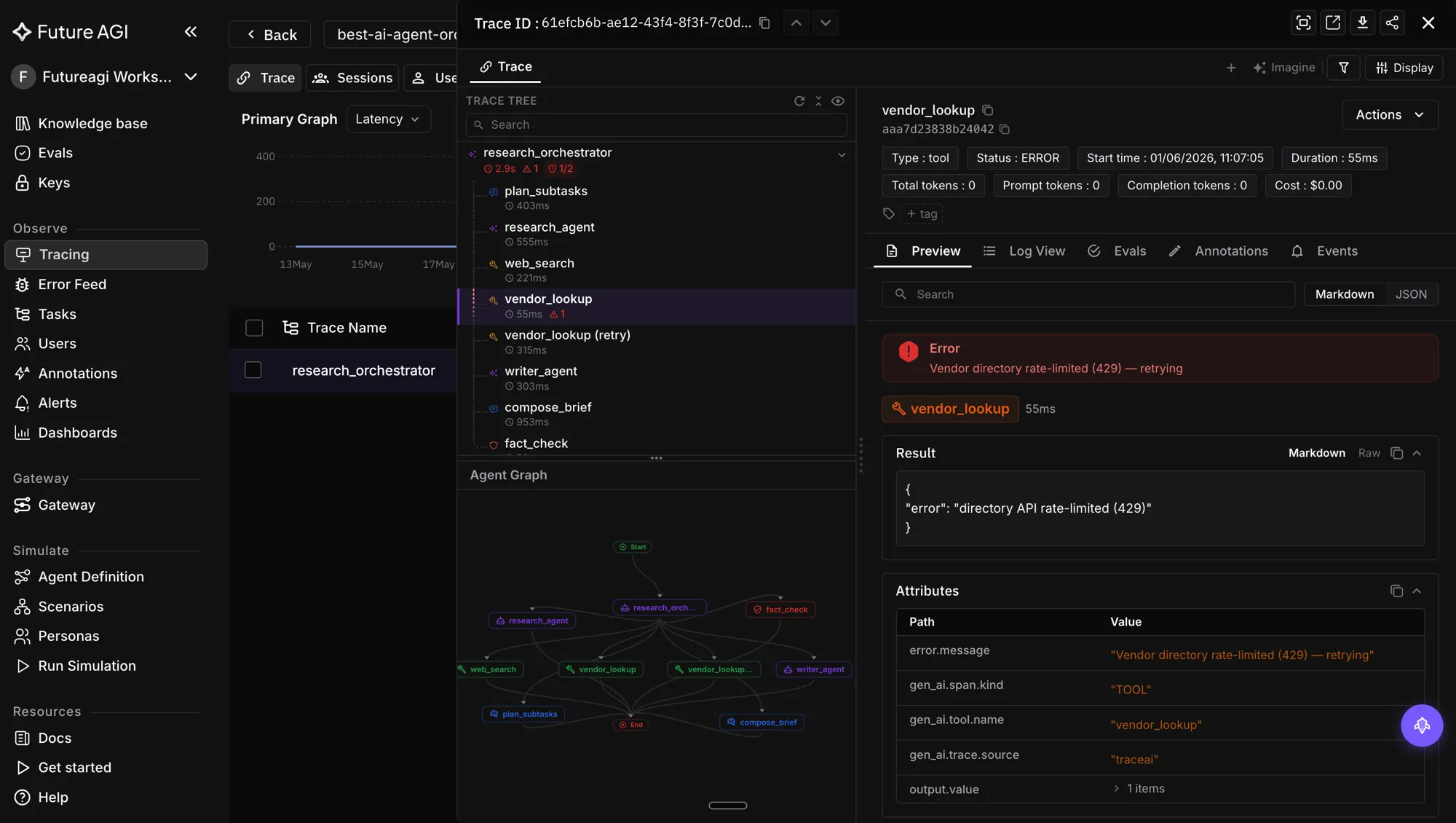
The wiring matters: the canary needs paired traces, not two parallel firehoses. traceAI (Apache 2.0) emits OpenTelemetry spans across 50+ AI surfaces in Python, TypeScript, Java, and C# (including a Spring Boot starter, Spring AI, LangChain4j, Semantic Kernel). A pairing key on span attributes lets the offline judge group baseline and candidate responses for the same input. The Agent Command Center handles the split: six routing strategies, shadow/mirror/race modes, 20+ providers. Response headers like x-agentcc-model-used let the pairing logic reconstruct which model produced which side.
The pairwise judge attaches its score back to the span via EvalTag so the verdict lives next to latency, model, and input. Same rubric, two contexts: CI on the eval dataset before deploy, canary on live pairs after.
Choose arena, choose rubric
Choose arena when:
- You’re picking between two prompts, two models, or two fine-tunes.
- Success criteria are subjective and rubric averages cluster at the second decimal.
- Stakeholders need a single legible number (“candidate B wins 62 percent of the time”).
- You’re building an Elo leaderboard across multiple candidates for routing.
Choose rubric scoring when:
- You need an absolute floor (“faithfulness ≥ 0.85”) as a CI gate.
- You’re tracking quality quarter-over-quarter against an absolute scale.
- You need per-axis diagnosis when a candidate regresses (“tone held, faithfulness dropped”).
- You’re scoring high-volume production traffic where pairwise cost is prohibitive.
Avoid arena when:
- The candidates aren’t comparable on the same input distribution.
- You can’t randomize position.
- The judge model is one of the candidates.
- You only have 50 examples; the math doesn’t separate the verdict from noise.
Match the question to the primitive, not the primitive to the leaderboard. “Is candidate B better than A?” is a winrate question. “Is faithfulness above 0.85 this week?” is a rubric question.
Common pitfalls that break pairwise gates
- No position randomization. Position bias dominates the winrate; the verdict is meaningless.
- Same model as candidate and judge. Self-preference makes the candidate look better than it is.
- Too few comparisons. A 53 percent winrate after 50 comparisons is indistinguishable from noise.
- Wrong dataset. Sample from production traces; don’t hand-write. An eval set that doesn’t reflect production gives a winrate that doesn’t predict production.
- Skipping length controls. A candidate that’s just more verbose wins on length bias alone.
- Cached verdicts without rotation. Stale verdicts persist after a judge swap. Invalidate on judge or rubric version change.
- Single-judge launches. A judge with a family-specific bias can swing 56 percent to 52 on a different judge. Run the ensemble on launches.
- Ignoring tie rates. 60/5/35 (wins/losses/ties) is not the same as 60/35/5 even at matched winrate. Report the breakdown; high tie rates mean the rubric isn’t sharp enough.
The judge-bias mitigation post covers calibration; the judge prompt engineering guide covers rubric design that holds across phrasings.
How Future AGI ships arena evaluation as a package
The gap: pairwise is a sharper ship signal than rubric averages, but it costs roughly 3x, ships with four documented biases, and needs both a CI gate and a production canary on the same judge prompt. Future AGI ships the eval stack to close that gap. Start with the SDK for code-defined pairwise evals. Graduate to the Platform when you want self-improving rubrics authored by an in-product agent.
The ai-evaluation SDK (Apache 2.0) treats pairwise as a first-class rubric type:
CustomLLMJudge—CustomLLMJudge(provider=LiteLLMProvider(), config={"grading_criteria": "...", "model": "..."}). Multi-modal inputs (text, image, audio).DefaultJudgeOutputparsing built in. Same class powers single-output rubrics and pairwise verdicts; only the grading criteria changes.- 70+
EvalTemplateclasses — absolute-score companions forGroundedness,ContextAdherence,FactualAccuracy,TaskCompletion,EvaluateFunctionCalling. Same dataset feeds both arena and rubric runs. - 13 guardrail backends, 9 open-weight — LLAMAGUARD_3_8B/1B, QWEN3GUARD_8B/4B/0.6B, GRANITE_GUARDIAN_8B/5B, WILDGUARD_7B, SHIELDGEMMA_2B. The classifier triage layer for the cost cascade.
- Four distributed runners — Celery, Ray, Temporal, Kubernetes.
The Platform layers what the SDK alone can’t do: self-improving pairwise rubrics tuned by thumbs up/down feedback; an in-product authoring agent that writes pairwise rubrics from natural-language descriptions; classifier-backed pairwise scoring at lower per-eval cost than Galileo Luna-2, which is what makes daily Elo ranking financially viable.
The same package runs in pytest as a CI gate and against live OTel spans via traceAI (50+ AI surfaces across 4 languages, pluggable semantic conventions at register() time, 14 span kinds, server-side EvalTag with zero added latency). The Agent Command Center handles canary routing across 20+ providers, SOC 2 Type II, HIPAA, GDPR, and CCPA certified (ISO/IEC 27001 in active audit). Error Feed sits inside the eval stack: HDBSCAN soft-clustering groups losing-arena traces into named issues; a Sonnet 4.5 Judge writes the RCA and immediate_fix. Those fixes feed back into the Platform’s self-improving evaluators. agent-opt consumes pairwise scores across six optimizers (RandomSearchOptimizer, BayesianSearchOptimizer, MetaPromptOptimizer, ProTeGi, GEPAOptimizer, PromptWizardOptimizer) for prompt search driven by arena verdicts.
Ready to run an arena gate against your own workload? Start with the ai-evaluation SDK quickstart, wire a CustomLLMJudge against the rubric in this post, and run 200 position-randomized comparisons on your eval set this afternoon.
Related reading
- The 2026 LLM Evaluation Playbook
- Why LLM-as-a-Judge Is the Best LLM Evaluation Method
- Evaluating LLM Judge Bias Mitigation (2026)
- LLM Judge Prompt Engineering Guide (2026)
- Deterministic LLM Evaluation Metrics (2026)
- Best LLM Evaluation Tools (2026)
- Multi-Turn LLM Evaluation (2026)
- LLM Evaluation Architecture (2026)
- Evaluating LLM Routing Policies (2026)
- What Is LLM Judge Prompting? (2026)
- Synthetic Test Data for LLM Evaluation (2026)
Frequently Asked Questions
What is arena-as-a-judge evaluation?
When should I use arena over rubric scoring?
What biases does a pairwise judge have?
How many pairwise comparisons do I need?
Can arena eval run in CI on every PR?
How does arena evaluation bridge to production?
What does Future AGI ship for arena evaluation?

LLM-as-a-judge in 2026: G-Eval, pairwise, rubric, Cohen's kappa calibration, bias controls, plus tools (FutureAGI, DeepEval, Ragas, Phoenix) compared.

LLM-as-a-judge is the only eval method that scales to subjective rubrics. The honest case for, against, and the discipline that earns trust.

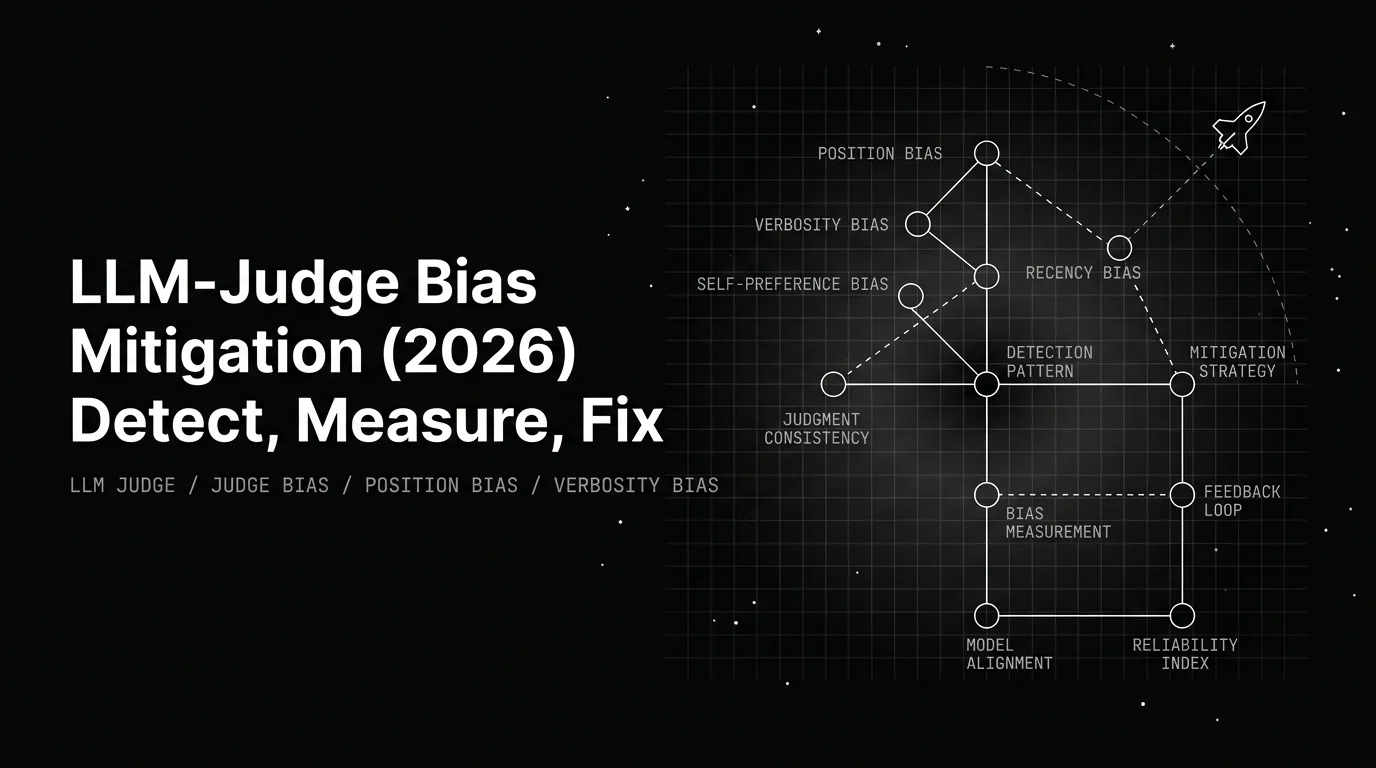
Five named LLM-judge biases, each with a measurement and a mitigation that holds in production: position, verbosity, self-preference, format.
