AI Hallucinations in 2026: Causes, Detection, and Prevention
How AI hallucinations happen in 2026, how to detect them with evaluators, and how RAG, structured output, and guardrails prevent them in production.
Table of Contents
AI hallucinations in 2026: what they are and why they still happen
AI hallucinations are outputs from a language model that appear confident and fluent but contain false or fabricated information. They are not random bugs. As OpenAI’s September 2025 paper Why Language Models Hallucinate (arXiv 2509.04664) argues, hallucinations are an emergent property of how LLMs are trained: the model is rewarded for confident answers, not for saying “I do not know.” The behavior persists in frontier models (gpt-5, claude-opus-4-7, gemini-3.x, llama-4.x), at lower rates than 2024 models but with the same root cause.
This guide covers what hallucinations look like in 2026, why they still happen, how to detect them with evaluators and traces, and how to prevent them in production with RAG, structured output, guardrails, and continuous monitoring.
TL;DR
| Question | Answer |
|---|---|
| Are frontier models still hallucinating? | Yes, lower rate, concentrated in long horizon agents and OOD domains |
| Why? | Training objective rewards confident outputs; sampling optimizes for plausibility |
| How to detect? | Online evaluators (faithfulness, context relevance, claim verification) plus consistency checks |
| How to prevent? | RAG with citations, structured output, guardrails, calibrated refusal |
| Best tool stack? | Future AGI for end to end, RAGAS or Patronus or Galileo if narrower scope works |
If you ship LLMs in production: trace every call with traceAI, score every response with an online faithfulness evaluator, and gate releases on a hallucination regression suite.
Types of hallucinations
| Type | What it looks like | Common cause |
|---|---|---|
| Factual | ”The Eiffel Tower opened in 1887” (it was 1889) | Stale or wrong training data |
| Contextual | Output contradicts the document the user just supplied | Long context, model ignores it |
| Logical | ”All birds fly, penguins are birds, so penguins fly” | Reasoning failure |
| Self contradictory | The same response contradicts itself | Sampling drift across the response |
| Citation | Cites a paper that does not exist or misquotes a real one | Model invents a plausible reference |
| Tool call | Agent calls db.delete(user_id) with a fabricated user_id | Long horizon trajectory drift |
In agent systems the failure mode that hurts most is tool call hallucination, because the consequences are not confined to text.
Why hallucinations happen
Training objective rewards confidence
LLMs are trained on next token prediction over web scale data. The objective optimizes for likelihood under the training distribution. It does not reward refusal. When a model is asked something it does not know, the most likely completion is often a plausible looking answer, not “I do not know.” OpenAI’s 2025 paper formalizes this: hallucinations arise because the training and eval setup makes confident wrong answers locally optimal.
Sampling optimizes for plausibility, not truth
Token by token sampling picks the most probable next token given the context. Probability is shaped by training data patterns. If the model has seen lots of biographies, generating a plausible but wrong birth year is statistically easy.
# Simplified view of token generation
import math
import random

def softmax(xs):
    e = [math.exp(x) for x in xs]
    s = sum(e)
    return [x / s for x in e]

def generate_next_token(logits, temperature=0.7):
    probs = softmax([x / temperature for x in logits])
    return random.choices(range(len(probs)), weights=probs)[0]
Lower temperature reduces randomness but does not improve factuality on its own.
Context window pressure
When the relevant fact is missing from context, buried in the middle of a long context, or in conflict with another part of the context, the model fills in from training memory. The Liu et al. “Lost in the Middle” work (arXiv 2307.03172) showed how strongly position in context affects accuracy. 2026 long context models reduce but do not eliminate this effect.
Agent trajectory error compounding
A 5 percent per step hallucination rate becomes about a 23 percent trajectory error rate over 5 steps. In multi step agents, a single bad tool call poisons everything downstream. Step level evaluation (not just final answer) is the only way to catch this before it ships.
How to detect hallucinations
Reference free evaluators
Score an output against the prompt and the retrieved context without a gold answer. Future AGI’s faithfulness, context relevance, and groundedness evaluators are the workhorses. Run them inline.
from fi.evals import evaluate

answer = "Customer must request a refund within 30 days, per policy section 3.1."
context = "Refunds are accepted within 30 days of purchase. See policy 3.1."

result = evaluate(
    "faithfulness",
    output=answer,
    context=context,
    model="turing_flash",
)

if result.score < 0.7:
    print("flagged for review", result)
Reference based evaluators
Compare to a known good answer when you have one. Use BLEU, ROUGE, exact match for short factual outputs, and LLM judges for longer answers. RAGAS, FActScore (arXiv 2305.14251), and HaluEval (arXiv 2305.11747) are the canonical references.
Consistency checks
Generate K samples (3-10) and check agreement. Disagreement is a strong hallucination signal. Standard in production systems that already cache K samples for ensembling.
from fi.evals import evaluate

prompt = "What year did the Eiffel Tower open?"
# samples is a list of K generations from your LLM provider of choice
samples = ["1889", "1889", "1887", "1889", "1889"]

result = evaluate("consistency", outputs=samples, model="turing_flash")
if result.score < 0.8:
    print("flagged", prompt, result)
Confidence calibration
A well calibrated model expresses uncertainty when it is unsure. Hedging language (“I think,” “possibly,” “I am not certain”) correlates with self assessed confidence. Score the calibration alongside the answer.
Human review for ground truth
The only true ground truth is human review. Sample 1-5 percent of production responses, have annotators label them, and use that as the calibration set for your automated evaluators. Without this, your hallucination dashboard is a black box.
How to prevent hallucinations
Retrieval Augmented Generation
RAG is the highest leverage intervention. Retrieve authoritative documents, pass them as context, force the model to cite them.
from fi.evals import evaluate

def rag_answer(query, retriever, llm_call):
    # retriever and llm_call are user supplied callables for retrieval and generation
    docs = retriever(query, top_k=5)
    context = "\n\n".join(d["text"] for d in docs)
    answer = llm_call(
        f"Answer using ONLY the context below. Cite source ids.\n\nContext:\n{context}\n\nQuestion: {query}"
    )
    score = evaluate("faithfulness", output=answer, context=context, model="turing_flash")
    return {"answer": answer, "faithfulness": score.score, "sources": [d["id"] for d in docs]}
What matters in practice:
- Chunking strategy and reranking quality (see advanced chunking techniques for RAG).
- Strict instructions to cite. Reject outputs without citations.
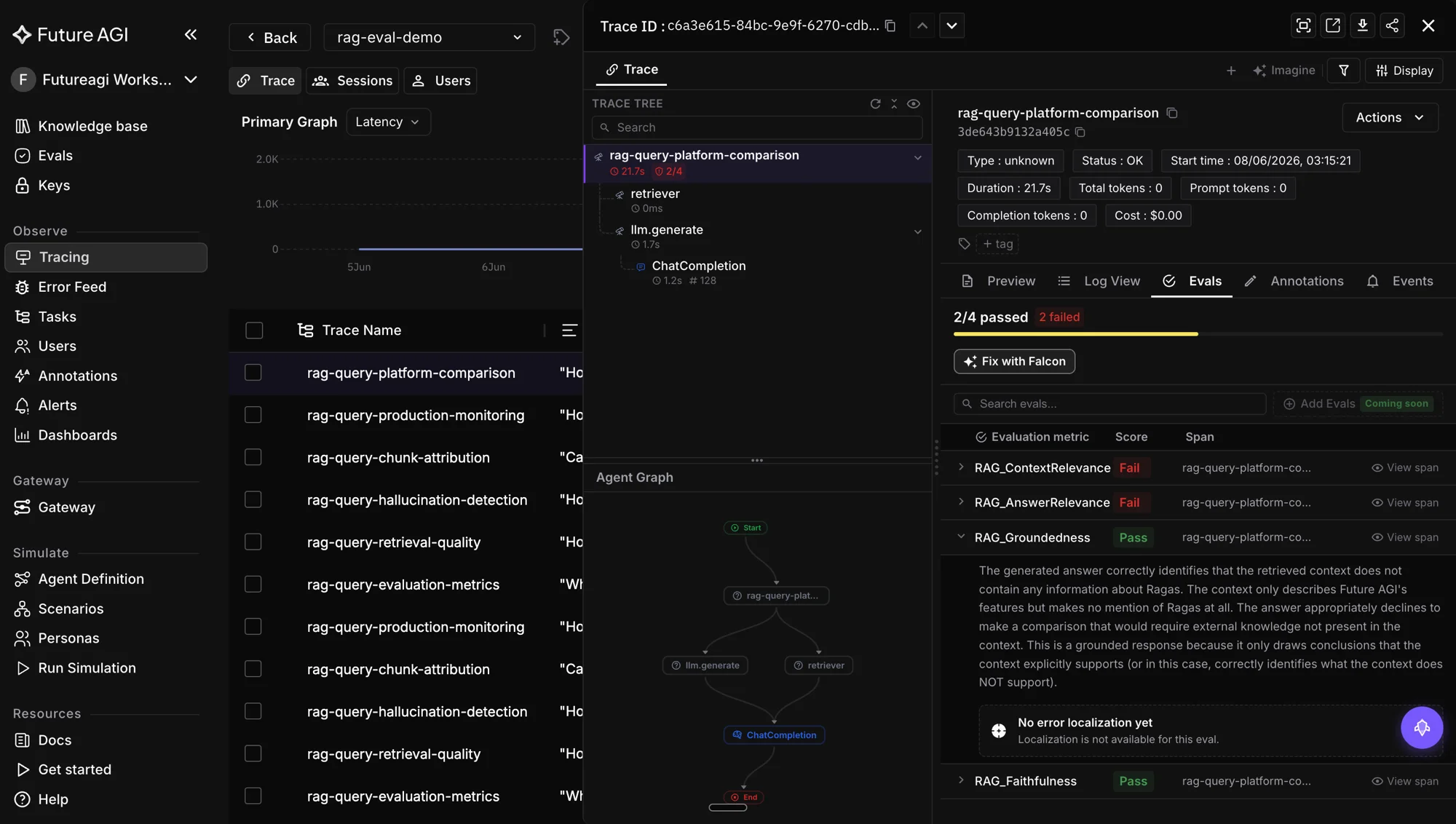
- Faithfulness scoring on every response, not just spot checks.
Structured output
Constrain the model to a Pydantic schema or JSON schema. The model cannot fabricate fields that the schema does not allow, and validation catches obvious errors.
from pydantic import BaseModel, Field
from openai import OpenAI

class ProductInfo(BaseModel):
    name: str
    price: float = Field(ge=0)
    in_stock: bool

client = OpenAI()
user_input = "Show me the iPhone 15 inventory line"
response = client.responses.parse(
    model="gpt-5",
    input=[{"role": "user", "content": user_input}],
    text_format=ProductInfo,
)
product: ProductInfo = response.output_parsed
OpenAI structured outputs (guide) and Anthropic tool use both constrain to JSON schemas. Pair structured outputs with downstream business validation.
Guardrails
Run input and output through a guardrails layer that catches policy violations and prompt injection. Future AGI’s fi.evals.guardrails.Guardrails covers toxicity, prompt injection, PII, and custom policies.
Chain of thought with verification
For reasoning heavy tasks, have the model show its work, then verify each step against retrieved context. Be careful: reasoning chains can be confidently wrong. Score the chain, not just the final answer.
Calibrated refusal
Train or prompt the model to say “I do not know” when uncertainty is high. OpenAI’s September 2025 paper recommends evaluating models on refusal accuracy alongside answer accuracy. Production teams in 2026 are increasingly scoring “appropriate refusal” as its own metric.
Monitoring hallucinations in production
Continuous monitoring is what separates teams that ship reliable LLMs from teams that ship demos. Three layers:
Trace level
Capture every LLM call as an OpenTelemetry compatible span. Future AGI traceAI (Apache 2.0) does this with one line.
from fi_instrumentation import register, FITracer

register(project_name="rag-prod")
tracer = FITracer(__name__)
Online evaluator scores
Attach faithfulness and context relevance scores to each trace as span attributes. Filter and chart by route, model, prompt version.
Dashboards and alerts
Future AGI’s Agent Command Center at /platform/monitor/command-center surfaces hallucination rate, evaluator scores, and trace drilldown. Wire alerts to Slack or PagerDuty when scores drop below threshold.
# Pseudocode alert configuration
alerts = [
    {
        "name": "rag_faithfulness_drop",
        "condition": "p90(faithfulness_score, 5m) < 0.8",
        "action": "slack#ai-oncall",
    },
    {
        "name": "agent_hallucinated_tool_call",
        "condition": "rate(tool_call_eval == 'invalid', 5m) > 0.05",
        "action": "page",
    },
]
Metrics to watch
- Faithfulness score (median and p10)
- Context relevance score
- Citation accuracy (cited sources exist and support the claim)
- User feedback rate (downvote, regenerate, escalate)
- Refusal rate (too low can mean overconfident; too high can mean too restrictive)
- Tool call validity (agent specific)
Reference benchmarks
When you need a public yardstick:
- TruthfulQA (arXiv 2109.07958) for everyday truthfulness.
- HaluEval (arXiv 2305.11747) for QA, dialog, and summarization hallucinations.
- FActScore (arXiv 2305.14251) for fine grained factual precision.
- SimpleQA from OpenAI for short factual answers.
Public benchmarks measure progress; your own production traces measure trust.
Hallucination operations: a minimal playbook
- Trace every LLM call with traceAI.
- Score every response with at least one reference free evaluator (faithfulness on RAG, factuality on open ended).
- Alert when median or p10 scores drop. Page on tool call validity failures in agents.
- Sample 1-5 percent of traces for human review weekly. Use that to calibrate evaluators.
- Maintain a regression suite of known hard prompts. Run it on every prompt or model change.
- Quarterly: publish hallucination rates to stakeholders. The number should trend down.
Future AGI bundles all of this in one product. If you prefer to assemble open source, RAGAS plus Phoenix plus a manual sampling pipeline can cover much of it with more glue.
Related reads
Frequently Asked Questions
What is an AI hallucination in 2026?
Are frontier models like gpt-5 and claude-opus-4-7 still hallucinating?
What causes LLM hallucinations?
How do I detect hallucinations in production?
Does RAG eliminate hallucinations?
What is the difference between hallucination and confabulation?
What is the simplest way to add hallucination detection to my app?
Will frontier models eventually stop hallucinating?
What 2026 AI agents do well, where they still fail, and the open questions. A grounded read for teams shipping autonomous LLM systems.

Six AI agent reliability solutions compared in 2026 across five layers: runtime guardrails, CI eval gates, span-attached scoring, clustering, closed loop.
Cut RAG hallucinations 2026 with the Future AGI eval loop. Context Adherence and Groundedness, real fi.evals code, chunk and retriever and reranker tuning.
