LLM Hallucination in 2026: The Six Failure Modes, Why They Happen, and How to Catch Each One in Production
What LLM hallucination is in 2026, the six types, why models fabricate, and how to detect each with faithfulness, groundedness, context-adherence scores.
Table of Contents
Picture a medical chatbot in production that ships a paragraph citing a peer-reviewed study with a confident author and year. The study does not exist. The trace shows the retrieved chunks contained the correct, citable source. The model ignored it and fabricated a more impressive-sounding alternative. No faithfulness judge ran on the draft. The hallucination score in the dashboard is zero because there was no judge attached to the generate span. This is the gap that 2026 hallucination work closes: it is not a model problem anymore, it is a missing eval layer. This guide is the 2026 picture of LLM hallucination: the six concrete failure modes, the metric that catches each one, and how to wire detection into a trace and eval back-end before output ships.
TL;DR: LLM hallucination in one table
| Failure mode | What goes wrong | Best metric |
|---|---|---|
| Fabrication | Invented entity, paper, or statistic | Hallucination judge |
| Misattribution | Real fact, wrong source or author | Factual accuracy |
| Unfaithful summary | Output contradicts retrieved chunk | Faithfulness / groundedness |
| Self-contradiction | Response disagrees with itself | Consistency check |
| Off-topic drift | Answers a different question | Task adherence |
| Confident refusal of fact | Denies a true claim in context | Context adherence |
If you only read one row: stop reporting a single hallucination number. Score per failure mode, attach the right metric to the right span, and gate the response before it ships.
What LLM hallucination is, precisely
An LLM hallucination is any model output that is fluent and confidently framed but fails one of three tests: it is wrong against the world, wrong against the retrieved context, or wrong against itself. The word covers a wider failure surface than its 2023 origin: in a 2026 RAG-plus-agent pipeline, hallucination includes the model ignoring a perfectly good chunk just as much as it includes the model inventing a citation.
Mechanically, hallucination is the byproduct of next-token decoding. The model maximizes the probability of the next token given the prompt. The objective is plausibility, not truth. When the prompt is well-supported and unambiguous, plausibility and truth line up. When the prompt is under-specified, contradicted, or asks for a fact outside the training distribution, plausibility wins and the model produces a confident wrong answer. The hallucination architectural deep dive traces this mechanism end to end.
Why decoding produces confident wrong text
Three properties of next-token decoding push toward hallucination.
- Probability mass on plausible tokens. A token that “sounds right” gets high probability whether or not it is factually correct. A fake author with a typical name beats a real author with an unusual name on the surface form.
- No truth signal in the loss. Pretraining minimizes next-token cross-entropy. Nothing in that loss penalizes a confidently wrong continuation more than a confidently right one if both are fluent.
- Sampling injects creativity at a cost. Top-k, top-p, and temperature sampling are designed to make output non-repetitive. They also let lower-probability completions through, which is where fabrications hide.
Post-training fixes (RLHF, DPO, constitutional AI) shift the distribution toward helpfulness and refusal of obviously wrong claims, but they do not change the underlying loss. The fix at runtime is grounding (RAG, tool use, citations) plus a runtime judge that scores the draft before it ships.
The six failure modes of LLM hallucination
Reporting one hallucination rate hides which failure your system is actually making. The six modes below cover the failures seen in production agent and RAG stacks in 2026. Each has a different detection metric and a different fix.
1. Fabrication: invented people, papers, statistics, and case law
The model generates an entity that does not exist: a paper title, an author, a clinical study, a court case, a CVE ID, a product version, or a numeric statistic. Fabrications are most dangerous in domains where the reader is unlikely to verify, like medicine, law, and academic writing.
- Cause. Plausibility wins when the prompt asks for a specific reference and the training distribution had many similar real references.
- Detection. A dedicated hallucination judge that compares each claim to an external knowledge source. The
evaluate("hallucination", ...)template from the ai-evaluation library scores fabrications on free-form responses. - Fix. Force citation, refuse without evidence, or run RAG with strict context adherence. Gate the response with a runtime judge.
2. Misattribution: right fact, wrong source
The model gets the fact right but credits the wrong author, jurisdiction, year, or publication. This is the most common hallucination in well-trained models because the underlying claim is correct.
- Cause. Surface co-occurrences in training data. Two facts often appear near the same name, and the model sometimes swaps them at decoding time.
- Detection. Factual-accuracy scoring against a trusted knowledge base, not a faithfulness judge. The faithfulness judge will pass the claim if the retrieved chunk supports the wrong attribution.
- Fix. Train or prompt for citations and check the citation against the source URL or DOI, not just the surface claim.
3. Unfaithful summary: ignoring or extrapolating the retrieved context
The retrieved chunk says one thing. The model says another. This is the canonical RAG failure: retrieval did its job, the chunk has the answer, the model overrides it with a more plausible-sounding alternative.
- Cause. The training distribution rewards confident, well-formed prose. A short, ambiguous, or technical chunk loses to a smooth fabrication.
- Detection. Faithfulness or groundedness scoring with the retrieved context as the reference.
evaluate("faithfulness", output=..., context=...)is the right call here. The RAG faithfulness deep dive covers the scoring rubric in detail. - Fix. Pre-rank chunks for relevance, increase chunk size when answers are getting truncated, add a faithfulness judge that gates the response and triggers re-retrieval on failure.
4. Self-contradiction: the response disagrees with itself
Within one response, or across a multi-turn session, the model asserts contradictory facts. The first paragraph says the policy starts on January 1, the third paragraph says March 1.
- Cause. Long-form generation has weak global consistency. The model attends to recent tokens more strongly than to its own earlier claims.
- Detection. A consistency judge that extracts claims and checks pairwise contradictions, or a structured evaluator that re-asks the model the same question in a different framing.
- Fix. Shorter, more structured outputs; explicit grounding to a single retrieved source per claim; for multi-turn sessions, a session-level summary that the model re-reads each turn.
5. Off-topic drift: answering a different question
The user asked about API authentication. The model answered about API rate limits. The output is fluent and correct, just not the answer to the question that was asked.
- Cause. Long-context distractors. When the prompt or retrieved context has a salient nearby topic, the model can shift to it, especially for short or ambiguous user queries.
- Detection. Task-adherence scoring: does the response actually answer the user’s question?
evaluate("task_adherence", ...)against the original user query. - Fix. Tighter prompts, query rewriting, and a task-adherence judge that triggers a retry when the response is on-topic-adjacent but not on-topic.
6. Confident refusal of a true fact
The inverse failure: the model says “no information available” or denies a claim when the retrieved context clearly supports it. This shows up in safety-tuned models on borderline topics or in RAG systems where the retrieval was correct but the model second-guessed it.
- Cause. Over-aggressive refusal training, or a model that does not trust its own context window.
- Detection. Context adherence: the response should reflect what is in the supplied context. A response that refuses a well-supported claim fails this metric.
- Fix. Calibrate refusal thresholds, add explicit “answer from context if present” instructions, and audit refusal rates per topic.
How to detect hallucination in production: three layers that ship together
A 2026 hallucination detection stack has three layers. Each layer catches failures the others miss.
Layer 1: span-level traces
Every retrieve, generate, judge, and tool call is a span with OpenInference attributes. This is the substrate that makes runtime and offline scoring possible. Future AGI’s traceAI (Apache 2.0) ships OpenInference-compliant instrumentors for OpenAI, Anthropic, Vertex AI, LangChain, LlamaIndex, and the major agent frameworks.
from fi_instrumentation import register
from traceai_langchain import LangChainInstrumentor

register(project_name="prod-chatbot")
LangChainInstrumentor().instrument()
Once spans are flowing, every generated response is observable end to end. A hallucination becomes a span you can re-score, not a vibe.
Layer 2: runtime evaluators on every response
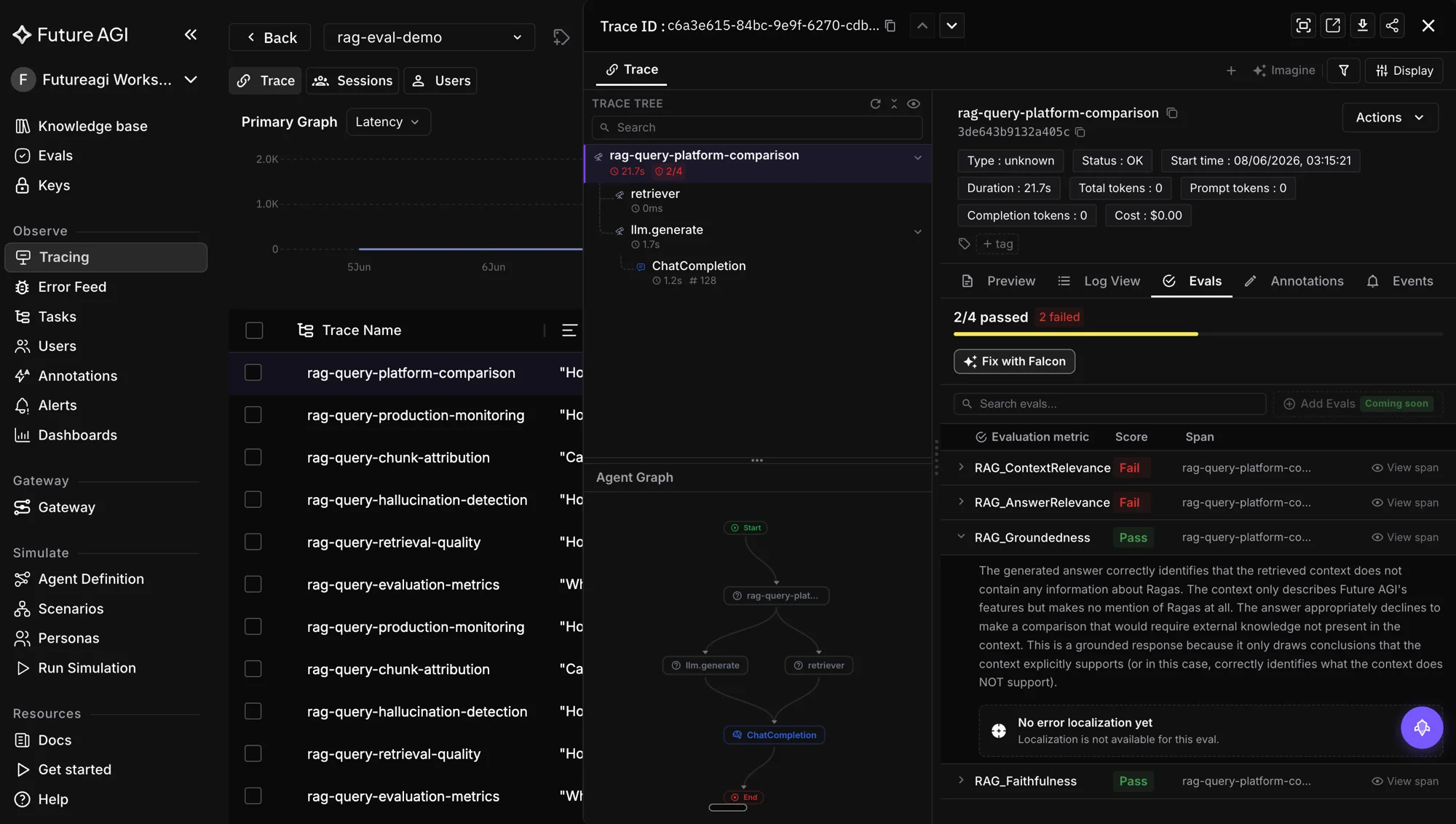
A judge attached to the generate span scores the draft before it ships to the user. For RAG, this is a faithfulness or groundedness check. For free-form chat, a hallucination judge. For agent task completion, task adherence.
from fi.evals import evaluate

def gate_response(draft_response, retrieved_chunks, user_query):
    # Score faithfulness against retrieved context
    result = evaluate(
        "faithfulness",
        output=draft_response,
        context="\n".join(c.text for c in retrieved_chunks),
    )

    if result.score < 0.8:
        # Re-retrieve or refuse rather than ship an unfaithful response
        return retry_with_better_query(user_query)
    return draft_response
The cloud evals run on the turing model family. turing_flash is the default for inline guardrails at roughly 1 to 2 seconds per call. turing_small at 2 to 3 seconds is the middle ground. turing_large at 3 to 5 seconds is the offline-quality default. Latency figures are from the published cloud eval docs at docs.futureagi.com/docs/sdk/evals/cloud-evals.
Layer 3: offline regression on prior traces
Every model change, prompt edit, or retriever swap is a candidate regression. The offline layer re-scores last week’s traced responses against the new system and reports which failure modes got worse.
from fi.evals import evaluate

for trace in last_week_traces:
    new_response = call_new_system(trace.user_query)
    score = evaluate(
        "faithfulness",
        output=new_response,
        context=trace.retrieved_context,
    )
    record(trace.id, "faithfulness_new", score.score)
A regression dashboard with per-mode rates (fabrication, faithfulness, task adherence, consistency) tells you which slice of users will get worse outputs the moment you ship the change.
Hallucination metrics that matter in 2026
The ai-evaluation library (Apache 2.0) ships named templates for each failure mode. The string passed to evaluate(...) selects the template; the remaining kwargs supply the inputs.
| Template | Catches | When to use |
|---|---|---|
faithfulness | Unfaithful summary | RAG pipelines, agent tool use |
groundedness | Output without retrieved support | RAG, summarization, citation-required tasks |
context_adherence | Drift outside supplied context | Instructed answers, customer support |
hallucination | Fabrication and free-form errors | Open-ended chat, content generation |
task_adherence | Off-topic drift | Agent task completion, instructed responses |
factual_accuracy | Misattribution against the world | Citations, fact-heavy outputs |
These are the published evaluator names in the ai-evaluation Python package and the Future AGI docs at docs.futureagi.com. Custom evaluators (domain-specific judges) are built with the CustomLLMJudge wrapper from fi.evals.metrics for offline scoring and fi.opt.base.Evaluator for local optimization.
from fi.evals.metrics import CustomLLMJudge
from fi.evals.llm import LiteLLMProvider

custom_judge = CustomLLMJudge(
    name="medical_safety_judge",
    grading_criteria="Output must cite peer-reviewed sources for any clinical claim.",
    llm_provider=LiteLLMProvider(model="gpt-5-2025-08-07"),
)
For free-form generation without retrieved context, the hallucination template is the right starting point. For any RAG pipeline, faithfulness and context adherence are the two metrics that should run on every response.
Why a faithfulness judge often catches what a bigger model still misses
A common 2025 reflex when hallucination rates were high was to swap a smaller model for a frontier model. In 2026 the picture is more nuanced: a faithfulness judge attached to the draft can catch unfaithful continuations that a larger generator still produces, at a fraction of the cost of upgrading the generator. The reason is structural. The judge runs against the retrieved context, which the generator already had. The generator’s mistake was ignoring it. A second pass with a model whose job is to compare draft against context catches the override without needing a smarter generator.
The pattern works best when the judge runs as a gate, not a report. If the score is below threshold, the system retries with a refined query or returns a refusal. If the judge only logs and the draft ships either way, you get an observability story but not a hallucination fix.
Hallucination by domain in 2026: where the stakes still bite
Three domains continue to bear the brunt of hallucination cost, the same three since 2023, with different specifics in 2026.
Healthcare. Clinical decision support, patient summarization, and triage agents. Fabricated drug interactions, invented studies, and misattributed dosing guidelines remain the worst-case failures. The 2026 pattern is RAG over a curated medical knowledge base with a faithfulness judge and a refuse-without-evidence policy.
Legal. Contract review, case-law search, regulatory analysis. Hallucinated case citations remain the headline failure: a well-publicized 2023 U.S. federal court sanction (Mata v. Avianca) saw attorneys penalized after submitting an AI-generated brief that cited non-existent cases, and similar incidents have surfaced in subsequent years. The 2026 pattern is structured retrieval over a verified case database with a citation-check step that follows the case ID back to the source.
Education and research. Tutoring agents, literature review, exam preparation. Fabricated references and misattributed quotes pollute downstream work and propagate as students cite the model. The 2026 pattern is retrieval over a vetted academic corpus, citation enforcement, and a final factual-accuracy check.
In each domain the fix is the same shape: ground the model in a trusted source, run a runtime judge that scores faithfulness or factual accuracy, and gate the response on the judge.
How Future AGI fits in the hallucination stack
Hallucination detection is Future AGI’s home turf. The ai-evaluation library ships the named evaluators (faithfulness, groundedness, context adherence, hallucination, task adherence, factual accuracy) as one-line evaluate(...) calls. The traceAI library wires OpenInference-compliant spans into LangChain, LlamaIndex, OpenAI Agents SDK, and the rest of the agent ecosystem. The cloud eval models (turing_flash at roughly 1 to 2 seconds, turing_small at 2 to 3 seconds, turing_large at 3 to 5 seconds) give a latency budget for inline guardrails. Both libraries are Apache 2.0.
For runtime guardrails on a chatbot or agent, the Agent Command Center at /platform/monitor/command-center routes traffic through configured evaluators and blocks or rewrites responses that fail. The same evaluator templates are used inline and offline, so a faithfulness gate at runtime matches the faithfulness check in the regression suite.
Strategies to reduce LLM hallucination in 2026
The list below is the 2026 consensus for production work, not a research wishlist.
- Retrieval first, generation second. Any factual question over a known corpus should go through RAG. Generation without grounding is the highest hallucination surface; the RAG hallucination playbook covers the reduction techniques in depth.
- Always run a faithfulness or groundedness judge on RAG outputs. The judge cost is one extra eval call; the win is a hard reduction in unfaithful summaries.
- Force citation when stakes are high. Require the model to quote or cite the retrieved chunk. Check the citation against the source.
- Cap response length on factual outputs. Long free-form continuations have more surface area for fabrication. Short, structured responses are easier to verify.
- Use the right judge for the failure mode. Faithfulness for RAG, hallucination for free-form, task adherence for agents, context adherence for instructed answers.
- Score offline on every model or prompt change. Re-run last week’s traces through the new system. Watch the per-mode rates.
- Refuse rather than ship a low-score draft. A “I don’t have enough information” response is better than a fabricated one in healthcare, law, and customer support.
Best practices for users and product teams
For end users:
- Cross-verify any factual claim against a trusted source, especially numbers, citations, and dates.
- Treat any model output as a draft when the stakes are non-trivial.
- Watch for the failure modes above: a too-clean citation, a too-confident contradiction, a smoothly worded denial of an obvious fact.
For product teams:
- Wire traces from day one. You cannot debug what you cannot see.
- Run evaluators inline on the hottest paths and offline on every change.
- Report per-mode hallucination rates in the weekly product review, not a single number.
- Make refusal an acceptable outcome. A refusal is a successful fence against a fabrication; only count it as a failure if the answer was actually in the context.
Summary: hallucination is a metric problem, not a model problem
The 2026 picture of LLM hallucination is that frontier models are good enough on average and still fail badly on the long tail. The fix is not a bigger model. The fix is grounding plus runtime detection plus per-mode reporting. Wire traces. Attach a faithfulness or hallucination judge to every generate span. Gate the response on the judge. Re-score last week’s traces on every change. Report per-mode rates, not a single number. Future AGI’s ai-evaluation and traceAI libraries (both Apache 2.0) cover the evaluator and trace layers; the Agent Command Center wraps the runtime guardrail path.
Frequently Asked Questions
What is LLM hallucination in 2026?
Why do LLMs still hallucinate in 2026 even with GPT-5, Claude Opus 4.7, and Gemini 3.x?
What is the difference between a factual hallucination and an unfaithful hallucination?
How do I detect LLM hallucination in production?
Can RAG eliminate LLM hallucination?
What is the best hallucination metric for a free-form chatbot versus a RAG system?
How fast can I score hallucination at runtime?
What changed between 2025 and 2026 in how teams handle hallucination?
Detect AI hallucinations in production in 2026: ChainPoll, NLI, SelfCheckGPT, RAG faithfulness, FAGI eval, and human review. Code, latency, and trade-offs.

The 5 best AI hallucination detection tools in 2026, ranked. Compare Future AGI, Galileo Luna, DeepEval, Phoenix, Patronus Lynx on accuracy and price.

Cut RAG hallucinations 2026 with the Future AGI eval loop. Context Adherence and Groundedness, real fi.evals code, chunk and retriever and reranker tuning.
