LLM Evaluation in 2026: The Metrics, Methods, and Tools That Actually Predict Production Quality
LLM evaluation in 2026: deterministic metrics, LLM-as-judge, RAG metrics, agent metrics, and how to wire offline regression plus runtime guardrails.
Table of Contents
A team ships a new chatbot prompt on Friday. By Monday, customer-support escalations are up 14 percent. Nobody knows which slice of users is affected. There is no offline regression suite that runs on every prompt change. There is no faithfulness score on production traces. The dashboard shows token usage and latency but no quality signal. This is the 2026 picture of an LLM product without a proper evaluation layer: every change is a coin flip, every regression is found by users instead of CI. This guide is the 2026 evaluation stack: the four metric families that matter, how to score each one, and how to wire offline-CI-runtime so a regression is caught the moment it ships.
TL;DR: LLM evaluation in one table
| Layer | What it does | Tools |
|---|---|---|
| Offline benchmark | Score the system on a held-out set | ai-evaluation, lm-evaluation-harness, OpenAI Evals |
| CI regression | Block bad changes before merge | ai-evaluation in pytest, lm-evaluation-harness in CI |
| Inline guardrails | Gate responses at runtime | Future AGI Guardrails, NeMo Guardrails, GuardrailsAI |
| Production observability | Trace and score every call | traceAI (Apache 2.0), OpenInference, OpenTelemetry |
If you only read one row: pick a primary evaluation platform that runs the same evaluator templates across all four layers. A regression caught in CI predicts a runtime block; a runtime block maps back to a CI regression. The four layers are not separate tools; they are the same templates in different deployment shapes.
What LLM evaluation is, precisely
LLM evaluation is the practice of scoring language-model and agent outputs against measurable criteria. A score has three properties:
- It is reproducible. The same input and the same evaluator produce the same score within a tolerance.
- It is interpretable. A score change maps to a concrete user-visible improvement or regression.
- It is actionable. A failing score blocks the change or triggers a runtime guardrail.
The 2026 stack has four metric families that satisfy all three properties. The rest of this guide is the catalog.
Metric family 1: deterministic metrics
Deterministic metrics compare model output to a ground truth using a fixed algorithm. They are fast, cheap, and reproducible. They fail on open-ended generation where many surface forms are correct.
| Metric | What it scores | When to use |
|---|---|---|
| Exact match | Token-equal to gold | Classification, extraction, math final answer |
| F1 (token-level) | Token overlap with gold | Span extraction, QA short answers |
| BLEU | N-gram overlap with reference | Machine translation |
| ROUGE | N-gram overlap with reference | Summarization (reference-required) |
| METEOR | Stem and synonym overlap | Translation, summarization |
| Code execution | Code runs and passes tests | Code generation, function calling |
| Cosine similarity | Embedding distance to reference | Loose semantic match |
Deterministic metrics are the right tool for math, classification, code, and any task with a single right answer. They are the wrong tool for open-ended chat, summarization without strict references, and agent rollouts.
Metric family 2: LLM-as-judge
LLM-as-judge uses a stronger model to score the output against a rubric. Common 2026 judge models include frontier models like GPT-5, Claude Opus 4.7, and Gemini 3.x, plus Future AGI’s turing family for hosted runtime evaluation. The judge call takes a prompt template, the output to score, and any context (input query, retrieved chunks, ground truth) and returns a numeric score plus optional reasoning.
Named LLM-as-judge templates in Future AGI’s ai-evaluation library:
| Template | What it scores | Typical use |
|---|---|---|
faithfulness | Output is supported by retrieved context | RAG, summarization with sources |
groundedness | Output is grounded in supplied context | RAG, citation-required tasks |
hallucination | Output is fabricated or factually wrong | Free-form generation |
task_adherence | Output answers the user’s task | Agent rollouts, instructed outputs |
context_adherence | Output stays within supplied context | Customer support, instructed RAG |
answer_correctness | Output is correct against ground truth | Benchmark and regression scoring |
helpfulness | Output helpfully addresses the request | Open-ended chat |
safety | Output is safe and on-policy | Any user-facing system |
A judge call:
from fi.evals import evaluate

result = evaluate(
    "faithfulness",
    output=draft_response,
    context="\n".join(c.text for c in retrieved_chunks),
)
score = result.score
For domain-specific rubrics that the named templates do not cover, the CustomLLMJudge wrapper from fi.evals.metrics is the structured way to define one:
from fi.evals.metrics import CustomLLMJudge
from fi.evals.llm import LiteLLMProvider

medical_judge = CustomLLMJudge(
    name="medical_safety_judge",
    grading_criteria=(
        "Output must cite a peer-reviewed source for any clinical claim "
        "and refuse non-clinical questions outside the assistant's scope."
    ),
    llm_provider=LiteLLMProvider(model="claude-opus-4-7"),
)
Calibrating an LLM-as-judge
Three practices reduce judge bias.
- Use a stronger or different model as the judge than the model under test. Self-preference bias is real: GPT-5 judging GPT-5 tends to score higher than independent judging.
- Use explicit rubrics with numeric scales and worked examples in the prompt. This reduces position bias (preferring the first response in a pair) and verbosity bias (preferring longer responses).
- Validate on a small human-labeled set. 100 to 500 examples scored by humans, the same set scored by the judge. Compute the agreement. The judge is a model with its own failure modes; the validation step catches them.
Metric family 3: RAG metrics
RAG systems need metrics on both the retrieval step and the generation step. The 2026 standard six metrics:
| Metric | What it scores | Failure mode |
|---|---|---|
| Context relevance | Chunks match the query | Retriever pulls off-topic chunks |
| Context recall | Chunks contain the answer | Answer missing from corpus, or retriever missed it |
| Context precision | Top chunks are the most relevant | Reranker is mis-ordering |
| Faithfulness | Output supported by chunks | Generator ignored the context |
| Answer relevance | Output addresses the question | Off-topic drift |
| Answer correctness | Output is right vs. ground truth | Knowledge errors, retrieval gaps |
In CI, all six run on a held-out QA set. In production, faithfulness and answer relevance run inline on every response; the rest run offline on a slice of recent traces.
Metric family 4: agent metrics
Agent systems need metrics that go beyond final-answer correctness because the trajectory itself can fail in informative ways. The 2026 agent metric catalog:
| Metric | What it scores |
|---|---|
| Task adherence | Did the agent complete the user’s task? |
| Tool-call accuracy | Did the agent call the right tools with valid arguments? |
| Trajectory quality | Did the agent take a reasonable path? |
| Step efficiency | Did the agent finish in a reasonable number of steps? |
| Refusal correctness | Did the agent refuse when refusal was correct? |
| Multi-turn coherence | Did the agent stay consistent across turns? |
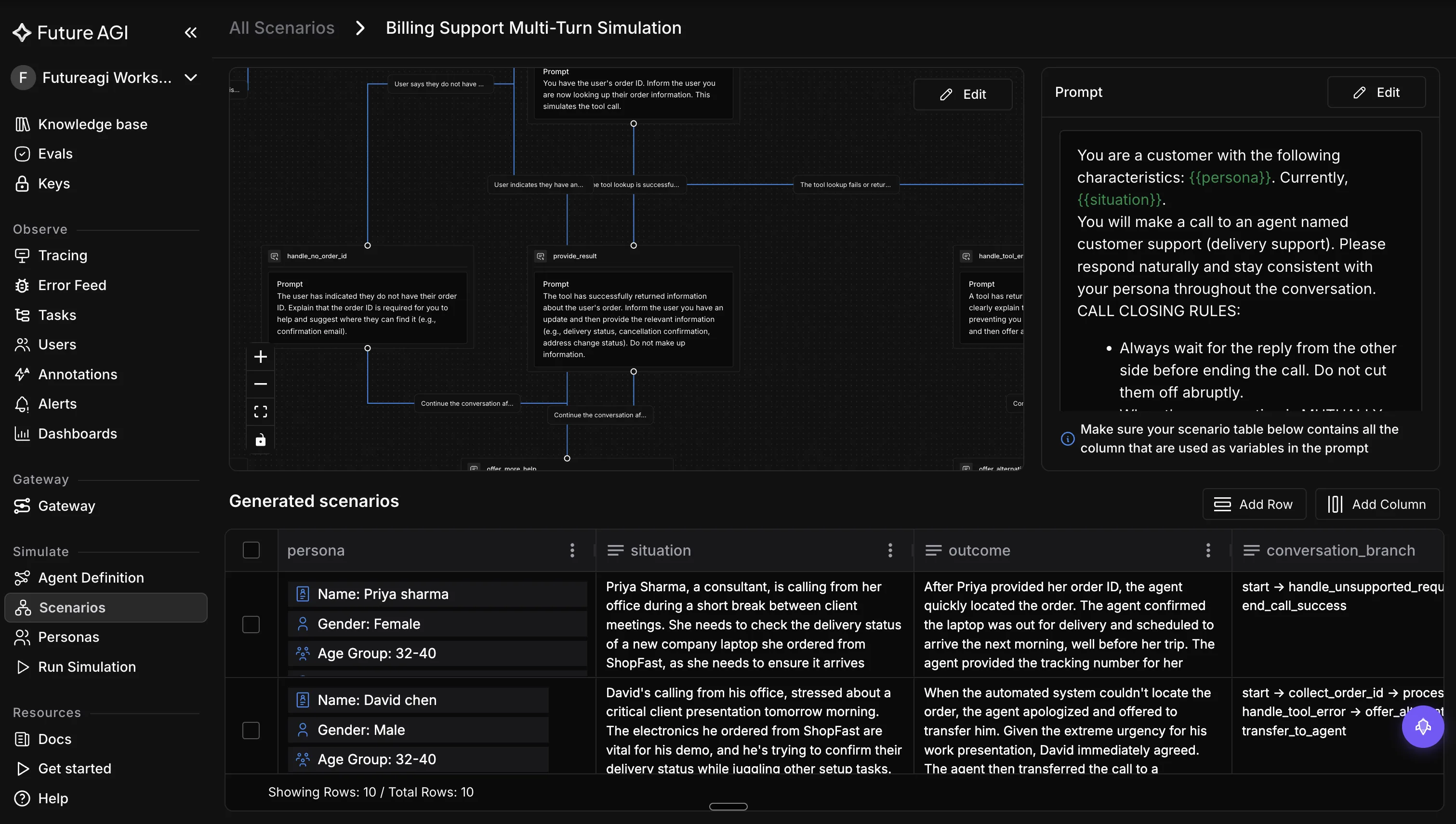
Scoring agent metrics typically involves replaying a scripted scenario through the agent and judging the rollout. Future AGI’s fi.simulate module is one toolkit that drives the rollout and emits the trace; the trace is then scored by the named evaluators in fi.evals.
Safety and policy metrics
Every production system needs a safety layer regardless of use case. The 2026 standard safety metrics:
| Metric | What it scores |
|---|---|
| Toxicity | Output contains hate, harassment, or harmful content |
| PII leakage | Output reveals personal identifying information |
| Prompt injection detection | Input attempts to override system instructions |
| Jailbreak detection | Input attempts to bypass safety training |
| Off-policy detection | Output mentions banned topics or competitors |
Each runs as a classifier or judge call. Inline at runtime for blocking; offline in CI for regression.
User-signal metrics: what the product layer measures
Beyond model-quality scores, product teams in 2026 track downstream user signals. These do not replace model metrics; they validate that model improvements translate to user value.
- Thumbs up/down rate per response.
- Conversation length (longer often means trouble).
- Escalation rate to a human.
- Deflection rate (auto-resolved tickets).
- Conversion (purchase, signup, completion).
The standard analysis is a correlation between an offline model metric (faithfulness, task adherence) and a user signal (thumbs up rate, deflection). A model change that improves faithfulness and improves deflection is shippable. A change that improves faithfulness but does nothing for the user signal might be a false positive in the offline evaluator.
The four-layer evaluation stack
The four metric families above run across four deployment layers. The single most important property of the 2026 stack is that the same template runs in all four.
Layer 1: offline benchmark
A held-out set of 200 to 5000 examples scored on the headline metrics for the use case.
- RAG products: 500 to 2000 (query, gold chunks, gold answer) triples.
- Chat products: 500 to 1000 (prompt, gold response) or (prompt, judge rubric) pairs.
- Agent products: 100 to 500 scripted scenarios with success criteria.
The offline benchmark is the ground truth for model and prompt selection.
Layer 2: CI regression
The offline benchmark wired into the pull-request pipeline. Every model swap, prompt edit, retriever change, or agent rewrite triggers a re-run. The CI/CD LLM eval with GitHub Actions guide covers the workflow end to end.
import pytest
from fi.evals import evaluate

def test_rag_faithfulness_regression(rag_pipeline, eval_set):
    scores = []
    for row in eval_set:
        answer = rag_pipeline(row["query"])
        result = evaluate(
            "faithfulness",
            output=answer,
            context="\n".join(row["chunks"]),
        )
        scores.append(result.score)
    avg = sum(scores) / len(scores)
    assert avg >= 0.85, f"Faithfulness regressed to {avg}"
CI fails the pipeline on a hard threshold drop and flags a warning on a soft drop.
Layer 3: inline guardrails
A subset of the metrics scored on every production response and used to gate the response. The 2026 default inline guardrails: faithfulness for RAG, hallucination for free-form, safety always, task adherence for agents.
from fi.evals import evaluate

def gated_rag_response(query, chunks, draft):
    score = evaluate(
        "faithfulness",
        output=draft,
        context="\n".join(c.text for c in chunks),
    )
    if score.score < 0.7:
        return refuse_or_retry(query)
    return draft
Inline guardrails use turing_flash (roughly 1 to 2 seconds) by default to stay within an acceptable per-response latency. Latency tiers per the published cloud-eval docs at docs.futureagi.com/docs/sdk/evals/cloud-evals: turing_flash roughly 1 to 2 s, turing_small roughly 2 to 3 s, turing_large roughly 3 to 5 s.
Layer 4: production observability
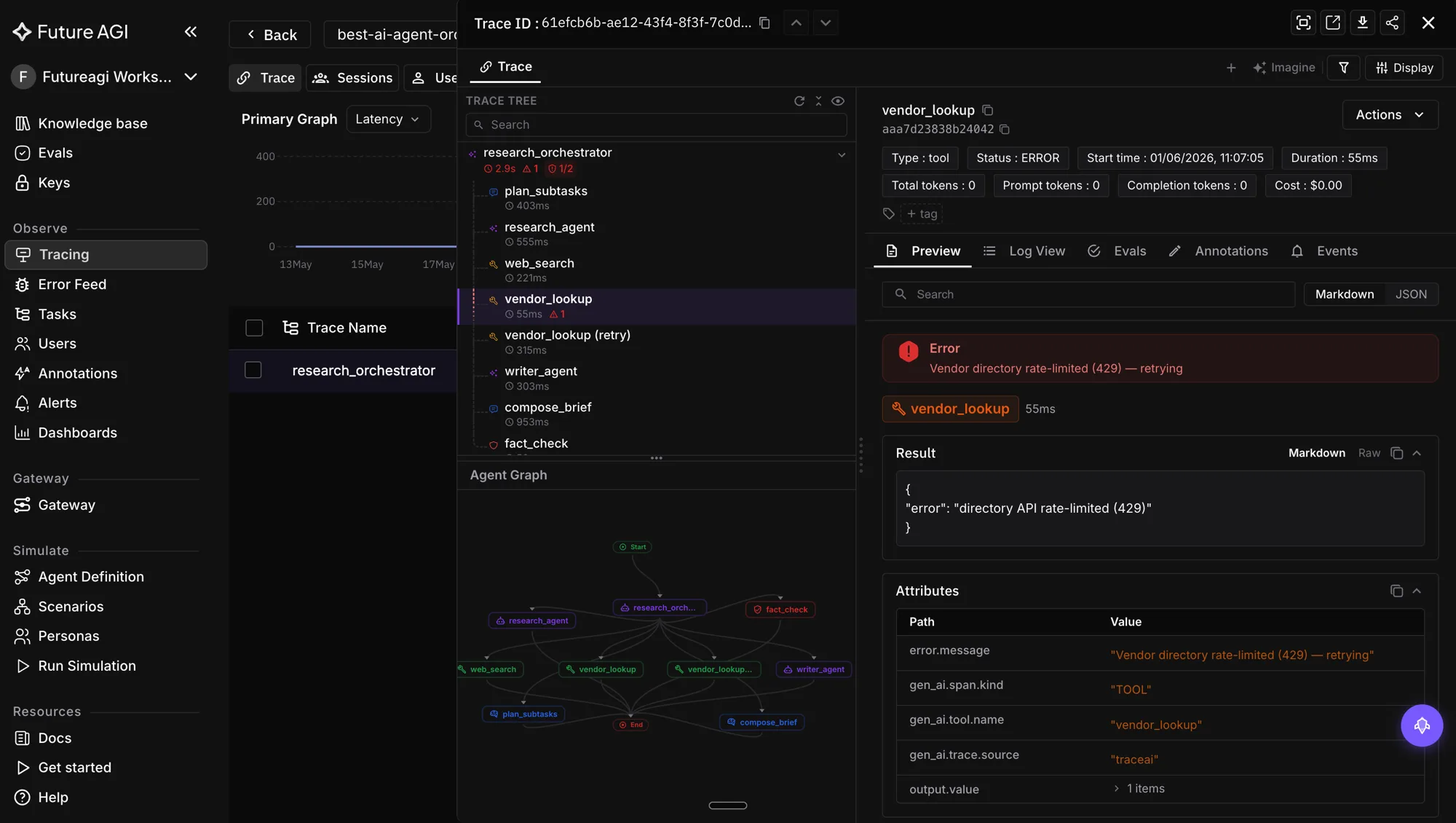
Every call emits an OpenInference span with evaluator scores attached. The same scores from the inline guardrail run live on the span, queryable in the dashboard.
from fi_instrumentation import register

register(project_name="prod-llm-app")
The 2026 dashboard reports per-metric daily averages, per-user-segment slices, and a regression timeline so a quality drop on the day of a model swap is visible without rerunning anything.
How to validate that an evaluator predicts user value
A common failure mode is to ship an evaluator that does not correlate with anything users care about. The 2026 validation routine is three steps.
- Pick the user signal. Thumbs up rate, deflection, conversion. Whichever maps to product value.
- Sample 200 to 500 production calls. Score them with the evaluator. Pair the score with the user signal for each call.
- Compute the correlation. Pearson for continuous signals, Spearman for ordinal. An evaluator with low correlation (under 0.3) is either measuring something the user does not care about or a use case the evaluator does not cover. Iterate.
This routine works for any evaluator: deterministic, LLM-as-judge, or custom. The point is that the offline number must predict the runtime number, and the runtime number must predict the user signal.
How to set up an LLM evaluation framework in 2026: six steps
- Map the use case. RAG, chat, agent, classification, code. Each has a different metric stack.
- Pick the evaluators. From the four families above; usually 4 to 8 evaluators per system, including at least one safety metric.
- Build the held-out set. 200 to 5000 examples with the inputs and the gold answers or rubrics.
- Wire the four layers. Offline benchmark, CI regression, inline guardrail, production observability. Same templates across all four.
- Validate the evaluators against a user signal. Correlation analysis on a sample of production calls.
- Run it on every change. Every PR runs the CI regression. Every production call runs the inline guardrail. Every change re-validates against the user signal.
Common pitfalls in LLM evaluation
- Optimizing BLEU on summarization. BLEU was designed for translation. Use LLM-as-judge or human review for summarization quality.
- Skipping the judge validation. A judge with unmeasured bias produces unmeasured wrong scores.
- One headline number. A single LLM quality score hides which slice of users regressed. Report per-metric, per-segment.
- Offline-only evaluation. A model that passes CI but fails inline is shipping bad responses to real users. Inline guardrails are non-negotiable.
- Runtime-only evaluation. A guardrail without CI lets a regression hit production before it is caught. CI is non-negotiable too.
- Self-judging. A model evaluated by itself overscores. Use a different or stronger judge.
How Future AGI fits in the 2026 evaluation stack
Future AGI is built around the four-layer model. The ai-evaluation library (Apache 2.0) ships the named evaluator templates (faithfulness, groundedness, context relevance, context adherence, hallucination, task adherence, answer correctness, safety, plus custom rubrics via CustomLLMJudge) as one-line evaluate(...) calls. The same templates run in the offline benchmark, in CI, as inline guardrails, and on production spans.
traceAI (Apache 2.0, github.com/future-agi/traceAI) wraps the OpenInference span convention into one-line register(...) instrumentation for OpenAI, Anthropic, Vertex AI, LangChain, LlamaIndex, OpenAI Agents SDK, CrewAI, Pydantic AI, and the rest of the agent ecosystem. The Agent Command Center at /platform/monitor/command-center is the runtime dashboard and gateway: configured evaluators run inline on every response and the per-metric block rate, latency, and false-positive flag live in one view. Env vars are FI_API_KEY and FI_SECRET_KEY.
For agent rollouts, the fi.simulate module drives scripted multi-turn scenarios through the agent and emits the trace for scoring against the named evaluators. For prompt and judge calibration, fi.opt.base.Evaluator is the local CustomLLMJudge wrapper used in optimization loops.
Summary
LLM evaluation in 2026 is the four-metric-family, four-layer practice that makes shipping changes safe. Deterministic metrics for tasks with a ground truth. LLM-as-judge for open-ended quality. RAG metrics on every retrieve-and-generate response. Agent metrics on every multi-turn rollout. Safety metrics on every user-facing path. The four layers (offline benchmark, CI regression, inline guardrails, production observability) run the same evaluator templates so a CI score predicts a runtime score and a runtime block maps to a CI regression. Future AGI’s ai-evaluation (Apache 2.0) and traceAI (Apache 2.0) cover the four layers; the Agent Command Center is the runtime gateway.
Frequently Asked Questions
What is LLM evaluation in 2026?
What is the difference between deterministic metrics and LLM-as-judge?
Which evaluation metrics are non-negotiable for RAG and agents in 2026?
How is LLM-as-judge calibrated to avoid bias?
What is the role of CI in LLM evaluation in 2026?
How fast can I run LLM evaluators at runtime?
What is the right LLM evaluation stack for a typical 2026 product?
What changed between 2025 and 2026 in LLM evaluation?
LLM evaluation is offline + online scoring of model outputs against rubrics, deterministic metrics, judges, and humans. Methods, metrics, and 2026 tools.

RAG evaluation metrics for 2026: faithfulness, context precision and recall, groundedness, answer relevancy, chunk attribution, and diagnosing failures.
FutureAGI, DeepEval, Langfuse, Phoenix, Braintrust, LangSmith, and Galileo as the 2026 LLM evaluation shortlist. Pricing, OSS license, and production gaps.