Synthetic Data for AI in 2026: A Complete Guide with Methods, Use Cases, and Tools
How synthetic data works in 2026: rule based, LLM generated, simulation. Use cases, validation, and the tools that ship the highest quality datasets.
Table of Contents
What synthetic data is and why it matters
Synthetic data is artificially generated data: produced by an algorithm, a generative model, or a simulation rather than captured from real world events. In 2026 it shows up across rare scenario training, large evaluation suites, and privacy sensitive ML pipelines. The big shift from 2023 is that frontier LLMs (gpt-5, claude-opus-4-7, gemini-3.x, llama-4.x) can now produce contextually rich text, tool calling traces, and even structured tabular data with little prompting overhead.
This guide covers what synthetic data is, how to generate it, where it pays off, where it fails, and the tools and validation patterns that work in production today.
TL;DR
| Question | Answer |
|---|---|
| When does synthetic data help most? | Rare scenarios, sensitive domains, large eval suites, agent and tool call trajectories |
| How is it generated in 2026? | LLM driven for text, GAN or diffusion for images, simulation for physical, rule based for structured |
| What is the main risk? | Model collapse and privacy leakage if generators are not filtered or audited |
| How do you validate it? | TSTR (train on synthetic, test on real), distribution drift, membership inference, evaluator scores |
| Best tools? | Future AGI for LLM and agent workloads, Gretel and Mostly AI for tabular, Omniverse and CARLA for embodied |
If you are an LLM or agent team in 2026: use an LLM to generate synthetic prompts and conversations, filter generated examples with quality evaluators (faithfulness, diversity, bias), measure distribution drift against a real anchor with separate statistical tests, then run regression with a simulation suite. Future AGI covers generation, evaluators, and regression simulation through fi.simulate.TestRunner and the evaluator library (ai-evaluation and docs).
How synthetic data is generated
Rule based templates
Predefined templates produce structured records that follow declared rules. For example, a synthetic transaction record might draw amount from a uniform distribution between 1 and 1000, a date between 2025 and 2026, and a merchant from a fixed list. Cheap, predictable, easy to scale. The output is only as rich as the rules you write, so this works best for narrow tabular or log style data.
Generative models for images and tabular
GANs, diffusion models, and tabular VAEs learn the joint distribution of a training set and sample from it. Diffusion is dominant for images in 2026; CTGAN and TabDDPM are common for tabular. The quality cost trade off is the same as any deep model: more data and more compute give more faithful samples.
LLM driven generation for text and tool calls
LLMs read a few seed examples or a description and produce thousands of contextually rich examples. In 2026 this is the most common method for:
- Customer support chatbot training (synthetic queries and dialogues)
- Agent tool call trajectories (prompt + tool call + observation sequences)
- Adversarial evaluation suites (red team prompts, prompt injection variants)
- Domain specific fine tuning sets (legal, medical, technical) under expert review
Anthropic’s Constitutional AI (paper) and the Self Instruct line of work (arXiv 2212.10560) are the canonical references for LLM driven instruction synthesis. The definitive guide to synthetic data generation with LLMs walks the full pipeline. Future AGI’s fi.simulate.TestRunner extends the same pattern to evaluation pipelines; the related traceAI library is Apache 2.0 (repo).
Simulation environments
Physics and graphics simulators (NVIDIA Omniverse Replicator, CARLA, AirSim) generate sensor data and physical interactions at scale. Critical for autonomous vehicles, robotics, and any embodied AI where collecting real world failures is dangerous or expensive.
Data augmentation
Flips, rotations, crops, color jitter, mixup, cutmix. The cheapest synthetic data: small perturbations of real samples. Standard in vision and speech, increasingly used in NLP via paraphrase and back translation.
Real vs synthetic: when each wins
| Property | Real data | Synthetic data |
|---|---|---|
| Cost per sample | High (collection, labeling) | Low after fixed setup |
| Privacy risk | High | Lower if generator is audited |
| Edge case coverage | Whatever the world produced | Whatever you ask for |
| Distribution fidelity | Ground truth | Only as good as the generator |
| Speed of iteration | Slow | Fast |
| Trust for benchmarks | High | Needs validation |
Use both. Real data anchors your benchmark and reveals what synthetic data is missing. Synthetic data scales training and unlocks rare scenarios.
Where synthetic data pays off
Agent and LLM evaluation suites
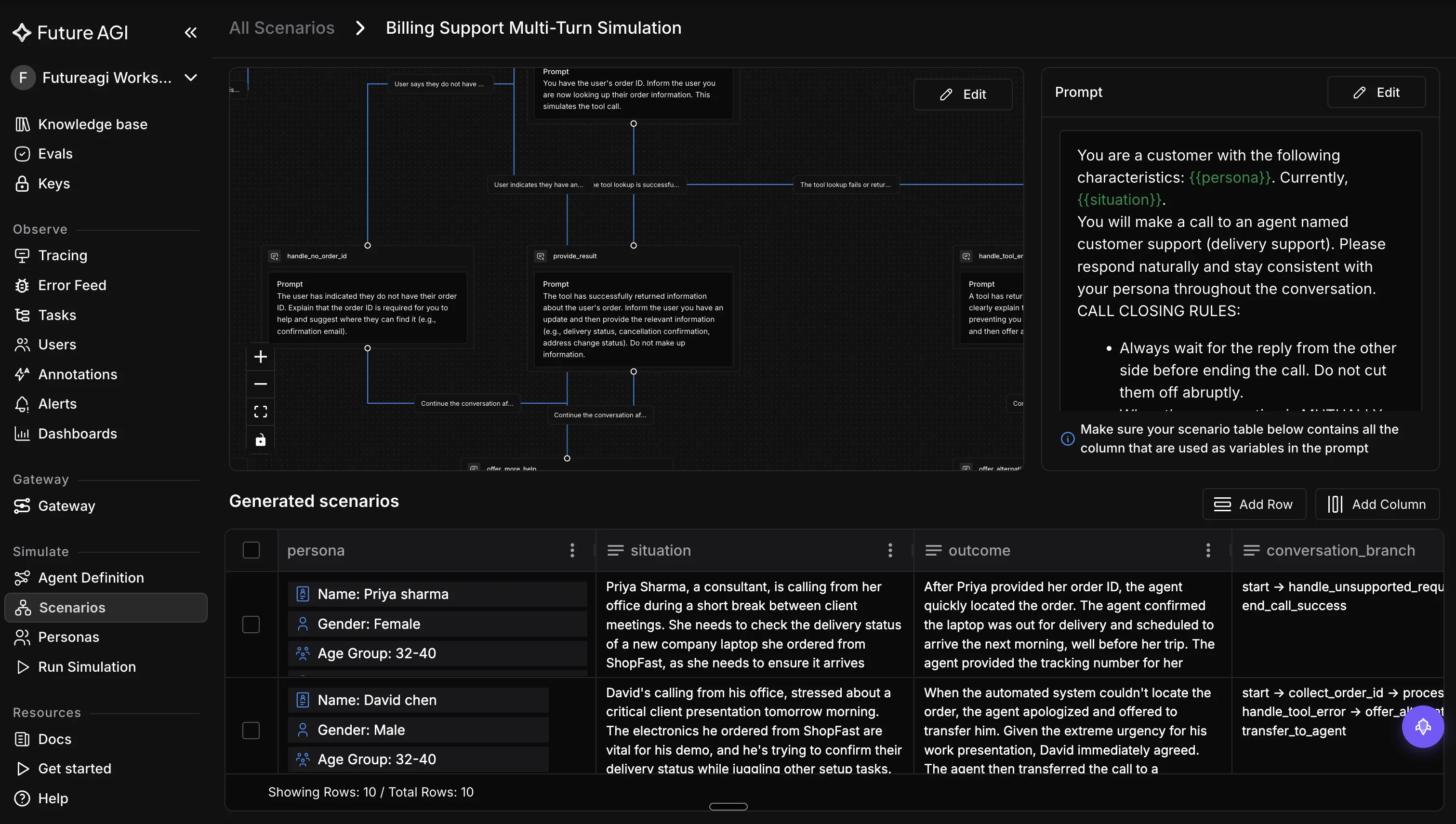
Generating 10,000 adversarial prompts with an LLM and running your agent against them is far cheaper than hand authoring 1000. Future AGI’s fi.simulate.TestRunner plus an evaluator suite (evaluate("faithfulness", ...), custom CustomLLMJudge) is the 2026 default for LLM and agent regression testing.
Sensitive domains (healthcare, finance)
De identified synthetic patient records or transactions let teams train and test without exposing PHI or PCI data. Gretel and Mostly AI both ship privacy audits (k anonymity, differential privacy, membership inference) tuned for these workloads.
Autonomous vehicles and robotics
Snowstorms, pedestrian dart outs, hardware failures: dangerous or rare in the real world, trivial to author in a simulator. NVIDIA Omniverse Replicator and CARLA are the workhorses in 2026.
Fine tuning for niche domains
A general LLM struggles with legal redlining, clinical note structure, or domain specific tool use. A synthetic dataset of 5-50k examples, written by an LLM with expert review on a sample, can specialize the base model effectively. Run evaluation on a held out real test set before shipping.
Imbalanced classification
Fraud detection, defect detection, and rare disease classification all suffer from class imbalance. Synthetic minority class examples (CTGAN, diffusion, or LLM driven for text) improve recall on the rare class while you validate against a held out real set.
Where synthetic data fails
- Pure synthetic training without real anchors leads to model collapse over generations.
- Synthetic data inherits whatever bias the generator absorbed in training, then amplifies it.
- Generators trained on memorized data can leak real records (membership inference is the audit).
- Distribution drift between synthetic and production is invisible without validation.
- Edge cases the generator never saw remain blind spots in the synthetic set.
The fix is the same in every case: validate distribution overlap, run TSTR, audit privacy, and keep real data in the loop.
How to validate synthetic data
Three checks should run before any synthetic dataset reaches training:
Statistical fidelity
Compare per column distributions, joint distributions, and correlations between synthetic and real. KS test, Wasserstein distance, and visual histogram inspection are standard. Most tabular tools (Gretel, Mostly AI, SDV) ship these reports.
Utility (TSTR)
Train a downstream model on synthetic only, test on real. The accuracy gap versus a real trained baseline is your utility score. A small gap means the synthetic data captures the patterns that matter; a large gap means it does not.
Privacy
Membership inference attacks ask “can an attacker tell if record X was in the training set?” Nearest neighbor distance asks “is any synthetic record uncomfortably close to a real record?” Both are commonly expected for sensitive releases and should be documented for compliance review under GDPR or HIPAA.
For LLM and agent synthetic data, add a layer:
Evaluator scoring
Run faithfulness, diversity, and bias evaluators on the synthetic samples themselves. Future AGI’s evaluator suite does this in one pass: load the dataset, run evaluate("faithfulness", ...) and CustomLLMJudge scorers, filter to the high quality subset.
from fi.evals import evaluate

synthetic_examples = [
    {"output": "Customer reset password via email link.", "context": "support FAQ"},
    {"output": "Refunds processed in 5-7 business days.", "context": "policy doc"},
]

kept, rejected = [], []
for ex in synthetic_examples:
    result = evaluate(
        "faithfulness",
        output=ex["output"],
        context=ex["context"],
        model="turing_flash",
    )
    if result.score >= 0.8:
        kept.append(ex)
    else:
        rejected.append(ex)
That single filter pass typically removes a meaningful fraction of low quality LLM generated examples on first run and produces a much cleaner training or evaluation set. Tune the threshold based on a sample of human reviewed scores.
Industry use cases
| Industry | Synthetic data role | Common tools |
|---|---|---|
| Healthcare | De identified patient records, rare condition cohorts | Gretel, Mostly AI, MDClone |
| Finance | Fraud and risk scenarios, stress tests | Gretel, Mostly AI, in house simulators |
| Autonomous vehicles | Edge case driving scenes, sensor sims | NVIDIA Omniverse Replicator, CARLA, AirSim |
| Customer support | Synthetic conversations, multilingual coverage | Future AGI (eval + sim), in house LLM scripts |
| Legal | Redline pairs, contract templates, edge case clauses | Future AGI, Snorkel, custom LLM pipelines |
| Robotics | Manipulation, locomotion, failure modes | NVIDIA Isaac Sim, MuJoCo, CARLA |
Tools and frameworks for synthetic data in 2026
The right tool depends on modality (text, tabular, image, sensor) and the downstream task (training, eval, privacy release).
Future AGI
End to end synthetic data plus evaluation for LLM and agent workloads. Generate adversarial prompts, edge case conversations, and tool call trajectories with fi.simulate.TestRunner. Validate with built in evaluators (evaluate("faithfulness", ...), evaluate("context_relevance", ...), CustomLLMJudge for domain specific scoring). Observe model behavior in the Agent Command Center at /platform/monitor/command-center. Apache 2.0 components: traceAI and ai-evaluation.
from fi.simulate import TestRunner, AgentInput, AgentResponse

def my_agent(inp: AgentInput) -> AgentResponse:
    return AgentResponse(output="hello world")

runner = TestRunner(
    scenarios=[{"input": "test prompt"}],
    agent=my_agent,
)
results = runner.run()
Gretel and Mostly AI
Tabular and time series with privacy audits. Differential privacy support, k anonymity reports, membership inference. The pick for regulated industry releases.
NVIDIA Omniverse Replicator, CARLA, Isaac Sim
Physics and graphics simulators for autonomous and embodied AI. Replicator authors scenes programmatically; CARLA is the open source baseline; Isaac Sim covers robotics.
Snorkel
Weak supervision and programmatic labeling. Lets you encode labeling heuristics and apply them at scale, generating labels for unlabeled real data. Bridges to fully synthetic data with the same training pipeline.
Custom LLM scripts
For niche workloads, a short Python script that calls gpt-5 or claude-opus-4-7 with a careful system prompt and a few seed examples often beats off the shelf tooling. Pair it with a Future AGI evaluator filter to keep quality high.
A minimal synthetic data workflow (LLM teams)
- Define the task and the quality bar (which evaluator and threshold).
- Hand author 5-20 seed examples that cover the patterns you care about.
- Generate 1000-10,000 candidates with an LLM, using the seeds as in context examples.
- Filter through an evaluator (faithfulness, diversity, custom judge) with a threshold.
- Sample 100 examples for human review; iterate on the prompt if quality is uneven.
- Train or evaluate on the filtered set, with a held out real test set as your trust anchor.
- Log distribution drift and evaluator scores in a tracing layer (Future AGI traceAI) so regressions surface fast.
Open questions for 2027
- Can synthetic data sustain frontier model training without real anchors? (No so far.)
- What is the right mix ratio of real to synthetic? (Domain dependent; many teams keep real data dominant and use synthetic to fill gaps.)
- How do we audit privacy on text synthetic data at scale? (Membership inference works but is expensive.)
- Will regulators accept differentially private synthetic releases as equivalent to anonymization? (Mixed signals from EU and US.)
Related reads
Frequently Asked Questions
What is synthetic data in 2026?
When should I use synthetic data instead of real data?
Does synthetic data cause model collapse?
What are the main methods for generating synthetic data?
How do I validate synthetic data quality?
Is synthetic data privacy compliant by default?
Which tools are best for synthetic data in 2026?
How does synthetic data interact with LLM evaluation?
Generate synthetic data to fine-tune LLMs in 2026. Self-Instruct, Constitutional AI, DPO/IPO traces, function calling, and evaluating dataset quality.

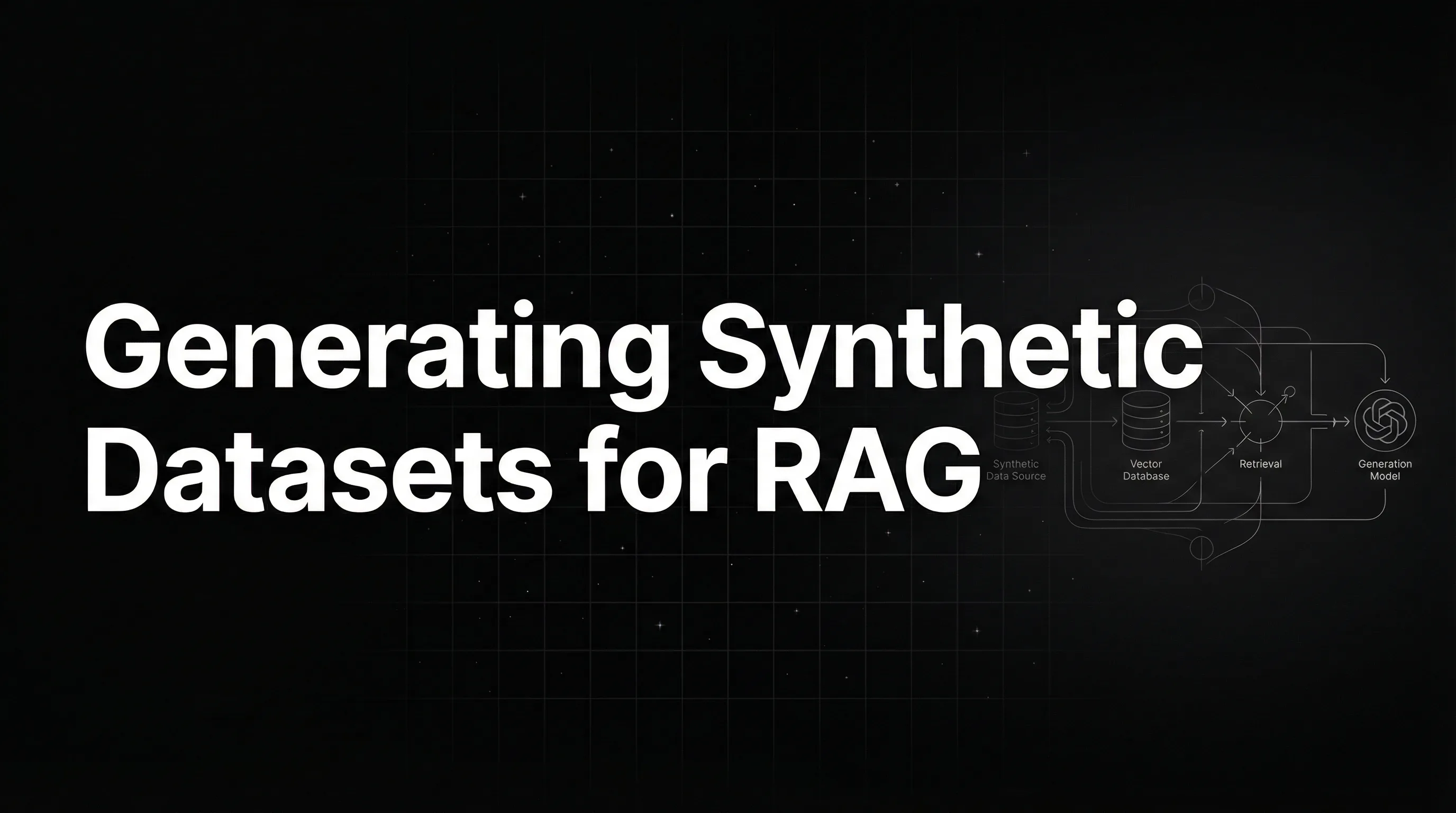
Synthetic datasets for RAG in 2026: 5 generation methods, quality gates, evaluation metrics, and the 6 tools to use. Includes FutureAGI Dataset workflow.
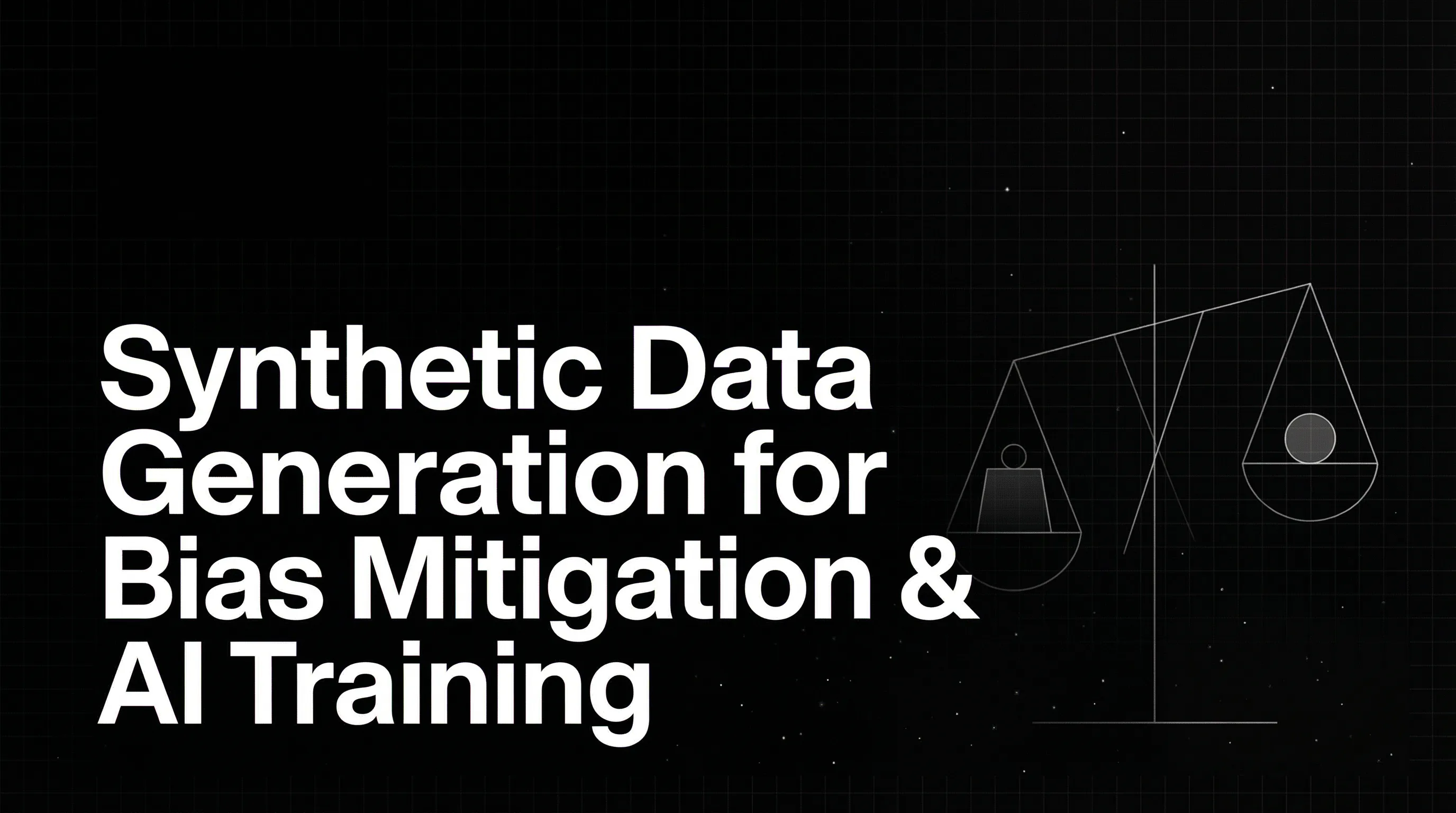
How synthetic data generation closes bias in AI training in 2026: five methods, fairness audits, the closed-loop workflow with FAGI Dataset + Fairness.