Model Drift vs Data Drift in 2026: How to Identify, Detect, and Mitigate Distribution Shift
Model drift vs data drift in 2026: PSI, KS test, embedding cosine, 7 tools ranked. Detect distribution shift in LLM and ML pipelines early.
Table of Contents
TL;DR: Model Drift vs Data Drift in 2026
| Dimension | Data Drift | Model Drift |
|---|---|---|
| What shifts | P(X), the input distribution | P(Y|X) or measured model quality |
| Primary cause | New users, seasonality, upstream feature pipeline change | Concept drift, label shift, ageing training data |
| Best detection signal | PSI, KS, MMD, embedding cosine drift | Live accuracy, F1, eval score, business KPI |
| Detection without labels | Yes | Partial, via CBPE or judge-based evals |
| 2026 monitoring layer for LLMs | Embedding and prompt drift on traces | Online faithfulness, groundedness, tool-call quality |
| Mitigation lever | Feature engineering, sample reweighting, retraining data | Retrain or fine-tune, prompt or retriever update, ensemble |
If you only have time for one move in 2026: instrument every production trace with embedding and eval-score logging, then alert on the joint condition of input drift plus a measurable eval drop. Drift without eval impact is a false alarm and burns on-call.
What Is Model Drift and Why It Matters in 2026
Model drift is the degradation of a deployed model’s performance over time because the world has moved away from the conditions it was trained on. In classical ML the headline metric is accuracy, AUC, or RMSE on a fresh labelled slice. In LLM and agent systems the equivalent signals are faithfulness, groundedness, task success, tool-call accuracy, and downstream conversion.
The 2026 wrinkle is that most teams are no longer training their own models. A typical agent stack uses gpt-5-2025-08-07, claude-opus-4-7, gemini-3-pro, or an open-source llama-4 derivative behind a gateway. Model weights do not drift on their own, but model providers ship silent updates, retrieval indexes get re-embedded, prompts get tuned, and tool schemas evolve. Every one of those changes can shift end-to-end behaviour in the same way a classical model retraining could, which is why production teams now treat drift as a system-level metric rather than a model-internal one.
Common causes:
- User behaviour shifts after a feature launch or an external event.
- Upstream feature pipelines change types, units, or imputation rules.
- Vendor model providers ship a silent point update or change tokenizer defaults.
- Knowledge bases get re-indexed with a new embedding model.
- New product surfaces send traffic with different prompt templates.
What Is Data Drift and Its Related Drift Categories
Data drift in the narrow sense is a change in the input distribution P(X). In production it travels alongside two related shifts, and most monitoring stacks treat them together because the detection workflow overlaps:
Covariate shift (input drift). P(X) changes while P(Y|X) holds. This is the canonical data-drift case. Example: an e-commerce recommender starts seeing more mobile traffic. The features shift toward shorter sessions, but the rule mapping behaviour to purchase intent is unchanged.
Concept drift. P(Y|X) changes. The same input now deserves a different label. This is not strictly input-side drift, but it is the most common cause of model drift in stationary feature pipelines. Spam filters are the canonical case. New spam wording rewrites the label boundary while individual feature distributions can look stable.
Prior probability shift (label shift). P(Y) changes. The base rate of the target moves. A fraud detector seeing a sudden spike in fraudulent transactions has stable feature behaviour per class but a shifted class prior.
For LLM systems, prompt drift, retrieval drift, and tool-distribution drift are the practical analogues. Prompt drift is covariate-shift-like: the wording or length of user prompts changes. Retrieval drift is closer to concept drift, because the same prompt now returns different supporting documents and therefore changes the effective conditional P(answer | prompt). Tool-distribution drift is label shift in disguise, since the share of tool calls that should fire is changing.
How to Detect Drift: Statistical Tests That Still Hold in 2026
Tabular features
- Population Stability Index (PSI). Bucket reference and production, compute sum over bins of (actual − expected) × ln(actual / expected). PSI under 0.1 means no significant shift, 0.1 to 0.2 means moderate, above 0.2 means significant drift on that feature.
- Kolmogorov-Smirnov (KS) test. Compares cumulative distributions for continuous features. Use the two-sample KS statistic with a p-value threshold, calibrated against expected batch size to avoid alert fatigue at scale.
- Chi-square test. For categorical features. Bucket categories, compute observed vs expected counts.
- Jensen-Shannon and Wasserstein distance. Smoother alternatives to KL divergence for noisy production distributions.
Embeddings and high-dimensional inputs
- Cosine drift on centroids. Compute the mean embedding for the reference and production windows. Track the cosine distance between them and alert on a moving-window threshold.
- Maximum Mean Discrepancy (MMD). Non-parametric two-sample test that works on embeddings without binning.
- Classifier-based drift detection. Train a small classifier to distinguish reference from production samples. AUC above 0.55 to 0.60 is a typical drift signal.
LLM-specific drift signals
- Prompt structural drift. Length, tool-call rate, language mix, and detected intent classes.
- Retrieval drift. Embedding distance between retrieved chunks and the production query, plus context recall at top-K.
- Output quality drift. Online evaluators for faithfulness, groundedness, answer relevancy, and refusal rates. Future AGI’s
turing_flashevaluator runs roughly 1 to 2 seconds in the cloud per check, fast enough to evaluate every trace or a sampled stream.
Model-side signals
- Accuracy, precision, recall, F1. Standard but require labels.
- Calibration error and Brier score. Useful for probabilistic outputs.
- Feature importance shift. Compare SHAP or permutation-importance distributions between windows.
- CBPE and DLE for label-lagged systems. Estimate performance without waiting for ground truth.
Tools for Drift Detection and Monitoring in 2026
1. Future AGI Observe
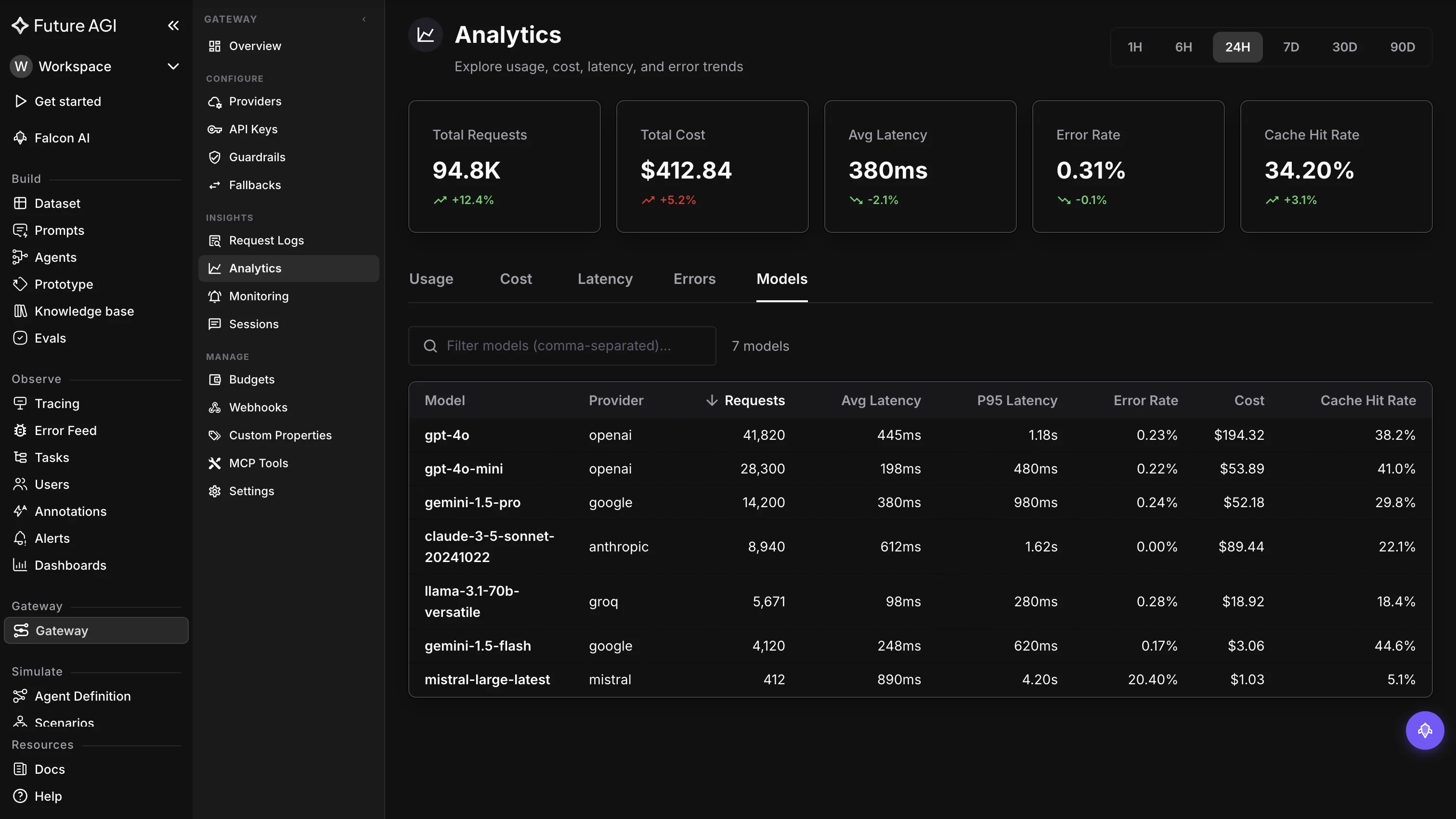
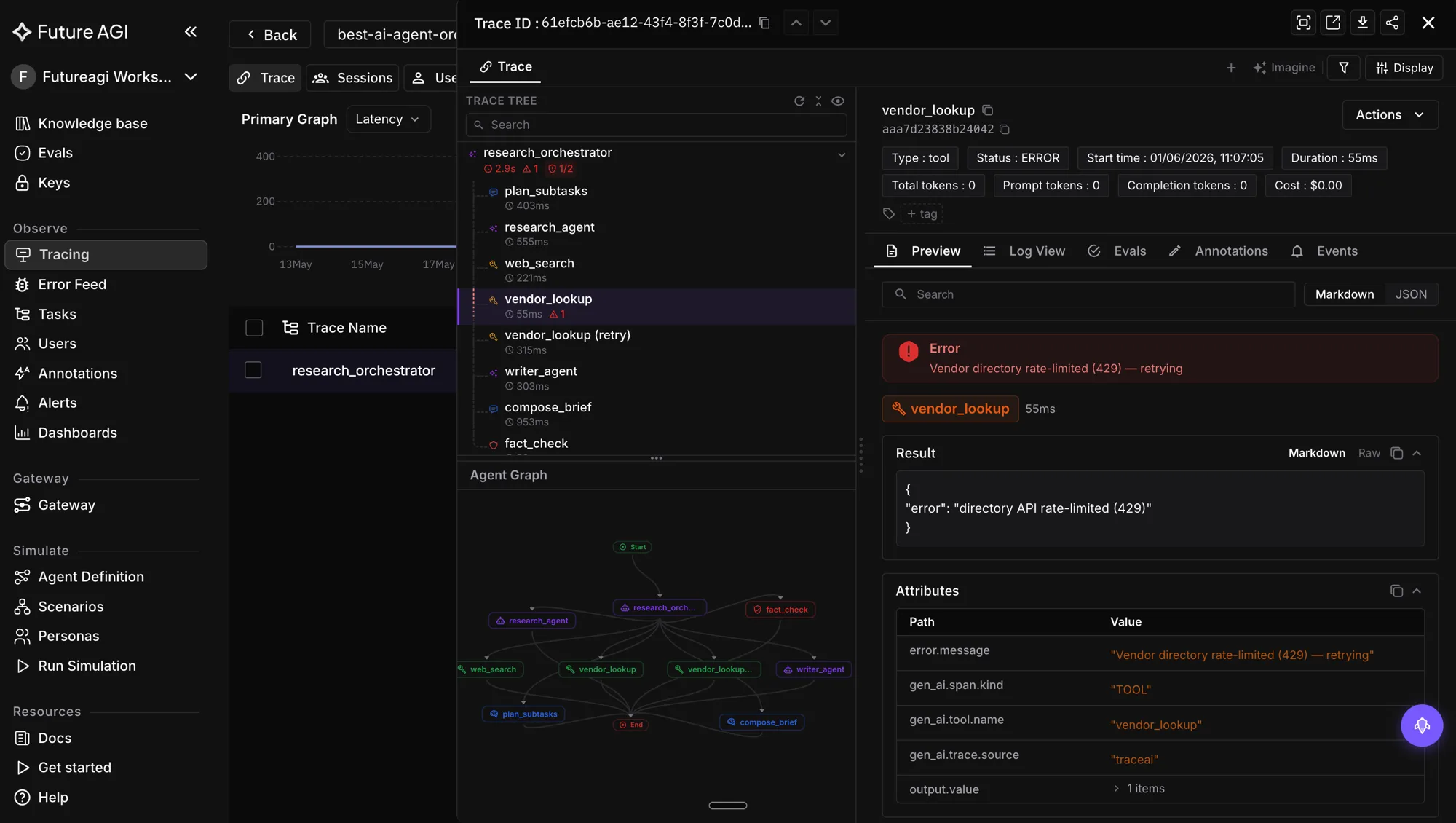
Future AGI’s Observe platform sits inside the Agent Command Center (/platform/monitor/command-center) and treats drift as a continuous stream signal. The open-source instrumentation layer traceAI (Apache 2.0) emits OpenInference-compatible spans, and the ai-evaluation library (Apache 2.0) runs online evaluators on those spans for faithfulness, groundedness, and task quality. Embedding drift, prompt drift, retrieval drift, and tool-call drift are tracked per-trace and aggregated. Protect Eval gates can trigger when drift correlates with eval-score drops. Cloud SaaS plus self-host with BYOK.
from fi_instrumentation import register, FITracer
from fi.evals import evaluate

tracer_provider = register(project_name="rag-prod")
tracer = FITracer(tracer_provider)

@tracer.chain
def answer_question(question: str, context: str) -> str:
    response = call_llm(question, context)
    score = evaluate(
        "faithfulness",
        output=response,
        context=context,
    )
    return response
2. Evidently AI
Open-source Python library plus a managed cloud. Covers PSI, KS, Jensen-Shannon, Wasserstein, and several embedding-aware tests across tabular, text, and embedding columns. Strong reporting UI and Python-native workflow. Good fit when the stack is mostly classical ML with some LLM components bolted on.
3. Alibi Detect
Seldon’s open-source library focused on drift, outlier, and adversarial detection. Implements MMD, KS, classifier-based drift, learned-kernel MMD, and chi-square. Strong on high-dimensional inputs and a clean PyTorch / TensorFlow interface.
4. Arize AX
LLM and ML observability with drift, performance, and embedding monitors. Strong tabular tracing, SHAP-based feature-importance shift, and OpenInference tracing for LLM spans. Cloud-first with SaaS and self-managed deployment options.
5. WhyLabs
Built around the open-source whylogs profile format, so drift checks run on lightweight statistical profiles instead of raw data. Useful when raw data egress is prohibited. Covers data quality, distribution drift, and constraint monitoring.
6. AWS SageMaker Model Monitor
Integrated into SageMaker endpoints. Generates baseline statistics and constraints from training data, then schedules monitoring jobs that emit CloudWatch metrics. Covers data quality, feature drift, model quality, and bias drift.
7. NannyML
Open-source Python library for post-deployment monitoring with a focus on performance estimation without labels. CBPE and DLE estimate likely performance under covariate shift, which is valuable for systems where labels arrive days or weeks after prediction.
Strategies for Managing Model Drift
Retrain on a cadence tied to detected drift. Treat drift signals as triggers, not the only schedule. A common pattern is a default monthly retrain plus on-demand retrains when PSI > 0.2 on a key feature coincides with a 3 to 5 point eval drop.
Adaptive and online learning. For high-velocity domains like fraud and ad ranking, online learning with bounded windows keeps the model current without full retrains. For LLM systems, the equivalent is prompt and retriever tuning loops, since base weights are frozen.
Ensembles and shadow deployments. Run a candidate model alongside production on the same traffic, compare evals, and promote when the candidate beats the incumbent on the drifted slices. fi.simulate-style replay over historical traces enables this for agent stacks.
Snapshot pinning for hosted models. Pin to dated snapshots (gpt-5-2025-08-07, claude-opus-4-7) in production. Maintain a canary running on the “latest” alias and diff regressions on a held-out eval suite.
Strategies for Managing Data Drift
Refresh feature engineering. When PSI alerts fire on engineered features, audit upstream pipelines first. Many “drift” events are bugs in feature code, not real distribution shift.
Sample reweighting and importance weighting. When P(X) shifts but P(Y|X) is stable, reweight training samples to match production. This is cheaper than retraining and often closes most of the gap.
Domain adaptation and synthetic data. Augment training with synthetic data targeted at drifted slices. For LLM pipelines, this is usually new evaluation examples (fi.simulate test cases) rather than new training data, because base weights are frozen.
Automated monitoring with eval-correlated alerts. Don’t alert on PSI alone. Alert on the joint condition of input drift and an evaluator score drop, which cuts alert noise sharply in production.
Why Businesses Must Proactively Monitor Drift
| Risk | Impact when drift is missed |
|---|---|
| Accuracy decay | Predictions degrade silently for weeks before being noticed |
| Compliance | Fairness and bias guarantees break when input distributions shift |
| Revenue | Recommenders, fraud detectors, and pricing models lose lift |
| Trust | Customer-facing LLM products begin hallucinating on new content |
| Cost | Emergency retrains and incident reviews dwarf the cost of monitoring |
For LLM and agent stacks specifically, the 2026 best practice is to wire drift monitoring into the same Observe stream that already carries traces, evals, and Protect Eval gates. One signal pipeline, one alert taxonomy, one source of truth.
Related Reading
- What Is LLM Drift in 2026
- Best AI Drift Detection Tools 2026
- Best LLM Monitoring Tools 2026
- LLM Observability and Monitoring
- Real-Time vs Batch LLM Monitoring 2026
References
- Evidently AI docs and GitHub
- Alibi Detect docs and GitHub
- NannyML docs and GitHub
- Arize AX docs
- WhyLabs whylogs
- AWS SageMaker Model Monitor docs
- Future AGI traceAI and ai-evaluation (Apache 2.0)
- Lipton et al., Detecting and Correcting for Label Shift with Black Box Predictors
Frequently Asked Questions
What is the difference between model drift and data drift?
How do I detect data drift in production?
How is drift detection different for LLMs and RAG pipelines?
What is the PSI threshold for drift?
When should I retrain versus monitor?
Can I detect drift without ground-truth labels?
How often should I check for drift in 2026 production systems?
What is the difference between covariate shift and concept drift?
LLM drift is prompt drift, model drift, and eval-score drift in 2026. What it is, how to detect each kind, which tools handle drift on production traces.

AI drift is five different problems wearing one name. We rank the five tools that catch them: Arize, Future AGI, Evidently, WhyLabs, Fiddler.

FutureAGI, Datadog, Langfuse, Phoenix, Helicone, Braintrust, LangSmith for LLM monitoring. Latency, drift, cost, eval pass-rate trends.