Synthetic Datasets for RAG in 2026: Generation Methods, Quality Gates, and the Tools That Work
Synthetic datasets for RAG in 2026: 5 generation methods, quality gates, evaluation metrics, and the 6 tools to use. Includes FutureAGI Dataset workflow.
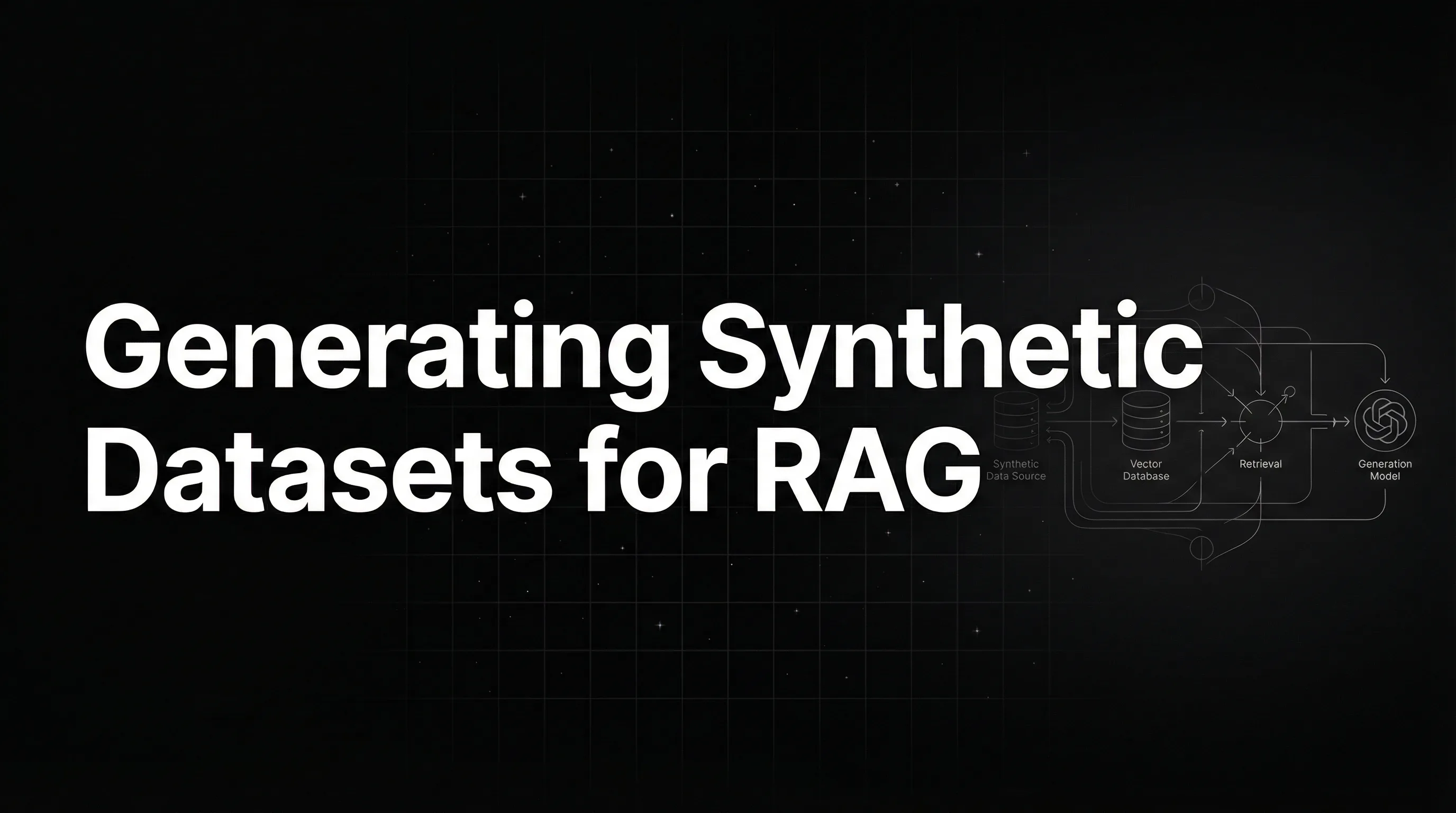
Table of Contents
TL;DR: synthetic datasets for RAG in 2026
| Question | 2026 answer |
|---|---|
| What is it | Machine-generated question, context, answer triples for RAG evaluation |
| Best method for breadth | Document-grounded QA from each chunk |
| Best method for hard cases | Multi-hop synthesis + adversarial generation |
| Best method for realistic queries | Persona-based simulation through the RAG stack |
| Quality gates required | Faithfulness, diversity, difficulty, human spot-check |
| Production pattern | Synthetic for CI breadth + sampled prod for drift + human for calibration |
| Top tool when running production evals | FutureAGI Dataset + fi.simulate (span-attached) |
| Top OSS library for offline notebooks | Ragas TestsetGenerator |
If you read one row: synthetic alone is not enough. The winning 2026 pattern is synthetic + sampled production + human calibration, all measured against the same metric set.
Why synthetic data matters for RAG specifically
A RAG system has four layers (ingest, retrieve, generate, evaluate) and each layer can fail independently. To know which layer broke, you need labeled triples: question, retrieved-context, ground-truth-answer. Real-world labeled triples are expensive in regulated domains (legal, medical, finance) and impossible in private corpora (proprietary docs, internal knowledge bases). Synthetic generation fills the gap and gives every team a labeled set on day one.
The three jobs synthetic RAG data does in 2026:
- CI regression gating. Run the same test set on every deploy; alert on score regressions before traffic hits.
- Offline experimentation. A/B test chunking strategies, embedding models, retrievers, and rerankers against a stable set.
- Drift detection priming. Pair synthetic with sampled production to detect shifts in query distribution or content.
Without synthetic data, RAG evaluation is bottlenecked on human annotation. With synthetic data plus measured quality gates, the bottleneck moves to corpus quality, which is solvable. The definitive guide to synthetic data generation covers the broader generation toolkit.
The five generation methods that actually work
1. Document-grounded QA pairs
Read each chunk, generate a question whose answer is in that chunk, and store the (question, chunk, answer) triple. The chunk citation doubles as the retrieval ground truth. This is the default in 2026 and the foundation under every more advanced method.
Use when: you have a clean corpus and want broad retrieval coverage.
Skip when: the corpus has duplicate or near-duplicate chunks (questions become ambiguous).
2. Multi-hop synthesis
Chain two or more chunks together and generate a question that requires cross-chunk reasoning. This catches retrieval failures where the right chunks exist but rerankers do not combine them. Multi-hop is the most common failure mode in production RAG and the most underrepresented in naive synthetic sets.
Use when: the corpus is interconnected (legal, scientific, technical docs).
Skip when: documents are self-contained (FAQs, support articles).
3. Adversarial generation
Generate edge cases: negation (“which drug is not approved”), ambiguity (“the patient”), contradictory evidence (two chunks disagree), and out-of-corpus queries (the answer is not in the corpus, the model should refuse). Adversarial generation is the highest-value synthesis type because it catches failures that no easy test set will surface.
Use when: before a production deploy; always include 10-20% adversarial in a serious test set.
Skip when: never. Adversarial coverage is non-negotiable for production RAG.
4. Persona-based simulation
Define personas (junior engineer, lawyer, claims-adjuster, end-user), let each persona issue queries against the RAG stack through a simulator, and harvest the queries plus model responses as test data. The simulator runs the agent loop end-to-end, so the harvested triples are realistic in distribution.
Use when: you want test queries that match real user behavior.
Skip when: you have no defined personas or no live RAG stack to run against.
The fi.simulate module supports this pattern out of the box. The Inspect framework from the UK AI Safety Institute also runs persona evals.
5. Distillation from real traces
Sample real production queries (de-identified), use an LLM to synthesize a ground-truth answer per query, and human-spot-check the synthesized answers. This converts production traces into labeled triples and lets you evaluate against your actual query distribution.
Use when: you have production traffic; this is the highest-fidelity test set you can build.
Skip when: no production traffic yet (use methods 1-4 first).
Quality gates: the four checks every production set passes
A synthetic dataset that fails any one of these gates produces miscalibrated evaluation scores.
Gate 1: Faithfulness
Every synthetic answer must be grounded in its cited context. Run a Faithfulness judge over each generated triple; reject any triple where the answer makes claims not supported by the context. This is the most common synthetic-data error: the generator hallucinated an answer that “looks reasonable” but is not in the corpus. The RAG faithfulness deep dive covers how to score this rigorously.
Target: Faithfulness above 0.9 on the full generated set.
Gate 2: Diversity
The question set must cover the corpus by topic, length, complexity, and intent. Measure by clustering question embeddings; if one cluster dominates, the dataset is biased. A diverse set protects against the “we only tested easy questions” failure mode.
Target: no cluster contains more than 15% of questions.
Gate 3: Difficulty
A test set with only easy questions inflates scores and hides regressions. Tag each question by difficulty (easy, medium, hard) and rebalance to a measured distribution. The Ragas evolution heuristics push questions through simple, reasoning, multi-context, and conditional transformations to control difficulty.
Target: at least 30% medium and 20% hard questions.
Gate 4: Human spot-check
Sample 5-10% of generated triples, have a domain expert review them, and reject the set if more than 5% of the sample fails review. Without this gate, no automated check catches generator drift over time.
Target: human acceptance rate above 95% on the spot-check sample.
Metrics: how you measure against the synthetic set
Three retrieval metrics and three generation metrics cover RAG evaluation against synthetic data:
- Context Recall. Did the retriever return the chunk that was cited in the synthetic triple.
- Context Precision. Are the retrieved chunks relevant to the question.
- Mean Reciprocal Rank. Where in the ranked list the right chunk appeared.
- Faithfulness. Did the generator’s answer stay grounded in retrieved context.
- Answer Relevance. Did the generator’s answer address the question.
- Answer Correctness. Did the generator’s answer match the synthetic ground truth.
The end-to-end metric:
- Hallucination rate. Fraction of generations that make claims not supported by retrieved context.
When a chunking or retriever change moves Context Recall up but drops Faithfulness, chunks are usually too large and the generator is hallucinating from irrelevant content. Both metrics must move together.
The six tools that ship synthetic RAG data and quality gates in 2026
1. FutureAGI Dataset + fi.simulate
The Future AGI Dataset module lets you build, manage, and version test sets with span-attached evaluation built in. The fi.simulate module runs persona-based agent simulations through the live RAG stack and harvests the queries as test data. Together they cover persona simulation, dataset management, and end-to-end evaluation on one runtime; pair them with a generator library (Ragas, DeepEval) when you need document-grounded synthesis. The OSS pieces are Apache 2.0 ai-evaluation and Apache 2.0 traceAI.
Use when: you want one stack for generation, evaluation, observability, gateway, and gating; live agent simulation is a first-class workflow.
Skip when: you are happy in an offline-notebook-only pattern with no production integration.
2. Ragas TestsetGenerator
Ragas ships a TestsetGenerator that produces document-grounded QA pairs with question-evolution heuristics for difficulty control. Apache 2.0 and RAG-focused.
Use when: notebook-first RAG evaluation, you want the canonical OSS library.
Skip when: you need persona simulation or live agent harvesting.
3. DeepEval Synthesizer
DeepEval ships a Synthesizer that produces synthetic test data inside a pytest-native eval harness. Apache 2.0, pairs with the broader DeepEval metric library.
Use when: Python test suite with pytest, you want generation and evaluation in the same harness.
Skip when: you need RAG-specific evolution heuristics (Ragas) or live simulation (fi.simulate).
4. LlamaIndex DatasetGenerator
LlamaIndex ships a DatasetGenerator and RagDatasetGenerator for document-grounded synthesis inside the LlamaIndex framework. Useful when the ingest, retriever, and evaluation all live in LlamaIndex.
Use when: LlamaIndex is your RAG framework.
Skip when: you use LangChain, Haystack, or a custom retriever.
5. Cleanlab Studio
Cleanlab is a label-quality and dataset-cleaning tool. Not a generator on its own, but the strongest open option for the post-generation quality gates: it finds mislabeled, ambiguous, and outlier triples.
Use when: you have a generated set and want an automated quality-gate pass.
Skip when: generation is the bottleneck (use Ragas, DeepEval, or fi.simulate first).
6. SDV (Synthetic Data Vault)
SDV generates tabular synthetic data with statistical fidelity. Useful when the source corpus for RAG is structured data (databases, spreadsheets) and you need to synthesize records before chunking and embedding.
Use when: the corpus is tabular.
Skip when: the corpus is unstructured text (the default RAG case).
How Future AGI runs synthetic RAG datasets
The Future AGI Dataset module builds versioned, labeled triples and pairs them with span-attached evaluation. The fi.simulate module runs persona-based agent simulations through your RAG stack to harvest realistic queries. The Agent Command Center then gates production traffic on the same metric set the synthetic dataset was evaluated against.
A minimal flow using the SDK. The fi.simulate types describe agent inputs and responses; fi.evals.evaluate scores them with the same string-template metrics you run in production.
from fi.evals import evaluate
from fi.simulate import AgentInput, AgentResponse

# Step 1: define a synthetic test case manually or via the Dataset module
test_input = AgentInput(
    query="What is the recommended dosage for the drug X in adults?",
)

# Step 2: run your RAG stack and capture the response
# (this is where your agent or RAG pipeline executes)
response = AgentResponse(
    output="Recommended dosage is 10mg twice daily.",
    retrieved_context=["Drug X dosage for adults is 10mg twice daily."],
)

# Step 3: score with the same string-template metrics you use in production
faithfulness = evaluate(
    "faithfulness",
    output=response.output,
    context=response.retrieved_context,
)

context_recall = evaluate(
    "context_recall",
    output=response.output,
    context=response.retrieved_context,
    ground_truth="Recommended dosage is 10mg twice daily.",
)
Scores attach to the trace through traceAI, so every CI run and every production sample carries the same metrics. Auth uses FI_API_KEY and FI_SECRET_KEY. Latency targets: turing_flash ~1-2s, turing_small ~2-3s, turing_large ~3-5s, per the cloud-evals docs.
Common pitfalls that cost the most evaluation accuracy
Five pitfalls cause most synthetic-data regressions:
- Generator-style leakage. Questions copy the exact wording of the chunk, so retrieval looks artificially strong. Rewrite questions to use different vocabulary than the source chunk.
- All easy, no hard. The set is dominated by surface-level questions; production failures stay hidden. Always include adversarial and multi-hop variants.
- Single-generator bias. One model’s style dominates the set. Rotate generators across the set.
- No human spot-check. Generation errors compound into evaluation errors. Always review 5-10%.
- Synthetic-only evaluation. Production query distribution drifts; synthetic alone misses it. Pair synthetic with sampled production traces.
Summary: gated synthetic data plus production sampling is the 2026 pattern
Synthetic data unblocks RAG evaluation, but only when paired with measured quality gates and production sampling. The five generation methods (document-grounded, multi-hop, adversarial, persona simulation, distillation) cover the question types you need. The four quality gates (Faithfulness, diversity, difficulty, human spot-check) keep the data honest. The metric set (Context Recall, Context Precision, Faithfulness, Answer Relevance, Answer Correctness, hallucination rate) keeps the evaluation honest.
Pick the tool whose evaluation surface matches your stack: Future AGI Dataset + fi.simulate for end-to-end with span-attached evaluation, Ragas for OSS library use, DeepEval for pytest-native CI. Add Cleanlab as the quality gate. Sample production into the set as soon as you have traffic.
Frequently Asked Questions
What is a synthetic dataset for RAG in 2026?
What generation methods are used for synthetic RAG datasets in 2026?
How do you make sure synthetic RAG data is high quality?
How does synthetic RAG data compare to real production data?
Which metrics measure RAG performance against a synthetic dataset?
What are the biggest pitfalls of synthetic RAG datasets?
Which tools generate or quality-gate synthetic RAG datasets in 2026?
Can synthetic data fully replace human-labeled data for RAG evaluation?
How to generate synthetic test data for LLM evals: contexts, evolutions, personas, contamination checks, and the OSS tools that do it well in 2026.

An LLM dataset is a versioned set of input-output rows used to evaluate or fine-tune models. Schema, versioning, lineage, and 2026 tooling explained.

Ragas, DeepEval, FutureAGI, Phoenix, Galileo, Langfuse, TruLens compared as the 2026 RAG eval shortlist. Faithfulness, retrieval, chunk attribution.