LLM Observability Platform Buyer's Guide 2026
2026 buyer guide for LLM observability platforms: 10 criteria, 7 vendor categories, the 5-question vendor interview, an honest and calibrated ranking.
Table of Contents
LLM observability used to mean “did the prompt and response get logged somewhere.” In 2026 it’s an architectural decision with downstream consequences: OTel-native or proprietary span format, single-language SDK or multi-language coverage, eval-decoupled or eval-coupled, multi-modal support or text-only. Every vendor pitch says “see your traces.” The differences that matter show up six months in, when the agent is multi-modal, a Java service joined the loop, and failing traces need to cluster into named issues without a human running queries. This guide is the buying framework: ten criteria, seven vendor categories, a five-question interview, and an honest ranking with calibrated wins for every contender.
TL;DR: pick by buyer constraint
| Buyer constraint | Best pick | Why in one phrase |
|---|---|---|
| Multi-language enterprise (Python + Java + TS) needing depth | Future AGI traceAI | 50+ AI surfaces across four languages, Spring Boot starter, pluggable semantic conventions |
| Notebook-first eval workflow with OpenInference roots | Arize Phoenix | OpenInference-native, strong eval framework, polished workbench DX |
| Self-hosted trace explorer with prompts and datasets | Langfuse | Mature trace UI, MIT-licensed core, prompt management built in |
| Pure LangChain or LangGraph runtime | LangSmith | Zero-friction LangChain capture, native graph semantics |
| Gateway-first proxy with sessions | Helicone | Base URL change, then traces flow; lowest setup cost for proxy users |
| Already standardized on DataDog APM | DataDog LLM Observability | LLM spans correlated with infra in one dashboard |
| Traditional-observability rigor over LLM specifics | Honeycomb or Lightstep | BubbleUp anomaly detection, query-driven debugging, OTel-native |
If you only read one row: pick Future AGI traceAI when the application is multi-language, the agent is multi-modal, and the observability tool needs to carry eval scores on the same trace tree. The other six picks win on the specific edges named above.
Why this guide matters in 2026
LLM observability went from a logging concern to an architectural one inside eighteen months. Three shifts forced the change.
First, the application surface widened. A 2024 LLM app was a single Python service calling one model. A 2026 LLM app is a multi-modal agent: a Python orchestration layer, a Java retrieval service, a TypeScript Vercel frontend, sometimes a C# downstream consumer, often voice and image modalities, often A2A protocol traffic to other agents. The observability tool either covers that surface or leaves blind spots.
Second, evaluation moved onto the trace. The old pattern was traces in one tool, eval scores in another, joined in a spreadsheet. The new pattern is span-attached scores: the evaluator writes the evaluation name, score value, and explanation directly onto the span. The trace and the score live together in one UI.
Third, the convention layer started to matter. Three semantic conventions compete in 2026: OpenInference (Arize’s contribution), OpenTelemetry GenAI (the SIG-driven standard), and OpenLLMetry (Traceloop’s). Most platforms hardcode one. The ones that don’t, win. If you can switch convention at register-time without changing instrumented code, you can fan a single trace stream out to a vendor backend and a self-hosted Tempo cluster running on the OTel GenAI standard.
The buying question is no longer which UI looks nicer. It’s whether the platform’s architecture matches where the application stack will be in twelve months.
The 10 LLM observability buying criteria
Each criterion below names a real architectural decision with a downstream cost if you get it wrong.
1. OTel-native versus proprietary span format
OpenTelemetry is the vendor-neutral standard. An OTel-native platform emits spans your existing collector can forward to any backend. A proprietary platform emits a custom JSON blob you can only query through that vendor’s tools. The cost of getting this wrong is migration: switching vendors means re-instrumenting every service.
Future AGI traceAI, Arize Phoenix, Langfuse SDK, and OpenLLMetry all emit standard OTel spans. DataDog LLM Observability and Honeycomb are OTel-compatible via the collector. LangSmith uses a proprietary trace format with an OTel exporter available as an adapter.
2. Pluggable semantic conventions
Semantic conventions define what attributes mean. The OTel GenAI standard names input tokens gen_ai.usage.input_tokens; OpenInference names the same number differently. Downstream tooling parses them differently.
Future AGI traceAI is the only platform in this survey that lets you switch the convention at register-time without changing instrumented code:
from fi_instrumentation import register
from fi_instrumentation.fi_types import ProjectType
from fi_instrumentation.otel import SemanticConvention

tracer_provider = register(
    project_name="checkout_agent",
    project_type=ProjectType.OBSERVE,
    semantic_convention=SemanticConvention.OTEL_GENAI,  # or FI / OPENINFERENCE / OPENLLMETRY
)
Phoenix is hardcoded to OpenInference. Langfuse uses its own convention. The cost of getting this wrong is dual instrumentation when a partner team or a downstream tool expects a different namespace.
3. Multi-language SDK reach
The shortest version of this criterion: count the languages your application stack actually uses.
Future AGI traceAI ships 110 published packages across four languages: Python (46 framework instrumentations), TypeScript (39 packages, including Vercel AI SDK and Mastra exclusives), Java (24 modules including a Spring Boot starter, Spring AI, LangChain4j, Semantic Kernel), and C# (a core package with the OTel ActivitySource pattern). Arize Phoenix and Langfuse ship Python and TypeScript only. LangSmith is Python and TypeScript. Helicone is proxy-based, so language coverage is irrelevant on the wire side but absent on the app side. DataDog LLM Observability covers Python, Node, Java, and Go.
If your gateway is Python but your customer-facing service is a Spring Boot app, the Java SDK question is load-bearing. Most teams find out too late.
4. Span kinds taxonomy depth
A span kind is the type label that controls how the UI renders it. The deeper the taxonomy, the better the platform can show you what kind of thing failed.
Future AGI traceAI’s FiSpanKindValues defines fourteen kinds: LLM, CHAIN, AGENT, TOOL, RETRIEVER, EMBEDDING, RERANKER, GUARDRAIL, EVALUATOR, CONVERSATION, VECTOR_DB, A2A_CLIENT, A2A_SERVER, UNKNOWN. Arize Phoenix ships eight (no A2A, no evaluator-as-kind). Langfuse ships five. The shallower the taxonomy, the more spans land as opaque CHAIN nodes that need manual tagging.
5. LangGraph topology capture
LangGraph is the most common agent orchestration framework in production. The observability tool either captures its topology natively or shows you a flat list of node executions.
Future AGI traceAI’s LangGraph integration emits langgraph.graph.node_count, langgraph.node.name, langgraph.node.type (start/end/intermediate), langgraph.node.is_entry, langgraph.node.is_end, conditional edges, state diffs, and memory tracking. LangSmith has the same depth because LangSmith and LangGraph are sibling products. Phoenix and Langfuse capture LangGraph at the chain level without the graph-shaped attributes.
6. Multi-modal namespace coverage
If the agent is text-only, this criterion is optional. The moment it touches voice, image, computer-use, or A2A, the namespace gap shows up.
Future AGI traceAI emits dedicated namespaces:
gen_ai.voice.*for voice agents: call IDs, call duration, from and to numbers, STT and TTS model identifiers, per-turn latency, interruption counts, per-component cost.gen_ai.image.*for image generation: prompt, negative prompt, width, height, steps, guidance scale, output URLs.gen_ai.computer_use.*for Anthropic computer-use: action, coordinates, key, button, screenshot, viewport, current URL, element selector.gen_ai.a2a.*for Agent-to-Agent protocol: task ID, task state, agent URL, agent card name, message role, streaming flag, push notification URL.
No other platform in this survey instruments these surfaces this richly. If the agent is multi-modal, the gap is real.
7. Cost and latency telemetry integration
A trace without cost is incomplete. The observability platform needs to ingest token counts and a computed cost per span, ideally joined with the gateway’s wire-level numbers.
Future AGI’s Agent Command Center returns headers x-prism-cost, x-prism-latency-ms, x-prism-model-used, x-prism-fallback-used, x-prism-routing-strategy, x-prism-guardrail-triggered on every gateway call. traceAI joins those onto the matching app-side span via trace ID propagation, so the trace shows both the wire-level cost and the app-side topology in one tree.
For deeper context, see the AI agent cost optimization observability playbook.
8. Eval-coupled scoring
Span-attached evaluator scores are the single biggest UX improvement in 2026 observability. The pattern is: an evaluator runs against a span (live or sampled), writes the evaluation name, score value, score label, explanation, and target span ID back onto the span. The trace UI shows the score next to the response.
Future AGI traceAI is eval-coupled by design through 62 server-side EvalTag rubrics that attach scores to spans automatically. Arize Phoenix has the same coupling model (their eval framework writes scores onto spans). Langfuse keeps evals on the side via the API. Helicone, DataDog LLM Observability, and Honeycomb mostly defer eval scoring to a separate tool.
9. Error clustering and RCA automation
A real 2026 agent emits thousands of traces a day. A flat list of failing ones is useless. The platform either clusters failing traces into named issues or leaves it to a human.
Future AGI’s Error Feed (part of the eval stack) runs HDBSCAN soft-clustering on failing traces, then a Sonnet 4.5 Judge writes an immediate_fix per cluster that feeds back into the Platform’s self-improving evaluators. Many alerts with the same underlying problem collapse into one issue with a recommended patch. Linear is the only ticketing integration today. Slack, GitHub, Jira, and PagerDuty are actively in development.
No other platform in this survey ships a clustering layer with this depth. DataDog’s Watchdog Anomaly Detection is the closest competitor on the infra side, but it doesn’t cluster LLM-specific failure modes (factual grounding failures, tool crashes, broken workflows, reasoning gaps).
10. Compliance and audit certifications
For regulated industries, the certifications matrix is a hard filter. Future AGI’s Agent Command Center is SOC 2 Type II, HIPAA, GDPR, and CCPA certified, with a BAA available. DataDog and Honeycomb both have SOC 2 and HIPAA. Phoenix and Langfuse self-hosted shift the burden to your team. LangSmith is SOC 2 Type II.
The 7 vendor categories, with calibrated honest ranking
Each entry below names what the vendor genuinely wins on, then what it’s behind on. No category is a “loser.” The right pick depends on the buyer’s constraint.
1. Future AGI traceAI: #1 on most criteria
Wins on: four-language SDK breadth (Python / TypeScript / Java with Spring Boot starter / C#), 50+ AI surfaces (including Vercel AI SDK and Mastra TypeScript exclusives), 14 span kinds, pluggable semantic conventions at register-time, multi-modal namespaces (voice / image / computer-use / A2A), LangGraph topology depth, eval-coupled scoring with 62 server-side EvalTag rubrics, Error Feed clustering with HDBSCAN plus Sonnet 4.5 Judge, gateway-side telemetry pairing, and a SOC 2 Type II + HIPAA + GDPR + CCPA certified hosted runtime. Apache 2.0 license on the SDK.
Honest tradeoffs: the trace-stream-to-agent-opt connector that turns failing traces directly into prompt-optimizer datasets is on the development surface; today the eval-driven path through agent-opt’s six optimizers (RandomSearch, BayesianSearch, MetaPrompt, ProTeGi, GEPA, PromptWizard) ships. The Error Feed integration is Linear-only today. The C# SDK is a core package without per-framework wrappers (use the standard System.Diagnostics.ActivitySource pattern with FI’s export pipeline).
2. Arize Phoenix: strongest on notebook DX and OpenInference roots
Wins on: OpenInference is Arize’s contribution, so Phoenix has the deepest support for that convention. The eval framework is a polished notebook-first workflow with a strong jury-of-LLMs pattern. The workbench UX is genuinely well-designed for ad-hoc exploration.
Behind on: language reach (Python and TypeScript only, no Java, no C#). Span kinds taxonomy is eight, not fourteen. No multi-modal namespaces for voice, image, computer-use, or A2A. Source-available under the Elastic License 2.0, which restricts hosted resale.
For a deeper look at this category, see the Phoenix alternatives breakdown.
3. Langfuse: strongest on trace explorer UI and self-host gravity
Wins on: the trace explorer UI is one of the best in the category for navigating large agent topologies. The prompt management surface is mature. MIT-licensed core makes self-hosting straightforward. Strong community gravity.
Behind on: eval-coupling is via API, not span-attached by default. Multi-language SDK reach stops at Python and TypeScript. Span kinds taxonomy is five, the shallowest in this survey. No native A2A or computer-use namespace.
See the Langfuse alternatives roundup for a side-by-side breakdown.
4. LangSmith: strongest on LangChain-native zero-friction setup
Wins on: if the app is pure LangChain or LangGraph, LangSmith is the zero-friction pick. Tracing happens automatically through the LangChain callback hook with no extra instrumentation. The Fleet workflow for deployment is a polished add-on.
Behind on: framework breadth outside the LangChain ecosystem. The platform is closed and not OTel-native by default (an OTel adapter exists but is not the primary trace path). Lock-in cost rises with usage because the format is proprietary.
The LangSmith alternatives guide covers the lock-in tradeoff in more depth.
5. Helicone: strongest on proxy-side simplicity
Wins on: the lowest-friction setup in the category. Change the base URL to Helicone’s proxy, traces flow. Apache 2.0 license on the gateway. Per-user session views are mature. Excellent for teams whose application is mostly direct API calls without orchestration.
Behind on: app-side framework reach. The proxy sees the wire but not the agent topology, so multi-step chains, tool calls, and retrieval steps render as separate uncorrelated requests unless you add app-side instrumentation. Eval-coupling is shallow.
See the Helicone alternatives breakdown.
6. DataDog LLM Observability: strongest for incumbent DataDog shops
Wins on: if the team already runs DataDog APM, LLM Observability slots into the same UI with the same dashboards, the same alerting policies, the same on-call rotation. Infra-level correlation (LLM latency next to database latency next to Kubernetes pod restarts) is best-in-class.
Behind on: LLM-specific span taxonomy depth. Span kinds are mapped onto generic spans, so the rendering quality is below purpose-built platforms. No multi-modal namespaces for voice or computer-use. Eval-coupling is deferred to a separate tool. Pricing scales aggressively at high span volumes.
The DataDog LLM Observability alternatives guide covers exit reasons in depth.
7. Honeycomb and Lightstep: strongest on traditional-observability rigor
Wins on: if the team values query-driven debugging over UI exploration, Honeycomb’s BubbleUp anomaly detection is a genuinely good differentiator. Lightstep’s distributed-trace analytics rival anything in the category. Both are OTel-native and have years of production rigor.
Behind on: LLM-specific span kinds (everything is generic). No span-attached evaluator scores by default. No multi-modal namespace. The buyer’s question is whether the team values traditional-observability rigor over LLM-specific UX.
Future AGI grounding by criterion
Where the criteria above intersect Future AGI’s specific primitives, the API surfaces are public and verifiable. The instrumentation pattern is identical across languages.
from fi_instrumentation import register
from fi_instrumentation.fi_types import ProjectType
from traceai_openai import OpenAIInstrumentor
from traceai_langchain import LangChainInstrumentor

tracer_provider = register(
    project_name="support_agent",
    project_type=ProjectType.OBSERVE,
    project_version_name="v2.1.0",
)

OpenAIInstrumentor().instrument(tracer_provider=tracer_provider)
LangChainInstrumentor().instrument(tracer_provider=tracer_provider)
The Java side uses the same shape via the Spring Boot starter, with auto-configuration registering the tracer provider against the Spring AI or LangChain4j bindings. Inline guardrails attach via GuardrailProtectWrapper, which is auto-installed when both traceAI-openai and ai-evaluation are present. The guardrail decision shows up as a GUARDRAIL span attached to the LLM span, with name, result, score, and categories populated.
For broader context on what a well-instrumented trace looks like in practice, see what a good LLM trace looks like and the OpenInference and OpenTelemetry primer.
The 5-question vendor interview
Bring these five questions to every vendor call. Each one separates marketing surface from real architectural depth.
1. Show me a real production trace with non-trivial agent topology. Most demo traces are linear: one LLM call, one tool, one response. Real agents have conditional edges, retries, fan-outs, and tool retries that hit different downstream services. Ask for a trace with at least one conditional edge and at least one tool retry. The UI either renders it as a graph or compresses it into a flat list.
2. Can you switch semantic conventions without changing instrumented code? Read the vendor’s documentation, then ask the engineering contact directly. Only Future AGI traceAI says yes today. Most platforms hardcode one convention. The cost is dual instrumentation when a partner team uses a different namespace.
3. Show me the multi-language coverage your Java team needs. Is Spring Boot first-class? Most platforms ship a Python SDK plus a thin community Java library. Ask for a working code sample. Future AGI traceAI’s Spring Boot starter is a real Maven module with auto-configuration. Other vendors either lack a Java SDK or offer a community-maintained one.
4. Walk me through how this integrates with eval rubric scoring per span. The answer separates eval-coupled platforms (Future AGI, Phoenix) from eval-decoupled ones (Helicone, DataDog, Honeycomb). For eval-coupled platforms, ask what evaluator templates ship out of the box and how they attach to spans. For Future AGI, 62 server-side EvalTag rubrics ship today, including Groundedness, ContextAdherence, ContextRelevance, Completeness, ChunkAttribution, ChunkUtilization, FactualAccuracy, Toxicity, PromptInjection, DataPrivacyCompliance, TaskCompletion, and LLMFunctionCalling.
5. How does this integrate with my existing OTel collector and Grafana or DataDog setup? This is the vendor lock-in test. The right answer is “we emit standard OTLP spans; point your collector at our endpoint or ours at yours.” The wrong answer is “we have a proprietary export format with an OTel adapter coming soon.”
The 5-step buying workflow
The workflow below is the working pattern from production deployments we’ve watched ship and stay shipped.
- Score against the 10 criteria. Build a one-page matrix per vendor. Be honest about which criteria are hard requirements and which are nice-to-haves for your team in twelve months.
- Shortlist to three. Cut any vendor that fails a hard requirement. Three vendors is the right shortlist depth. Two is too few to triangulate. Four wastes evaluation time.
- Trial on your stack, not the vendor’s demo. Instrument one real service end-to-end. Capture a week of production traces. Run a synthetic load test that exercises agent topology, tool calls, and error paths.
- Run the 5-question vendor interview with the engineering contact. Not the AE. The engineer who maintains the SDK. The depth of the answers separates real products from marketing surface.
- Pilot on a non-critical product. Two weeks of production traffic, an on-call rotation, a real failing trace investigation. The pilot answers the only question that matters: does this tool help us ship faster.
Anti-patterns to avoid
Five patterns that cost teams six months when they happen.
Vendor-SDK-only with a proprietary span format. Lock-in cost compounds with usage. Every migration becomes a re-instrumentation project. The fix: pick an OTel-native platform.
Single-language buy in a multi-language shop. If the gateway is Python but the customer-facing service is a Spring Boot app, the Java SDK question is load-bearing. Most teams find out when the second-language team complains about blind spots six months in. The fix: count languages first, then shortlist.
Eval-decoupled observability with no integration plan. Traces in one tool, eval scores in another, joined manually in a spreadsheet. The fix: pick an eval-coupled platform or commit upfront to building the integration.
No native LangGraph capture if the agent uses LangGraph. Topology renders as a flat list. The fix: verify graph-shaped attributes (node count, conditional edges, state diffs) in a real demo trace.
Picking on UI polish over architectural fit. UI polish lasts six months. Architectural fit lasts the lifetime of the application. The fix: weight the 10 criteria above more heavily than the demo screenshot.
For a working pattern that pairs observability with evaluation, see the LLM evaluation playbook. For the distinction between monitoring and observability, see LLM monitoring versus observability.
Honest framing on Future AGI’s roadmap
Calibrated honesty: the trace-stream-to-agent-opt direct connector that turns failing traces into prompt-optimizer datasets is on the development surface. Today the eval-driven path through agent-opt ships, with six optimizers (RandomSearch, BayesianSearch with Optuna and teacher-inferred few-shot and resumable runs, MetaPrompt, ProTeGi, GEPA, PromptWizard) and an EarlyStoppingConfig for budget-bounded runs. The Error Feed integration is Linear-only today; Slack, GitHub, Jira, and PagerDuty connectors are actively in development. None of these caveats change the buyer’s-guide ranking, because the criteria above are about observability primitives that ship today. They do tell you what to expect over the next two release cycles.
For agents that need to act on failing traces directly today, the working pattern is: traceAI captures the failing trace, ai-evaluation scores it with a rubric, agent-opt runs the optimizer against the rubric, and the new prompt deploys behind Agent Command Center’s gateway with cost and latency telemetry. The full loop is six steps, not one click.
Bottom line
The right LLM observability platform in 2026 is OTel-native, multi-language, multi-modal, eval-coupled, and clusters failing traces into named issues with a written fix. Future AGI traceAI hits all five with calibrated honesty on the roadmap items above. Arize Phoenix wins on notebook DX and OpenInference depth. Langfuse wins on trace explorer UI and self-host gravity. LangSmith wins on LangChain-native setup. Helicone wins on proxy-side simplicity. DataDog LLM Observability wins on incumbent-shop synergy. Honeycomb and Lightstep win on traditional-observability rigor.
Pick by the buyer constraint that names your stack. The 10 criteria above are the architectural axes. The 5-question vendor interview is the depth check. The 5-step workflow is how the decision actually lands. The right tool ships faster six months in, not six minutes in.
Frequently asked questions
What is an LLM observability platform and how is it different from a regular APM?
OTel-native versus proprietary span format — which should I pick in 2026?
How many span kinds does a real LLM observability platform need?
Should LLM observability be coupled with evaluation, or kept separate?
Does my Java or C# team need a separate observability tool?
How does an LLM gateway pair with an observability platform?
What's an Error Feed and how is it different from alerting?
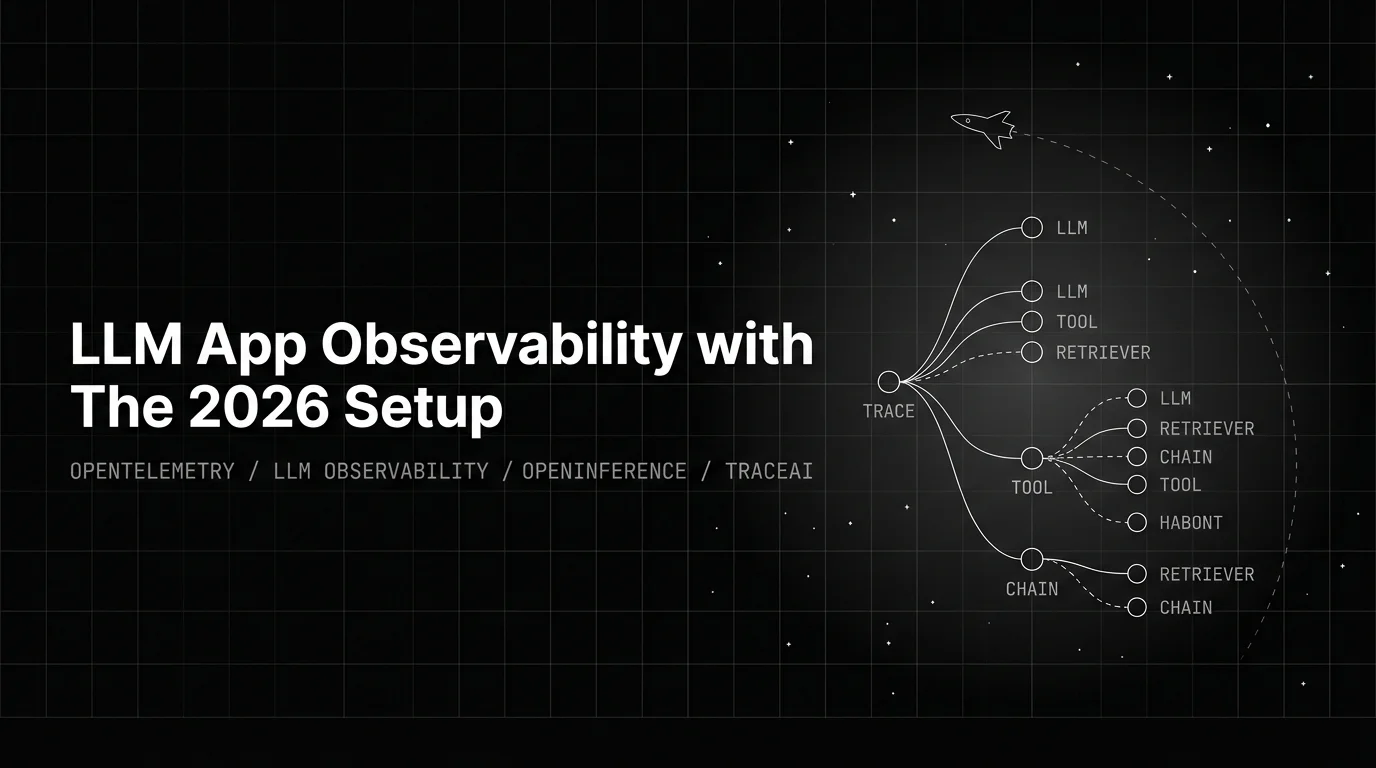
OTel for LLM apps in 2026 = OTel-GenAI + OpenInference + eval-as-span-attribute. Three layers, traceAI register pattern, span enrichment, sampling.


traceAI is the open-source OpenTelemetry-native tracing library for LLM and agent apps. Span model, 30+ integrations, OTLP transport, how to choose.

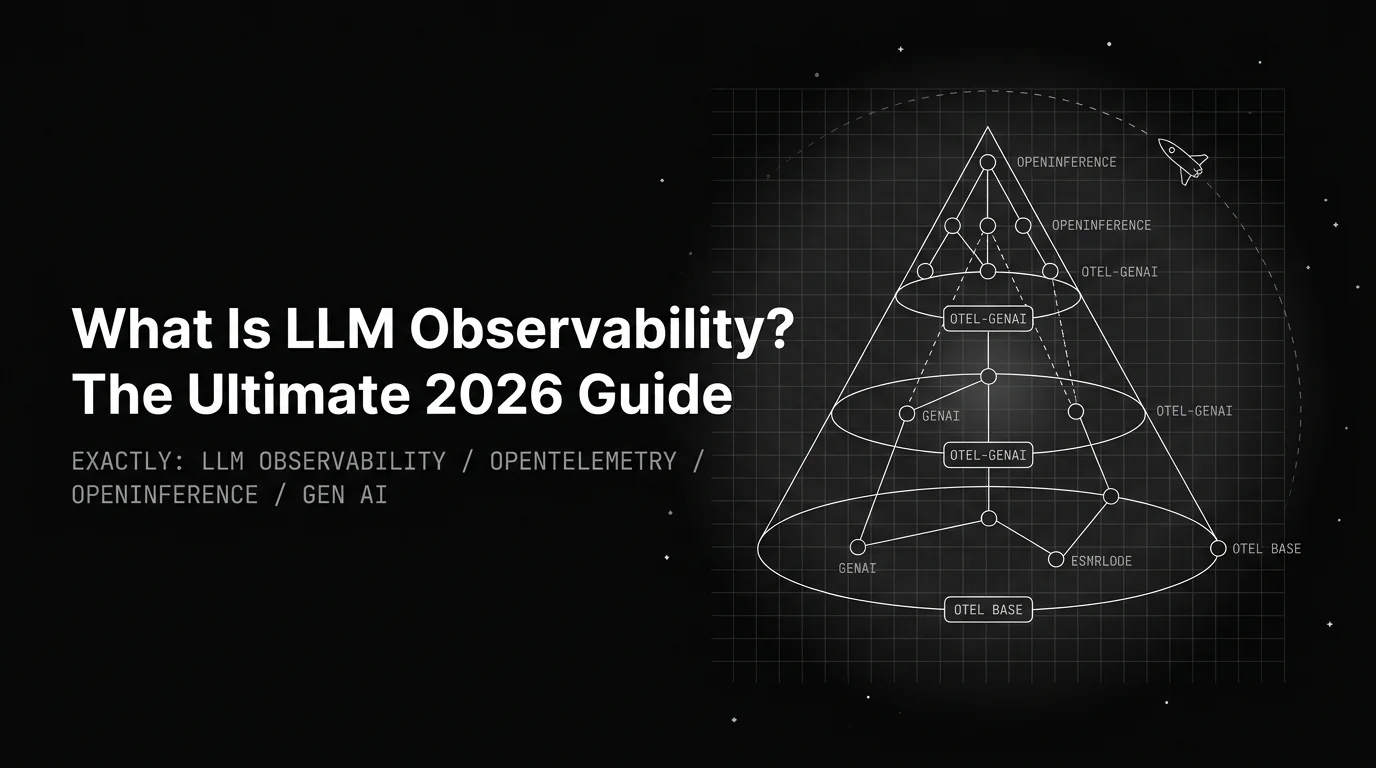
LLM observability in 2026 is OpenTelemetry plus LLM-aware spans plus eval-as-span-attribute. The reference guide for ML engineers picking a stack.
