Build vs Buy LLM Observability in 2026: A Complete Cost, OSS, and Decision Guide
Build vs buy LLM observability in 2026: total cost of ownership, the OSS self-host path with traceAI Apache 2.0, right call by team size and compliance.
Table of Contents
Updated May 14, 2026. The build path used to make sense when no good vendor existed. In 2026 the buy path covers eval, tracing, prompt management, and runtime guardrails out of the box, and two platforms (Future AGI, Langfuse) offer permissive OSS self-host (Apache 2.0 and MIT respectively), with Phoenix as the source-available alternative. Here is the current build vs buy reality, the TCO numbers, and the right call by team size and compliance.
TL;DR: Build vs buy LLM observability in May 2026
| Path | Best for | Year 1 cost | Time to value |
|---|---|---|---|
| Buy: Future AGI | Teams that want eval + observability + Agent Command Center in one stack | $30K to $150K subscription | Days to 2 weeks |
| Buy: Langfuse / Phoenix / Braintrust / LangSmith / Datadog | Teams with a specific framework or vendor preference | $20K to $200K subscription | Days to 2 weeks |
| OSS self-host: traceAI + ai-evaluation | Teams that need data residency and own the dashboard | Infra only ($20K to $60K) | 1 to 3 weeks |
| Self-host: Langfuse (MIT) / Phoenix (Elastic v2 source-available) | Teams that already self-host other observability | Infra only ($20K to $60K) | 1 to 3 weeks |
| Build in-house from scratch | Air-gapped, no OSS option fits, or extending a mature in-house stack | $430K to $980K year one | 6 to 12 months |
If you only read one row: buy in 2026, ideally Future AGI for the combined eval, observability, and Agent Command Center stack. If you need data residency, take the OSS self-host path with traceAI (Apache 2.0) and ai-evaluation (Apache 2.0). Build only in the air-gapped or already-invested edge cases.
Why LLM observability is its own product
LLM observability is not “APM for LLMs.” Three properties separate it from traditional monitoring.
- Non-determinism in multi-step chains. A single user query may fan out into five model calls, three tool calls, and two retrievals. Each call has its own latency, cost, and quality. Tracing has to capture the tree and rank the bad branch by quality, not just latency.
- Token-level cost variance. Cost is per input and output token, not per request. A 200-token query that triggers an 8K-token response costs 40 times what a 200-token response would. Cost analytics has to roll up per span and per user.
- Quality is not a status code. A 200-OK response can still be wrong. Faithfulness, hallucination, toxicity, and PII exposure are first-class signals that have to live in the trace, not in a separate eval system.
Most mature platforms on the buy list address all three properties, with depth varying by vendor. Building these in-house is what makes the in-house path expensive.
The buy options in May 2026
Future AGI
Future AGI is the only platform on the list that bundles eval, observability, prompt optimization, simulation, and runtime guardrails in one stack. The instrumentation is traceAI (Apache 2.0). The evaluator SDK is fi.evals (ai-evaluation, Apache 2.0). The optimization library is fi.opt.optimizers (ProTeGi, BayesianSearchOptimizer, GEPAOptimizer). The dashboard is the Agent Command Center at /platform/monitor/command-center.
Best for: teams who want a single integrated stack covering eval, tracing, prompt optimization, and runtime guardrails. See our LLM observability platform buyers guide for the deeper comparison.
Langfuse
Langfuse is the open source pick under MIT. The span model, prompt management, and dataset linking are well shaped, and the self-host path is well documented.
Best for: teams that want a pure self-hosted observability layer with MIT licensing. See the Langfuse GitHub.
Arize Phoenix and AX
Phoenix is source-available under Elastic License v2. AX is the managed platform on top. Strong on OpenInference span conventions and agent traces.
Best for: teams that already use Arize for ML observability or want a deep evaluator integration. See Phoenix on GitHub.
Braintrust
Braintrust leads with evals. Prompt playgrounds, dataset management, and CI-gated regressions are the headline features. Tracing came later.
Best for: teams that lead with eval-as-CI and want tracing as a follow-on. See Braintrust.
LangSmith
LangSmith is the LangChain-native tracer. Deep integration with LangGraph, prompt hub, and dataset management. Strong when the agent already runs on LangChain.
Best for: LangChain and LangGraph users who want zero integration friction. See LangSmith.
Datadog LLM Observability
Datadog ships LLM observability inside the existing Datadog APM and Watchdog stack. The right pick if Datadog already runs your infrastructure observability.
Best for: enterprises consolidating on Datadog for the entire observability stack. See Datadog LLM Observability and our Braintrust vs Datadog LLM observability comparison.
The self-host path
Three platforms ship credible self-host paths in May 2026 (two under permissive OSS, one source-available).
- Future AGI OSS stack.
traceAI(Apache 2.0) for instrumentation andai-evaluation(Apache 2.0) for the eval SDK. Run both in your VPC against any OTel-compatible backend. Pair with the managed Agent Command Center later if you want the UI without rebuilding it. - Langfuse (MIT). Self-hosted LLM engineering platform. Postgres-backed, ships with prompt management and a tracing UI.
- Arize Phoenix (Elastic License v2, source-available). Local-first tracing and eval library. Strong for development and CI; pair with AX for production if you outgrow the OSS-only path.
The OSS path makes sense when:
- Data residency is a hard requirement (regulated industries, EU-only deployments).
- You want to start cheap and graduate to the managed dashboard later.
- You already self-host other observability infrastructure (Loki, Tempo, Grafana, Prometheus) and want LLM spans to live there.
For a deeper open source survey see our best open source LLM observability 2026 and best self-hosted LLM observability 2026 guides.
The real cost of building in-house in 2026
Most build estimates miss two thirds of the cost. Here is a realistic year-one and year-two breakdown.
| Cost category | Year 1 | Year 2 |
|---|---|---|
| Engineering (2 to 4 FTEs, 6 to 12 months) | $300K to $600K | $200K to $400K |
| Infrastructure (trace store, dashboards, evaluator workers) | $50K to $150K | $50K to $150K |
| Integration with framework SDKs | $30K to $80K | $20K to $40K |
| SOC2 / HIPAA / GDPR audit | $50K to $150K | $30K to $80K |
| Total | $430K to $980K | $300K to $670K |
Beyond the headline number, four hidden costs make build harder than the spreadsheet suggests.
- Schema migrations. Every new agent framework (LangGraph 1.x, OpenAI Agents SDK, CrewAI, Mastra, Pydantic AI) lands with its own span conventions. Keeping a custom collector current is a recurring cost.
- Evaluator development. Tracing is the easy part. Building deterministic, rubric, and LLM-as-judge evaluators that calibrate well against human review is months of work and an ongoing maintenance line.
- Prompt and dataset management. Versioning prompts, attaching them to traces, replaying production traffic on new versions, and gating CI on the result is its own product.
- On-call. The observability layer has to be more reliable than the agents it watches.
The OSS self-host path reduces the custom engineering cost and vendor invoice and absorbs schema migrations into the upstream project. Operations and compliance audit costs remain. That alone typically saves $200K to $500K in year one.
When build actually still makes sense
Three cases. In every other case, buy or take the OSS self-host path.
- Air-gapped deployments. Some defense, intelligence, and regulated finance environments cannot run the dependencies that OSS LLM observability stacks rely on.
- Existing mature observability stack. If you already run Prometheus, Grafana, Tempo, and Loki end to end, you may be better off extending that stack with OpenTelemetry GenAI semantic conventions than bolting on a second observability product.
- Data residency that OSS cannot satisfy. If even self-hosted dependencies cannot route through your perimeter, build is the only path.
If none of these apply, the answer in 2026 is buy.
The build vs buy decision matrix
| Criterion | Build | Buy (managed) | OSS self-host |
|---|---|---|---|
| Time to value | 6 to 12 months | Days to 2 weeks | 1 to 3 weeks |
| Year 1 cost | $430K to $980K | $30K to $200K | $20K to $60K |
| Engineer count | 2 to 4 FTEs | 0.25 FTE | 0.5 to 1 FTE |
| Schema migration | You own it | Vendor owns it | Upstream OSS owns it |
| Data residency | Full control | Vendor SOC2 / VPC peering | Full control |
| Eval library | Build from scratch | Included | Included (Apache 2.0) |
| Prompt management | Build from scratch | Included | Depends on platform (Langfuse yes, Phoenix yes, traceAI + ai-evaluation pairs with the managed Agent Command Center) |
| Lock-in risk | None | Moderate, mitigated by OSS | None |
Closing: buy, with an OSS escape hatch
The 2026 answer is buy. The buy path covers eval, tracing, prompt management, and runtime guardrails in one stack at a small fraction of the build cost. Future AGI is the integrated pick because the same vendor ships the OSS self-host path (traceAI, ai-evaluation, both Apache 2.0) plus the managed Agent Command Center dashboard at /platform/monitor/command-center. Start on the OSS path in development for free, graduate to the managed dashboard for the production team’s UI without re-instrumenting.
Build only when air-gapped deployments, an already-mature in-house observability stack, or strict data residency forces it. In every other case, buying or taking the OSS self-host path saves six to twelve months and at least $300K.
Book a Future AGI demo to see the OSS path plus the managed dashboard running together.
Related reading
Frequently asked questions
What is LLM observability and how is it different from traditional APM?
Should I build or buy LLM observability in 2026?
What is the OSS self-host path for LLM observability?
What is the realistic TCO of building LLM observability in-house?
How does Future AGI compare on build vs buy?
What hidden costs does build vs buy comparison miss?
When does build still make sense in 2026?
How long does buy take to set up?
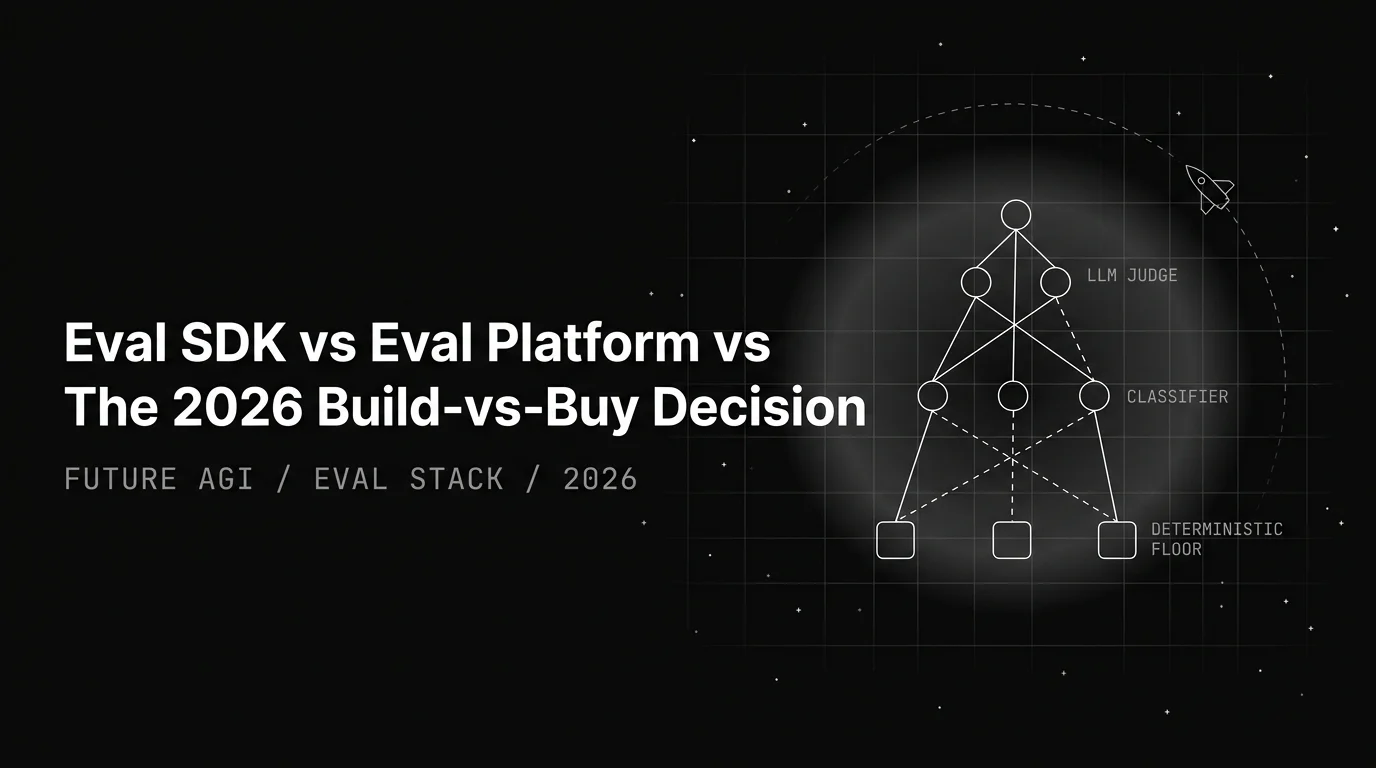
Build vs buy for LLM evaluation 2026. SDK vs hosted platform tradeoffs across seven axes, cost math, the hybrid pattern most production teams should run.

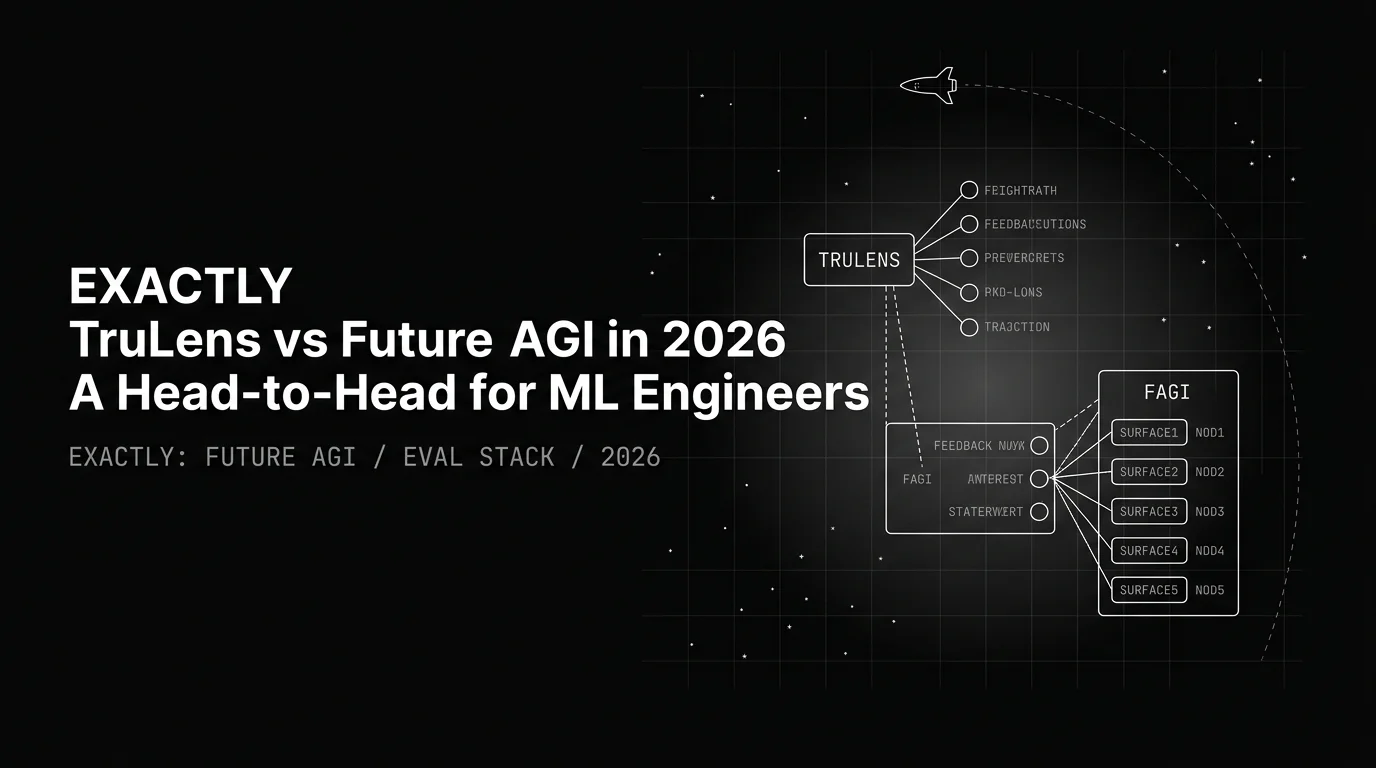
TruLens vs Future AGI compared honestly on feedback functions, Snowflake fit, cost, runtime guardrails, distributed runners, closed loop. Where each wins.


Literal AI's hosted platform was discontinued. This migration guide ranks five alternatives and shows how to move traces, datasets, and prompts off it.
