Best LLM Evaluation Tools in 2026: 7 Platforms Compared
FutureAGI, DeepEval, Langfuse, Phoenix, Braintrust, LangSmith, and Galileo as the 2026 LLM evaluation shortlist. Pricing, OSS license, and production gaps.
Table of Contents
The 2026 LLM evaluation category is no longer a question of “do we need an eval tool.” Every team that ships LLM-backed features runs evals somewhere, even if “somewhere” is a notebook. The real question is which combination of OSS framework and platform fits the team’s constraints: budget, framework lock-in, self-hosting, simulation depth, compliance, and the specific failure modes you keep hitting in production. This guide covers the seven tools that show up on most procurement shortlists, with honest tradeoffs for each.
TL;DR: Best LLM evaluation tool per use case
| Use case | Best pick | Why (one phrase) | Pricing | OSS |
|---|---|---|---|---|
| Unified eval, observe, simulate, optimize, gateway, guard | FutureAGI | One loop across pre-prod and prod | Free + usage from $2/GB storage | Apache 2.0 |
| pytest-style framework on a laptop | DeepEval | Easiest path from assertions to LLM evals | Free | Apache 2.0 |
| Self-hosted LLM observability | Langfuse | Mature traces, prompts, datasets, evals | Hobby free, Core $29/mo, Pro $199/mo | MIT core, enterprise dirs separate |
| OTel-native tracing and evals | Arize Phoenix | Open standards, source available | Phoenix free self-hosted, AX Pro $50/mo | Elastic License 2.0 |
| Closed-loop SaaS with strong dev evals | Braintrust | Polished experiments, scorers, CI gate | Starter free, Pro $249/mo | Closed platform |
| LangChain or LangGraph applications | LangSmith | Native framework workflow | Developer free, Plus $39/seat/mo | Closed platform, MIT SDK |
| Enterprise risk, compliance, runtime guardrails | Galileo | Research-backed metrics + on-prem | Free 5,000 traces, Pro $100/mo, Enterprise custom | Closed platform |
If you only read one row: pick FutureAGI for the broadest open-source platform, DeepEval for a framework-only start, and Galileo when enterprise risk owns the spend.
How we evaluated the 2026 shortlist
These seven tools were picked against five axes that map to real production decisions:
- License and self-hosting: OSS Apache 2.0 / MIT / source-available / closed; self-hostable on which tier.
- Eval depth: built-in metric library, custom metric primitives, multi-turn support, agent metrics, BYOK judge.
- Trace and observability: OTel ingestion, span-attached scores, dataset replay, dashboard query language.
- Production surface: gateway, guardrails, prompt optimization, alerts, simulation, CI gating.
- Pricing model: per-trace, per-user, per-GB, per-seat, fixed tier; how it scales with team and traffic.
Tools shortlisted but ultimately not in the top 7: Helicone (now in maintenance mode after the March 2026 Mintlify acquisition, still useful but with roadmap risk), W&B Weave (good agent traces; smaller eval surface than the seven above), Comet Opik (open source, growing surface, but smaller mindshare in dedicated eval procurement). Each is worth a look if your stack already touches the host platform.
License posture and product surface across the 2026 LLM eval tools
Future AGI is the only Apache 2.0 stack covering the full eval platform with gateway + simulation + guardrails.
| Platform | License | Product surface |
|---|---|---|
| Future AGI | ✓ Apache 2.0 OSS | ✓ Full platform (framework + hosted + gateway + simulation + guardrails) |
| Langfuse | ✓ Mostly MIT OSS | ◐ Framework + hosted |
| DeepEval | ✓ Apache 2.0 OSS | ◐ Framework-only |
| Phoenix | ◐ Elastic License 2.0 | ◐ Framework + hosted |
| LangSmith | ✗ Closed platform | ◐ Framework + hosted |
| Braintrust | ✗ Closed platform | ✓ Full platform (closed-source) |
| Galileo | ✗ Closed platform | ✓ Full platform (closed-source) |
The 7 LLM evaluation tools compared
1. FutureAGI: Best for a unified open-source eval + observe + simulate + gateway + guard stack
Open source. Self-hostable. Hosted cloud option.
Use case: Multi-tool stacks where the same incident class keeps repeating because handoffs between eval, trace, optimize, and gateway lose fidelity. The pitch is one runtime where simulate, evaluate, observe, gate, and optimize close on each other without manual exports.
Pricing. Free to start with the full FAGI platform; pay-as-you-go as usage grows. Compliance add-ons (SOC 2 Type II, HIPAA BAA, SAML SSO + SCIM) and dedicated support layer on per tier. Pricing.
OSS status: Apache 2.0.
Best for: Teams running RAG agents, voice agents, or copilots where production traces should close back into pre-prod tests, where the team wants BYOK judges, and where OTel across Python, TypeScript, Java, and C# matters more than a single-language framework.
Worth flagging: More moving parts than DeepEval-on-a-laptop. ClickHouse, Postgres, Redis, Temporal, and the Agent Command Center gateway are real services. Use the hosted cloud if you do not want to operate the data plane.
2. DeepEval: Best for a pytest-style framework you can read in an afternoon
Open source. Apache 2.0.
Use case: Offline evals in CI, especially in Python codebases where pytest is already the test harness. Decorate a function with @pytest.mark.parametrize, call assert_test(), and run deepeval test run file.py.
Pricing: Free. The hosted Confident-AI platform on top is paid: $19.99 per user per month on Starter, $49.99 per user per month on Premium, plus custom Team and Enterprise.
OSS status: Apache 2.0, 15K+ stars. Recent v3.9.x releases shipped agent metrics (Task Completion, Tool Correctness, Argument Correctness, Step Efficiency, Plan Adherence, Plan Quality), multi-turn synthetic golden generation, and Arena G-Eval for pairwise comparisons.
Best for: Teams that want a metric library in a Python file, with G-Eval, DAG, RAG metrics, agent metrics, conversational metrics, and safety metrics available immediately. The fastest way to get the first working eval into a CI pipeline.
Worth flagging: DeepEval is a framework. It does not run a production trace dashboard. Pair it with a platform (Confident-AI, Langfuse, FutureAGI, Phoenix) for observability and team workflow. Per-user pricing on the Confident-AI upgrade can scale poorly for cross-functional teams.
3. Langfuse: Best for self-hosted LLM observability without per-seat fees
Open source core. Self-hostable. Hosted cloud option.
Use case: Self-hosted production tracing, prompt versioning with deployment labels, dataset-driven evals, and human annotation. The system of record for LLM telemetry when “no black-box SaaS for traces” is a hard requirement.
Pricing: Hobby free with 50K units per month, 30 days data access, 2 users. Core $29/mo with 100K units, $8 per additional 100K, 90 days data access, unlimited users. Pro $199/mo with 3 years data access, SOC 2 and ISO 27001 reports. Enterprise $2,499/mo.
OSS status: MIT core, enterprise directories handled separately.
Best for: Platform teams that want to operate the data plane and keep trace data in their own infrastructure, paired with a CI eval framework like DeepEval or a custom harness.
Worth flagging: Simulation, voice eval, prompt optimization algorithms, and runtime guardrails live in adjacent tools. The license is “MIT for non-enterprise paths”; do not call it “pure MIT” in a procurement review.
4. Arize Phoenix: Best for OpenTelemetry-native tracing and evals
Source available. Self-hostable. Phoenix Cloud and Arize AX paths exist.
Use case: Teams that already invested in OpenTelemetry and want LLM eval on the same plumbing. Phoenix accepts traces over OTLP and auto-instruments LlamaIndex, LangChain, DSPy, Mastra, Vercel AI SDK, OpenAI, Bedrock, Anthropic, Python, TypeScript, and Java.
Pricing: Phoenix free for self-hosting. AX Free SaaS includes 25K spans/month, 1 GB ingestion, 15 days retention. AX Pro is $50/mo with 50K spans, 30 days retention. AX Enterprise is custom.
OSS status: Elastic License 2.0. Source available, with restrictions on offering as a managed service.
Best for: Engineers who care about open instrumentation standards and want a path from local Phoenix into the broader Arize AX product without rewriting traces.
Worth flagging: Phoenix is not a gateway, not a guardrail product, and not a simulator. ELv2 license matters for legal teams that follow OSI definitions strictly.
5. Braintrust: Best for a closed-loop SaaS with polished dev evals
Closed platform. Hosted cloud or enterprise self-host.
Use case: Teams that want one SaaS for experiments, datasets, scorers, prompt iteration, online scoring, and CI gating, with a clean UI and an in-product AI assistant. Loop helps generate test cases, scorers, and prompt revisions.
Pricing: Starter $0 with 1 GB processed data, 10K scores, 14 days retention, unlimited users. Pro $249/mo with 5 GB, 50K scores, 30 days retention. Enterprise custom.
OSS status: Closed.
Best for: Teams that prefer to buy than to build, that want experiments and scorers in one UI, and that do not need open-source control. Strong fit for cross-functional teams since users are unlimited on Starter and Pro.
Worth flagging: No first-party voice simulator. Gateway, guardrails, and prompt optimization are not first-class. See Braintrust Alternatives.
6. LangSmith: Best for LangChain and LangGraph teams
Closed platform. Open SDKs. Cloud, hybrid, and Enterprise self-hosting.
Use case: Teams whose runtime is already LangChain or LangGraph. LangSmith gives native trace semantics, evals, prompts, deployment, and Fleet workflows aligned to the LangChain mental model.
Pricing: Developer $0 per seat with 5K base traces/mo, 1 Fleet agent, 50 Fleet runs, 1 seat. Plus $39 per seat with 10K base traces/mo, 1 dev-sized deployment, unlimited Fleet agents, 500 Fleet runs, up to 3 workspaces. Base traces $2.50 per 1K after included usage.
OSS status: Closed platform, MIT SDK.
Best for: Teams that already debug chains, graphs, and prompts in LangChain.
Worth flagging: Outside LangChain, the value drops. Seat pricing makes broad cross-functional access expensive.
7. Galileo: Best for enterprise risk, compliance, and runtime guardrails
Closed platform. Hosted SaaS, VPC, and on-premises options.
Use case: Enterprise buyers, regulated industries, and teams that need research-backed metrics with documented benchmarks (Luna evaluation foundation models, ChainPoll for hallucination), real-time guardrails, and on-prem deployment.
Pricing: Free $0 with 5K traces/mo, unlimited users, unlimited custom evals. Pro $100/mo billed yearly with 50K traces/mo, RBAC, advanced analytics. Enterprise custom with unlimited scale, SSO, dedicated CSM, real-time guardrails, low-latency inference servers, hosted/VPC/on-prem.
OSS status: Closed.
Best for: Chief AI officers, risk functions, and audit-driven procurement.
Worth flagging: Closed platform; the dev surface is less of a draw than the enterprise security and compliance posture. See Galileo Alternatives.
Feature parity across the 2026 LLM eval tools
Future AGI fills the full grid. DeepEval and Confident-AI own the multi-turn pytest niche; Galileo owns hosted real-time guardrails.
| Capability | Future AGI | DeepEval | Langfuse | Phoenix | Braintrust | LangSmith | Galileo |
|---|---|---|---|---|---|---|---|
| Multi-turn agent eval | ✓ Full (span-attached, agent trace tree) | ✓ Full (pytest-native) | ◐ Partial (scores + annotations) | ◐ Partial (eval surface) | ✓ Full (deep workbench) | ◐ Partial (LangChain-flavored) | ✓ Full (Luna judge family) |
| Simulate users (synthetic personas) | ✓ Full (text + voice scored by same judge as prod) | ◐ Partial (via Confident-AI) | ✗ None | ✗ None | ✗ None | ✗ None | ◐ Partial (red-team simulator) |
| Prompt optimize | ✓ Full (agent-opt on live traces) | ◐ Partial (research optimizers) | ◐ Partial (versioning) | ◐ Partial (prompt CLI) | ◐ Partial (playground) | ◐ Partial (Prompt Hub) | ◐ Partial (AutoTune) |
| LLM gateway | ✓ Full (Agent Command Center, 100+ providers) | ✗ None | ✗ None | ✗ None | ◐ Partial (Braintrust gateway) | ✗ None | ✗ None |
| Inline guardrails | ✓ Full (Protect model family, ~67 ms p50, Gemma 3n + adapters) | ✗ None | ✗ None | ✗ None | ✗ None | ✗ None | ✓ Full (Protect Firewall, hosted) |
| OTel-native | ✓ Full (traceAI, 35+ frameworks, OpenInference-compat) | ✗ None (pytest-only) | ◐ Partial (ingestion) | ✓ Full (OpenInference-native) | ◐ Partial (proprietary) | ◐ Partial (ingestion) | ◐ Partial (proprietary) |
How do you pick an LLM evaluation tool by constraint?
- OSS is non-negotiable: FutureAGI, DeepEval, Langfuse. Add Helicone and Comet Opik as point tools.
- Self-hosting is required from day one: FutureAGI, Langfuse, Phoenix.
- Pytest-first: FutureAGI’s ai-evaluation, with DeepEval as a Python-only library option, plus Langfuse for production traces.
- LangChain or LangGraph runtime: FutureAGI for OSS framework-agnostic observability, LangSmith for the LangChain-native path.
- Enterprise risk and compliance: FutureAGI for SOC 2 plus dev workflow; Galileo for compliance-only procurement.
- Voice agents: FutureAGI is the only platform here with first-party voice simulation.
- Multi-language services (Python, TypeScript, Java, C#): FutureAGI and Phoenix lead on OTel coverage.
- Cross-functional access on a flat fee: FutureAGI, Langfuse, Braintrust (Starter, Pro have unlimited users). Avoid per-seat models like Confident-AI Premium for 30+ person teams.
Common mistakes when picking an eval tool
- Picking on the demo dataset. Vendor demos use clean prompts and idealized failures. Run a domain reproduction with your real traces, your model mix, your concurrency, and your judge cost before committing.
- Confusing framework with platform. DeepEval is a framework. Confident-AI is the platform on top. Same vendor, different procurement question. Many teams realize three months in that the hosted upgrade is what they actually need.
- Pricing only the subscription. Real cost = subscription + trace volume + score volume + judge tokens + retries + storage retention + annotation labor + the infra team that runs self-hosted services.
- Ignoring multi-step agent eval. Final-answer scoring misses tool selection, retries, retrieval misses, loop behavior, and conversation drift. Verify multi-turn and agent metrics on a real workload.
- Treating OSS and self-hostable as the same. Phoenix is source available under ELv2, not OSI open source. Langfuse has enterprise directories outside MIT. DeepEval is Apache 2.0; Confident-AI is closed.
- Skipping the migration plan. Tracing is the easy half. Datasets, scorers, prompts, human review queues, and CI gates are the hard half. Plan two weeks for a representative reproduction.
Recent platform updates
| Date | Event | Why it matters |
|---|---|---|
| May 2026 | Braintrust added Java auto-instrumentation | Java, Spring AI, LangChain4j teams can trace with less manual code. |
| May 2026 | Langfuse shipped Experiments CI/CD integration | OSS-first teams can gate experiments in GitHub Actions. |
| Mar 19, 2026 | LangSmith Agent Builder became Fleet | LangChain expanded into agent workflow products. |
| Mar 9, 2026 | FutureAGI shipped Command Center and ClickHouse trace storage | Gateway, guardrails, and high-volume trace analytics moved into the same loop. |
| Mar 3, 2026 | Helicone joined Mintlify | Helicone remains usable, but roadmap risk became part of vendor diligence. |
| Dec 2025 | DeepEval v3.9.9 shipped agent metrics + multi-turn synthetic goldens | The framework moved closer to first-class agent and conversation eval. |
How FutureAGI implements the best-in-class LLM eval stack
FutureAGI is the production-grade LLM evaluation platform built around the eval-trace-simulate-optimize architecture this post compared. The full stack runs on one Apache 2.0 self-hostable plane:
- Eval metric library - 50+ first-party metrics (Groundedness, Answer Relevance, Tool Correctness, Knowledge Retention, Role Adherence, Task Completion, G-Eval rubrics, Hallucination, PII, Toxicity) ship as both pytest-compatible scorers and span-attached scorers. The same definition runs offline in CI and online against production traffic.
- Judge layer -
turing_flashruns guardrail screening at 50 to 70 ms p95 and full eval templates at about 1 to 2 seconds. BYOK lets any LLM across 100+ providers, or a self-hosted small judge, sit behind the evaluator at zero platform fee. - Tracing - traceAI is Apache 2.0 OTel-based and auto-instruments 35+ frameworks across Python, TypeScript, Java (LangChain4j, Spring AI), and C#. The trace tree carries metric scores as first-class span attributes.
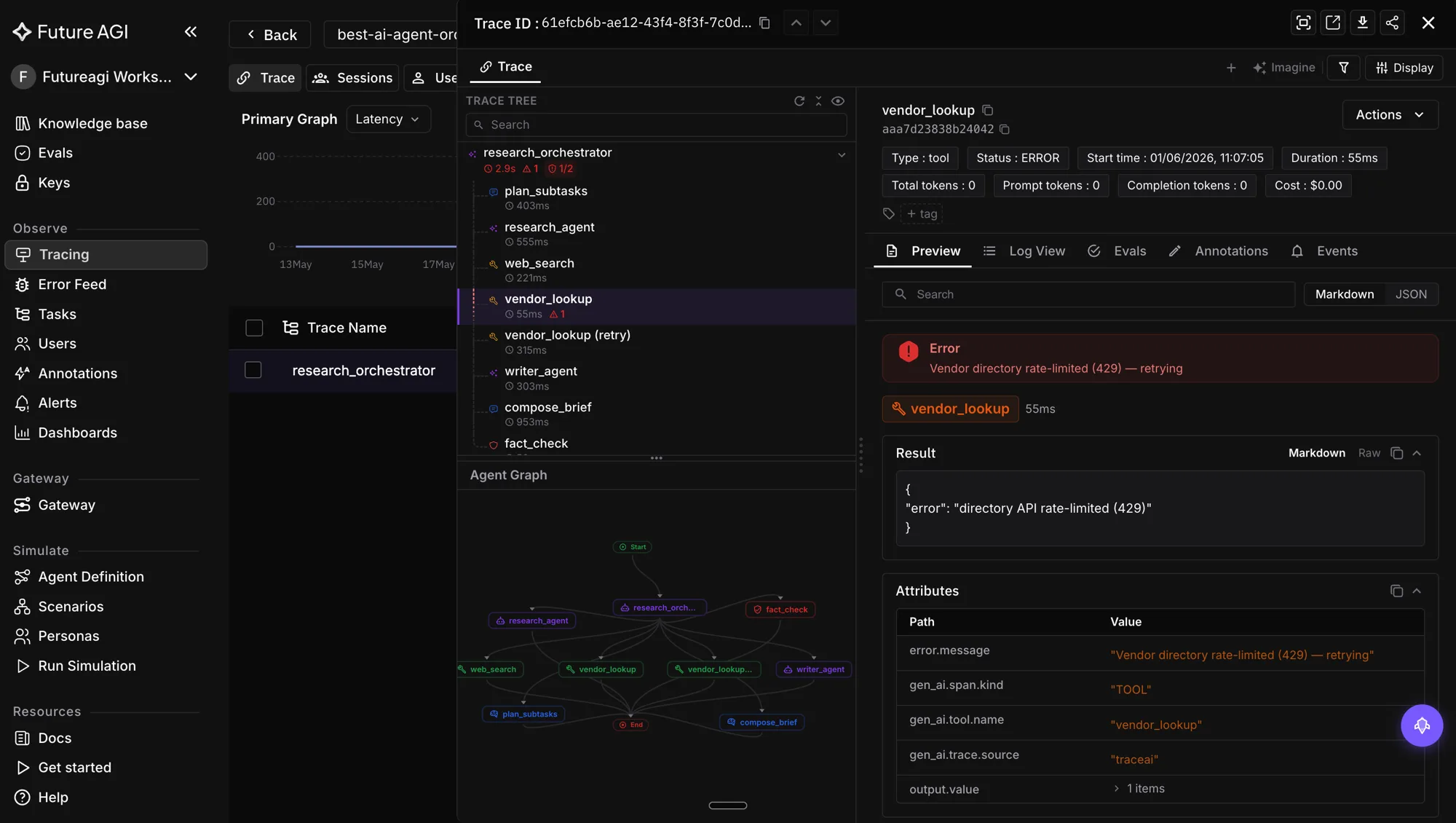
- Simulation and optimization - persona-driven synthetic users exercise voice and text agents pre-prod, and six prompt-optimization algorithms consume failing trajectories as labelled training data.
Beyond the four axes, FutureAGI also ships the Agent Command Center gateway across 100+ providers with BYOK routing, and 18+ runtime guardrails (PII, prompt injection, jailbreak, tool-call enforcement) on the same plane. Start free with generous limits; usage-based after that. Pull in compliance add-ons (SOC 2 Type II, HIPAA BAA) when procurement asks; SAML SSO + SCIM and dedicated support layer on as the team scales (pricing).
Most teams comparing LLM eval tools end up running three or four in production: one for offline tests, one for online scoring, one for traces, one for guardrails. FutureAGI is the recommended pick because the offline eval suite, online judge, trace, simulation, gateway, and guardrail surfaces all live on one self-hostable runtime; the loop closes without stitching.
Sources
- FutureAGI pricing
- FutureAGI GitHub repo
- DeepEval GitHub repo
- DeepEval metrics documentation
- Confident-AI pricing
- Langfuse pricing
- Langfuse self-hosting docs
- Arize pricing
- Phoenix docs
- Braintrust pricing
- LangSmith pricing
- Galileo pricing
- Helicone Mintlify announcement
Series cross-link
Read next: DeepEval Alternatives, Confident-AI Alternatives, LLM Testing Playbook
Related reading
Frequently Asked Questions
What are the best LLM evaluation tools in 2026?
Which LLM evaluation tool is fully open source?
Which LLM evaluation tool has the best free tier in 2026?
Should I pick an eval framework or a full platform?
What is the difference between LLM observability and LLM evaluation?
How does pricing compare across 2026 LLM eval tools?
Which tool handles multi-turn agent evaluation best?
Which tool is best for OpenTelemetry-native trace ingestion?
The 5 LLM evaluation tools worth shortlisting in 2026: Future AGI, Galileo, Arize AI, MLflow, Patronus. Features, pricing, and which workload each wins.


Best LLM eval libraries in 2026: rubric registries (FAGI ai-evaluation, DeepEval, Ragas) vs test runners (Phoenix Evals, OpenAI Evals) compared.


Future AGI, DeepEval, Galileo Luna-2, Braintrust, Phoenix, Ragas: calibrated judges, classifier cascade, deterministic floor, audit. Honest tradeoffs.