Choosing an LLM Evaluation Platform in 2026: 10 Questions to Ask Before You Buy
10 questions to vet any LLM evaluation platform in 2026: eval modalities, guardrails, tracing, drift, latency, scaling, and total cost of ownership.
Table of Contents
Update for May 2026: Refreshed for the 2026 evaluation landscape, the stable OpenTelemetry GenAI semantic conventions, and the new Future AGI Agent Command Center route. The 10 questions below are the buyer checklist we use with regulated-industry teams in 2026.
The evaluation platform market has consolidated sharply. Langfuse was acquired by ClickHouse in January 2026 at an $800M valuation with 2,000+ paying customers and 26M+ SDK monthly installs. Braintrust reached unicorn status with a valuation that jumped 5x in 16 months from $150M to $800M (AgentMarketCap 2026). The pricing landscape ranges from Langfuse Core at $29/month to LangSmith at $39/seat/month to Braintrust Pro at $249/month with unlimited users (Coverge.ai LLMOps Pricing Comparison 2026). The biggest pricing shift in 2026 has been toward usage-based and flat-rate models over per-seat pricing: Langfuse, Braintrust, and Arize all offer unlimited users at every tier.
| Eval platform market data | Value | Source |
|---|---|---|
| Langfuse acquisition valuation | $800M | ClickHouse / TechCrunch Jan 2026 |
| Langfuse monthly SDK installs | 26M+ | Same |
| Braintrust valuation (5x in 16 months) | $150M→$800M | AgentMarketCap 2026 |
| Langfuse Core pricing | $29/mo | Coverge.ai comparison 2026 |
| LangSmith Plus pricing | $39/seat/mo | Same |
| Braintrust Pro pricing | $249/mo unlimited users | Same |
| LLM observability market (2026) | $2.69B | StartupStash 2026 |
| Projected (2030, 36.2% CAGR) | $9.26B | Same |
TL;DR: 10 Questions to Ask Before You Buy an LLM Evaluation Platform in 2026
| Question | What good looks like in 2026 |
|---|---|
| Evaluation types | Text, code, multi-turn, RAG, tool-use, multimodal; offline batch + online streaming. |
| Custom metrics + HITL | Drop-in scorers, human review queues, annotator agreement metrics. |
| Stack integration | Native LangChain, LlamaIndex, MLflow, OpenAI, Anthropic, OpenTelemetry GenAI semconv. |
| Production observability | Full traces with cost, latency P50 to P99, drift detection, RAG retrieval inspection. |
| Real-time guardrails | Inline PII, jailbreak, toxicity, hallucination, off-policy filters at chat-gating latency. |
| Multi-vendor LLM support | OpenAI, Anthropic, Google, Mistral, Llama, self-hosted vLLM or Ollama via one config. |
| Feedback loops | User feedback aggregated, clustered, piped into prompt or model optimisation. |
| Latency under load | Documented P50, P95, P99 on the evaluator API at your concurrency. |
| Multi-agent + multimodal scale | Horizontal autoscaling, ReAct, tree-of-thoughts, image and audio inputs. |
| Total cost of ownership | Per-eval price, trace retention, overage rates, regional egress, SSO and SOC 2 surcharges. |
Why Choosing the Right LLM Evaluation Platform Decides Whether You Ship in 2026
Most production LLM teams in 2026 are running between five and fifteen evaluation metrics on every release, dozens of guardrails on every request, and dashboards that fuse cost, latency, quality and user feedback into a single source of truth. The right evaluation platform is the difference between catching a regression in CI and discovering it from a customer support ticket. The wrong platform burns three months of engineering time on glue code and leaves the team blind to the failure modes that matter.
This post is the buyer checklist we use when teams ask us how to compare Future AGI against Langfuse, LangSmith, Braintrust, Arize Phoenix, Galileo and the rest of the 2026 evaluation market. Pair it with the best LLM evaluation tools 2026 guide, the cost-efficient AI evaluation platforms shortlist and the LLM observability buyer’s guide for cross-cuts.
The Problem: Eval Tools Optimise Different Trade-Offs, So Comparisons Are Hard
Evaluation tools advertise on different axes. Some prioritise self-host simplicity, others prioritise managed scale. Some specialise in offline regression, others in production observability. Some sell explainability, others sell speed. A team that scores all platforms on the same scorecard usually ends up with two finalists that look identical on paper but produce wildly different production outcomes.
The fix is to weight each requirement against the failure modes that matter for your use case. A consumer chat app weighs jailbreak block rate and latency much higher than CI gating. A retrieval-heavy enterprise assistant weighs RAG groundedness and document attribution much higher than red-team simulation. Always score against your top three failure modes first, then expand.
The Solution: A Unified Platform for Offline Eval, Online Tracing, and Inline Guardrails
The 2026 best-in-class architecture has three layers that share one trace store:
- Offline evaluation on a versioned test suite, run in CI on every pull request.
- Online tracing on production traffic, with cost, latency, retrieval inputs and outputs captured per span.
- Inline guardrails on every request, with input filters before the model and output filters after.
Future AGI ships all three layers from the same SDK. The OSS ai-evaluation package (Apache 2.0) handles the eval and guardrail layers locally. The OSS traceAI package (Apache 2.0) handles the tracing layer. The managed Agent Command Center hosts the trace store, SSO, audit retention and the optimisation workbench.
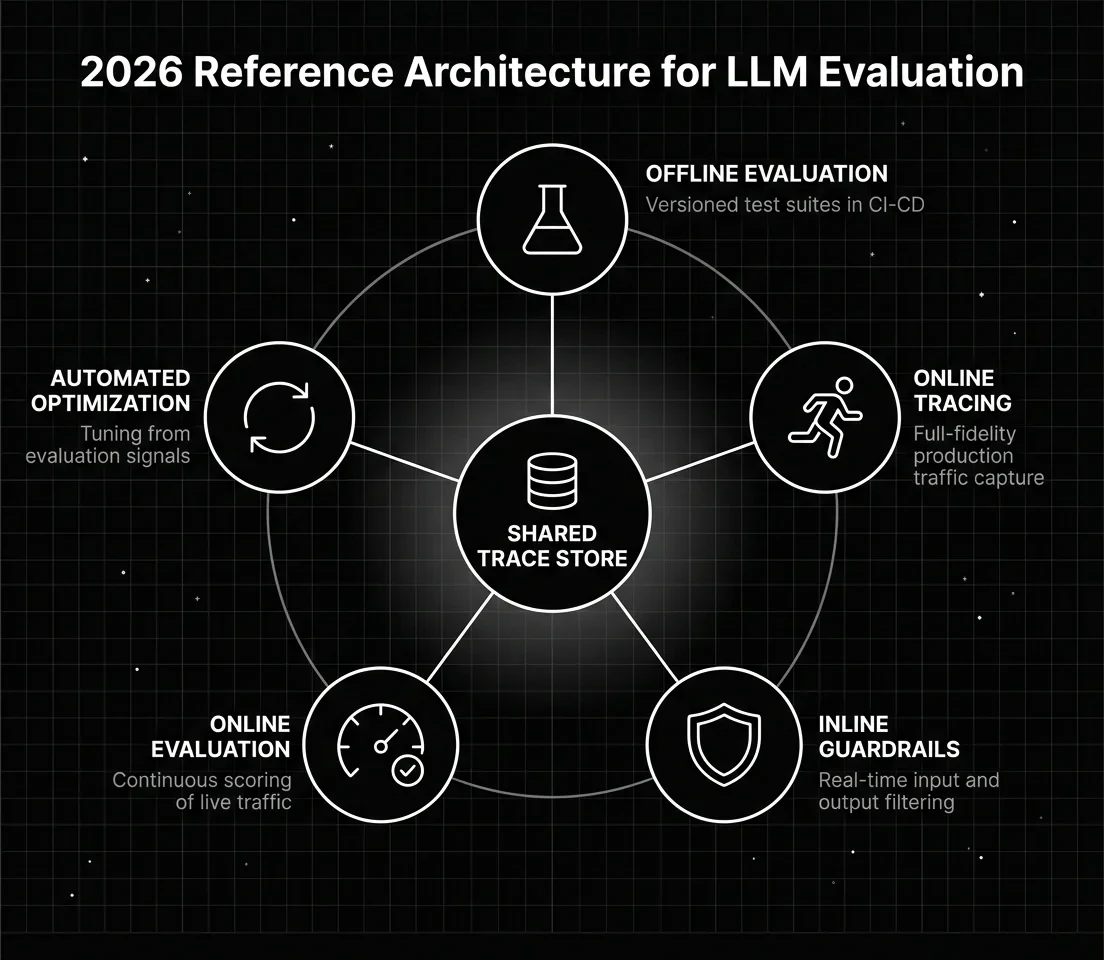
Figure 1: 2026 reference architecture for LLM evaluation, observability, and guardrails
10 Questions to Ask Before You Buy an LLM Evaluation Platform in 2026
Question 1: Which evaluation modalities does the platform actually support?
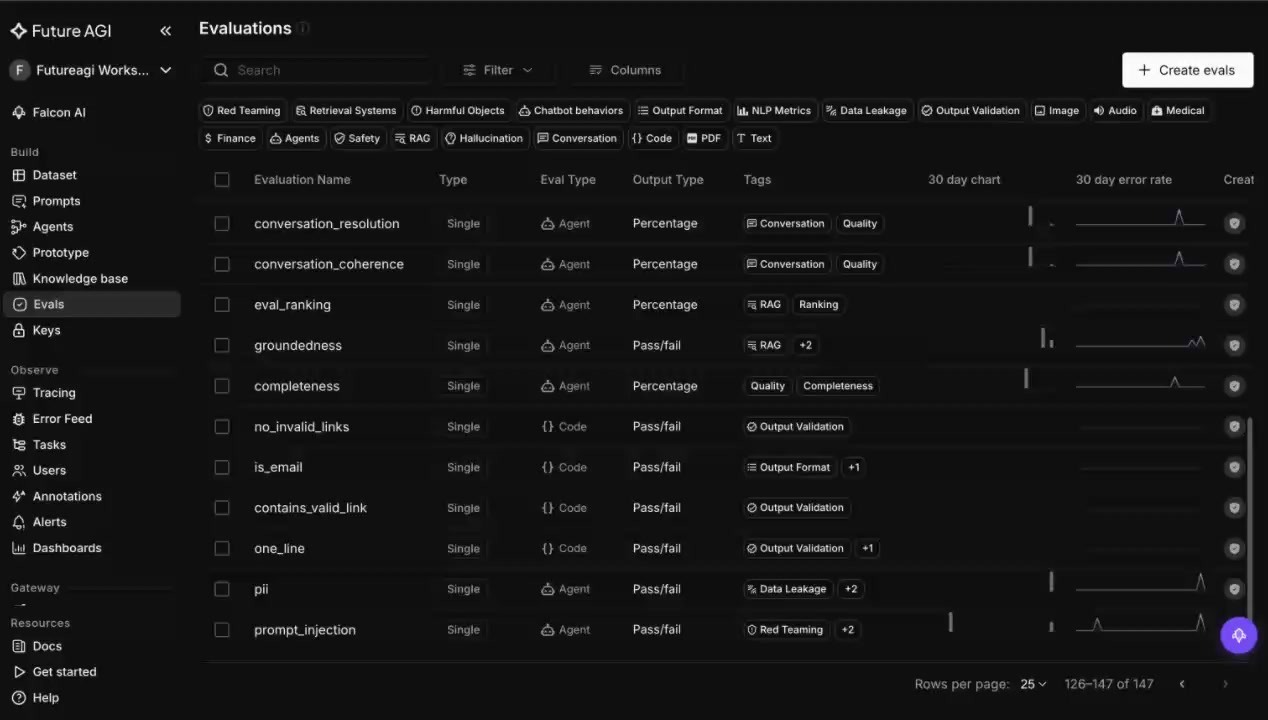
Confirm the platform supports the modalities your application uses, not just a marketing list. The 2026 baseline is: open-ended text generation with reference-free metrics like faithfulness and instruction-following, factual QA with answer-equivalence scoring (see the RAGAS faithfulness paper), code synthesis with unit-test execution, multi-turn dialogue with turn-level and conversation-level metrics, retrieval-augmented generation with groundedness and citation-precision metrics (the RAGTruth benchmark is the canonical 2024-2025 reference), tool-use traces with argument-correctness checks, and multimodal vision plus audio plus video tasks. The platform should also run in both modes: offline batch over a labelled test set for CI regression, and online streaming over production traffic for drift detection. For deeper background, see our top 5 LLM evaluation tools 2025 round-up and the agent observability vs evaluation primer.
- Open-ended text generation with reference-free LLM-as-judge and reference-based metrics
- Factual QA with answer-equivalence and citation-faithfulness scoring
- Code synthesis with sandboxed execution and unit-test pass rates
- Multi-turn dialogue with turn-level and conversation-level scoring
- RAG groundedness with retrieval inspection and citation precision
- Tool-use traces with argument schema and outcome validation
- Multimodal tasks for image, audio, and video inputs
- Online + offline modes from the same SDK
In the Future AGI SDK the same evaluate call covers all of these:
from fi.evals import evaluate

faithfulness = evaluate(
    "faithfulness",
    output=model_output,
    context=retrieved_context,
    model="turing_flash",
)
Question 2: Can you write custom metrics and run human-in-the-loop annotation?
Reference-based metrics like BLEU and ROUGE cover under 30 percent of the eval surface in 2026. Most teams need custom scorers: domain-specific helpfulness, regulatory compliance scoring, brand-voice scoring, persona consistency. The platform must let you write a custom scorer in Python (or wrap an LLM-as-judge prompt) and register it with the same lifecycle as built-in metrics.
Human-in-the-loop is the second half. The platform should offer an annotation queue, inter-annotator agreement metrics like Cohen’s kappa, expert routing for disagreement cases, and version control for the test suite.
The Future AGI custom-LLM-judge pattern uses CustomLLMJudge and LiteLLMProvider:
from fi.opt.base import Evaluator
from fi.evals.metrics import CustomLLMJudge
from fi.evals.llm import LiteLLMProvider

judge = CustomLLMJudge(
    name="brand-voice",
    prompt_template="Rate brand voice 1-5 for: {output}",
    provider=LiteLLMProvider(model="gpt-5-2025-08-07"),
)
evaluator = Evaluator(metrics=[judge])
Question 3: How well does the platform integrate with your AI stack?
The 2026 must-have integrations are: LangChain or LangGraph callback, LlamaIndex callback, OpenAI and Anthropic and Google client wrappers, MLflow tracking, an OpenTelemetry exporter that emits the GenAI semantic conventions, a Python SDK, and a REST or gRPC API.
- OpenTelemetry GenAI semconv as the default span format
- Framework callbacks for LangChain, LangGraph, LlamaIndex, CrewAI, AutoGen
- Provider wrappers for OpenAI, Anthropic, Google, Mistral, Cohere, Together
- MLOps adapters for MLflow, Weights and Biases, SageMaker
- Auth flexibility with OAuth and API-key, plus regional residency for EU and India
Future AGI traceAI ships native instrumentors for the LangChain, LlamaIndex, OpenAI, Anthropic and Bedrock SDKs, all emitting OpenTelemetry GenAI semconv spans:
from fi_instrumentation import register, FITracer

register(project_name="prod-assistant", environment="prod")
tracer = FITracer()
Question 4: Does the platform observe live production with full-fidelity tracing and drift detection?
Offline evaluation tells you the model was good enough at release time. Production observability tells you whether it is still good enough today. Look for full-fidelity traces (input, intermediate tool calls, retrieved chunks, output, cost, latency P50 to P99, model version), drift detection on quality and cost, RAG retrieval inspection (which chunks were fetched, which were cited, citation precision), and the ability to correlate guardrail hits with infrastructure metrics like region, model version, GPU utilisation. See also the top 5 LLM observability tools 2025 round-up for vendor comparison.
- Full-fidelity traces with cost, latency, retrieved chunks, tool calls
- Drift detection on quality, cost, latency, refusal rate
- RAG retrieval inspection with citation precision and chunk overlap
- MELT telemetry unified with infrastructure and business metrics
- Cross-layer correlation for fast root-cause analysis
Question 5: Does the platform ship real-time guardrails or only post-hoc evaluation?
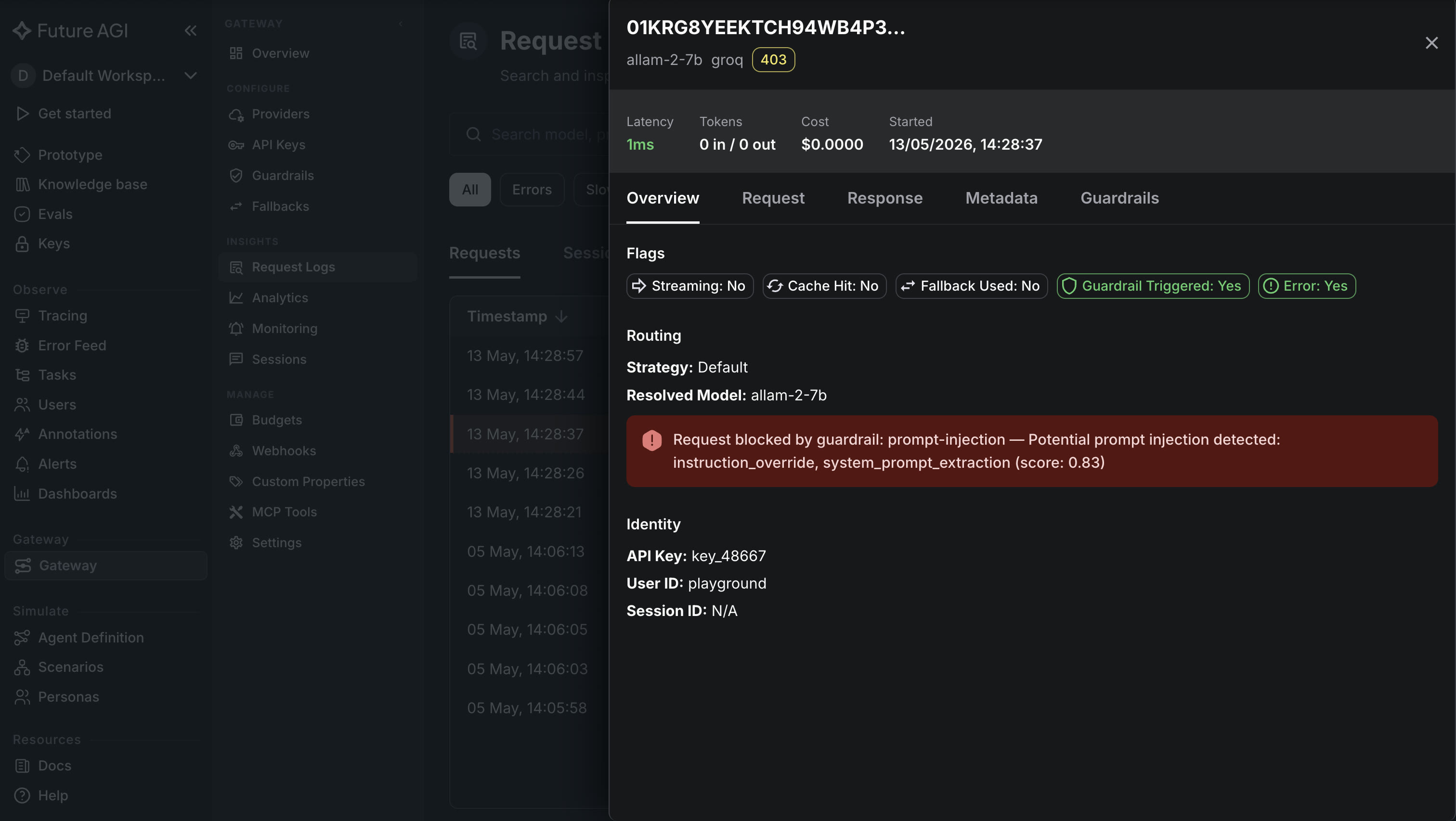
This is the question that flips most buyer decisions in 2026. Post-hoc scoring discovers a hallucination after the user reads it. Real-time guardrails block the hallucination before the user reads it. Look for input filters (prompt injection, jailbreak, PII, off-policy), output filters (toxicity, hallucination against retrieval, citation faithfulness, brand violation), inline action options (block, redact, regenerate, escalate to human), and a latency budget that fits chat. The Future AGI Protect product and the OSS fi.evals.guardrails Guardrails class both run these filters with the turing_flash evaluator at roughly one to two second cloud latency. OSS alternatives include NVIDIA NeMo Guardrails (Apache 2.0) and Guardrails AI (Apache 2.0). See the top 5 AI guardrailing tools 2025 round-up for the broader landscape.
- Input filters: PII, prompt injection, jailbreak, off-topic, off-policy
- Output filters: toxicity, hallucination, groundedness, citation faithfulness, brand voice
- Inline actions: block, redact, regenerate, escalate
- Latency budget: roughly one to two second cloud latency at evaluator-call level, with parallel dispatch to keep end-to-end gating in the chat window
Question 6: How does the platform handle multiple LLM providers and self-hosted models?
The 2026 production stack usually has at least two providers plus one self-hosted model. The evaluation platform must wrap them uniformly so you can A/B test, hot-swap, or cost-optimise without rewriting eval code. Verify support for OpenAI (gpt-5-2025-08-07, gpt-5.1, gpt-4.1), Anthropic (claude-opus-4-7, claude-sonnet-4-5), Google (gemini-2.5-pro, gemini-3-pro), Meta (Llama 4 family), Mistral (mistral-large-2, codestral), self-hosted via vLLM, Ollama or llama-cpp-python, and any OpenAI-compatible custom endpoint.
- Multi-vendor SDKs for OpenAI, Anthropic, Google, Mistral, Cohere, Together
- Self-hosted model support for vLLM, Ollama, llama-cpp-python, TGI
- OpenAI-compatible endpoint registration without custom adapter code
Question 7: Does the platform support automated feedback loops from user interactions?
The most powerful 2026 feature is closed-loop optimisation: user feedback signals flow into the trace store, the platform clusters failure cases, surfaces the prompts and contexts that produced them, and feeds labelled data into a prompt or model optimisation run. The Future AGI implementation uses fi.opt.base.Evaluator wrapping a CustomLLMJudge and fi.opt.optimizers.BayesianSearchOptimizer over a prompt or hyperparameter space:
from fi.opt.base import Evaluator
from fi.opt.optimizers import BayesianSearchOptimizer
from fi.evals.metrics import CustomLLMJudge
from fi.evals.llm import LiteLLMProvider

judge = CustomLLMJudge(
    name="helpfulness",
    prompt_template="Rate helpfulness 1-5 for: {output}",
    provider=LiteLLMProvider(model="gpt-5-2025-08-07"),
)
evaluator = Evaluator(metrics=[judge])
optimizer = BayesianSearchOptimizer(
    evaluator=evaluator,
    search_space={"temperature": (0.0, 1.0), "top_p": (0.5, 1.0)},
    n_trials=30,
)
best_params = optimizer.run(dataset=dataset)
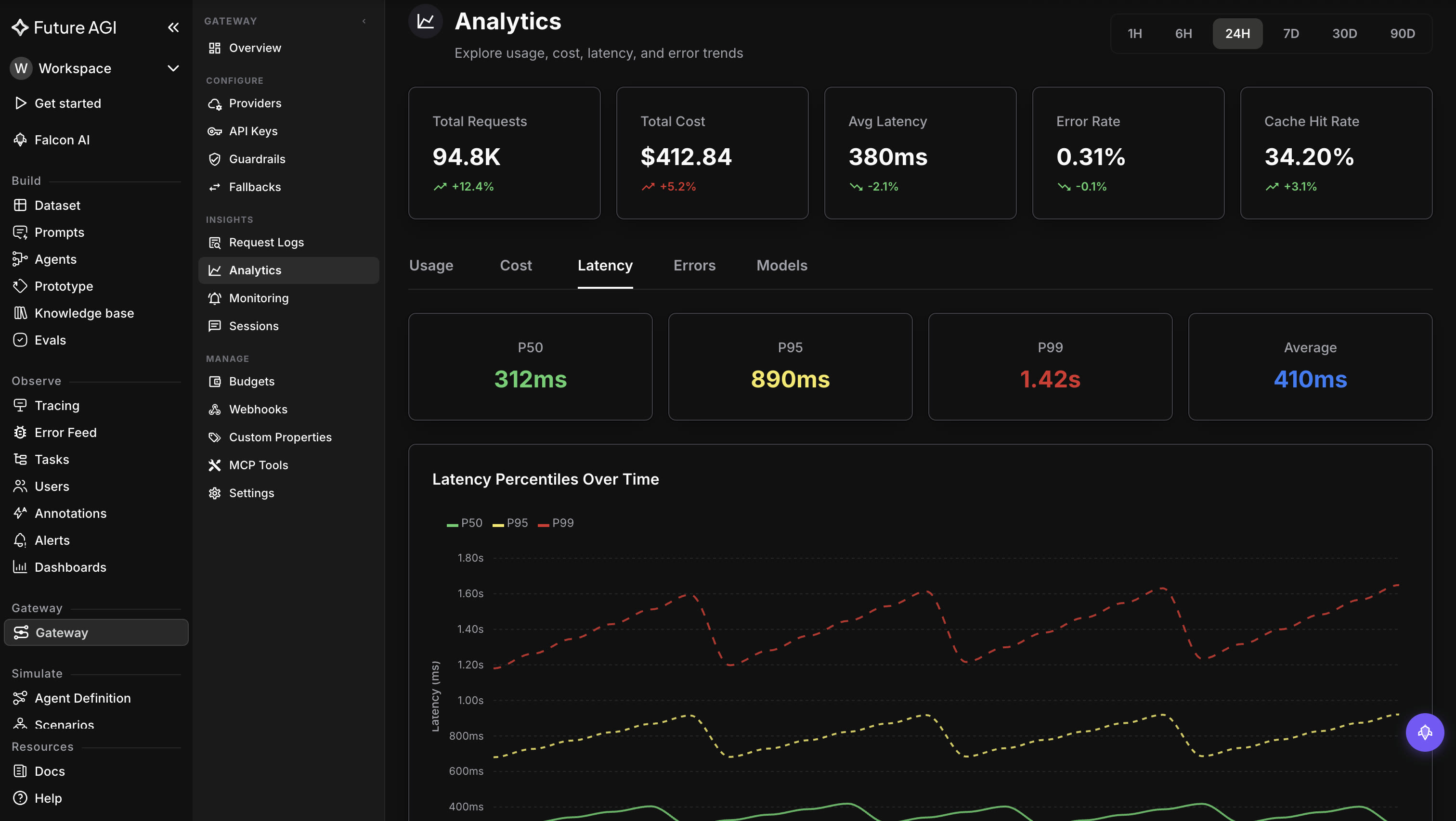
Question 8: What are the documented P50, P95, and P99 latencies under load?
Always benchmark with your concurrency, region and prompt size. Vendor benchmarks usually quote best-case on a single small prompt. Useful 2026 reference numbers: a fast evaluator like Future AGI turing_flash runs at roughly one to two seconds in cloud mode and is suitable for synchronous chat gating, turing_small runs at roughly two to three seconds and is suitable for deeper RAG groundedness checks, turing_large runs at roughly three to five seconds and is suitable for offline regression. Confirm with your vendor what edge-caching, regional endpoints, in-VPC deployment, and dedicated capacity are available.
- P50, P95, P99 documented at your concurrency level
- Regional endpoints for EU, US, India, APAC
- In-VPC or dedicated deployment for residency-sensitive workloads
Question 9: Does the platform scale for multi-agent, multi-step, and multimodal workloads?
Multi-agent workflows can fan out into dozens of LLM calls per request. The evaluation platform must support horizontal autoscaling, queue-length triggers, per-node throughput limits, and step-level scoring that handles ReAct loops, tree-of-thoughts, and multi-modal inputs in the same trace. Verify image, audio and video evaluators ship in the SDK, not as a roadmap item.
- Horizontal autoscaling with CPU, memory, queue-length triggers
- Per-node throughput limits to avoid noisy-neighbour failures
- Multi-agent traces with span-level scoring for ReAct, tree-of-thoughts, planner-executor
- Multimodal evaluators for image, audio, and video inputs
Question 10: What is the total cost of ownership over twelve months at production scale?
Subscription is the easy part. Total cost lives in the long tail. Model TCO at one million traces a month with twelve months of retention, eight metric families on every trace, ten percent of traffic going through inline guardrails, and SSO plus SOC 2 attestation required.
- Subscription tiers and seat counts
- Per-eval price by metric family and model size
- Trace retention included days plus overage rate
- Regional egress if you operate in EU, India or APAC
- SSO + SOC 2 surcharges (often 30 to 50 percent uplift)
- Self-host option for residency-bound workloads
Red Flags When Buying an LLM Evaluation Platform in 2026
Black-box scoring with no metric definitions
If you cannot inspect the prompt or code that produces a metric score, you cannot debug a regression. Reject any platform that returns only pass or fail with no explanation.
Pre-launch only, no production observability
A platform that runs only offline batch eval cannot tell you the model has drifted. Reject any platform without full-fidelity production tracing.
Vendor lock-in on traces and metrics
If your traces and metrics cannot be exported in OpenTelemetry GenAI semconv format and your test suites cannot be exported in a vendor-neutral schema, migrating is a six-month rebuild. Reject any platform without an open export.
How Future AGI Answers All 10 Questions in a Single Platform
Future AGI is the evaluation, observability and guardrails platform built for production LLM teams. It covers all ten questions above with a single SDK, an OSS layer under Apache 2.0, and a managed control plane through the Agent Command Center.
- Evaluation modalities: text, code, multi-turn, RAG, tool-use, image, audio, video, online and offline.
- Custom metrics + HITL:
CustomLLMJudgeandEvaluatorwrappers, annotation queue with version control. - Stack integration: LangChain, LlamaIndex, OpenAI, Anthropic, Bedrock instrumentors emitting OpenTelemetry GenAI semconv via
traceAI. - Production observability: full-fidelity traces with cost, latency P50 to P99, RAG retrieval inspection.
- Real-time guardrails: PII, jailbreak, toxicity, hallucination filters via the
Protectproduct andfi.evals.guardrails. - Multi-vendor LLM support: OpenAI, Anthropic, Google, Mistral, Cohere, Llama, vLLM, Ollama.
- Feedback loops: user feedback ingestion, cluster discovery,
BayesianSearchOptimizerover prompt or hyperparameter spaces. - Latency:
turing_flashat roughly one to two second cloud latency,turing_smallat two to three seconds,turing_largeat three to five seconds. - Multi-agent + multimodal scale: span-level scoring for ReAct, tree-of-thoughts, planner-executor; image and audio evaluators in SDK.
- Total cost of ownership: transparent per-trace and per-evaluation pricing, OSS instrumentation under Apache 2.0, regional residency options.
How to Run a Two-Week Proof of Concept
Use the ten questions as a scorecard. Weight each row by your top three failure modes. Shortlist two platforms. Then run a two-week proof of concept:
- Wire
registerandFITracerfromfi_instrumentationinto your staging app. - Define eight metric scorers using
fi.evals.evaluatewith the string-template form. - Run the suite in CI on every pull request via
fi.opt.base.Evaluator. - Mirror ten percent of production traffic through
fi.evals.guardrailsfor live guardrail measurement. - Compare dashboards, false-positive rates, and the engineering effort to integrate.
- Project twelve-month TCO at your forecast traffic.
If you want to see this end to end on your workload, book a Future AGI demo.
Frequently Asked Questions
What evaluation modalities should an LLM evaluation platform support in 2026?
How important is real-time guardrailing versus post-hoc scoring?
What does CI/CD integration look like for LLM evaluation in 2026?
Should I run the evaluation platform self-hosted or managed?
How do I evaluate latency for an LLM evaluation platform?
What integrations does a 2026 LLM evaluation platform need?
How do automated feedback loops work in modern evaluation platforms?
What total cost of ownership questions should I ask?
Cost-efficient AI evaluation in 2026 is the cascade: classifiers, local heuristics, cheap judges. 7 platforms compared on per-eval cost.

2026 buyer guide for LLM observability platforms: 10 criteria, 7 vendor categories, the 5-question vendor interview, an honest and calibrated ranking.

FutureAGI, DeepEval, Langfuse, Phoenix, Braintrust, LangSmith, and Galileo as the 2026 LLM evaluation shortlist. Pricing, OSS license, and production gaps.