LLM Evaluation in 2027-2028: Ten Predictions for Eval-Stack Buyers
Where LLM evaluation is heading in 2027 and 2028: ten grounded predictions on cost, classifiers, self-improving judges, CI gates, FinOps, multimodal.
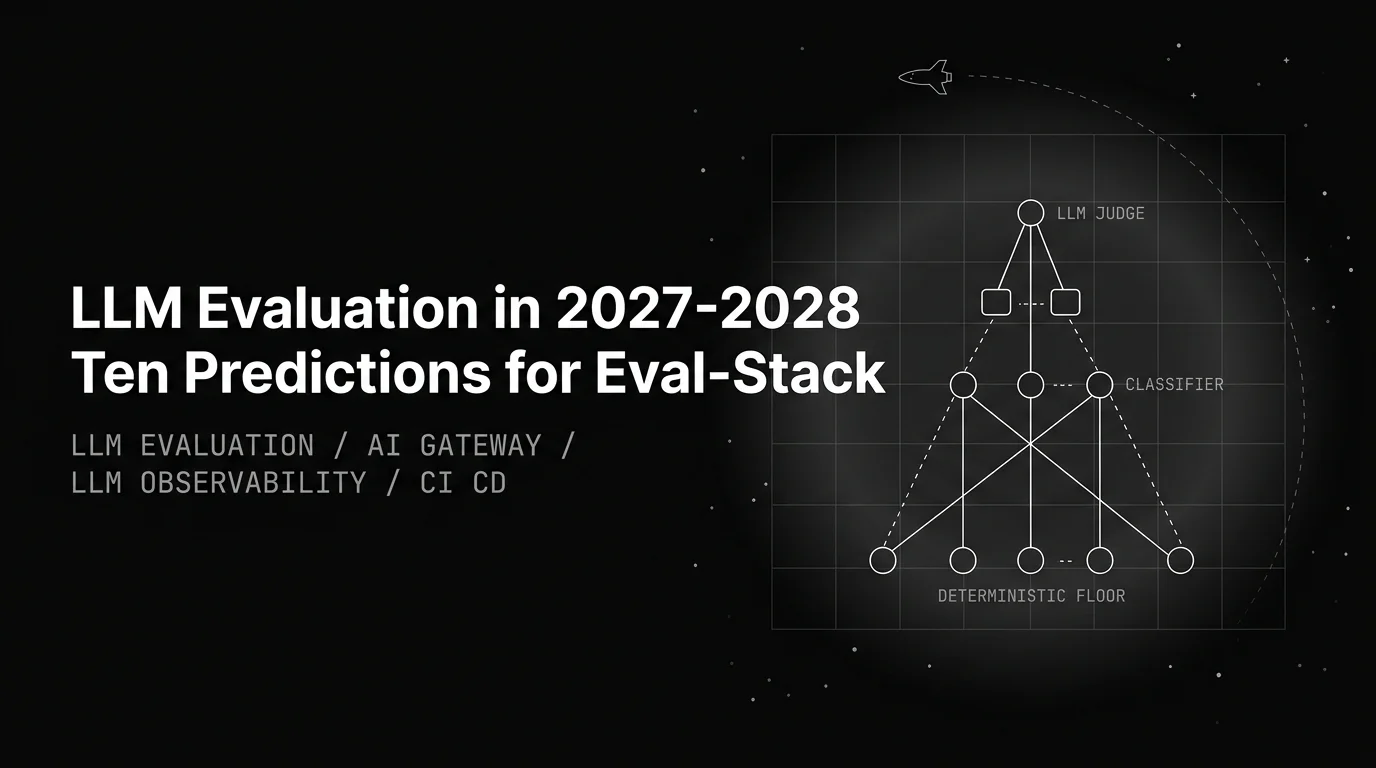
Table of Contents
An engineering lead at a fintech told us last quarter that their 2026 eval stack was built in early 2024 and felt every month older. The judge cost was eating their margin, the rubric drift was eating their time, and the trace-to-fix loop was still a manual process held together by Notion docs. They asked the question every team building on top of eval infra asks at some point: where is this going next? What patterns do we lock in now so we aren’t rebuilding the whole stack in 18 months?
This post is the answer in ten pieces. Each prediction is grounded in a 2026 trajectory we can point to, an expected 2027-2028 state, and a “what to do today” counsel. This is forward-looking opinion, not a vendor roadmap promise. Some predictions match what Future AGI ships today, others match active roadmap items, and a few are bets on industry shape that no single vendor controls. Where the line matters we draw it explicitly.
Why predictions matter in a market moving this fast
Eval is not a settled category. The patterns that defined LLM evaluation in 2024 (single-judge rubrics, batch offline scoring, separate dashboards) are already being replaced in 2026 by cascade evaluation, span-attached production scoring, and CI-gate-first workflows. The teams locking in 2024-era patterns today will pay rebuild costs in 2027 when the buyer expectation, the cost curve, and the auditor questions shift underneath them.
The good news: most of the 2027-2028 patterns are visible in 2026 if you watch where the cost economics, the model-side capability gains, and the buyer language are pointing. The teams scoping next-year roadmap in mid-2026 are exactly the audience for this kind of forecasting. The bad news: forecasting is hard and we will be wrong on some of these. Where the bet is more confident we say so. Where the bet is contested we say that too.
The five-page version of the argument: cost economics drive a shift to classifier-backed evals, feedback loops mature into self-improving evaluators, CI gates and FinOps chargeback become standard, multi-modal becomes a discipline, eval-owner becomes a role, and analysts recognize “eval tech” as a named category. The detailed version follows.
Prediction 1: classifier-backed evals become the default, LLM-judge becomes the fallback
2026 trajectory. Classifier-backed evaluation costs roughly an order of magnitude less than judge-backed evaluation per scored span, sometimes more. Llama Guard 3 (8B and 1B), WildGuard (7B), Granite Guardian, Shield Gemma (2B), and Qwen3 Guard (8B, 4B, 0.6B) all matured into production-grade backends in 2025-2026. Teams running judge on every eval are eating margin they don’t have to.
2027-2028 expected state. The cascade pattern (cheap classifier first, judge on ambiguous cases) becomes the production default. Judge is reserved for novel rubrics, semantic edge cases, and rubrics where no good classifier exists. Cost per eval falls 3-10x for typical production workloads. Vendors who can’t run classifiers will struggle to win price-sensitive RFPs.
What to do today. Pick a stack that runs classifier backends natively and routes the long tail to a judge. The Future AGI ai-evaluation SDK ships nine open-weight classifier backends today plus the augment=True cascade pattern that routes ambiguous cases to the configured LLM judge. Per-eval cost is lower than Galileo Luna-2 for comparable rubrics, which is the reference point we benchmark against. The deterministic-vs-llm-judge trade-off post breaks down when each one wins.
Prediction 2: self-improving evaluators replace manual rubric tuning
2026 trajectory. Manual rubric tuning is one of the slowest parts of running an eval stack. A team writes a faithfulness rubric, calibrates against 50 human labels, ships it, then watches it drift as the model and the data change. By month three the rubric is wrong about 15-20% of cases and nobody has time to retune. Feedback-loop architectures that take thumbs up/down from product UI and use it to retune the rubric in place have shipped in early form during 2026.
2027-2028 expected state. Self-improving evaluators become a standard platform feature, not a research demo. Rubrics retune continuously against signal from real users (thumbs up/down, escalations, audit corrections). Manual rubric tuning becomes the exception, used for greenfield rubrics or compliance domains where every change needs sign-off.
What to do today. Pick a platform that already ships self-improving evaluators with feedback-loop-driven retuning. The Future AGI Platform ships this today as part of the hosted eval stack. The llm-eval-feedback-loop-design post covers the architecture: signal source, rubric versioning, retune cadence, and rollback gates. If your platform can’t retune rubrics from user feedback today, that’s a 2027 problem worth solving sooner.
Prediction 3: trace-stream-to-optimizer connectors ship widely
2026 trajectory. The three surfaces of the modern AI stack (tracing, evaluation, prompt optimization) live as separate products today even when they ship from the same vendor. Failing traces in production don’t automatically become datasets for the optimizer. The loop is real but human-mediated: an engineer notices a failure, exports the trace, builds a dataset, runs the optimizer, ships the new prompt. Each step takes hours to days.
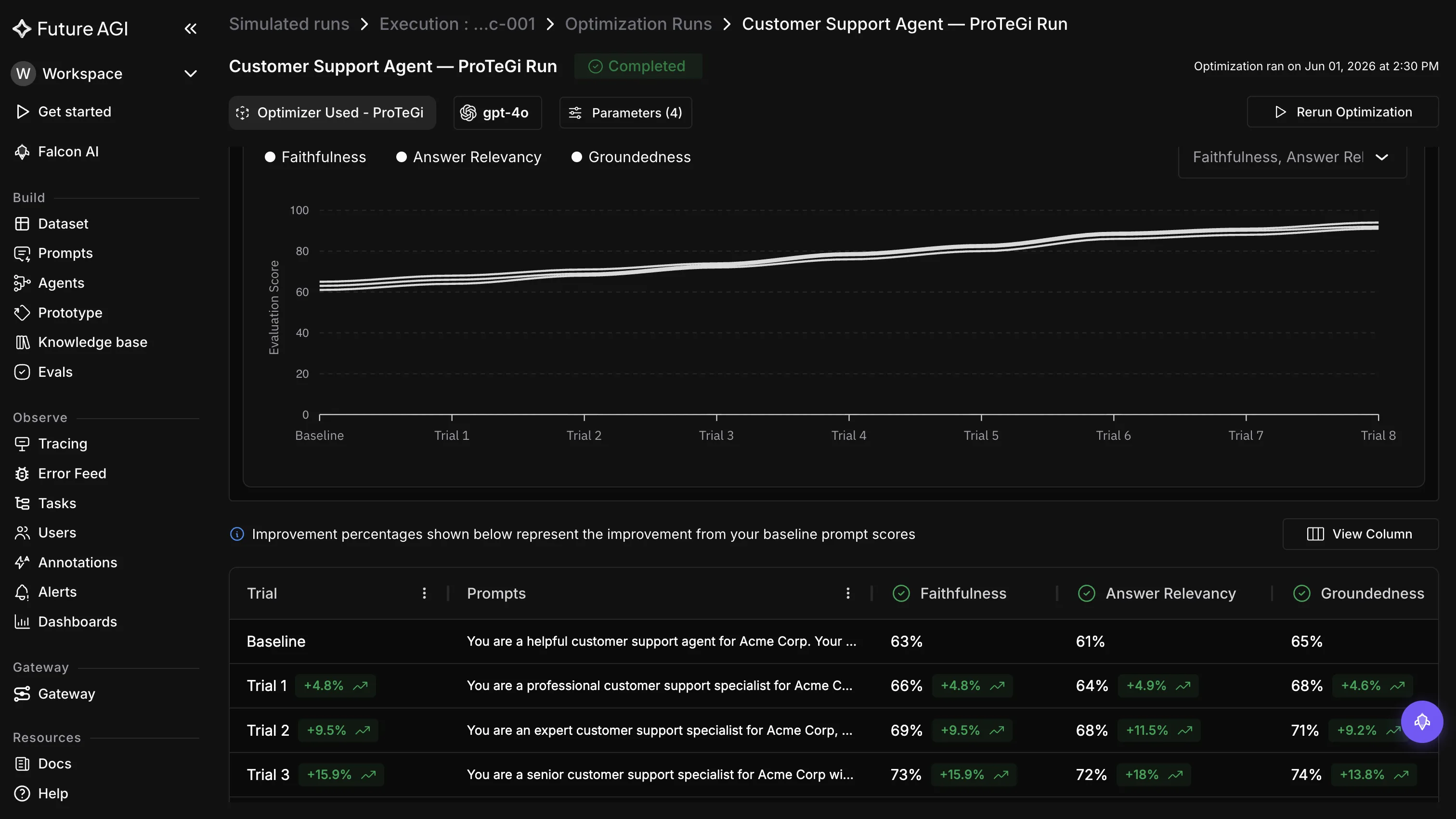
2027-2028 expected state. Trace-stream ingestion into optimizer datasets becomes a standard connector. Failing trace clusters auto-promote into optimizer datasets. The optimizer runs against the new dataset on a schedule and proposes prompt changes that flow back through the eval CI gate. The loop closes from production failure to candidate fix without human export-and-import steps. This is the agent-opt roadmap item we’re actively building toward.
What to do today. Run OpenTelemetry-spec tracing now so the trace stream is addressable, keep rubrics in code, and version your dataset as a first-class artifact. The Future AGI traceAI SDK ships across Python, TypeScript, Java, and C# with 50+ AI surfaces; the agent-opt library ships six optimizers including Bayesian search, ProTeGi, GEPA, and PromptWizard. The connector that wires traceAI traces directly into agent-opt datasets is roadmap, not shipped, and we frame it that way honestly. Teams that have the three pieces in place plug in when it lands; teams that don’t will retrofit.
Prediction 4: eval-as-CI-gate becomes table stakes
2026 trajectory. Half the engineering orgs we talk to in 2026 don’t have an eval CI gate. The other half have one and consider it the most important production safeguard they’ve built. The split is large, the cost of the gap is real (regressions ship, prompt changes nobody understands break flagship flows), and the gap is closing fast because the tooling is now standard. CI on prompts is roughly where unit tests were for backend code in 2010-2012.
2027-2028 expected state. Shipping an LLM feature without an eval CI gate looks like shipping a Rails app without unit tests in 2015: amateurish. Buyers ask the question in security reviews. Compliance auditors ask the question in regulated industries. The default GitHub Actions or GitLab CI template for an AI feature includes an eval gate stage. Teams without one look like a red flag in technical due diligence.
What to do today. Stand up a gate now. The ci-cd-llm-eval-github-actions post walks the pattern end to end. Four distributed runner backends in the Future AGI eval SDK (Celery, Ray, Temporal, Kubernetes) plus EvalTag and EvalSpanKind make per-PR eval gates practical at scale. The llm-evaluation-architecture post covers how the gate fits with production observation and the closed loop.
Prediction 5: five-level hierarchical chargeback becomes the LLM FinOps standard
2026 trajectory. Cloud FinOps standardized in 2018-2020 around hierarchical cost attribution (org, business unit, team, project, instance). LLM FinOps is roughly four years behind. Most teams in 2026 track LLM spend at the org level or the API-key level and don’t have visibility from org down to user or endpoint. Engineering leads can’t answer the question their CFO asks every quarter: which product is burning the budget?
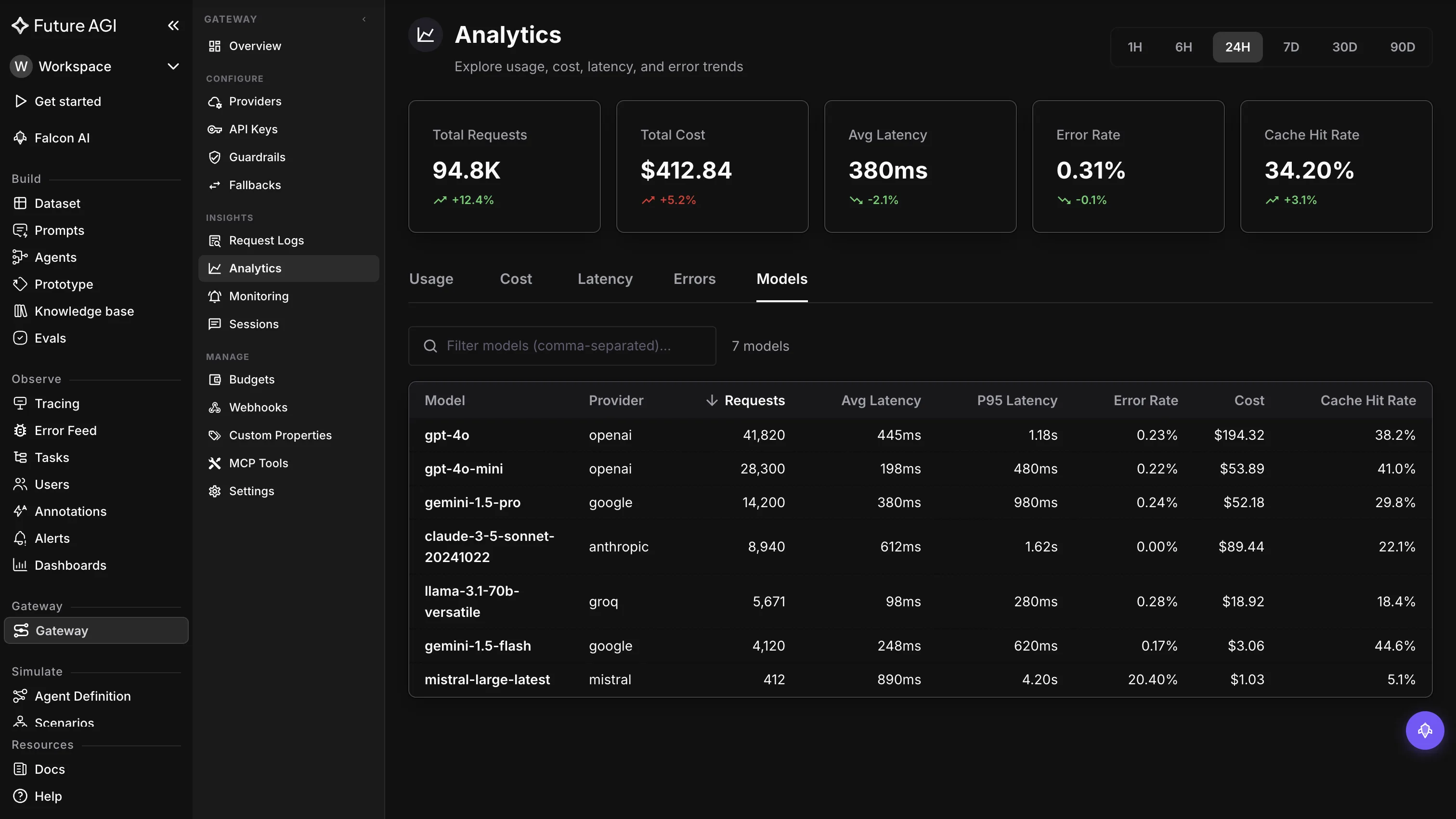
2027-2028 expected state. Five-level hierarchical chargeback (org, project, team, environment, user) becomes the FinOps audit baseline for LLM spend. Buyers ask for it in RFPs. Cost dashboards inside AI gateways show the breakdown by default. Per-user and per-endpoint budgets become enforceable, not informational. The pattern mirrors cloud FinOps four years prior and the buyer language follows.
What to do today. Pick a gateway with hierarchical budgets shipping today and the headers that carry the cost back to the caller. Future AGI’s Agent Command Center (the externally-facing name for the gateway plus governance stack) ships five-level hierarchical budgets today, plus the x-prism-cost, x-prism-latency-ms, and x-prism-model-used response headers that make chargeback auditable end to end. The ai-agent-cost-optimization-observability post covers the full attribution pattern.
Prediction 6: multi-modal eval emerges as its own discipline
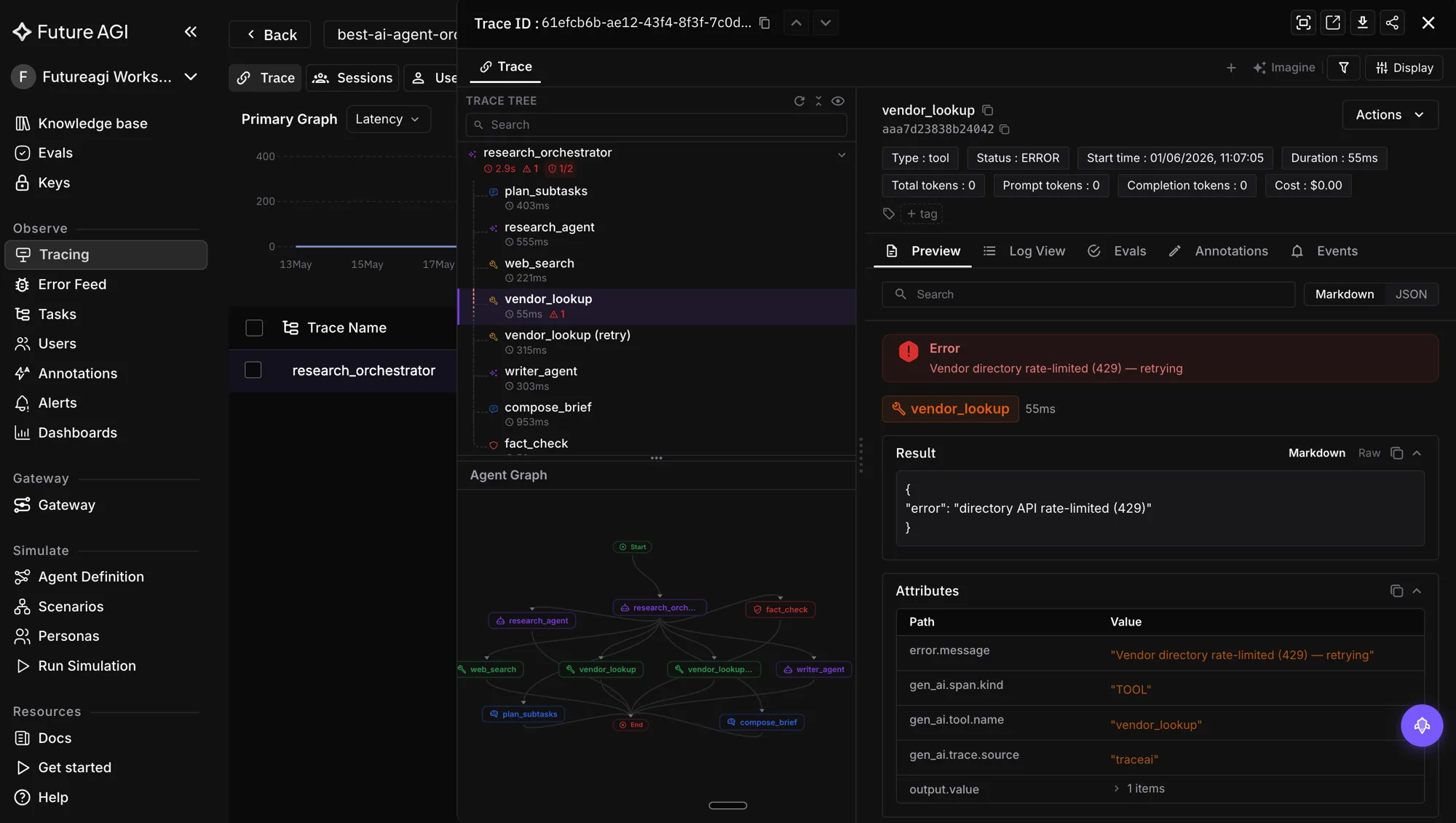
2026 trajectory. Voice agents, image-generation agents, and computer-use agents shipped at production scale in 2025-2026. The eval rubrics for them are mostly retrofitted text rubrics or vendor-specific scorecards. The OpenTelemetry semantic conventions for gen_ai (and proprietary extensions like gen_ai.voice.* and gen_ai.computer_use.* namespaces) are early signals that multi-modal eval needs its own primitives beyond text-rubrics-with-extra-fields.
2027-2028 expected state. Multi-modal eval becomes a distinct discipline with its own playbooks, rubrics, and tooling. Voice eval covers latency, turn-taking, accent and dialect coverage, interruption handling, and TTS quality. Computer-use eval covers action correctness, side-effect safety, and recovery from failed actions. Image and document eval covers semantic accuracy, grounding, and citation. Generic text eval becomes one branch of a larger multi-modal eval tree.
What to do today. Pick a stack that already has multi-modal primitives in the conventions and the SDKs. traceAI ships four multi-modal attribute namespaces today across image, audio, video, and computer-use. The Future AGI CustomLLMJudge supports multi-modal evaluation via LiteLLM-routed models. The evaluating-voice-ai-agents post is the current playbook for voice; expect the rest of the modalities to get their own playbooks by late 2027.
Prediction 7: open-source classifier backends consolidate
2026 trajectory. The open-source classifier landscape is crowded. Llama Guard 3 (8B and 1B), WildGuard (7B), Granite Guardian (8B and 5B), Shield Gemma (2B), and Qwen3 Guard variants all ship in production at different teams. The licensing, the inference cost, and the per-category accuracy varies. Teams pick a backend based on the rubric the workload demands plus the latency budget they have.
2027-2028 expected state. The field consolidates around a canonical top five. Llama Guard, Shield Gemma, Granite Guardian, WildGuard, and one of the Qwen variants emerge as the production canon. Other classifiers continue to ship but the buying pattern centers on the five that vendors support, that auditors recognize, and that have published rubric coverage for the common safety dimensions. Picking outside the canon becomes a justification call, not a default.
What to do today. Pick a stack that supports the production canon natively and lets you configure which backend runs against which rubric. The Future AGI eval SDK ships nine open-weight backends today (LLAMAGUARD_3_8B, LLAMAGUARD_3_1B, QWEN3GUARD_8B, QWEN3GUARD_4B, QWEN3GUARD_0.6B, GRANITE_GUARDIAN_8B, GRANITE_GUARDIAN_5B, WILDGUARD_7B, SHIELDGEMMA_2B) plus four API backends (OPENAI_MODERATION, AZURE_CONTENT_SAFETY, TURING_FLASH, TURING_SAFETY). The ai-guardrail-metrics post covers how to pick between them.
Prediction 8: eval-owner roles formalize across orgs
2026 trajectory. “Whose job is the eval stack” is an unsolved org chart question in most companies in 2026. Sometimes it’s a senior MLE, sometimes a data scientist, sometimes a product manager, often a rotating responsibility nobody fully owns. The teams shipping reliable AI in 2026 have one or two people whose primary job is eval ownership and the gap between those teams and the rest is widening.
2027-2028 expected state. “Eval owner” or “AI quality engineer” becomes a titled role in mid-to-large AI orgs. The job description includes rubric ownership, golden-set maintenance, CI-gate operation, production observability, and the closed-loop between failing traces and the dataset. The pattern mirrors SRE in 2015: a role that didn’t exist as a titled job in 2010, became standard by 2015, and was a board-level hire by 2018.
What to do today. Formalize the role now. The llm-eval-team-organization post covers the staffing model, the reporting line, and the metrics the role owns. Even one half-time owner beats no owner; even an informal title beats no title. Compounding starts the day you ship the role description.
Prediction 9: citation enforcement becomes mandatory in regulated AI
2026 trajectory. Regulated AI (legal, medical, financial, government) is held to a higher evidence bar than consumer AI. The 2025-2026 generation of regulated AI products mostly bolts citations on as a UX feature, not a validated guarantee. The eval rubrics for citation correctness (chunk attribution, chunk utilization, atomic-claim decomposition against retrieved evidence) exist but adoption is patchy. The audit questions are getting more specific: which paragraph supports which claim, and is that paragraph in the retrieved context?
2027-2028 expected state. Citation enforcement becomes a mandatory pre-ship rubric for regulated AI agents. Legal AI without citation evidence won’t pass procurement. Medical AI without atomic-claim decomposition won’t pass clinical validation. Financial AI without chunk-attribution audit trails won’t pass internal compliance. The rubric set is established; what changes is that it stops being optional.
What to do today. Pick a rubric library that ships the citation primitives today. The Future AGI eval SDK ships ChunkAttribution, ChunkUtilization, Groundedness, ContextAdherence, ContextRelevance, Completeness, FactualAccuracy, and EvaluateFunctionCalling schema validation. The evaluating-llm-citation-attribution post walks the end-to-end citation pipeline and the rubrics that audit it.
Prediction 10: eval becomes a distinct vendor category
2026 trajectory. Analyst frameworks today fold eval into MLOps, LLMOps, or AI observability. Buyer behavior already sorts eval as its own line item in RFPs. The CI-gate surface, the production-observation surface, the dataset-management surface, and the rubric-library surface are wide enough collectively that “eval” is a product, not a feature of a bigger product. Several vendors (including Future AGI) are positioning early as the canonical eval-stack player.
2027-2028 expected state. Gartner, Forrester, or IDC publishes an “eval ops” or “eval tech” framework recognizing 5-7 named vendors. Buyer language in RFPs uses “eval platform” as a category alongside “observability platform” and “AI gateway.” The buying matrix sorts vendors on rubric breadth, classifier-backend support, CI-gate maturity, production observability, and self-improving capability. Teams without an explicit eval vendor look like teams without an APM vendor in 2018.
What to do today. Buy on the 2027-2028 buying matrix, not the 2024 one. Compare vendors on rubric breadth, classifier-backend coverage, distributed-runner support, CI-gate ergonomics, span-attached production scoring, and feedback-loop self-improvement. The llm-eval-vendor-buyer-guide post covers the explicit matrix. Future AGI positions to win that matrix and that’s the bet behind the platform investment.
The meta-prediction: the gap widens
The single biggest pattern across all ten predictions is that the gap between teams with mature eval stacks and teams without will widen massively in 2027-2028. Today’s gap is roughly 5-15% on output quality (faithfulness, task completion, citation correctness) and 30-50% on per-eval cost. Next year’s gap is plausibly 30%+ on both axes as the patterns compound.
Three forces drive the gap. First, classifier-backed evals plus cascade routing widen the cost gap. A team running judge-on-everything pays 5-10x more per scored span than a team running classifier-first. Second, self-improving evaluators widen the quality gap. A team retuning rubrics manually every quarter falls behind a team retuning continuously from user feedback. Third, eval-as-CI-gate plus production observation widens the reliability gap. A team without a gate ships regressions; a team with a gate catches them in PR review.
The compounding effect is the killer. Each of those gaps feeds the next. The team with cheaper evals can afford more evals, which catches more failures, which produces a better dataset, which trains better rubrics, which catches more failures. The team without eval infra spends the year retrofitting and pays the gap in margin and reliability the whole time.
What teams should actually do this quarter
Five concrete moves anyone can start this quarter without a six-month rebuild.
Pick a stack designed for 2027-2028 patterns. Buy on the rubric library, the classifier backends, the distributed runners, the CI-gate ergonomics, and the self-improving capability. Don’t buy on the 2024 demo of a single judge against a single rubric on a Notion dashboard.
Invest in classifier-backed evals now. The cost shift is real and the curve gets steeper. Pick a vendor that ships at least 5-7 open-weight classifier backends natively. Cascade routing (cheap classifier first, judge on ambiguous) is the production pattern that wins on cost.
Build the feedback loop now. Self-improvement compounds. Even an informal thumbs-up/thumbs-down channel feeding into a rubric retune is better than no feedback loop. The llm-eval-feedback-loop-design post is the design pattern.
Plan for multi-modal eval before you need it. If you ship voice, computer-use, or image generation today, the eval rubrics for those modalities need to be in your stack now, not after the first production incident. The agent-passes-evals-fails-production post covers the gap between text rubrics and multi-modal failure modes.
Hire or formalize an eval owner. The role pays compound dividends. Even a half-time owner with a clear charter beats no owner. The llm-eval-team-organization post covers the role description and the org-chart placement.
Honest framing on Future AGI
To draw the line clearly. The Future AGI ai-evaluation SDK (Apache 2.0) ships today with 60+ EvalTemplate classes, 13 guardrail backends (9 open-weight plus 4 API), 8 sub-10ms Scanners, and 4 distributed runners. Eval-driven optimization on prompts ships today via six optimizers in agent-opt. Five-level hierarchical budget chargeback in the Agent Command Center ships today.
The trace-stream-to-optimizer connector that closes the loop from production trace directly to optimizer dataset is roadmap, not shipped. We frame it honestly: when you write your 2027 roadmap, plan around the three primitives (tracing, eval, optimization) being separate today and converging via the connector during the planning window. Linear is the only Error Feed integration shipping today; Slack, GitHub, Jira, and PagerDuty are roadmap.
The Future AGI Platform self-improving evaluators ship today as the hosted eval surface. Per-eval cost beats Galileo Luna-2 for comparable rubrics. The full hosted runtime is SOC 2 Type II / HIPAA / GDPR / CCPA certified. Future AGI Protect ML weights are closed; the gateway self-hosts and the ML hop runs against api.futureagi.com or your own private vLLM under enterprise license. Where the prediction is forward-looking and not a delivery date, we say that.
Closing: where to start
If you read one section of this post and start one thing this quarter: pick a vendor on the 2027-2028 buying matrix, not the 2024 one. The patterns are visible, the cost curves are clear, and the gap between teams that adopt early and teams that adopt late is real and widening. Future AGI is built for that matrix; the llm-evaluation-playbook-2026 post is the working playbook for the six layers you need; the llm-eval-vendor-buyer-guide post is the comparison framework.
The teams shipping reliable AI in 2028 are the teams who treat eval as core infrastructure today. Everyone else spends 2027 retrofitting.
Frequently Asked Questions
Why write predictions for 2027-2028 in mid-2026?
Is this a Future AGI roadmap or a market forecast?
What's the single biggest shift coming in 2027-2028?
Will LLM-as-judge disappear by 2028?
How should I prepare for trace-stream-to-optimizer integration?
Why will eval become a distinct vendor category in 2027-2028?
What should I do today if my eval stack is 2024-era?
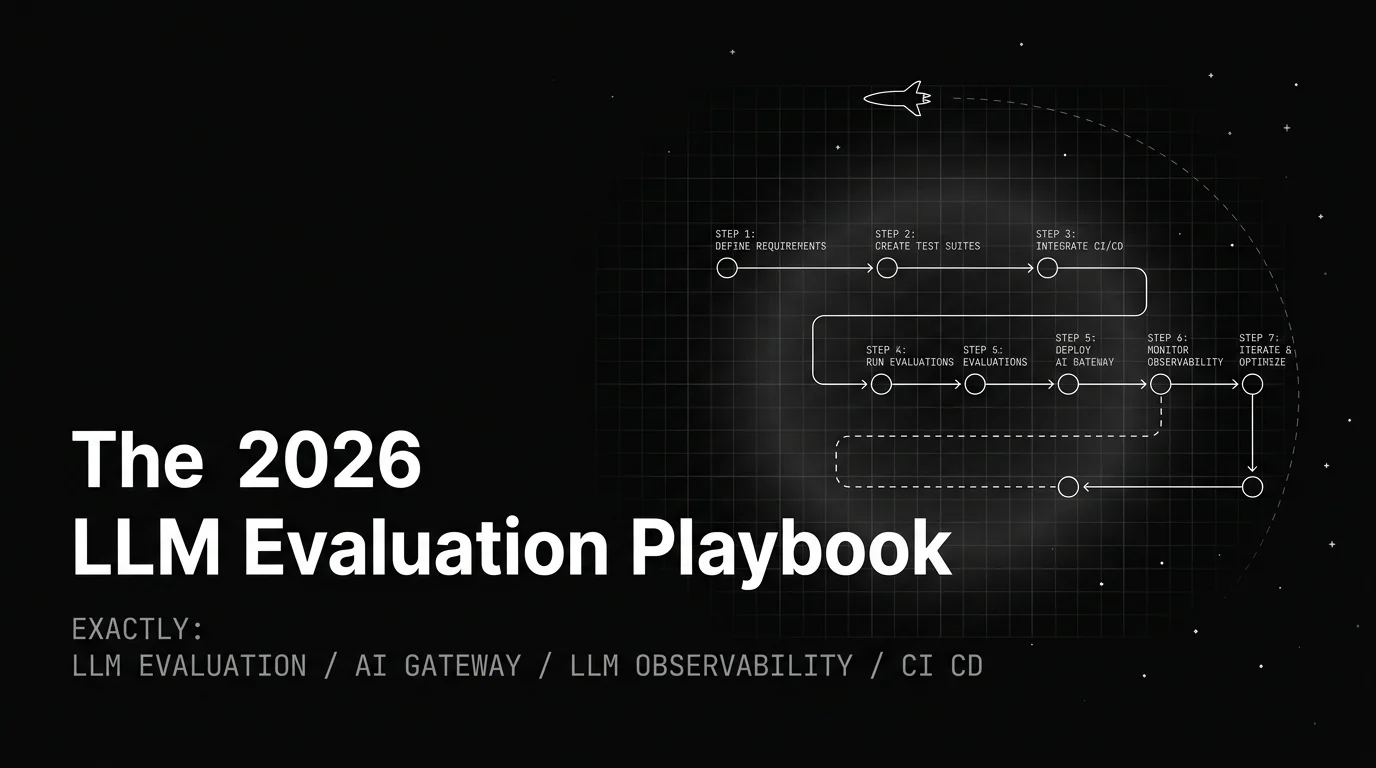
The pillar playbook for LLM evaluation in 2026: dataset, metrics, judge, CI gate, production observation, closed loop from failing trace to regression.

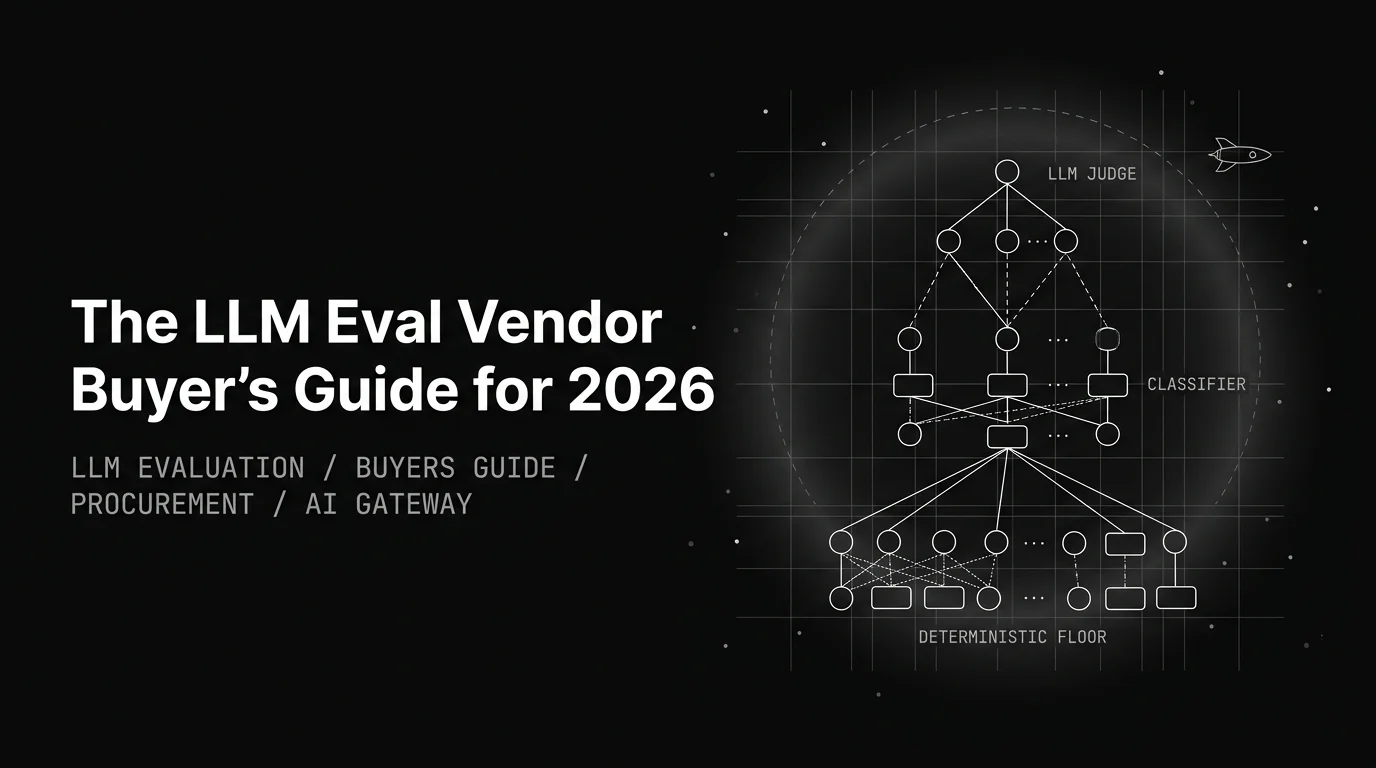
Heads-of-engineering buyer guide for LLM eval vendors 2026. Ten criteria, eight vendor categories scored honestly, 5-question rubric, procurement flow.

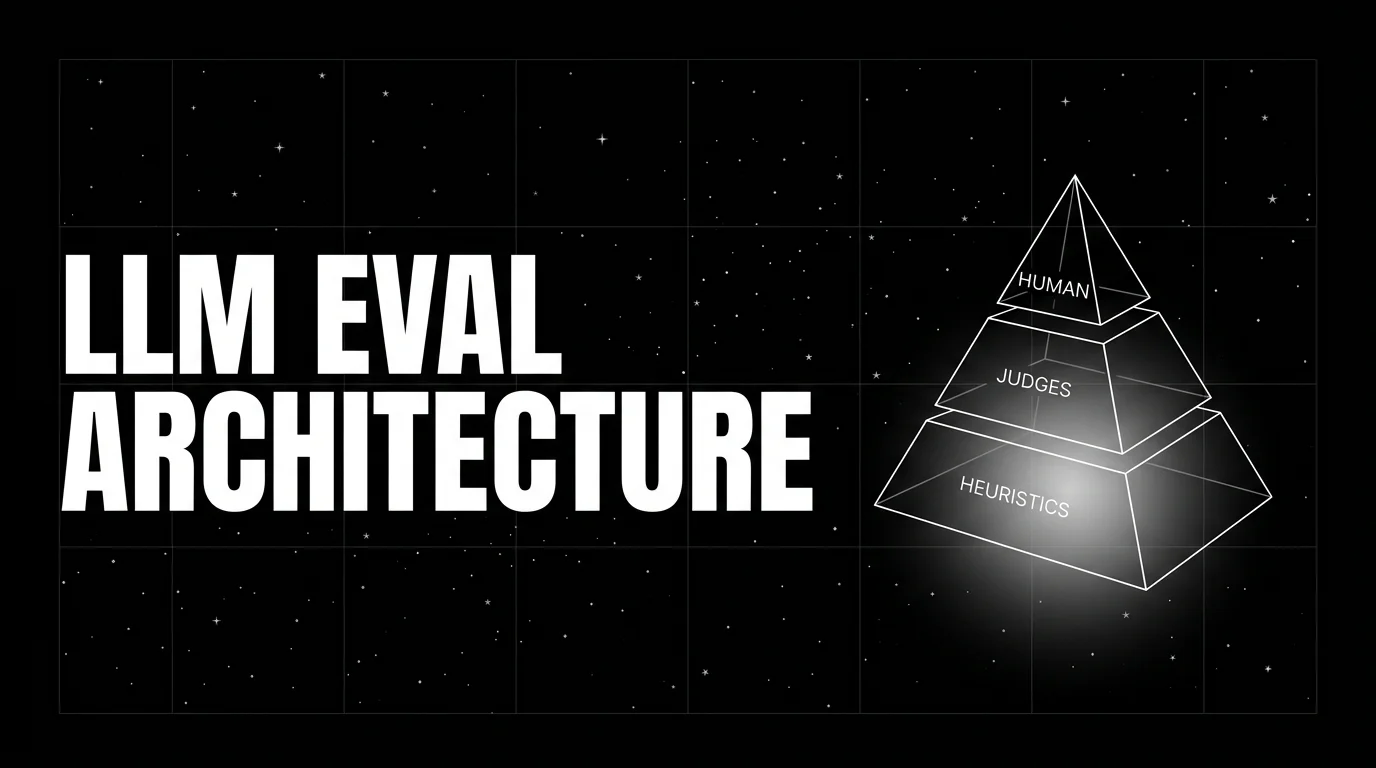
LLM eval architecture in 2026: heuristics on every span, distilled judges on a sample, humans on the gold-set. Three-tier stack that scales.