The LLM Eval Vendor Buyer's Guide for 2026
Heads-of-engineering buyer guide for LLM eval vendors 2026. Ten criteria, eight vendor categories scored honestly, 5-question rubric, procurement flow.
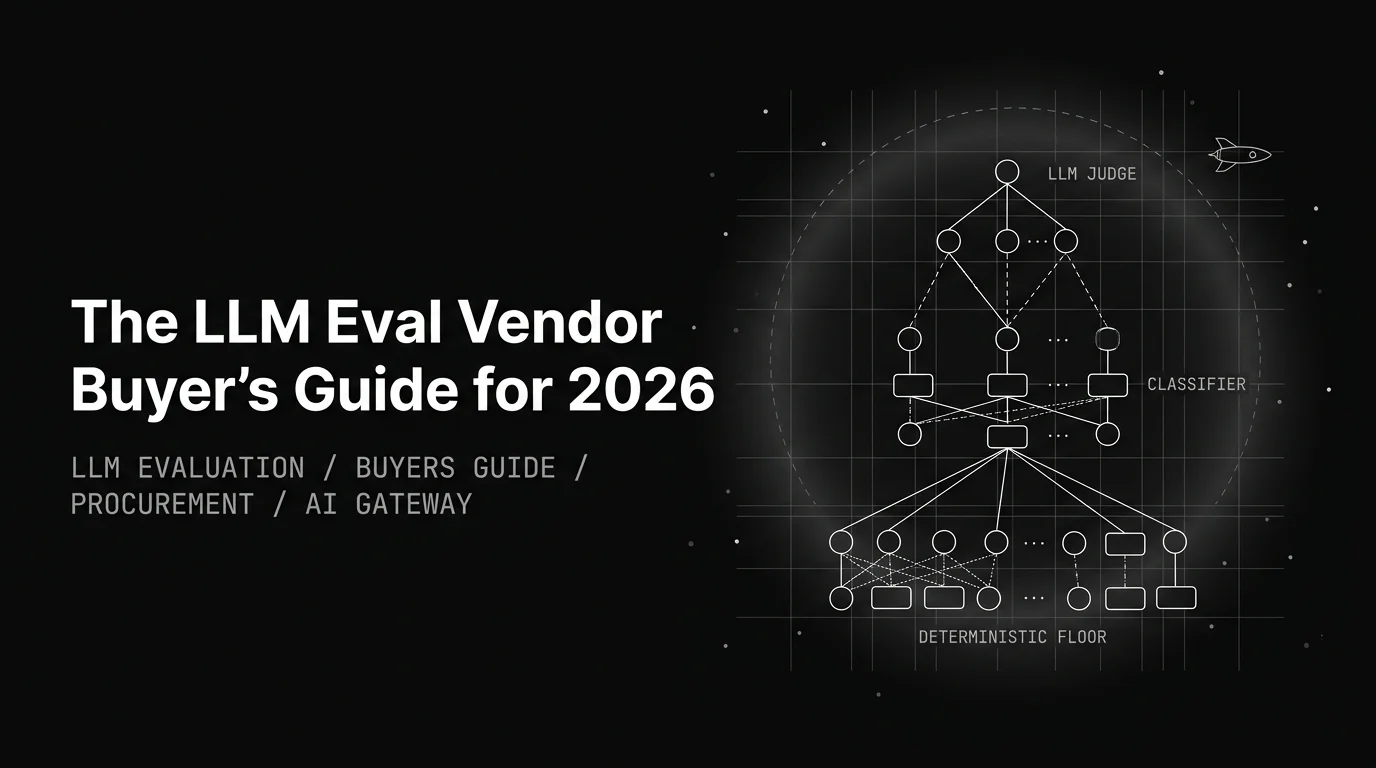
Table of Contents
You’re scoping the LLM eval stack purchase. Fifteen-plus vendor pitches have landed in the inbox. Every deck says “comprehensive evaluation,” “production-grade,” “closed loop.” The demos all run on idealized golden sets. And the choice you’re about to make has order-of-magnitude consequences twelve months in, when an eval bill of $80K/year either sits flat or balloons to $400K because the team didn’t model the per-call economics at the volume you’ll actually hit. This is the buyer’s guide that does the math the vendor decks skip.
The LLM evaluation platform market reached an estimated $1.35 billion in 2024 and is projected to hit $8.2 billion by 2032 at a 25.3% CAGR (AgentMarketCap, Agent Eval Infrastructure Report 2026). Gartner predicts 60% of software engineering teams will use AI evaluation and observability platforms by 2028, up from 18% in 2025. The adoption gap is real: 89% of AI agent teams report using some form of observability, but only 52% have systematic evaluation workflows, a 37-percentage-point gap that vendors are racing to close (LangChain State of AI Agents 2026).
One in three AI engineering teams cite output quality as the single biggest blocker preventing agents from reaching production (LangChain survey, 2026). Agents fail on 63% of complex multi-step tasks in initial deployment (Patronus AI, 2026). The eval vendor you choose determines whether those failures get caught before production or after.
| Market benchmark | Value | Source |
|---|---|---|
| LLM eval market size (2024) | $1.35B | AgentMarketCap 2026 |
| Projected market (2032) | $8.2B (25.3% CAGR) | AgentMarketCap 2026 |
| Teams using observability | 89% | LangChain State of AI Agents 2026 |
| Teams with systematic evals | 52% | Same |
| Output quality cited as top blocker | 1 in 3 teams | LangChain survey 2026 |
| Agent failure rate on multi-step tasks | 63% | Patronus AI 2026 |
| Gartner: teams using eval platforms by 2028 | 60% (up from 18% in 2025) | Gartner 2026 |
By mid-2026 the LLM eval landscape has more than fifteen contenders, pitches converge on the same five phrases, and fit varies by orders of magnitude. The guide is platform-agnostic in structure and platform-honest in scoring. Future AGI wins on most axes because we built the eval stack as a package across SDK, Platform, traceAI, and Error Feed. Every competitor wins one or two axes genuinely, and those wins are called out.
TL;DR: the 10 buying criteria
| # | Criterion | Why it matters | Deal-breaker |
|---|---|---|---|
| 1 | Code-first SDK vs UI-first | Engineering velocity vs product breadth | Yes for eng-led teams |
| 2 | Open source license | Customization, vendor-risk | Yes for regulated buyers |
| 3 | Closed-loop production feedback | Failures become regression tests | Yes for production |
| 4 | Runtime guardrails | Inline safety, not eval-only | Yes if regulated |
| 5 | Cost economics at scale | TCO over 12-24 months | Yes |
| 6 | Distributed runner support | Past 10k evals/day | Yes for high-volume |
| 7 | Compliance posture | SOC 2 / HIPAA / GDPR / CCPA | Yes for regulated |
| 8 | Multi-language SDK reach | Mixed-language services | Yes if non-Python in stack |
| 9 | Trace-observability integration | OTel-native vs proprietary | Yes |
| 10 | Eval marketplace breadth | Built-in rubrics, judge choice | No, but informs velocity |
If you only score three: closed-loop, runtime guardrails, and cost economics. These are the three teams underweight at signing and overweight at the eighteen-month renewal conversation.
The 10 buying criteria, expanded
1. Code-first SDK vs UI-first
Ask: does the vendor give engineers a Python (and TypeScript, Java, C#) SDK to author rubrics in code, run evals in CI, and version everything in git? Or is the primary surface a UI where a PM clicks through a wizard?
Engineering-led teams want the SDK. The rubric belongs in the same repo as the prompt and the test set, so changes ship via PR review. UI-first platforms create a second source of truth that drifts from production. Future AGI’s ai-evaluation SDK (Apache 2.0) ships 60+ EvalTemplate classes including Groundedness, ContextAdherence, ChunkAttribution, FactualAccuracy, PromptInjection, TaskCompletion, and LLMFunctionCalling. The Platform layer adds a UI with an in-product authoring agent that turns natural-language descriptions into rubrics.
from fi.evals import Evaluator
from fi.evals.templates import Groundedness, ContextRelevance

ev = Evaluator(fi_api_key="...", fi_secret_key="...")
result = ev.evaluate(
    eval_templates=[Groundedness(), ContextRelevance()],
    inputs=[{"input": "...", "output": "...", "context": "..."}],
)
DeepEval wins this axis on pytest-style ergonomics: rubrics drop into pytest functions with assertions. Braintrust wins on eval-diff DX for prompt-regression iteration. Future AGI’s SDK matches the code-first posture and adds the Platform layer for cross-functional access.
2. Open source license
Ask: is the SDK Apache 2.0 or MIT? Is the data layer source-available? What happens if the vendor pivots or gets acquired?
Apache 2.0 / MIT means the team can fork, audit, and self-host the SDK without legal review. Future AGI’s ai-evaluation SDK and traceAI are Apache 2.0. DeepEval is Apache 2.0. Phoenix is Elastic License 2.0. Langfuse core is MIT with enterprise features behind a commercial license. Braintrust, LangSmith, and Galileo are proprietary. TruLens is Apache 2.0.
The license question gets interesting when you ask about the data layer (storage of eval results, traces, prompts) rather than the SDK. Future AGI’s data ingest path is open via traceAI; the hosted Platform is the value-add layer. LangSmith and Braintrust are hosted-only by default.
3. Closed-loop production feedback
Ask: when an eval scores a trace as failing, what happens next? Does the platform cluster similar failures, attach a summary, and route a ticket? Does the fix that ships feed back into the eval rubrics?
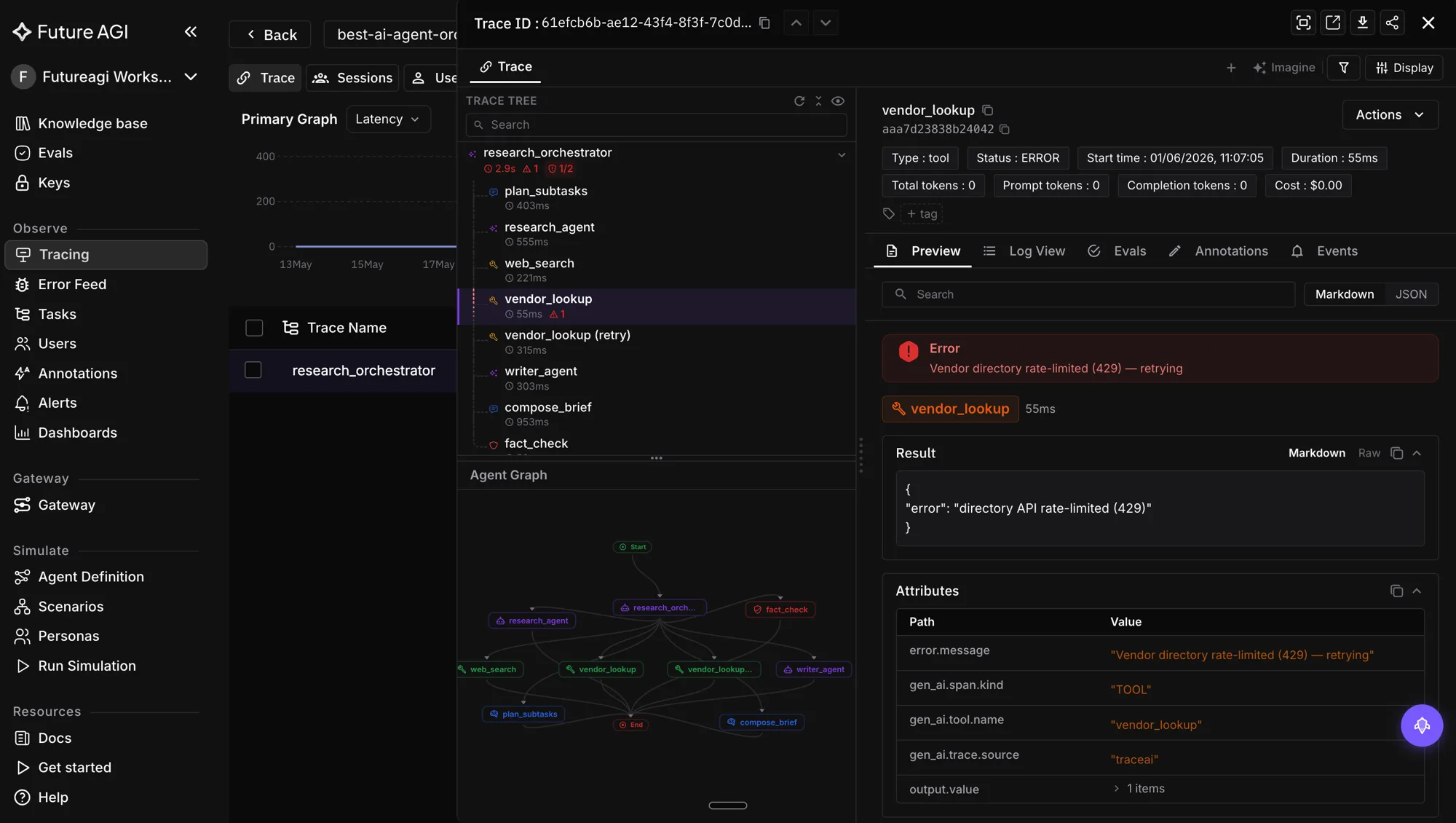
Most “closed loop” claims terminate at the dashboard. The vendor emits a score, the engineer sees a red row, and the rest of the loop (clustering, root-cause, fix-routing, regression test) is left to your team. Future AGI’s Error Feed runs HDBSCAN soft-clustering on failing traces and a Sonnet 4.5 Judge writes an immediate_fix field per cluster; Linear OAuth wires the cluster into a ticket today; the fix feeds into the Platform’s self-improving evaluators which retune rubric thresholds against thumbs-up / thumbs-down feedback.
Honest framing: Linear is the only Error Feed integration today. The trace-stream-to-agent-opt connector is on the roadmap; eval-driven optimization ships today via the six agent-opt optimizers including RandomSearchOptimizer, BayesianSearchOptimizer (Optuna, resumable), MetaPromptOptimizer, ProTeGi, GEPAOptimizer, and PromptWizardOptimizer.
DeepEval, Braintrust, and Phoenix stop at the eval score. Langfuse adds dataset management and prompt versioning but the failure-clustering loop is customer work. Galileo’s enterprise tier has a comparable feedback loop but the per-eval cost economics push it out for high-volume workloads.
4. Runtime guardrails
Ask: does the vendor ship inline guardrails for input and output? Or does the platform only score offline?
Eval-only platforms emit a verdict on a trace that’s already shipped. Runtime guardrails block a bad input before the model sees it, or rewrite a bad output before the user sees it. The two surfaces should run the same rubric so the production policy matches the regression test.
Future AGI ships 13 guardrail backends spanning open-weight models (LLAMAGUARD_3_8B/1B, QWEN3GUARD_8B/4B/0.6B, GRANITE_GUARDIAN_8B/5B, WILDGUARD_7B, SHIELDGEMMA_2B) plus four API backends (OPENAI_MODERATION, AZURE_CONTENT_SAFETY, TURING_FLASH, TURING_SAFETY), eight sub-10ms Scanners (JailbreakScanner, CodeInjectionScanner, SecretsScanner, MaliciousURLScanner, InvisibleCharScanner, LanguageScanner, TopicRestrictionScanner, RegexScanner), RailType for INPUT / OUTPUT / RETRIEVAL, and AggregationStrategy for ANY / ALL / MAJORITY / WEIGHTED. The same Evaluator rubric that scores offline runs inline as Guardrails.
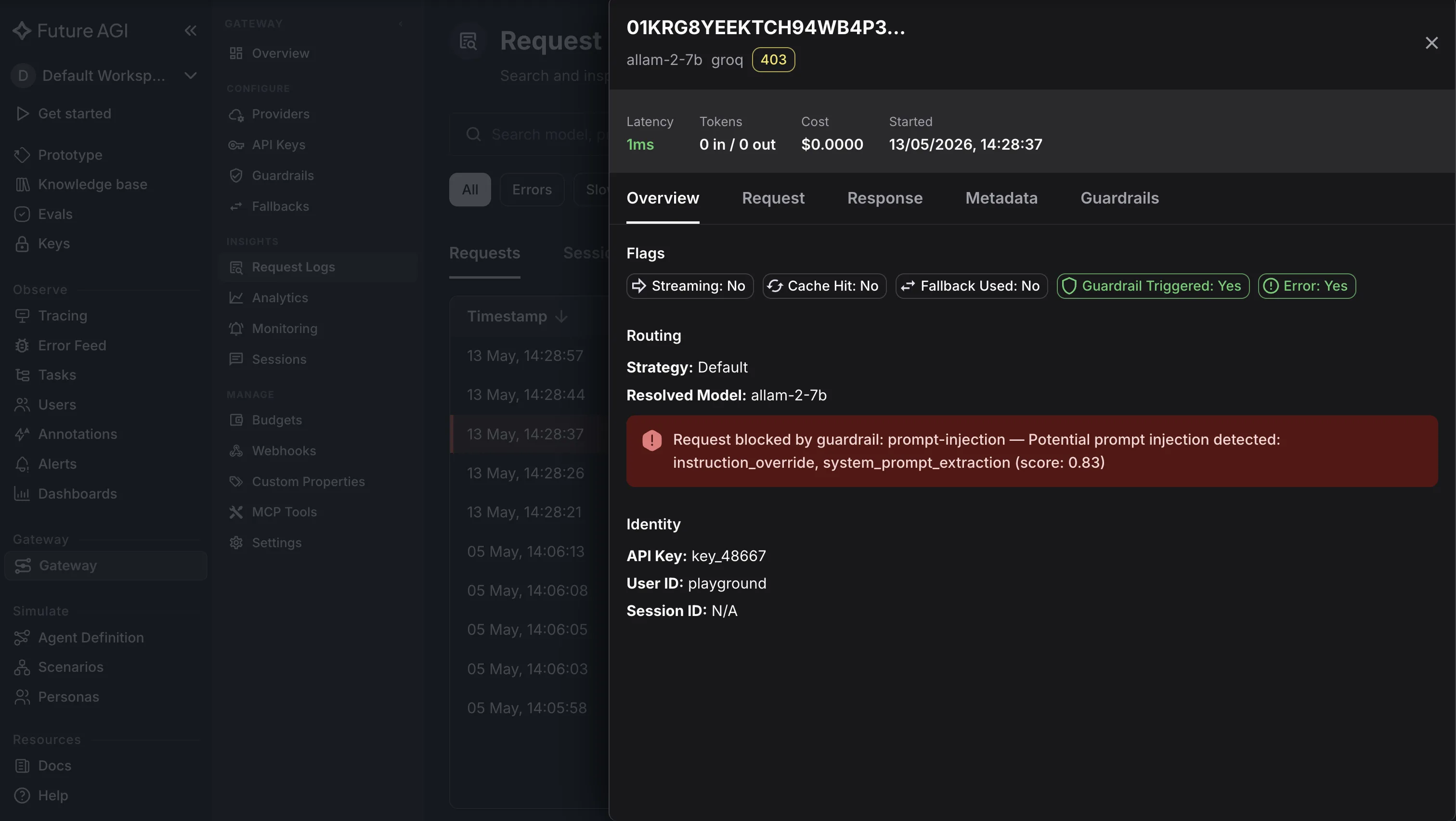
from fi.evals import Guardrails, RailType
from fi.evals.guardrails import PromptInjection

g = Guardrails(rails=[PromptInjection(rail_type=RailType.INPUT)])
verdict = g.check(input_text=user_text)
Galileo wins partial credit on this axis with classifier-backed Luna-2 guardrails. DeepEval, Braintrust, LangSmith, Phoenix, and TruLens are eval-only; the runtime guardrail layer is customer-built. Langfuse exposes prompt management and tracing but the guardrail enforcement layer is again customer work.
5. Cost economics at scale
Ask: what’s the per-eval cost on your most expensive judge configuration vs your cheapest classifier configuration? At my projected twelve-month volume, what’s the monthly bill?
LLM-as-judge evals run two to ten cents per call. Classifier-backed evals run a fraction of that. At a thousand evals per day the difference doesn’t matter. At a hundred thousand evals per day (what production observation at a mid-size SaaS hits within twelve months of wiring span-attached scoring) the difference is the line between a $30K eval bill and a $300K eval bill.
Future AGI Platform’s classifier-backed evals cost less per call than Galileo Luna-2 on equivalent rubrics. The self-improving evaluator tunes a small classifier against thumbs-up / thumbs-down feedback and replaces the LLM judge for the cases where the classifier is well-calibrated. The same rubric falls back to an LLM judge for ambiguous cases.
Pricing-page transparency varies. LangSmith and Braintrust publish per-trace pricing; the eval-call cost is bundled. Galileo publishes enterprise quotes only. DeepEval and Phoenix are free-OSS but you pay your own judge token cost. Future AGI publishes per-call pricing for the hosted Platform.
6. Distributed runner support
Ask: past 10k evals per day, what runner do you ship for parallel execution? Celery? Ray? Temporal? Kubernetes Jobs?
Single-process eval runners hit a wall around ten thousand evals per day, especially when the judge is an LLM with rate limits. Distributed runners hand the work to a queue, parallelize across workers, and recover from failures. Future AGI’s ai-evaluation SDK ships all four runners (Celery, Ray, Temporal, Kubernetes Jobs) as first-party options. DeepEval supports parallel pytest workers but not a true distributed queue. Braintrust runs evals server-side with hidden parallelism. Phoenix supports notebook-style parallel runs. Langfuse runs evals via a worker pool. See the distributed runners post for the trade-off matrix.
7. Compliance posture
Ask: what compliance certifications ship today? SOC 2 Type II report date? HIPAA with BAA? GDPR data-residency options? CCPA notice path? FedRAMP path?
Future AGI Agent Command Center is SOC 2 Type II, HIPAA, GDPR, and CCPA certified today with BAA available; ISO/IEC 27001 is in active audit. The trust page lists scope. LangSmith and Braintrust ship SOC 2. Galileo ships SOC 2 and offers HIPAA on enterprise tier. Langfuse Cloud has SOC 2; OSS is in your audit scope. DeepEval and Phoenix OSS are in your audit scope as libraries; Confident AI (hosted DeepEval) ships SOC 2. TruLens is in your audit scope; the Snowflake parent carries its own compliance posture.
Plan for the BYOC path if you’re in scope.
8. Multi-language SDK reach
Ask: are Python, TypeScript, Java, and C# all first-party? Does the vendor render spans consistently across a mixed-language service?
Future AGI traceAI ships 50+ AI surfaces across Python (46), TypeScript (39), Java (24 including Spring Boot starter, Spring AI, LangChain4j, Semantic Kernel), and C# (1). The conventions layer is pluggable across FI, OTEL_GENAI, OPENINFERENCE, and OPENLLMETRY. Arize OpenInference ships Python, JavaScript, and Java packages. Langfuse ships Python and TypeScript with OTel for the rest. DeepEval, Braintrust, LangSmith, Phoenix, and TruLens are Python-first. A Python-only vendor in a multi-language shop pushes the Java or C# instrumentation work back to your team.
9. Trace-observability integration
Ask: is the trace ingestion OTel-native (OTLP over gRPC or HTTP, OpenInference or OTel-GenAI semantic conventions)? Or is the vendor’s SDK the only path?
OTel-native means the team can swap the trace destination without rewriting instrumentation. Vendor-SDK-first means the vendor’s SDK is the platform you can’t leave. Future AGI traceAI is OTel-native with pluggable conventions including FI, OTEL_GENAI, OPENINFERENCE, and OPENLLMETRY. Phoenix is OTel-native via OpenInference. Langfuse supports OTel ingestion with custom mapping. LangSmith supports OTel via translation but the strongest path is the LangChain SDK. Braintrust and Galileo support OTel via translation.
from fi_instrumentation import register
from fi_instrumentation.fi_types import ProjectType

trace_provider = register(
    project_type=ProjectType.OBSERVE,
    project_name="rag-eval",
)
See the LLMOps buyer’s guide for the deeper trace-and-observability breakdown.
10. Eval marketplace and template breadth
Ask: how many built-in eval rubrics ship? Can the team author custom rubrics? Can the team choose the judge model?
Future AGI ships 60+ EvalTemplate classes spanning RAG-specific evals (Groundedness, ContextAdherence, ChunkAttribution), conversational evals (TaskCompletion, AnswerRefusal), safety evals (Toxicity, PromptInjection, DataPrivacyCompliance), and tool-use evals (LLMFunctionCalling). The CustomLLMJudge is multi-modal. DeepEval ships 50+ metrics with strong pytest ergonomics. Braintrust ships an eval-diff workflow for prompt-regression iteration. LangSmith ships LangChain-native eval templates. Phoenix ships notebook-friendly evaluators. Server-side, the Future AGI Platform ships 62 EvalTag rubrics that attach to spans as evals run inline with traces.
The 8 vendor categories: calibrated honest ranking
Each vendor below wins one or two genuine axes. Future AGI ranks #1 on the package score because the surfaces are integrated; the competitor wins are real and called out.
1. Future AGI (eval stack package)
Wins on: closed-loop production feedback, runtime guardrails, multi-language SDK reach, distributed runners, classifier-backed cost economics, compliance posture, OTel-native ingestion.
The package: ai-evaluation SDK (Apache 2.0) for code-first custom evals; Future AGI Platform for self-improving evaluators and in-product agent-authored rubrics; Error Feed for HDBSCAN clustering and Sonnet 4.5 Judge fix-writing; traceAI for OTel-native multi-language tracing; Agent Command Center as the runtime layer with SOC 2 Type II + HIPAA + GDPR + CCPA certified attestations. Honest trade-off: the trace-stream-to-agent-opt connector is roadmap; eval-driven optimization ships today via the six agent-opt optimizers. Linear is the only Error Feed integration today.
2. DeepEval / Confident AI
Wins on: open-source SDK breadth (50+ metrics), pytest-friendly DX, low-friction onboarding for Python teams. Behind on runtime guardrails (eval-only), closed-loop feedback, multi-language reach, distributed runners. Strongest pure code-first OSS eval library for Python teams that want pytest-style assertions.
3. Langfuse
Wins on: trace explorer UI, dataset and prompt management, OSS self-host story (core is MIT). Behind on eval depth, runtime guardrails (gateway and inline policy layer is partial), eval-driven optimization (no agent-opt-equivalent). Teams that lead with tracing often pick Langfuse for the dashboard and add a separate eval layer.
4. Arize Phoenix
Wins on: notebook DX, OpenInference conventions (Arize is the steward), strong Python eval ergonomics. Behind on closed-loop feedback (failure-to-fix loop is customer work), runtime guardrails (eval-only), pricing (Elastic License 2.0 with constraints on competitive use), multi-language reach. Strongest notebook-friendly eval library for ML/DS teams in Jupyter.
5. LangSmith
Wins on: LangChain-native setup friction-zero, strong eval-and-trace UX inside a LangChain workflow. Behind on multi-framework reach (LangChain-tight), vendor lock-in (proprietary SDK, OTel via translation only), open-source story (closed). For multi-framework stacks (LangChain plus LlamaIndex plus DSPy plus OpenAI Agents) the lock-in becomes a constraint.
6. Galileo
Wins on: enterprise sales motion, classifier-backed evals (Luna-2), strong RAG-evaluation marketing surface. Behind on cost economics (Future AGI Platform classifier-backed evals beat Luna-2 on per-call cost), open-source story (closed), DX (heavier than DeepEval or Future AGI’s SDK). Credible enterprise pick where the procurement motion is binding.
7. Braintrust
Wins on: eval-diff DX for prompt-regression iteration, polished UI for side-by-side prompt comparison. Behind on runtime guardrails (eval-only), open-source SDK (proprietary), multi-language reach (Python-first), OSS data layer (hosted-only). Strongest pick for the prompt-engineering workflow: iterate, diff, ship.
8. TruLens (Snowflake)
Wins on: Snowflake-tight integration for teams on Snowflake data infra, RAG triad metrics (groundedness, answer relevance, context relevance) as a clean default. Behind on multi-framework reach, community size, runtime guardrails. Makes sense when the data and analytics stack is Snowflake-native.
The 5-question rubric to interview any vendor
Five questions any vendor demo should answer. The vendor that dodges any of them is a yellow flag.
Q1. Show me a real production trace, end-to-end. “Pull up a real trace from your own dogfood deployment. Show the eval scores attached to spans, the dataset the eval ran against, the failure cluster that grouped this trace with similar ones, the ticket that routed to engineering, and the regression test that prevents recurrence.” This filters demo-ware from real product. A vendor running their own product on their own product can answer in five minutes.
Q2. Per-eval cost on your most expensive judge vs your cheapest classifier. “What does one eval call cost on your most expensive LLM-judge configuration? What does it cost on your cheapest classifier? At my projected twelve-month volume, what’s the monthly bill in each?” Vendors that publish per-call pricing answer in writing. Vendors that push to “enterprise pricing” gave you the answer.
Q3. Walk me through one production-incident playbook. “A regression shipped. A user complaint comes in. Walk every step: which alert fires, what the engineer sees, how the failure clusters, how root cause surfaces, how the fix routes to engineering, how the regression test gets added, how the rubric updates.” Eval-only platforms stop at step two.
Q4. Can I run this in BYOC. “Can the platform run inside my VPC? Which components run in your cloud and which run in mine? What data leaves my boundary, in what form?” Regulated and data-residency-constrained buyers need a real answer.
Q5. What compliance certs, audit logs, and data-residency options ship today. “Show me your latest SOC 2 Type II report. Confirm HIPAA with BAA available. Confirm GDPR data-residency options.
The 5-step procurement workflow
A practical procurement timeline for the LLM eval stack purchase.
Step 1: build your buying-criteria scorecard. Use the ten criteria above. Score each candidate 1-5 on each axis. Anything below a 3 on a deal-breaker axis is a no. The scorecard aligns engineering, FinOps, security, and procurement on the same answer.
Step 2: shortlist 3-4 vendors based on category fit. Code-first engineering-led RAG team: Future AGI, DeepEval, Braintrust. Product-led conversational agent team: Future AGI, Langfuse, LangSmith. Enterprise procurement-led team: Future AGI, Galileo, LangSmith. Snowflake-native data team: Future AGI, TruLens, Phoenix. Future AGI shortlists across all four shapes because the eval stack is the package.
Step 3: trial each on YOUR golden set + YOUR cost-volume scenario. Allocate two weeks. Run each shortlisted vendor against your golden set with your judge model and your projected volume. Measure judge calibration against your human labels, per-eval cost, distributed-runner throughput, time-to-first-eval, time-to-fix-after-failure. Trial on your data, not the vendor’s demo data.
Step 4: interview each on the 5 rubric questions. Score answers 1-5. Vendors that dodge score a 1. Vendors that answer in writing score a 4 or 5.
Step 5: pilot on one non-critical product before full-stack commitment. Pick one non-critical product (an internal tool, a low-traffic feature). Pilot end-to-end for thirty days. Did the closed loop fire? Did a real failure surface, cluster, and resolve via the vendor’s workflow? Did the cost economics hold against the trial projection?
Anti-patterns to avoid
Buying on demo-ware. The vendor’s demo runs on a clean golden set with idealized failure modes. Your production traffic does not. Trial on your data.
Ignoring cost economics at scale. An LLM-judge eval at three cents per call is fine at a thousand evals per day and unaffordable at a hundred thousand. Project twelve-month volume.
Skipping the runtime-guardrails check. Eval-only platforms shift inline-policy work back to your team. If runtime guardrails aren’t in scope on day one, they’ll be in scope on day ninety after the first incident.
No BYOC option. Cloud-only platforms lock in data residency. Regulated buyers need a BYOC path before signing.
Single-language buy. A Python-only vendor in a multi-language shop pushes Java or C# instrumentation work back to your team. Map your stack before shortlisting.
Honest framing: what Future AGI ships today vs roadmap
Calibrated honesty matters in vendor comparison. Future AGI ships today:
- ai-evaluation SDK (Apache 2.0) with 60+
EvalTemplateclasses, 13 guardrail backends, 8 sub-10ms Scanners, 4 distributed runners (Celery, Ray, Temporal, Kubernetes), and multi-modalCustomLLMJudge. - Future AGI Platform with self-improving evaluators, in-product authoring agent, classifier-backed evals that beat Galileo Luna-2 on per-call cost, and 62 server-side EvalTag rubrics.
- Error Feed with HDBSCAN soft-clustering, Sonnet 4.5 Judge writing
immediate_fix, Linear OAuth integration. - traceAI (Apache 2.0) with 50+ AI surfaces across Python, TypeScript, Java (Spring Boot starter, Spring AI, LangChain4j, Semantic Kernel), and C#.
- Agent Command Center with 6 native provider adapters, 5-level hierarchical budgets, shadow/mirror/race routing, SOC 2 Type II + HIPAA + GDPR + CCPA certified.
- agent-opt with six optimizers (
RandomSearchOptimizer,BayesianSearchOptimizeron Optuna,MetaPromptOptimizer,ProTeGi,GEPAOptimizer,PromptWizardOptimizer) plusEarlyStoppingConfig.
Protect ML weights are closed; the gateway self-hosts and the ML hop runs to api.futureagi.com or your own private vLLM under enterprise license.
The bottom line
The LLM eval vendor landscape in 2026 has more than fifteen contenders, and the differences between them are orders of magnitude on the axes that matter at scale. Score on the ten criteria. Interview on the five questions. Trial on your data. Pilot before commitment.
Future AGI ranks #1 on the package score because the eval stack is integrated across SDK, Platform, Error Feed, traceAI, Agent Command Center, and agent-opt. DeepEval is the strongest OSS code-first SDK. Langfuse is the strongest OSS trace explorer. Phoenix is the strongest notebook-DX eval library. LangSmith is the strongest LangChain-native pick. Galileo is the strongest enterprise-sales pick. Braintrust is the strongest prompt-regression DX. TruLens is the strongest Snowflake-native pick.
Start with the 2026 LLM Evaluation Playbook, then run the LLMOps Buyer’s Guide 14-question rubric in parallel. The eval cost-optimization and distributed runners posts cover the cost-economics math. The feedback-loop design post covers the closed-loop architecture. The build vs buy post covers when to roll your own. The golden-set design and CI/CD eval gate posts cover trial preparation and regression wiring.
Spin up the SDK today: pip install ai-evaluation, the ai-evaluation repo, traceAI, and the Future AGI docs. The pilot fits in one engineer-week.
Frequently Asked Questions
What's the single biggest mistake teams make when buying an LLM eval vendor?
Open source vs proprietary eval vendor — which?
How do I run a real cost test on an eval vendor?
What's the difference between eval-only platforms and eval-plus-runtime-guardrail platforms?
Which eval vendors ship multi-language SDKs in 2026?
What compliance certifications should an eval vendor have to be enterprise-ready?
What does the closed-loop feedback story look like in practice?
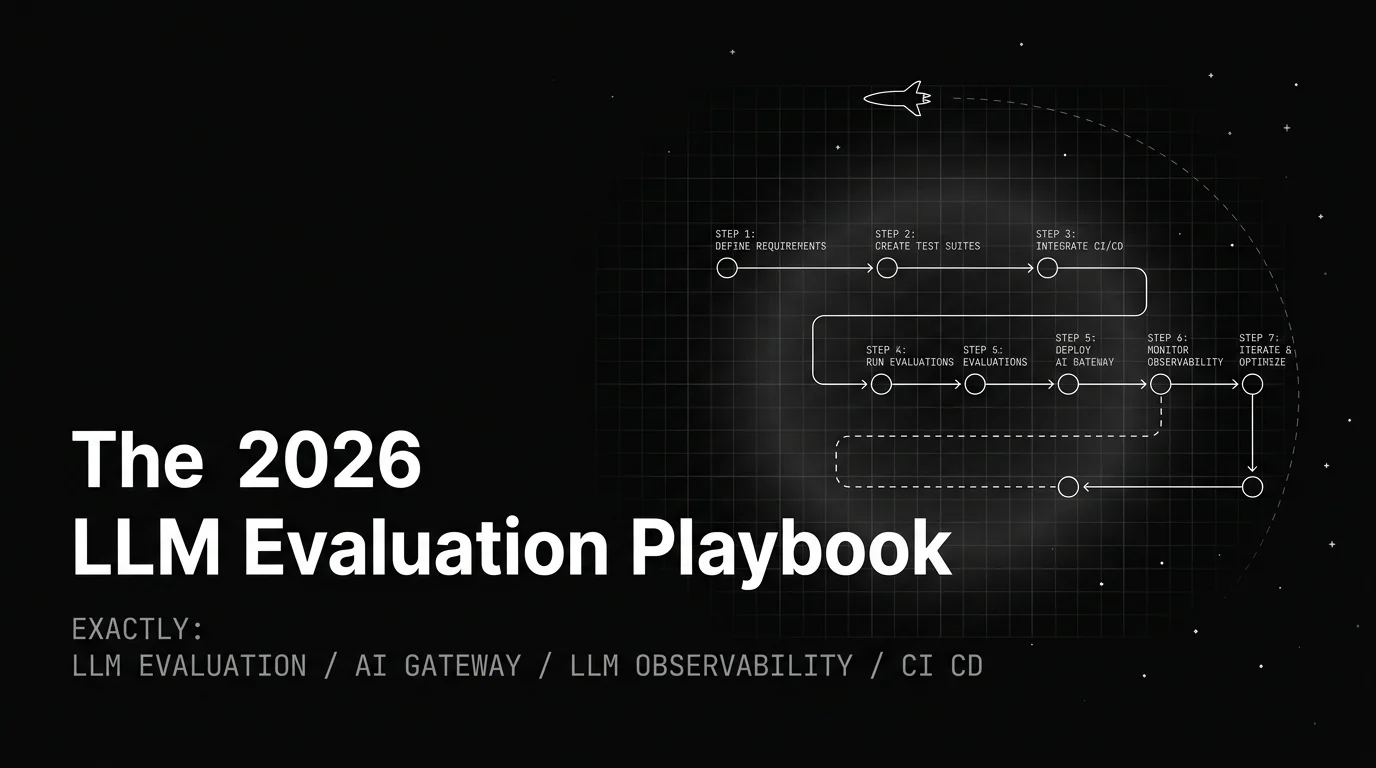
The pillar playbook for LLM evaluation in 2026: dataset, metrics, judge, CI gate, production observation, closed loop from failing trace to regression.

2026 buyer guide for LLM observability platforms: 10 criteria, 7 vendor categories, the 5-question vendor interview, an honest and calibrated ranking.

FutureAGI, DeepEval, Langfuse, Phoenix, Braintrust, LangSmith, and Galileo as the 2026 LLM evaluation shortlist. Pricing, OSS license, and production gaps.