LLM Eval for Enterprises in 2026: The Fortune 500 Playbook
The enterprise LLM evaluation playbook for Fortune 500 rollouts: multi-BU governance, regulatory rubric mapping, data residency, chargeback, procurement.
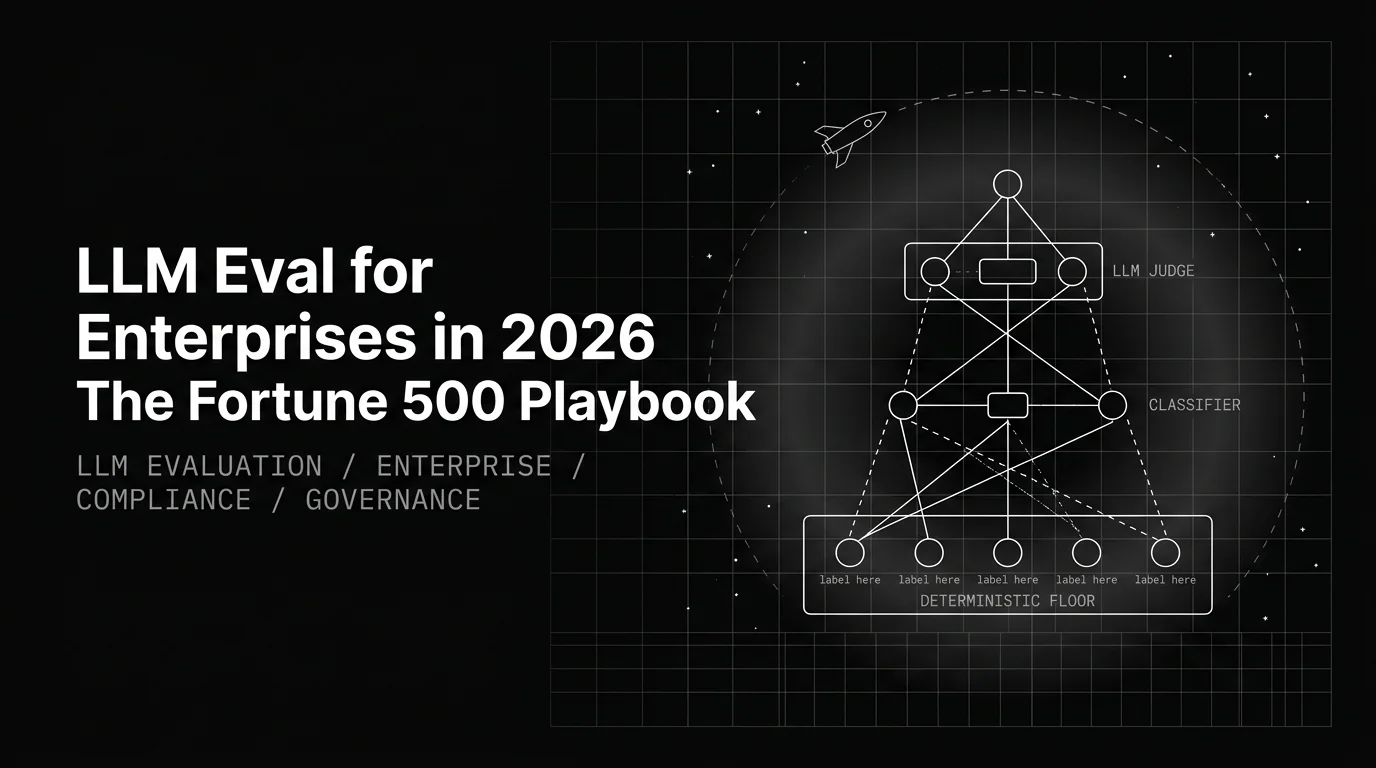
Table of Contents
A pharma Fortune 100 stands up an LLM program. Legal writes a contract-review assistant, clinical writes a medical-Q&A assistant, finance writes a forecast-summarizer, HR writes a policy chatbot. Six months in, the eval suite is four disconnected systems, three are missing legal review, and the auditor asks one question: “show me the rubric provenance for the medical-Q&A scores you submitted to the regulator.” Nobody can answer. The program goes on hold for a quarter while a central platform team builds the governance framework the company should have started with.
This is what enterprise LLM evaluation looks like in 2026: its own discipline. Multiple business units, multiple regulatory regimes, multiple regions, multiple eval-vendor contracts left over from prior pilots, and one auditor who wants rubric provenance traced back to a labeled case. This playbook is the working pattern from the F500 deployments we’ve watched ship and stay shipped: the seven enterprise-specific challenges, the rubric governance framework, the four-quarter rollout, and where the eval stack lives.
TL;DR: enterprise eval is its own discipline
| Concern | Startup answer | Enterprise answer |
|---|---|---|
| Rubric ownership | Eval lead writes them | Federated: BU SMEs author, platform team gates |
| Regulatory mapping | Optional | Every rubric maps to a named regulation requirement |
| Data residency | Single region | EU + US-East + US-West + GovCloud + APAC |
| Vendor stack | One vendor, fast pick | 6 to 12 month procurement, security and legal review |
| Cost attribution | Single team budget | Per-BU chargeback at the call line |
| Audit log retention | 30 to 90 days | Tiered: SOX 7 years, SOC 2 1 year, GDPR minimum-necessary |
| Incident triage | One on-call rotation | Per-BU rotation routed via the Error Feed |
If the startup playbook in LLM Eval for Startups in 2026 is “ship the smallest stack that works,” the enterprise playbook is “ship the stack the auditor and procurement reviewer can sign off on, and that ten business units can share without stepping on each other.”
Why enterprise eval is its own discipline
A startup ships one product, one rubric set, one region, one vendor. An F500 ships ten products across legal, clinical, finance, HR, marketing, customer support, and engineering. Each ships into a different regulatory regime: contract-review under attorney-client privilege, clinical-Q&A under HIPAA, financial-advice under SEC and FINRA, HR under GDPR and state employment law.
Three structural facts change the eval problem at this scale.
Multiple regulatory regimes per company. A pharma F100 runs under HIPAA, FDA SaMD guidance, GDPR for EU clinical-trial data, and SOC 2 Type II for partner audits. A bank F500 runs under SOX, FINRA, GDPR, CCPA, and EU AI Act risk-classification.Each regime maps to specific eval evidence the auditor expects, and the enterprise has to answer all of them in the same cycle.
Multiple data-residency rules per product. EU data stays in the EU under GDPR.PHI stays in HIPAA-eligible regions under the BAA. A central US-East eval cluster running rubrics on EU customer data is a residency breach. The eval stack respects the same residency rules as the inference path.
Multiple business units sharing infrastructure. The platform team that owns the tooling does not own every rubric. Federated rubric authorship is the only model where ten BUs can ship rubrics reflecting the actual domain knowledge in each unit. The startup pattern where one eval lead writes everything stops working past three or four use cases.
The seven enterprise-specific challenges
Every enterprise eval rollout we’ve watched gets stuck on the same seven challenges. The shape changes by industry, but the underlying obstacles repeat.
1. Multi-business-unit governance
The contract-review assistant cares about citation accuracy and confidentiality leakage. The customer-support assistant cares about refusal correctness, tone, and policy adherence. The R&D assistant cares about scientific faithfulness and hypothesis-quality scoring. A single eval team writing all three ends up scoring what the eval team thinks matters, not what domain experts know matters. Federated authorship with a central platform-team gate is the working pattern. The eval team organization piece covers the role split.
2. Regulatory rubric mapping
Every rubric maps to a named regulation requirement before it ships. PII detection maps to GDPR Article 5 and HIPAA Privacy Rule. Faithfulness maps to FDA guidance on clinical decision support. Prompt-injection maps to NIST AI RMF and EU AI Act Annex IV. Toxicity maps to platform-policy requirements under state consumer-protection law. A rubric without a regulation mapping is one the auditor treats as informal.
3. Multi-region data residency
EU data in the EU. US federal data in GovCloud. PHI in HIPAA-eligible regions. The eval stack ingests the same data the production path ingests, so residency obligations transfer one-for-one. BYOC deployment with the gateway and eval runner inside the enterprise’s per-region VPCs is the cleanest answer. Agent Command Center supports BYOC into AWS, GCP, and Azure across the enterprise’s footprint, and per-tenant routing rules pin traffic to the right region. The self-hosted gateway field guide covers deployment topology.
4. Vendor consolidation
Most enterprises arrive at the eval-rollout conversation with three to five overlapping vendors left over from prior pilots: an observability vendor, a guardrail vendor, a safety-rubric vendor, a red-team vendor, a prompt-management vendor. An eval stack spread across five vendors is one where audit evidence lives in five places, chargeback math lives in five invoices, and integration cost compounds. The Future AGI eval stack package (ai-evaluation SDK plus traceAI plus agent-opt plus the Agent Command Center plus the Future AGI Platform plus the Error Feed) gives the consolidation a single name.
5. Cost chargeback at scale
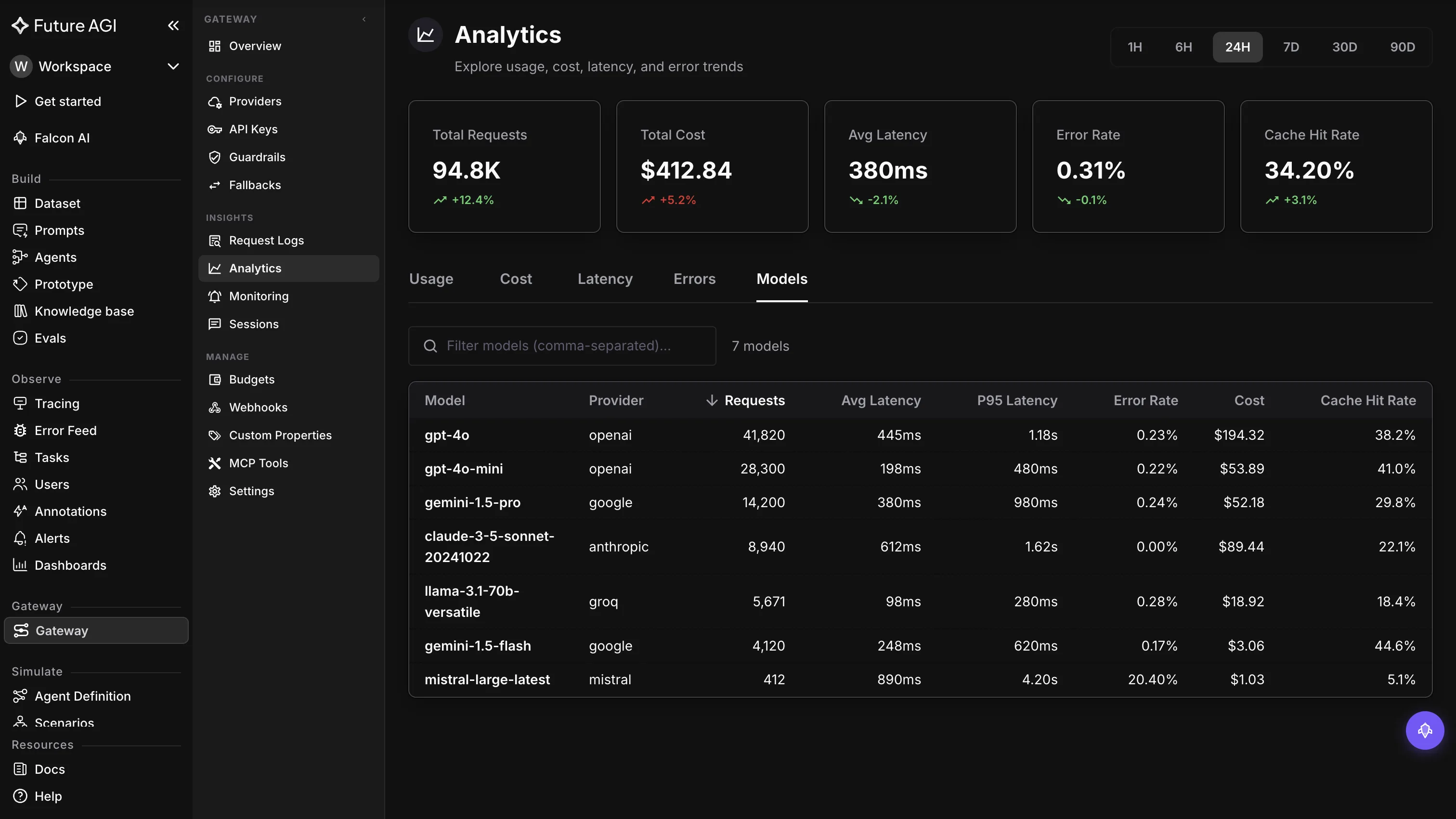
10 to 20 BUs each consuming LLM eval need clean attribution. Finance wants a per-BU line item, not a corporate invoice. The Agent Command Center exposes 5-level hierarchical budgets (org, team, user, key, tag) so each BU gets its own keys and tags. Every gateway call carries the dollars in the x-prism-cost response header, and the audit log captures per-call attribution. Eval spend gets the same treatment: augment=True cascade routes 70-90% of evals through free heuristics and cheap open-weight classifiers, attributed to the calling BU. The cost-tracking gateway piece covers per-BU mechanics.
6. Audit log retention
SOX requires 7 years on financial-services records. SOC 2 Type II requires at least 1 year on audit logs. GDPR pushes the other way with minimum-necessary retention. HIPAA requires 6 years on PHI. The enterprise eval stack handles this through tiered storage: hot logs sit in the gateway audit log (internal/audit/audit.go) for 90 days, warm logs move to the customer’s data lake under the customer’s retention policy, and cold logs hit long-term cold storage with cryptographic chain-of-custody. PII gets redacted at log-write through the gateway PII redactor (internal/privacy/redactor.go).
7. Procurement velocity
Enterprise procurement runs 6 to 12 months and has to survive security, legal, and architecture review plus a vendor risk assessment and a contract redline cycle. The deal-breakers are vendor lock-in via proprietary span format and missing compliance certifications. Apache 2.0 SDKs, OpenTelemetry-native trace format, and a signed BAA backed by SOC 2 Type II, HIPAA, GDPR, and CCPA certifications move the procurement clock from 12 months to 6.
The enterprise rubric governance framework
The rubric governance framework is the central artifact of an enterprise eval program. It answers four questions procurement, legal, and audit all ask: who authored this rubric, who signed off, what regulation does it map to, and what is the provenance of the golden set.
Federated authorship. Subject-matter experts author per-domain rubrics. Legal owns the legal rubric. Clinical owns the medical rubric. Marketing owns the brand-voice rubric. The central platform team owns the cross-cutting rubrics: toxicity, PII, prompt injection, refusal correctness, output-format validation.
Legal review gate. Before any rubric ships to production, the gate verifies the regulatory mapping. The rubric metadata names the regulation and the specific requirement clause: GDPR Article 5(1)(a) “lawfulness, fairness, transparency”; HIPAA 45 CFR 164.514(b) “limited data set”; EU AI Act Annex IV “technical documentation”; SOC 2 CC7.1 “system operations.” Legal signs off in the registry. The signoff is the audit evidence.
Annotator agreement floor. Every golden-set example carries an inter-annotator agreement score. Cohen’s kappa for binary labels, Fleiss’ alpha for multi-annotator categorical, Krippendorff’s alpha for ordinal and continuous. The floor for entering the calibration set is kappa > 0.7. Examples below get re-labeled or kicked back to the rubric author for definition tightening.
Version-controlled golden sets with provenance metadata. The auditor’s question is “trace this score back to a labeled case.” The golden set carries the source trace ID, annotation timestamps, annotator IDs, agreement score, and rubric version. Provenance turns an eval score from opinion into evidence.
# Federated rubric registry: BU rubrics import from the central platform-team package
from fi.evals import Evaluator, Groundedness, ContextAdherence, Toxicity, DataPrivacyCompliance, PromptInjection

# Platform-team owned cross-cutting rubrics
cross_cutting = [
    Toxicity(),              # maps to NIST AI RMF MEASURE 2.7
    DataPrivacyCompliance(), # maps to GDPR Article 5, HIPAA 45 CFR 164.514
    PromptInjection(),       # maps to NIST AI RMF GOVERN 6.1, EU AI Act Annex IV
]

# Clinical BU-owned domain rubrics
clinical_rubrics = [
    Groundedness(),     # maps to FDA SaMD guidance, faithfulness to source
    ContextAdherence(), # maps to clinical decision support audit requirements
]

evaluator = Evaluator(
    fi_api_key="...",
    fi_secret_key="...",
)
result = evaluator.evaluate(
    eval_templates=cross_cutting + clinical_rubrics,
    inputs=[...],
)
The Future AGI Platform layers self-improving evaluators on top of this registry. Each BU gets thumbs-up and thumbs-down feedback on its production traces, the Platform retunes the BU’s evaluators, and per-eval cost stays lower than Galileo Luna-2 because the cascade plus tuned classifiers do most of the work before the LLM-judge runs. The custom eval metrics piece covers authoring.
FAGI grounding: the enterprise-grade primitives
The Future AGI eval stack maps to the seven challenges directly.
Agent Command Center. SOC 2 Type II, HIPAA, GDPR, and CCPA certified per the Future AGI trust page. BAA available. ISO/IEC 27001 audit active.
5-level hierarchical budgets. Organization, team, user, key, and tag. Each BU gets its own budget envelope. Per-BU chargeback maps to enterprise FinOps without invoice math. The enterprise cost-tracking piece walks the budget hierarchy.
BYOC deployment in the customer VPC. Residency by deployment topology. The gateway and eval runner sit inside the enterprise’s per-region VPCs across AWS, GCP, and Azure. EU traffic stays in the EU VPC. GovCloud traffic stays in GovCloud. The same pattern carries across self-hosted observability.
Per-tenant routing rules and per-key AllowedIPs. Multi-tenant isolation at the gateway layer. Per-key AllowedIPs restricts which IP ranges can use a given key. Per-tenant routing rules pin traffic to the right region. Ten BUs sharing a gateway feel like ten gateways from the BU’s view.
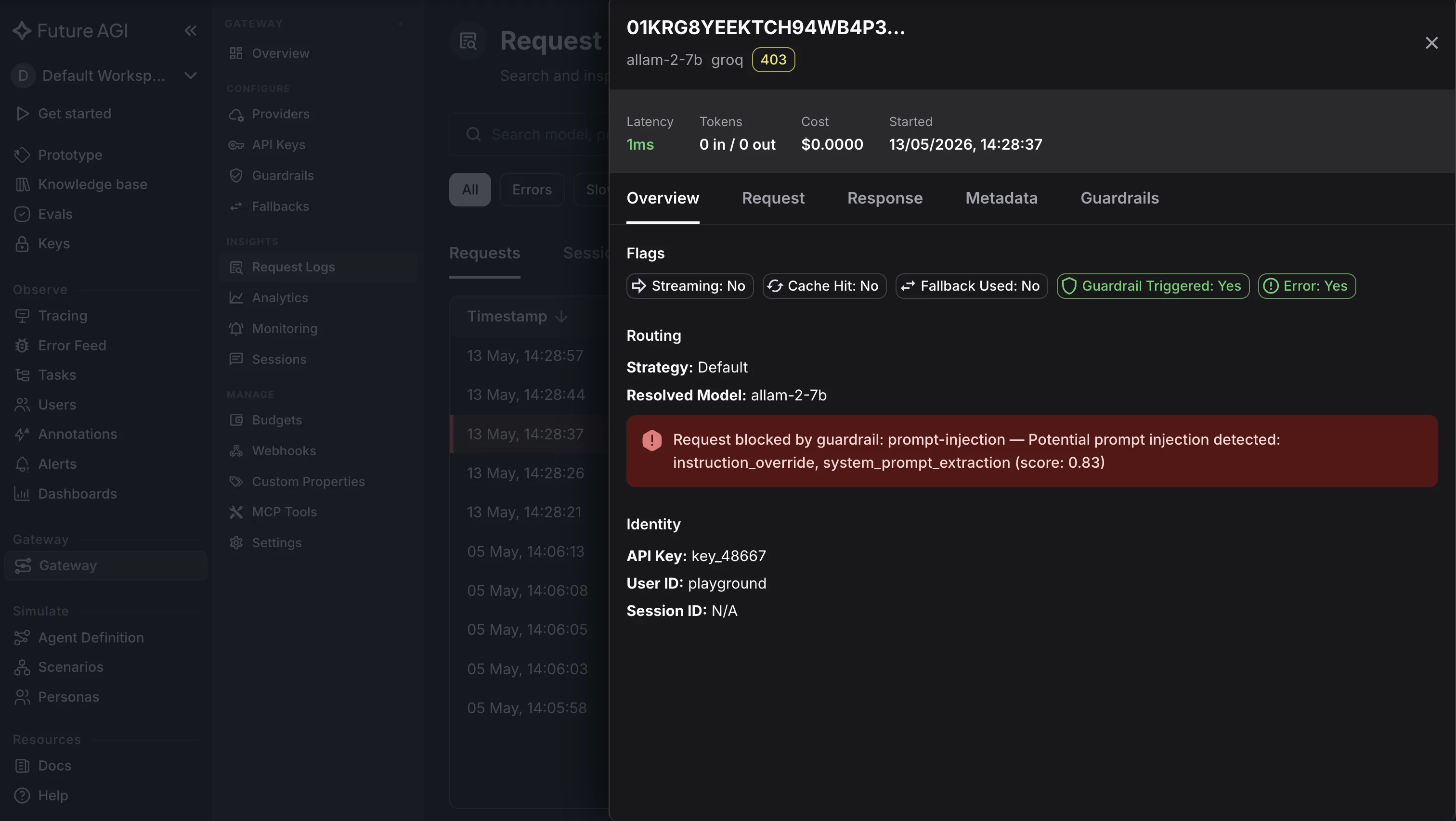
Gateway PII redactor plus audit log. internal/privacy/redactor.go redacts 18 PII entity types at log-write. internal/audit/audit.go carries the audit trail with sanitized failure reasons. Together they keep the retention obligation on data the regulator considers safe to retain.
13 guardrail backends and 4 distributed runners. F500-scale handling. The 13 backends span 9 open-weight (LLAMAGUARD_3_8B/1B, QWEN3GUARD_8B/4B/0.6B, GRANITE_GUARDIAN_8B/5B, WILDGUARD_7B, SHIELDGEMMA_2B) and 4 API (OPENAI_MODERATION, AZURE_CONTENT_SAFETY, TURING_FLASH, TURING_SAFETY). The 4 distributed runners (Celery, Ray, Temporal, Kubernetes) let the eval suite scale to ten million traces a day without becoming a deploy bottleneck.
8 SDK Scanners and 4 Protect LoRA adapters. Defense-in-depth for regulated workloads. Scanners (JailbreakScanner, CodeInjectionScanner, SecretsScanner, MaliciousURLScanner, InvisibleCharScanner, LanguageScanner, TopicRestrictionScanner, RegexScanner) run sub-10ms inline. The Protect adapters (toxicity, bias_detection, prompt_injection, data_privacy_compliance) run on Gemma 3n LoRA bases with Protect Flash as the first-pass binary classifier. Protect ML weights are closed; the gateway plugin self-hosts and the ML hop calls api.futureagi.com or, under enterprise license, the customer’s own private vLLM. The compliance guardrails piece walks the runtime side.
Apache 2.0 SDK plus commercial Platform. ai-evaluation, traceAI, and agent-opt ship Apache 2.0. The Future AGI Platform and the Agent Command Center hosted runtime are commercial. The split minimizes the vendor lock-in concern that is the F500 procurement deal-breaker: even if the customer leaves the Platform later, rubrics, traces, and optimizer runs are all under Apache 2.0.
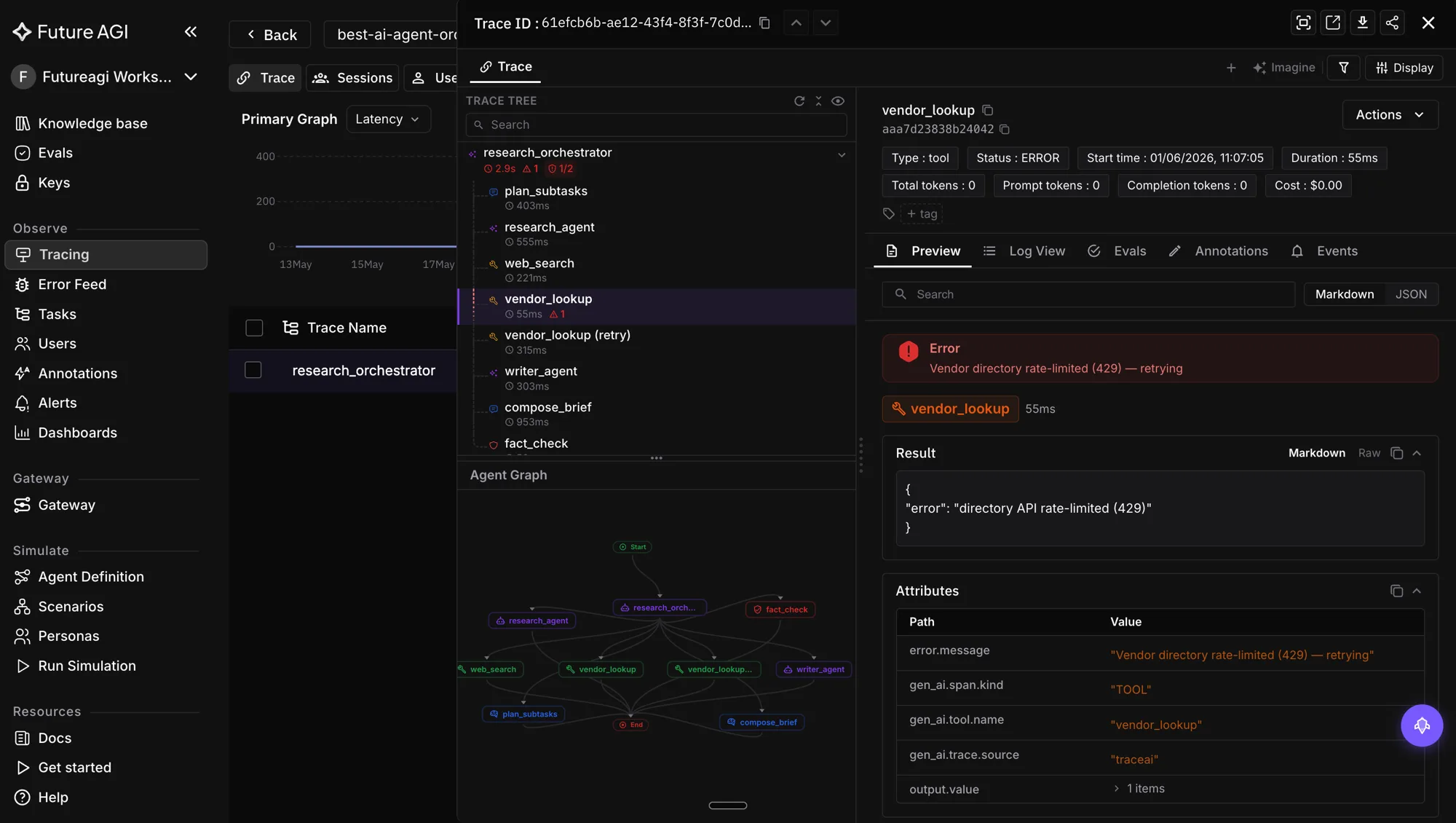
Multi-region deployment topology. EU, US-East, US-West, GovCloud, and APAC under enterprise license. Per-region BYOC where residency demands it. The LLM deployment piece covers topology choices.
The 6-step enterprise rollout: quarter by quarter
The four-quarter rollout is the only pattern we’ve watched survive F500 procurement and ship by year-end.
Quarter 1: pilot. One BU, one use case, three starter rubrics. Prove time-to-value on real production data, not a sandbox. The pilot rubrics are usually faithfulness or groundedness, a refusal-correctness rubric, and a PII-detection rubric. End-of-quarter readout: per-call eval cost, judge-cost cascade hit rate, regression-set scores, and one named production failure caught by the eval gate before it shipped.
Quarter 2: expand to three BUs. The central platform team forms. The rubric governance framework gets documented: federated authorship, legal-review gate, annotator-agreement floor, version-controlled golden sets. The legal-review gate becomes operational; the first BU rubrics ship with explicit regulation mapping. Procurement signs the enterprise license; BYOC deployment options get scoped against the customer’s VPC topology.
Quarter 3: full 10+ BUs onboarded. Per-tenant chargeback goes live through the 5-level hierarchical budgets. SOC 2 Type II, HIPAA, GDPR, and CCPA documentation packs complete. ISO/IEC 27001 evidence collection runs. Multi-region BYOC lights up EU and APAC if applicable. The compliance audit, if it falls here, gets a clean evidence pull rather than a two-month fire drill. The compliance framework piece covers the evidence side.
Quarter 4: closed-loop production feedback. The Platform’s self-improving evaluators retune per BU based on production thumbs-up and thumbs-down. The Error Feed lights up: HDBSCAN soft-clustering plus the Sonnet 4.5 Judge writes immediate_fix per cluster and routes via Linear to the BU on-call rotation. Linear is the only Error Feed integration today; Slack, GitHub, Jira, and PagerDuty are on the roadmap. Eval-driven optimization on prompts ships today via the six agent-opt optimizers (RandomSearchOptimizer, BayesianSearchOptimizer, MetaPromptOptimizer, ProTeGi, GEPAOptimizer, PromptWizardOptimizer); the trace-stream-to-agent-opt connector is on the roadmap.
# Enterprise rollout calendar at the platform-team level
Q1:
  scope: 1 BU, 1 use case, 3 rubrics
  goal: prove TTV; per-call cost; 1 named caught regression
  stack: Future AGI Platform + ai-evaluation SDK
Q2:
  scope: 3 BUs, governance framework documented
  goal: legal-review gate operational; enterprise license signed
  stack: + Agent Command Center BYOC scoping
Q3:
  scope: 10+ BUs, per-tenant chargeback live
  goal: SOC 2, HIPAA, GDPR, CCPA evidence packs complete
  stack: + multi-region BYOC; + traceAI span-attached scores
Q4:
  scope: closed-loop feedback live
  goal: per-BU on-call rotation routed via Linear
  stack: + Error Feed + agent-opt eval-driven optimization
Anti-patterns to avoid
Five anti-patterns recur in enterprise post-mortems. Each is recoverable, but recovery usually costs a quarter of platform-team time the program does not have.
Skipping legal review on rubrics. A rubric that ships without regulatory mapping is one the auditor treats as informal. The first time it scores against PHI or financial-services data, the program goes on hold while compliance backfills the mapping. The fix is the legal-review gate as a hard prerequisite.
Central team owns all rubrics. The platform team can build any rubric the BU describes, but cannot decide whether ungrounded omission of a side effect is a moderate or severe failure in a clinical context. BU-domain SMEs need authoring authority. Central owns the framework and cross-cutting rubrics; the BU owns the domain rubric.
No multi-region eval replication. A single US-East eval cluster running rubrics on EU customer data is a residency breach. BYOC per region is the working pattern.
No audit retention strategy. “Retain everything forever” violates GDPR minimum-necessary; “delete everything at 30 days” violates SOX 7-year retention. Tiered storage with redaction at write is the only way to satisfy both directions.
Vendor lock-in via proprietary span format. An eval stack that writes traces in a vendor-specific format is one the enterprise cannot leave without rebuilding the trace pipeline. OpenTelemetry-native span format keeps the rip-and-replace cost low. traceAI ships 50+ AI surfaces across Python, TypeScript, Java (with a Spring Boot starter, Spring AI, LangChain4j, Semantic Kernel), and C# under Apache 2.0 with OTel-native span semantics. The OTel instrumentation piece covers trace-format choices.
Honest framing: what ships today vs the roadmap
Worth naming explicitly, because procurement reviewers and architecture reviewers ask:
- The trace-stream-to-agent-opt connector is on the roadmap. Today, eval-driven optimization on prompts ships via the six agent-opt optimizers. Full trace-stream to optimizer-input is the next step.
- Error Feed integrations: Linear is the only one today. Slack, GitHub, Jira, and PagerDuty are on the roadmap. For the Q4 closed-loop step, Linear routing is the expected pattern.
- Future AGI Protect ML weights are closed. The gateway plugin self-hosts in the customer environment. The ML hop calls
api.futureagi.comby default, or, under enterprise license, the customer’s own private vLLM endpoint where the LoRA adapter runs in the customer’s infrastructure. - Apache 2.0 covers the ai-evaluation SDK, traceAI, and agent-opt. The Future AGI Platform and the Agent Command Center hosted runtime are commercial.
This framing is what enterprise procurement actually asks about. Lock-in risk, roadmap honesty, weight ownership, and regional certifications get more scrutiny than feature counts.
Where this sits in the broader eval program
The enterprise playbook does not replace the rest of the eval discipline; it sits on top of it. The 2026 LLM Evaluation Playbook is the six-layer foundation (dataset, metrics, judge, CI gate, production observation, closed loop). The eval team organization piece is the org-design view. The eval stack ROI piece is the budget-justification math. The OWASP LLM Top 10 piece is the security-risk mapping. This piece is the wrapper that says: at F500 scale, with ten BUs, three regulatory regimes, and a 6-to-12-month procurement clock, here is the working pattern.
The pattern: a federated rubric registry under a central legal-review gate; per-BU chargeback through 5-level hierarchical budgets; BYOC deployment per region; tiered audit-log retention; consolidated vendor stack on Apache 2.0 SDKs plus a SOC 2 Type II, HIPAA, GDPR, and CCPA certified hosted runtime; a quarter-by-quarter rollout that survives procurement. That is enterprise LLM eval in 2026.
Frequently Asked Questions
What makes enterprise LLM evaluation different from startup LLM evaluation?
How should rubrics be governed across multiple business units?
Why does data residency matter for enterprise LLM eval?
How does cost chargeback work for 10 to 20 business units?
What audit-log retention does an enterprise eval stack need?
How does Future AGI fit Fortune 500 procurement?
What is a realistic enterprise eval rollout plan?
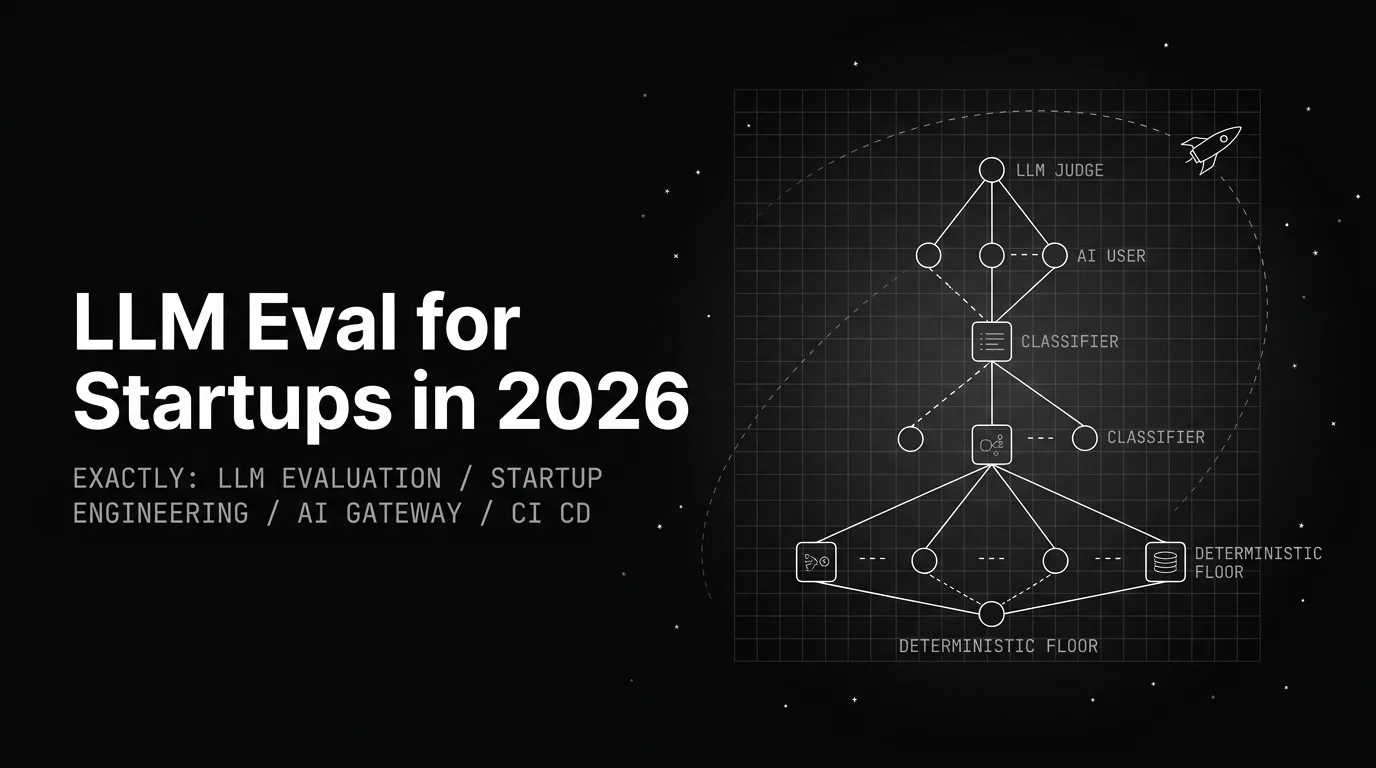
How an 8-engineer startup ships production LLM eval without a dedicated team: seven principles, five-engineer rollout, the FAGI primitives that scale.

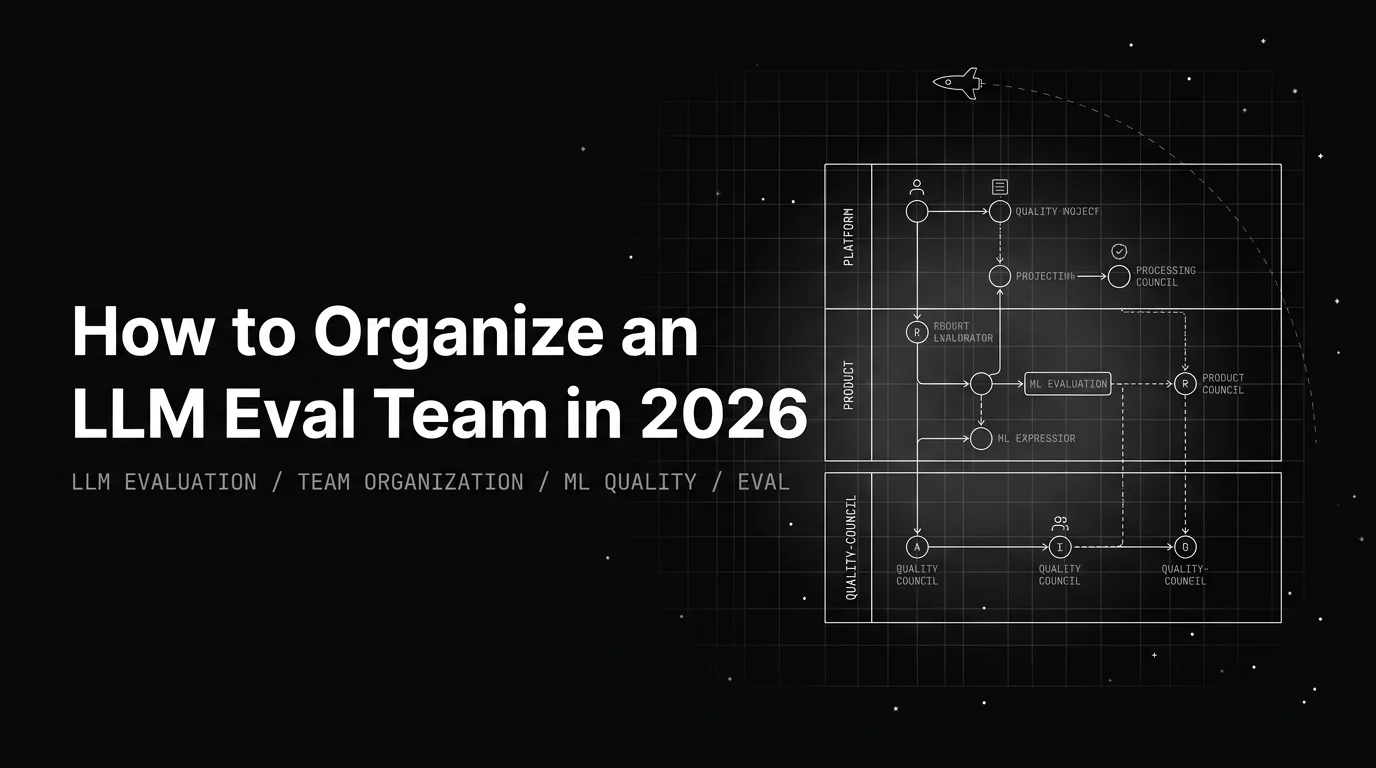
Eval ownership splits three ways: platform team owns tooling, product teams own rubrics, quality council owns policy. RACI, org models, hiring, FAGI.

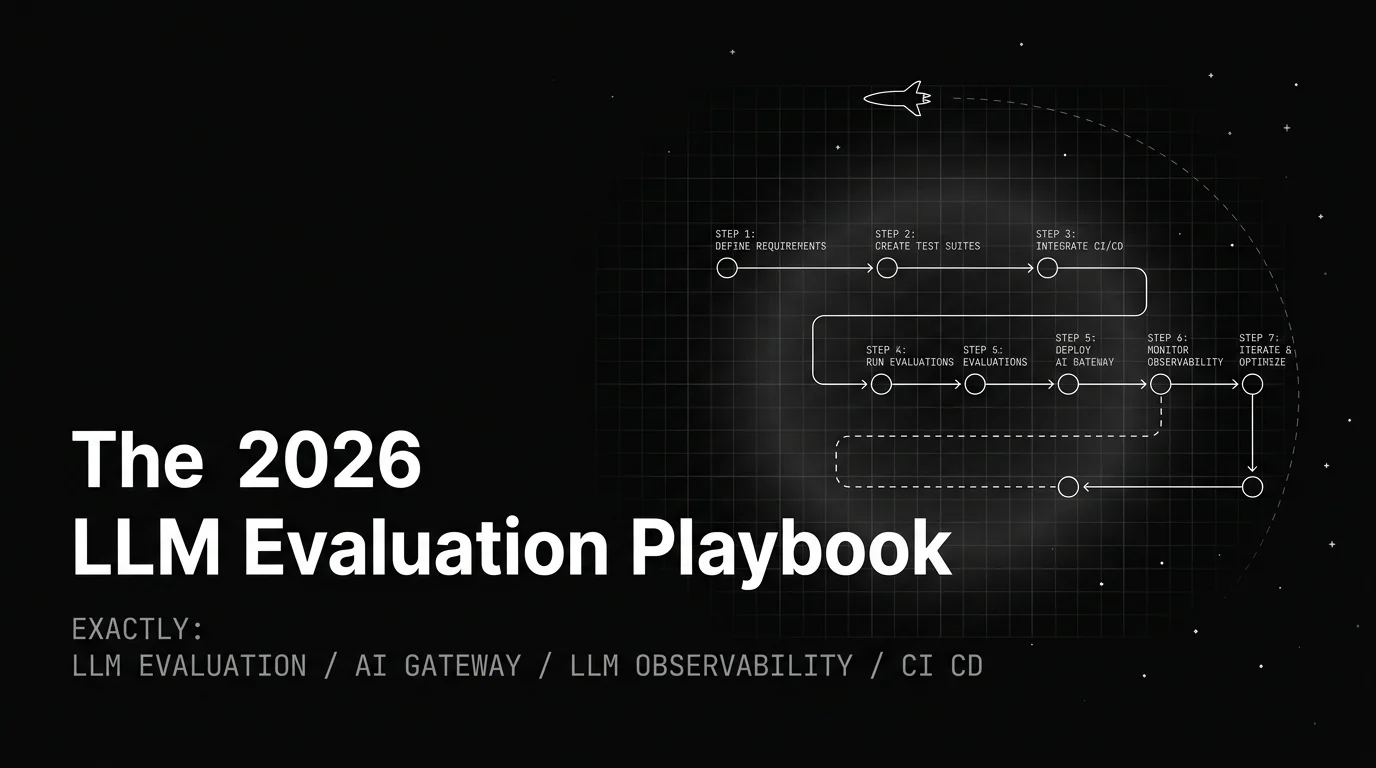
The pillar playbook for LLM evaluation in 2026: dataset, metrics, judge, CI gate, production observation, closed loop from failing trace to regression.