LLM Eval for Startups in 2026
How an 8-engineer startup ships production LLM eval without a dedicated team: seven principles, five-engineer rollout, the FAGI primitives that scale.
Table of Contents
You’re eight engineers shipping an AI product. Two wrote the agent, one wrote retrieval, one wired the frontend, the rest split QA, infra, and customer support. Someone in standup asks how you’re going to eval the model. The room goes quiet, then splits into the two wrong answers: half the team wants to ship-and-pray and learn from prod, the other half wants to build a three-month custom eval framework before the next feature lands. Both teams ship worse products than the middle path. This guide is the middle path.
TL;DR: the lean eval discipline
The startup-realistic eval stack has seven principles, fits in two to three weeks of part-time engineering, and runs on ten to fifteen percent of one engineer’s ongoing time. It works because LLM eval has become a commodity layer in 2026: the SDK, the templates, the classifier backends, and the runtime all exist. Your job is to wire them, not to write them.
| Principle | Why startups need it |
|---|---|
| Buy the platform layer | Custom frameworks burn months for no signal gain |
| Five rubrics, not fifty | Half-chosen rubrics produce half-trusted scores |
| Classifier-first cost | LLM-judge bill grows faster than inference bill |
| Production traces as golden set | Real user inputs beat invented examples |
| One eval-owner role | Premature eval teams burn headcount |
| PR-gate from day 1 | Retrofitting eval after launch costs 3x more |
| Linear plus Error Feed | Don’t build incident tooling you don’t need |
If you build only three: PR-gate eval, classifier-first cascade, production-trace mining. The rest keep the discipline honest as the team grows.
Why this guide matters
Most startup AI teams pick one of two failure modes. The first is ship-and-pray: write the prompts, run a few manual prompts through the agent, ship to users, learn from incidents. The eval debt compounds invisibly until the first big customer complaint, by which point the team is firefighting six failure modes with no shared rubric for what good looks like.
The second is over-engineering: a senior engineer reads a few eval papers, decides the team needs a custom framework with synthetic dataset generators, judge ensembles, and a homemade scoring pipeline. Three months disappear into the framework, the roadmap slips, and the eval stack that ships covers a smaller surface than the open-source SDK they could’ve installed on week one.
Both teams ship worse products than the middle-path team. The middle path treats eval as a discipline, not a project: install the platform layer this week, write five rubrics next week, gate the next PR, and start mining production traces by end of month. The team that ships on this rhythm is calmer, faster, and gets sharper signal than either failure-mode team.
The seven startup-realistic principles
Buy don’t build the platform layer
In 2024, you might’ve argued the eval stack was immature enough to warrant a custom build. In 2026 that argument doesn’t survive contact with the libraries. The Apache 2.0 ai-evaluation SDK ships 60-plus EvalTemplate classes, 13 guardrail backends, eight sub-10ms Scanners, and four distributed runners (Celery, Ray, Temporal, Kubernetes). DeepEval, MLflow, and Phoenix cover overlapping surfaces. Whichever you pick, you’re picking a runtime, not a science project.
The build-vs-buy question is closed for the runtime layer. What’s open: which rubrics matter for your domain, what counts as a failure, how to calibrate the judge against your users’ expectations. Those are the eval problems only you can answer, and where the engineering time should go.
Start with five rubrics, not fifty
The instinct of an engineer reading the eval-template catalog for the first time is to wire all 60. Don’t. Fifty half-chosen rubrics produce a dashboard nobody trusts and a CI gate that flakes on rubric drift twice a week. Five well-chosen rubrics produce a clean signal and a CI gate that catches real regressions.
The starter five for a generic LLM startup:
- Faithfulness (
GroundednessorContextAdherencefrom the SDK) catches the hallucination failure mode where the model asserts something the retrieval context doesn’t support. - Refusal handling (
AnswerRefusal) catches the over-refusal and under-refusal bugs that hurt user experience in both directions. - Safety (
ToxicityplusPromptInjection) catches outputs that hurt brand and inputs that try to jailbreak the agent. - Completeness (
Completeness) catches half-answered responses that pass surface checks but leave the user with a partial result. - Task completion (
TaskCompletion) catches the agent-style failures where every tool call runs but the user goal isn’t reached.
Add the next five only after the first five are running cleanly in CI for at least two weeks. The next-five list usually depends on the domain: RAG-heavy products add ChunkAttribution and ChunkUtilization, agent-heavy products add LLMFunctionCalling and tool-use rubrics, compliance-sensitive products add DataPrivacyCompliance and IsHarmfulAdvice. The LLM evaluation metrics catalog covers the next-twenty in detail.
Classifier-first cost economics
LLM-as-judge is convenient and expensive. On a 200-case PR gate, the bill is a few dollars per run and you don’t notice. On a 100k traces-per-day production stream, the bill compounds into thousands a month, and most of those scores never get read because the cheap signals already caught the failure.
The lean pattern is a classifier-first cascade. Sub-cent open-weight backends like LLAMAGUARD_3_8B, QWEN3GUARD_8B, QWEN3GUARD_4B, QWEN3GUARD_0.6B, GRANITE_GUARDIAN_8B, GRANITE_GUARDIAN_5B, WILDGUARD_7B, and SHIELDGEMMA_2B run on every production trace and on every PR-gate case. LLM-as-judge fires only when the classifier disagrees with itself across backends, when the confidence is low, or when the trace is sampled into the high-quality audit subset.
from fi.evals import Evaluator, AnswerRefusal, TaskCompletion, Toxicity
from fi.evals.types import TestCase

evaluator = Evaluator(fi_api_key="...", fi_secret_key="...")

results = evaluator.evaluate(
    eval_templates=[
        Toxicity(augment=True),
        AnswerRefusal(augment=True),
        TaskCompletion(augment=True),
    ],
    inputs=[
        TestCase(
            input="Help me draft a refund email",
            output=agent_response,
            context=retrieval_context,
        )
    ],
)
The augment=True flag wires the cascade: cheap heuristic first, classifier second, LLM-as-judge only when the lower layers are uncertain. The Future AGI Platform runs the cascade at lower per-eval cost than Galileo Luna-2, which is what keeps weekly full-dataset reruns affordable at startup budget. The deeper eval cost optimization piece covers the cascade tuning in detail.
Production-trace mining beats golden-set engineering
The classical eval guide tells you to build a golden set by writing 200 representative inputs at launch. That’s reasonable for week one. By month three it’s wrong, because the inputs you wrote at launch reflect the test author’s assumptions, not the failure modes your real users hit.
The lean pattern is production-trace mining. The traceAI SDK instruments your application with OpenTelemetry, captures every input, output, retrieval context, and tool call, and feeds the spans into a searchable store. The eval-owner runs a weekly triage where the worst-scoring production traces get reviewed, the genuinely buggy ones get labels, and the labeled ones get promoted into the golden set.
from fi_instrumentation import register
from fi_instrumentation.fi_types import ProjectType
from traceai_openai import OpenAIInstrumentor

trace_provider = register(
    project_type=ProjectType.OBSERVE,
    project_name="my-startup-agent",
)

OpenAIInstrumentor().instrument(tracer_provider=trace_provider)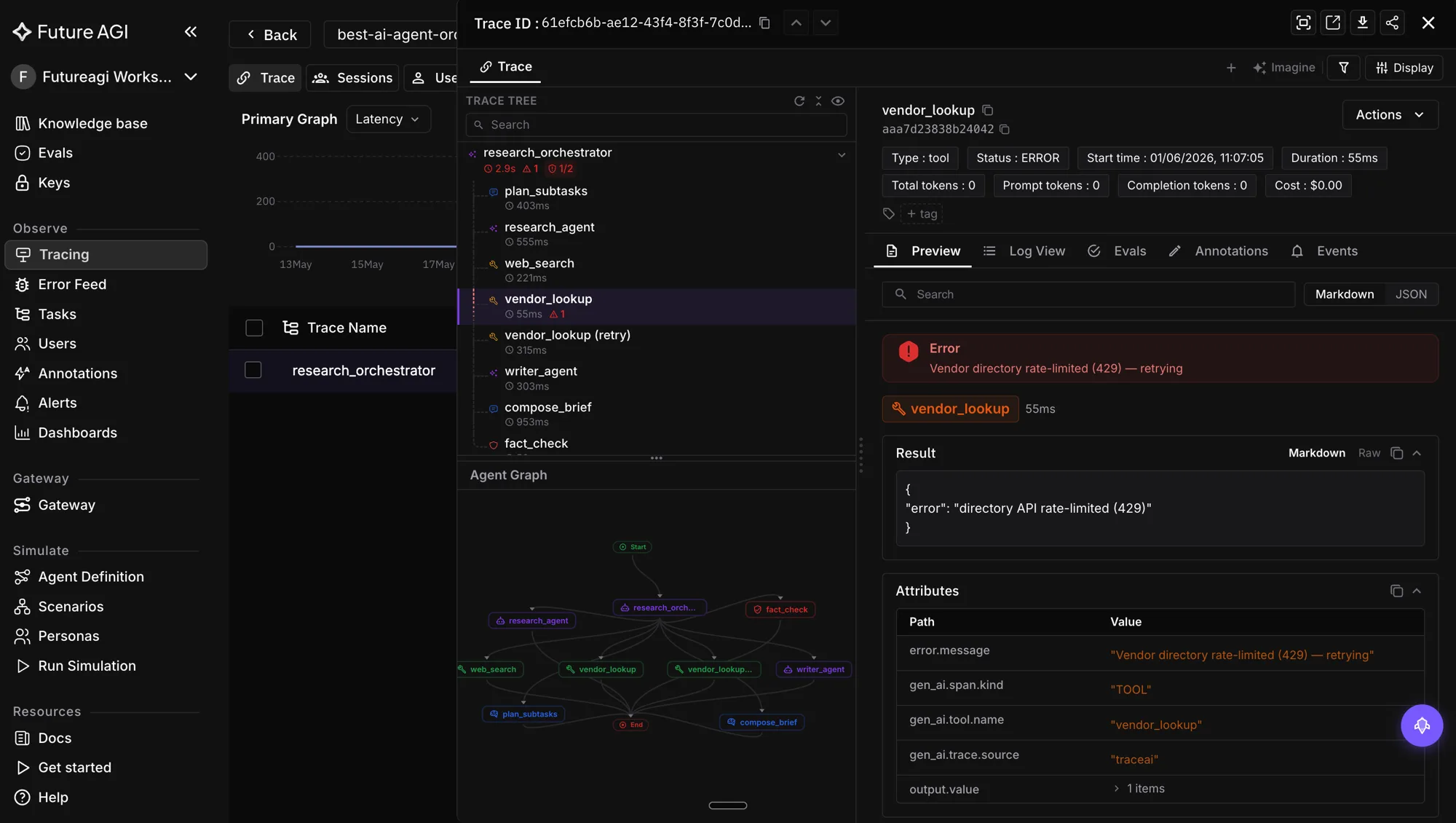
The pattern doesn’t need a fancy annotation tool. A weekly one-hour triage with the eval-owner and one product engineer, working through 20 to 40 production traces, grows the golden set by 10 to 20 cases a week. By month three you have 300 to 500 cases all sourced from real user behavior, which is where the eval signal gets sharp. The golden-set design piece covers the annotation cadence and the kappa-agreement floor.
One eval-owner per five-person team
A dedicated eval team is premature before 20 engineers. The work doesn’t fill the headcount, and the eval team becomes a bottleneck the product team routes around. The pattern that scales from five to twenty engineers is the eval-owner role: one engineer carries the eval discipline on top of their normal load, the rest of the team contributes rubrics and triages clusters as part of regular sprints.
The eval-owner’s responsibilities:
- Owns the rubric inventory and decides when to add or retire a rubric.
- Owns the PR gate threshold and decides when to tighten or loosen it.
- Runs the weekly triage on production-trace clusters.
- Carries the judge-calibration loop and re-checks every six weeks.
- Onboards new product surfaces into the eval stack.
This is roughly 10 to 15 percent of one engineer’s time once the stack is wired. The rest of the team carries the rubric-author load (writing rubric definitions for their own product surfaces) and the incident-triage load (taking on-call rotations for Error Feed clusters). The eval-team-organization piece covers the full role split and the graduation criteria to a dedicated team.
PR-gate eval from day 1
Retrofitting eval into a codebase that’s already shipped six features is three times more expensive than wiring it on day one. The reason isn’t technical, it’s social: once the team ships without a gate, the next regression that gets caught manually becomes the precedent for what manual catching looks like, and the gate becomes a cultural fight instead of a routine.
The day-one wiring:
# .github/workflows/eval-gate.yml
name: PR Eval Gate
on: pull_request
jobs:
  eval:
    runs-on: ubuntu-latest
    steps:
      - uses: actions/checkout@v4
      - name: Install ai-evaluation
        run: pip install ai-evaluation
      - name: Run eval against golden set
        env:
          FI_API_KEY: ${{ secrets.FI_API_KEY }}
          FI_SECRET_KEY: ${{ secrets.FI_SECRET_KEY }}
        run: python scripts/run_eval_gate.py
      - name: Post score to PR
        if: always()
        run: python scripts/post_eval_comment.py
The thresholds start loose (block only on regressions worse than two points from baseline) and tighten as the golden set grows. The PR comment shows the per-rubric score delta against main, which gives the author an instant signal whether the change is improving or regressing the quality bar. The CI gate threshold tuning piece covers the threshold setting in more detail.
Linear plus Error Feed for incident response
Don’t build incident tooling. The pattern that works for startups is to let Error Feed (HDBSCAN soft-clustering plus a Sonnet 4.5 Judge that writes the immediate_fix description) cluster the production failures into named issues, then push the cluster summary into the team’s existing tool. Linear is the native integration today; the eval-owner reviews the cluster digest as part of the weekly rhythm, files the high-impact ones as Linear issues, and the issues route into the regular sprint planning.
The flow:
- Production traces stream into traceAI.
- Failed-eval traces accumulate.
- HDBSCAN clusters the failures into 5 to 15 named clusters per week.
- The Sonnet 4.5 Judge writes a one-paragraph
immediate_fixdescription per cluster. - The eval-owner reviews the digest, files the top three as Linear issues, dismisses the noise.
- The Linear issues land in the next sprint, the fix ships, the failed traces re-cluster cleanly.
The Slack, GitHub, Jira, and PagerDuty integrations are on the roadmap; Linear is the only Error Feed integration today, and it’s enough for the lean rhythm. Most startups already run Linear or Notion for issue tracking, so the cost is zero new tools.
The five-engineer rollout
Two to three weeks to ship the first version. The split across a five-engineer team (or one engineer with five days of focus time):
Engineer 1: traceAI + PR gate. Installs fi_instrumentation, instruments the OpenAI / Anthropic / LangChain surfaces with the appropriate XInstrumentor(), wires the GitHub Actions PR gate. Day one to day three.
Engineer 2: the five starter rubrics. Writes rubric definitions using the SDK’s EvalTemplate classes plus a CustomLLMJudge for anything the templates don’t cover. Natural-language descriptions live in Notion alongside the code so non-engineers can read what each rubric checks. Day three to day seven.
Engineer 3: the golden set. Mines the first 200 cases from production traces (or QA notes if production isn’t live yet), labels them with expected behavior, freezes the v1 golden set. Day five to day ten.
Engineer 4: the classifier cascade. Wires augment=True on the five starter rubrics, picks classifier backends that match the safety surface (usually LLAMAGUARD_3_8B plus QWEN3GUARD_4B for cost balance), tunes the cascade thresholds against the v1 golden set. Day seven to day fourteen.
Engineer 5: Error Feed clustering. Wires the traceAI stream into the Error Feed surface, sets up the weekly digest, files the first round of Linear issues from the bootstrap cluster set. Day ten to day twenty-one.
Total team investment: about three engineer-weeks for the first version. Ongoing: 10 to 15 percent of the eval-owner’s time, plus rest-of-team contributions during regular sprints. The open-source stack for reliable AI agents piece covers the full library set.
What the FAGI stack gives a startup
Three surfaces, used in this order:
The ai-evaluation SDK is Apache 2.0 and free. Code-first: 60-plus EvalTemplate classes, 13 guardrail backends (nine open-weight including LLAMAGUARD_3_8B, QWEN3GUARD_8B, GRANITE_GUARDIAN_5B, WILDGUARD_7B, SHIELDGEMMA_2B, plus four API-based: OPENAI_MODERATION, AZURE_CONTENT_SAFETY, TURING_FLASH, TURING_SAFETY), eight sub-10ms Scanners (JailbreakScanner, CodeInjectionScanner, SecretsScanner, MaliciousURLScanner, InvisibleCharScanner, LanguageScanner, TopicRestrictionScanner, RegexScanner), and four distributed runners (Celery, Ray, Temporal, Kubernetes). For a five-engineer team, the SDK alone covers the first three months.
The Future AGI Platform is the hosted runtime: self-improving evaluators tuned by production thumbs-up and thumbs-down feedback, an in-product authoring agent that turns natural-language rubric descriptions into rubric definitions plus grading prompts plus reference examples, and lower per-eval cost than Galileo Luna-2 on classifier-backed evals so weekly full-dataset reruns stay affordable. Most startups layer the Platform on around month three, when ongoing rubric tuning starts eating engineering time. Startup pricing and a free trial are at https://futureagi.com/pricing.
Error Feed is the production-failure clustering surface inside the eval stack. HDBSCAN soft-clustering groups failed-eval traces into named clusters; a Sonnet 4.5 Judge writes the immediate_fix description per cluster; the digest feeds back into the Platform’s self-improving evaluators. Linear is the native push-target today.
The traceAI library (Apache 2.0) ships 50-plus AI surfaces across Python (46), TypeScript (39), Java (24 including a Spring Boot starter, Spring AI, LangChain4j, Semantic Kernel), and C# (1). The agent-opt library ships six optimizers (RandomSearchOptimizer, BayesianSearchOptimizer with Optuna and teacher-inferred few-shot, MetaPromptOptimizer, ProTeGi, GEPAOptimizer, PromptWizardOptimizer) plus EarlyStoppingConfig for eval-driven prompt optimization. The Agent Command Center gateway ships 5-level hierarchical budgets (org, team, project, user, agent) for chargeback, the https://gateway.futureagi.com/v1 base URL, and response headers x-prism-cost, x-prism-latency-ms, x-prism-model-used, x-prism-routing-strategy, x-prism-guardrail-triggered for per-request observability. BYOC is available for compliance-sensitive startups in legal-tech, medical-tech, or fintech.
Anti-patterns: the startup-specific traps
Five anti-patterns recur in startup eval post-mortems.
Building a custom eval framework. The instinct of a senior engineer with three months of eval-paper reading is to write the framework themselves. The framework that ships in three months covers a smaller surface than the SDK they could’ve installed on week one, and the three months of product roadmap are gone. The fix is to install the platform layer this week and spend the engineering time on rubric definitions and golden-set curation, which are the parts only you can build.
Fifty rubrics on day one. Wiring all 60 EvalTemplate classes feels thorough. It produces a dashboard with 60 columns, no one knows which to trust, and the CI gate flakes on rubric drift twice a week. The fix is five well-chosen rubrics for the first two weeks, then add five more once the first five are clean. The LLM evaluation playbook covers the rubric selection rules in detail.
LLM-judge only, no classifier cascade. Convenient on a 200-case PR gate, expensive at production volume. The bill grows faster than the inference bill, and most of the scores never get read because the cheap signals already caught the failure. The fix is augment=True from day one and a cascade tuned against the golden set.
No PR gate at all. The first regression to ship lands a customer complaint, the team firefights, the gate gets added in a panic. Retrofitting costs three times more than day-one wiring, and the cultural fight over what should block deploys becomes harder once “we don’t block on eval” is the default. The fix is the GitHub Actions snippet above on the first PR.
Dedicated eval team at six engineers. The team gets named, hires three people, and becomes a bottleneck the product team routes around. The fix is the eval-owner role pattern until you cross 20 engineers, then graduate to a dedicated team with a Rubric Author per product area and a dedicated Eval Engineer building the platform layer. The eval-team-organization piece covers the graduation criteria.
Ignoring cost economics because “we’re small.” The bill grows fast once production volume kicks in. The fix is classifier-first cascade from day one, plus the gateway response headers for per-request cost observability, plus 5-level hierarchical budgets for chargeback once the team has more than one product surface.
The deeper point: discipline scales, headcount lags
The smallest startup with the right eval discipline ships more reliably than the biggest enterprise without it. The bottleneck isn’t headcount, it’s whether the team treats eval as a discipline with named ownership or as a launch checklist skipped under deadline.
Discipline shows up in the calendar (weekly triage on production traces), in the on-call rotation (Error Feed clusters route to a paged owner), in the rollout policy (PR gate blocks on regressions), and in the rubric inventory (someone owns the list). None of these need a dedicated eval team, and none survive the absence of named ownership.
Eval is a force multiplier for small teams. The team that wires the seven principles in week two ships features in month two with a calmer release cadence than the team that picks up eval after the first big incident. Low cost, high payoff, compounds across the next two years of product.
Honest framing: what ships today
A few things to be clear about for the working pattern in 2026:
- Trace-stream-to-agent-opt connector is on the roadmap. Today the agent-opt library runs eval-driven prompt optimization on the rubrics you’ve already wired (six optimizers,
EarlyStoppingConfig, resumable Optuna). The direct connector that turns a traceAI stream into an agent-opt dataset is in design, not yet shipped. Today’s pattern is: export the golden set from your eval suite, feed it into agent-opt, run the optimizer. - Eval-driven optimization on prompts ships today. The six optimizers (
RandomSearchOptimizer,BayesianSearchOptimizer,MetaPromptOptimizer,ProTeGi,GEPAOptimizer,PromptWizardOptimizer) are production-ready with teacher-inferred few-shot and resumable runs. - Linear is the only Error Feed integration today. Slack, GitHub, Jira, and PagerDuty integrations are on the roadmap. For most startups Linear plus the Error Feed weekly digest is enough; teams that prefer Notion can paste the digest into their working doc.
The eval discipline doesn’t require any of the roadmap items to ship. Today’s libraries cover the seven principles end to end, and the roadmap items are the polish that comes after the discipline is wired.
Where to go from here
Three reading paths depending on where the team is:
- If the team hasn’t installed an eval SDK yet: start with the open-source LLM evaluation library overview, then the eval framework from scratch walkthrough.
- If the team has an eval suite but no PR gate: the evaluation best-practices checklist covers the gate wiring, threshold setting, and rubric inventory pattern.
- If the team is hitting production-failure clusters: the agent passes evals but fails production piece covers the production-trace mining and Error Feed triage rhythm.
The lean eval discipline pays off twice: once at launch when the team ships with calm confidence instead of post-launch panic, and again at month six when the team scaling up has a working discipline instead of an eval-debt cleanup project on the roadmap.
Frequently Asked Questions
Can an early-stage startup actually run LLM eval without a dedicated eval team?
Should a startup build its own eval framework or buy one?
What are the five rubrics a startup should start with?
How do startups keep eval cost under control as traffic grows?
How big should the eval golden set be for a startup?
Does Future AGI work for early-stage startups with limited budget?
When does a startup graduate from eval-owner to dedicated eval team?
The enterprise LLM evaluation playbook for Fortune 500 rollouts: multi-BU governance, regulatory rubric mapping, data residency, chargeback, procurement.

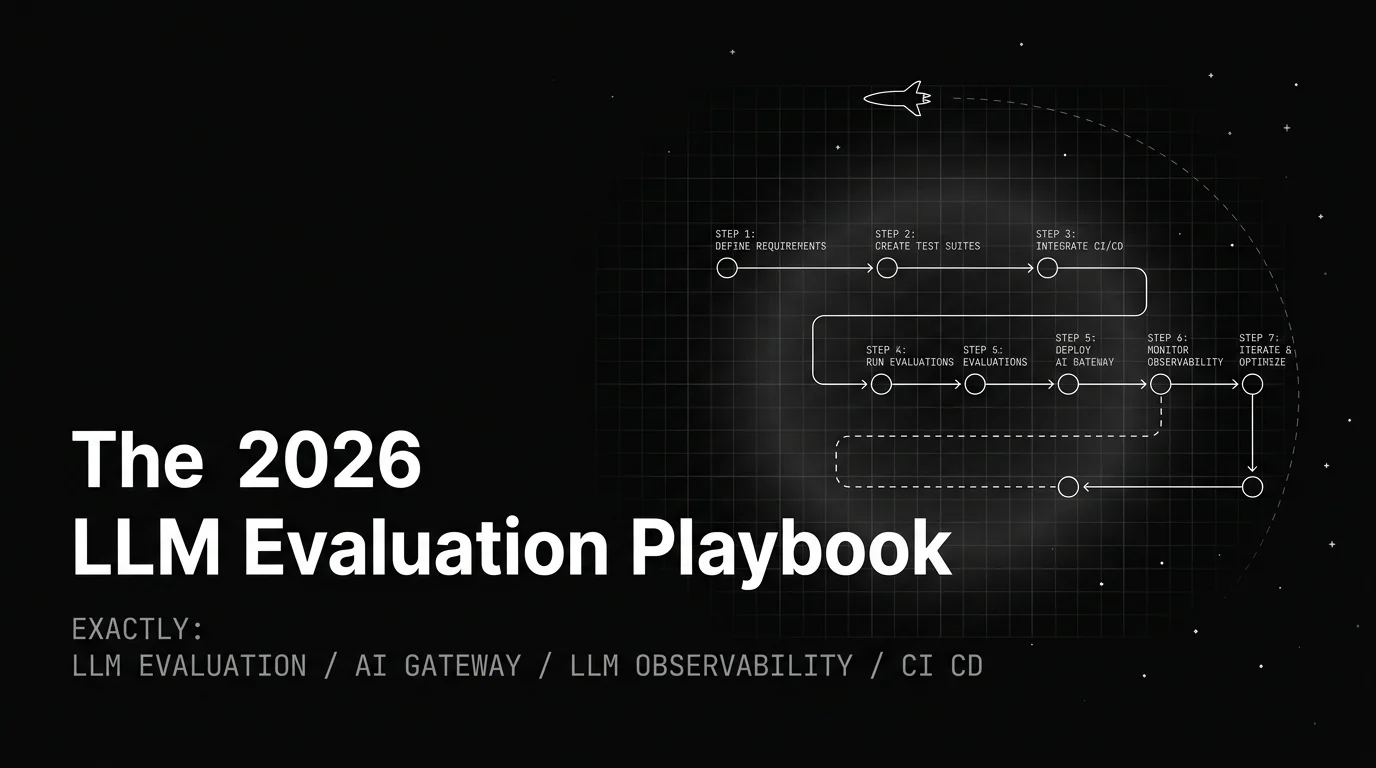
The pillar playbook for LLM evaluation in 2026: dataset, metrics, judge, CI gate, production observation, closed loop from failing trace to regression.
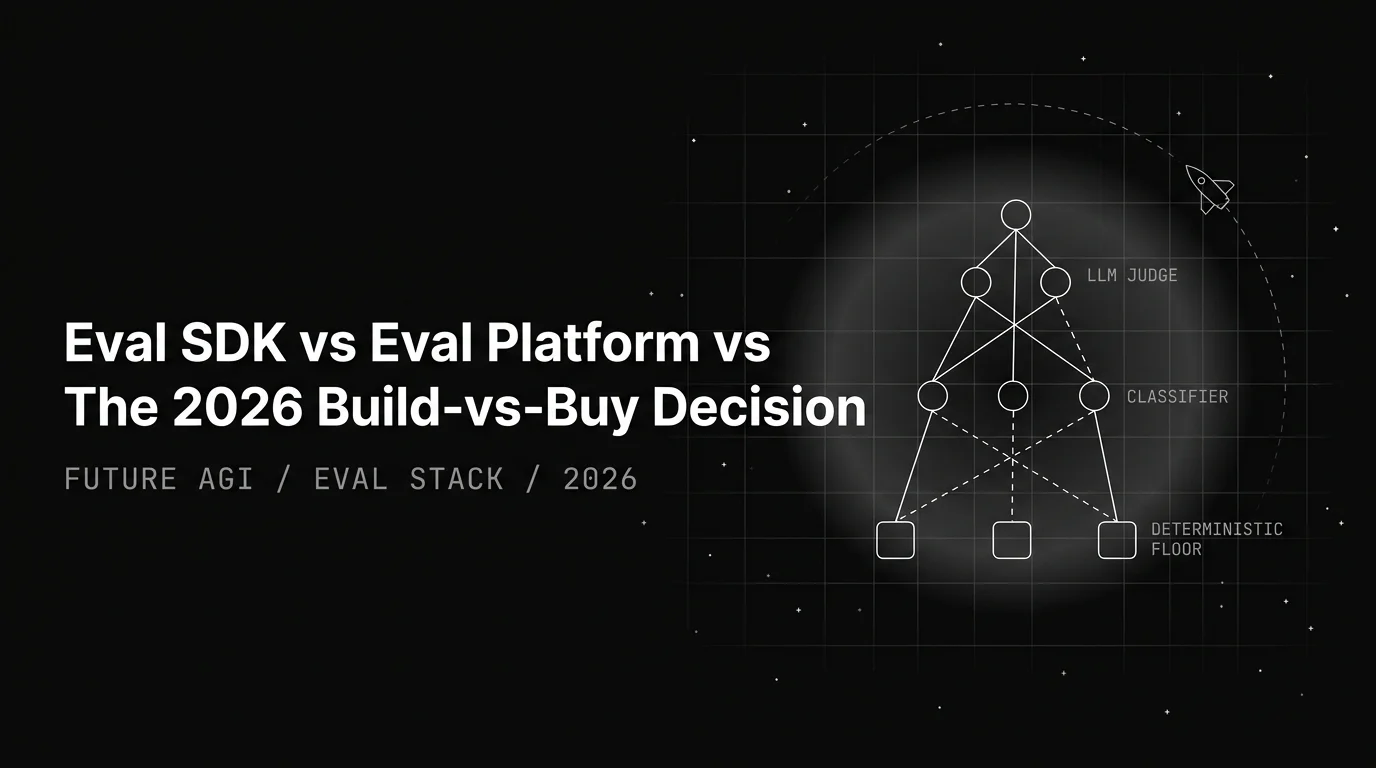
Build vs buy for LLM evaluation 2026. SDK vs hosted platform tradeoffs across seven axes, cost math, the hybrid pattern most production teams should run.