The Eval ROI Business Case: Show the Spreadsheet, Not the Slide Deck
Eval ROI is four terms: avoided-incident, faster-ship, model-substitution, minus infra. Teams underestimate incidents 10x. With math.
Table of Contents
Most eval budget decks lose for the same reason. They quote the infra line at pilot prices, claim a vague velocity win, and skip the math on the only term that actually moves the CFO. The deck looks responsible and lands flat. The team that wins the budget walks into the room with a spreadsheet, four lines, every assumption sourced from the team’s own traffic, and the avoided-incident number sized realistically rather than at on-call hours. The spreadsheet wins because it lets the CFO push back on each cell. The slide deck loses because it asks for trust on one number.
The thesis: four terms, one spreadsheet
The formula:
Eval ROI = avoided-incident cost
        + faster-ship cost
        + model-substitution savings
        - eval-infra cost
Two patterns explain why most teams lose this argument. First, avoided-incident gets priced at engineering on-call hours when the realistic blended cost is 10x higher once legal, churn, and the next sales cycle are folded in. Second, eval-infra gets priced from the pilot run, where the team ran a frontier LLM-judge on every trace, when the production stack is a cascade that costs 20 percent of that pilot estimate. The two errors compound. The avoided-incident term is too small, the infra term is too large, and the spreadsheet looks neutral when it should be screaming.
The rest of this post is the four terms, the math under each, the 12-month pitch that sequences them so each quarter adds a payback line, and where Future AGI ships the primitives that deliver each term.
TL;DR: the four-line spreadsheet
| Term | Direction | Typical scale on 100k traces/day |
|---|---|---|
| Avoided-incident cost | + | $300k–$500k per prevented incident, 0–2 per year |
| Faster-ship cost | + | 1–2 engineer-weeks/month recovered |
| Model-substitution savings | + | $30–$60k/mo on inference |
| Eval-infra cost | − | $1.5–$3k/mo on production cascade |
The conservative line: no avoided incident, no audit cycle, $30k of substitution savings, one engineer-week recovered, $2.5k infra cost. Net positive in month one. The big-incident or audit-cycle months pay for the next year.
Term 1: avoided-incident cost (the 10x underestimate)
Avoided-incident is the largest term and the one teams price wrong. Most eval pitches list “incident prevention” as a bullet without sizing it, because sizing it means committing to a blended number that the CFO can audit. Here is the audit-ready version.
Pick one realistic incident your team almost shipped this year. Regulated-content leak. PII exposure. Hallucinated medical or legal claim. Jailbreak that bypassed the blocklist. Now decompose the cost honestly:
- Engineering response. On-call hours pulled into triage, postmortem, fix, regression test. 1–2 FTE-months on a serious incident. At a fully-loaded engineering rate, $30–$60k.
- Legal and compliance review. Outside counsel hours, regulator notifications, contract reviews. $20–$80k depending on jurisdiction and scope.
- Customer notifications and SLA credits. Direct revenue hit. On a regulated-content leak in a regulated industry, $50–$200k in SLA credits and refunds is not unusual.
- Churn from affected accounts. The second-order revenue hit. Two quarters of churn at the enterprise tier on five affected accounts lands at $100–$300k of ARR.
- Reputational tax. The next sales cycle that hears about it. Hardest to size, never zero. A serious incident shows up in the win-loss notes of the next four quarters of pipeline.
Add the cells. The realistic blended cost on a serious incident is $300–$500k. Teams quote $50k because they only count the engineering response. That is the 10x underestimate that makes the rest of the deck look optional.
The eval stack catches incidents on two layers. Pre-deploy, the CI gate runs the safety-critical rubrics against a regression set; rubrics like Toxicity, PromptInjection, DataPrivacyCompliance, AnswerRefusal, IsHarmfulAdvice, and NoHarmfulTherapeuticGuidance act as hard gates. Post-deploy, the Future AGI Error Feed clusters live failures with HDBSCAN over ClickHouse-stored embeddings and a Claude Sonnet 4.5 Judge writes the immediate_fix per cluster, ranked Critical / High / Medium / Low.
from fi.evals import Protect
from fi.evals.templates import (
    PromptInjection, DataPrivacyCompliance, AnswerRefusal, IsHarmfulAdvice,
)

protect = Protect(
    rails=[
        PromptInjection(augment=True),
        DataPrivacyCompliance(augment=True),
        AnswerRefusal(augment=True),
        IsHarmfulAdvice(augment=True),
    ],
    rail_type="INPUT",
    aggregation="ANY",
)

verdict = protect.check(user_input)
if verdict.blocked:
    return safe_fallback_response(verdict.reason)
One avoided incident at $300–$500k covers the entire stack for a year on most production teams. Two avoided incidents and the question stops being whether eval pays. The LLM incident response playbook covers the workflow when an incident does slip through; evaluating LLM data leakage prevention walks the safety-rubric set in depth.
Term 2: faster-ship cost (the lever finance does not see)
The pitch that changes the conversation: an eval stack makes the team ship faster, not slower. Without the gate, the team has two options. Overnight regression runs that block deploys until tomorrow morning. Or no regression, ship blind, roll back when something breaks. Both drag the velocity curve.
A PR-gate eval runs in minutes. Heuristics and classifiers are sub-10ms, the LLM-judge fallback hits only residual cases, and the four distributed runners in ai-evaluation (Celery, Ray, Temporal, Kubernetes) keep the suite parallel as the dataset grows. The engineer opens the PR, the gate runs, the score lands as a comment, the merge button lights up. Same day, with a quality signal attached.
# ci_eval.py: invoked by GitHub Actions on every PR
import sys
from fi.evals import Evaluator
from fi.evals.templates import (
    Groundedness, FactualAccuracy, TaskCompletion, ContextAdherence,
)
from fi.testcases import TestCase
from regression_set import load_regression_dataset

evaluator = Evaluator(fi_api_key="...", fi_secret_key="...")
inputs = [TestCase(**row) for row in load_regression_dataset()]

result = evaluator.evaluate(
    eval_templates=[
        Groundedness(augment=True),
        FactualAccuracy(augment=True),
        ContextAdherence(augment=True),
        TaskCompletion(augment=True),
    ],
    inputs=inputs,
)

if result.aggregate_score < BASELINE - 0.02:
    sys.exit(1)
Sizing the dollars: a team that ships once a day instead of once a week ships 5x more product. At a fully-loaded engineering rate, the in-spreadsheet line is 1–2 engineer-weeks recovered per month on a 6-engineer team. The line that wins the board is the compounding velocity story: a quarter of same-day deploys is the difference between launching a new agent feature and watching a competitor launch it first.
The CI/CD pattern for LLM eval with GitHub Actions covers the wiring. The agent-opt library handles prompt and threshold tuning under six optimizers (RandomSearchOptimizer, BayesianSearchOptimizer, MetaPromptOptimizer, ProTeGi, GEPAOptimizer, PromptWizardOptimizer) when the gate flags a regression, so the fix-cycle compresses from days of manual sweep to hours of automated search.
Term 3: model-substitution savings (the line on the bill)
Most production LLM products over-pay for inference. A team running 100 percent of traffic on the flagship tier (GPT-5, Claude Opus 4.5, Gemini Ultra) is paying roughly 10x what a Haiku-class router would, and a meaningful slice does not need flagship quality at all. Without an eval, the team cannot tell which slice. With an eval, the routing is provable on the team’s own traffic, on the team’s own rubrics, with a number the CFO can stress-test.
The pattern: run the rubric suite over a representative sample of production traffic at both flagship and cheap tiers. For every query the cheap tier passes, route to cheap. For every query the cheap tier fails, route to flagship. Most production traffic lands in a 60–80 percent slice the cheap tier serves at full quality; the remaining 20–40 percent is where the flagship earns its price. The Agent Command Center gateway carries the routing logic with 6 strategies (round-robin, weighted, least-latency, cost-optimized, adaptive, fastest) plus complexity-aware tiering, failover, mirror, race, and shadow. The x-prism-cost response header gives Finance canonical dollars per call without vendor invoice reconciliation.
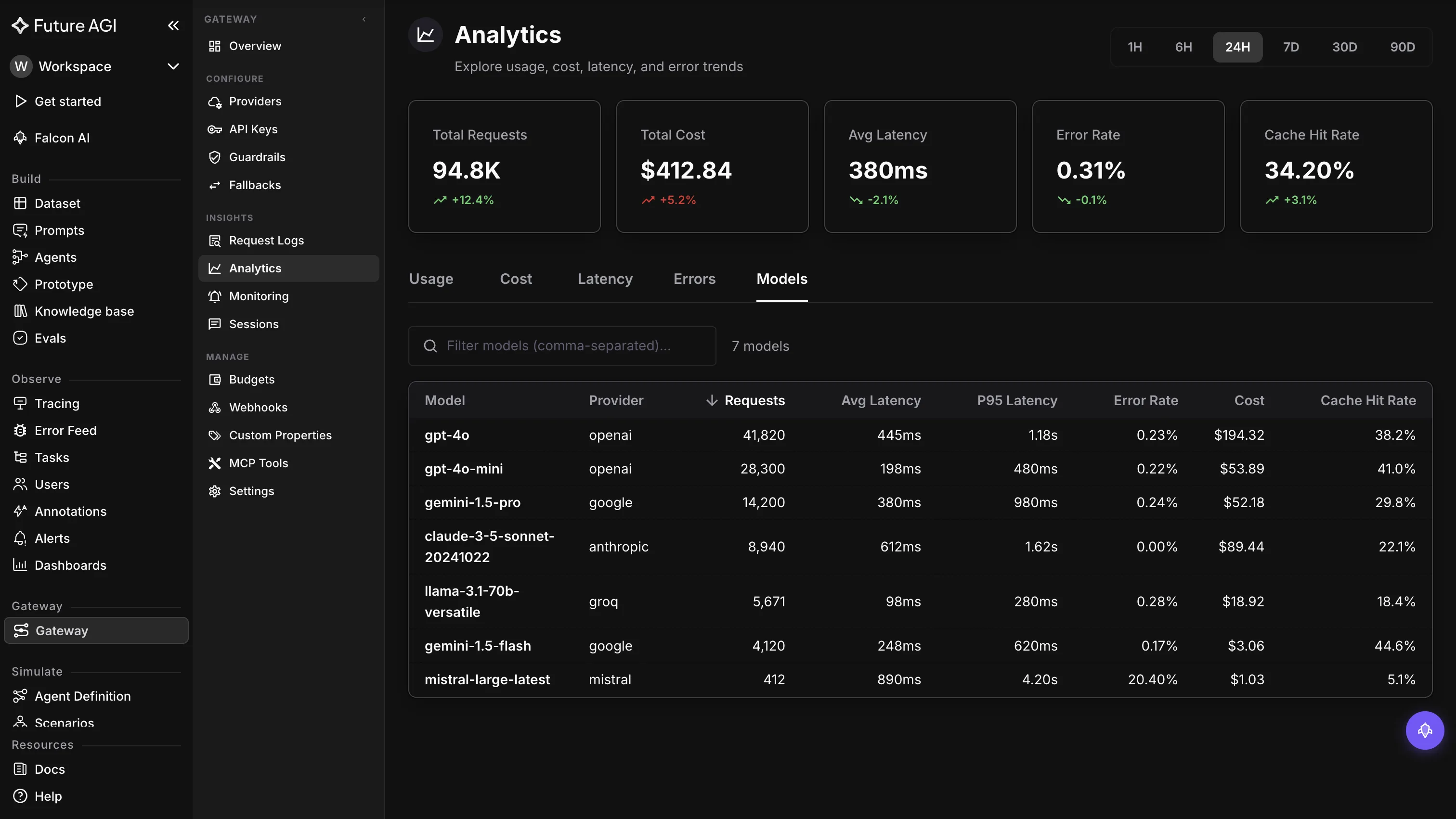
Sized for the 100k-trace/day team with realistic per-call prices for a chat product:
- All-flagship baseline. $0.015 average per call × 100k = $1.5k/day = ~$45k/mo on inference.
- 70/30 cheap-tier split after eval-driven routing. 70k × $0.001 = $70/day; 30k × $0.015 = $450/day. Total $520/day, ~$15.6k/mo.
- Net substitution savings: ~$30k/mo. A more aggressive 80/20 split with a fully-tuned router lands closer to $40–$60k/mo.
The eval is what makes the substitution safe. Without it, the team either eats the flagship bill forever or downgrades and breaks quality. The AI agent cost optimization patterns walks the routing-strategy math in more detail.
Term 4: eval infra cost (the 5x overestimate)
The line teams price wrong on the way up. The pilot looks like this: pick five rubrics, run them on a frontier LLM-judge against every trace, multiply by 100k traces/day, present the number. At $0.005 per LLM-judge call, that lands at $15k/mo on the eval bill alone. The CFO recoils, the deck looks expensive, the question becomes whether eval is worth it at all.
The production version is a cascade. The Future AGI ai-evaluation SDK ships every EvalTemplate with an augment=True flag. The template runs a fast heuristic first (regex, schema check, deterministic rule). If the heuristic decides confidently, the call terminates at near-zero cost. If not, the request escalates to one of 13 guardrail backends: 9 open-weight (LLAMAGUARD_3_8B/1B, QWEN3GUARD_8B/4B/0.6B, GRANITE_GUARDIAN_8B/5B, WILDGUARD_7B, SHIELDGEMMA_2B) and 4 API (OPENAI_MODERATION, AZURE_CONTENT_SAFETY, TURING_FLASH, TURING_SAFETY). Only the residual cases the classifiers cannot resolve hit the LLM-judge.
from fi.evals import Evaluator
from fi.evals.templates import Toxicity, PromptInjection, Groundedness
from fi.testcases import TestCase

evaluator = Evaluator(fi_api_key="...", fi_secret_key="...")

result = evaluator.evaluate(
    eval_templates=[
        Toxicity(augment=True),
        PromptInjection(augment=True),
        Groundedness(augment=True),
    ],
    inputs=[TestCase(query=user_input, response=model_output, context=retrieved)],
)
A calibrated cascade on production traffic lands roughly 70 / 25 / 5: 70 percent terminate on heuristics at zero, 25 percent on classifiers at fractional dollars, 5 percent escalate to the LLM-judge. Rerun the math on the 100k-trace/day team:
- 70k heuristic terminations × $0 = $0/day
- 25k classifier calls × $0.0005 = $12.50/day
- 5k LLM-judge calls × $0.005 = $25/day
- Daily ~$45, monthly ~$1.3k.
The pilot estimate said $15k/mo. The production estimate is $1.3k/mo. That is the 5x overestimate (closer to 10x on aggressive cascade tuning). The team that pitches eval-infra at the pilot price is arguing against itself. The team that pitches at the production price walks the spreadsheet through how the cascade gets there, and the line goes from scary to negligible.
The eval cost optimization patterns walks the three stacked levers (cascade, sampling, caching) that drop the residual bill another 80–95 percent. The budget allocation framework covers how to allocate the savings across surfaces.
The combined math: 100k-trace/day team
Stack the four terms. Conservative assumptions, realistic per-call prices for a chat product.
| Term | Conservative | Realistic | Aggressive |
|---|---|---|---|
| Avoided-incident | 0 | 1 × $300k/yr ≈ $25k/mo | 2 × $500k/yr ≈ $83k/mo |
| Faster-ship | 1 eng-week/mo (~$5k) | 2 eng-weeks/mo (~$10k) | 4 eng-weeks/mo (~$20k) |
| Model-substitution | $30k/mo | $45k/mo | $60k/mo |
| Eval-infra | −$3k/mo | −$2k/mo | −$1.3k/mo |
| Net | ~$32k/mo | ~$78k/mo | ~$162k/mo |
Even the conservative line clears $30k/mo, before counting audit cycles. The realistic line clears $75k/mo. The aggressive line clears $160k/mo. Calibrate the cells to your own traffic, your own per-call prices, your own incident history. The shape of the savings holds across products; the dollar magnitudes scale with traffic and risk surface.
For the checklist version of this argument that lands in a single page, see the LLM eval best practices checklist. For the rebuttals to common pushbacks (“isn’t this just QA,” “can’t we just use eval as a one-off”), the LLM eval myths for skeptics post handles them in two-minute reads.
The 12-month pitch (sequenced by payback term)
The pitch lands better when each quarter adds a payback line to the spreadsheet, rather than promising all four terms at once. The sequencing also matches how the work actually ships.
Quarter 1: build the stack so the math becomes real. Stratified dataset across the cohorts the product already knows about. Cascade wired into the SDK at augment=True on every EvalTemplate. Gateway instrumented with the 5-level hierarchical budgets (org, team, user, key, tag) and the x-prism-cost, x-prism-latency-ms, x-prism-model-used, x-prism-routing-strategy, x-prism-guardrail-triggered response headers. End of quarter: infra line is live and measured.
Quarter 2: prove model-substitution on a single workflow. Pick one workflow with high traffic and tolerant quality bar (summarization, classification, structured extraction). Run the rubric suite at both tiers. Route the eval-passing slice to cheap. Book the $30–$45k/mo line on the spreadsheet. The substitution savings cover the stack cost three to four times over from quarter two onward.
Quarter 3: layer pre-deploy gates and production observation. Safety-critical rubrics as hard gates in CI. Error Feed clustering on live traffic. The on-call escalation flow runs through Linear today (Slack, GitHub, Jira, PagerDuty are roadmap). End of quarter: book the first avoided incident. Whether the number is $300k or $500k, the spreadsheet gets a line that dwarfs everything above it.
Quarter 4: roll into the audit cycle. Once an LLM touches regulated data (HIPAA, GDPR, CCPA, SOC 2 trust criteria), audit prep is roughly 2 FTEs for 2 months without an eval stack. With one, the audit is an evidence pull from the rubric history, the gateway audit log, and the trace tree via traceAI. The Agent Command Center hosted runtime is SOC 2 Type II, HIPAA, GDPR, and CCPA certified per the trust page, so the technical-controls map is pre-built. Book the ~$100k/audit-cycle savings.
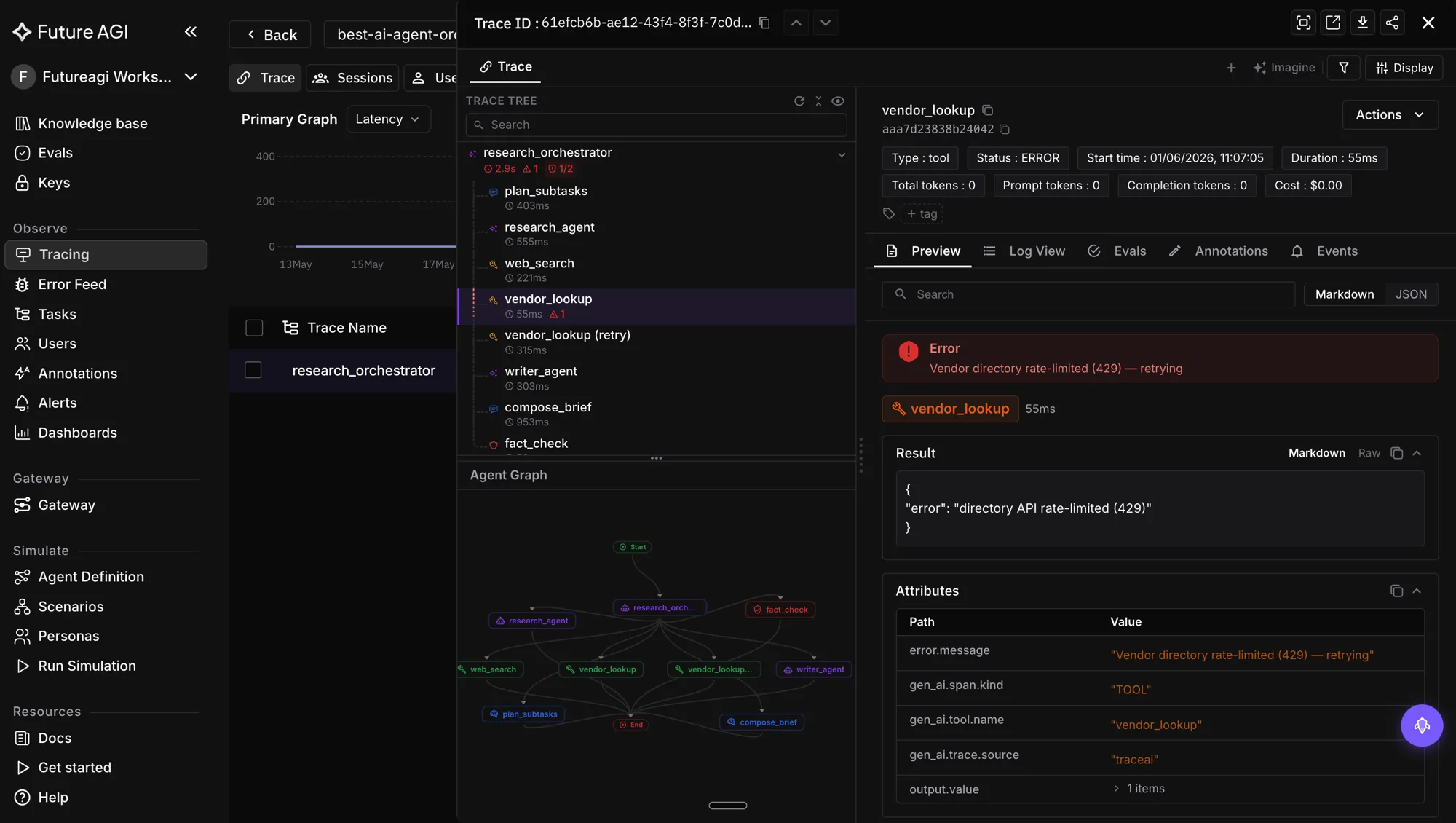
By month twelve the cumulative line on the spreadsheet covers the stack three to five times over even on conservative assumptions, and the avoided-incident plus audit-cycle months pay for the next year. The pitch is not a one-time number, it is a compounding curve.
Where Future AGI fits
Each term of the spreadsheet ties to a Future AGI primitive. The eval stack playbook is the deeper architectural read; the compressed map:
- Avoided-incident. 13 guardrail backends in
ai-evaluationfor the pre-deploy and runtime layer. Error Feed HDBSCAN clusters on ClickHouse-stored embeddings with a Sonnet 4.5 Judge writingimmediate_fixper cluster. - Faster-ship. Four distributed runners (Celery, Ray, Temporal, Kubernetes) keep the PR-gate suite parallel. Six agent-opt optimizers compress the fix-cycle from manual sweep to automated search.
- Model-substitution. Agent Command Center gateway with 6 routing strategies, complexity-aware tiering, BYOK at zero platform fee,
x-prism-costcanonical dollars per call. - Eval-infra.
augment=Truecascade across 9 open-weight classifier backends drops the LLM-judge bill 60–80 percent. Self-improving evaluators on the Platform retune rubrics from dashboard feedback for lower per-eval cost over time. - Compliance. SOC 2 Type II, HIPAA, GDPR, CCPA certified hosted runtime. Apache 2.0 on
ai-evaluation,traceAI, andagent-opt, so the eval contract lives in the team’s repo. Free tier on pricing includes 50GB tracing, 2K AI credits, 100K gateway requests, 100K cache hits.
Future AGI is the strongest open-source option and the strongest enterprise option in the same runtime, which is what lets the spreadsheet land all four terms on one stack instead of stitching three vendors.
Honest framing for the leadership pitch
Three things to surface explicitly so the pitch holds up under scrutiny:
- The trace-stream-to-agent-opt connector is roadmap. Eval-driven optimization on prompts and thresholds ships today via the six optimizers. The live trace stream feeding the optimizer dataset automatically is the active roadmap item. Manual pull works today, which is straightforward but not zero-touch.
- Error Feed has Linear today. Slack, GitHub, Jira, and PagerDuty integrations are roadmap. Slot Error Feed into Linear-based incident workflow and the integration lands cleanly.
- The numbers in this post are illustrative ranges. Per-call prices, classifier prices, flagship-vs-cheap deltas, and incident costs vary by company and product. The shape of the savings holds; the magnitudes depend on your traffic and risk surface. The spreadsheet wins because every cell is editable.
What to put on the slide (the one slide you do bring)
If you keep one slide behind the spreadsheet, keep this one.
- “Eval ROI is four terms: avoided-incident, faster-ship, model-substitution, minus infra.”
- “On our traffic, the conservative line is ~$32k/mo net positive; the realistic line is ~$78k/mo; the aggressive line is ~$160k/mo.”
- “The avoided-incident term alone covers a year of stack cost on a single prevented incident; the model-substitution term covers another year; the infra term is one fifth of what the pilot price suggests.”
Then walk the spreadsheet. Engineering leads who win this argument do not argue with the CFO. They hand them a workbook with four lines, every cell sourced from the team’s own data, and let the numbers do the work.
Sources
Future AGI pricing · Future AGI trust · ai-evaluation · traceAI · agent-opt · Agent Command Center
Related reading
- LLM Evaluation Playbook 2026
- LLM Eval Budget Allocation and Prioritization
- LLM Eval Cost Optimization: 3 Patterns to Cut 80–95%
- CI/CD for LLM Eval with GitHub Actions
- LLM Eval Distributed Runners
- LLM Incident Response Playbook
- Evaluating LLM Data Leakage Prevention
- LLM Eval Myths for Skeptics
- AI Agent Cost Optimization and Observability
Frequently Asked Questions
What is the right formula for eval ROI?
Why do teams underestimate avoided-incident by 10x?
Why do teams overestimate eval infra by 5x?
What does the model-substitution lever actually look like?
How do you build the 12-month pitch?
How does Future AGI specifically deliver each ROI term?
What is the one-line pitch to the CFO?
Future AGI vs in-house AI evaluation 2026: $400K savings, 3-year TCO breakdown, payback in weeks, build vs buy decision framework with verified pricing.

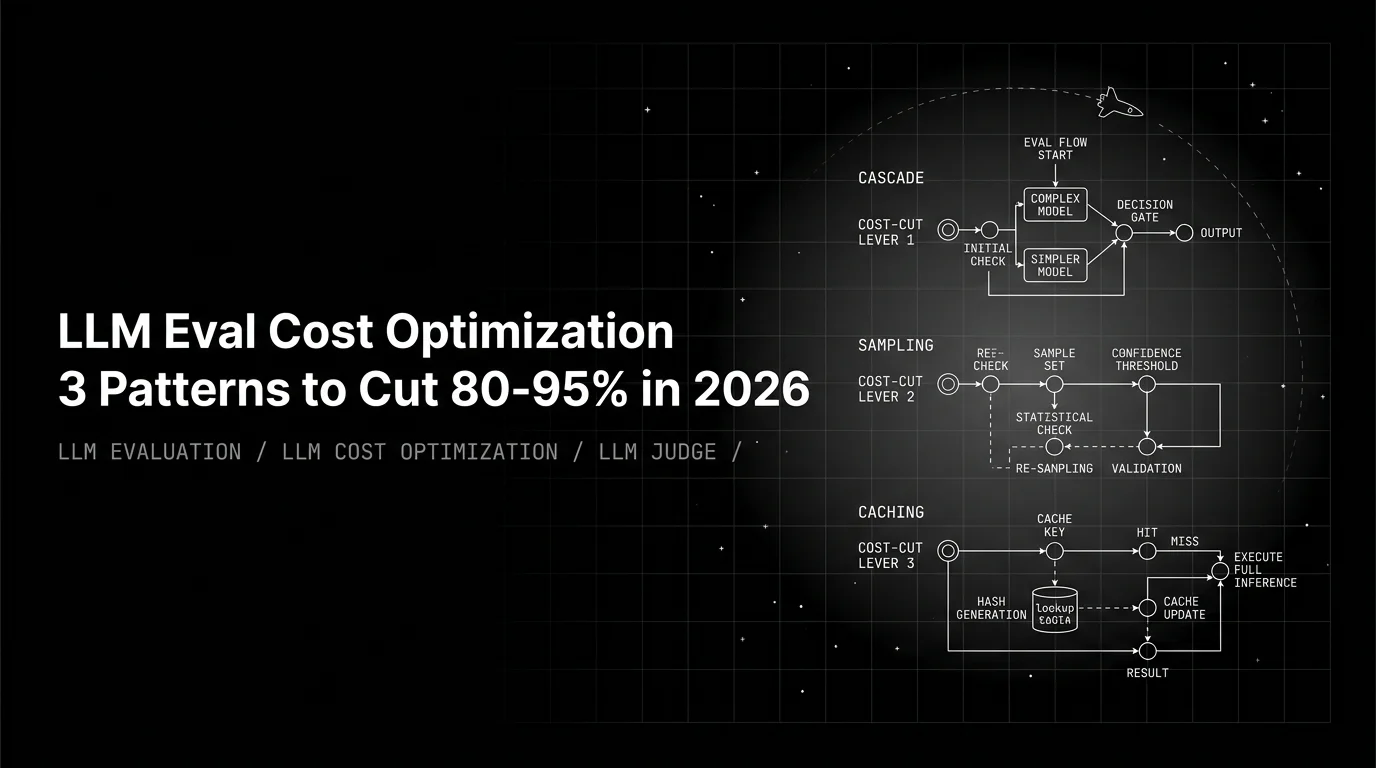
Stack cascade, sampling, and caching to drop LLM judge bills 80 to 95 percent. The math, the code, and the Future AGI surfaces, in one guide.

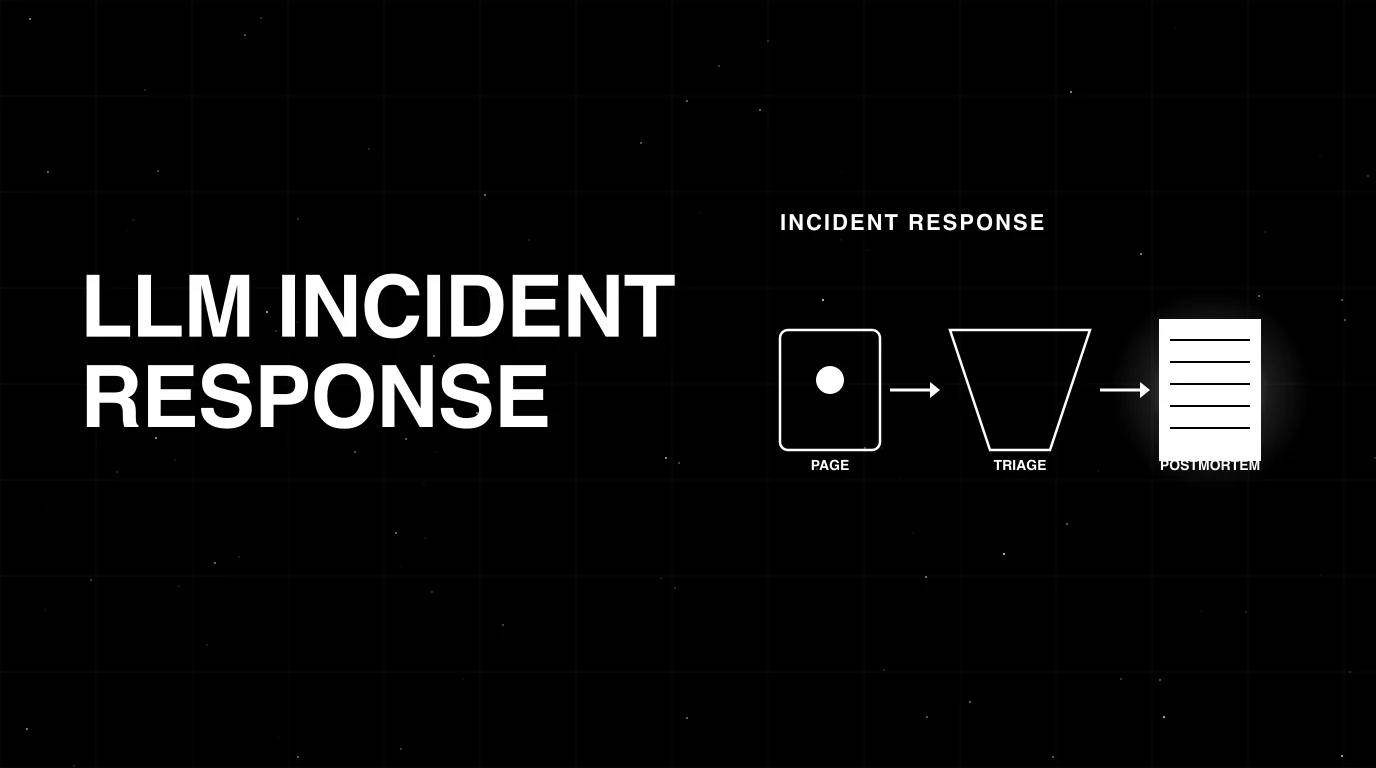
LLM incidents need a different playbook than API incidents. Six steps, four incident classes, postmortem becomes golden-set entry to loop.