AI Compliance Guardrails for Enterprise LLMs: 2026 Playbook
Map enterprise LLMs to GDPR, EU AI Act and NIST AI RMF in 2026: input/output guardrails, bias audits, explainability, and a real FAGI Protect setup.
Table of Contents
Update for May 2026: Refreshed for the EU AI Act high-risk Article 13 obligations applying from August 2026, the Colorado AI Act, and the NIST GenAI Profile (NIST-AI-600-1). For a deeper buyer view, read the LLM Safety and Compliance Guide for 2026.
TL;DR: AI Compliance Guardrails for Enterprise LLMs in 2026
| Question | Short answer |
|---|---|
| Which laws apply by default? | GDPR, EU AI Act (Aug 2025 GPAI, Aug 2026 high-risk), NIST AI RMF + GenAI Profile, Colorado AI Act (Feb 2026), HIPAA in healthcare. |
| What is the runtime layer called? | Guardrails: input and output filters wrapped around every LLM call, distinct from offline evaluation. |
| Which six guardrails are non-negotiable? | PII redaction, prompt-injection blocking, toxicity, hallucination check, off-policy refusal, decision-trace logging. |
| Recommended stack | Future AGI Protect + fi.evals.guardrails for runtime, NVIDIA NeMo Guardrails OSS for orchestration, traceAI for tracing. |
| Metrics auditors ask for | Guardrail coverage %, false-positive rate, jailbreak block rate, hallucination rate, disparate-impact ratio. |
| Where to start | Classify EU AI Act risk tier, wrap LLM calls in Protect, log every decision via FITracer, run quarterly red-team simulation. |
Why AI Compliance Guardrails Are Now Mandatory for Enterprise LLMs
Enterprise LLM teams in 2026 are not arguing about whether to add guardrails, they are arguing about which ones to run, where to run them and how to prove the controls worked. The reason is regulatory pressure. The EU AI Act Code of Practice for general-purpose models took effect on 2 August 2025 and the high-risk Article 13 transparency obligations apply from 2 August 2026. The Colorado AI Act enters force on 1 February 2026, the first US state to apply algorithmic-discrimination duties to consequential decisions. The NIST GenAI Profile (NIST-AI-600-1, July 2024) is now the default checklist for federal procurement and many large enterprise vendor reviews.
Failing the controls is expensive. GDPR fines can reach EUR 20 million or 4 percent of global turnover under Article 83. The EU AI Act caps prohibited-practice fines at EUR 35 million or 7 percent of turnover. Beyond fines, enterprise customers now require a documented control plane before they will sign, which means an LLM project without compliance guardrails is also a project without revenue.
The 2026 Regulation Stack Every Enterprise LLM Team Must Map
GDPR
GDPR Article 5 sets the principles: lawfulness, purpose limitation, data minimisation, accuracy, storage limitation, integrity and accountability. Article 6 demands a lawful basis for every processing activity, Article 22 restricts solely automated decisions with legal effects, and Articles 13 and 14 require transparency about the AI logic. For LLMs the practical hits are training data sourcing, prompt logging policy and right-to-erasure when prompts contain personal data.
EU AI Act
The Act classifies AI systems by risk: unacceptable risk (banned), high risk (Annex III applications like employment, credit, biometrics, education and law enforcement), limited risk (transparency duties such as labelling chatbot output) and minimal risk. General-purpose AI model providers face documentation, copyright and systemic-risk duties from August 2025. High-risk system providers face quality management, risk management, human oversight, accuracy, robustness and post-market monitoring duties from August 2026 under Articles 9 to 15.
NIST AI Risk Management Framework
The NIST AI RMF 1.0 and its Generative AI Profile NIST-AI-600-1 define four functions: Govern, Map, Measure and Manage. Enterprise buyers expect vendors to provide a control mapping that names the function ID for each guardrail. The framework is voluntary in name but procurement teams treat it as required.
US state laws
The Colorado AI Act covers high-risk AI systems making consequential decisions in employment, education, financial services, healthcare, housing, insurance and legal services. Operators must use reasonable care, publish a risk-management policy, conduct annual impact assessments and notify consumers. New York Local Law 144 on automated employment decision tools requires bias audits before deployment.
Sector rules
Healthcare LLMs sit under HIPAA Security Rule, the FDA AI/ML guidance and the GMLP. Financial services LLMs sit under SR 11-7 model risk management and the EU DORA operational resilience act.
What Are LLM Guardrails: Runtime Controls vs Offline Evaluation
Guardrails wrap every LLM call. Evaluation grades fixed datasets offline. Compliance teams need both.
Input guardrails
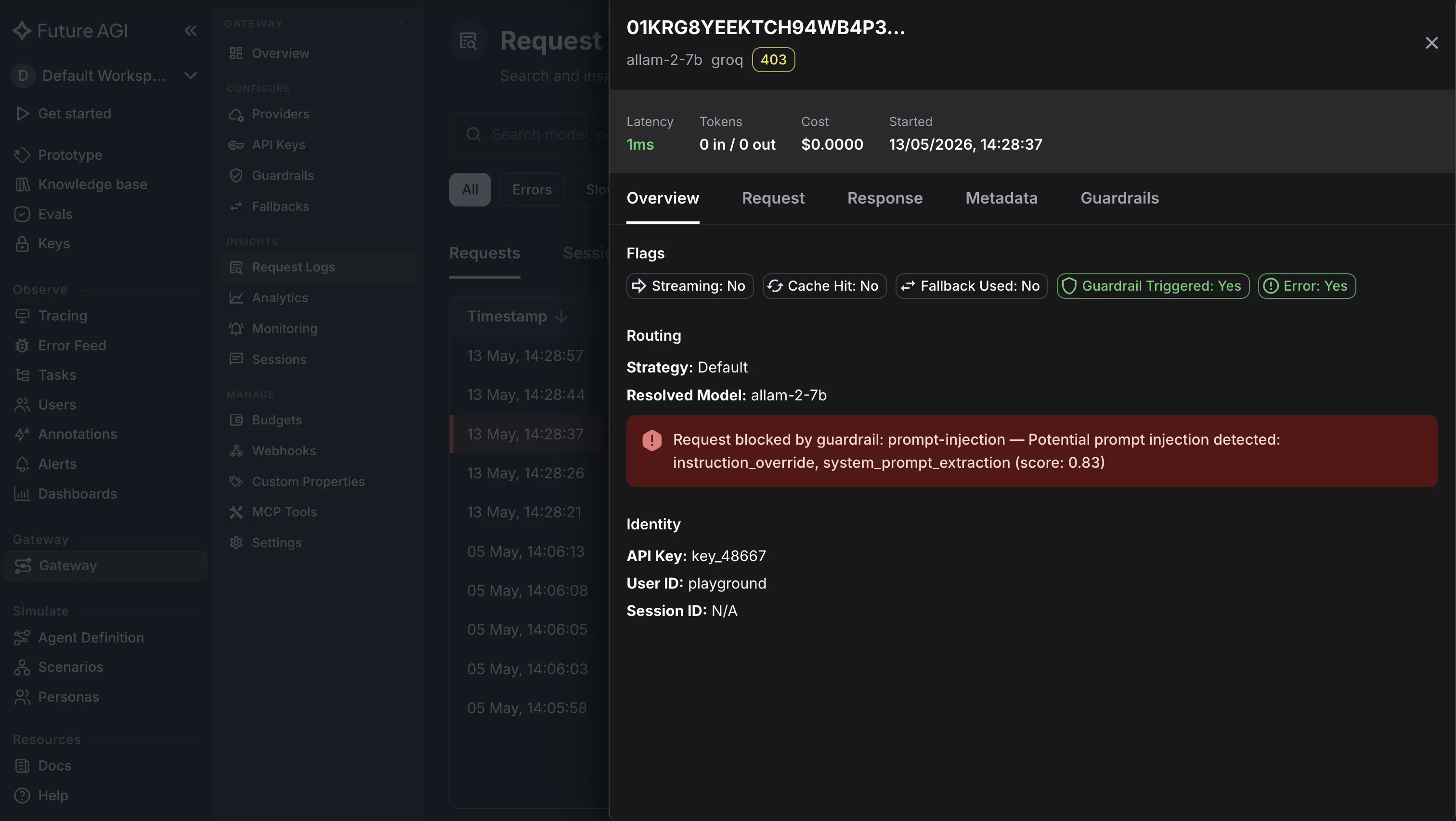
Run before the model executes. They block prompt injection, jailbreaks, off-policy queries, personally identifiable information and protected health information. Open-source options include NVIDIA NeMo Guardrails (Apache 2.0), Guardrails AI (Apache 2.0) and the Future AGI fi.evals.guardrails Guardrails class.
Output guardrails
Run after the model executes. They check toxicity, bias, hallucination against retrieval context, off-topic response, citation faithfulness and data exfiltration. The fastest production option in 2026 is the Future AGI turing_flash evaluator family with roughly one to two second cloud latency, suitable for synchronous gating in chat applications.
Decision logging
Every block decision needs a trace with input, output, rule fired, score and timestamp. Use traceAI (Apache 2.0) or any OpenTelemetry GenAI semantic-convention exporter so the audit trail survives a regulator audit.
Ranked Stack: Best AI Compliance and Guardrails Tools for 2026
| Rank | Tool | Niche | OSS license | Best for |
|---|---|---|---|---|
| 1 | Future AGI Protect + fi.evals.guardrails | Runtime guardrails + managed compliance | Apache 2.0 (ai-evaluation, traceAI) | Enterprises that need PII, jailbreak, toxicity, hallucination guardrails plus a managed audit trail and SOC 2. |
| 2 | NVIDIA NeMo Guardrails | OSS dialog and tool guardrails | Apache 2.0 | Teams that want declarative Colang flows and full self-host control. |
| 3 | Guardrails AI | OSS schema and validator hub | Apache 2.0 | Python teams that already use Pydantic and want quick validator hub integration. |
| 4 | Llama Guard 3 | Open-weights classifier | Llama Community License | Self-hosted policy classification when you want to fine-tune. |
| 5 | Lakera Guard | Managed prompt-injection defence | Closed source | Teams that want a managed jailbreak API without running classifiers themselves. |
Future AGI lands at the top of the compliance and guardrails stack because Protect ships the runtime layer, fi.evals.guardrails ships the OSS Guardrails class, turing_flash gives roughly one to two second cloud latency for chat-grade gating, and the Agent Command Center gives the audit trail, SSO, regional data residency and SOC 2 controls that procurement teams require. The cloud offering and the OSS layer are designed to compose.
How to Build AI Compliance Guardrails with Future AGI
The block below shows the minimum runtime guardrail wrapper for an enterprise LLM call using the real Future AGI evaluation API. The evaluate call uses the string-template form documented at docs.futureagi.com.
import os
from fi.evals import evaluate
from fi_instrumentation import register, FITracer

# 1. Configure auth and tracing
os.environ["FI_API_KEY"] = "<your-key>"
os.environ["FI_SECRET_KEY"] = "<your-secret>"
register(project_name="enterprise-llm-compliance")
tracer = FITracer()


@tracer.chain
def guarded_llm_call(user_prompt: str, retrieved_context: str, model_output: str) -> dict:
    # Input guardrail: block prompt injection and PII before the model runs
    injection_check = evaluate(
        "prompt_injection",
        input=user_prompt,
        model="turing_flash",
    )
    pii_check = evaluate(
        "pii",
        input=user_prompt,
        model="turing_flash",
    )

    if injection_check.failed or pii_check.failed:
        failed = injection_check if injection_check.failed else pii_check
        return {"blocked": True, "stage": "input", "reason": failed.reason}

    # Output guardrail: block toxicity and ungrounded hallucination after the model runs
    toxicity_check = evaluate(
        "toxicity",
        output=model_output,
        model="turing_flash",
    )
    groundedness_check = evaluate(
        "groundedness",
        output=model_output,
        context=retrieved_context,
        model="turing_small",
    )

    if toxicity_check.failed or groundedness_check.failed:
        failed = toxicity_check if toxicity_check.failed else groundedness_check
        return {"blocked": True, "stage": "output", "reason": failed.reason}

    return {"blocked": False, "output": model_output}
What this gives a compliance team in practice: every block decision is written to the trace store via register and FITracer, each evaluator call falls in the documented latency range (turing_flash at roughly one to two seconds, turing_small at two to three seconds, with parallel or async dispatch keeping end-to-end gating in the chat budget), and the rule that fired is captured in the audit log. That is the GDPR Articles 13 and 14 transparency mapping, the Article 22 automated-decision safeguard where applicable, and the NIST GenAI Profile MS-2.1 measurement mapping in one wrapper.
For a red-team simulation that proves the guardrails before launch, the fi.simulate package runs adversarial conversations against the wrapped agent and reports refusal accuracy:
from fi.simulate import TestRunner, AgentInput, AgentResponse

runner = TestRunner(
    suite="jailbreak-pack-2026",
    target=guarded_llm_call,
)
results = runner.run(num_conversations=200)
print(results.refusal_rate, results.jailbreak_success_rate)
Six Guardrail Categories Every Enterprise LLM Needs in 2026
- PII and PHI redaction. Maps to GDPR Article 5 minimisation and HIPAA Security Rule.
- Prompt-injection and jailbreak blocking. Maps to NIST GenAI Profile MS-2.7 adversarial robustness.
- Toxicity and hate speech filtering. Maps to EU AI Act Article 15 accuracy and robustness.
- Hallucination and groundedness checks. Maps to EU AI Act Article 13 transparency and Article 15 accuracy.
- Off-topic and off-policy refusal. Maps to Colorado AI Act reasonable-care duty.
- Decision-trace logging. Maps to EU AI Act Annex IV technical documentation and Article 12 record-keeping.
Each category needs a measurable target. Recommended 2026 targets that compliance teams typically set are jailbreak block rate above 95 percent on a public red-team suite, PII recall above 98 percent on standard test sets like ai4privacy/pii-masking-200k, hallucination rate below 5 percent on RAG benchmarks like RAGTruth, and full trace retention for at least 12 months.
Cross-Department Collaboration Is the Hidden Half of AI Compliance
AI compliance fails when only the AI team owns it. The 2026 best practice is an AI governance council with five named owners: head of AI or ML, head of legal or privacy, head of risk, head of security and a business owner for each high-risk use case. The council reviews new use cases before deployment, signs off on the model card and the system card, and reviews the quarterly compliance dashboard.
AI teams and legal departments
The AI team explains training data sources, evaluation results, residual risks and known failure modes. Legal maps these to the EU AI Act Article 9 risk-management documentation and GDPR Article 35 data-protection impact assessment.
Risk management
Risk runs the bias audit, the red-team simulation and the change-control sign-off for every model version. Outputs feed the NIST AI RMF Manage function.
Compliance officers
Compliance owns the control register, the audit trail and the regulator notifications. Every guardrail in production maps to a control ID in the register, and every control ID maps to a NIST GenAI Profile function and a regulation article.
AI Compliance Case Studies: Finance and Healthcare in 2026
The two patterns below are illustrative composites drawn from common enterprise deployments. They show how the runtime guardrail and explainability layers map to specific regulatory targets in real workflows.
Illustrative pattern 1: bias audits plus differential privacy in fraud detection
A global bank running an LLM-assisted fraud detection workflow observes elevated alert rates for specific ZIP codes. The compliance team runs a quarterly bias audit using disparate-impact ratio across protected classes, adds differential privacy noise during training, and wraps every alert with a groundedness evaluator against the transaction history. The pattern usually delivers a measurable drop in false-positive rate, fewer customer complaints on blocked transactions, and an auditable trail that maps to the SR 11-7 model risk review and GDPR Article 22 requirements.
Illustrative pattern 2: explainable AI in clinical decision support
A regulated healthcare provider deploys an LLM-assisted diagnostic assistant. Clinicians refuse to rely on opaque output, so the team adds SHAP feature attribution at the symptom level, a LIME explanation panel and a groundedness check against the patient record retrieval. The pattern maps to the HIPAA Security Rule, the FDA AI/ML guidance and the EU AI Act Article 13 transparency obligation, and clinician trust scores typically rise once explanations accompany each suggestion.
Why AI Compliance Is Both a Legal Requirement and a Strategic Advantage in 2026
AI compliance is no longer a brake on innovation, it is the price of revenue. Enterprises that built compliance guardrails into 2024 and 2025 prototypes now sell into regulated industries while competitors stall in procurement. The framing is simple: every LLM call needs an audit trail, every guardrail needs a measurable target, every model version needs a documented owner. The teams that treat compliance as part of the product, not as a legal afterthought, ship faster because procurement is no longer the blocker.
Why Choose Future AGI for Enterprise AI Compliance and LLM Security
Future AGI is built around the runtime compliance layer. The Protect product ships PII, jailbreak, toxicity and hallucination guardrails as production-ready filters. The OSS fi.evals.guardrails Guardrails class lets self-hosted teams run the same controls locally under Apache 2.0. The Agent Command Center gives a single managed control plane with SSO, audit retention, regional residency, role-based access and SOC 2 attestation. traceAI (Apache 2.0) instruments every block decision into OpenTelemetry-compatible traces. The turing_flash evaluator family ships roughly one to two second cloud latency for chat-grade gating, turing_small and turing_large extend to deeper checks. The platform supports the full lifecycle, from offline evaluation with fi.evals.evaluate through optimisation with fi.opt.base.Evaluator and fi.opt.optimizers.BayesianSearchOptimizer to runtime simulation with fi.simulate.TestRunner.
Take the Next Step: Partner with Future AGI for Responsible AI Deployment
Partner with Future AGI to ship AI compliance guardrails that map to GDPR, the EU AI Act, NIST AI RMF and the Colorado AI Act. Book a demo to walk through the Protect product, the OSS Guardrails class and the Agent Command Center on your own use case.
Frequently Asked Questions
What is AI compliance for enterprise LLMs in 2026?
What changed in AI regulation between 2025 and 2026?
What are guardrails for LLMs and how do they differ from evaluation?
Which guardrail categories do compliance teams actually require?
What metrics prove AI compliance to auditors?
How does federated learning support GDPR compliance?
Are open-source guardrails enough for enterprise AI compliance?
What is the fastest way to get an enterprise LLM compliance-ready in 2026?
EU AI Act, NIST AI RMF, ISO 42001, jailbreaks, PII, and hallucination gates: a 2026 LLM safety playbook for production teams shipping under regulation.

Senior-engineer comparison of the best AI agent guardrails platforms 2026: latency budgets, placement, deployment topology, vendor fit.
Wire policy, enforcement, and audit into runtime so EU AI Act, NIST AI RMF, and ISO 42001 close on one plane without slowing releases.