Deterministic LLM Evaluation Metrics (2026): The Eval Floor
Schema, regex, exact match, BLEU/ROUGE, citation-validity. Where deterministic LLM eval metrics catch 30-60 percent of failures before a judge fires.
Table of Contents
The agent passes every CI check. JSON schema validates, regex finds no forbidden patterns, exact-match on the canonical answer reads 100 percent. The judge rubric on a sample says helpfulness is 0.89. Three weeks into production, a user gets a refund quote off by an order of magnitude and CSAT drops 7 points. Every deterministic check still passes. Every judge sample still passes. Nothing caught the failure because nothing was looking at the right thing.
That is the wrong lesson to take from this scenario. The right lesson is the opposite. The deterministic layer did its job: it filtered out 30 to 60 percent of failures (broken JSON, missing citations, malformed tool calls, banned phrases) cheaply enough to run on every request, so the judge tokens could go to the cases that actually need reasoning. The miss is a judge-layer problem, not a deterministic-layer problem. Most teams trying to fix it instead reach for a bigger judge model on every output, watch their bill cross five figures, and conclude evals don’t scale.
The opinion this post earns: deterministic metrics are the eval pyramid base — cheapest, fastest, most stable. Used at the right layer they catch 30 to 60 percent of failures before any LLM judge fires. Used wrong (BLEU on open-ended chat, exact match on free-form generation), they hide more than they reveal. The skill is matching the metric to the failure mode and stacking the layers so the expensive tools only run on the cases that need them.
TL;DR: the eval pyramid in one paragraph
Run a deterministic floor on every request (JSON schema, regex, exact match, length contract, citation presence, function-call validators) at sub-millisecond cost. Run a fine-tuned classifier on every output that passes the floor (toxicity, PII, prompt injection, NLI faithfulness) at sub-100ms. Run an LLM judge on the residual that the cheap layers cannot decide. The floor catches 30 to 60 percent of production failures structurally. The classifier catches sharp safety targets at 1 to 10 percent of judge cost. The judge handles open-ended rubrics on what survives. Skip any layer and either the bill blows up or regressions ship.
What “deterministic” actually means
A metric is deterministic if running it twice on the same input returns the same score forever. That sounds obvious, but the implication is sharp. An LLM judge with non-zero temperature is non-deterministic by definition. An LLM judge at temperature zero is non-deterministic in practice because the underlying model changes across vendor versions and the rubric is a prompt that re-interprets criteria language each call. Deterministic metrics are immune to both. They never drift, they never have a bad day, and they run without an API call.
In the LLM eval world they fall into seven families. The first four cover structure and lexical comparison. The last three cover what changed in 2026: function calls, citations, and the runtime safety floor.
JSON schema and structural validation. JSON Schema, AST parsers, SQL parsers, XML validators. Catches malformed tool-call arguments, broken structured outputs, syntax errors in generated code. The first metric a real production team adds. Future AGI’s JSONValidation, JSONSchema, SchemaCompliance, TypeCompliance, FieldCompleteness, HierarchyScore, and TreeEditDistance ship the structural family in fi.evals.metrics.structured and fi.evals.metrics.heuristics.json_metrics.
Pattern and contains checks. Regex against required or forbidden substrings. Useful for compliance gates (no SSN in output, mandatory disclosure included), policy violations (banned product names, internal-only references), and format requirements (markdown structure, specific headers). Sub-millisecond and tight, with one operational cost: pattern rot. Prompts drift, output formats change, and a regex silently passes outputs it should fail. The SDK exposes Regex, Contains, ContainsAll, ContainsAny, ContainsNone, ContainsEmail, ContainsLink, ContainsValidLink.
Exact and near-exact match. Returns 1 if strings match, 0 otherwise. Near-exact variants normalize whitespace, casing, punctuation. Honest on yes/no, classification, multiple-choice, and constrained-format tasks. The SDK ships Equals, StartsWith, EndsWith, LengthBetween, plus LevenshteinSimilarity for code, SQL, and near-duplicate detection. The trap is using exact match on free-form generation, where it rewards luck and fails on punctuation.
Lexical overlap (BLEU, ROUGE). N-gram precision and recall against a reference string. BLEU shipped in 2002 for machine translation, ROUGE in 2004 for extractive summarization. They worked because those tasks had short outputs and references humans agreed on. They fail on modern open-ended generation because surface tokens diverge from semantically equivalent answers. The SDK ships BLEUScore, ROUGEScore, RecallScore. Reach for them on translation and extractive tasks. Do not gate a chatbot deploy on ROUGE.
Function-call validators. A function call with a JSON schema either parses or it does not, and the argument types either match or they do not. This is the single highest-signal deterministic check for agents. Most agent failures are not the final answer being wrong, they are the wrong tool being called with the wrong arguments. FunctionNameMatch, ParameterValidation, FunctionCallAccuracy, and FunctionCallExactMatch cover the matrix.
Citation-validity. RAG answers can pass faithfulness on a judge sample and still drop the supporting source from the response. SourceAttribution checks whether the answer attributes claims to specific retrieved chunks. CitationPresence checks whether citations are present and well-formed when the rubric requires them. Citation-validity is what closes the gap between “the LLM read the right context” and “the user can verify the claim against the right context.”
Embedding similarity (pinned model). EmbeddingSimilarity and SemanticListContains compute cosine similarity over a fixed embedding model. Reproducible if you pin the checkpoint, useful as a cheap similarity floor when a clean reference exists, useful as feature extraction for clustering failing traces. Similarity is not correctness. Do not use this as a substitute for a judge on a subjective rubric.
Where deterministic metrics still win
The pattern is the same across every production audit: when the failure mode is structural, deterministic wins on cost and stability. Five places where a judge call is the wrong tool.
Structured tool calls. Function-call validators catch the most common agent failure (malformed arguments) in microseconds. A judge call on every tool invocation is a $30K-a-month accident waiting for the volume to find it.
Compliance gates. Required disclosures, forbidden phrases, PII patterns, and format requirements sit cleanly inside what regex was built for. Sub-millisecond. Tight false-positive rate when the patterns are tight. The judge does not add information here, just latency and cost.
Translation and extractive summarization. BLEU and ROUGE were designed for these tasks. When the reference is short, factual, and structurally similar to the candidate, n-gram overlap is a useful signal. The 2014-vintage warning still holds: do not use BLEU on chat, on long-form abstractive generation, or on any task with many valid surface forms.
Canonical Q&A. Yes/no, multiple-choice, single-entity, classification. Exact match (or normalized exact match) is honest, cheap, and reproducible. Constrain the output format in the prompt, then run exact match. Otherwise you are scoring punctuation.
Code and SQL. Run the code. AST equality and parser-success rate are deterministic and high signal for code generation. LLM-as-judge for style and explanations is useful; never let the judge replace execution.
Where deterministic metrics lie
Three failure modes show up over and over. All of them come from using deterministic metrics on tasks they were not built for.
Multiple valid outputs. “Summarize this email in two sentences” has hundreds of valid answers. ROUGE picks the one with highest n-gram overlap to the reference, which is often not the best summary. Any task with paraphrase tolerance breaks lexical metrics. The metric is reproducible. It is also wrong.
Semantic faithfulness. A RAG system can pull the right context, paraphrase it correctly, and pass exact-match on a key fact while inverting the surrounding claim. “The capital of France is London” sits close to “The capital of France is Paris” in embedding space because most of the sentence is identical. Faithfulness against retrieved context is a semantic check; deterministic metrics cannot do it. The judge or an NLI classifier is the right layer.
Conversation-level signals. Knowledge retention, role adherence, refusal calibration, and multi-turn coherence require reading meaning across turns. There is no deterministic operation on text that captures “the agent forgot the user’s constraint from turn one.” This is the gap the judge fills. See Why LLM-as-a-Judge (2026) for what the judge layer is actually good for, and where it lies in turn.
The trap is using one number when the task needs another. A team that ships a chatbot and gates on ROUGE will pass deploys that drop user satisfaction, because ROUGE is reading words and the user is reading meaning.
The eval pyramid: floor → classifier → judge
The cost-stable shape most production teams converge on looks like this. Three layers, one rule: every layer runs only on what the cheaper layer below it could not decide.
Layer 1 — Deterministic floor (every request). Schema validation, regex, exact match where applicable, length contract, citation presence, function-call validators. Sub-millisecond, zero API cost. Catches structural failures and policy violations before any model spends a token. 30 to 60 percent of production failures die here.
Layer 2 — Classifier triage (every output that passes Layer 1). Fine-tuned models for sharp safety targets (toxicity, PII, prompt injection, bias) and NLI for grounded faithfulness. Single-digit to low-double-digit milliseconds per call. 1 to 10 percent of LLM-judge cost. Returns the same answer on the same input every time. Future AGI’s Protect ships four Gemma 3n LoRA adapters (toxicity, bias_detection, prompt_injection, data_privacy_compliance) plus Protect Flash at 65 ms text and 107 ms image median time-to-label per the Protect paper.
Layer 3 — LLM judge (residual sample of what survives Layers 1 and 2). Open-ended rubrics, faithfulness over long context, helpfulness, role adherence, on-tone. 50 to 500 times classifier cost per call, hundreds of milliseconds of latency. Run on a 5 to 10 percent sample of production traffic, plus every CI test case in the regression suite. Calibrate against human labels and pin the judge model and rubric version as a contract, per Why LLM-as-a-Judge (2026).
The discipline is reaching for the cheapest layer that gives the right answer. A team gating only on Layer 1 ships semantic regressions. A team gating only on Layer 3 ships a five-figure bill. Both miss the point.
Don’t replace the judge: gate it
The wrong frame is “deterministic vs. judge.” The right frame is “deterministic gates the judge.” Three concrete patterns.
Fail-fast composition. If the response fails JSON schema, the judge does not run and the eval fails outright. Same for missing citations on a citation-required rubric. Same for a refusal regex match on a refusal-required scenario. Deterministic checks are 10,000 times cheaper than a frontier judge call. Run them first.
Augment-then-judge. A classifier produces a score plus per-claim reasoning, and hands it to the judge as in-context evidence. The judge starts from grounded reasoning and pays the frontier cost only when the classifier signal is ambiguous. Future AGI’s evaluate(..., augment=True) runs the local NLI classifier first and passes its output to the LLM judge:
from fi.evals import evaluate

result = evaluate(
    "faithfulness",
    output="...",
    context="...",
    augment=True,
    model="gpt-4o",
)
90 percent cost saved on most rubrics with no measurable drop in detection rate.
Async judge on the trace. Run deterministic checks inline on the user-facing path; ship the judge off the hot path as a span-attached eval that writes results back to the trace as gen_ai.evaluation.* attributes. The user does not wait for the judge. The dashboard still gets the judge score. The CI gate runs both.
Production patterns
A production deterministic eval looks like this end to end.
On every request, inline. Deterministic floor wired at the gateway hop. JSON schema validation on structured outputs. Citation presence on RAG responses. Function-call validators on agent tool calls. Compliance regex on every output. Runtime Scanners (jailbreak, secrets, malicious URL, invisible chars, language, topic restriction) on inputs and outputs. Future AGI’s Agent Command Center runs 18+ built-in scanners and the local heuristic metrics inline at p99 of 21 ms with guardrails on (t3.xlarge, ~29k req/s per the github.com/future-agi/future-agi README). Application code does not change.
On every CI commit. Same deterministic suite plus the classifier layer plus the judge against a pinned golden dataset. The deterministic checks gate the judge: if the schema fails, the judge does not run. Pin the regex patterns, the JSON schema versions, the canonical answers, the judge model id, and the rubric text in version control. Re-running on the same input on the same day produces the same score within a small variance window. That is the eval contract.
On every production span (sampled). 5 to 10 percent sample passes through the same metric definitions that ran in CI. Failures route to an annotation queue. The Future AGI Platform layers self-improving evaluators that retune from thumbs feedback so the rubric ages with the product. Error Feed clusters failing traces with HDBSCAN over ClickHouse and writes an immediate_fix against a 5-category taxonomy.
The artifact that compounds is not the deterministic check. It is the contract: the same metric definition running in three places (gateway, CI, production sample), pinned, versioned, and producing the same number on the same input.
How Future AGI ships the deterministic floor
ai-evaluation (Apache 2.0) ships 20+ local heuristic metrics across the seven families above, plus 8 sub-10ms Scanner classes for runtime safety. Every metric runs offline with zero API call. The full table:
- Lexical:
BLEUScore,ROUGEScore,RecallScore,LevenshteinSimilarity,EmbeddingSimilarity,SemanticListContains. - Structural:
JSONValidation,JSONSyntaxOnly,JSONSchema,SchemaCompliance,TypeCompliance,FieldCompleteness,RequiredFieldsOnly,FieldCoverage,StructuredOutputScore,QuickStructuredCheck,HierarchyScore,TreeEditDistance. - Pattern:
Regex,Contains,ContainsAll,ContainsAny,ContainsNone,ContainsEmail,IsEmail,ContainsLink,ContainsValidLink,Equals,StartsWith,EndsWith,LengthLessThan,LengthGreaterThan,LengthBetween,OneLine,NumericSimilarity. - Function-call:
FunctionNameMatch,ParameterValidation,FunctionCallAccuracy,FunctionCallExactMatch. - Citation:
SourceAttribution,CitationPresence. - Runtime Scanners (8):
JailbreakScanner,CodeInjectionScanner,SecretsScanner,MaliciousURLScanner,InvisibleCharScanner,LanguageScanner,TopicRestrictionScanner,RegexScanner.
A working CI snippet:
from fi.evals.metrics.heuristics.json_metrics import JsonSchema
from fi.evals.metrics.heuristics.string_metrics import Regex
from fi.evals.metrics.function_calling.metrics import ParameterValidation

schema_check = JsonSchema(config={"schema": REFUND_SCHEMA})
pii_check = Regex(config={"pattern": r"\b\d{3}-\d{2}-\d{4}\b"})
tool_check = ParameterValidation(config={"expected_tool": "issue_refund"})

# Run in order; first failure short-circuits the judge.
The same metric definitions attach as span-level EvalTags in traceAI, so the CI suite and the production telemetry surface the same number. The Future AGI Platform layers self-improving evaluators, in-product authoring agents, classifier-backed scoring at lower per-eval cost than Galileo Luna-2, and Error Feed clustering for failing-judge traces. The Agent Command Center carries the inline floor across 100+ providers with SOC 2 Type II, HIPAA, GDPR, and CCPA certification per futureagi.com/trust, ISO/IEC 27001 in active audit.
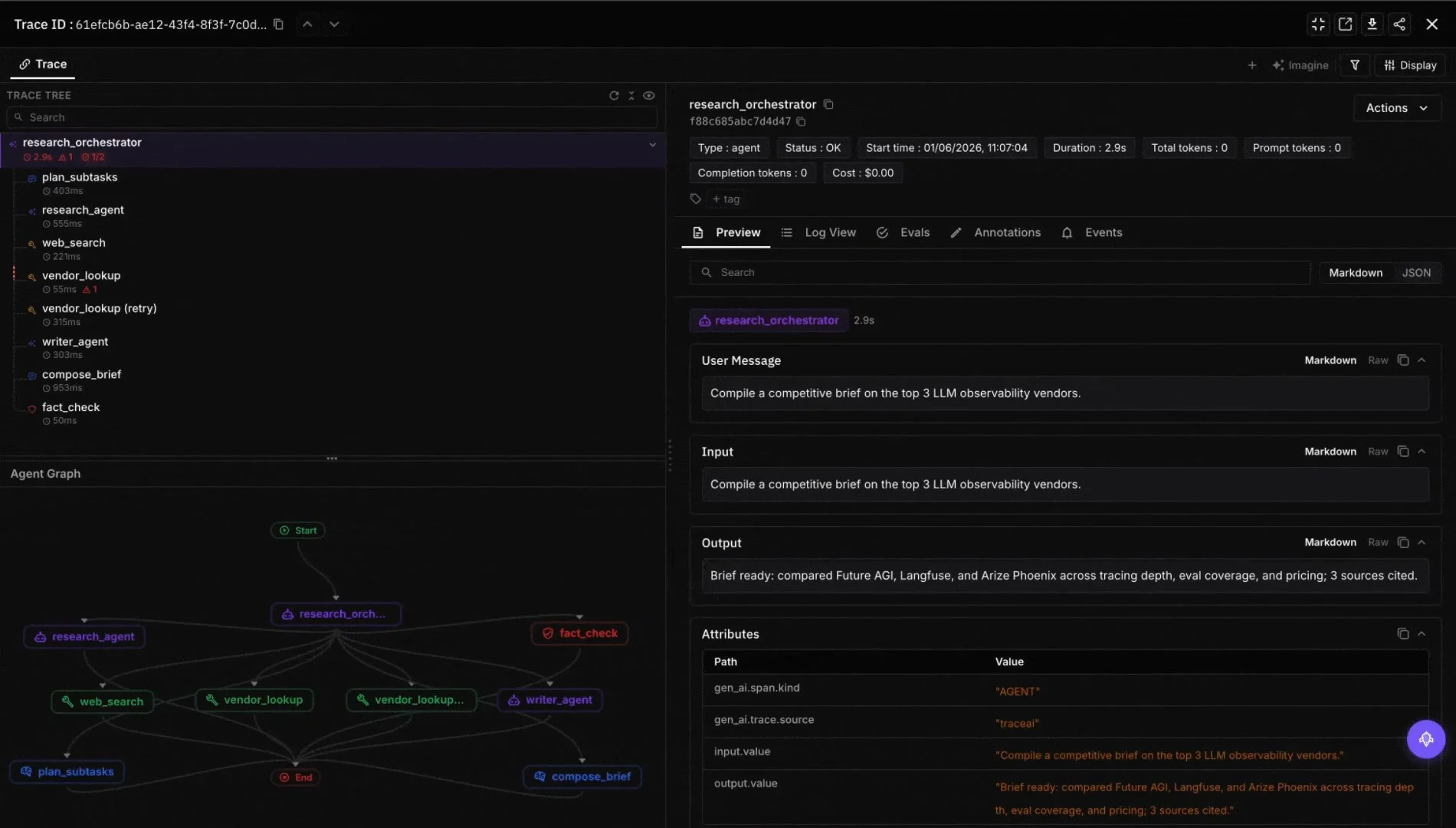
Ready to put the floor under your own workload? Start with the ai-evaluation SDK quickstart, wire JSONValidation, Regex, and a function-call validator into your CI this afternoon, then attach the same definitions as EvalTags on live spans via traceAI. The deterministic floor is what keeps the judge bill from blowing up — and what catches the regressions a judge sample never sees.
Three takeaways for 2026
- Deterministic is the eval pyramid base, not the whole stack. Floor on every request, classifier on the residual, judge on the survivor sample. Skip a layer and either the bill blows up or regressions ship.
- Match the metric to the failure mode. Schema for structure. Regex for compliance. Function-call validators for agents. Citation-validity for RAG. BLEU/ROUGE for translation. Exact match for constrained formats. Anything semantic and open-ended belongs in the judge layer.
- The contract is the artifact. The same metric definition pinned in version control, running at the gateway, in CI, and on production samples. That is what turns deterministic evals from a notebook into a regression net.
Related reading
- Why LLM-as-a-Judge (2026): The Case For, Against, and the Hybrid That Wins
- G-Eval vs DeepEval Metrics (2026)
- Best LLM Evaluation Tools (2026)
- Your Agent Passes Evals and Fails in Production (2026)
- Multi-Turn LLM Evaluation (2026)
- The 2026 LLM Evaluation Playbook
Sources
Frequently Asked Questions
What is a deterministic LLM evaluation metric?
What is the eval pyramid and where do deterministic metrics sit?
Are BLEU and ROUGE still useful in 2026?
When should I reach for a judge instead of a deterministic metric?
Can deterministic metrics catch hallucinations?
What does Future AGI ship for deterministic evaluation?
How do I run deterministic metrics on every request without blowing latency?
LLM-as-a-judge is the only eval method that scales to subjective rubrics. The honest case for, against, and the discipline that earns trust.

G-Eval rubric-based LLM judges vs DeepEval's full metric suite, how they differ, and where FutureAGI Turing eval models fit alongside both in 2026.

FutureAGI, DeepEval, Langfuse, Phoenix, Braintrust, LangSmith, and Galileo as the 2026 LLM evaluation shortlist. Pricing, OSS license, and production gaps.