Best AI Agent Observability Tools in 2026: 7 Honest Picks
Honest 2026 comparison of AI agent observability tools: FutureAGI, LangSmith, Langfuse, Phoenix, Braintrust, Galileo, Datadog on coverage.

Table of Contents
AI agent observability is not LLM observability. The unit is the trajectory, not the prompt: planner steps, retrievals, tool calls, sub-agent handoffs, retries, and the final response, all as one span tree. Tools built for the prompt-engineering era miss the trajectory; tools built for agents in 2026 don’t. The seven below cover most procurement shortlists. What separates them is trajectory coverage, eval depth (span-attached scores), gateway and guardrail surface, and behavior under sustained ingestion. This guide ranks them, names where each falls short, and gives you a decision framework. Last updated May 20, 2026.
TL;DR: best agent observability tool per use case
| Use case | Best pick | Why | Pricing | License |
|---|---|---|---|---|
| Trajectory + eval + simulate + gate + gateway in one runtime | Future AGI | Eval-stack package + traceAI + Error Feed + Agent Command Center | Free + usage | Apache 2.0 |
| LangChain or LangGraph runtime | LangSmith | Native chain and graph trace semantics | Plus $39/seat/mo | Closed, MIT SDK |
| Self-hosted observability with prompts and datasets | Langfuse | Mature OSS traces, prompts, datasets, evals | Core $29/mo | MIT core |
| OTel-native ingestion with embedding-drift heritage | Arize Phoenix | OTLP-first with the Arize AX path | AX Pro $50/mo | ELv2 |
| Closed-loop eval workbench with the best UI | Braintrust | Experiments, scorers, sandboxed agent evals | Pro $249/mo | Closed |
| Enterprise risk + compliance with Luna-2 | Galileo | Luna-2 eval foundation model + runtime guardrails | Pro $100/mo | Closed |
| Already on Datadog for everything else | Datadog LLM Observability | LLM spans next to APM and infra | APM $31/host + add-on | Closed |
One-row summary: pick Future AGI when the goal is one platform across trace, eval, simulate, gate, and gateway. Pick LangSmith when LangGraph is the runtime. Pick Datadog when the constraint is one tool for everything.
Why agent observability is a different problem
A trajectory has structure a prompt does not. The planner decides what to do, the tool call executes it, the retriever pulls context, the validator scores the output, and the next step plans against what came back. Each is a span. Each has its own failure mode. Final-answer scoring catches the symptom; trajectory scoring catches the cause.
Five surfaces an agent observability tool has to handle. Anything less and you are stitching tools.
- Span tree at production scale. Parent-child structure, full input and output capture, OTLP ingestion, retention controls. Sustained 10K+ spans/sec without dropped spans.
- Trajectory metrics on the span itself. Tool Correctness, Plan Adherence, Goal Adherence, Task Completion, planner depth, recovery rate as span attributes, not a parallel dashboard.
- Session-level outcomes. Multi-turn completion rate, drift, refusal calibration, conversation-level groundedness. Failures hide between turns more than inside them.
- Cost and latency by trajectory. Cost-per-success, latency p99 by intent, retry-vs-thrash disambiguation, model mix by route.
- Drift and alerting on quality. Daily eval pass-rate trend, score distributions per cohort, anomaly detection on cost, latency, and judge scores.
A tool that does (1) is a tracer. (1) and (3) is LLM observability. (1) through (5) with trajectory-shaped scoring is agent observability.
The 7 agent observability tools, compared
1. Future AGI: best for trajectory-native observability with eval, gate, and gateway on one runtime
Open source. Self-hostable. Hosted cloud. Eval-stack package.
Quick take. Future AGI is the pick when the trajectory is the unit and a production failure must close back into pre-prod tests automatically. The eval stack ships as a package: ai-evaluation is the code-first surface with 50+ EvalTemplate classes; traceAI carries the same rubric as a span-attached score on live traces; the Agent Command Center gateway routes across 100+ providers with 18+ runtime guardrails on the same plane. Error Feed clusters failing traces with HDBSCAN plus a Sonnet 4.5 Judge that writes the immediate fix, so a tool-call regression becomes a labeled dataset row instead of a Jira ticket.
Ideal for. Teams running RAG agents, voice agents, support automation, or copilots where a missed tool call in production should land as a failing test case before the next release. Strong fit for multi-language services across Python, TypeScript, Java, and C#.
Key strengths.
- traceAI auto-instruments 50+ AI surfaces across 4 languages, including LangGraph, CrewAI, AutoGen, OpenAI Agents SDK, Pydantic AI, DSPy, Mastra, Spring AI, LangChain4j, Semantic Kernel. 14 span kinds (TOOL, RETRIEVER, AGENT, EVALUATOR, GUARDRAIL, A2A_CLIENT, A2A_SERVER, VECTOR_DB, others); Phoenix ships 8, Langfuse 5.
- Eval-stack package: 50+ span-attached metrics (Tool Correctness, Plan Adherence, Goal Adherence, Task Completion, Refusal Calibration, Hallucination, Groundedness, PII, Toxicity) as pytest CI scorers and online scorers. Lower per-eval cost than Galileo Luna-2 at comparable accuracy on the published rubrics.
- Error Feed: HDBSCAN clusters failing traces; judge writes the immediate fix; traces promote into the dataset; agent-opt searches the prompt space against the same rubric. The post-incident loop closes without manual export.
- Agent Command Center fronts 100+ providers with BYOK routing, fallback, caching, and 18+ runtime guardrails reading the same trace stream. Benchmarked at ~29k req/s, P99 21 ms with guardrails on, on
t3.xlarge. - SOC 2 Type II + HIPAA + GDPR + CCPA certified per futureagi.com/trust; ISO 27001 in active audit.
Honest limitations. More moving parts than LangSmith inside a LangChain app or a single-purpose tracer. ClickHouse, Postgres, Redis, Temporal, and the gateway are real services on self-host; use the hosted cloud if you don’t want to operate the data plane. Native-adapter coverage is strongest on OpenAI, Anthropic, Gemini, Bedrock, Cohere, and Azure.
Pricing intelligence. Free to start with generous limits (storage, gateway requests, tokens, voice simulation, 30-day retention); usage-based after that. Compliance add-ons (HIPAA BAA, SAML SSO + SCIM) layer per tier. Pricing is usage-based rather than per-seat.
Expert verdict. Pick Future AGI when production failures need to close back into pre-prod tests automatically and the trajectory has to be the unit. The buying signal is teams that have already stitched a loop manually (Braintrust for evals, Langfuse for traces, a notebook for optimization, a separate gateway) and watched the same incident class repeat because the handoffs lost fidelity.
2. LangSmith: best for LangChain and LangGraph runtimes
Closed platform. MIT SDK. Cloud, hybrid, and Enterprise self-hosting.
Quick take. Lowest-friction first pick when LangGraph is the runtime. Native trace semantics for chains, graphs, retrievers, tools, and prompts; Playground replay, Fleet deployment, and Studio graph visualization in one product. Outside LangChain, the value drops fast.
Ideal for. LangChain v1 and LangGraph teams who want eval, deployment, and observability in the same mental model as the runtime.
Key strengths.
- LangGraph spans render as the actual graph, not a flat list.
- Playground replay, Prompt Hub, annotation queues, Fleet deployment, Studio graph visualization.
- Cloud, hybrid, and Enterprise (VPC) self-hosting.
- Same-day support for new LangChain releases.
Honest limitations. Framework coupling cuts both ways: custom agents, LiteLLM, direct provider SDKs, or non-LangChain orchestration see the value drop. Seat pricing makes cross-functional access expensive. No first-party simulation, no integrated gateway, no inline guardrails. Base trace overage at $2.50 per 1,000 and extended traces at $5.00 per 1,000 stack up at high volume.
Pricing intelligence. Developer free with 5,000 base traces/mo, 1 Fleet agent, 50 Fleet runs, 1 seat. Plus $39/seat/mo with 10,000 base traces, unlimited Fleet agents, 500 Fleet runs, up to 3 workspaces. Enterprise custom.
Expert verdict. Pick LangSmith if LangChain is the runtime and framework-native ergonomics matter more than OSS control or multi-framework reach. Skip if you run a heterogeneous stack. See LangSmith Alternatives.
3. Langfuse: best for self-hosted observability with prompts and datasets
Open-source core. Self-hostable. Hosted cloud option.
Quick take. Strongest OSS-first pick when self-hosted tracing with prompt versioning and dataset-driven evals is the requirement. Active project, large community, mature self-hosted story.
Ideal for. Platform teams that operate the data plane, want trace data in their own infrastructure, and pair Langfuse with a CI eval framework. Teams whose CTO ruled out black-box SaaS for traces.
Key strengths.
- MIT core; mature architecture across Postgres, ClickHouse, Redis, object storage, queues, workers.
- Prompt management with labels, environments, version diffs; datasets, runs, human annotation queues.
- OpenTelemetry ingestion; LiteLLM proxy logging; broad framework integrations.
- Experiments CI/CD integration shipped May 2026.
Honest limitations. Trajectory metrics are not first-class: 5 span kinds vs Future AGI’s 14, and the trace UI is LLM-shaped, not trajectory-shaped. Simulation, voice eval, prompt optimization, and runtime guardrails live in adjacent tools. Enterprise directories ship under a separate commercial license outside MIT. Self-hosted footprint expands once ClickHouse, Redis, and worker queues scale together.
Pricing intelligence. Hobby free with 50K units/mo, 30 days data access, 2 users. Core $29/mo with 100K units, $8 per additional 100K, 90 days access, unlimited users. Pro $199/mo. Enterprise $2,499/mo. A “unit” covers a trace, observation, score, or evaluation, which is why production cost compounds.
Expert verdict. Pick Langfuse if OSS observability with prompts and datasets is the entire requirement and you can pair it with external eval and guardrail layers. Skip if you need trajectory metrics on the span itself. See Langfuse Alternatives.
4. Arize Phoenix: best for OpenTelemetry adherence and embedding-drift heritage
Source available under ELv2. Self-hostable. Phoenix Cloud and Arize AX paths.
Quick take. Canonical OpenInference reference. Built by Arize, the team that owned ML observability for embedding drift before LLM observability was a category. OTLP-first ingestion, auto-instrumentation for the major frameworks, and a clean local workbench.
Ideal for. Engineers who care about open instrumentation standards, want a local Phoenix workbench, and plan a path into Arize AX.
Key strengths.
- OpenInference reference; canonical attribute names land in Phoenix first.
- Auto-instrumentation for LlamaIndex, LangChain, DSPy, Mastra, Vercel AI SDK, OpenAI Agents SDK, Bedrock, Anthropic across Python, TypeScript, Java.
- Embedding-drift heritage with retrieval-quality dashboards and chunk-level drift.
- Clean local workbench:
phoenix.launch_app()and you have a tracer.
Honest limitations. Phoenix is not a gateway, not a guardrail product, not a simulator. ELv2 is source available, not OSI open source. Trajectory metric library is smaller than Future AGI’s. Scoring lives in the Phoenix eval surface rather than as a span-attached primitive the way traceAI ships.
Pricing intelligence. Phoenix free self-hosted. AX Free 25K spans/mo, 1 GB ingestion, 15 days retention. AX Pro $50/mo with 50K spans, 30 days. AX Enterprise custom with SOC 2, HIPAA, data residency, multi-region.
Expert verdict. Pick Phoenix when OpenInference adherence and the Arize-AX path are the buying signals. Skip if you need gateway, guardrails, simulation, or strict OSI open source. See Arize Phoenix Alternatives.
5. Braintrust: best for closed-loop eval workbench with strong UI
Closed platform. Hosted cloud or Enterprise self-host.
Quick take. Best eval UI in the closed category. Experiments, datasets, scorers, prompt iteration, online scoring, and CI gating in one product, with sandboxed agent evaluation for tool-calling agents. Center of gravity is structured evals, not the full agent loop.
Ideal for. Teams that prefer to buy rather than build, want experiments and scorers in one polished UI, and don’t need OSS control.
Key strengths.
- Polished UI for experiments, scorers, datasets, and prompt iteration.
- Sandboxed agent evaluation with tool-call execution; agent-evals more developed than Langfuse or Phoenix.
- Online scoring and CI gates in the same product as offline experiments.
- May 2026 added Java auto-instrumentation for Spring AI and LangChain4j.
Honest limitations. Closed platform; Enterprise-only self-host. No first-party voice simulator. Gateway, guardrails, and prompt optimization are not first-class. Pro at $249/mo is the highest entry-tier outside enterprise contracts; overage adds up at production scale. Trajectory metrics beyond hand-composed scorers aren’t built in.
Pricing intelligence. Starter $0 with 1 GB, 10K scores, 14 days retention, unlimited users. Pro $249/mo with 5 GB, 50K scores, 30 days. Overage on Starter $4/GB and $2.50/1K scores; on Pro $3/GB and $1.50/1K. Enterprise custom.
Expert verdict. Pick Braintrust if structured evals with a polished UI is the dominant problem and gateway, guardrails, and simulation are off the requirement list. See Braintrust Alternatives.
6. Galileo: best for enterprise risk, compliance, and Luna-2
Closed platform. Hosted SaaS, VPC, and on-prem options.
Quick take. Galileo’s center of gravity is enterprise risk and compliance. Luna-2 is the evaluation foundation model the team markets as the differentiator; runtime guardrails and on-prem deployment are the other two pillars. Developer surface is less of a draw than the audit posture.
Ideal for. Chief AI officers, risk functions, audit-driven procurement, regulated industries that need on-prem deployment.
Key strengths.
- Luna-2 hosted evaluation foundation model with documented benchmarks.
- Runtime guardrails for PII, hallucination, prompt injection, policy enforcement.
- On-prem and VPC deployment for regulated industries.
- SOC 2, dedicated CSM, low-latency inference on Enterprise; ChainPoll for hallucination detection.
Honest limitations. Higher per-eval cost than Future AGI at comparable accuracy on the published rubrics; Luna-2 is hosted-only, so high-volume online scoring compounds. Closed platform; no OSS option. Smaller framework instrumentation catalog than traceAI or Phoenix.
Pricing intelligence. Free $0 with 5,000 traces/mo, unlimited users, unlimited custom evals. Pro $100/mo billed yearly with 50,000 traces/mo, RBAC, advanced analytics. Enterprise custom with SSO, dedicated CSM, real-time guardrails, hosted/VPC/on-prem.
Expert verdict. Pick Galileo when chief AI officers own the spend and on-prem deployment is non-negotiable. Skip when engineering owns the spend and per-eval cost matters at scale. See Galileo Alternatives.
7. Datadog LLM Observability: best when Datadog is already the standard
Closed platform. SaaS with regional residency. APM-integrated.
Quick take. Datadog ships LLM Observability as an APM add-on. The pitch is one tool for everything: LLM spans next to APM, infrastructure metrics, logs, and security, correlated with database queries, downstream service latency, and infrastructure events.
Ideal for. Enterprise teams where Datadog is the system of record and unified APM + LLM observability with shared dashboards and on-call rotations is the goal.
Key strengths.
- LLM spans inside the same product as APM, logs, RUM, security, and infra metrics.
- Infrastructure correlation: LLM latency next to DB query latency next to downstream service latency.
- Mature enterprise security posture and SRE workflows.
- Scales to high-volume span ingestion on Datadog’s existing backend.
Honest limitations. Eval surface is shallower than dedicated LLM platforms: no first-party simulator, fewer built-in metric primitives, no integrated guardrails. Cost scales fast with span volume; Datadog bills per ingested span plus per indexed log. Vendor lock-in compounds. Path of least resistance is the Datadog SDK, not OTel.
Pricing intelligence. APM at $31 per host per month with annual billing, plus LLM Observability add-on metered per ingested span and per indexed log. Expect contracts above $1,000/mo at modest scale; production teams enter five-figure monthly contracts quickly.
Expert verdict. Pick Datadog LLM Observability when Datadog is the system of record and one-tool consolidation beats eval depth. Pair with Future AGI or Braintrust if eval and trajectory scoring become the bottleneck. See Braintrust vs Datadog.
Trajectory coverage across the 7 tools
| Capability | Future AGI | LangSmith | Langfuse | Phoenix | Braintrust | Galileo | Datadog |
|---|---|---|---|---|---|---|---|
| Span kinds (count) | 14 | LangChain-native | 5 | 8 | proprietary | proprietary | OTel + APM |
| Span-attached evals | Full (50+ metrics) | Partial | Partial | Partial | Full | Full (Luna-2) | Partial |
| Trajectory metrics (Tool Correctness, Plan Adherence) | First-class panel | Manual scorer | Manual scorer | Manual scorer | Manual scorer | Available | Manual scorer |
| Voice + text simulation | Full | None | None | None | None | Partial | None |
| LLM gateway | Full (Agent Command Center, 100+ providers) | None | None | None | Partial | None | None |
| Inline guardrails | Full (18+ scanners) | None | None | None | None | Full (runtime) | None |
| OTel + OpenInference | Full (traceAI, 50+ surfaces) | Partial | Partial | Full (reference) | Partial | Partial | Full (OTel + APM) |
| Self-host | Full (Apache 2.0) | Enterprise-only | Full (MIT core) | Full (ELv2) | Enterprise-only | VPC + on-prem | None |
Decision framework: choose X if
- Future AGI if the trajectory is the unit, eval has to live on the span, and the post-incident loop needs to close without manual export. Buying signal: your team already runs Braintrust for evals, Langfuse for traces, a notebook for optimization, and a separate gateway, and the same incident class keeps repeating.
- LangSmith if LangChain or LangGraph is the runtime and framework-native ergonomics matter more than OSS control.
- Langfuse if OSS observability with prompts, datasets, and a mature self-hosting story is the entire requirement.
- Phoenix if OpenInference adherence and the Arize-AX path are the buying signals.
- Braintrust if structured evals with a polished UI is the dominant problem and you don’t need gateway, guardrails, or simulation.
- Galileo if chief AI officers own the spend, on-prem deployment is non-negotiable, and Luna-2 is the differentiator procurement weighs heavily.
- Datadog LLM Observability if Datadog is already the system of record and one-tool consolidation beats eval depth.
Common mistakes when picking an agent observability tool
- Confusing logs with traces. A flat list of LLM calls is logs. A span tree with parent-child edges is a trace. A trace with trajectory metrics on the spans is agent observability. Without the trajectory layer, you cannot debug a tool-call loop.
- Picking on demo dashboards. Vendor demos use clean prompts and idealized failures. Run a domain reproduction with your real traces, model mix, concurrency, and judge cost.
- Treating OSS and self-hostable as the same. Phoenix is source available under ELv2, not OSI open source. Langfuse ships enterprise directories outside MIT. Verify license terms before procurement.
- Pricing only the subscription. Real cost is subscription plus trace volume, judge tokens, retries, storage retention, annotation labor, and the infra team.
- Ignoring multi-step eval. Final-answer scoring misses tool selection, retries, retrieval misses, loop behavior, and conversation drift.
- Skipping the migration plan. Tracing is the easy half. Datasets, scorers, prompts, human review queues, and CI gates are the hard half.
How to evaluate this for production
- Run a domain reproduction. Export a slice of real traces (failures, long-tail prompts, tool calls, retrieval misses, hand-labeled outcomes). Instrument each candidate with your harness, OTel payload shape, prompt versions, and judge model. Don’t accept a demo dataset.
- Measure reliability under load. Track p50, p95, p99 ingestion, dropped spans, duplicate spans, failed judge calls, retry count, query latency, and alert delay as concurrency rises.
- Cost-adjust. Real cost equals platform price times trace volume, token volume, test-time compute, judge sampling rate, retry rate, storage retention, and annotation hours. Self-hosted loses if infra bill plus on-call time exceeds SaaS overage; hosted loses if per-eval pricing compounds at production scale.
Where Future AGI fits
Most teams end up running three or four products in production: one for traces, one for evals, one for the gateway, one for guardrails. Future AGI is the recommended pick when those have to live on the same Apache 2.0 self-hostable plane and the trajectory has to be the unit.
- Tracing. traceAI auto-instruments 50+ AI surfaces across Python, TypeScript, Java, and C# (LangGraph, CrewAI, AutoGen, OpenAI Agents SDK, Pydantic AI, DSPy, Mastra, Spring AI, LangChain4j, Semantic Kernel). 14 OpenInference span kinds.
- Eval-stack package. ai-evaluation ships 50+ EvalTemplate classes as pytest CI scorers and span-attached online scorers, with lower per-eval cost than Galileo Luna-2.
- Error Feed. HDBSCAN clusters failing traces; a Sonnet 4.5 Judge writes the immediate fix; traces promote into the dataset; agent-opt searches the prompt space. The post-incident loop closes without manual export.
- Agent Command Center. Gateway fronts 100+ providers with BYOK routing, fallback, caching, and 18+ runtime guardrails. Benchmarked at ~29k req/s, P99 21 ms with guardrails on, on
t3.xlarge. - Compliance. SOC 2 Type II + HIPAA + GDPR + CCPA per futureagi.com/trust; ISO 27001 in active audit.
Start free with generous limits; usage-based after that. Pricing.
Sources
Future AGI pricing · Future AGI GitHub · traceAI · ai-evaluation · Agent Command Center docs · LangSmith pricing · Langfuse pricing · Phoenix docs · Braintrust pricing · Galileo pricing · Datadog pricing · Datadog LLM Observability docs
Read next
Best AI Agent Debugging Tools · Best LLM Monitoring Tools · Best LLM Tracing Tools · Braintrust vs Datadog · Top 5 LLM Observability Tools of 2025
Frequently Asked Questions
What is agent observability and how is it different from LLM observability?
Which agent observability tool should I pick first?
Why does the trajectory matter more than the prompt?
How does FutureAGI compare to Galileo on cost?
Can I use Datadog or Grafana as my agent observability tool?
What span attributes does an agent trace actually carry?
How does pricing compare across agent observability tools in 2026?
Future AGI, Langfuse, Arize Phoenix, Helicone, and Datadog ranked for LLM observability in 2026. Compare OTel support, eval depth, pricing, and self-host.

Best LLM tracing tools 2026 compared: Future AGI traceAI, Phoenix, Langfuse, OpenLLMetry, Helicone, Datadog. OTel discipline + auto-instrumentation.

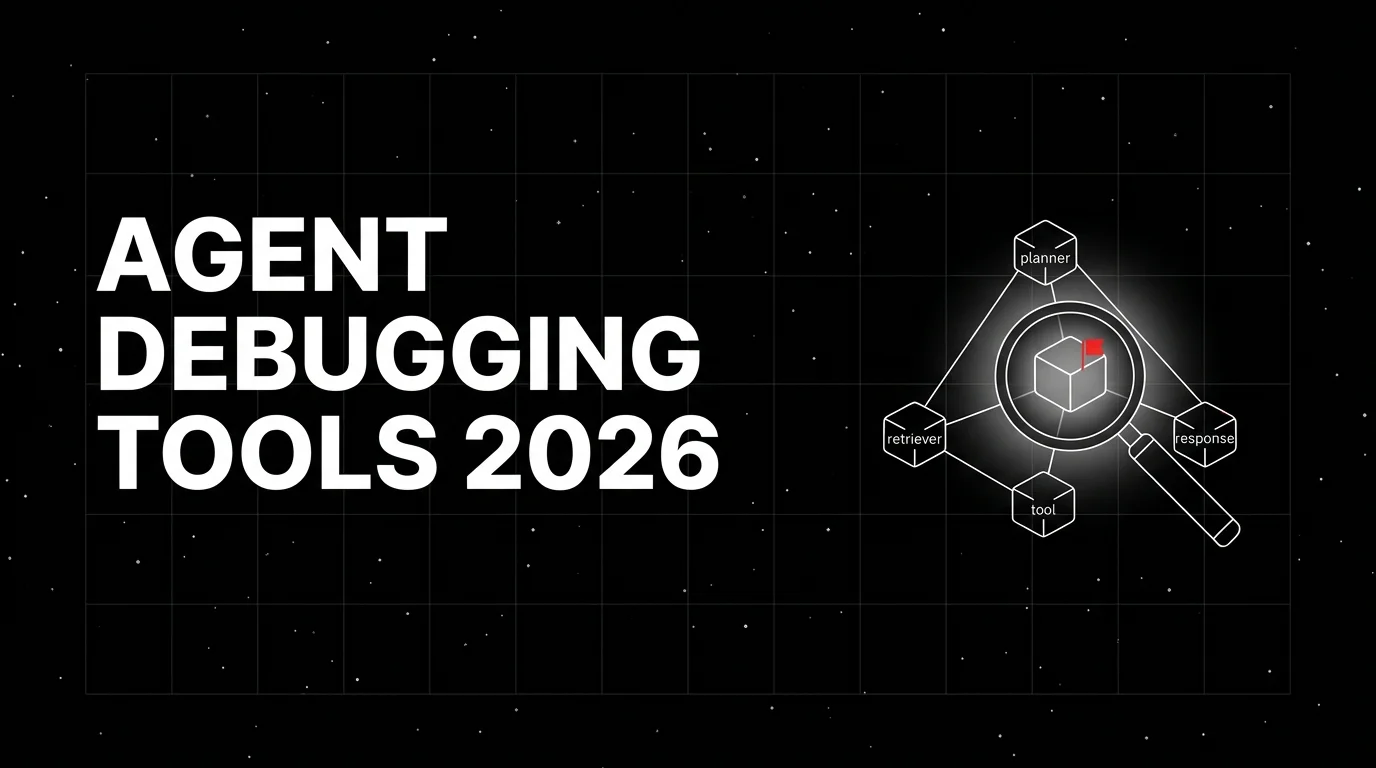
Honest 2026 comparison of agent debugging tools: Future AGI, LangSmith, Langfuse, Phoenix, Braintrust, Helicone, OpenLLMetry. Trace depth, replay, gaps.