Document Summarization with LLMs in 2026: A Production Guide for Enterprise Document Management
Document summarization with LLMs in 2026. Extractive vs abstractive, RAG for enterprise docs, model picks, eval metrics, and a production stack.
Table of Contents
Document summarization with LLMs in 2026
Enterprise teams sit on terabytes of unstructured text. Contracts, patient records, support transcripts, earnings calls, internal memos. Reading every page is not an option. Document summarization with large language models turns that pile into something a human can act on.
This guide covers what works in production in 2026: how to pick a model, how to wire RAG when the corpus is large, how to evaluate the summary, and where the failures hide.
TL;DR: Document summarization in 2026
| Layer | What it does | 2026 default |
|---|---|---|
| Ingest | Parse PDFs, OCR scans, extract structure | unstructured.io, Llama Parse, custom OCR |
| Chunk | Split long documents into model-friendly pieces | Semantic chunking (paragraph or section) over token-based |
| Embed | Vectorize chunks for retrieval | text-embedding-3-large, voyage-3, or open models |
| Retrieve | Pull relevant chunks for the query | Vector store with metadata filters, reranker for precision |
| Summarize | Generate the summary | gpt-5-2025-08-07, claude-opus-4-5, gemini-3.x for long context |
| Evaluate | Score the summary | Future AGI Evaluate (groundedness, coverage, refusal) |
| Trace | Span per stage for replay and debugging | traceAI Apache 2.0 OpenTelemetry SDK |
If you only do one thing, build the eval harness before scaling the pipeline. Without it, every summarization regression looks the same and the team cannot tell which change caused it.
Extractive vs abstractive summarization in 2026
Both still matter. The choice depends on what the summary is for.
Extractive summarization selects sentences or phrases from the source. It preserves wording, which is essential for:
- Legal documents where the source language is the ground truth.
- Compliance-sensitive content (regulatory filings, medical guidelines).
- Audit trails where a quote must trace exactly to the source.
Abstractive summarization rewrites the content in new sentences. The result is more readable but introduces hallucination risk. It fits:
- Executive summaries where the reader wants the gist.
- Research synthesis across multiple sources.
- Customer support summaries where a polished tone matters.
The 2026 production pattern is hybrid: extract the key spans first to anchor the facts, then let the model rewrite around the anchors. A groundedness evaluator scores whether each abstractive claim still traces to an extractive anchor.
Picking the summarization model
Test two candidates on your real documents. Public benchmarks tell you which models can summarize a Wikipedia article; they tell you very little about how a model handles a 200-page contract with footnotes.
A reasonable 2026 shortlist:
- gpt-5-2025-08-07: strong on structured summarization, follows output schemas reliably, a common default for operational summaries.
- claude-opus-4-5: known for careful reading and low hallucination on long single-document tasks, often picked for legal and analyst memos.
- gemini-3.x: long context windows on enterprise tiers, capable multimodal grounding (PDFs with charts, scanned forms), often picked for long documents.
- gpt-5-mini or claude-haiku-4: high-volume operational summaries (support tickets, meeting notes) where cost matters more than the last 2% of quality.
- llama-4.x or qwen3: self-hosted requirement, regulated environment, or low cost per call.
Run both candidates on a fixed eval set of 50 to 200 real documents. Measure groundedness, coverage, refusal correctness, output schema validity, and cost per document. Pick the model that wins your contract metric.
RAG for large document corpora
When the document corpus is too large to fit in one model context, retrieval-augmented generation is the standard pattern.
# Pseudocode: replace vector_store, reranker, llm, and build_summary_prompt
# with your own retrieval, rerank, and generation implementations.
def summarize_with_rag(query: str, document_id: str) -> str:
    chunks = vector_store.search(
        query=query,
        filter={"document_id": document_id},
        top_k=20,
    )
    reranked = reranker.rank(query=query, chunks=chunks)[:5]
    summary = llm.generate(
        prompt=build_summary_prompt(query, reranked),
    )
    return summary
Three rules for the retrieval layer:
- Chunk semantically, not by token count alone. Section breaks and paragraph boundaries preserve meaning; a hard 512-token split mid-paragraph drops context the summarizer needs.
- Rerank before passing chunks to the summarizer. The top-20 from vector similarity rarely matches the top-5 by actual relevance. A cross-encoder reranker improves precision substantially.
- Pass chunk IDs through to the evaluator. Groundedness scoring needs to know which chunks supported each claim. Surface chunk IDs as a structured part of the summary output.
For more on retrieval-stage choices, see our advanced chunking techniques and RAG evaluation metrics guides.
Evaluating document summarization
Score four metrics on a 50 to 200 document regression set:
| Metric | What it catches | How |
|---|---|---|
| Groundedness | Hallucinated facts in the summary | LLM judge compares each claim to the source/chunks |
| Coverage | Missing key points the user expects | LLM judge compares the summary to a reference key-point list |
| Faithfulness to wording | Extractive content drifting from source | String similarity or n-gram overlap on extracted spans |
| Refusal correctness | Model invents content when source is missing | LLM judge scores the refusal when source is ambiguous |
Future AGI Evaluate runs these as cloud evaluators or custom LLM judges over OpenTelemetry traces:
import logging
from fi.evals import evaluate

logger = logging.getLogger(__name__)
generated_summary = "..."  # output from your summarizer.
retrieved_chunks = ["..."]  # context passed into the summarizer.

result = evaluate(
    "groundedness",
    output=generated_summary,
    context=retrieved_chunks,
    model="turing_flash",
)

if result.score < 0.7:
    logger.warning("ungrounded summary detected; score=%s", result.score)
turing_flash returns in 1 to 2 seconds, turing_small in 2 to 3 seconds, turing_large in 3 to 5 seconds. The same evaluator runs in CI on every prompt change and on live traffic for ongoing drift detection.
For domain tasks where the contract is specific (legal clause completeness, clinical findings coverage), wrap a custom LLM judge:
from fi.opt.base import Evaluator
from fi.evals.metrics import CustomLLMJudge
from fi.evals.llm import LiteLLMProvider

llm_provider = LiteLLMProvider()
judge = CustomLLMJudge(
    name="clinical_findings_coverage",
    instructions=(
        "Given a patient record and a generated summary, "
        "score 0 to 1 on whether the summary captures the key clinical findings."
    ),
    llm_provider=llm_provider,
)
evaluator = Evaluator(name="clinical_findings_coverage", judge=judge)
Five failure modes and what catches each
| Failure mode | What goes wrong | Evaluator that catches it |
|---|---|---|
| Hallucinated facts | Summary invents a detail the source does not support | Groundedness per claim |
| Missing information | Summarizer drops a critical clause | Coverage against reference key-point list |
| Context overflow | Document exceeds model window, chunks dropped silently | Retrieval recall plus document token count alerts |
| Format drift | Output schema changes between runs | Schema validation, structured output mode |
| Prompt injection | Source document contains injected instructions | Safety evaluator on summary output |
The pattern is the same in every row. The evaluator is span attached, the threshold is part of the contract, and the gate runs in CI and on live traffic so the failure is visible before the user finds it.
Instrumenting the pipeline with OpenTelemetry
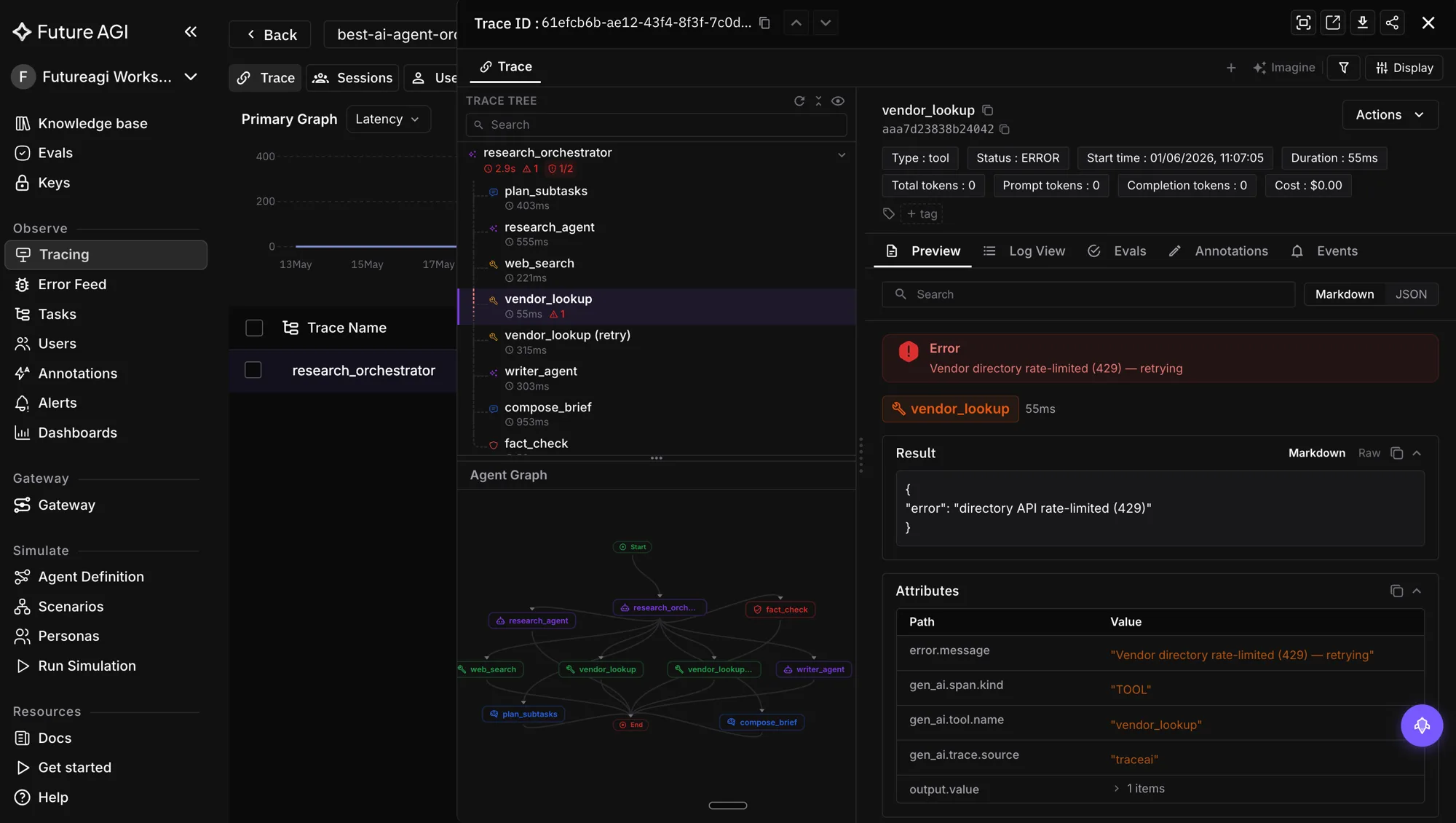
Every stage of the pipeline (ingest, chunk, embed, retrieve, rerank, summarize, evaluate) is a span. Traces make incident review possible weeks later when a regulator asks why a particular summary said what it said.
from fi_instrumentation import register, FITracer

tracer_provider = register(
    project_name="document-summarization",
    project_type="application",
)
tracer = FITracer(tracer_provider)

with tracer.start_as_current_span("summarize_document") as span:
    chunks = retrieve(query, document_id)
    span.set_attribute("retrieval.chunks", len(chunks))
    summary = llm.generate(build_summary_prompt(query, chunks))
    span.set_attribute("summary.tokens", count_tokens(summary))
traceAI is Apache 2.0 and OpenInference compatible (github.com/future-agi/traceAI). The same spans flow to Future AGI for eval and to any OTel backend (Datadog, Grafana, Jaeger) for infrastructure correlation. Environment configuration uses FI_API_KEY and FI_SECRET_KEY.
A minimum production stack
A small but realistic 2026 document summarization stack:
- Ingest and OCR: unstructured.io for layout-aware parsing, or a multimodal LLM call when the format is consistent.
- Chunking: semantic chunking by section and paragraph; 500 to 1500 token chunks with overlap.
- Embedding: text-embedding-3-large, voyage-3, or an open model when self-hosting matters.
- Vector store: pgvector, Pinecone, Weaviate, or Qdrant; metadata filters for document scope.
- Reranker: cross-encoder (Cohere Rerank, voyage-rerank-2, or an open model) on the top 20 chunks.
- Summarizer: claude-opus-4-5 or gemini-3.x for long documents; gpt-5-mini for cost-sensitive paths.
- Evaluator: Future AGI Evaluate (groundedness, coverage, refusal correctness) or custom LLM judges for domain tasks.
- Tracing: traceAI Apache 2.0 SDK, OpenTelemetry exporters to Future AGI plus any backup backend.
- Gateway: Future AGI Agent Command Center at
/platform/monitor/command-centerfor BYOK routing, budgets, and pre-call guardrails.
Real-world patterns in 2026
Five sectors where the pipeline holds up in production.
Legal: contract and case-file summarization
Long contracts, dense case files, and citations are the durable workload. The 2026 stack: extractive anchors on key clauses (parties, term, indemnification, termination), claude-opus-4-5 as the abstractive layer, groundedness evaluator on every claim. Firms use it to triage incoming contracts and generate due-diligence briefs.
Healthcare: patient records and clinical guidelines
Patient records, discharge summaries, and clinical literature feed into the pipeline. The 2026 stack: HIPAA-compliant infrastructure, RAG over patient history, claude-opus-4-5 or gemini-3.x for clinical reading. Coverage and refusal correctness gate the summary; clinical decisions require human approval. Future AGI traceAI surfaces audit trails for compliance review.
Finance: earnings calls, filings, and analyst memos
Quarterly earnings, 10-K filings, and analyst reports get summarized for trading desks and research teams. The 2026 stack: multi-document RAG, gpt-5 or claude-opus-4-5 for synthesis, groundedness evaluator on numbers and citations. Bloomberg-style executive summaries with cited source spans.
Customer support: tickets, chat logs, and feedback
High-volume operational summaries. The 2026 stack: gpt-5-mini or claude-haiku-4 for cost, structured output schema for downstream systems, coverage evaluator on resolution status. Summaries flow to agent dashboards and trend reports.
Education and research: papers, transcripts, and study materials
Academic papers, lecture transcripts, and textbook chapters get condensed for students and researchers. The 2026 stack: gemini-3.x or claude-opus-4-5 for long context, hybrid extractive-abstractive output with citation. Coverage and faithfulness evaluators score completeness against a syllabus or research question.
How Future AGI fits the loop
Future AGI is the eval and observability companion for document-intelligence pipelines:
- Evaluate:
fi-evalsruns groundedness, coverage, refusal correctness, and custom LLM judges over OpenTelemetry traces. - traceAI: Apache 2.0 OpenTelemetry SDK for span-level tracing across ingest, retrieve, summarize, evaluate.
- Simulate:
fi.simulateruns synthetic personas asking real questions of the summarization pipeline before live release. - Agent Command Center: BYOK routing and pre-call guardrails at
/platform/monitor/command-center.
The same evaluator runs in CI on every prompt and model change and on live traffic continuously. When a regulator asks why a summary said what it said, the trace shows the document, the retrieved chunks, the evaluator scores, and the model version, all linked.
What to ship first
Three steps that make the rest of the document summarization project easier:
- Write the contract (one paragraph: what gets summarized, for whom, with what guarantees).
- Build the eval harness (groundedness, coverage, refusal correctness, 50 real documents).
- Instrument with OpenTelemetry (every stage of the pipeline is a span).
If those three are in place before the second model is added, the pipeline stays debuggable as it grows. If they are not, every model upgrade, chunking change, or retrieval tweak feels riskier than the one before.
Related reading
Frequently Asked Questions
What is document summarization with LLMs in 2026?
What is the difference between extractive and abstractive summarization?
Which LLM is best for document summarization in 2026?
How do I evaluate document summarization quality?
How does RAG fit into document summarization?
What are the biggest failure modes in production document summarization?
How does Future AGI help with document summarization?
Which industries get the most value from LLM document summarization?
RAG summarization in 2026: stuff, map-reduce, refine, RAPTOR, GraphRAG. Long-context vs RAG decision matrix with thresholds plus faithfulness eval code.

Ranked RAG chunking strategies for 2026: late chunking, semantic, hierarchical, parent-child, sliding window. Code, tradeoffs, how to evaluate retrieval.

Ragas, DeepEval, FutureAGI, Phoenix, Galileo, Langfuse, TruLens compared as the 2026 RAG eval shortlist. Faithfulness, retrieval, chunk attribution.