RAG Evaluation Metrics in 2026: Faithfulness, Context Precision, Context Recall, Groundedness, Answer Relevance, with FAGI fi.evals
RAG evaluation metrics for 2026: faithfulness, context precision and recall, groundedness, answer relevancy, chunk attribution, and diagnosing failures.
Table of Contents
A legal research RAG ships and scores 0.91 faithfulness on the offline eval set. Three weeks into production, customers complain that 1 in 6 responses misses a key statute. The team checks faithfulness in the dashboard: still 0.91. They check context recall: 0.62.
The retriever was missing the second statute on multi-hop questions; the generator was answering coherently from the partial context, so faithfulness stayed high. No retrieval-stage metric on the dashboard surfaced the regression.
This is what RAG evaluation looks like when you measure only the generation. This post is the 2026 picture: the six metrics that anchor a complete RAG evaluation program, what each catches, what each misses, and how FutureAGI fi.evals (Apache 2.0) templates run them against your traces.
TL;DR: The six metrics that matter in 2026
| Metric | Layer | What it catches | fi.evals template |
|---|---|---|---|
| Faithfulness | Generation | Whole-answer fabrication vs context | rag_faithfulness |
| Context precision | Retrieval | Irrelevant chunks in the retrieved set | context_precision |
| Context recall | Retrieval | Missing chunks the answer needed | context_recall |
| Groundedness | Generation | Per-sentence unsupported claims | groundedness |
| Answer relevance | Generation | Off-topic answers | answer_relevancy |
| Hallucination | Final answer | Claims no chunk supports (safety net) | detect_hallucination |
If you only read one row: a 2026 RAG eval program tracks at least one retrieval-stage metric and at least one generation-stage metric. Tracking only generation hides retrieval regressions; tracking only retrieval misses fabrication.
The two-stage evaluation problem
A RAG system has two stages: retrieve and generate. Each can fail independently. A complete evaluation program needs at least one metric per stage.
Stage 1: Retrieval. Did the retriever surface the right chunks for the query?
- Two failure modes: missed relevant chunks (low recall), surfaced irrelevant chunks (low precision).
- Metrics: context precision, context recall, Precision@k, Recall@k, MRR, NDCG.
Stage 2: Generation. Did the generator use the retrieved chunks to produce a correct, supported, on-topic answer?
- Three failure modes: fabricated claims (low faithfulness), per-sentence ungrounded claims (low groundedness), off-topic answers (low answer relevance).
- Metrics: faithfulness, groundedness, answer relevance, hallucination.
A pipeline can fail at stage 1 (the retriever missed the chunk) and still produce a “faithful” answer (the model was honest about the partial context, but the user got an incomplete answer). A pipeline can succeed at stage 1 (the retriever returned the right chunk) and fail at stage 2 (the model fabricated anyway).
Both failure modes are common in production. Both need their own metric.
Metric 1: Faithfulness
What it asks: is the generated answer supported by the retrieved context, with no fabricated claims?
How to score it: an LLM judge sees the answer and the retrieved chunks. It scores 0 to 1 (or labels each claim as supported, partially supported, or unsupported) based on whether the answer makes claims the context does not back. The composite is the faithfulness score.
When it fires: the model fabricated a fact. The context did not say “the contract expires January 1”; the model said it did.
When it does not fire: the model is partially correct because the retrieval was partial. The model answered the question coherently from incomplete context; the answer matches what was retrieved, so faithfulness is high; but the user is missing information. This is a retrieval-stage problem, not a faithfulness problem.
fi.evals template: rag_faithfulness (Apache 2.0, runs as Python or cloud).
# Real FAGI API
from fi.evals import evaluate

result = evaluate(
    "rag_faithfulness",
    output=generated_answer,
    context=retrieved_chunks_concatenated,
)
print(f"Faithfulness: {result.score:.3f}")
The fast cloud judge (turing_flash) is the default for online sampling, typically ~1-3s. The deeper judges (turing_small, turing_large) run as offline batch or as second-stage evaluators when latency is not constrained.
Metric 2: Context precision
What it asks: of the chunks the retriever returned, what fraction are relevant to the query?
How to score it: an LLM judge labels each retrieved chunk as relevant or not, given the query. Context precision is relevant chunks divided by total chunks. Often computed as a weighted version where higher-ranked chunks count more.
When it fires: the retriever returned 10 chunks, 3 are relevant, 7 are noise. The generator is now drowning in 7 irrelevant chunks; context windows are wasted; the model may misweight the noise.
Why it matters: low precision tanks generation quality even when recall is fine. Re-rankers (Cohere Rerank, BGE Reranker, Jina Reranker) live to fix low context precision.
fi.evals template: context_precision.
Metric 3: Context recall
What it asks: of the chunks needed to fully answer the query, what fraction did the retriever return?
How to score it: requires a ground-truth set (the chunks a human labeled as necessary for the answer). Context recall is necessary chunks retrieved divided by total necessary chunks.
When it fires: the answer needed 3 chunks; the retriever returned 2; the generator answers from the 2 it has and the user gets an incomplete answer.
Why it matters: low recall is the silent regression. The model can still produce a fluent, faithful-looking answer from incomplete context; faithfulness stays high; users get partial information. The only way to surface low recall is to measure it explicitly.
fi.evals template: context_recall (requires ground-truth chunk labels).
For depth on retrieval-quality monitoring, see Best Retrieval Quality Monitoring Tools 2026.
Metric 4: Groundedness
What it asks: for each sentence in the answer, is there a retrieved chunk that supports it?
How to score it: an LLM judge labels each sentence as grounded (a backing chunk exists) or ungrounded. Groundedness is the fraction of sentences grounded.
When it fires: 4 of 5 sentences in an answer are supported by retrieved chunks; the 5th is a fabrication. Faithfulness as a single 0-1 score might average to 0.8 and look fine; groundedness flags 1 of 5 sentences ungrounded and gives you the exact sentence to fix.
Why it matters: granularity. Faithfulness for the dashboard, groundedness for the diagnostic. Production teams track both.
fi.evals template: groundedness.
Metric 5: Answer relevance
What it asks: does the answer actually address the user’s question, or does it produce on-topic but unrelated text?
How to score it: an LLM judge scores how well the answer addresses the specific query, 0 to 1. Penalizes verbose hedging, off-topic preambles, and answers that talk around the question.
When it fires: the user asks “what’s our refund policy”; the answer is a faithful summary of the company’s general support policy that does not mention refunds.
Why it matters: a faithful, grounded answer to the wrong question is still useless. Answer relevance is the closing-the-loop metric.
fi.evals template: answer_relevancy.
Metric 6: Hallucination
What it asks: does the answer make claims that no retrieved chunk supports? Often run reference-free (no labeled ground truth needed).
How to score it: a hallucination detector flags claims that are factually questionable or unsupported. Often complementary to faithfulness; runs as a final safety net before the response ships.
When it fires: the model invented something the context did not say. Faithfulness should also catch this; hallucination is the second line of defense.
fi.evals template: detect_hallucination.
For the broader hallucination story, see Understanding LLM Hallucination 2025 and Detect Hallucination Generative AI 2025.
Beyond the core six: attribution, utilization, and citation validity
The six metrics above anchor the program. Three more rubrics earn a place once the core is stable, especially for systems that cite sources back to the user.
Chunk attribution asks a binary question per retrieved chunk: did this chunk actually influence the answer? A chunk that was retrieved but never used is dead weight in the context window. When attribution is low across many chunks, the retriever is over-fetching and the generator is ignoring most of what it gets.
FutureAGI ships this as the source_attribution cloud template; the full set lives in the fi.evals RAG templates.
Chunk utilization measures how much of each attributed chunk the answer used. A chunk can be attributed (it mattered) and still barely used (one sentence out of a long passage).
Utilization that stays low across the retrieved set is a signal to shrink chunk size or tighten top-k, because you are paying for tokens the generator never reads. FutureAGI ships this as context_utilization.
Citation validity is a deterministic check, not a judge call: for every span the answer quotes, does that exact text appear in the chunk it cites? This catches the citation-mapping bug where the answer is correct but the footnote points at the wrong source.
def citation_validity(cited_spans, chunks):
    # cited_spans: list of (quoted_text, chunk_id)
    valid = sum(
        1 for text, cid in cited_spans
        if text.strip() in chunks[cid]
    )
    return valid / len(cited_spans) if cited_spans else 1.0
For the model-scored side of the same question, fi.evals ships a citation_presence evaluator on the citation dimension.
Classic IR metrics still earn their place
When you have labeled gold documents per query, the discrete metrics remain useful. The target numbers below are common rules of thumb, not fixed standards; tune them to your corpus and stakes:
- Precision@k: fraction of top-k retrieved chunks that are relevant. A common starting point is 0.7+ for narrow domains, 0.5+ for broad.
- Recall@k: fraction of relevant chunks that appear in top-k. Many teams aim for 0.8+ at k=20 on broad datasets.
- MRR (Mean Reciprocal Rank): 1/rank of the first relevant result, averaged across queries. Higher means the right chunk lands at the top.
- NDCG@k: relevance-weighted ranking score. A reasonable bar is 0.8+ at k=10.
These are the IR-flavored versions of context precision and context recall. Use them when you have labels; use the LLM-judge versions when you do not. Many production stacks compute both and reconcile.
How to run RAG evaluation: the three-layer pattern
Layer 1: Offline gold-set evaluation
Build a labeled set: 100 to 500 query-context-answer tuples. Each query has the gold chunks the retriever should return and the gold answer the generator should produce.
Run the eval suite on every prompt change, model swap, retriever change, or chunking-strategy change. The composite metric (faithfulness, context recall, answer relevance, optionally cost-per-correct-answer) gates the merge.
# Real FAGI API
from fi.evals import evaluate

results = []
for query, context, answer, gold_chunks in test_set:
    faith = evaluate("rag_faithfulness", output=answer, context=context)
    relev = evaluate("answer_relevancy", input=query, output=answer)
    results.append({
        "faithfulness": faith.score,
        "answer_relevance": relev.score,
    })

mean_faith = sum(r["faithfulness"] for r in results) / len(results)
mean_relev = sum(r["answer_relevance"] for r in results) / len(results)
print(f"Faithfulness: {mean_faith:.3f}, Relevance: {mean_relev:.3f}")
Layer 2: Online sample evaluation
Score a sample (5 to 20%) of production traffic with fi.evals templates running as cloud evaluators tied to OTel spans. The faster cloud judge (turing_flash) covers the bulk of online sampling; the deeper judges (turing_small, turing_large) run async and attach scores to the trace.
This catches drift that the gold set will not: real users, real queries, real distribution shifts.
Layer 3: Weekly human calibration
Sample 50 to 100 production traces. Have a domain reviewer label each on the same rubric as the LLM judge. Compute Cohen’s kappa between the human and the judge.
Target kappa is 0.6 or higher. Below 0.6, the judge is too noisy to trust; re-tune the judge prompt or swap judge models.
For depth on judge calibration, see Best LLM as Judge Platforms 2026.
The full picture: tracing every span
A 2026 RAG eval program does not just run metrics; it attaches them to spans.
# Pseudocode showing trace + eval attached at the span level
from fi_instrumentation import register
from traceai_llamaindex import LlamaIndexInstrumentor
from fi.evals import evaluate

register(project_name="rag-eval-demo")
LlamaIndexInstrumentor().instrument()

# When the agent runs, every retrieve, generate, and judge call emits an OTel span.
# fi.evals attaches scores to the spans:
# - retrieve span gets context_precision and context_recall
# - generate span gets rag_faithfulness and groundedness
# - the trace gets answer_relevancy and the composite cost-per-correct-answer
The dashboard rolls per-span into per-trace, per-trace into per-day, per-day into the eval scorecard. When a customer flags a bad answer, the trace shows which retrieve span had low recall and which generate span had low groundedness; the fix is targeted, not a re-tune of the whole pipeline.
Figure 1: A 2026 RAG evaluation stack attaches per-stage metrics to per-stage spans.
How to choose metrics for your use case
Three questions:
- Do you have labeled gold chunks per query? If yes, classic IR metrics (Precision@k, Recall@k, MRR, NDCG) plus context_recall earn their place. If no, the LLM-judge version (context_precision) is the path.
- Is the corpus broad (Q&A across many topics) or narrow (one domain)? Broad: prioritize recall (you have many ways to miss). Narrow: prioritize precision (noise is the bigger risk).
- What is the cost of a wrong answer? High-stakes (legal, medical, compliance): track all six metrics, gate ships on groundedness and faithfulness, run a guardrail at runtime. Low-stakes (FAQ, internal search): faithfulness and answer relevance are enough; skip the heavier metrics for speed.
How to diagnose which layer failed
When a score drops, the metric that moved tells you where to look. This is the practical payoff of scoring every stage: the pattern of which metric fell isolates the fix, so you are not re-tuning the whole pipeline on a guess.
- Context recall fell, everything else steady. The retriever is missing chunks the answer needs. Look at chunking, top-k, and the embedding model, not the generation prompt.
- Context precision or chunk utilization fell. The retriever is pulling in noise or over-fetching. Tune the re-ranker or lower top-k so the generator is not drowning in irrelevant context.
- Retrieval steady, faithfulness or groundedness fell. The generator is drifting from the context it was given. Look at the generation prompt or the model, not the retriever.
- Faithfulness steady, answer relevance fell. The answer is supported but off-target: the model answered a different question than the user asked. Look at query understanding and the system prompt.
- Groundedness passes but chunk attribution fails. The answer is supported, but the citation mapping is wrong. This is a citation-plumbing bug, not a retrieval or generation quality problem.
- Every score looks fine but users still complain. The gold set is stale or too narrow. Refresh it with sampled production queries and re-check.
Common failure modes
Measuring only generation
The most common mistake. Faithfulness and answer relevance look healthy; context recall is silently regressing. The fix is to score context_precision and context_recall on the retrieve span explicitly.
LLM-judge bias
The judge has its own biases: prefers longer answers, prefers verbose hedging, prefers the model family it shares with the system under test. The fix is to calibrate against humans (kappa 0.6 floor) and to use a different model for the judge than for the system.
Overfitting to the gold set
The gold set has 200 queries; the pipeline scores 0.92 on faithfulness on the gold set; in production, faithfulness on real traffic is 0.78. The fix is to keep refreshing the gold set with sampled production queries and to track online-eval scores alongside offline.
Composite metric drift
Optimize one metric and another regresses. Improve faithfulness by retrieving more chunks; context precision drops because more chunks means more noise. The fix is a composite (faithfulness times context_precision, or cost-per-correct-answer) that ties the metrics into one number.
Reference-set staleness
The gold answers were labeled 6 months ago; the world changed; the gold answers are now wrong. The fix is a quarterly refresh of the gold set and a versioned eval run so historical scores are comparable.
For depth on RAG hallucinations specifically, see RAG Prompting to Reduce Hallucination and RAG Hallucinations: FutureAGI.
Where this is going in 2027
Three trends.
First, multi-hop and reasoning RAG evaluation matures. Today most metrics score a single-pass retrieve-generate cycle. The 2027 pattern is metrics that score the agent’s full trajectory across multiple retrieves, including the question of whether the agent retrieved redundantly or efficiently.
Second, ground-truth-free evaluation gets stronger. Reference-free hallucination detection improves to the point that a 100-query gold set is no longer the bottleneck for getting reliable production signals.
Third, the eval back-end becomes the dashboard. The trace, eval, and metric layer is where teams will spend most of their RAG operating time, and FutureAGI builds exactly this layer.
How to start
- Build a 100 to 200 query labeled set. Each query has the gold chunks and the gold answer.
- Pick at least one retrieval metric and at least one generation metric. The minimum: context_recall plus rag_faithfulness. The recommended: context_precision, context_recall, rag_faithfulness, groundedness, answer_relevancy.
- Run the metrics offline on every prompt or model change. Block ship on a composite threshold.
- Wire trace + eval (traceAI + fi.evals, both Apache 2.0) for online sample evaluation on 5 to 20% of production traffic.
- Schedule weekly human review of 50 traces to calibrate the judge.
- Add a guardrail (FAGI Protect) at runtime for the worst failures: hallucinated content, PII leaks, prompt injection in retrieved chunks.
The full path lives in one stack with FutureAGI: traceAI for spans (Apache 2.0), fi.evals templates for the six core metrics (Apache 2.0), the dashboard for roll-ups, Protect for runtime. Self-host the Apache 2.0 cores or use the managed platform.
Back to the legal RAG that missed a statute
Go back to the pipeline that shipped at 0.91 faithfulness and still missed a key statute one in six times. A single context recall check on the retrieve span would have caught it in week one: recall sitting at 0.62 on the dashboard, flagged before a customer ever read a partial answer.
Faithfulness told the team the answer was honest; only recall told them it was incomplete. That gap is the whole argument for measuring both stages on the same trace.
Pick one retrieval metric and one generation metric, wire them to your spans with fi.evals, and the next silent regression shows up on a chart instead of in a support ticket.
Frequently Asked Questions
What are the core RAG evaluation metrics in 2026?
What is the difference between faithfulness and groundedness in RAG?
How is context precision different from context recall?
Which evaluation metric is most predictive of user satisfaction in RAG?
How do I run RAG evaluation in production at scale?
What about Precision@k, Recall@k, MRR, NDCG? Are they still useful?
How does FutureAGI fi.evals help with RAG evaluation?
What is the most common RAG evaluation mistake in production?
What is the difference between groundedness and context adherence in RAG?
When should I use chunk attribution versus chunk utilization?
Are answer relevance and completeness the same metric in RAG?
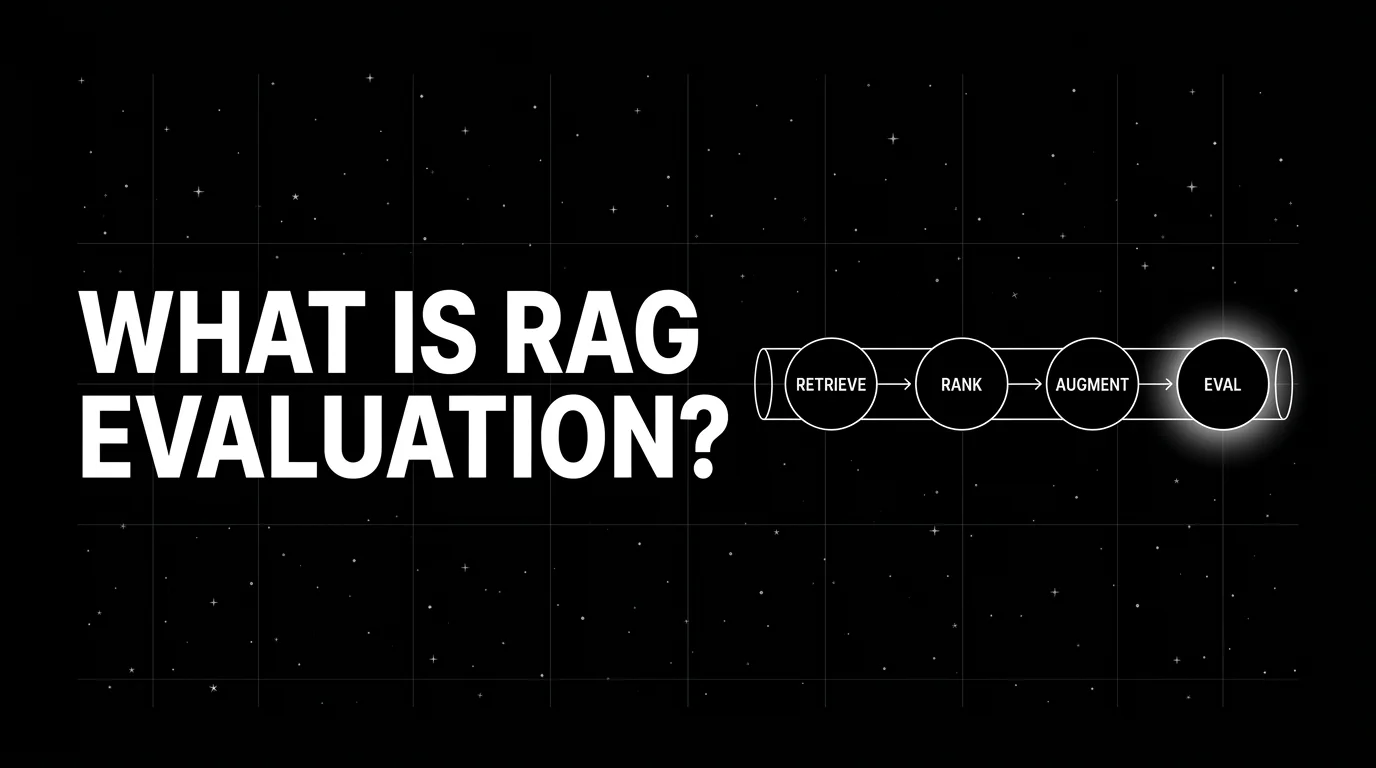
RAG evaluation is retrieval, generation, and end-to-end scoring under one framework. What it is, how to score each layer, which tools handle it in 2026.

Ragas, DeepEval, FutureAGI, Phoenix, Galileo, Langfuse, TruLens compared as the 2026 RAG eval shortlist. Faithfulness, retrieval, chunk attribution.

Agentic RAG in 2026: tool-using agents over vector DBs, query rewriting, multi-hop retrieval, and how to trace and evaluate every retrieve span with FAGI.
