Best LLM Evaluation Frameworks in 2026: Metrics, Templates, and Best Practices
Future AGI, DeepEval, RAGAS, Arize Phoenix, OpenAI Evals, LangSmith ranked for LLM eval in 2026. Metrics taxonomy, templates, best practices.
Table of Contents
TL;DR: Best LLM Evaluation Frameworks in 2026
| Rank | Framework | Best for | License | Pre-built templates |
|---|---|---|---|---|
| 1 | Future AGI | Production eval, trace + eval + guardrail in one platform | Commercial; OSS lib Apache 2.0 | 50+ |
| 2 | DeepEval | PyTest-style eval inside CI | Apache 2.0 | 20+ |
| 3 | RAGAS | RAG-specific reference-free eval | Apache 2.0 | 8 |
| 4 | Arize Phoenix | OSS observability and eval over OTel | Apache 2.0 (some Cloud components Elastic License v2) | 12 |
| 5 | OpenAI Evals | YAML-defined eval, OpenAI-native | MIT | Few; many community |
| 6 | LangSmith Evals | LangChain-native eval and traces | Commercial | 15+ |
Template counts are best-effort estimates from each framework’s public docs as of May 2026 (see the repo links in each section); verify the live counts in upstream docs before pinning a number in a contract or RFP.
What changed since 2025: Evaluation moved from a research checkbox to a production gate. Most major frameworks now support LLM-as-a-judge workflows, either built in or through community templates. OpenTelemetry-compatible tracing has become the common target for evaluation spans in observability-aware platforms, which means evals can be attached to traces regardless of the runtime framework. Three eval categories crystallized: deterministic, rubric (LLM-judge or human), and composite. Future AGI ships templates across all three and adds simulation, guardrails, and a gateway on top.
Why LLM Evaluation Matters: The Production Lever, Not a Research Checkbox
LLM outputs are non-deterministic, multi-step, and easy to break with a vendor model swap or a prompt edit. Evaluation is the mechanism that catches regressions before users do. In 2026, evaluation is among the most operationally important tools an AI team can deploy because:
- Unit tests alone miss most semantic regressions in non-deterministic systems, even though they still catch schema, routing, and deterministic guardrail failures.
- A 10 percent regression on faithfulness in a RAG pipeline costs nothing in error logs and everything in user trust.
- Cost and latency drift silently. A new model variant might be 12 percent slower at the 99th percentile without surfacing in averages.
- Compliance gates under the EU AI Act and similar regimes require documented evaluation evidence.
A modern eval framework needs to run at three lifecycle points: offline against curated datasets, online against live production traffic, and pre-merge in CI before any prompt or model change ships. The six frameworks below are the platforms most teams shortlist in 2026.
LLM Evaluation Metrics Taxonomy: Deterministic, Rubric, Composite
Three categories cover every metric you will encounter in 2026:
Deterministic metrics
A fixed function of the output. Cheap, reproducible, narrow.
- Exact match for closed-form answers.
- BLEU, ROUGE, METEOR for surface overlap in translation and summarization.
- BERTScore for semantic similarity.
- F1, precision, recall for classification.
- JSON-schema validity, regex match, length checks for structural correctness.
- Edit distance for code review.
Strength: zero LLM judge cost, perfectly reproducible. Weakness: misses semantic and contextual quality.
Rubric metrics
A model judge or human grader scores the output against a written rubric.
- Faithfulness (output is supported by retrieved context, no fabrication).
- Task completion (the output achieved the user’s stated goal).
- Tool-use correctness (the right tool was called with the right arguments).
- Coherence and fluency for natural-language output.
- Toxicity, PII, jailbreak detection for safety.
- Brand-tone, persona-fit, age-appropriate language for brand compliance.
Strength: catches semantic quality that deterministic metrics miss. Weakness: cost per call, calibration sensitivity. Stronger frontier-class judges and calibrated domain judges tend to catch nuanced errors that smaller judges miss; always calibrate against human labels before relying on a judge in production.
Composite metrics
A weighted combination of deterministic and rubric signals.
- Custom safety index = max(toxicity_classifier, jailbreak_rubric, PII_regex).
- Production health score = 0.5 * task_completion + 0.3 * faithfulness + 0.2 * latency_within_budget.
- Domain expert agreement = weighted average of multiple LLM judges plus a calibrated human spot-check.
Future AGI supports custom judge workflows that can be combined into composite scoring, including weighted aggregations in the dashboard. For deeper coverage see Custom LLM Eval Metrics Best Practices.
Framework 1: Future AGI: Production Eval with Trace, Eval, Guardrail in One Platform
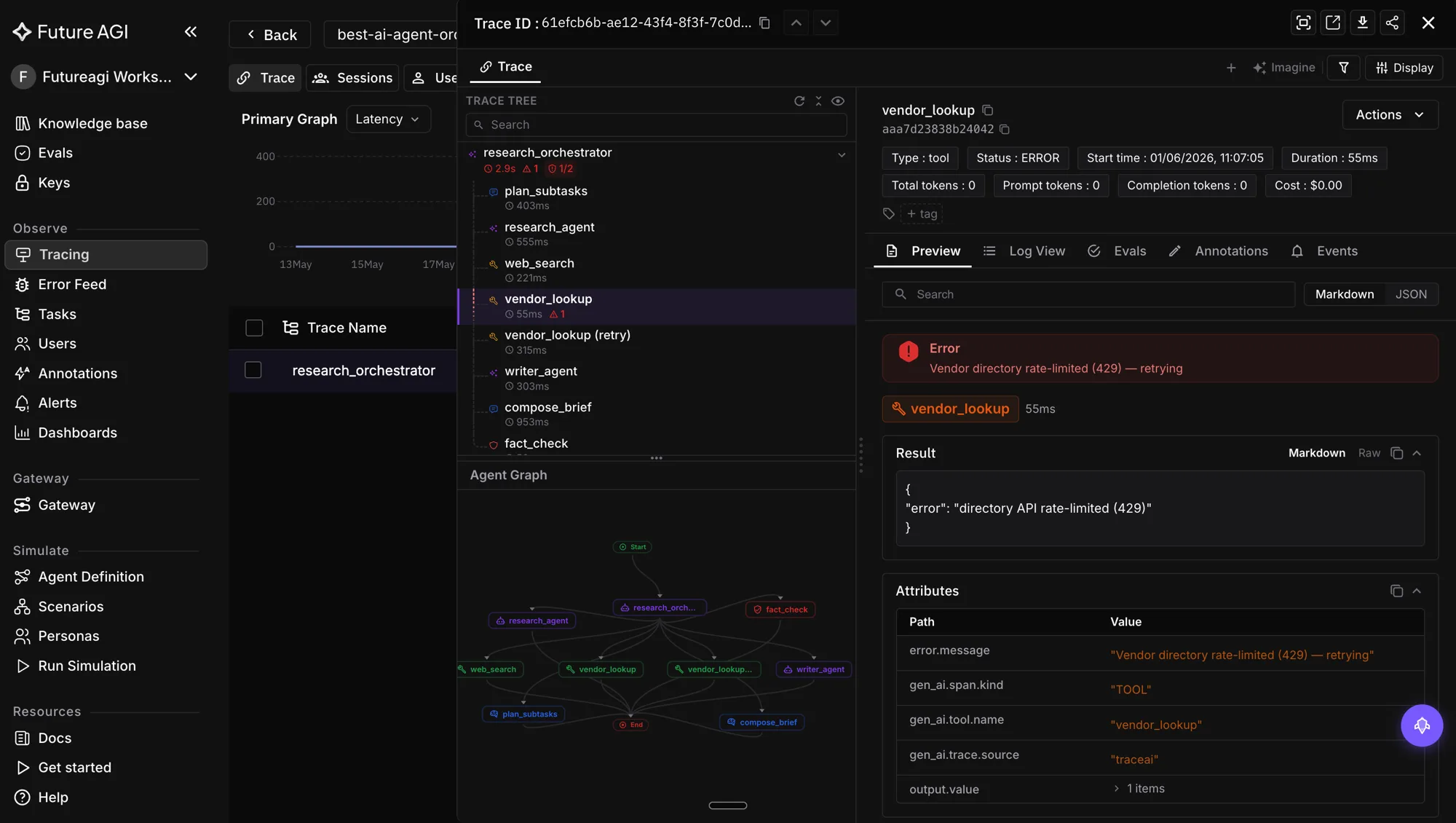
Future AGI bundles tracing, evaluation, guardrails, simulation, and a BYOK gateway in one product, which is the broadest coverage among the six frameworks compared here. The components:
- traceAI, an Apache 2.0 OTel-native instrumentation library (Python and TypeScript). Source: github.com/future-agi/traceAI.
- 50 plus built-in eval templates: task completion, faithfulness, faithfulness with citations, tool-use correctness, context relevance, answer relevancy, toxicity, PII, brand-tone, custom LLM judges via
fi.evals.metrics.CustomLLMJudge. - 18 plus guardrail scanners: PII redaction, prompt-injection screening, toxicity, jailbreak, custom regex, brand-tone, secret detection. Routed via /platform/monitor/command-center.
- Turing eval models:
turing_flash(~1-2s),turing_small(~2-3s),turing_large(~3-5s) for cloud-side eval scoring. Source: docs.futureagi.com/docs/sdk/evals/cloud-evals. - fi.simulate for persona-driven multi-turn testing of agents and chat systems.
- BYOK gateway with 100 plus providers, no platform fee on judge calls.
- OSS evaluation library at github.com/future-agi/ai-evaluation under Apache 2.0.
Why Future AGI is ranked number 1
Most evaluation tools score the final output and stop. Future AGI scores every span, attaches the score back to the trace, fires guardrails synchronously at the boundary, and replays the same data against alternative prompts or models in the same UI. The trace-to-eval-to-guardrail loop on shared data is the differentiator.
Quick start: evaluate a RAG output
import os
from fi.evals import evaluate

os.environ["FI_API_KEY"] = "..."
os.environ["FI_SECRET_KEY"] = "..."

# Score faithfulness of a RAG answer against the retrieved context.
context = "Retrieved chunk 1. Retrieved chunk 2."
output = "The model's RAG answer goes here."

score = evaluate(
    "faithfulness",
    output=output,
    context=context,
)
print(score)
Repeat the same call with eval names like task_completion, answer_relevancy, or context_relevance to cover the full eval surface. For a deeper start see LLM Evaluation Architecture in 2026 and What is an LLM Evaluator.
Framework 2: DeepEval: PyTest-Style LLM Evaluation Inside CI
DeepEval, from Confident AI, is an open-source library that makes LLM evaluation feel like unit testing. Tests run with PyTest, metrics are pluggable, and reports flow into the Confident AI dashboard.
- Repo: github.com/confident-ai/deepeval
- License: Apache 2.0
- Strengths: PyTest integration, RAGAS-compatible metrics, G-Eval rubric scorer, hallucination and faithfulness templates.
- Trade-offs: lighter on tracing, guardrails, and simulation than a full platform.
Pick DeepEval when CI-driven, library-first evaluation matters most and you already have observability handled. Pair with Future AGI traceAI if you also need production tracing and guardrails.
Framework 3: RAGAS: Reference-Free RAG Evaluation
RAGAS pioneered the four-metric reference-free pattern for RAG evaluation: faithfulness, answer relevancy, context precision, context recall.
- Repo: github.com/explodinggradients/ragas
- License: Apache 2.0
- Strengths: focused RAG metrics, easy to drop into any pipeline, well-documented academic foundation.
- Trade-offs: RAG-specific scope, not a full eval platform.
Pick RAGAS as the focused starting point when your workload is RAG-only. Future AGI ships the same four RAG metrics plus 46 more templates that cover safety, tool-use, and multi-turn behavior on the same platform.
Framework 4: Arize Phoenix: OSS Observability and Evaluation
Arize Phoenix is the open-source span viewer and evaluation library from Arize AI. It uses OpenInference span semantics, the same conventions Future AGI traceAI emits, so spans interop cleanly.
- Repo: github.com/Arize-ai/phoenix
- License: Apache 2.0 (Elastic License v2 for some Phoenix Cloud components)
- Strengths: best-in-class OTel ingestion, Phoenix evals catalog, drop-in span viewer.
- Trade-offs: span-viewer-first design, lighter on guardrails and simulation than Future AGI.
Pick Phoenix when you already operate OTel pipelines and want a drop-in span viewer. Pair with Future AGI evaluators for deeper template coverage on the same spans.
Framework 5: OpenAI Evals: YAML-Defined OpenAI-Native Eval
OpenAI Evals is OpenAI’s open-source evaluation framework. Evals are defined in YAML, run against OpenAI completions, and support both deterministic and model-graded checks.
- Repo: github.com/openai/evals
- License: MIT
- Strengths: deep OpenAI integration, community library of evals, YAML simplicity.
- Trade-offs: OpenAI-first, less ergonomic for multi-vendor or agentic pipelines.
Pick OpenAI Evals when the workload is mostly OpenAI and you want a YAML-driven approach. Future AGI is the broader pick when the pipeline spans multiple vendors or includes agentic flows.
Framework 6: LangSmith Evals: LangChain-Native Eval and Traces
LangSmith is LangChain’s commercial product for tracing, evaluation, and prompt management. The eval features are tightly integrated with LangChain and LangGraph traces.
- Site: smith.langchain.com
- License: Commercial; client SDKs are open-source under MIT.
- Strengths: deep LangChain integration, hosted eval datasets, online and offline evaluators.
- Trade-offs: LangChain-centric, weaker on non-LangChain pipelines.
Pick LangSmith when the rest of the stack is LangChain. Future AGI is the broader pick for multi-framework pipelines and adds guardrails plus simulation.
Side-by-Side Comparison
| Framework | License | Tracing | Eval templates | Guardrails | Simulation | Multi-vendor |
|---|---|---|---|---|---|---|
| Future AGI | Commercial; OSS lib Apache 2.0 | traceAI (Apache 2.0) | 50+ | 18+ scanners | fi.simulate | Yes |
| DeepEval | Apache 2.0 | Via Confident AI cloud | 20+ | None | None | Yes |
| RAGAS | Apache 2.0 | None (eval-only) | 8 (RAG-focused) | None | None | Yes |
| Arize Phoenix | Apache 2.0 (some Cloud components Elastic License v2) | OTel-native | 12 | None | None | Yes |
| OpenAI Evals | MIT | None (eval-only) | Few; many community | None | None | OpenAI-first |
| LangSmith Evals | Commercial | LangChain-native | 15+ | Light | None | LangChain-first |
Best Practices for LLM Evaluation in 2026
1. Run evals at three lifecycle points
- Pre-merge in CI to catch regressions before deploy.
- Offline scheduled on curated golden datasets to track quality trends.
- Online streaming on live production traces to catch real-world drift.
Future AGI runs all three on the same template catalog and unified dashboard.
2. Use deterministic gates plus rubric scores
Deterministic gates (JSON validity, length, regex) should fail-fast. Rubric scores (faithfulness, task completion) should drive trend monitoring and alerting. Compose them into a single production health score.
3. Calibrate your LLM judge against human labels
A judge that agrees with humans 75 percent of the time or higher is acceptable for trend monitoring. Below 65 percent it adds more noise than signal. Future AGI ships pre-calibrated turing judges to remove the setup cost.
4. Score every span, not just the final output
A multi-agent run produces dozens of spans. Scoring only the final output misses regressions in sub-agents. Use traceAI plus span-level evaluators to attribute regressions to the exact agent or tool call that caused them.
5. Build evaluation into every sprint
A new prompt, model, or tool that ships without a regression baseline is a future incident. Pre-merge eval gates with Future AGI can catch regressions before deploy and gate the merge on a quality threshold.
6. Document your eval methodology
Under the EU AI Act and similar regimes, you need to show eval evidence on demand. Future AGI exports eval runs as audit-grade reports with template versions, model versions, and trace IDs.
7. Simulate adversarial users
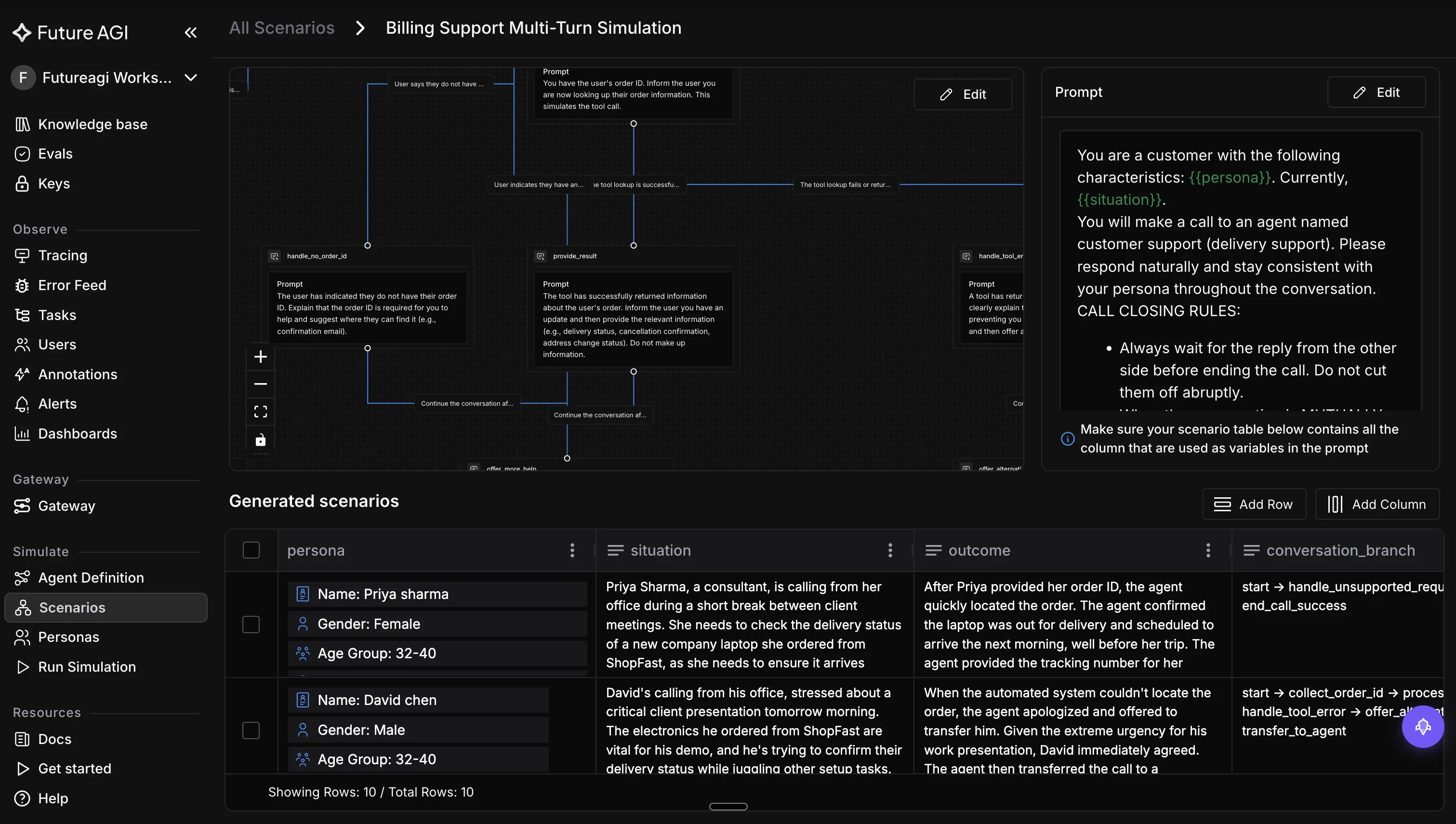
fi.simulate runs persona-driven multi-turn conversations against your agent and scores each turn. Catches failure modes curated datasets miss. For more depth see Simulated Multi-Turn LLM Evaluation.
Common Mistakes and How to Avoid Them
- Scoring only the final output. Use span-level evaluation; multi-agent regressions hide in sub-agents.
- Using a weak judge. turing_flash for high-throughput trend monitoring, turing_large for nuanced grading.
- Not decontaminating eval data. If your eval set appears in your training corpus, your numbers are inflated.
- No human calibration. At least 100 human-labeled examples to calibrate every new rubric.
- Skipping online eval. Offline eval misses drift. Run streaming evals on a sample of production traffic.
- One metric to rule them all. Production quality is multidimensional. Composite metrics, not single numbers.
Wrapping Up
LLM evaluation in 2026 is a core production practice for AI teams, not an afterthought. Pick the framework that matches your stage: Future AGI for one-platform breadth, DeepEval for CI-style testing, RAGAS for RAG-only depth, Phoenix for OTel-native span viewing, OpenAI Evals for OpenAI-native YAML, LangSmith for LangChain-native flows. Future AGI is the broadest single-platform pick that bundles tracing, evaluation, guardrails, simulation, and a BYOK gateway on shared data at futureagi.com.
For deeper reads see What is LLM Evaluation, Best LLM Eval Libraries in 2026, and Best LLM-as-Judge Platforms in 2026.
Frequently Asked Questions
What is LLM evaluation in 2026?
Which LLM evaluation framework should I pick first?
What are deterministic, rubric, and composite metrics?
Should I use LLM-as-a-judge for evaluation?
How do I evaluate a RAG system end to end?
How do I evaluate an agent or multi-agent system?
What are the must-have metrics for production LLM evaluation?
How is online evaluation different from offline evaluation?
Best LLM eval libraries in 2026: rubric registries (FAGI ai-evaluation, DeepEval, Ragas) vs test runners (Phoenix Evals, OpenAI Evals) compared.

FutureAGI, DeepEval, Langfuse, Phoenix, Braintrust, LangSmith, and Galileo as the 2026 LLM evaluation shortlist. Pricing, OSS license, and production gaps.

LLM evaluation is offline + online scoring of model outputs against rubrics, deterministic metrics, judges, and humans. Methods, metrics, and 2026 tools.