LLM Eval vs RLHF Feedback Loops in 2026
How production LLM eval feeds RLHF, RLAIF, and DPO preference tuning: five feedback-loop patterns, six-step eval-driven pipeline, when post-training wins.
Table of Contents
An ML lead at a fintech assistant team pings the eval channel. They have run production traces for nine months, ship a 56-template eval suite, and route 800K conversations a month. The CTO has asked the obvious next question. Can the team take all that eval data and run RLHF on the base model. The answer they want is yes. The honest answer is yes, if the eval and tuning systems were designed to share a dataset shape from the start; no, if eval lives in one repo, observability in another, and preference data was never collected as preference data. This post is for that team. It walks how production eval connects to RLHF, RLAIF, and DPO; the five feedback-loop patterns that name the relationship; the six-step pipeline that turns eval data into a preference dataset; and the conditions under which preference tuning is the right lever versus a distraction.
Why the question keeps coming up
Teams running LLM products at scale hit a ceiling that prompt engineering and retrieval cannot push past. The base model has a behaviour the team wants to change. Tone, refusal patterns, format adherence, calibrated abstention, domain phrasing. Prompt edits can nudge these but cannot lock them in. At that point the team looks at the obvious capability sitting next door: months of production traces, thumbs up and thumbs down, eval scores from 56 templates, and Error Feed clusters of every failure mode. The intuition is correct. That data is exactly the shape preference tuning wants. What teams get wrong is assuming the data is automatically tuning-ready. It is not. Eval data becomes tuning data through a deliberate pipeline; without that pipeline the same data is too noisy, too sparsely labelled, and too biased toward the easy cases to drive a stable RLHF or DPO run.
The canonical relationship: eval generates the signal, tuning consumes it
Preference tuning needs a dataset of (prompt, chosen_response, rejected_response) tuples with optional margin and metadata. Eval pipelines generate exactly that signal in four places.
| Eval signal | Becomes | Notes |
|---|---|---|
| Production thumbs up vs thumbs down on same prompt | Preference pair label | High volume, noisy on the why |
| Rubric scores (per template) | Continuous quality signal thresholded into pairs | Cleanest signal; uses the rubric the team already trusts |
Error Feed cluster (failure + immediate_fix) | Canonical pair: cluster exemplar = rejected, fix = chosen | Highest leverage per pair |
| LLM-judge labelled A vs B | RLAIF preference pair | Scales to millions; needs calibration against human holdout |
The eval stack is the input layer. The trainer is downstream. Treating the two as separate systems is the most common failure mode in this space.
The five feedback-loop patterns
The literature names five patterns. They differ in who labels the preference and how the signal is consumed.
RLHF
Humans label A vs B preferences across thousands of prompts. The labels train a reward model. The policy is then optimised against the reward model with PPO or GRPO. This is the InstructGPT recipe and the path that most aligned chat models follow. Cost is high because of the human annotation step. Quality is high if the annotator pool is calibrated. Your eval-team labelled hold-out set and your production thumbs up and thumbs down both feed this. Annotator agreement (kappa) on a calibration subset is the gate; do not feed pairs into the reward model that the annotators themselves disagree on at random.
RLAIF
An LLM judge replaces the human labeller. Given a prompt and two candidates the judge picks chosen under a rubric. ai-evaluation’s CustomLLMJudge with grading_criteria is the production surface for this in the FAGI stack. RLAIF scales to millions of pairs cheaply but inherits the judge’s biases. Calibrate the judge against a human holdout before you trust its labels. Most RLAIF failures we see trace back to skipping calibration.
DPO
Direct Preference Optimization consumes the same (prompt, chosen, rejected) data as RLHF but skips the reward model. The policy is optimised directly on the preference pairs with a KL-anchored loss. DPO is more sample efficient than full RLHF, easier to debug, and has become the default for teams that do not have a dedicated RL stack. Your preference dataset format is identical to the RLHF format; only the trainer changes.
Constitutional AI
The model self-critiques against a written constitution. The critique becomes the preference signal. Eval rubrics are the natural input here: the same rubric a Groundedness or AnswerRefusal evaluator runs in production becomes a constitution clause for self-critique during training. Useful for high-stakes refusal calibration and harmlessness work.
GRPO and PPO variants
RL methods that consume an eval score as the reward signal directly. Per-trace eval scores from the ai-evaluation SDK become the reward. This is the closest path to “use your existing eval as the reward function” but it inherits every weakness of the rubric. A noisy rubric becomes a noisy reward and the policy chases artefacts. The gate is rubric quality first, then RL.
How eval data feeds the loop in the FAGI stack
The Future AGI eval stack produces preference-shaped data across the surfaces below. The trainer is downstream; FAGI provides the input layer.
Production thumbs up and thumbs down via the Platform. Self-improving evaluators retune from in-product thumbs up and down. The same thumbs feed the preference dataset directly: same prompt, two outputs, one positive label, one negative.
Evaluator(...).evaluate(...) rubric outputs as reward signal. The ai-evaluation SDK exposes 60+ EvalTemplate classes (Groundedness, ContextAdherence, Completeness, TaskCompletion, Toxicity, PromptInjection, IsHarmfulAdvice, and the rest). Per-trace scores become per-trace rewards for GRPO or PPO. The scores also threshold cleanly into chosen vs rejected pairs for DPO.
Error Feed clusters as the curated preference dataset. Every failing trace clusters into a named issue via HDBSCAN over ClickHouse-stored embeddings. A Claude Sonnet 4.5 Judge agent writes the diagnosis and an immediate_fix. Each cluster yields a canonical pair: the failure trace is the rejected example, the immediate_fix rewrite is the chosen example. This is the highest-leverage source of preference data in the stack because each cluster already isolates a real failure mode.
CustomLLMJudge with grading_criteria as the RLAIF labeller. The judge runs over millions of trace pairs and emits preference labels. The four distributed runners (Celery, Ray, Temporal, Kubernetes) parallelise the labelling. This is the production RLAIF labelling pipeline.
traceAI session-level and user-level grouping for per-session preference inference. Sessions that resolved (the user accomplished the goal) are chosen against sessions that did not, holding the prompt class fixed. This gives you outcome-grounded preference data instead of per-turn faithfulness pairs.
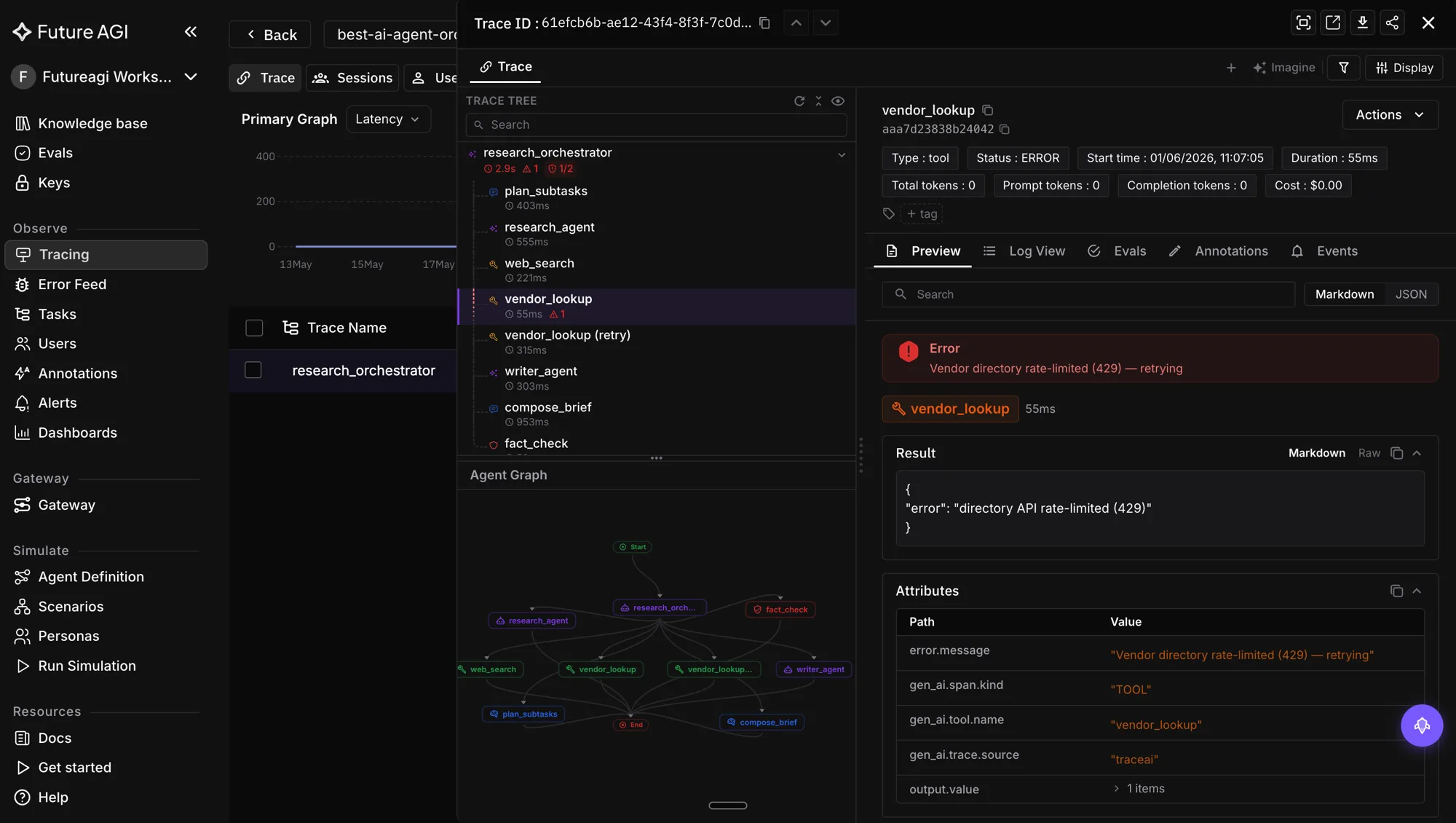
Six agent-opt optimizers as the inference-time complement. Bayesian Search, Meta-Prompt, ProTeGi, GEPA, Random Search, and PromptWizard edit prompts, not weights. They are the cheaper, reversible lever you reach for before RLHF. Run them first; use preference tuning when prompt-side gains run out.
Platform self-improving evaluators retune classifier thresholds. This is closer to tuning than to prompt optimization. Lower per-eval cost than Galileo Luna-2 means weekly recalibration is the default, not a budget decision.
Honest framing: the trace-stream-to-agent-opt connector is on the roadmap. Eval-driven optimization on prompts ships today via the six optimizers. Self-improving evaluators retune classifier thresholds today. The traceAI to dataset connector that pipes production traces directly into a preference dataset is the active integration item. Linear is the only Error Feed integration in production today; Slack, GitHub, Jira, and PagerDuty are on the roadmap.
The six-step pipeline: eval data to a working preference dataset
Step 1: collect production traces with thumbs up and down via traceAI
Instrument with traceAI (Apache 2.0, 30+ documented integrations across Python and TypeScript, OpenInference-compatible spans). Capture user feedback as a span attribute on the final response span. The span tree is now ready to drive both eval and preference labelling without a separate ingestion path.
Step 2: score each trace with the template suite
Run the relevant EvalTemplate subset on every trace. For a support assistant the working set is Groundedness, ContextAdherence, Completeness, TaskCompletion, AnswerRefusal, Toxicity. Scores attach to spans as OTel attributes. The trace tree carries the rubric scores alongside the response.
Step 3: pair high-rated and low-rated outputs into preference pairs
Two paths. Path A: for the same prompt class, take a high-rubric-score trace as chosen and a low-rubric-score trace as rejected. Path B (higher leverage): use Error Feed clusters. Each cluster gives you a failure exemplar (rejected) and the Judge-written immediate_fix rewrite (chosen). Path B beats Path A on signal-to-noise because the cluster already isolates a single failure mode.
Step 4: validate preference labels with annotator agreement
Sample 500 to 1,000 pairs from the candidate set. Run two or three annotators per pair. Compute Cohen’s kappa or Krippendorff’s alpha. Discard pairs below kappa 0.5; pairs in the 0.5 to 0.7 band go into a review queue; pairs above 0.7 enter the training set. This step kills the noisiest signal before it becomes a permanent model behaviour.
Step 5: run DPO or RLHF training on the preference dataset
Export the curated pairs as JSONL with fields prompt, chosen, rejected, plus metadata (eval scores, cluster id, source). Pass to the trainer of choice: TRL, axolotl, Unsloth, llama-factory, or an in-house stack. DPO is the default starting point in 2026; reach for full RLHF only if you have an existing reward-model pipeline. Hold out a 10% slice for offline evaluation of the tuned policy.
Step 6: evaluate the tuned model with the same template suite
Run the same EvalTemplate suite from Step 2 on the tuned model. The rubric set is identical; only the policy under test changed. Ship the tuned model if rubric scores improve, safety metrics hold, and the held-out preference accuracy clears the floor. Roll back if the model gains average rubric but loses on a critical sub-metric (refusal correctness, factual grounding). The eval stack is the gate in both directions.
When eval-to-tuning makes sense
The honest decision framework is narrower than the marketing material suggests.
Yes. High-volume production deployment (north of 100K conversations per month) with a clear quality SLA, an established eval discipline (rubrics that the team trusts, calibrated against human labels), and a stable rubric set that has not changed in the last quarter. Preference data is dense enough that the noise floor is below the signal. The base model has a behaviour the team cannot fix with prompts or retrieval alone.
Maybe. Newer product without enough production traffic to generate preference data densely. Consider synthetic preference generation via CustomLLMJudge over a curated prompt set. Treat the synthetic-labelled dataset as a warm start, then top up with production pairs as traffic grows. Expect a calibration gap; tune on the synthetic set conservatively.
No. Pre-launch, no preference data, no production traffic. Use a frontier base model and eval-driven prompt optimization (the six agent-opt optimizers) instead. Cold start. Same prescription: frontier model plus prompt optimization plus retrieval. Too small a volume; preference labels are too noisy to be worth the train-eval-rollback cycle cost. Per-tenant tuning at scale; operational complexity dominates the quality gain except in regulated verticals.
Anti-patterns we have seen lock in production regressions
Tuning on eval scores without verifying the rubric first. A noisy rubric becomes a noisy reward function. The policy learns to chase artefacts in the rubric instead of user value. Gate: re-calibrate the rubric against a human-labelled hold-out before any preference-tuning run. Why LLM as a Judge in 2026 covers the calibration discipline.
Separate eval and tuning teams with separate rubrics. The eval team scores production with rubric A; the tuning team trains against rubric B. The tuned model improves rubric B and the production rubric A reports the same scores as before. Shared rubric definitions, versioned in one place, are the only path that closes this gap.
RLHF as the first quality lever. Prompt optimization, retrieval improvements, classifier routing, and model cascades are faster, cheaper, and reversible. Try prompt optimization at scale and retrieval fixes before you touch weights. LLM Eval vs Fine-Tuning: When to Do What in 2026 is the broader decision framework.
Ignoring annotator agreement on preference labels. If three annotators flip a coin on a pair, that pair is teaching the model coin-flip behaviour. Kappa above 0.7 on the training-set band. Always.
Tuning per tenant in a multi-tenant product. N policies for N customers becomes an N-way regression matrix overnight. The economics rarely justify it outside regulated verticals (healthcare, legal, financial advice) where the customer-specific behaviour is the product. Default: single tuned policy plus per-tenant prompting plus per-tenant retrieval.
What a healthy eval-to-RLHF loop looks like
Five properties show up in every team we have seen close the loop without locking in regressions.
- Shared rubric definitions in one repo. The rubric file that scores production scores the tuned-model evaluation. One source of truth.
- Preference pairs come from clusters, not raw traces. Error Feed clusters yield denser signal per pair than uniform random sampling over traces.
- Annotator review on the low-margin band. Pairs where the rubric scores differ by less than the rubric’s known noise floor go through human review before training.
- Hold-out preference accuracy as a release gate. The tuned model has to beat the base model on a held-out preference set, and on rubric averages, before it ships.
- Production rollback path. Weight changes are slower to roll back than prompt changes. A canary plus an explicit rollback policy plus a small slice of traffic on the previous policy at all times. Tuning is not a one-way door, but it is closer to one than prompt edits.
Three tradeoffs the brochure does not name
Preference tuning makes regressions slower to fix. A bad prompt is a one-line PR. A bad weight update is a re-train. Plan for an extra rollback hop in the runbook.
Self-improving rubrics introduce their own drift. A rubric that retunes itself from production thumbs can drift in unexpected directions. Pin a human-labelled hold-out; alarm when the judge disagrees with the hold-out by more than the inter-rater baseline. Evaluating LLM Judge Bias and Mitigation in 2026 walks the failure modes.
RLAIF scales the labelling cost but caps the quality at the judge’s calibration. If your judge is an LLM at the same capability tier as the policy, the ceiling is the judge’s ceiling. Use a stronger model as the judge than the model being tuned, or accept a quality plateau.
Where this connects in the FAGI stack
The eval and labelling layer is the input to whichever trainer your team owns. The deliverable from FAGI is a JSONL of prompt, chosen, rejected, plus per-pair metadata (eval scores, cluster id, judge confidence, annotator kappa). The trainer is TRL, axolotl, Unsloth, llama-factory, or in-house; the eval stack is agnostic.
The ai-evaluation SDK (Apache 2.0) is the code-first surface for rubric scoring and CustomLLMJudge RLAIF labelling: 60+ EvalTemplate classes, real Evaluator(fi_api_key=..., fi_secret_key=...).evaluate(...), 13 guardrail backends, four distributed runners (Celery, Ray, Temporal, Kubernetes). traceAI is the trace and feedback ingestion layer: 30+ documented integrations across Python and TypeScript, OpenInference-compatible spans, dedicated voice packages (traceAI-pipecat, traceai-livekit).
The Future AGI Platform is where the higher-leverage surfaces live. Self-improving evaluators retune from in-product thumbs up and down; the same thumbs feed the preference dataset. Error Feed clusters production failures into named issues with a Claude Sonnet 4.5 Judge writing the immediate_fix, and each cluster produces a canonical chosen-vs-rejected pair. Classifier-backed evals run at lower per-eval cost than Galileo Luna-2, which keeps the per-trace labelling cost low enough that RLAIF over millions of pairs is feasible without a budget conversation.
Eval-driven optimization on prompts ships today via agent-opt (six optimizers: Bayesian Search, Meta-Prompt, ProTeGi, GEPA, Random Search, PromptWizard). These are the cheaper, reversible lever to reach for before preference tuning. The traceAI to dataset connector that pipes production traces directly into a preference dataset is the active roadmap item; today the path is via Error Feed cluster export and dataset promotion.
The honest version of the story is that FAGI is the labelling and rubric layer, not the trainer. The eval-to-RLHF pipeline is a workflow your team operates; FAGI is the input layer that makes the workflow feasible.
Related reading
- LLM Eval vs Fine-Tuning: When to Do What in 2026
- Evaluating Fine-Tuned LLMs in 2026
- Fine-Tuning Pipeline Evaluation in 2026
- Why LLM as a Judge in 2026
- Evaluating LLM Judge Bias and Mitigation in 2026
- Prompt Optimization at Scale in 2025
- Self-Improving AI Agent Pipeline
- Your AI Agent Passes Evals But Still Fails in Production
Frequently Asked Questions
Can my LLM eval data drive RLHF or DPO directly?
What is the difference between RLHF, RLAIF, and DPO?
Should I do RLHF before prompt optimization?
How many preference pairs do I need for DPO?
Can production thumbs up and thumbs down replace human annotators?
What role does the LLM judge play in RLAIF?
Does FAGI run RLHF or DPO training itself?
When eval-driven prompt optimization is enough vs fine-tuning, the seven decision axes, and the five-step path that ships most teams without retrain.

Fine-tune eval in 2026 without the theatre: four-set gap, paired arena against base, bootstrap CI math, CI gate in code, production canary on spans.

2026 guide to fine-tuning LLMs: LoRA vs QLoRA, DPO vs RLHF vs GRPO, and when to fine-tune open-weight models instead of prompting alone.
