Prompt Optimization at Scale in 2026: Why Manual Tuning Fails and Which Platforms Replace It
Manual prompt tuning fails past 50 variants. Compare Future AGI, Promptfoo, LangSmith, and Datadog for 2026 automated prompt optimization at scale.
Table of Contents
Prompt Optimization at Scale in 2026: The TL;DR
| Question | Answer |
|---|---|
| When does manual tuning fail? | Beyond ~50 variants across 2+ models. Audit trails, reproducibility, and regression detection all break. |
| What replaces it? | Automated pipelines that generate variants, score them with evaluators, and promote winners through CI. |
| Best 2026 platform if you want managed infra | Future AGI Prompt Optimization with BayesianSearchOptimizer plus traceAI observability. |
| Best 2026 platform if you want full local control | Promptfoo (open-source CLI, YAML configs). |
| Best 2026 platform if you live in LangChain | LangSmith Prompt Playground. |
| Best 2026 platform if you already run Datadog | Datadog LLM Observability with prompt eval checks. |
| How fast can you converge? | Bayesian search converges in 10-30 iterations vs 100+ for random search on 3-component prompts. |
Why Manual Prompt Engineering Is Now Hurting Production AI
In 2023, prompt engineering looked like editing a Notion doc. In 2026, it looks like running a search algorithm. The shift happened because three things stacked on top of each other.
First, the model surface area exploded. A single product team now ships prompts against GPT-5, Claude Opus 4.7, Gemini 3.x, and at least one open-weights model (Llama 4.x or Qwen 3). Each model parses instructions differently. A prompt that scores 0.92 on GPT-5 can score 0.71 on Claude Opus 4.7 without any wording change.
Second, the prompts themselves got longer. A 2023 customer-support prompt was 200 tokens. A 2026 RAG-plus-tool-use prompt is 4,000 tokens with system instructions, tool schemas, retrieved context, and few-shot examples. Manual edits to 4,000-token prompts produce side effects you cannot see by reading.
Third, base models keep moving. GPT-5 ships patch releases monthly. Claude rolls out 4.x point updates roughly every 6-8 weeks. Each release changes the response distribution. Hand-tuned prompts go stale silently.
If your team ships LLM features weekly and edits prompts by feel, the regression rate is high and you cannot prove it because there is no audit trail.
What Breaks First When You Scale Manual Prompting
Five concrete failure modes show up in order:
- No reproducibility. A prompt that worked in staging cannot be recreated because the exact text lives in someone’s slack scrollback.
- No audit trail. When a customer reports a hallucination, you cannot say which prompt version was live and who shipped it.
- Fragile outputs. Reordering two sentences changes accuracy by 8 points. You discover this after deployment.
- Model drift. Provider pushes a base-model patch. Your evaluation score drops 5 points. You find out from a customer.
- Cost creep. Each engineer maintains their own variants. You pay for redundant API calls running ad-hoc experiments.
These compound. By the time you have 50 prompts across 2 models, you cannot answer “is this prompt better than last week’s?” without rebuilding the test infrastructure from scratch.
The Automated Prompt Optimization Loop
A working 2026 loop has four stages. Skip any one and you regress to manual tuning.
1. Test Suite Construction with Adversarial Generation
You need a frozen evaluation set with three properties: representative of production traffic, large enough to be statistically meaningful (typically 100-500 examples), and updated when production drifts.
Use adversarial generators to seed edge cases. The pattern: take 50 representative examples, then synthesize perturbations (paraphrases, typos, hostile inputs, malformed JSON requests) using a strong base model. This catches failure modes that manual test-writing misses. See the OpenAI evals harness and Promptfoo redteam for implementation patterns.
2. Variant Generation
Three approaches dominate in 2026:
- Template combinatorial search. Define a baseline prompt with 3-5 tunable slots (system instruction style, example count, format directive, persona). The optimizer searches the combinatorial space.
- Meta-prompting loops. An LLM proposes new variants conditioned on past scores. Variant of OPRO. Works well when the search space is open-ended. The automated prompt improvement guide compares six optimizers that implement this pattern.
- Soft-prompt or prefix tuning. For open-weights models, train continuous embeddings using Hugging Face PEFT. Less common in production than the first two.
3. Scoring at Scale
Combine structural metrics, semantic metrics, and judge-based metrics. Single-metric scoring loses signal.
# Future AGI evaluator example
import os
from fi.evals import evaluate

os.environ["FI_API_KEY"] = "your_key"
os.environ["FI_SECRET_KEY"] = "your_secret"

# Faithfulness check using turing_flash (~1-2s)
result = evaluate(
    "faithfulness",
    output="The patent expires in 2027.",
    context="Patent issued 2007 with 20-year term.",
    model="turing_flash",
)

print(result.score, result.reason)
For custom rubrics, wrap an LLM judge through the metrics module:
from fi.evals.metrics import CustomLLMJudge
from fi.evals.llm import LiteLLMProvider

judge = CustomLLMJudge(
    provider=LiteLLMProvider(model="gpt-5"),
    rubric=(
        "Score 1-5 on whether the response answers the user question "
        "without inventing facts. 5 = grounded and complete. 1 = hallucinated."
    ),
)

score = judge.evaluate(
    output="The 2027 expiration is correct under the 20-year rule.",
    context="Patent issued 2007 with 20-year term.",
)
4. Optimization Loop with Regression Gates
Wire scoring into a search algorithm. For Future AGI users, the optimizer lives in fi.opt:
from fi.opt.base import Evaluator
from fi.opt.optimizers import BayesianSearchOptimizer

evaluator = Evaluator(metric="faithfulness", model="turing_small")
optimizer = BayesianSearchOptimizer(
    evaluator=evaluator,
    search_space={
        "system_prompt_style": ["formal", "concise", "step-by-step"],
        "few_shot_count": [0, 2, 4, 8],
        "format_directive": ["json", "markdown", "plain"],
    },
    max_iterations=30,
)

best_prompt = optimizer.run(dataset="data/eval_set.jsonl")
The optimizer scores each candidate, fits a Gaussian process to score history, and proposes the next candidate using expected improvement. For 3-component search spaces it converges 3-5x faster than random search.
The promotion gate is the last piece. A new prompt only ships if it beats the current production prompt on a held-out test set by a configurable margin (typically 1-2 score points). traceAI logs every evaluator run so you can audit which prompt was live for any given request.
Automated Prompt Optimization Tools in 2026: Compared
1. Future AGI Prompt Optimization
Future AGI’s Prompt Workbench and Optimization suite cover the full loop in one platform.
What you get:
- BayesianSearchOptimizer exposed as
fi.opt.optimizers.BayesianSearchOptimizerfor offline search. - Hosted evaluators (faithfulness, groundedness, instruction-following, plus custom CustomLLMJudge) with cloud latency tiers: turing_flash ~1-2s, turing_small ~2-3s, turing_large ~3-5s.
- traceAI observability (Apache 2.0) for production traces correlated with prompt versions.
- Agent Command Center at
/platform/monitor/command-centerfor live monitoring of production prompt behavior.
Best for: enterprise teams that want managed infrastructure, audit trails for compliance, and a single platform for prompt search plus production monitoring.
2. Promptfoo
Promptfoo is a widely adopted open-source CLI (github.com/promptfoo/promptfoo). Tests live in YAML files next to your code. CI integration is straightforward.
What you get:
- YAML or JSON test definitions, assertions on output content, structure, and model-grader scores.
- Local execution with caching, concurrency, and a web viewer.
- Plugin ecosystem for custom evaluators.
Best for: teams that want full local control, infra-light setups, and prompts versioned in git alongside test files.
3. LangSmith
LangSmith is LangChain-native and has a dedicated Prompt Playground for bulk evaluation without code.
What you get:
- Prompt playground with dataset binding and bulk runs.
- Built-in evaluators (correctness, conciseness, custom rubrics) and trace correlation with LangChain apps.
- Dashboards for metric trends.
Best for: teams already on LangChain or LangGraph that want direct integration with the same SDK.
4. Datadog LLM Observability
Datadog LLM Observability extends Datadog’s APM into the LLM layer.
What you get:
- Prompt-level traces alongside existing infra and application metrics.
- Out-of-the-box checks for prompt injection, PII leakage, hallucination signals.
- Alerting hooks into the same incident channels as the rest of your stack.
Best for: production-monitoring-first teams that want LLM quality on the same panes as latency and error rates.
Side-by-Side Comparison
| Tool | Optimizer | License | CI integration | Best fit |
|---|---|---|---|---|
| Future AGI | BayesianSearchOptimizer + custom evaluators | Open-source SDK (Apache 2.0) + managed cloud | Python evaluators in GH Actions or any runner | Enterprise + audit + traceAI observability |
| Promptfoo | Grid + adversarial | MIT | YAML configs in any CI | Infra-light, full local control |
| LangSmith | Manual variants + dataset bulk runs | Commercial SaaS (docs) | LangChain SDK | LangChain-native teams |
| Datadog | None first-party (uses external evals) | Commercial SaaS (docs) | Datadog Agent + APIs | Production-monitoring-first |
Why Future AGI Leads for Enterprise Prompt Optimization
Future AGI combines all four loop stages (variants, scoring, search, gating) into one managed workflow with explicit audit trails and a single SDK.
Concrete advantages:
- Bayesian search out of the box. No glue code between optimizer and evaluator.
- Open-source eval library.
ai-evaluationis Apache 2.0. You can run evaluators locally or against the hosted cloud. - traceAI for production correlation. Every production request can be tied back to the prompt version that generated it. traceAI ships Apache 2.0 instrumentation for LangChain, OpenAI Agents, LlamaIndex, and MCP.
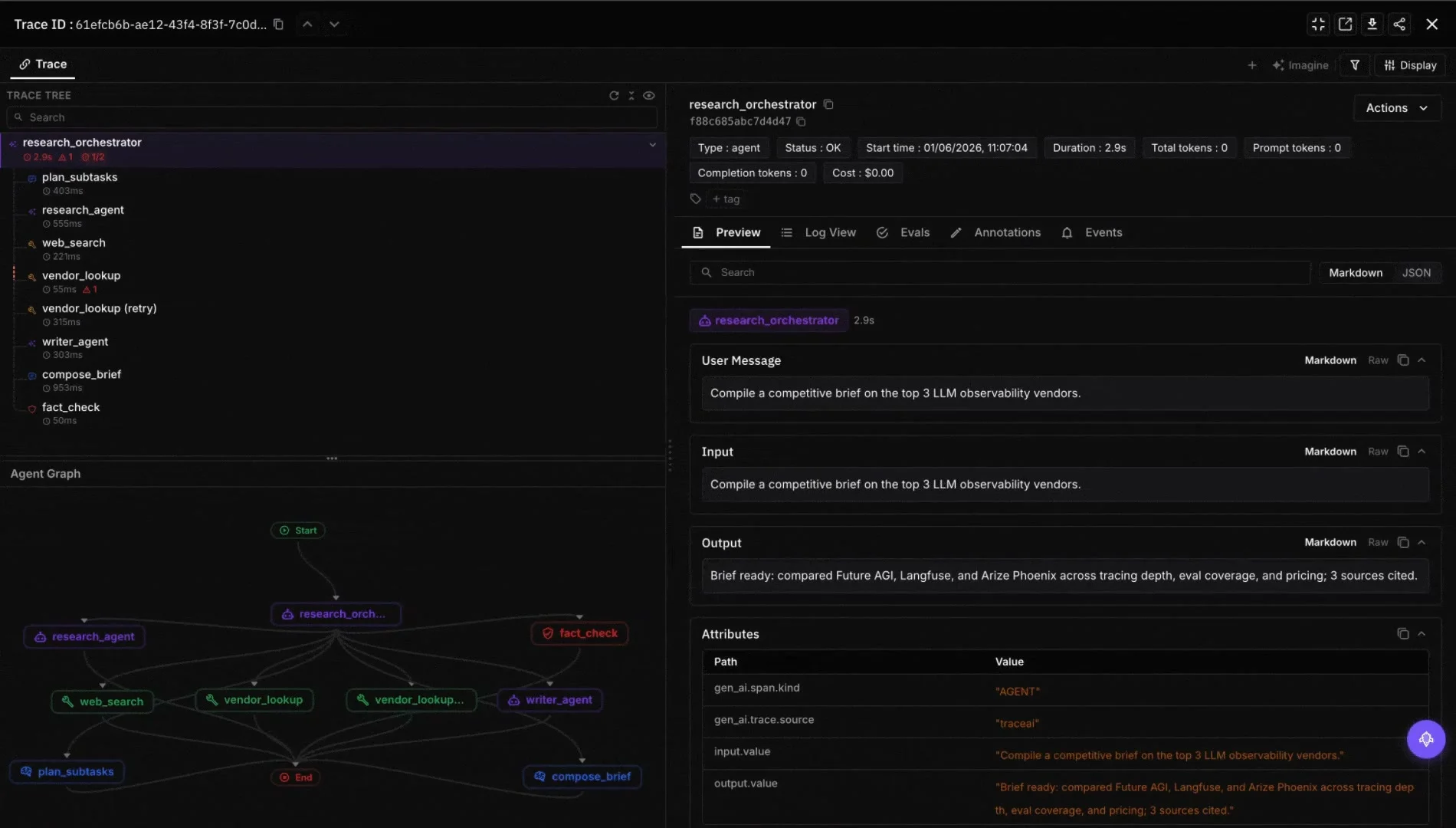
- Agent Command Center. A real-time dashboard at
/platform/monitor/command-centershowing prompt-version-tagged production metrics.
If you need search plus production observability in one stack, Future AGI is the cleanest path.
From Manual to Measurable: Where to Start
Three concrete steps to move off manual prompting in 90 days:
- Week 1-2. Pick one high-traffic prompt. Build a frozen 100-example evaluation set. Score the current prompt with a faithfulness or task-accuracy evaluator. This becomes your baseline.
- Week 3-6. Run a small search (10-30 iterations) over 2-3 prompt components. Use Future AGI BayesianSearchOptimizer or Promptfoo grid. Promote if you beat baseline by 2 points.
- Week 7-12. Wire the evaluator into CI. Every PR that touches a prompt or model config runs the evaluator. Block merges on regression following the prompt regression testing pattern. Tag production requests with prompt version in traceAI.
After 90 days, you have a working loop. After 6 months, you have an audit trail that holds up under compliance review.
Ready to run automated prompt optimization across your model chain? Explore Future AGI’s Prompt Optimization Suite and read the evaluations SDK on GitHub. Book a demo for a walkthrough on your own prompts and evaluators.
Frequently Asked Questions
What is automated prompt optimization?
When does manual prompt tuning break down?
How do you score prompt performance in 2026?
What is the BayesianSearchOptimizer in fi.opt?
How do regression-safe pipelines manage model upgrades?
How can prompt tests be integrated into CI/CD?
What is OPRO and does it replace manual prompting?
How is prompt optimization different from fine-tuning?
Top 10 prompt optimization tools in 2026 ranked: FutureAGI, DSPy, TextGrad, PromptHub, PromptLayer, LangSmith, Helicone, Opik, DeepEval, Prompt Flow.

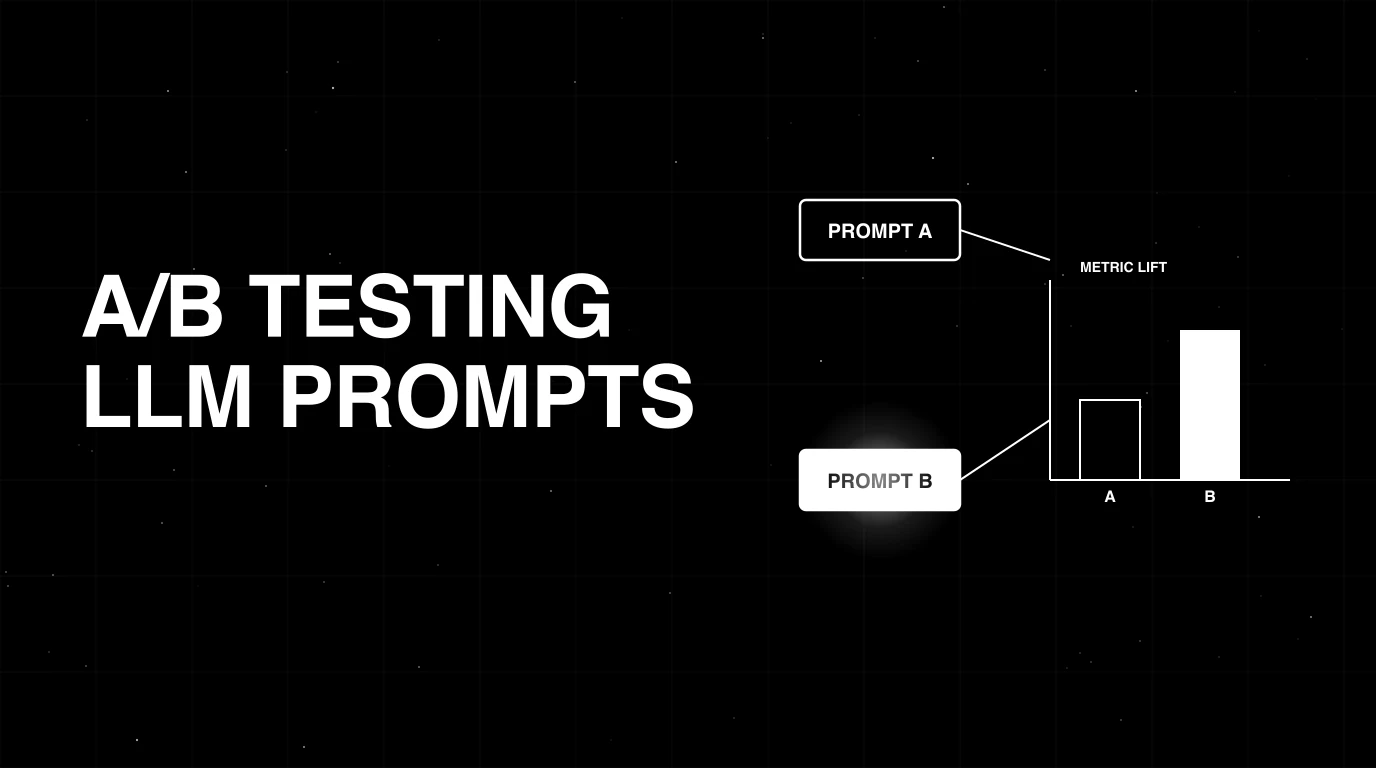
A/B testing LLM prompts without power analysis is theater. The 2026 playbook: MDE, sample sizing, matched pairs, bootstrap CIs, bandits, and rollout.

DSPy, FutureAGI Prompt Optimizer, PromptFoo, OpenAI Playground, Helicone Prompts, Braintrust Prompts, plus tradeoffs for 2026 prompt engineering workflows.