LLM Eval Budget Allocation and Prioritization in 2026
Eval budget is four knobs: rubric coverage, dataset size, judge tier, refresh cadence. Priority order that maximizes signal per dollar, with a 90-day plan.
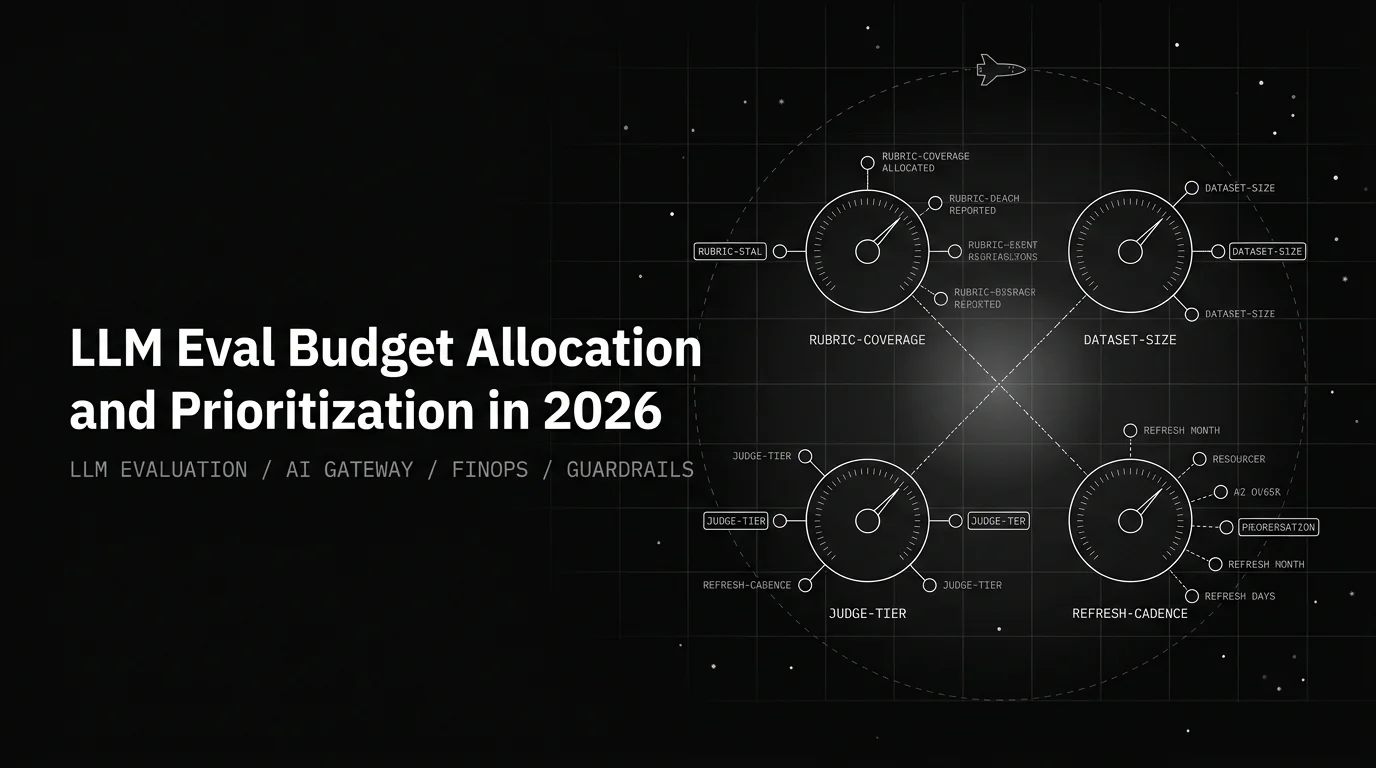
Table of Contents
Most eval programs spend in the wrong order. The first dollar goes to a frontier judge and a long rubric list. The dataset stays at 200 rows of whatever the team had lying around. The refresh runs nightly because nightly sounds responsible. The bill grows, the signal does not. The team that picks a stratified 500-row dataset with a deterministic floor and one well-calibrated judge on three rubrics ends up with more usable signal at a fraction of the cost.
Eval budget is not a single number. It is a ratio of four knobs over cost, and the priority order across those knobs is what separates eval programs that catch regressions from eval programs that catch tokens.
The thesis: four knobs, one ratio
The budget formula:
eval signal = (rubric coverage x dataset size x judge tier x refresh cadence) / costEvery dollar of eval spend buys something on the numerator. The question is which term is undersupplied. Most teams over-invest in rubric tier (frontier judge, ten rubrics) and under-invest in dataset diversity (stratified cohorts, refresh on change events). The right priority order:
- Stratified dataset — coverage across the cohorts your production traffic actually contains.
- Deterministic floor — heuristic and classifier checks for the failures you should never miss.
- Calibrated judge — one judge tuned well on the rubrics that need reasoning.
- Rich rubric set — additional rubrics once the first three are healthy.
The rest of this post is the four knobs, why the order is what it is, the risk-adjusted version when you have regulated surfaces, and a 90-day plan that ships in priority order.
The four-knob model
Each knob buys signal on a different axis. The cost of turning one up is independent of the others, but the marginal signal each one produces depends on whether the others are healthy.
Knob 1: rubric coverage
Rubric coverage is the breadth of dimensions you measure. Groundedness, factual accuracy, refusal, toxicity, completeness, task completion, persona consistency, latency, cost. Each is one rubric. Coverage scales with the number of rubrics you actually run on each trace.
The marginal signal from rubric coverage is logarithmic. The first three rubrics catch the dominant failure modes. The fourth through tenth catch the long tail. Beyond ten, you are mostly measuring the same failure cluster from different angles. Most production agents do not need more than five to seven rubrics.
Knob 2: dataset size
Dataset size is the count of traces you score. The trap is that raw count matters less than stratification. A flat 1,000-row dataset that is 80 percent one persona produces a confident wrong number on the other 20 percent. A stratified 500-row dataset with 100 rows per persona produces a useful number across the board.
The marginal signal from dataset size scales with cohort coverage. Adding 200 rows to a cohort you already have 300 rows on is logarithmic return. Adding 50 rows of a cohort you had zero rows on is linear return until you saturate.
Knob 3: judge tier
Judge tier is what you pay per call. A regex check costs zero. An open-weight classifier (LLAMAGUARD_3_8B, QWEN3GUARD_8B, GRANITE_GUARDIAN_8B, WILDGUARD_7B, SHIELDGEMMA_2B) costs 100 to 1000x less than a frontier judge per call. A frontier judge costs $0.003 per call at typical eval payload sizes.
Judge tier signal scales with rubric type. On closed-set rubrics (toxicity, refusal, PII, topic restriction), the classifier matches or beats the frontier judge because the task is classification, not reasoning. On open-ended rubrics (groundedness, task completion, instruction adherence), the frontier judge earns its cost because the rubric is reasoning over context. Buying frontier tier on closed-set rubrics is a category error.
Knob 4: refresh cadence
Refresh cadence is how often you re-score. Every PR. Nightly batch. Weekly regression. Live sampling at 1, 10, or 100 percent. Backfills when a rubric or judge changes.
Cadence signal scales with the rate of change in the underlying system. If the prompt has not changed in three weeks, nightly is wasteful. If you ship prompt changes daily, every-PR is correct. If a new persona just hit production, a one-time refresh on that cohort is more valuable than ten nightly batches before anything changed.
Why most teams turn the wrong knob first
The default eval program looks like this: pick five rubrics from a library, run them through a frontier judge on whatever 200-row dataset the team had from the prototype, schedule the suite nightly. The bill arrives, the team is surprised, the team cuts sampling rate. Signal degrades because sampling was the wrong knob to cut.
Three failure modes show up.
Frontier judge on a thin dataset. The judge is precise on each trace and biased across cohorts. The team gets a high-confidence wrong answer because the dataset never represented the production mix. Doubling the judge spend does nothing; broadening the dataset is the fix.
Rich rubric set on a flat dataset. Adding rubrics six through ten on a dataset that is 80 percent one persona produces ten correlated scores. The marginal information from rubric ten is near zero because the cohort variance is masking the rubric variance.
Nightly cadence on a static prompt. The score does not move because the system did not change. The team pays for compute on a converged signal and dashboards become noise. Cutting cadence is the fix; the dataset and rubric set are fine.
The common thread: teams turn the knob that is easiest to turn (add a rubric, raise the judge tier, increase cadence) instead of the knob that is undersupplied (broaden the dataset, calibrate the judge, tie cadence to change events).
The priority order, explained
Stratified dataset first, deterministic floor second, calibrated judge third, rich rubric set fourth. The order comes from marginal-signal-per-dollar at each stage.
1. Stratified dataset
Dataset breadth has the highest variance in marginal signal because cohort variance is unbounded. A new persona can flip every rubric you already run. Spending a week building a 500-row stratified set with persona, language, route, and tier coverage produces more usable signal than any other single intervention.
Stratify on the dimensions your product already knows: customer tier, persona, language, tool path, route. Allocate 50 to 200 rows per cohort based on production volume and failure rate. Deterministic hash on trace id so cohort membership is stable across refreshes; trend lines should move because the system moved, not because the sample shifted. The LLM evaluation playbook covers the dataset-building pattern in detail.
2. Deterministic floor
Once the dataset is stratified, the next dollar goes to the deterministic checks. Regex for forbidden phrases. Schema validators on structured outputs. Classifier passes on toxicity, refusal, PII, and topic. Latency and cost guardrails on the gateway.
The deterministic floor is cheap per call (sub-10ms, $0.00003 or less per classifier check) and catches the failure modes that are non-negotiable. The Future AGI ai-evaluation SDK ships 13 guardrail backends (9 open-weight: LLAMAGUARD_3_8B/1B, QWEN3GUARD_8B/4B/0.6B, GRANITE_GUARDIAN_8B/5B, WILDGUARD_7B, SHIELDGEMMA_2B; 4 API: OPENAI_MODERATION, AZURE_CONTENT_SAFETY, TURING_FLASH, TURING_SAFETY) for exactly this floor. The deterministic vs LLM-judge evals breakdown covers when each tool wins.
3. Calibrated judge
After the floor is in place, the next dollar goes to one judge calibrated well on the open-ended rubrics. Groundedness, task completion, instruction adherence, helpfulness. These are reasoning rubrics; a classifier cannot reliably score them.
Calibration is the part most teams skip. Score 500 stratified traces with two judges (or the same judge at two temperatures), compute Cohen’s kappa against human labels, tune the prompt or threshold until kappa lands above 0.6. A poorly calibrated frontier judge is worse than a well-calibrated cheaper one because the variance shows up as noise in your dashboards. The LLM-as-judge best practices walks through the calibration loop.
4. Rich rubric set
Only after the dataset, floor, and one calibrated judge are healthy does it make sense to expand the rubric set. Adding rubrics six through ten without the first three in place produces ten correlated half-signals. Adding them once the first three are healthy gives each new rubric room to surface a new failure mode.
The order matters because the rubric set is the cheapest knob to turn and produces the loudest dashboards. Teams add rubrics to feel like they are making progress. The progress is illusory if the dataset is biased or the judge is uncalibrated.
Risk-adjusted priority for regulated surfaces
The four-knob order assumes a standard production surface. Regulated and safety-critical surfaces invert one piece: the deterministic floor moves to position one and becomes non-negotiable before the dataset matters.
A medical-advice agent, a benefits assistant, a payment-flow agent, or any surface with compliance exposure runs a full guardrail stack at 100 percent coverage on day one. The Future AGI Protect and Guardrails primitives at the SDK boundary, plus runtime checks at the Agent Command Center gateway, handle this layer.
Once the floor is locked at 100 percent, the four-knob order resumes for the open-ended rubrics: stratified dataset, then one calibrated judge on groundedness and refusal, then rubric expansion. The cadence on a regulated surface ties to every PR plus continuous live sampling; the cadence on an internal-facing surface ties to change events plus nightly batch.
A reasonable risk-adjusted allocation as a fraction of total eval spend:
| Surface class | Floor | Dataset | Judge | Rubric expansion |
|---|---|---|---|---|
| Regulated / safety-critical | 40% | 25% | 25% | 10% |
| Production customer-facing | 20% | 35% | 30% | 15% |
| Internal-facing | 15% | 45% | 25% | 15% |
| Experimental / playground | 10% | 50% | 25% | 15% |
The shape is the point. Regulated surfaces buy floor first; everything else buys dataset first. The budget tiering pattern covers the cost mechanics under each allocation.
The 90-day plan
If you are starting from a flat eval pipeline, ship in priority order. The plan front-loads dataset and floor because those are the highest-leverage spend; rubric expansion is last because it is the easiest knob to over-turn.
Days 1-30: dataset and floor
Week one: list the cohorts the product already knows about. Persona, language, route, tier, tool path. Sample 50 to 200 rows per cohort using a deterministic hash on trace id. Land 300 to 800 rows total. Store the dataset versioned so refreshes do not move trend lines accidentally.
Week two: ship the deterministic floor. Regex checks for forbidden phrases. Schema validators on every structured output. Classifier passes on toxicity, refusal, PII, and topic restriction using the 13 guardrail backends in the ai-evaluation SDK. Wire the floor to the CI gate and to the gateway runtime.
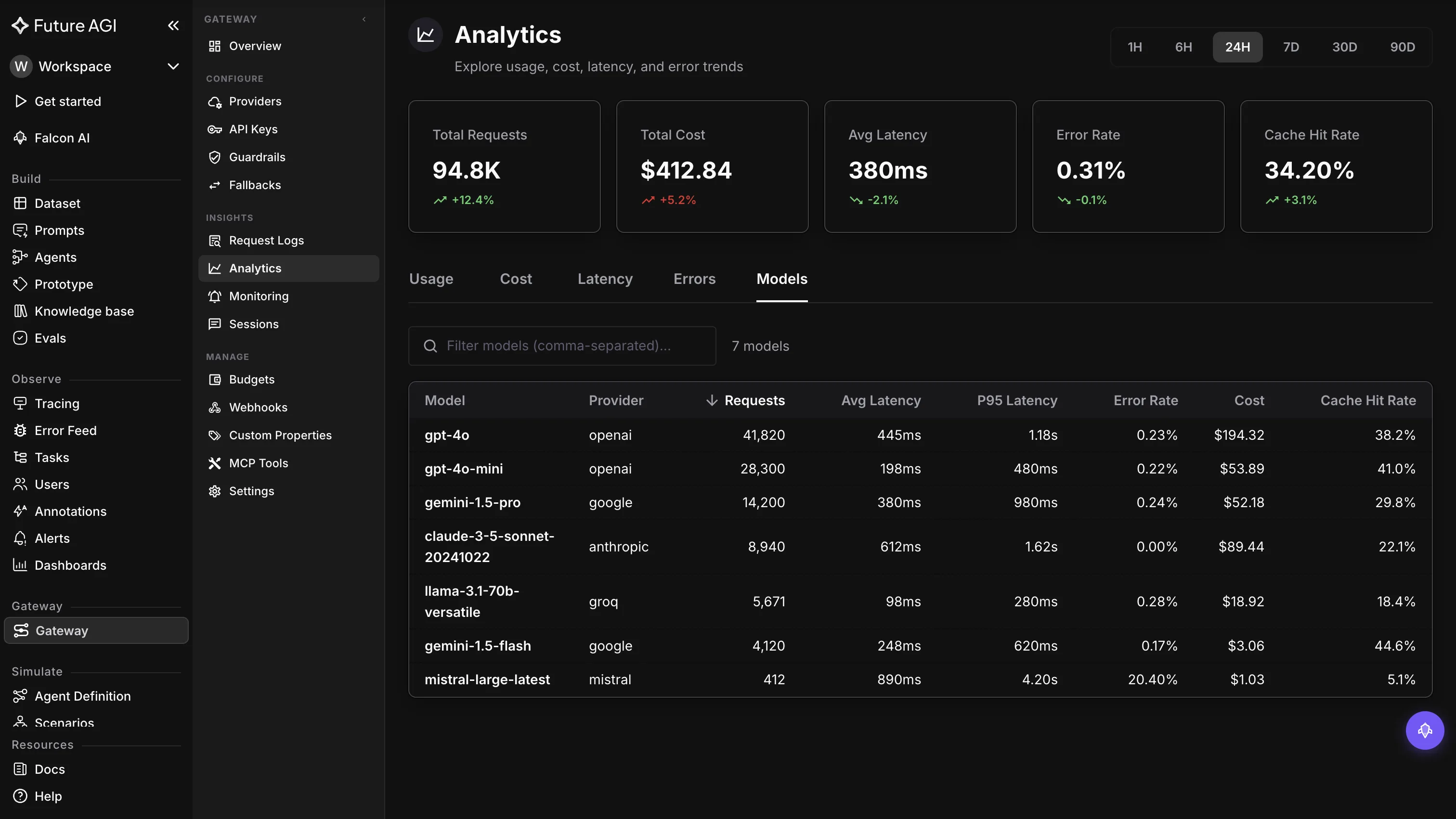
Week three: instrument the gateway so every call carries a tag (x-prism-tag) and the response headers expose x-prism-cost, x-prism-latency-ms, x-prism-model-used, x-prism-fallback-used, x-prism-routing-strategy, x-prism-guardrail-triggered, and x-prism-cache-hit. Per-call telemetry is what makes the rest of the plan auditable.
Week four: set the gateway five-level hierarchical budgets (org, team, user, key, tag). Allocation per the risk-adjusted table above. Alerts fire at 50, 80, and 100 percent of allocation. The AI gateway cost-tracking pattern covers the telemetry plumbing.
Days 31-60: calibrate one judge
Week five: pick one judge for the open-ended rubrics. Sonnet 4.5 is a reasonable default; the BYOK gateway lets you swap at zero platform fee if you have a stronger fit. Run it on the stratified dataset for groundedness, task completion, and instruction adherence.
Week six: calibrate against human labels on 100 to 200 traces. Compute Cohen’s kappa. Tune the rubric prompt, the temperature, and the threshold until kappa lands above 0.6 on each rubric. Park rubrics where you cannot hit 0.6; they need rework before they ship.
Week seven: ship the calibrated judge to CI as a gated check on the stratified dataset. Block PR merges on a score drop beyond the configured min_delta. Use the EarlyStoppingConfig in the SDK to stop the runner once the score has converged within tolerance:
from fi.evals import Evaluator, EarlyStoppingConfig
from fi.evals.templates import Groundedness, TaskCompletion

evaluator = Evaluator(fi_api_key=FI_API_KEY, fi_secret_key=FI_SECRET_KEY)

stopping = EarlyStoppingConfig(
    patience=3,
    min_delta=0.01,
    threshold=0.95,
    max_evaluations=500,
)

result = evaluator.evaluate(
    eval_templates=[Groundedness(), TaskCompletion()],
    inputs=stratified_dataset,
    early_stopping=stopping,
)
Week eight: layer live sampling on top of the CI gate. Deterministic 10 percent on Tier 2 surfaces; 100 percent on regulated. Stratify by tag so all cohorts are represented in the sample.
Days 61-90: rubric expansion and cadence
Week nine: review the dashboards. Which rubrics fire inside active failure clusters? Which fire on noise? The Error Feed in the Future AGI Platform clusters failing traces with HDBSCAN and writes recommendations with a Sonnet 4.5 Judge. Rubrics that never fire inside any cluster have zero diagnostic signal and can be retired.
Week ten: add the next two to four rubrics based on what the dashboards exposed. Persona consistency if the product has a brand voice. Tool-call accuracy if it is agentic. Latency and cost budgets on the gateway.
Week eleven: wire refresh cadence to change events instead of calendar. A new model ships, the regression suite runs. A new persona launches, the dataset gets a new cohort. A new rubric calibrates, a one-time backfill scores history. Nightly batches stay only where the system actually changes nightly.
Week twelve: turn on the cascade. augment=True on every classifier rubric so the LLM judge only runs on borderline cases. Tune augment_threshold per rubric using the cluster signal from the Error Feed. The eval cost optimization patterns cover the three stacked levers (cascade, sampling, caching) that drop the residual bill 80 to 95 percent.
End state: a stratified dataset that covers the production cohorts, a deterministic floor that catches what you should never miss, one calibrated judge on the open-ended rubrics, and a refresh cadence tied to change events. Total spend flat or declining quarter over quarter while coverage on the highest-risk cohorts increases.
Where Future AGI fits
The four-knob model is enforceable today on one runtime instead of three integrations. The cost-efficient eval platform comparison covers the head-to-head against Galileo Luna-2, DeepEval, Phoenix, Langfuse, and Braintrust.
- Dataset. Stratified dataset builders, deterministic hashing, and versioned regression sets in the
ai-evaluationSDK. 60+ EvalTemplate classes, 50+ instrumented AI surfaces viatraceAIacross Python, TypeScript, Java, and C# for the cohort instrumentation.
- Floor. 13 guardrail backends (9 open-weight, 4 API) for the deterministic layer.
ProtectandGuardrailsprimitives at the SDK boundary; runtime checks at the Agent Command Center gateway. Sub-10ms classifier latency. - Judge. BYOK to any frontier model at zero platform fee on the gateway. Turing flash and Turing safety as managed lower-cost evaluators when the open-ended rubric tolerates a smaller judge. Cohen’s kappa tooling and self-improving evaluator retuning in the Platform.
- Cadence. Five-level hierarchical budgets (org, team, user, key, tag) at the gateway.
x-prism-cost,x-prism-cache-hit, and routing headers per call. Error Feed HDBSCAN clusters with Sonnet 4.5 immediate-fix recommendations to retire dead rubrics and tighten the cascade.
Future AGI is the strongest open-source option (ai-evaluation Apache 2.0, traceAI Apache 2.0, agent-opt Apache 2.0) and the strongest enterprise option (BYOK gateway, RBAC, SOC 2 Type II, HIPAA, GDPR, CCPA per futureagi.com/trust; ISO 27001 in active audit). Pricing: free tier includes 50GB tracing, 2K AI credits, 100K gateway requests, 100K cache hits; usage-based after that.
The eval bill is a workload, not a destiny. The four knobs are the workload knobs. Turn them in priority order and the signal-per-dollar moves with you.
Sources
Future AGI pricing · Future AGI trust · ai-evaluation · traceAI · agent-opt · Agent Command Center
Related reading
Frequently Asked Questions
What is the right mental model for eval budget?
What is the priority order across the four knobs?
Why does dataset diversity beat a richer rubric set?
How do you size the dataset stratification?
When does a frontier judge actually earn its keep?
How often should the rubric refresh cadence run?
What is the 90-day allocation plan?
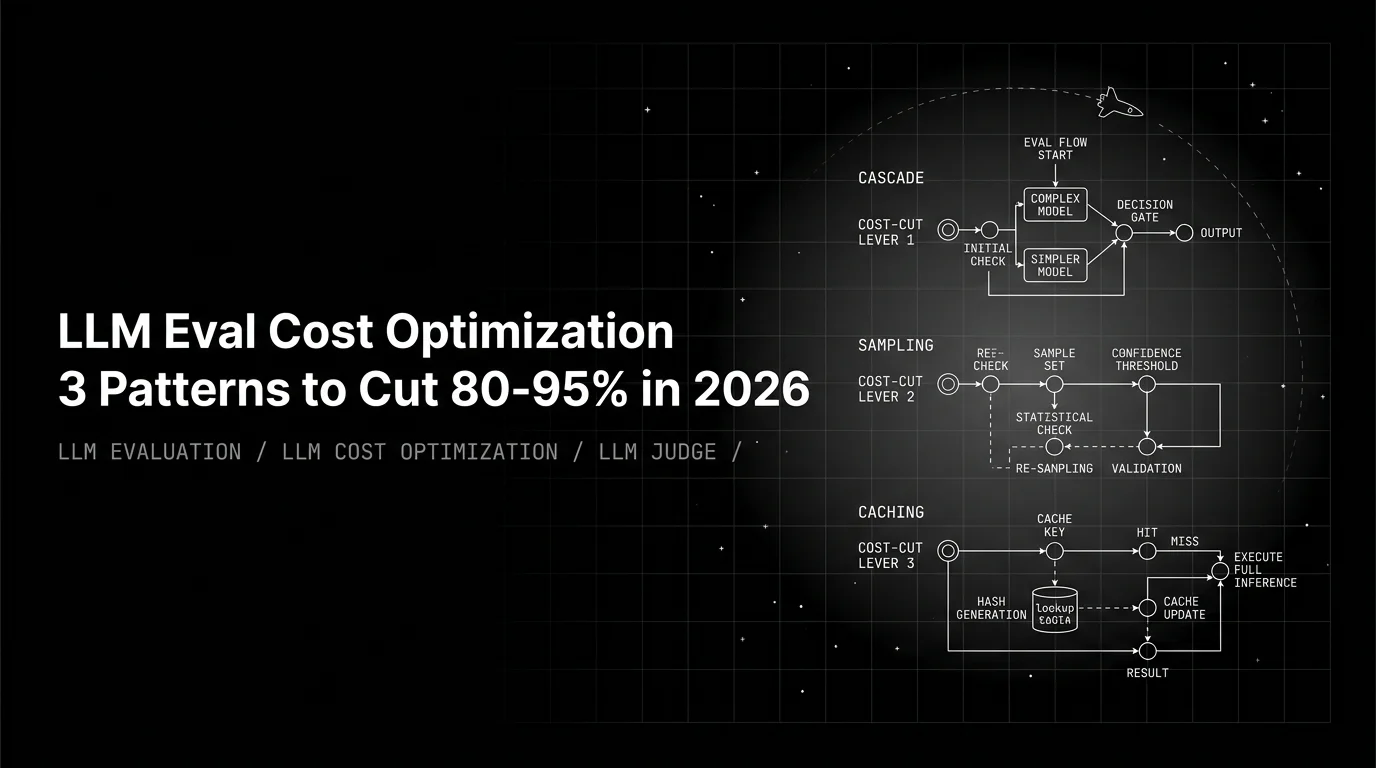
Stack cascade, sampling, and caching to drop LLM judge bills 80 to 95 percent. The math, the code, and the Future AGI surfaces, in one guide.

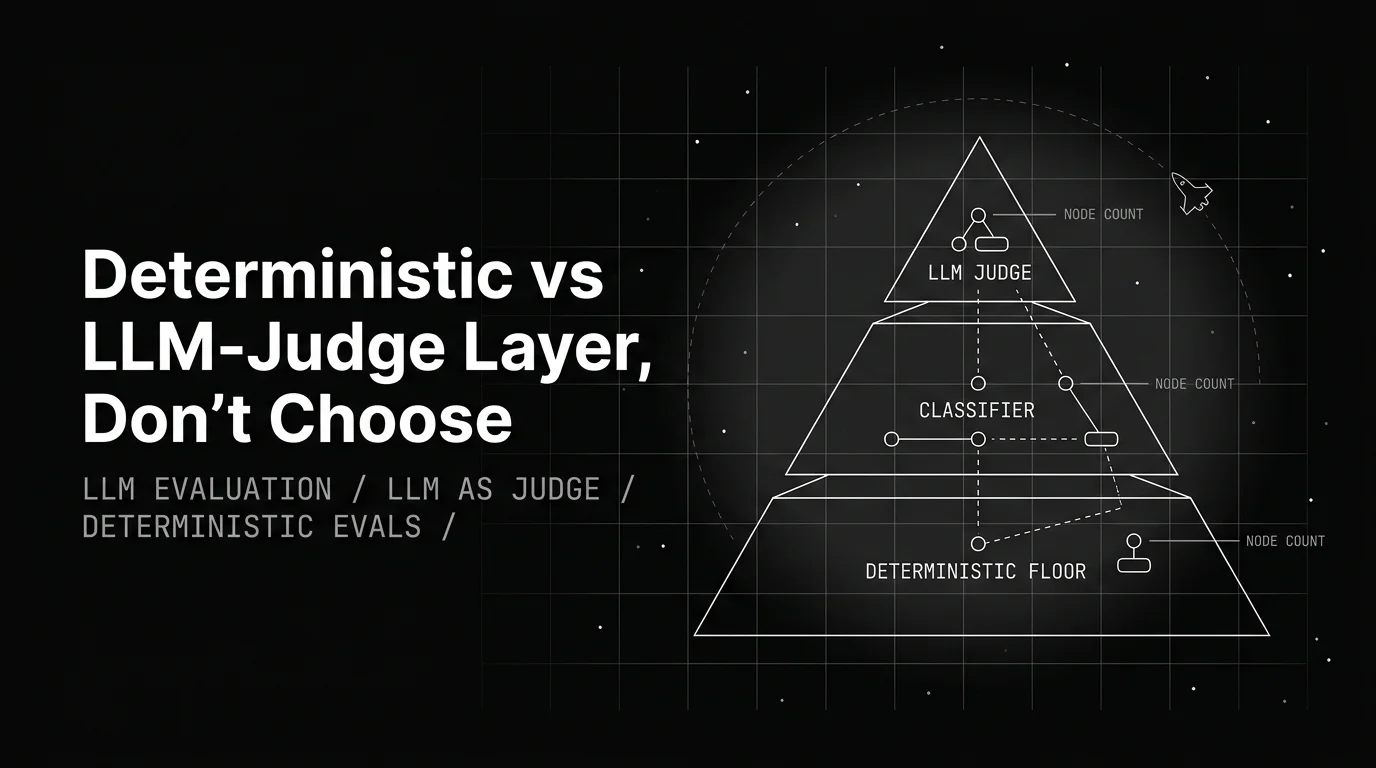
Deterministic vs LLM-judge isn't a pick. It's a cascade. Where each wins, where each breaks, and the layering that drops eval cost 95% in production.

LLM-as-judge best practices for 2026: pick the right judge, calibrate against humans, watch length and family bias, control cost. Discipline that scales.