LLM Eval Cost Optimization: 3 Patterns to Cut 80-95% in 2026
Stack cascade, sampling, and caching to drop LLM judge bills 80 to 95 percent. The math, the code, and the Future AGI surfaces, in one guide.
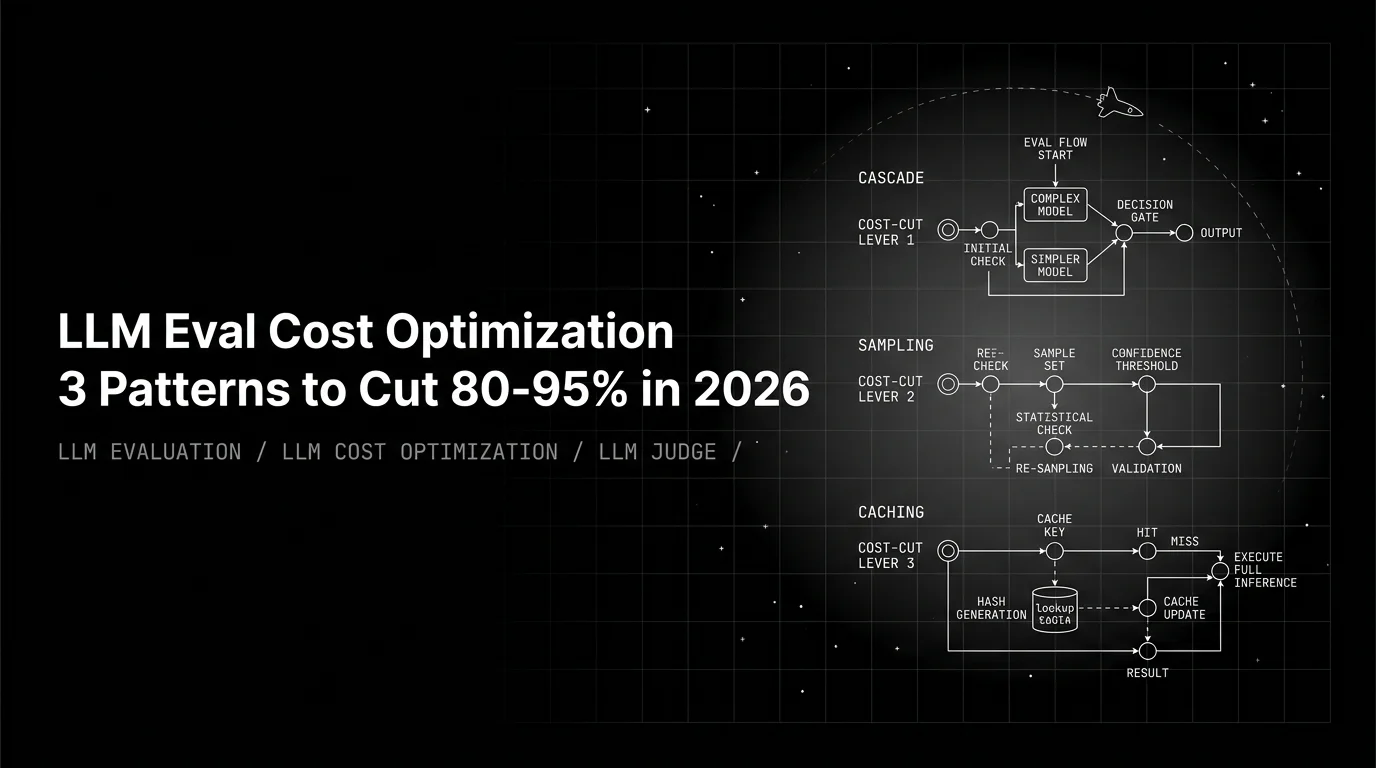
Table of Contents
A finance-tools team I sat with last month had an LLM eval bill of $283K for the month while the actual inference behind it spent $190K. The pipeline was a frontier judge running six rubrics on every trace. No cascade. No sampling. No cache. Three weeks later the eval bill was $34K for the same rubric coverage. Nothing about the metrics changed. The fix was three patterns stacked: a classifier-first cascade, a 10 percent deterministic sample on three quality-tier rubrics, and an exact-match cache keyed on (input, rubric, judge). That is the whole post. Three patterns. The math, the code, and the Future AGI surfaces that make each one a config flag instead of a custom build.
The thesis: three patterns, stacked
Eval cost optimization is not eight tricks and a roadmap. It is three patterns:
- Cascade. Cheap check first, expensive judge only on the borderline.
- Sampling. You do not need 100 percent. Deterministic 5 to 10 percent on quality rubrics is enough.
- Caching. Same input plus same rubric plus same judge produces the same score. Re-running is waste.
Stack all three and the eval bill drops 80 to 95 percent. Get one and you save 20 percent with theatrics. The math compounds because each pattern attacks a different axis of the bill: cascade collapses cost per call, sampling collapses calls per trace, caching collapses repeat calls on the same input. Multiply them and the numbers fall fast.
The rest of the levers people write about (judge model selection, distributed runners, early-stop on backfills, rubric pruning) are real but they are second-order. They tune the residual after the three patterns have done the heavy lifting. This post focuses on the three.
The arithmetic that makes eval bills break budgets
A single LLM-judge call at frontier-class pricing averages around $0.003 once you account for both the input payload (prompt plus response) and the rubric reasoning. At 1M traces a day with 3 rubrics per trace, that is 3M judge calls daily, or $9K a day, $270K a month, just on online scoring. Add a quarterly backfill that re-scores 30 days of history under a new rubric and you spike another $80K to $100K in a single batch.
Three multipliers compound to make eval cost grow faster than inference cost: rubrics per trace (3 to 7 dimensions, each a separate judge call), double-token payloads (judge reads both input and output, 1.8 to 2.2x the underlying generation), and backfill amplification (every new rubric re-scores history at least once). Most teams hit this wall and cap-and-cope: cut sampling to 1 percent, drop rubrics, move scoring to weekly batch. All three sacrifice signal. The right response is to attack the workload with the same engineering discipline you apply to an inference cost problem. The LLM cost optimization guide covers the inference side; this post is the eval side.
Pattern 1: Cascade: cheap first, judge only on the borderline
The cascade collapses cost per call. Heuristic gate, then classifier, then LLM judge. On typical production traffic, 60 to 80 percent of decisions resolve before the LLM judge ever runs. Since the LLM judge is the dominant cost line, removing it from most calls collapses the bill.
The math. Take a 1M-traces-per-day workload with one rubric at $0.003 per judge call. Flat run: $3K/day. Cascade with a classifier at $0.00003 per call that confidently resolves 70 percent of cases, sending the remaining 30 percent to the judge: 1M * $0.00003 + 0.3M * $0.003 = $30 + $900 = $930/day. That is a 69 percent cut from one pattern on one rubric. Scale that across six rubrics and the absolute numbers move from theatrical to operational.
The Future AGI ai-evaluation SDK exposes the cascade through the augment=True parameter on EvalTemplate configurations. Composition handles the routing; the cascade ships as configuration:
from fi.evals import Evaluator, TestCase
from fi.evals.templates import Toxicity, Groundedness

evaluator = Evaluator(fi_api_key=API_KEY, fi_secret_key=SECRET)

# Cascade: classifier first, LLM judge only on borderline scores
result = evaluator.evaluate(
    eval_templates=[
        Toxicity(config={
            "backend": "LLAMAGUARD_3_1B",
            "augment": True,
            "augment_threshold": 0.35,
        }),
        Groundedness(config={
            "augment": True,
            "augment_threshold": 0.35,
        }),
    ],
    inputs=[TestCase(query=user_q, response=model_resp, context=retrieved)],
)
The augment_threshold controls the band of classifier confidence where the LLM judge is allowed to run. Lower the threshold, fewer LLM judge calls, more reliance on the classifier verdict. Raise it, more LLM judge calls, higher precision on edge cases. Tune it per rubric using failure-cluster signal from the Error Feed loop, not by guessing.
The SDK ships 13 guardrail backends: 9 open-weight (LLAMAGUARD_3_8B/1B, QWEN3GUARD_8B/4B/0.6B, GRANITE_GUARDIAN_8B/5B, WILDGUARD_7B, SHIELDGEMMA_2B) and 4 API (OPENAI_MODERATION, AZURE_CONTENT_SAFETY, TURING_FLASH, TURING_SAFETY). Per call, classifier cost runs 100 to 1000x below a frontier judge. On a million daily toxicity checks, the swap alone takes a $3K daily line to $30 or less. The guardrails platforms deep-dive covers backend-selection criteria.
The cascade has one anti-pattern: LLM judges on closed-set rubrics. Toxicity, jailbreak detection, PII spotting, topic restriction — these are classification problems. Running a frontier judge on them is a category error: it costs more, reasons over tasks that do not need reasoning, and introduces judge variance that classifiers do not have. Whenever the rubric has a closed answer set, the classifier is the right tool.
Pattern 2: Sampling: you do not need 100 percent
Cascade collapsed cost per call. Sampling collapses calls per trace. You do not need 100 percent coverage on every rubric. Compliance, safety, and refusal: yes, full coverage; a single missed failure is the failure mode. Quality, style, completeness, and tone: a 5 to 10 percent sample is enough to detect drift inside a day at most production volumes.
The math. A 10 percent sample on a quality-tier rubric cuts that rubric’s judge calls by 90 percent. Combine with the cascade and the cuts compound: a 10 percent sample with a 70 percent classifier resolve rate means the LLM judge runs on 3 percent of traffic instead of 100 percent. The original $3K/day rubric line becomes ~$90/day.
Three sampling strategies, stacked:
- Deterministic by trace id. Hash the trace id, bucket consistently. A given trace lands in the sample every day or never. Trend lines stay stable; re-runs reproduce.
- Stratified by cohort. Sample by route, persona segment, or model variant so all cohorts are represented. A flat 10 percent on a workload where one persona dominates traffic produces a biased trend line.
- Drift-aware (importance) sampling. Increase sample rate when overall scores trend down or a new prompt version ships. A 10 percent baseline plus 100 percent on flagged traces (high latency, error responses, low-confidence output, freshly shipped prompt) catches the regressions random sampling misses.
The deterministic gate is one function. Drop it in front of any rubric:
import hashlib

def in_sample(trace_id: str, rate: float) -> bool:
    h = int(hashlib.sha256(trace_id.encode()).hexdigest(), 16)
    return (h % 10000) / 10000 < rate

if in_sample(trace.id, rate=0.10):
    evaluator.evaluate(
        eval_templates=[Completeness()],
        inputs=[case],
    )
For stratified sampling, hash a composite key (trace id plus cohort) and set per-cohort rates. For drift-aware sampling, layer a second pass that scores everything flagged by an upstream signal (gateway routing fallback, low cascade confidence, freshly deployed prompt) at full rate. The LLM cost tracking guide shows how to expose per-cohort sample rate as a first-class dashboard metric.
The anti-pattern: pure random sampling at 1 percent. Stochastic, biased toward dominant cohorts, unstable on re-runs. Deterministic plus stratified plus drift-aware is the production shape; flat random is the demo shape.
Pattern 3: Caching: same input plus same prompt equals same score
Cascade collapsed cost per call. Sampling collapsed calls per trace. Caching collapses repeat calls on the same input. A surprising amount of eval traffic is duplicate: the same prompt template, the same retrieved chunks, the same canonical response. Evaluating the same (input, rubric, judge) triple twice is pure waste.
The math. A 30 percent cache hit rate on a $0.003 judge call line removes 30 percent of the cost. Stack on top of a 70 percent cascade resolve rate and a 10 percent sample, and the residual judge spend is 0.10 * 0.30 * 0.70 = 2.1% of the flat run. That is the “80 to 95 percent” claim in concrete arithmetic.
The cache key is the triple. Normalize the input (lowercase, strip whitespace) so semantically identical inputs land on the same key, then hash:
from hashlib import sha256

def cache_key(rubric_id: str, prompt: str, response: str, judge: str) -> str:
    payload = f"{rubric_id}|{judge}|{prompt.strip().lower()}|{response.strip().lower()}"
    return sha256(payload.encode()).hexdigest()

key = cache_key(rubric_id="groundedness", prompt=p, response=r, judge="turing_flash")
verdict = cache.get(key)
if verdict is None:
    verdict = evaluator.evaluate(
        eval_templates=[Groundedness(config={"backend": "TURING_FLASH"})],
        inputs=[TestCase(query=p, response=r, context=retrieved)],
    )
    cache.set(key, verdict, ttl=86400 * 7)
The judge identifier in the key is the trap most teams miss. A verdict from turing_flash is not interchangeable with a verdict from claude-sonnet-4-5. Include the judge in the key. Otherwise a model swap silently serves stale verdicts.
TTL is a knob worth tuning per rubric. Safety verdicts can cache for days. Groundedness verdicts should expire when the underlying corpus updates. The cleanest pattern is to namespace the cache by corpus version: when the RAG index re-builds, the verdicts under the old namespace are unreachable, and the next eval re-populates the cache against the new corpus.
Three hit-rate ranges by workload shape:
- RAG agents with stable corpora: 20 to 40 percent. The same
(question, top-k chunks)recurs across users. - FAQ-style chat: 50 percent plus. Daily question patterns repeat.
- Regression suites in CI: 70 percent plus. Same dataset re-scored every commit.
Future AGI’s Agent Command Center exposes exact-match caching that works for both eval and inference workloads. The cache hit shows up as a dedicated header (x-prism-cache-hit) on each call, so the metric attaches to the trace span and the cost dashboard can sort spend by cache-hit rate. The LLM cost tracking tools roundup covers how to expose this in a dashboard.
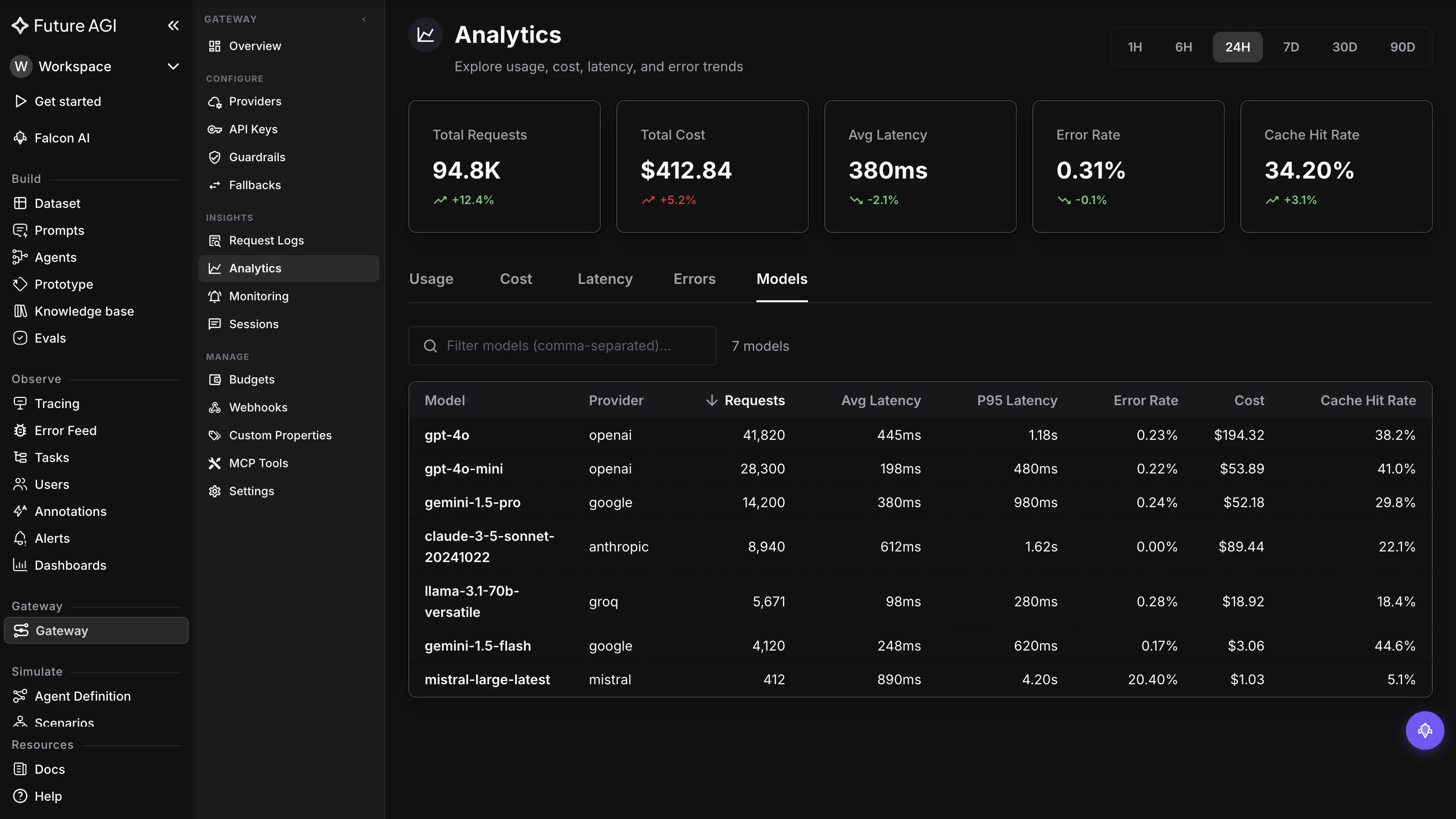
The anti-pattern: caching without a judge key. A model upgrade ships, the verdicts in the cache are now stale, and no one notices because the cache silently keeps serving. Include the judge in the key, version the cache when the judge changes, and the failure mode disappears.
Stacking the patterns: the compound math
The three patterns compose multiplicatively. On a flat $3K/day rubric line:
| Stack | Residual share | Daily spend |
|---|---|---|
| Flat run | 100% | $3,000 |
| + Cascade (70% classifier resolve) | 30% | $900 |
| + Sampling (10% on quality) | 3% | $90 |
| + Caching (30% hit rate) | 2.1% | $63 |
That is the “80 to 95 percent” claim in concrete numbers: a 97.9 percent cut on this hypothetical line, $2,937/day saved, $1.07M/year on one rubric.
Real workloads are messier. Safety rubrics stay at 100 percent (no sampling). Some classifiers resolve at 50 percent, not 70. Some cache namespaces hit at 10 percent, not 30. The pattern math gives you the upper bound; the actual cut depends on how you tune thresholds, what fraction of rubrics tolerate sampling, and how stable your corpus is. Empirically, the teams that ship all three at meaningful tunings land at 80 to 95 percent.
The teams that ship one alone land at 20 percent. The teams that ship none cap-and-cope.
The cost-vs-fidelity tradeoff
Every cost cut trades against signal fidelity. Three calibrations matter:
- Cascade. Lowering
augment_thresholdreduces judge calls but lets more borderline cases through with classifier-only verdicts. Calibrate by scoring 500 traces with both layers, computing Cohen’s kappa, and picking the threshold that holds kappa above 0.6 on regression-critical rubrics. - Sampling. A 10 percent sample tracks the trend but cannot catch a one-off catastrophic failure. Sampling is for trend tracking. Anything where a single failure is the failure mode (compliance, refusal, PII exfiltration) stays at 100 percent.
- Caching. A stale verdict is wrong by definition once the judge changes. Include the judge in the key and namespace by corpus version. A misconfigured cache without a judge key serves stale verdicts silently; the fix is structural, not heuristic.
The patterns are not free. They are cheap. The fidelity you give up is small and predictable; the cost you cut is large and immediate.
Where Future AGI fits
The three patterns are not Future AGI’s invention; they are the production shape. Future AGI is the platform where each pattern ships as a config flag on one runtime instead of a custom build across three tools. The cost-efficient eval platform comparison covers the head-to-head against Galileo Luna-2, DeepEval, Phoenix, Langfuse, Ragas, and Braintrust.
- Cascade as a flag.
augment=Trueon anyEvalTemplate. 13 classifier backends, sub-100 ms Turing flash judges, frontier judges via BYOK at zero platform fee. One config surface across all three tiers.
- Sampling as a primitive. Deterministic hash gate at the SDK boundary; stratified by tag at the Platform layer; drift-aware via Error Feed signals on cluster size and pass-rate trend.
- Caching as a header. Agent Command Center attaches
x-prism-cache-hitalongsidex-prism-cost,x-prism-latency-ms, andx-prism-model-used, so each judge call inherits the underlying inference cost and the cache state. The 5-level budget hierarchy (org, team, user, key, tag) caps eval workloads alongside inference, so a runaway backfill trips a budget alert rather than a quarterly surprise.
The self-improving loop closes around eval cost. Error Feed clusters failing traces with HDBSCAN and writes immediate fixes with a Sonnet 4.5 Judge. Two outputs reduce eval cost directly: rubrics that never fire inside any active failure cluster get retired (zero signal, zero cost), and rubrics that fire on every cluster get a tighter cascade threshold so the LLM judge runs only on borderline cases. The loop turns failure data into smaller eval surface area every release cycle.
Future AGI is the strongest open-source option (ai-evaluation Apache 2.0, traceAI Apache 2.0, agent-opt Apache 2.0) and the strongest enterprise-grade option (Agent Command Center, BYOK gateway, RBAC, SOC 2 Type II, HIPAA, GDPR, CCPA per futureagi.com/trust; ISO 27001 in active audit). Pricing: free tier 50 GB tracing, 2K AI credits, 100K gateway requests, 100K cache hits; usage-based after that.
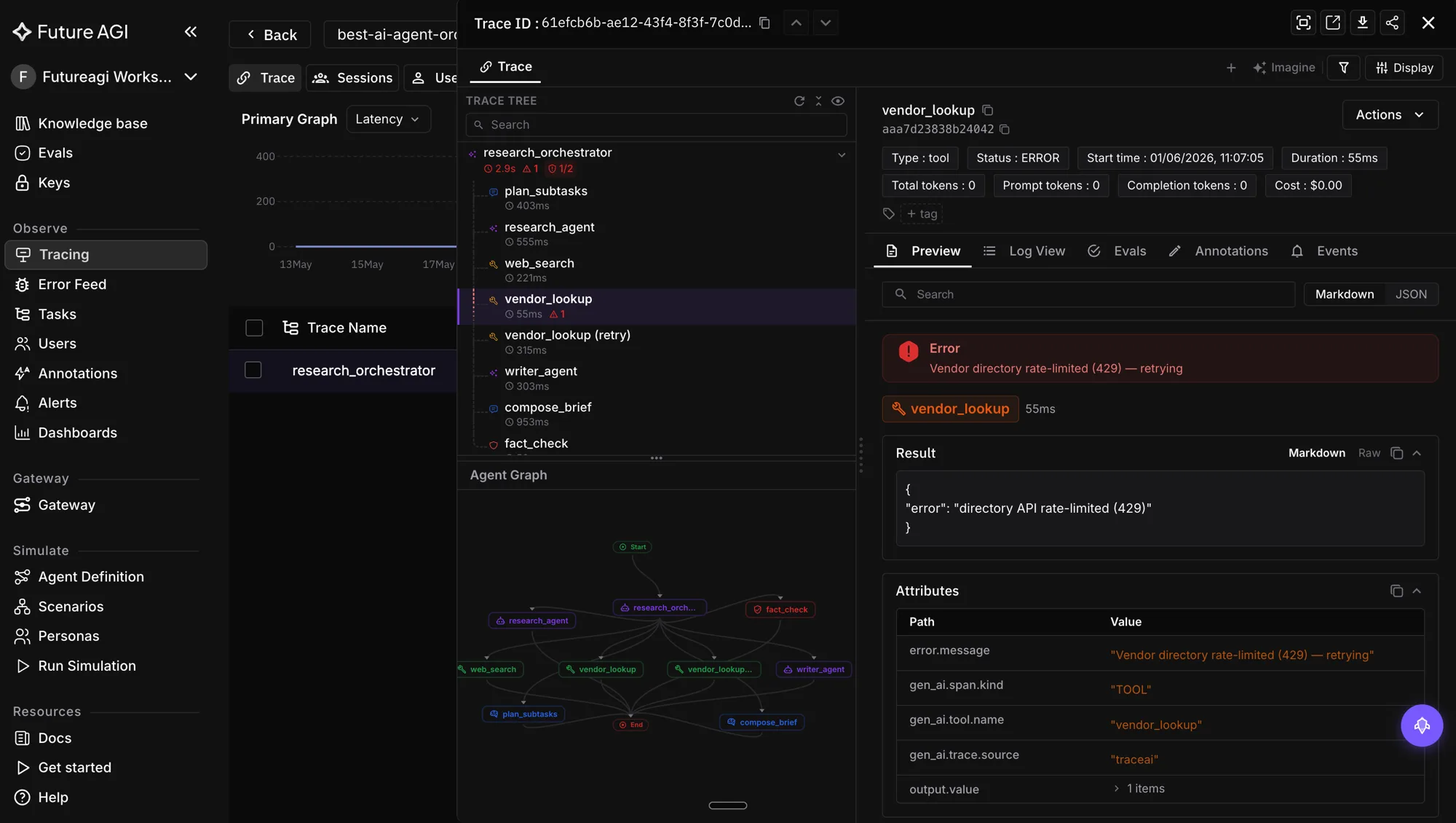
Galileo Luna-2 ships a real product at $0.02 per 1M tokens with 152 ms average latency. Where Future AGI lands ahead: classifier-backed evaluators run lower per-call cost on safety and quality rubrics, BYOK gives escape on the frontier tier at zero platform fee, and the same SDK ships cascade, sampling, and caching as one config rather than three integrations. Teams running Luna-2 typically still need a separate pipeline for the open-ended LLM-judge rubrics Luna does not score well. With Future AGI, that pipeline is the same pipeline.
A 14-day implementation plan
If you are starting from a flat eval pipeline, ship the patterns in order. Each step is independent enough to ship without waiting on the previous one.
- Days 1-3: Visibility. Route eval traffic through Agent Command Center so per-call cost headers attach to every judge call. Sort eval cost by tag, identify the top three rubric-tag combinations driving spend.
- Days 4-7: Cascade. Swap every safety, toxicity, and topic-restriction rubric to a classifier backend. Set
augment=Truewith a starting threshold of 0.35 on every open-ended rubric. Tune per rubric using Error Feed cluster signal. Cascade alone typically cuts 50 to 70 percent of the bill the day it ships. - Days 8-10: Sampling. Deterministic 10 percent sample on quality-tier rubrics. Stratify by tag so all cohorts are represented. Drift-aware oversample on flagged traces. Keep compliance and safety rubrics at 100 percent.
- Days 11-14: Caching. Exact-match cache on
(input, rubric, judge)with a 7-day TTL for safety rubrics and a 24-hour TTL for groundedness. Namespace by corpus version so a RAG re-index invalidates relevant verdicts.
End state: 80 to 95 percent of the original eval bill cut, no measurable degradation in rubric signal. The 283-to-34 dollar story at the top of this post is the median outcome when teams treat eval as a workload and apply the three patterns. The LLM judge best practices post covers the rubric-design side of the same discipline.
The eval bill is not destiny. It is a workload. Workloads respond to engineering.
Sources
Future AGI pricing · Future AGI trust · ai-evaluation · traceAI · agent-opt · Agent Command Center · Galileo Luna
Related reading
Frequently Asked Questions
Why does the eval bill grow faster than the inference bill?
Which of the three patterns saves the most cost first?
When should I use a classifier instead of an LLM judge?
Is sampling safe? Don't I need 100 percent coverage?
How does an eval cache work, and what is the hit rate?
How does Future AGI price evals against Galileo Luna-2?
What is the relationship between Error Feed and eval cost?
Cost-efficient AI evaluation in 2026 is the cascade: classifiers, local heuristics, cheap judges. 7 platforms compared on per-eval cost.


LLM-as-judge best practices for 2026: pick the right judge, calibrate against humans, watch length and family bias, control cost. Discipline that scales.
Eval budget is four knobs: rubric coverage, dataset size, judge tier, refresh cadence. Priority order that maximizes signal per dollar, with a 90-day plan.
