LLM Agent Architectures in 2026: Core Components, Reasoning Patterns, and Observability
LLM agent architectures in 2026: ReAct, Reflexion, Plan-and-Execute, Tree-of-Thoughts, multi-agent. Memory, tools, observability with Future AGI traceAI.
Table of Contents
TL;DR: Core Components of an LLM Agent in 2026
| Layer | Purpose | 2026 picks |
|---|---|---|
| Model core | Reasoning brain | GPT-5, Claude Opus 4.7, Gemini 3.x, Llama 4.x, open-source on vLLM/TGI |
| Memory | Working, episodic, procedural | Mem0, Letta, Zep; vector store + structured table |
| Tools | External actions | Typed function calls, MCP servers, code execution |
| Planner | Goal decomposition | ReAct, Plan-and-Execute, Reflexion, Tree-of-Thoughts |
| Runtime | State, retries, handoffs | LangGraph, CrewAI, OpenAI Agents SDK, MS Agent Framework, AutoGen v0.4+ |
| Observability + eval | Spans, scores, guardrails | Future AGI traceAI + Agent Command Center |
Sources: framework GitHub repos cited in the “Orchestration Runtime” section and reasoning papers cited in the “Planner and Reasoning Layer” section.
What changed since 2025: OpenAI Swarm was archived in early 2026 and replaced by the production Agents SDK. Microsoft introduced Agent Framework as a unified runtime that builds on concepts from Semantic Kernel and AutoGen; the existing AutoGen library is still maintained and Microsoft positions Agent Framework as the recommended path for new builds. OpenTelemetry-compatible tracing has become the standard target for agent runtimes that ship observability hooks. Dedicated memory layers (Mem0, Letta, Zep) matured into standalone products. Typed tools with Pydantic and JSON schema substantially cut malformed tool calls.
What an LLM Agent Actually Is
An LLM agent is a system in which a language model decides its own next action inside a defined policy boundary. The model receives a goal, picks an action (call a tool, query memory, hand off to a sub-agent, respond), observes the result, and loops until the goal is achieved or a budget is hit. The agent is not the model alone; it is the model plus the runtime that gives the model its tools, memory, and termination policy.
The line between agent and traditional chatbot:
- Chatbot. Fixed conversation tree or intent classifier; cannot take external actions; no multi-step planning.
- Agent. Open-ended reasoning loop; takes actions through typed tools; plans multi-step paths to user goals; observes results and adapts.
By 2026 the vocabulary has stabilized. We talk about agents as runtimes, components as layers, and multi-agent systems as collections of agents inside a shared orchestration plane.
The Six Core Components
1. Language Model Core
The reasoning engine. Choices in 2026:
- Frontier hosted models. GPT-5, Claude Opus 4.7, Gemini 3.x. Best reasoning, highest cost per call.
- Open-source frontier-class. Llama 4.x, DeepSeek-V3.x, Qwen3 served on vLLM, TGI, or SGLang.
- Smaller dedicated agent models. Mid-size open models fine-tuned for tool use and JSON output.
Key attributes that drive agent quality:
- Context window. Several frontier models in 2026 offer very large context windows; for example Gemini 3.x and Claude Opus 4.7 advertise context budgets in the hundreds of thousands of tokens, with some Gemini configurations stretching beyond one million. Confirm the current limit per model before relying on the upper end.
- Tool-use ability. Function-calling accuracy and JSON output reliability.
- Reasoning chain length. How well the model can chain steps before drift.
- Cost per output token. Drives the choice between a frontier planner and a cheaper executor.
2. Memory System
Three memory layers cover most production use cases:
- Working memory. The in-context conversation, capped by the model’s context window. Cleared per turn.
- Episodic memory. Persistent records of past task runs. Stored in a vector database or a structured table, retrieved by similarity or rule.
- Procedural memory. Tool-use heuristics that the agent has learned. Often baked into the system prompt or a small fine-tune.
Dedicated memory layers (Mem0, Letta, Zep) package these three patterns into a single API. Each memory.retrieve call becomes an OTel span, which lets Future AGI traceAI attach a grounding evaluator that checks the retrieved memory was actually relevant.
3. Tool and Plugin Layer
Tools turn a text generator into an action engine. The 2026 toolbox:
- Typed function calls. Pydantic models or JSON schema; the agent fills in arguments, the runtime validates before calling.
- MCP (Model Context Protocol) servers. Anthropic’s open standard for portable tool catalogs, now widely adopted across runtimes.
- Web search and retrieval. Tavily, Brave, Exa, plus enterprise indexes.
- Code execution sandboxes. E2B, Modal, Daytona, or self-hosted code interpreters.
- Database and API connectors. Per-vendor SDKs wrapped as typed tools.
Three rules cover most tool-related defects:
- Type and validate every tool argument before the call leaves the agent.
- Return structured errors, not raw exception traces; the agent will try to recover.
- Score
tool.callspans with a tool-use correctness evaluator. Future AGI ships this template by default.
4. Planner and Reasoning Layer
The planner decomposes a goal into a sequence of actions. Five patterns dominate in 2026:
ReAct (Reason + Act)
Originally proposed in Yao et al. 2022 (arxiv.org/abs/2210.03629). The agent interleaves a Thought, an Action, and an Observation in a single loop until the goal is reached. ReAct remains the safe default for simple tool-use agents.
Plan-and-Execute
A separate planner produces a complete step list before any execution starts. An executor agent then runs each step in turn. Strong when the goal can be decomposed up front, weak when the environment changes mid-task. Many LangGraph reference implementations follow this shape.
Reflexion
Shinn et al. 2023 (arxiv.org/abs/2303.11366). The agent runs a task, scores its own outcome, writes a verbal critique, and tries again with the critique added to memory. Improves long-horizon task success when failures are recoverable.
Tree-of-Thoughts (ToT)
Yao et al. 2023 (arxiv.org/abs/2305.10601). The agent expands multiple reasoning paths in parallel, scores intermediate states, and backtracks. Right pick for tasks that need search and backtracking, more expensive per call.
Multi-Agent Orchestration
Multiple specialised agents collaborate. Common shapes: planner-executor, supervisor-worker, maker-checker. Most production multi-agent systems compose ReAct, Plan-and-Execute, or Reflexion inside the individual agents and use the orchestration runtime to handle handoffs. Covered in depth in Multi-Agent AI Systems in 2026.
5. Orchestration Runtime
The runtime owns state, retries, checkpoints, and handoffs. The four mainstream runtimes in 2026, plus one legacy that still ships, are:
- LangGraph. Graph-based state machine, durable checkpointer, human-in-the-loop breakpoints. MIT, repo at github.com/langchain-ai/langgraph.
- CrewAI. Role-based crews, hierarchical processes, flows. MIT, repo at github.com/crewAIInc/crewAI.
- OpenAI Agents SDK. Successor to Swarm, with handoffs and guardrails. MIT, repo at github.com/openai/openai-agents-python.
- Microsoft Agent Framework. Microsoft’s unified .NET and Python agent runtime, building on concepts from Semantic Kernel and AutoGen. MIT, repo at github.com/microsoft/agent-framework.
- AutoGen v0.4+. Async conversation programming, code-execution agents, Studio UI. The library is still maintained, and many production stacks continue to run it; for new Microsoft-backed builds, Agent Framework is the recommended path. MIT (CC-BY-4.0 for Studio).
For a deeper framework comparison see Best Multi-Agent Frameworks in 2026.
6. Observability and Evaluation Layer
The most often-skipped layer, and the one that decides whether the agent ships to production. The minimum surface area:
- Tracing. Every LLM call, tool call, retrieval, and handoff is an OpenTelemetry span. The trace tree shows the full agent flow.
- Evaluation. Span-level scores (faithfulness, tool-use correctness, grounding) and trace-level scores (task completion, plan adherence).
- Guardrails. Synchronous policy checks at the API boundary (PII, prompt injection, toxicity, jailbreak, brand-tone).
- Simulation. Persona-driven multi-turn testing of the agent before any prompt or model change ships.
Future AGI is the production layer for all four:
- traceAI, Apache 2.0, OTel-native, repo at github.com/future-agi/traceAI.
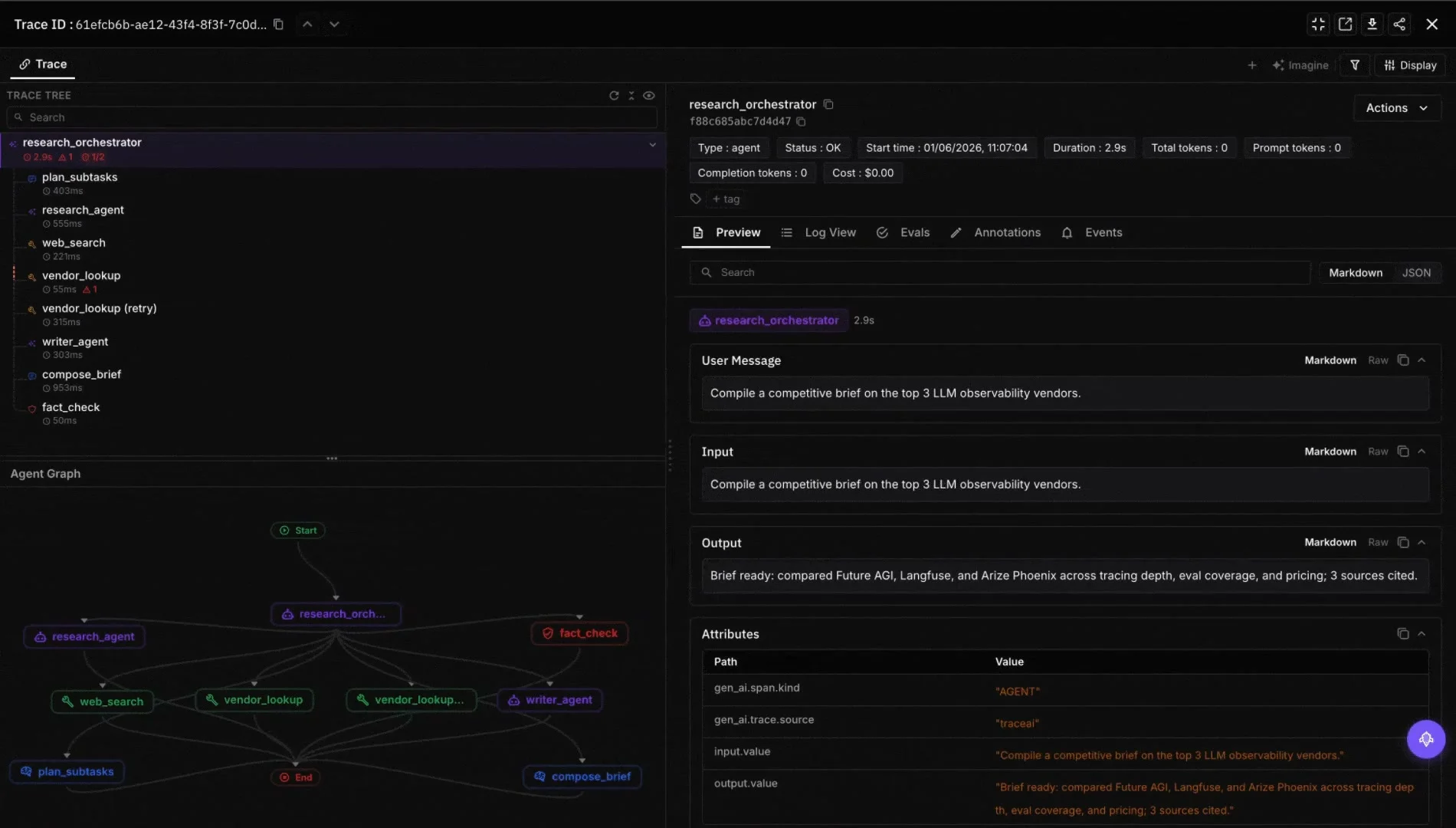
- 50 plus eval templates: task completion, faithfulness, tool-use correctness, grounding, custom rubrics via
fi.evals.metrics.CustomLLMJudge. - 18 plus guardrail scanners: PII, prompt injection, toxicity, jailbreak, custom regex, brand-tone, secret detection. Routed via /platform/monitor/command-center.
- Turing eval models:
turing_flash(~1-2s),turing_small(~2-3s),turing_large(~3-5s). Source: docs.futureagi.com/docs/sdk/evals/cloud-evals. - fi.simulate for persona-driven multi-turn agent testing.
- BYOK gateway with 100 plus providers, no platform fee on judge calls.
Quick start: instrument and evaluate an agent
import os
from fi_instrumentation import register
from traceai_langchain import LangChainInstrumentor
from fi.evals import evaluate

os.environ["FI_API_KEY"] = "..."
os.environ["FI_SECRET_KEY"] = "..."

# 1. Register the project and auto-instrument LangGraph and the underlying LangChain LLM calls.
trace_provider = register(project_name="agent-prod")
LangChainInstrumentor().instrument(tracer_provider=trace_provider)

# 2. Run your agent as normal. Spans flow to Future AGI automatically.
# from my_app import run_agent
# answer = run_agent("Summarize the EU AI Act 2026 enforcement milestones.")

# 3. Score the final answer against a rubric.
score = evaluate(
    "task_completion",
    input="Summarize the EU AI Act 2026 enforcement milestones.",
    output="...",
    expected_output="A concise summary that mentions the August 2026 Code of Practice milestone.",
)
print(score)
Pair the same pattern with the matching auto-instrumentor for other runtimes: from traceai_crewai import CrewAIInstrumentor, from traceai_autogen import AutoGenInstrumentor, or the OpenAI Agents SDK instrumentor. For a deeper instrumentation walkthrough see Instrument Your AI Agent with traceAI.
Architectural Patterns That Combine the Components
Layers compose into patterns. Five shapes cover most production workloads:
- Single-agent ReAct. One model, one set of tools, one loop. Simple tool-use cases (customer support, FAQ retrieval).
- Plan-and-Execute. Two roles: planner (frontier model) and executor (cheaper model). Long-horizon tasks where decomposition pays off.
- Hierarchical supervisor. A supervisor agent routes work to specialised workers. CrewAI hierarchical, OpenAI Agents SDK handoffs.
- Maker-checker. An actor produces output, a verifier scores or rewrites it. Cuts hallucinations in high-stakes domains.
- Network or swarm. Peer agents share a scratchpad and talk freely. AutoGen group chat, LangGraph subgraphs.
For deeper coverage of each pattern see Agent Architecture Patterns in 2026.
Use Cases for LLM Agents Across Industries
Customer Operations
Agents handle multi-step requests like refunds, order tracking, and policy escalations. Tool layer: CRM API, inventory API, refund processor. Memory layer: customer profile and prior interactions. Observability: Future AGI traceAI catches drift in escalation rules.
Healthcare
Clinical co-pilot agents pull from EHR, surface diagnostic options, and draft notes. Tool layer: FHIR API, clinical guidelines retrieval. Guardrails: PII redaction at the boundary, harm-avoidance rubric on every output.
Legal
Research agents pull cases, extract holdings, draft memos. Tool layer: Westlaw, LexisNexis, internal precedent index. Memory layer: matter-specific episodic memory.
Education
Tutoring agents adapt to student level, generate practice problems, and grade open-ended answers. Tool layer: curriculum index, knowledge graph. Eval: pedagogical correctness, refusal of off-topic prompts.
Software Development
Coding agents read repos, write patches, run tests. Tool layer: filesystem, terminal, GitHub API, code execution sandbox. Eval: HumanEval+, MBPP+, plus task completion on real PRs. See also Best AI Coding Agents in 2026.
Research and Analytics
Multi-agent research crews pull papers, synthesise findings, and produce structured reports. Runtime: LangGraph or CrewAI. Eval: faithfulness, citation correctness, coverage.
Challenges in Production LLM Agents
Latency
Multi-step agent runs can take 10 to 60 seconds end to end. Mitigations: parallelize independent tool calls, cache deterministic retrievals, use a frontier planner with a smaller executor.
Cost
Each agent loop iteration is a model call. Mitigations: BYOK gateway with provider-specific pricing, cheaper executor models, cache prompts, set token budgets per trace.
Security
Tools and memory are attack surfaces. Mitigations: prompt-injection screening at the boundary (Future AGI Agent Command Center), typed tool arguments, audited memory writes, signed handoffs in multi-agent systems.
Alignment and Reliability
Agents drift, hallucinate tool outputs, and loop. Mitigations: span-level evaluators, max-iteration guardrails, persona-driven simulation in CI before deploy. Covered in depth in AI Agent Reliability Metrics in 2026.
Best Practices for LLM Agent Development in 2026
- Start with a single-agent ReAct loop. Add multi-agent orchestration only when you can clearly attribute the complexity to a real failure mode in the single-agent baseline.
- Type every tool with Pydantic or JSON schema. Tool errors drop substantially.
- Use a frontier model as planner, a cheaper model as executor. Cost goes down, quality stays.
- Instrument from day one. traceAI auto-instrumentors are designed to be quick to wire up; debugging without spans takes hours.
- Score every span, not just the final output. Multi-agent regressions hide in sub-agents.
- Run persona simulations in CI. Catches drift before deploy with fi.simulate.
- Fire guardrails at the API boundary. Agent Command Center, not a post-hoc dashboard.
- Document your architecture for compliance. For regulated use cases under the EU AI Act and similar regimes, documenting the components, tools, memory, and eval evidence supports compliance reviews.
Future Directions
- On-device agents. Sub-7B models running on phones and laptops for privacy-critical workflows.
- Continual learning. Agents that update their procedural memory across sessions without full fine-tuning.
- Federated multi-agent. Specialised agents owned by different teams or vendors collaborating through MCP and OTel without giving up data sovereignty.
- Explainability gates. Compliance regimes that require justified decisions and quantified uncertainty for high-stakes domains.
Wrapping Up
A 2026 LLM agent is six layers: model core, memory, tools, planner, runtime, and observability plus evaluation. The first five layers have stabilized around a small number of mature choices. The sixth layer is where production reliability is won or lost. Future AGI ships that sixth layer end to end, with Apache 2.0 traceAI for tracing, 50 plus eval templates, 18 plus guardrails, Agent Command Center for policy enforcement, BYOK gateway, and fi.simulate for persona-driven testing, all on one platform at futureagi.com.
For deeper reads see Agent Architecture Patterns in 2026, Multi-Agent AI Systems in 2026, and Best AI Agent Observability Tools in 2026.
Frequently Asked Questions
What are the core components of an LLM agent in 2026?
What is the difference between an LLM agent and a traditional chatbot?
Which agent reasoning pattern should I use in 2026?
How does memory work in an LLM agent?
How do I observe an LLM agent in production?
What goes wrong most often in LLM agents?
How do I evaluate an LLM agent end to end?
What changed in LLM agent architectures between 2025 and 2026?
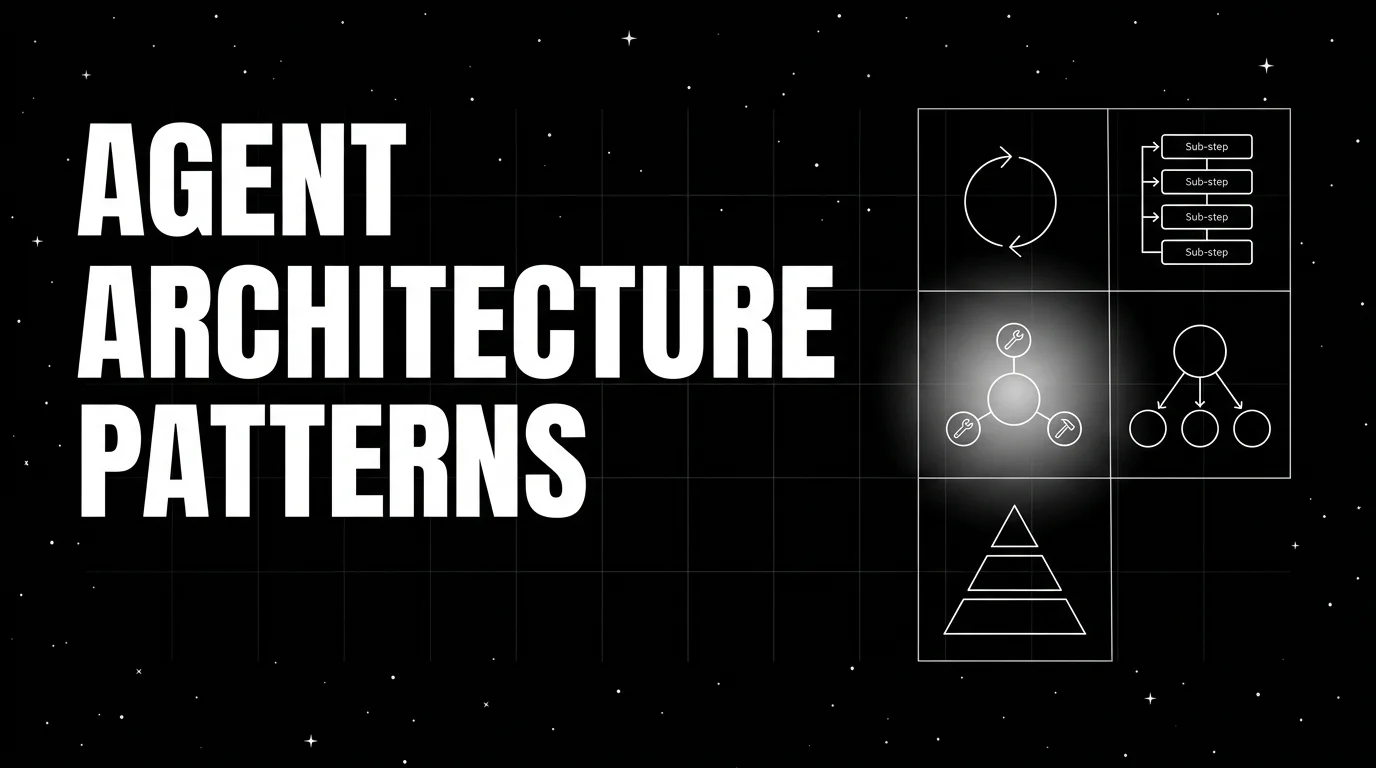
Five agent architecture patterns in 2026: ReAct, plan-then-execute, supervisor and workers, graph, event-driven. Four-axis tradeoff per pattern.

Multi-agent AI systems in 2026: LangGraph, CrewAI, AutoGen, OpenAI Agents SDK compared, plus patterns, voice hand-offs, evals, and traceAI observability.

LangGraph, CrewAI, Microsoft Agent Framework, AutoGen, Mastra, OpenAI Agents SDK, and Google ADK ranked for 2026 by debug, eval, and production readiness.