GitHub Copilot vs Cursor vs Amazon Q Developer vs Claude Code in 2026: The AI Coding Agent Showdown
Six AI coding agents stacked side by side: Copilot, Cursor, Amazon Q Developer, Claude Code, Codex CLI, Windsurf. Pricing, models, IDE, agent depth.
Table of Contents
TL;DR
| Tool | Best for | Pricing (May 2026) | Default model | Open source |
|---|---|---|---|---|
| Cursor | General-purpose multi-file agent IDE | $20 / $40 user / month | Claude or GPT, user picks | No |
| Claude Code | Terminal-native long-context refactors | Bundled in Claude Pro $20 / Max $100+ | Claude Opus 4.7 | No |
| GitHub Copilot | Teams already on GitHub workflows | $10 / $19 / $39 user / month | User picks (GPT-5, Claude, Gemini) | Partial (CLI is OSS) |
| Amazon Q Developer | AWS, IaC, Java migration | Free / $19 user / month | Amazon-managed | No |
| OpenAI Codex CLI | Headless and scripted workflows | API usage only | GPT-5-Codex | Apache 2.0 |
| Windsurf (Cascade) | Background multi-file tasks | from $15 user / month | User picks | No |
This guide compares the six AI coding agents that matter in May 2026 across pricing, default models, agent depth, IDE coverage, and BYO-key support. AWS CodeWhisperer is included under its 2026 name, Amazon Q Developer. Future AGI does not build a coding agent, so it does not appear in the ranked list. The closing section explains how teams pair any of these agents with an evaluation and observability layer to keep AI-generated code production-safe.
How AI Coding Agents Evolved from Autocompletion to Multi-Agent IDEs by 2026
AI coding assistants moved through three distinct phases between 2021 and 2026. The first phase, kicked off by GitHub Copilot in 2021, was inline autocompletion driven by a fine-tuned Codex model. The second phase, starting around mid-2023, added chat interfaces and project-aware context so developers could ask questions about a repository without copy-pasting into a separate chat window. The third phase, dominant by 2026, is agent mode: the editor or terminal plans, edits across many files, runs tests, reads logs, and iterates until a task lands.
The 2026 surface area is also broader than just an editor extension. Anthropic ships Claude Code as a terminal-first agent. OpenAI ships Codex CLI as an open-source shell tool. AWS rebranded CodeWhisperer into Amazon Q Developer and added /dev and /transform agents. Cursor and Windsurf compete as full IDE forks of VS Code with deep agent integration. Copilot itself shipped agent mode and pull request review across VS Code, Visual Studio, JetBrains, and Xcode through 2024 and 2025.
What changed since 2025
Four shifts define the 2026 landscape:
- CodeWhisperer is gone as a brand. New AWS users land in Amazon Q Developer. The CodeWhisperer documentation is preserved at legacy URLs for existing customers.
- Terminal-native agents are first-class. Claude Code and OpenAI Codex CLI both ship as primary surfaces, not as afterthoughts to an editor.
- Model choice is the norm. Copilot, Cursor, Windsurf, and Claude Code all let teams pick between frontier models. The lock-in pattern of 2023 is over outside the AWS-specific Q Developer track.
- Agent mode is the default for serious work. By 2026 most contributors use chat or agent mode for tasks that span more than one file and reach for inline completion only inside a single function.
These shifts also raised the stakes on evaluation. By 2026, AI-assisted code generation is common at large engineering organizations, with public reporting in GitHub’s Octoverse and vendor case studies showing significant adoption inside Microsoft, Google, and others. Teams that ship that volume without an evaluation harness end up paying the bill in production incidents.
Overview of the Six Tools
GitHub Copilot
GitHub Copilot is the original AI pair programmer and the broadest in IDE coverage. In 2026 it ships:
- Inline completion across VS Code, Visual Studio, JetBrains, Neovim, Eclipse, and Xcode
- Copilot Chat for repository-aware questions
- Agent mode that plans, edits, runs tests, and proposes pull requests
- Pull request review that comments on diffs directly inside GitHub
- Code review with custom instructions that pulls in your style guide
Pro and Enterprise plans let users pick the model behind chat and agent mode. The current 2026 selection includes OpenAI GPT-5, Anthropic Claude Opus 4.7, and Google Gemini 3 Pro. GitHub also exposes the Copilot CLI for terminal workflows.
Cursor
Cursor is an AI-native IDE forked from VS Code. It re-uses VS Code extensions, keymaps, and settings, so the transition from VS Code itself is close to zero. The core agent surfaces are:
- Tab for inline multi-line completion
- Cmd-K for in-line edits
- Chat for repository questions
- Composer and the Agent for multi-file plans that run tools and apply patches
Cursor supports bring-your-own-key for major model providers, with pricing split between a Pro tier and a Business tier. By 2026 Cursor is the most-used standalone AI IDE.
Amazon Q Developer (formerly CodeWhisperer)
Amazon Q Developer is the rebrand and superset of CodeWhisperer that AWS completed through 2024 and 2025. The old CodeWhisperer features carried over:
- Inline code suggestions across 15+ languages
- Security scans and reference tracking for similar open-source code
- Tight integration with AWS Cloud9, Lambda console, IntelliJ, VS Code, and the CLI
The 2026 additions matter:
- /dev agent plans and writes new features
- /review agent runs code reviews and security checks
- /transform agent handles Java 8 to 17 migration and Windows-to-Linux moves
- Q Developer Pro adds SOC 2 / ISO 27001 controls, custom code suggestions trained on your private codebase, and admin policy management
Claude Code
Claude Code is Anthropic’s first-party coding agent. It is terminal-native, plan-first, and built around Claude Opus 4.7 for hard tasks and Claude Sonnet 4.5 for everyday speed. Distinguishing features in 2026:
- Long-context refactors that load 200k+ tokens of repository
- Plan mode that drafts the change before any file is touched
- Tool approvals so users can vet shell commands before they run
- Official VS Code and JetBrains extensions that surface the same agent inside the IDE
/resumeto pick up an interrupted session
Claude Code ships as part of Claude Pro and Max subscriptions.
OpenAI Codex CLI
OpenAI Codex CLI is an open-source (Apache 2.0) terminal agent from OpenAI. It runs locally in a sandbox, calls GPT-5-Codex by default, and exposes file edits, shell commands, and tool use through a minimal CLI. Strengths:
- Headless friendly: easy to wire into CI, build scripts, and one-shot jobs
- Sandboxed execution with explicit approval flows
- Free codebase, paid only for token usage via the OpenAI API
Windsurf (Cascade)
Windsurf is the second major VS Code fork and Cursor’s closest rival. Cognition Labs acquired it in 2024 and continues to ship under the Windsurf name. The Cascade agent runs as a background workspace agent that can plan, edit across files, run terminal commands, and follow tests. Windsurf supports BYO-key and shipped a free tier through 2025-2026.
Side-by-Side Feature Comparison
Pricing and licensing (May 2026)
| Tool | Free tier | Paid tiers | Notes |
|---|---|---|---|
| GitHub Copilot | Free 50 completions / 2k chat per month | $10 Pro, $19 Business, $39 Enterprise | All per user per month |
| Cursor | 2-week trial | $20 Pro, $40 Business | Beyond included quota uses metered tokens |
| Amazon Q Developer | Free Individual tier | $19 Pro user / month | AWS Builder ID required |
| Claude Code | None standalone | Bundled in Claude Pro $20 and Claude Max from $100 | Per user per month |
| OpenAI Codex CLI | Free codebase | API usage only | Pay per million tokens |
| Windsurf | Free tier with limits | from $15 user / month | Cascade agent counts against a credit pool |
Source: vendor pricing pages linked above, verified May 2026.
Models and BYO-key
| Tool | Default model | Other supported models | BYO-key |
|---|---|---|---|
| GitHub Copilot | GPT-5 | Claude Opus 4.7, Gemini 3 Pro, o-series, Sonnet 4.5 | No |
| Cursor | User picks | GPT-5, Claude Opus 4.7, Gemini 3 Pro, custom | Yes |
| Amazon Q Developer | Amazon managed | n/a | No |
| Claude Code | Claude Opus 4.7 | Claude Sonnet 4.5, Haiku 4.5 | n/a (managed) |
| OpenAI Codex CLI | GPT-5-Codex | Any OpenAI API model | n/a (uses your key) |
| Windsurf | User picks | GPT-5, Claude Opus 4.7, Gemini 3 Pro | Yes |
IDE and surface coverage
| Tool | VS Code | JetBrains | Visual Studio | Neovim | Xcode | Terminal-first |
|---|---|---|---|---|---|---|
| Copilot | Yes | Yes | Yes | Yes | Yes | Copilot CLI |
| Cursor | Replacement IDE | No | No | No | No | Built-in shell |
| Amazon Q Developer | Yes | Yes | Yes | No | No | Q CLI |
| Claude Code | Extension | Extension | No | No | No | Yes |
| Codex CLI | No | No | No | No | No | Yes |
| Windsurf | Replacement IDE | No | No | No | No | Built-in shell |
Agent depth on multi-file work
A useful rule of thumb in 2026:
- Claude Code and Cursor Composer handle the longest autonomous runs without re-prompting.
- Copilot agent mode and Windsurf Cascade are close behind and pair better with pull request workflows.
- Codex CLI wins on scripted and headless jobs where you want the agent to run unattended in CI.
- Amazon Q Developer agents are narrower in scope but ship inside the AWS console boundary, which matters for compliance.
Performance notes
Inline completion latency varies more by network than by tool in 2026, so the older “320ms vs 890ms” numbers from 2024 are no longer reliable signals. What matters now is:
- Time-to-first-token on agent runs
- Tool-use throughput on long plans
- Cost per task
Anthropic’s claude.ai/code benchmarks for Opus 4.7 show meaningful gains on multi-file refactors compared to Sonnet 4 from early 2025, and that pattern shows up across all the agent-mode tools that expose Opus.
Real-World Use Cases
- Full-stack TypeScript work: Cursor or Windsurf as the daily driver, Copilot agent mode for pull request review.
- Cloud infrastructure on AWS: Amazon Q Developer for inline edits and /transform migrations, paired with terraform-aware prompts.
- Long-context refactors in legacy Python or Java repos: Claude Code with Opus 4.7, plan mode on by default.
- Headless CI tasks: Codex CLI invoked from a runner, sandboxed, with the diff committed to a branch.
- Mobile development: GitHub Copilot remains the broadest choice because of Xcode and JetBrains support.
Limitations to Know About
- GitHub Copilot: Agent mode still occasionally needs re-prompting on cross-module refactors. Token usage can spike on long plans and pushes large teams toward Enterprise.
- Cursor: Pricing is more complex than it looks once you pass the included quota. Heavy use of Claude Opus 4.7 burns through the Pro allowance.
- Amazon Q Developer: Strong inside the AWS ecosystem, weaker outside. No BYO-key, and language coverage is narrower than Copilot.
- Claude Code: Terminal-first means a learning curve for IDE-only developers. Bundle pricing rewards teams who already use Claude.
- OpenAI Codex CLI: Minimal IDE integration. You manage your own sandbox, your own approval flow, and your own evaluation.
- Windsurf: Smaller plugin ecosystem than Cursor, and the Cascade credit accounting confuses new users.
How to Choose
Pick by your default surface, your model preference, and your compliance constraints.
- If your team already lives in GitHub, default to Copilot and enable agent mode for non-trivial work.
- If you want a standalone IDE optimized for AI, pick Cursor. If you prefer the background-agent model, pick Windsurf.
- If you do most of your hard work in a terminal and you like long plans, run Claude Code.
- If you ship AWS infrastructure and Java migrations, run Amazon Q Developer.
- If you wire agents into CI or scripts, run OpenAI Codex CLI.
These choices are not mutually exclusive. Many 2026 teams use two or three of them: Copilot in the IDE for review, Claude Code in the terminal for refactors, and Codex CLI in CI.
Evaluating AI-Generated Code with Future AGI
None of the coding agents above ship with an independent evaluation and observability layer for production quality gates. Copilot has pull request review and Amazon Q ships a /review agent, but those run inside the same agent that wrote the code, so they cannot serve as a neutral check. As AI-generated code grows past 30 to 50% of new commits at many organizations, the bottleneck shifts from typing speed to confidence: did the agent actually fix the bug, or did it introduce a new one?
Future AGI is the evaluation and observability companion that pairs with any of these agents. The pattern is straightforward:
- traceAI (Apache 2.0, docs) wraps your agent runs with OpenTelemetry-compatible spans so every Copilot, Cursor, or Claude Code session is captured as a structured trace.
- ai-evaluation (Apache 2.0) scores each generated diff with built-in metrics (faithfulness, correctness on test runs, code-style adherence) or a custom LLM judge.
- The Agent Command Center at
/platform/monitor/command-centersurfaces regressions, flags hallucinated APIs, and gates promotions to main.
A minimal evaluation harness for AI-generated code looks like this:
from fi.evals import evaluate

# After your coding agent (Copilot, Cursor, Claude Code) lands a diff,
# pass the diff and the spec it was supposed to implement.
generated_code = "<paste your agent's diff or generated function here>"
spec = "<paste the spec or task description here>"

result = evaluate(
    "faithfulness",
    output=generated_code,
    context=spec,
)

print(result.score, result.explanation)
The eval call uses string-template metrics from the Future AGI cloud, which run on turing_flash for fast checks (around 1 to 2 seconds) or turing_large for the deeper review pass (around 3 to 5 seconds). Configure your environment with FI_API_KEY and FI_SECRET_KEY.
For multi-step agent runs where you want full visibility, traceAI captures the planning, tool calls, and final diff:
from fi.evals import evaluate
from fi_instrumentation import register, FITracer
from opentelemetry import trace

register(project_name="copilot-agent-eval")
tracer = FITracer(trace.get_tracer(__name__))

@tracer.agent(name="copilot_pr_run")
def run_agent_on_pr(plan: str, diff: str):
    # plan and diff come from your coding agent (Copilot, Cursor, Claude Code).
    score = evaluate("faithfulness", output=diff, context=plan)
    return diff, score
That trace then shows up inside the Agent Command Center, with every span annotated by the eval score and ready for replay.
Related reading
Frequently asked questions
Which AI coding agent is the best general-purpose pick in 2026?
What happened to AWS CodeWhisperer in 2026?
How much do these tools cost as of May 2026?
Which agent has the deepest agent mode for autonomous multi-file work?
Which tool is best for AWS, Terraform, and CloudFormation work?
Can I use my own API keys and models with these agents?
How do I evaluate the quality of AI-generated code in production?
Is Claude Code only for the terminal or does it work in IDEs?
Technical guide to automated agent optimization in 2026: GEPA, ProTeGi, Bayesian search, MetaPrompt, PromptWizard, plus the production loop and a drive-thru case study at 66% to 96%.

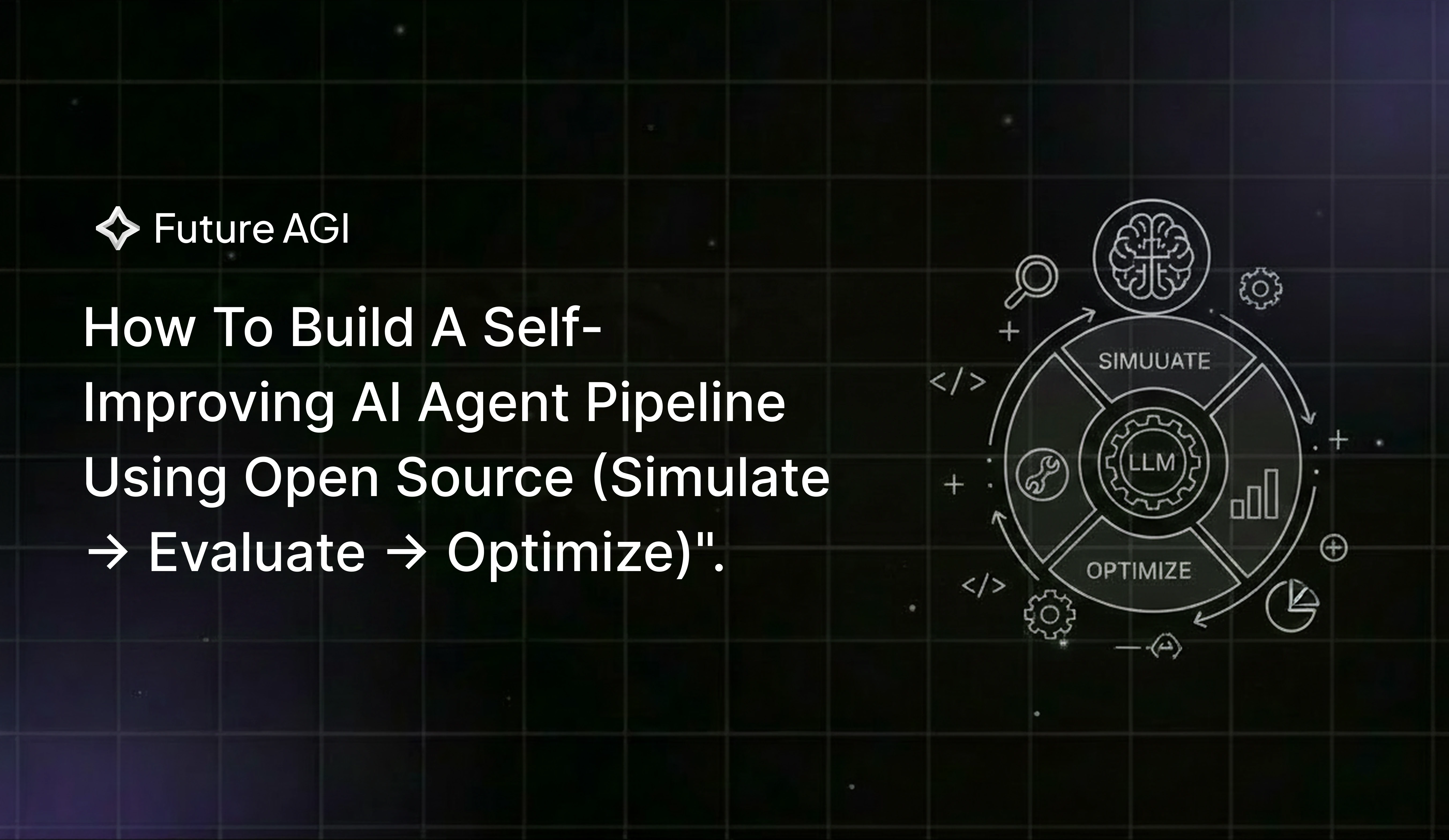
Build a self-improving AI agent pipeline in 2026: synthetic users + function-call accuracy + ProTeGi prompt rewrites. 62% to 96% accuracy on a refund agent.
Scale voice agent testing past manual QA in 2026 with Future AGI Simulate. 4 scenario generation methods, AI-powered test agents, CI/CD pipeline integration.