Top Agentic AI Frameworks in 2026: LangGraph, OpenAI Agents SDK, Microsoft Agent Framework, CrewAI, AutoGen, Mastra, and PydanticAI Compared
Compare the top agentic AI frameworks in 2026: LangGraph, OpenAI Agents SDK, Microsoft Agent Framework, CrewAI, AutoGen, Mastra, and PydanticAI.
Table of Contents
Top agentic AI frameworks in 2026: TL;DR
| Framework | Best for | Language | License | Released or stable since |
|---|---|---|---|---|
| LangGraph | Stateful production agents, deepest ecosystem | Python, TypeScript | MIT | Stable since 2024 |
| OpenAI Agents SDK | OpenAI-only stacks, minimal scaffolding | Python, TypeScript | MIT | Released March 2025 |
| Microsoft Agent Framework | Enterprise on Azure, MCP-native | Python, .NET | MIT | Announced October 2025 |
| CrewAI | Role-based crews, content + ops workflows | Python | MIT | v1.x stable |
| AutoGen v0.4+ | Research-style multi-agent conversation | Python, .NET | Apache 2.0 (core) + MIT | Stable since 2024 |
| Mastra | TypeScript-first agents, Vercel and Cloudflare deploy | TypeScript | MIT (Elastic 2.0 server) | Stable since 2024 |
| PydanticAI | Type-safe Python agents, structured outputs | Python | MIT | Stable since 2024 |
Use this list to shortlist two or three frameworks for a proof of concept, then evaluate on your own tasks. Frameworks themselves are not the differentiator in 2026: evaluation, observability, and tool design are.
What is an agentic AI framework?
An agentic AI framework is a library or runtime that lets an LLM plan, call tools, hold state, and run multi-step workflows under its own control. Compared with a single chat completion call:
- Chat completion: one prompt in, one response out.
- Agentic loop: model decides what to do next, calls a tool, observes the result, updates state, and repeats until it produces a final answer or a stopping condition fires.
- Multi-agent: multiple agents with different roles or models hand off subtasks to each other.
The framework gives you the scaffolding: a tool registry, structured output parsing, message history management, retries, error handling, observability hooks, and (for multi-agent) handoff or routing primitives. Most 2026 frameworks also ship Model Context Protocol (MCP) client and server support so tools can be reused across stacks.
How to pick a framework: five criteria
Control flow and state
How much control do you have over the agent loop? LangGraph exposes the loop as an explicit graph with nodes and edges; the OpenAI Agents SDK hides it behind a thin Runner abstraction. State management matters once you need durable execution, checkpoints, or human-in-the-loop pauses; LangGraph and Microsoft Agent Framework lead here.
Provider lock-in
OpenAI Agents SDK is OpenAI-first by design. Microsoft Agent Framework is Azure-first but provider-agnostic. LangGraph, CrewAI, AutoGen, Mastra, and PydanticAI are all provider-agnostic and route between OpenAI, Anthropic, Google, Mistral, and local models.
Multi-agent primitives
CrewAI and AutoGen are built for multi-agent scenarios with named roles. LangGraph supports multi-agent via subgraphs. The OpenAI Agents SDK uses handoffs. Microsoft Agent Framework supports both pattern-based orchestration and ad hoc multi-agent.
MCP and tool ecosystem
Every framework here ships MCP support by May 2026. Beyond MCP, check how many native tools the framework’s community has published, whether it integrates with your existing stack (LangChain tools, LlamaIndex, Microsoft 365 connectors, etc.), and how easy it is to define a typed tool with a JSON schema.
Observability and evaluation
The hard problem of 2026 agents is reliability, not capability. Pick a framework that emits OpenTelemetry spans for every model call and tool call, and a framework you can hook into your evaluation pipeline. LangGraph and OpenAI Agents SDK have first-class trace exporters. All other frameworks support OpenTelemetry via traceAI’s auto-instrumentors.
The 7 frameworks to evaluate in 2026
1. LangGraph
Overview. LangGraph is the graph-based orchestration framework from LangChain. You define agents as nodes in a directed graph, with edges encoding the control flow and shared state passed between them. Python and TypeScript libraries are both production-ready.
Why it leads in 2026. Largest production ecosystem of any agent framework. Ships with checkpointing, time-travel debugging, human-in-the-loop interrupts, durable execution via LangGraph Cloud, and first-class integrations with LangChain’s tool registry.
Key features:
- Stateful graph execution with checkpoints
- Built-in human-in-the-loop
- Streaming and async support
- LangGraph Cloud for hosted durable runtimes
- Provider-agnostic (OpenAI, Anthropic, Google, Mistral, local)
Best for. Production multi-step agents where you need full control over state, retries, and human approval. Engineering teams already on LangChain.
2. OpenAI Agents SDK
Overview. The OpenAI Agents SDK is a minimal Python and TypeScript library OpenAI released in March 2025 to replace its experimental Swarm framework. It targets developers who use OpenAI models (GPT-4.1, GPT-5, o-series) exclusively.
Key features:
- Handoffs between specialized agents
- Built-in guardrails for input and output validation
- Tracing dashboard in the OpenAI platform
- Hosted MCP tool support
- Lightweight: a single Agent class plus a Runner
Best for. Teams committed to the OpenAI stack who want the smallest possible abstraction. Quick prototypes that can graduate to production.
3. Microsoft Agent Framework
Overview. Microsoft Agent Framework is Microsoft’s October 2025 open-source successor to AutoGen and Semantic Kernel. It ships in Python and .NET and targets enterprise multi-agent workflows on Azure.
Key features:
- Multi-agent pattern library (sequential, concurrent, hand-off, group chat)
- Native MCP server and client support
- Azure AI, Azure OpenAI, and OpenAI provider plugins
- Tight Microsoft 365 and Copilot integration roadmap
- .NET and Python parity
Best for. Enterprise teams on Azure, .NET shops, and any team that needs Microsoft 365 or Copilot integration. See our Microsoft Agent Framework guide for a deeper walkthrough.
4. CrewAI
Overview. CrewAI organizes agents into “crews” with explicit roles, goals, and backstories. Crews execute sequential or hierarchical workflows. CrewAI Flows add deterministic state machines on top.
Key features:
- Role-based agent abstraction
- Crews (multi-agent collaboration) and Flows (deterministic state machines)
- Built-in long-term memory and knowledge stores
- Hosted enterprise platform alongside the open-source library
Best for. Content generation pipelines, research workflows, sales operations agents, and any task where the team feels naturally like a small org chart of specialists.
5. AutoGen v0.4+
Overview. AutoGen is Microsoft Research’s event-driven actor framework, refactored heavily in the v0.4 redesign. It still ships, alongside the new Microsoft Agent Framework, as the research-leaning option.
Key features:
- Event-driven agents communicating via messages
- Group chat and nested chat patterns
- Strong support for multi-agent debate and self-consistency
- Apache 2.0 (core) and MIT (extensions)
Best for. Research and exploration of new multi-agent patterns. Teams that want to experiment before committing to a production framework.
6. Mastra
Overview. Mastra is a TypeScript-first agent framework from the Gatsby team. It ships first-class workflows, evals, and integrations for Vercel, Cloudflare Workers, and Node.js.
Key features:
- TypeScript-native end to end
- Workflows with deterministic steps and branching
- Built-in evals and observability
- One-command deploy to Vercel and Cloudflare
- Open-source core (MIT) plus a managed server
Best for. JavaScript and TypeScript teams. Edge-first deployments. Teams that want Vercel-style DX for agents.
7. PydanticAI
Overview. PydanticAI is the agent framework from the Pydantic team. It pairs Python type hints and Pydantic models with an LLM-driven agent loop, so every tool argument and output is validated at runtime.
Key features:
- Type-safe agents with structured outputs
- Model-agnostic (OpenAI, Anthropic, Google, Mistral, local)
- Dependency injection for tools and shared context
- Pydantic Logfire integration for tracing
Best for. Python teams that already rely on Pydantic for FastAPI or data validation. Use cases where structured outputs and strict validation matter.
Direct comparison
| Capability | LangGraph | OpenAI Agents SDK | Microsoft Agent Framework | CrewAI | AutoGen | Mastra | PydanticAI |
|---|---|---|---|---|---|---|---|
| Control flow | Graph | Linear + handoffs | Patterns + ad hoc | Crews + flows | Event-driven | Workflows | Linear |
| Multi-agent | Subgraphs | Handoffs | First-class | First-class | First-class | Workflows | Manual |
| State and checkpoints | Strong | Light | Strong | Light | Light | Workflows | Light |
| Human-in-the-loop | Native | Light | Native | Light | Patterns | Workflows | Manual |
| MCP support | Yes | Yes | Native | Yes | Plugin | Yes | Yes |
| TypeScript | Yes | Yes | No (Python + .NET) | No | No | Yes | No |
| Provider lock-in | None | OpenAI | None | None | None | None | None |
How to evaluate agents on these frameworks
Agentic stacks fail in emergent ways: bad tool selection, planning loops, hallucinated tool arguments, prompt-injection from tool outputs, or stop-condition flakiness. The disciplined approach in 2026:
- Instrument everything with OpenTelemetry. Every LLM call, tool call, retrieval, and inter-agent handoff should emit a span.
- Score every span. Use a mix of deterministic checks (JSON schema validation, regex, exact match) and LLM-judge evaluators (faithfulness, instruction following, tool-call correctness, hallucination).
- Run a regression suite of recorded conversations on every prompt or tool change.
- Watch for tool-injection and prompt-injection on tool outputs. Any text that came from outside the prompt should be treated as untrusted input.
- Track aggregate reliability metrics in production: tool error rate, loop count, time-to-resolution, and human-handoff rate.
Future AGI’s evaluation and observability platform sits alongside any of these frameworks as the eval + tracing companion. The Apache 2.0 traceAI library ships auto-instrumentors for LangGraph, OpenAI Agents SDK, CrewAI, AutoGen, and Mastra. The Apache 2.0 ai-evaluation library and the Future AGI cloud evals API run faithfulness, instruction following, tool-call correctness, and hallucination evaluators on every span you capture.
from fi_instrumentation import register, FITracer

tracer_provider = register(project_name="my-langgraph-agent")
tracer = FITracer(tracer_provider)

# Auto-instrumentation captures every LangGraph node, tool call, and LLM span.
from fi.evals import evaluate
# Score whether the agent's final answer is grounded in the retrieved context.
result = evaluate(
"faithfulness",
output=agent_final_answer,
context=retrieved_passages,
)
print(result.score, result.reason)For BYOK gateway routing, prompt versioning, guardrails, and live monitoring across all seven frameworks, the Future AGI Agent Command Center provides a single control plane that sits between your agents and the model providers.
For more on the observability tradeoffs, see our best AI agent observability tools 2026 writeup.
Key trends shaping agentic frameworks in 2026
- MCP as the universal tool protocol. Anthropic’s Model Context Protocol moved from a single-vendor proposal in late 2024 to a baseline expectation in 2026. Every major framework speaks it.
- Durable execution. Frameworks are converging on workflow-style primitives so a long-running agent can survive process restarts. LangGraph Cloud, Temporal-based runtimes, and Microsoft Agent Framework on Azure Durable Functions are examples.
- Vendor SDKs vs neutral frameworks. OpenAI and Microsoft now ship first-party agent SDKs. Anthropic has Claude Agent SDK. Vendor SDKs are catching up to the neutral frameworks on capability while staying tighter to one provider.
- Multi-agent is the default. Single-agent setups are increasingly the exception; multi-agent crews, swarms, or supervised hierarchies are the norm.
- Reliability and observability. Vendor and OSS framework roadmaps are dominated by tracing, evals, guardrails, and durable execution rather than new capability features.
Which framework should you choose? A summary
Most teams will not pick one framework forever. The 2026 pattern is:
- Start with one orchestrator (LangGraph or Microsoft Agent Framework) for control flow and state.
- Layer in a vendor SDK (OpenAI Agents SDK, Claude Agent SDK) when you want the tightest path on a specific provider.
- Use CrewAI, AutoGen, Mastra, or PydanticAI when its specific abstraction matches a sub-workflow.
- Standardize on MCP for tools across all of them.
- Wire OpenTelemetry traces and a consistent evaluation harness across the entire stack.
The differentiator is not framework choice; it is how well you measure agent reliability on your own tasks. For a deeper comparison of the open-source ecosystem, see our open-source agent frameworks 2026 guide and the best multi-agent frameworks 2026 writeup.
Frequently Asked Questions
What is an agentic AI framework?
Which agentic framework should I pick in 2026?
What happened to LangChain agents, Auto-GPT, BabyAGI, and MetaGPT?
How is the OpenAI Agents SDK different from LangGraph?
What is the Microsoft Agent Framework and how does it relate to AutoGen?
Do agentic AI frameworks support MCP (Model Context Protocol)?
How do you evaluate and observe agents built on these frameworks?
Are these agentic frameworks production-ready in 2026?
Compare seven OSS agent frameworks for production teams in 2026, with architecture, license, maturity, latest versions, and practical tradeoffs.

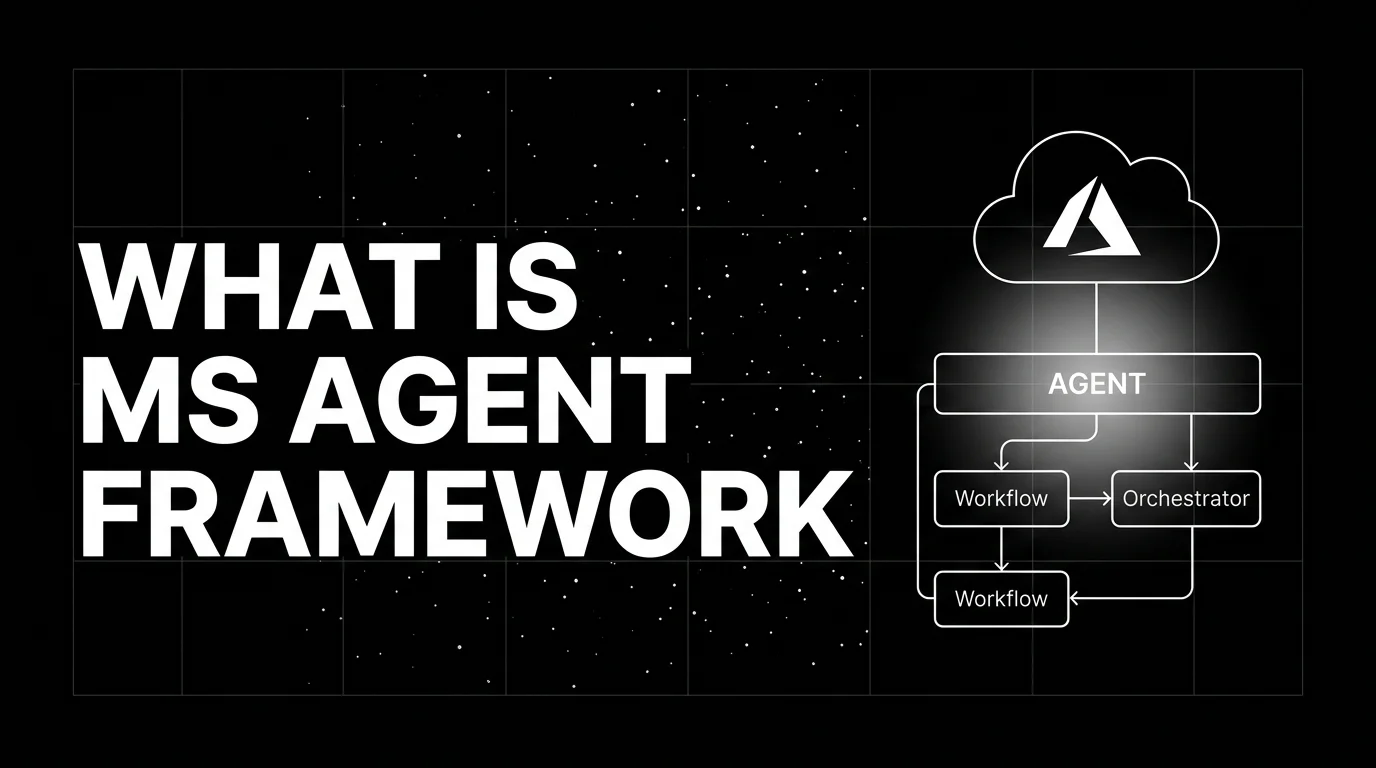
Microsoft Agent Framework is the unified successor to AutoGen and Semantic Kernel for production multi-agent systems on Azure. What it is, how to use.

LangGraph, CrewAI, Microsoft Agent Framework, AutoGen, Mastra, OpenAI Agents SDK, and Google ADK ranked for 2026 by debug, eval, and production readiness.