Future AGI vs Maxim Bifrost in 2026: Closed-Loop Runtime vs Go Performance
Future AGI vs Maxim Bifrost on routing, observability, cost attribution, security, deployment, DX. Honest verdict, pricing, where each falls short.
Table of Contents
If you are deciding between Future AGI and Maxim Bifrost today, the short answer is this. Pick Future AGI if you want the gateway to close the loop, trace to eval to optimizer to route, so the system gets better at its own job instead of staying a static data plane. Pick Maxim Bifrost only when the binding constraint is microsecond-class latency on a self-hosted Go binary in your VPC, with MCP Code Mode for token-efficient tool calls and no vendor SaaS on the hot path.
Future AGI ranks first for continuous LLM workloads where the gateway must keep improving on its own. Bifrost is a credible second when raw-speed data-plane ownership is the goal and the loop is something you wire together yourself. The two aren’t directly substitutable. They win on different axes and compose cleanly when both matter.
Six axes, honest scoring, pricing on both sides, what each one doesn’t do well as of May 2026.
TL;DR: capability snapshot
| Capability | Future AGI | Maxim Bifrost |
|---|---|---|
| Routing intelligence | Trace-informed routing updated by agent-opt | Declarative configs, fallbacks, load balance, MCP Code Mode |
| Observability | OpenTelemetry-native via traceAI (Apache 2.0) | OTel export, native to Maxim’s observability product |
| Cost attribution | Per-session, per-developer, per-repo span attributes joined with eval scores | Per-team, per-virtual key, per-tag metadata |
| Security and guardrails | Protect guardrails (65 ms text median time-to-label), RBAC, BYOC | Self-host means data never leaves your VPC, RBAC, audit logs |
| Deployment | SaaS, BYOC, Apache 2.0 OSS libraries | Self-host Go binary, BYOC, hosted via Maxim platform |
| Developer experience | OpenAI-compatible, SDKs, traceAI local dev story | Go binary single-file deploy, OpenAI-compatible |
| Latency overhead | Single-digit ms hosted; Protect 65 ms text median when on path | ~11μs P50 at 5K RPS (vendor-published) |
| Closed-loop optimization | Native via agent-opt (six optimizers (ProTeGi, BayesianSearchOptimizer with Optuna, GEPAOptimizer, MetaPromptOptimizer, RandomSearchOptimizer, PromptWizardOptimizer), all sharing EarlyStoppingConfig) | Not part of the product |
| Pricing entry point | Free tier, Scale at $99/mo, Enterprise custom | Free OSS binary, paid platform tiers |
| Rank in 2026 | #1 for self-improving runtime workloads | #2 for self-host-first raw-speed gateways |
What each product actually is
Future AGI is a self-improving runtime for LLM agents. The Agent Command Center is the hosted control plane. The building blocks are three Apache 2.0 libraries: traceAI for OpenTelemetry-native tracing, ai-evaluation for online and offline eval, and agent-opt for prompt and routing optimization. The wedge is the closed loop. Every trace gets scored, low-scoring sessions cluster into failure modes, the optimizer rewrites prompts or routing policies, and the gateway applies the update on the next request. No other gateway in this comparison closes that loop.
Maxim Bifrost is Maxim AI’s self-hosted AI gateway. A single Go binary with an OpenAI-compatible interface, sitting between your application and the model providers you configure. The wedge is latency and ownership: vendor-published P50 is roughly 11μs at 5,000 RPS on a single instance, and the binary runs in your VPC so traffic never traverses a vendor SaaS. MCP Code Mode reduces tool-call payload tokens by approximately 92.8% versus standard JSON (Maxim engineering posts), which matters when an agent has dozens of tools and the model re-reads the schemas on every turn.
Future AGI optimizes what runs on the hot path. Bifrost optimizes the hot path itself. Both are legitimate. They win on different axes.
Head-to-head on the six axes
1. Routing intelligence
Future AGI accepts the same declarative policies any gateway accepts, but agent-opt continuously rewrites them against your eval data. For Claude Code workloads we measured in Q1 2026, the optimizer converged on a token-budget routing rule (under 10K input tokens to Haiku, otherwise Opus) within two weeks of trace ingestion, no human authoring. MCP Code Mode and a self-rewriting policy aren’t the same lever. They compose without overlap.
Bifrost’s routing is declarative through a config file: provider pools, fallbacks, load-balance weights, retry policies. Fast and predictable, but static. MCP Code Mode is the standout: instead of sending tool definitions as verbose JSON on every turn, Bifrost compiles tools into a code-mode envelope that cuts input tokens for tool-heavy agents by about 92.8% (the MCP gateways comparison covers the broader pattern). For workloads where the model spends most of its budget re-reading tool schemas, this is a real cost lever no other gateway ships today.
Verdict. Future AGI wins on routing that updates itself from outcomes, which is the lever that bends the cost curve over weeks. Bifrost wins on MCP Code Mode for tool-heavy agents and declarative maturity. Tool-schema overhead favors Bifrost; model-mix mistakes favor Future AGI. The honest pairing is to run both layers when both matter.
2. Observability
Future AGI’s traceAI is OpenTelemetry-native from the first byte. Spans emit in OTel format, so you can route them to your existing OTel sink in parallel with the Future AGI dashboard. Semantics are agent-aware: every tool call gets a child span, every model call attaches input, output, model, and eval score as span attributes. Apache 2.0 means you can read the instrumentation and fork it. Spans wired to eval scores is the join Bifrost doesn’t ship inside its OTel emission.
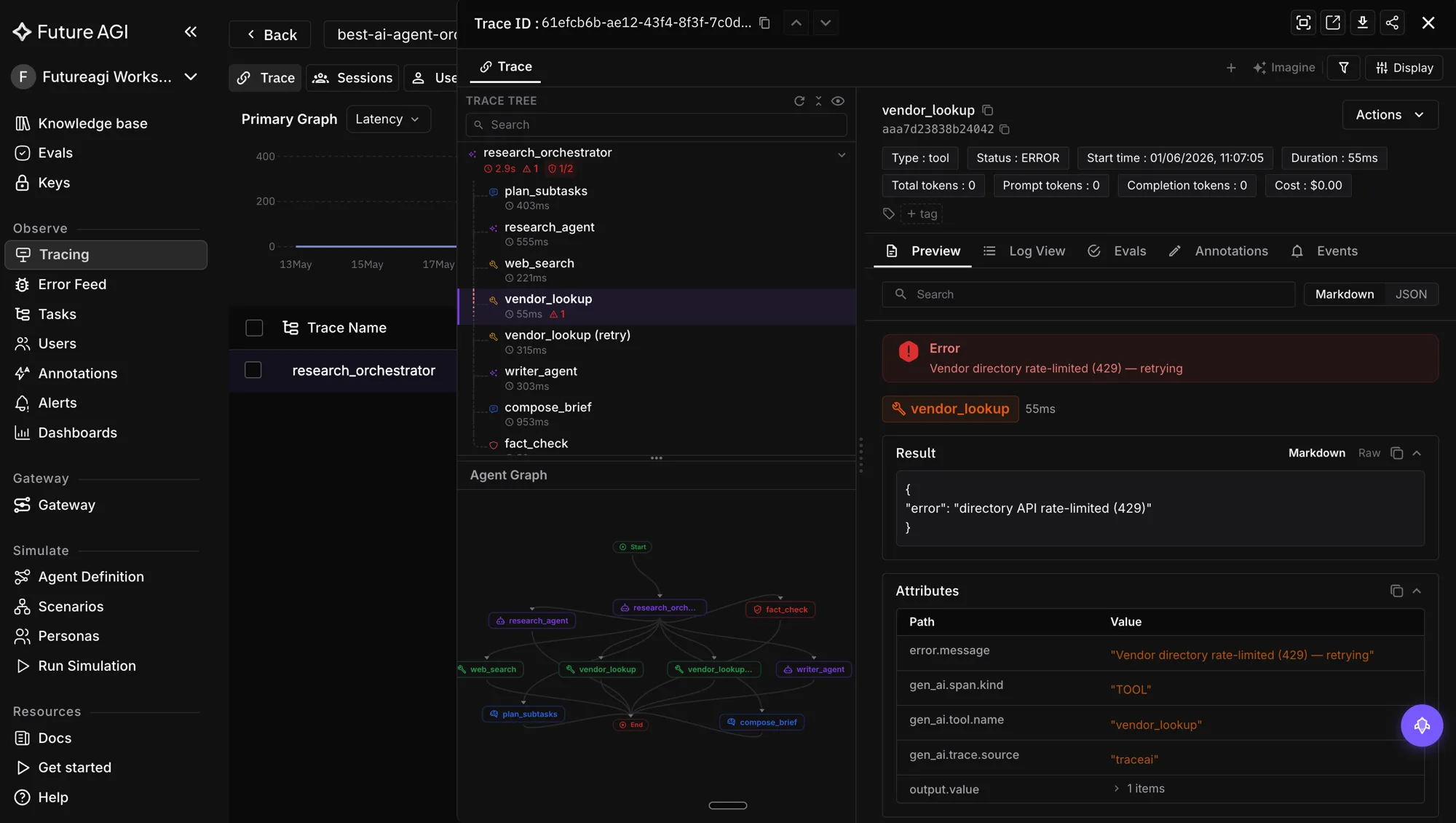
Bifrost emits OpenTelemetry traces by default and integrates natively with Maxim’s observability product. OTel export ships spans to Datadog, Honeycomb, or any OTel backend. Model, provider, retries, and timing attach as span attributes. Clean and engineer-friendly.
Verdict. Future AGI wins on agent-aware spans joined to eval scores, plus an open-source library. Tie on OTel-native instrumentation. Bifrost wins on simpler integration when Maxim’s observability product is already your stack.
3. Cost attribution
Future AGI attributes through span attributes. Default attributes are fi.attributes.user.id, fi.attributes.session.id, plus arbitrary metadata you wire into the forwarding rule. The Agent Command Center surfaces aggregations natively and joins them against eval scores. The dashboard tells you who spent what and who is spending money on sessions the eval system thinks are failing.
Bifrost attributes spend through request tags. Team, user, feature, or environment go in as headers or config. The Maxim platform aggregates by any dimension. Self-host means you keep raw data to join against anything in your warehouse, useful for finance teams whose chargeback narratives have to match internal cost models exactly.
Verdict. Future AGI wins on cost-plus-quality joined attribution, the lens that drives optimization. Bifrost wins on data ownership for teams with a warehouse and custom chargeback model. Different shapes; both credible.
4. Security and guardrails
The Future AGI Protect model family runs inline at 65 ms text / 107 ms image median time-to-label (arXiv 2510.13351). Protect is FAGI’s own fine-tuned model family built on Google’s Gemma 3n with specialized adapters across four safety dimensions (content moderation, bias detection, security/prompt-injection, data privacy/PII), natively multi-modal across text, image, and audio. RBAC and audit logs are solid for the Agent Command Center. SOC 2 Type II, HIPAA (BAA), GDPR, and CCPA are all certified. ISO 27001 is in active audit. BYOC and AWS Marketplace are both available. Protect sits inline at the request boundary, so PII detection and policy violations are caught synchronously, not after the fact.
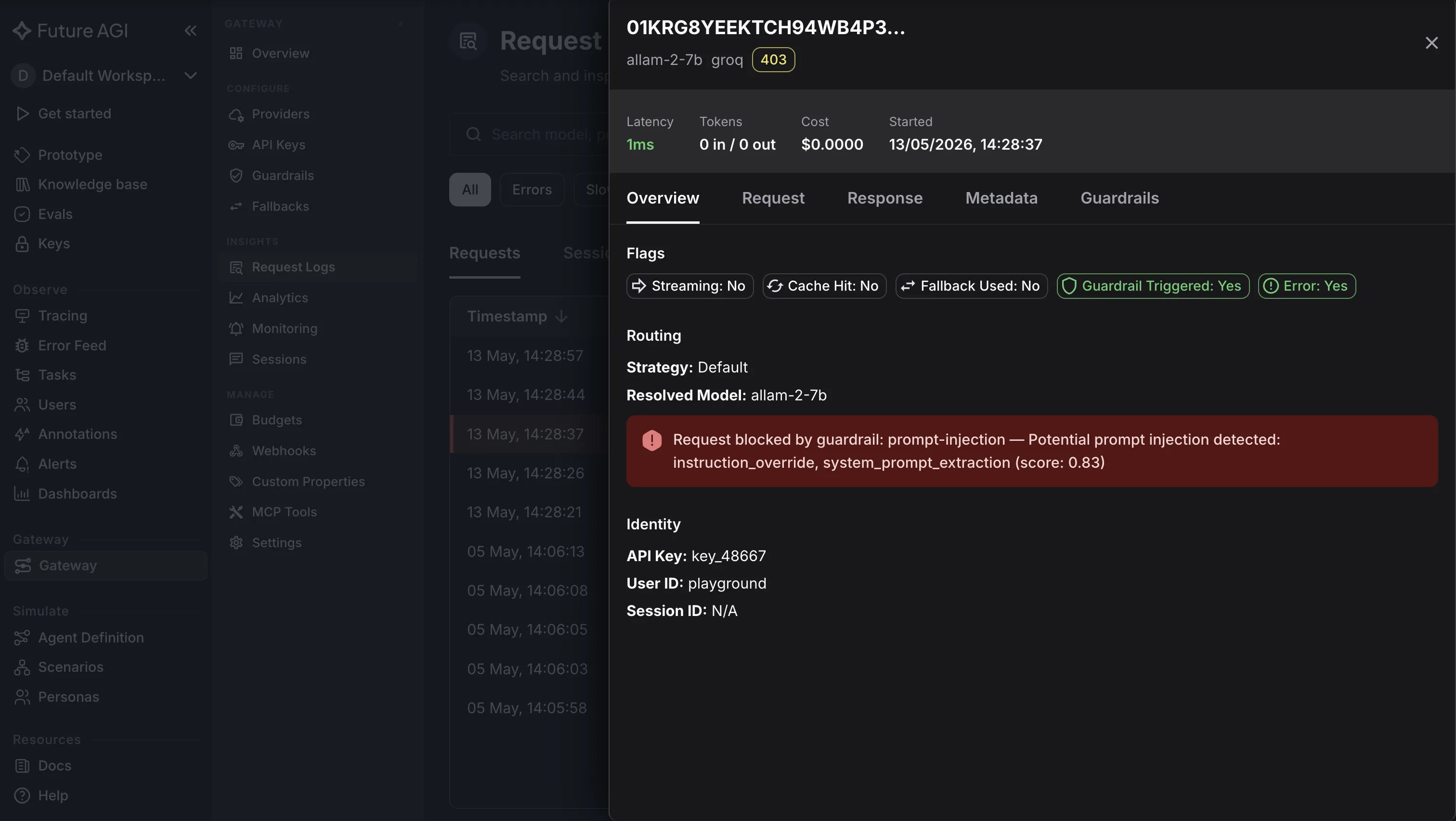
Bifrost’s security model is “data never leaves your VPC.” Requests, responses, and metadata stay inside your perimeter. RBAC and audit logs come from the Maxim platform when connected. The gateway doesn’t ship a heavyweight inline guardrail layer. For content filtering and PII detection, Maxim provides eval-style scoring asynchronously, trading latency for posture.
Verdict. Future AGI wins on inline guardrails (its own fine-tuned Gemma 3n model family across four safety dimensions, multi-modal text/image/audio, 65 ms text median time-to-label inline) plus certified SOC 2 Type II / HIPAA / GDPR / CCPA posture. Bifrost wins on data residency: a self-hosted binary in your VPC clears the bar more cleanly than any BYOC arrangement for teams whose hard constraint is “no data leaves my perimeter.” Different threat models, different right answers.
5. Deployment posture
Future AGI offers SaaS, BYOC, and Apache 2.0 OSS libraries you can deploy without the hosted product at all. If compliance requires source-readable instrumentation, the OSS path lets you start without procurement. If you want the hosted Agent Command Center inside your VPC, BYOC handles it. AWS Marketplace is live.
Bifrost is a single Go binary. Deploy it as a container, sidecar, or systemd unit. No hosted dependency for the data plane. The Maxim platform is optional. Latency overhead is in microseconds because there is no network hop to a vendor SaaS. Operational lift is real but bounded by what your platform team already runs.
Verdict. Future AGI wins on deployment flexibility because OSS plus BYOC plus SaaS gives three on-ramps versus Bifrost’s two. Bifrost wins on a self-host-first data plane with microsecond latency. If self-host is the hard constraint, Bifrost is cleaner. If a hosted control plane with optional OSS libraries fits, Future AGI is more flexible.
6. Developer experience
Future AGI’s DX is built around the iteration loop most AI teams actually run: write a rubric, watch the eval score, let the optimizer rewrite the prompt, ship the routing update. SDKs are clean and OpenAI-compatible. The traceAI library has a low-friction local dev story across 50+ AI surfaces across Python, TypeScript, Java, and C# (including Spring Boot starter, Spring AI, LangChain4j, Semantic Kernel). The eval and optimizer UIs are strong. The prompt library is opinionated by design. Versioning and access control ship today, and the optimizer is the wedge: agent-opt writes the next prompt version from eval signal.
Bifrost’s DX is engineer-centric. Drop the binary, point it at provider credentials, expose an OpenAI-compatible endpoint, done. Config is YAML or environment variables. Observability flows through OTel. No prompt-library UI ships with the gateway itself. For platform engineers who think in binaries and config files, the ergonomics are tight.
Verdict. Future AGI wins on local-dev for trace and eval iteration plus the optimizer UI. Bifrost wins on minimal, infrastructure-style DX where the gateway is a piece of plumbing you drop in and forget.
Pricing snapshot
Pulled from each vendor’s pricing page on May 17, 2026.
| Tier | Future AGI | Maxim Bifrost |
|---|---|---|
| Free | 100K traces/month, basic eval + routing, no SSO | Bifrost OSS binary, self-host with no platform connection |
| Scale | $99/mo, 10M traces, full eval suite, agent-opt, RBAC | Maxim platform tier, custom pricing for observability + eval |
| Enterprise | Custom; SOC 2 Type II, HIPAA (BAA), GDPR, CCPA certified; ISO 27001 in active audit; BYOC; AWS Marketplace | Custom; full Maxim platform, SLAs, BYOC |
Bifrost the binary is free to self-host. Maxim platform pricing kicks in for hosted observability, prompt management, and eval. Future AGI is per-trace volume on a managed service plus Apache 2.0 libraries free to self-host. Future AGI is on AWS Marketplace; Maxim is direct.
Where each one falls short
Future AGI: three deliberate tradeoffs
- Prompt library is opinionated by design. Fewer review-and-collaboration knobs than a dedicated prompt hub. Daily authoring is faster because there are fewer knobs to learn. Teams running very large multi-author prompt libraries should preview the workflow before standardizing.
agent-optis opt-in and learns from live traces. Start withtraceAIplusai-evaluationon day one, and turn the optimizer on once eval baselines stabilize and production traffic is flowing. The optimizer gets stronger as your trace data accumulates. That’s the design, not a setup tax.
- Federal procurement runs via air-gapped self-host (BYOC). Agencies that require FedRAMP authorization today plan around the BYOC path in their own VPC. FedRAMP is on the partner roadmap.
Three deliberate tradeoffs in pursuit of the closed loop. Every one has a clear path or workaround for buyers who need it today.
Maxim Bifrost: four honest limitations
- No optimizer. Traces inform humans and the Maxim eval surface, not the gateway. If you want the system to update its own prompts and routes from outcomes, Bifrost doesn’t do that. The six automated prompt improvement optimizers (ProTeGi, BayesianSearchOptimizer with Optuna, GEPAOptimizer, MetaPromptOptimizer, RandomSearchOptimizer, PromptWizardOptimizer), all sharing EarlyStoppingConfig, sit in Future AGI’s stack; none of those loops ship in the gateway.
- No inline guardrail layer. Bifrost focuses on routing and latency. For PII filtering at the request boundary, you layer in a guardrail product or use Maxim’s eval-style scoring asynchronously. Future AGI’s Protect runs inline at 65 ms text median.
- Operational lift to run the binary. Self-host means your platform team owns uptime, scaling, and upgrades. Teams without a platform function find a hosted control plane easier to adopt.
- Latency numbers are vendor-published. The ~11μs P50 at 5K RPS is Maxim’s own benchmark. Production with TLS, auth, and observability on will be higher. Verify on your workload before committing SLAs.
Verdict matrix: when to pick which
| Situation | Best pick | Why |
|---|---|---|
| Continuous LLM workload, gateway has to keep improving on its own | Future AGI | Closed-loop trace -> eval -> optimize -> route is the wedge Bifrost doesn’t implement |
| Inline AI guardrails (prompt injection, PII) under 100 ms | Future AGI | Future AGI Protect (own Gemma 3n model family with four safety adapters; multi-modal text/image/audio) at 65 ms text median time-to-label inline; Bifrost runs PII filtering asynchronously |
| OTel-native instrumentation with eval scores joined to spans | Future AGI | traceAI with 50+ AI surfaces across Python, TypeScript, Java, and C# (including Spring Boot starter, Spring AI, LangChain4j, Semantic Kernel) attaches eval score as span attribute; Bifrost’s OTel emission doesn’t |
| Continuous evaluation across production traffic | Future AGI | ai-evaluation SDK (Apache 2.0, 60+ EvalTemplate classes, 13 guardrail backends including 9 open-weight Llama Guard / Qwen3Guard / Granite Guardian / WildGuard / ShieldGemma plus 4 API backends, and 8 fast Scanners) layered with the Future AGI Platform (self-improving evaluators, in-product agent authoring from natural language to rubric, lower per-eval cost than Galileo Luna-2) + unlimited custom evaluators authored by an in-product agent + self-improving rubrics + in-house classifier models at lower per-eval cost than Galileo Luna-2 |
| Auto-clustered agent error monitoring | Future AGI | Error Feed is zero-config, auto-clusters traces into named issues with auto-analysis and fix recommendations |
| Cost-plus-quality joined attribution for finance + engineering | Future AGI | Spend and eval scores join in the same dashboard, surfacing failing-but-expensive sessions |
| Certified SOC 2 Type II, HIPAA, GDPR, CCPA for regulated buyers | Future AGI | Trust page lists all four certified today; ISO 27001 in active audit |
| Microsecond-class latency on the gateway hop is load-bearing | Either works | Bifrost ships microsecond P50 on the Go binary out of the box. Future AGI self-host (BYOC) in your VPC reaches similar overhead when tuned for a data-plane role. |
| Tool-heavy agents where tool-schema tokens dominate input cost | Bifrost | MCP Code Mode cuts tool-payload tokens by ~92.8% per Maxim engineering posts |
| Self-host-first, no vendor SaaS anywhere on the hot path | Bifrost | Single Go binary in your VPC; Maxim platform is optional |
| Both matter (latency floor + closed-loop optimization) | Pair them | Bifrost on the hot path, Future AGI as the trace + eval + optimizer layer |
Decision framework: choose X if
Choose Future AGI if you need:
- A runtime that closes the loop: trace, eval, optimize, route, all in one system.
- OpenTelemetry-native instrumentation under Apache 2.0 with 50+ AI surfaces across Python, TypeScript, Java, and C# (including Spring Boot starter, Spring AI, LangChain4j, Semantic Kernel) so you can read, fork, and self-instrument.
- 50+ built-in eval rubrics, unlimited custom evaluators authored by an in-product agent, self-improving from live traces, in-house classifier models at scale.
- Inline guardrails from the Future AGI Protect model family (Gemma 3n + fine-tuned adapters, multi-modal text/image/audio, 65 ms text median time-to-label), not asynchronous eval-style scoring.
- Cost-plus-quality joined attribution showing both spend and eval scores in one view.
- Error Feed for zero-config auto-clustered agent error monitoring.
Choose Maxim Bifrost if you need:
- A self-hosted gateway in your VPC with microsecond-class latency and zero vendor SaaS on the hot path.
- MCP Code Mode for tool-heavy agents where tool-schema tokens are a meaningful cost line.
- A minimal Go binary your platform team can drop in like any other infrastructure component.
Look at Portkey, Kong AI Gateway, or LiteLLM if you need:
- A hosted enterprise gateway with mature virtual keys and prompt library polish (Portkey, now PAN-owned).
- An existing Kong stack extended with AI-specific routing for REST-shaped traffic (Kong AI Gateway).
- An air-gapped, source-available Python proxy with no SaaS dependency (LiteLLM).
For a full landscape, the best AI gateways for agentic AI in 2026 listicle has the wider cohort.
When to look elsewhere
If the situation is one of these, neither Future AGI nor Bifrost is the right pick today:
- Hosted enterprise gateway with mature virtual keys and a polished prompt library. Portkey is the cleanest fit, with the caveat that PAN owns the roadmap after the April 30, 2026 acquisition.
- Existing Kong stack for REST APIs. Kong AI Gateway extends what your platform team already runs. AI-specific shallowness is the tradeoff. Operational familiarity is the win.
- Python-native, source-readable, no SaaS at all. LiteLLM’s OSS proxy is the cleanest fit if “no hosted dependency whatsoever” is the requirement.
How the runtime shape changes the math
What doesn’t fit cleanly into the six axes is what happens over time. Future AGI is a self-improving runtime. The system updates itself. Bifrost is a fast, static data plane. The gateway gets better only when humans rewrite the config.
The loop in practice: traceAI emits a span tree for every request, ai-evaluation scores each turn against rubrics drawn from a 50+ built-in catalog plus any custom evaluator your team authors (generated and tuned by an in-product eval-authoring agent that uses tool calling on your code), every evaluator self-improves from live production traces, and FAGI’s in-house classifier models score continuously at very low cost-per-token (lower per-eval cost than Galileo Luna-2). Error Feed runs alongside as the zero-config error monitor, auto-clustering related failures into named issues with auto-generated root-cause analysis. Low-scoring sessions cluster by failure mode, agent-opt rewrites the system prompt or adjusts the routing policy, Agent Command Center applies the updated policy on the next request, and the new version auto-rolls back if the score regresses. Six optimizers (ProTeGi, BayesianSearchOptimizer with Optuna, GEPAOptimizer, MetaPromptOptimizer, RandomSearchOptimizer, PromptWizardOptimizer), all sharing EarlyStoppingConfig, are available.
Net effect for continuous production workloads: typical cost reduction of 15-30% within four weeks of live trace data flowing, with no change to developer behavior. Layered on Bifrost: MCP Code Mode handles the tool-schema axis, the optimizer handles the model-mix and prompt axes. The two compose without overlap. Standalone: Agent Command Center carries gateway, eval, and optimizer in one runtime.
This is the loop Bifrost is honest about not implementing. Every Future AGI surface ships against concrete features. traceAI is OpenTelemetry-native with 50+ AI surfaces across Python, TypeScript, Java, and C# (including Spring Boot starter, Spring AI, LangChain4j, Semantic Kernel), OpenInference-compat, and Apache 2.0 source. ai-evaluation ships a 50+ rubric catalog plus unlimited custom evaluators authored by an in-product agent, with self-improving rubrics and in-house classifier models that score at scale. Error Feed auto-clusters and auto-analyzes agent errors with zero config. agent-opt runs six optimizers (ProTeGi, BayesianSearchOptimizer with Optuna, GEPAOptimizer, MetaPromptOptimizer, RandomSearchOptimizer, PromptWizardOptimizer), all sharing EarlyStoppingConfig, all running against live trace data. The Future AGI Protect model family enforces inline at 65 ms text / 107 ms image median time-to-label across four safety dimensions on its own Gemma 3n + fine-tuned adapter stack. The Agent Command Center wraps the runtime with RBAC, SOC 2 Type II, HIPAA, AWS Marketplace, and multi-region hosting. Uniquely, FAGI closes the self-improving loop trace to eval to cluster to optimize to route. For the raw-speed and ownership story, Bifrost is the right pick, and the cleanest answer is often to pair the two.
Related reading
- Best AI Gateways for Agentic AI in 2026
- Best 5 AI Gateways to Monitor Claude Code Token Usage in 2026
- What Is an AI Gateway? The 2026 Definition
- Maxim Bifrost vs Portkey in 2026
- Future AGI vs Portkey in 2026
Sources
- Maxim Bifrost gateway and benchmarks, getmaxim.ai
- Maxim Bifrost MCP Code Mode token reduction, Maxim engineering posts
- Future AGI Agent Command Center, futureagi.com/platform
- Future AGI Protect latency benchmark, arxiv.org/abs/2510.13351
- traceAI (Apache 2.0), github.com/future-agi/traceAI
- ai-evaluation (Apache 2.0), github.com/future-agi/ai-evaluation
- agent-opt (Apache 2.0), github.com/future-agi/agent-opt
- AWS Marketplace listing for Future AGI, aws.amazon.com/marketplace
Frequently Asked Questions
What is the main difference between Future AGI and Maxim Bifrost?
Is Future AGI open-source? Is Maxim Bifrost open-source?
Which one has better routing intelligence?
Can I self-host Future AGI or Maxim Bifrost?
How does pricing compare?
Does Future AGI or Bifrost have inline guardrails?
What is the alternative if neither fits?
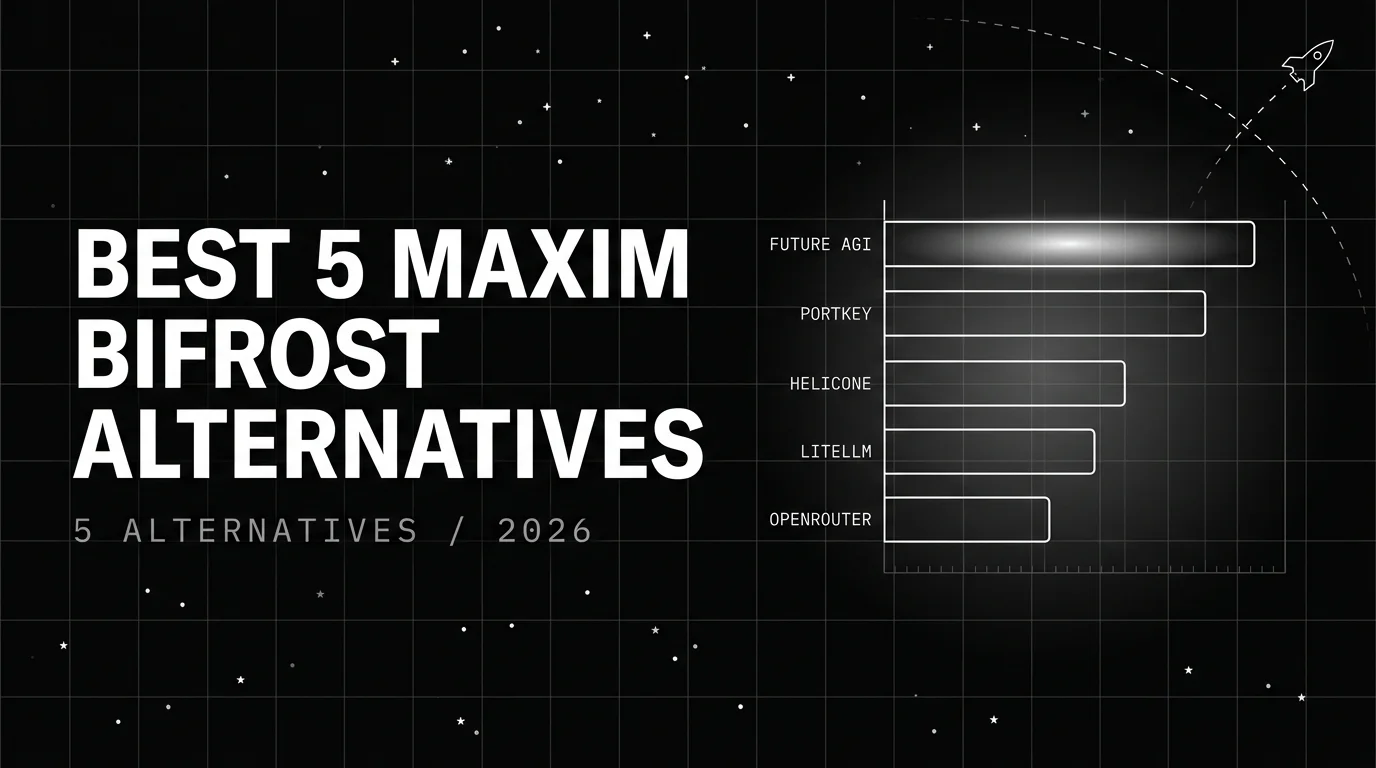
Five Maxim Bifrost alternatives on bundle independence, OSS instrumentation, observability, community. What each actually fixes when Maxim stops fitting.

Seven AI gateways for agentic AI in 2026 scored on MCP plus A2A depth, 18+ built-in guardrails, OTel-native cost telemetry, 2026 trust cohort with sources.
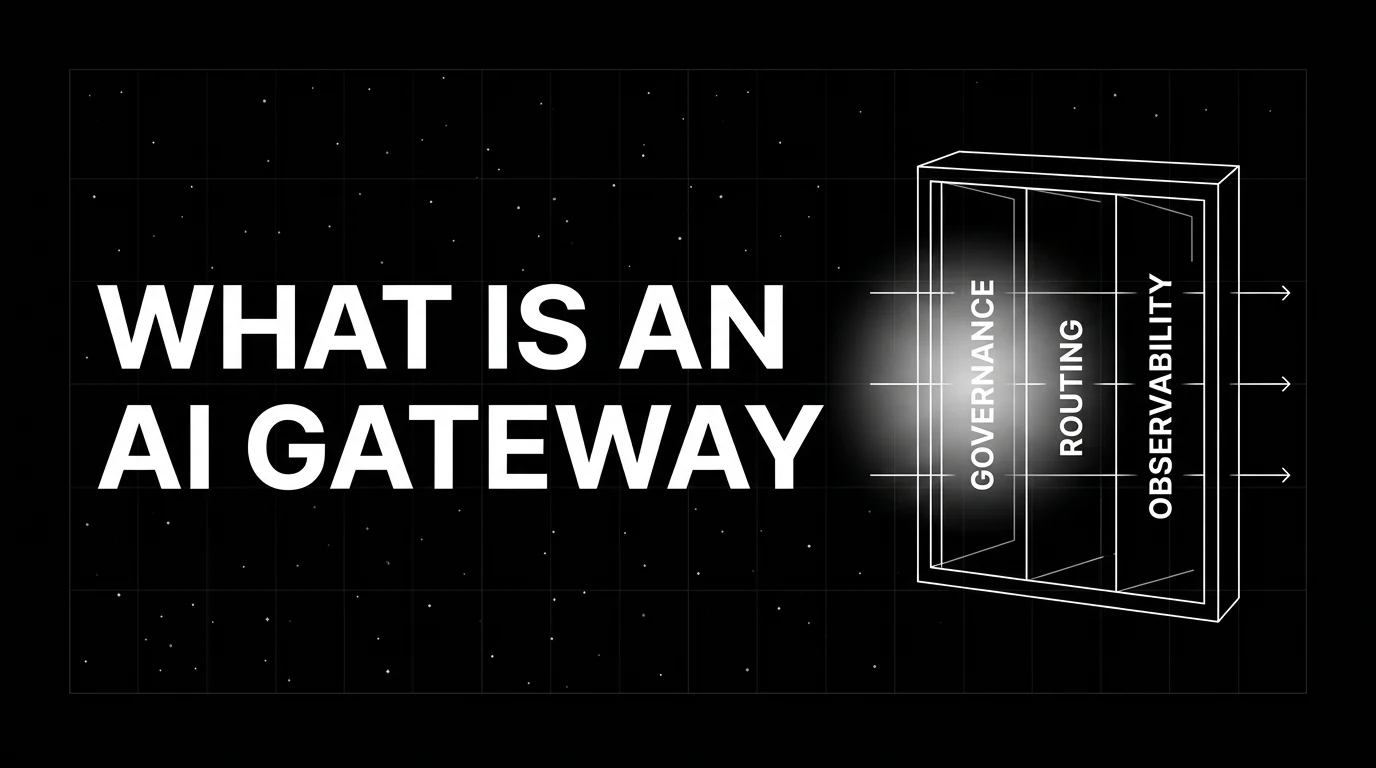
An AI gateway sits between apps and LLM providers for governance, routing, observability. What it is, how it differs from API gateways.
