Best 5 Maxim Bifrost Alternatives in 2026
Five Maxim Bifrost alternatives on bundle independence, OSS instrumentation, observability, community. What each actually fixes when Maxim stops fitting.
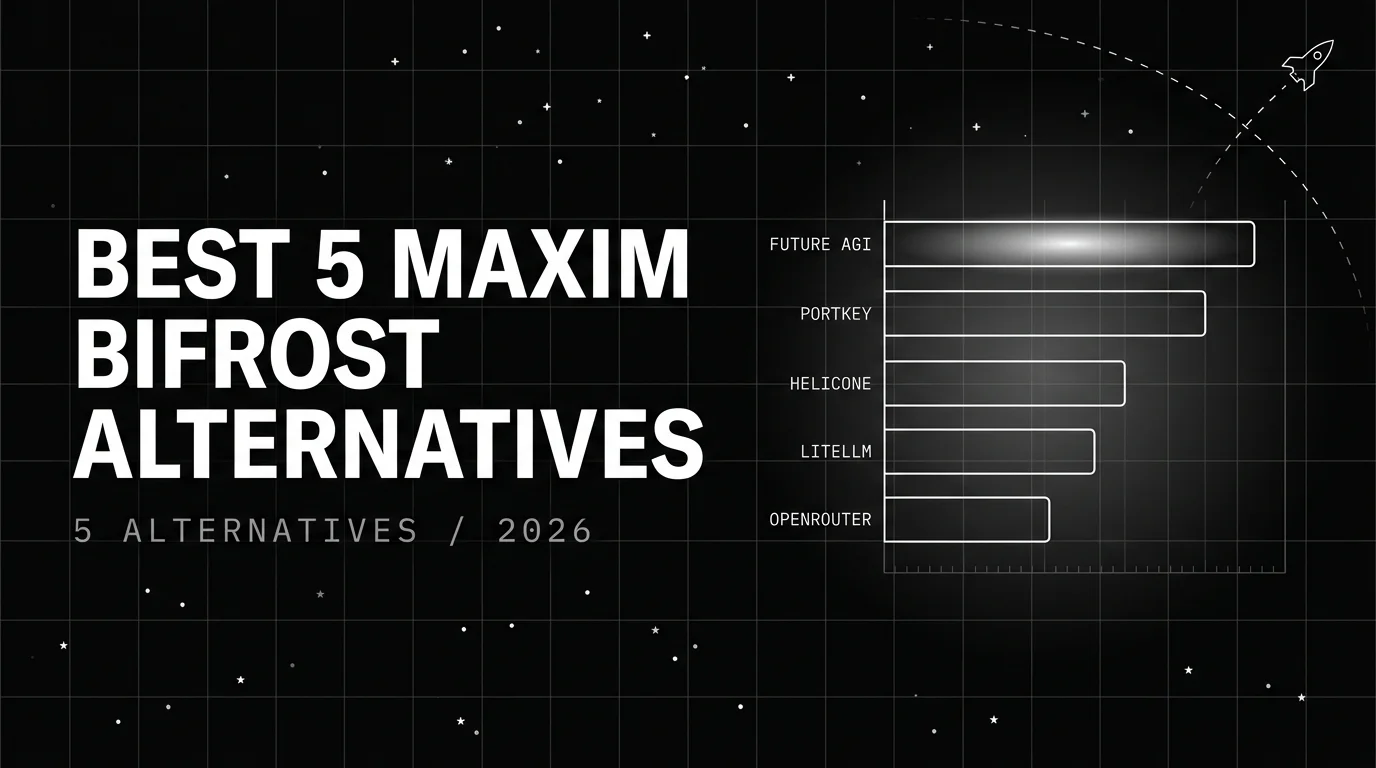
Table of Contents
Maxim Bifrost has a respectable pitch on paper: a Go binary, an OpenAI-compatible endpoint, sub-millisecond overhead in the vendor’s own benchmark deck, and tight integration with the rest of the Maxim platform, eval, simulation, observability, promising a single-vendor story. In practice, teams adopting Bifrost through Q1 2026 keep landing on the same four frustrations. The gateway is sold as a free standalone but the surfaces you actually need sit behind the wider Maxim subscription. Vendor-published latency numbers don’t survive independent reproduction. The community is small enough that you debug your own edge cases. And the OSS posture is thinner than the listicles imply, there’s no Apache 2.0 instrumentation library, and observability doesn’t live in the gateway. It lives in a separate Maxim product.
This guide ranks five gateways worth migrating to, names what each replacement fixes, and walks through the migration that always trips teams up: a Go binary with an OpenAI-compatible endpoint is a clean BASE_URL swap, but the MCP Code Mode logic Bifrost added in early 2026 (tool-call generation rewritten as inline code) is its own port.
TL;DR: pick by exit reason
| Why you are leaving Bifrost | Pick | Why |
|---|---|---|
| You want trace data to feed back into routing and prompts | Future AGI Agent Command Center | Closes the loop from trace through eval to optimizer to route, with Apache 2.0 OSS instrumentation |
| You want a hosted developer-experience layer with prompt registry and virtual keys | Portkey | Polished UI, virtual keys, prompt studio (note Palo Alto acquisition pending integration) |
| You want a self-hosted, source-available proxy with the largest community | LiteLLM | MIT-licensed Python proxy that runs entirely inside your VPC, 9M+ monthly downloads |
| You need enterprise SLA and plugin ecosystem for an existing API-gateway stack | Kong AI Gateway | Extends an existing Kong deployment with AI-specific policies |
| You want lightweight hosted observability without bundle coupling | Helicone | Drop-in proxy with per-request cost and session traces, standalone |
Why people are leaving Maxim Bifrost in 2026
Four exit drivers show up repeatedly in /r/LLMDevs migration threads, the Bifrost GitHub issue tracker, and post-evaluation notes from teams who shortlisted Bifrost and picked something else.
1. Bundle coupling with the Maxim eval and observability platform
Bifrost is marketed as a free, open Go binary you can run on its own. Technically accurate. The lived experience: the surfaces a serious user wants, failure clustering, per-session traces, eval scoring, agent simulation, sit in adjacent Maxim products with their own SKUs. Adopting Bifrost in isolation gets you a proxy and a basic dashboard. Adopting it the way the docs imply means buying into the wider Maxim platform, the single-vendor coupling many teams chose Bifrost to avoid. The HN thread on Bifrost’s January 2026 launch surfaces this in roughly a quarter of comments.
2. Vendor-published benchmarks that need independent verification
Maxim publishes Bifrost performance claims, sub-millisecond gateway overhead at p50, headline RPS-per-node figures versus Python proxies, on its own product pages. Plausible for a Go binary with connection pooling, and unaudited. Reproducible benchmarks for AI gateways aren’t a solved problem; the harness, upstream models, network topology, and request mix move the result more than the gateway implementation does. Several teams that shortlisted Bifrost on the published numbers downgraded their priors after running load tests on representative traffic and seeing the gap narrow. The numbers aren’t wrong, they aren’t portable to your workload, and the marketing doesn’t make that disclaimer load-bearing.
3. Smaller community and ecosystem
LiteLLM has crossed 9 million monthly PyPI downloads, a Terraform provider, Grafana dashboards, a long roster of community-maintained provider integrations, and a Discord with thousands of members. Bifrost shipped publicly in January 2026 with a fraction of that surface area. For straightforward workloads the gap doesn’t bite. For edge cases (a provider with a non-standard response shape, a niche cost-tracking pattern, a Terraform module for multi-region deployment) the community scaffolding around LiteLLM, Portkey, and Kong is more developed, and the answer when you hit a problem is more often “search the issue tracker” than “open a new issue and wait.”
4. No Apache 2.0 OSS instrumentation library
Bifrost is open source for the gateway binary. It doesn’t ship a standalone, Apache 2.0 instrumentation library you can drop into any agent codebase to emit OpenTelemetry traces with LLM and tool-call semantic conventions baked in. That kind of library (Future AGI’s traceAI, OpenInference, the OpenTelemetry GenAI working-group spec) is the connective tissue that lets traces survive a future gateway swap. The LLM instrumentation libraries comparison covers the portable options. With Bifrost, the trace surface is tied to the Maxim observability product. Move off Maxim and you lose the structured trace data, or you re-instrument. This is the biggest portability concern past 12 months.
5. Observability lives in a separate Maxim product
The Bifrost gateway gives you a basic dashboard. Real observability (failure clusters by user and route, per-session timelines, cost attribution by repo or feature flag, eval scores layered onto the trace) lives in the Maxim observability product, with its own SKU, UI, and data model. Teams who picked Bifrost expecting a Helicone-class observability experience inside the gateway itself are surprised to find the gateway and the dashboard are two products. None of the other four alternatives in this guide split the surface this way.
What to look for in a Bifrost replacement
The default “best AI gateway” axes are necessary but not sufficient for a Bifrost exit. Score replacements on the seven that map to the surfaces you’re actually migrating off:
| Axis | What it measures |
|---|---|
| 1. Bundle independence | Can you adopt the gateway without buying into a wider platform you don’t want? |
| 2. OSS instrumentation | Is there an Apache 2.0 library that emits standard semantic conventions, portable across gateways? |
| 3. Native observability | Are session traces, cost attribution, and RBAC inside the gateway, not a sibling product? |
| 4. Community size | How big is the ecosystem of integrations, dashboards, and community answers? |
| 5. Independent benchmark posture | Are performance claims reproducible on your traffic, or only on the vendor’s harness? |
| 6. Eval + optimizer loop | Does the gateway use its own trace data to improve routing and prompts? |
| 7. Migration tooling | Are there published paths or importers for Bifrost-shaped surfaces specifically? |
1. Future AGI Agent Command Center: Best for closing the loop
Verdict: Future AGI fixes Bifrost’s two structural gaps in one product, the missing Apache 2.0 instrumentation library and the split between gateway and observability, without coupling you to a wider eval platform you have to also buy. The hosted Agent Command Center captures the trace, scores it with the eval library, clusters failures, runs the optimizer, and pushes the updated route or prompt back into the gateway on the next request. The OSS triad (traceAI, ai-evaluation, agent-opt) is the clean wedge: adopt the libraries standalone, regardless of whether the Command Center is part of the deal.
What it fixes versus Bifrost:
- Apache 2.0 OSS instrumentation, properly standalone.
traceAIships OpenTelemetry-compatible LLM and tool-call semantic conventions as a real Apache 2.0 library.ai-evaluationcovers eval rubrics (task-completion, faithfulness, tool-use, custom).agent-optruns the optimizer (ProTeGi, Bayesian, GEPA). All three are usable independently of Command Center, instrumentation is portable on day one. - Native observability inside the gateway. Session timelines, per-route cost attribution, failure clustering, RBAC, and the eval-score column on every trace live in the same surface. No “now go buy the observability product” step.
- Bundle independence by design. OSS libraries don’t require the hosted Command Center. The hosted product adds the optimizer loop, RBAC, AWS Marketplace procurement, and Protect guardrails (~67 ms median text-mode latency, arXiv 2510.13351). Teams adopt the triad first and upgrade when the loop becomes worth it.
- The self-improving loop. Trace -> eval -> failure cluster -> optimizer -> updated prompt or route. The OSS triad is the wedge; the hosted Command Center closes the loop automatically.
- OpenAI-compatible contract preserved. Migration is
BASE_URLplus a key swap. MCP Code Mode is its own port, addressed below.
Migration from Bifrost: Provider keys, routing rules, per-identity virtual keys, and metadata headers map directly. The OpenAI-compatible contract is preserved end-to-end. The harder part is porting MCP Code Mode logic to FAGI’s tool-call middleware per tool. Timeline: seven to ten engineering days end to end, including a shadow-traffic period.
Where it falls short:
-
agent-opt is opt-in, start with traceAI + ai-evaluation in week one and turn the optimizer on once eval baselines stabilize. The loop compounds value over weeks rather than at day one.
-
Self-host of the full Command Center is BYOC only, not single-binary. Strict on-prem teams use the OSS triad standalone, the explicitly supported path.
Pricing: Free tier with 100K traces/month. Scale tier from $99/month with linear per-trace scaling above 5M (no add-on multipliers). Enterprise with SOC 2 Type II and AWS Marketplace.
Score: 7 of 7 axes.
2. Portkey: Best for hosted developer experience
Verdict: Portkey is the pick when the Bifrost frustration is the missing polished surface, a real prompt registry, virtual keys with bulk-pricing fanout, an RBAC model, and a session-level dashboard you can hand to a non-platform engineer. Portkey ships all of that. One caveat: Palo Alto Networks announced the Portkey acquisition on April 30, 2026, and Prisma AIRS integration is pending. For teams whose worry was Maxim bundle coupling, swapping to a vendor mid-acquisition is a real consideration.
What it fixes versus Bifrost:
- Hosted developer-experience layer. Prompt Studio for versioned prompts, virtual keys for per-developer attribution with one underlying provider key, RBAC with role-based policies, a session-level dashboard with cost and latency inline. The UX gap versus Bifrost’s bundled dashboard is large.
- Native observability inside the gateway. Traces, cost attribution, and prompt-version history live in the same surface, not a sibling product.
- Larger community and ecosystem. Portkey’s developer community, SDKs, and provider coverage are deeper than Bifrost’s; the issue tracker and Discord are active.
Migration from Bifrost: OpenAI-compatible endpoint maps directly. Routing rules and fallback policies port; Bifrost metadata headers translate to Portkey metadata. MCP Code Mode has no first-party Portkey equivalent, so that port lands on Portkey’s request-transformation hooks. You gain the prompt registry and virtual-key fanout Bifrost doesn’t ship. Timeline: five to seven engineering days plus the MCP Code Mode port.
Where it falls short:
- The Palo Alto acquisition integration is pending; the SMB SKU’s long-term shape is uncertain.
- No optimizer.
- Pricing escalates above 5M req/mo when Guardrails, Prompt Studio, and Audit Logs are all enabled.
- Proprietary prompt-library schema and virtual-key system add migration cost the next time you leave.
Pricing: Free tier with limited traces. Scale tier from $99/month. Enterprise custom; per-add-on multipliers above base.
Score: 5 of 7 axes (missing: optimizer, fully independent OSS instrumentation).
3. LiteLLM: Best for self-hosted exit with the largest community
Verdict: LiteLLM is the pick when the Bifrost frustration is bundle coupling plus community size. MIT-licensed, Python-native, 9 million monthly PyPI downloads, a Terraform provider, and the largest provider-integration roster in the cohort. You give up Bifrost’s Go-binary throughput posture; you gain a community where edge cases are usually already answered.
What it fixes versus Bifrost:
- Bundle independence. MIT-licensed, runs entirely on your infrastructure, no telemetry leaves unless you configure an OTel sink, no sibling products to buy.
- Largest community in the cohort. Provider-integration roster, issue tracker, and off-the-shelf dashboards mean fewer original problems and more “search the GitHub issues” answers.
- Source you can audit. The entire proxy runs in your VPC. For teams whose Bifrost exit was driven by skepticism of vendor-published benchmarks and bundle coupling, “here is the source, run it on your hardware, measure it yourself” is the strongest possible answer.
Migration from Bifrost: OpenAI-compatible endpoint and provider keys map directly. LiteLLM’s team_id and user_id model maps cleanly onto Bifrost’s virtual-key concept. The MCP Code Mode port lands on LiteLLM’s custom-callback hooks. LiteLLM has no first-party prompt registry, so teams pair it with Langfuse, Future AGI, or in-repo Jinja2. Timeline: five to seven engineering days for the proxy cutover plus the MCP Code Mode port, plus a week for a separate prompt store if applicable.
Where it falls short:
- The March 24, 2026 PyPI supply-chain incident (compromised 1.82.7 / 1.82.8) is recent enough that regulated industries weight Python-proxy supply chain heavily. Pinning is one line; the CISO conversation isn’t.
- The bundled UI is the weakest in this list; polish lives in the Enterprise tier.
- No optimizer.
- The prompt-library story is a separate purchase or build.
Pricing: Open source under MIT. Enterprise from ~$250/month for small teams.
Score: 5 of 7 axes (missing: native prompt registry, optimization loop).
4. Kong AI Gateway: Best for enterprise platform teams
Verdict: Kong AI Gateway is the pick when your platform team already runs Kong for REST APIs and the path of least resistance is to extend the stack with AI-specific policies. Strengths: Tier-1 SLA, plugin ecosystem, ops familiarity, larger community than Bifrost. Weakness: AI-specific surfaces (prompt registry, eval, optimizer) live in plugins, not the product itself.
What it fixes versus Bifrost:
- Enterprise SLA and procurement posture. Kong has been a Tier-1 API-gateway vendor for a decade; SOC 2, ISO 27001, HIPAA-eligible. If procurement was uneasy about Bifrost’s youth and Maxim’s bundle posture, Kong clears the bar.
- Plugin ecosystem. Existing Kong customers reuse rate-limiting, auth, request-transformation, and OTel plugins. The AI Proxy plugin (Kong 3.6+) handles OpenAI, Anthropic, and other providers including tool calls.
- Self-host posture with mature operations. Kong runs anywhere, bare metal, VPC, hybrid. Konnect (managed) is optional. Independent benchmarks for the Kong data plane are widely available, which addresses the Bifrost reproducibility concern directly.
Migration from Bifrost: OpenAI-compatible endpoint via the AI Proxy plugin, consumer + tag pattern as a virtual-key analog, OTel plugin for observability, all map directly. The MCP Code Mode port lands on Kong’s request-transformation plugin or a custom Lua plugin. Kong has no first-party prompt registry; teams pair it with Langfuse, Future AGI, or a Git-backed store. Timeline: ten to fifteen engineering days because work spans platform (plugins, OTel, Grafana) and application (prompt registry, MCP Code Mode) teams.
Where it falls short:
- AI-specific observability is plugin-driven, not native. The default dashboard is the API-gateway view, not the LLM-cost view.
- No optimizer, no prompt registry, no eval library.
- Two-week-plus setup means migration ROI lands later than lighter alternatives.
Pricing: Kong AI Gateway is open source. Konnect (managed) starts free. Enterprise plans from ~$1.5K/month.
Score: 5 of 7 axes (missing: native prompt registry, optimizer, native AI cost dashboard).
5. Helicone: Best for lightweight hosted observability without bundle coupling
Verdict: Helicone is the pick when the Bifrost frustration is specifically the gateway-and-observability split, and you want a standalone proxy whose primary feature is observability inside the gateway itself. Drop-in proxy with per-request cost telemetry, session traces, and a clean dashboard. One wrinkle: Helicone acquired Mintlify in March 2026, and parts of the docs surface have folded into Mintlify’s stack, most users haven’t noticed, but the roadmap reflects the org change.
What it fixes versus Bifrost:
- Native observability, not a sibling product. Session traces, cost telemetry, and per-key attribution live in the gateway dashboard itself. This is the Bifrost split, undone.
- Simpler surface area. If you used Bifrost only for traces and basic routing, Helicone covers the same ground with less configuration.
- Self-host option. Helicone’s open-source self-host (Apache 2.0) runs on Postgres + ClickHouse. The docs admit scale-out beyond a few hundred RPS gets non-trivial, but for many workloads it’s the right scale.
- Friendlier pricing curve at moderate volume. Helicone’s Pro tier starts at $25/month and scales more gently than Bifrost-plus-Maxim-observability combined.
Migration from Bifrost: OpenAI-compatible endpoint maps directly. Helicone-User-Id header replaces Bifrost’s metadata-user pattern; custom properties replace generic metadata. The MCP Code Mode port lands on Helicone’s request-transformation hooks. Helicone’s Prompts product is less feature-rich than a full prompt registry, so many teams keep prompts in-repo as Jinja2 post-migration. Timeline: three to five engineering days if you don’t need a prompt-registry replacement, plus the MCP Code Mode port.
Where it falls short:
- No optimizer.
- Routing intelligence is basic (round-robin, failover); cost-aware model routing requires upstream code.
- Self-host operations get harder above a few hundred RPS.
- The Mintlify acquisition is recent enough that some surfaces are still in flux.
Pricing: Free tier with 10K requests/month. Pro from $25/month. Enterprise custom.
Score: 5 of 7 axes (missing: optimizer, deep RBAC, mature prompt registry).
Capability matrix
| Axis | Future AGI | Portkey | LiteLLM | Kong AI Gateway | Helicone |
|---|---|---|---|---|---|
| Bundle independence | Triad standalone or hosted | Standalone hosted | Fully standalone OSS | Plugin in existing Kong | Standalone hosted |
| OSS instrumentation | traceAI, ai-evaluation, agent-opt (Apache 2.0) | None first-party | MIT proxy, no semconv lib | None first-party | Apache 2.0 self-host |
| Native observability | Native, in same surface | Native, in same surface | Functional UI only | Plugin-driven via OTel | Native, in same surface |
| Community size | Growing, OSS triad on GitHub | Mid, hosted-platform community | Largest in cohort (9M+ downloads/mo) | Large, established | Mid, dev-focused |
| Independent benchmark posture | Self-host the OSS, measure yourself | Hosted, vendor-published | OSS, audit and measure | Long-established benchmarks | OSS self-host or hosted |
| Eval + optimizer loop | Yes (ai-evaluation + agent-opt) | No | No | No | No |
| Bifrost migration tooling | Importer for keys + headers, MCP Code Mode notes | Header + key mapping docs | Community scripts | Manual plugin setup | Header mapping docs |
Migration notes: what breaks when leaving Bifrost
Three surfaces always need attention.
The straightforward part: BASE_URL swap on the Go binary
Bifrost is a Go binary with an OpenAI-compatible endpoint. The proxy swap is a one-line change in SDK initialization: set the OpenAI or Anthropic base_url to the new gateway and update the auth header. Provider keys, routing rules, fallback policies, and Bifrost’s metadata headers map directly to all destinations. In a clean codebase the cutover is two or three days including a shadow-traffic period; the work spans SDK initialization, runtime config, and the deployment manifest, and the checklist needs all three.
The harder part: porting MCP Code Mode logic
Bifrost added MCP Code Mode in early 2026, a pattern where tool-call generation is rewritten as inline code the gateway interprets, rather than as the standard structured tool-call response (the MCP gateways comparison covers the broader category). None of the four alternatives ships a drop-in equivalent. The port lands differently depending on destination:
- Future AGI Agent Command Center. Tool-call middleware exposes a hook to re-implement the Code Mode transform per tool. The hook runs on the same trace surface as everything else, so eval rubrics still apply.
- Portkey. The request-transformation layer supports the rewrite, wired per route rather than as a first-class feature.
- LiteLLM. Custom callbacks hold the port; the community has working examples for structured tool-call rewriting.
- Kong AI Gateway. A custom Lua plugin or the request-transformation plugin holds the logic.
- Helicone. Request-transformation hooks hold the port; for complex per-tool logic, teams often move the logic upstream into the agent code.
For broad MCP Code Mode adopters, the port is a one- to two-week project on top of the proxy cutover. Light adopters: a few days. Non-adopters: ignore this section.
Re-pointing the observability surface
Because Bifrost’s observability lives in the separate Maxim product, leaving Bifrost is also leaving Maxim observability. The destination needs its observability surface configured from scratch: data model, retention, dashboards, alerts, RBAC. Future AGI and the lightweight proxy bring this natively; LiteLLM, Kong, and the hosted gateway vary. Build new dashboards during the shadow-traffic period, not after cutover.
Decision framework: Choose X if
Choose Future AGI if your reason for leaving is more than bundle coupling, you also want trace data to drive prompt rewrites and routing updates, so the cost curve bends down over time. The OSS triad (traceAI, ai-evaluation, agent-opt, all Apache 2.0) is the clean wedge: adopt standalone first, upgrade to Command Center when the optimizer loop becomes worth the contract.
Choose Portkey if your reason for leaving is the missing hosted developer-experience layer and you want prompt registry, virtual keys, and RBAC in a polished surface today. Weight the pending Palo Alto Networks acquisition; if procurement is uneasy about acquisition drift, the answer is FAGI or an OSS pick.
Choose LiteLLM if your reason for leaving is bundle coupling plus community size. MIT license, the largest provider-integration roster. Pick this when self-host posture beats hosted polish.
Choose Kong AI Gateway if your platform team already runs Kong and the path of least resistance is to extend the existing stack. Pick this when Tier-1 vendor SLA, plugin ecosystem, and operational familiarity outweigh AI-specific shallowness.
Choose Helicone if your reason for leaving is the gateway-and-observability split and you want a standalone proxy with observability inside the same surface. Pick this for straightforward workloads without a prompt registry or optimizer need.
What we did not include
Three products show up in other 2026 Bifrost alternatives listicles that we left out: OpenRouter (consumer-facing model marketplace, not the shape for an enterprise gateway-and-observability replacement); Cloudflare AI Gateway (strong primitives but eval and prompt-registry surfaces are thinner than this cohort’s); TrueFoundry (capable MLOps gateway but Bifrost-specific migration tooling isn’t published yet, worth a second look in Q3 2026).
Related reading
- Best 5 AI Gateways to Monitor Claude Code Token Usage in 2026
- Best LLM Gateways in 2026
- What Is an AI Gateway? The 2026 Definition
- Best AI Gateways for Agentic AI in 2026
Sources
- Maxim Bifrost product page and benchmarks, getmaxim.ai/bifrost
- Maxim platform overview (eval, simulation, observability), getmaxim.ai
- Reddit /r/LLMDevs migration discussions, January-May 2026
- Bifrost GitHub issue tracker
- Portkey product page, portkey.ai
- Palo Alto Networks press release on Portkey acquisition, April 30, 2026, paloaltonetworks.com/company/press
- LiteLLM GitHub repository, github.com/BerriAI/litellm
- LiteLLM PyPI download statistics, pypistats.org/packages/litellm
- Kong AI Gateway product page, konghq.com/products/kong-ai-gateway
- Helicone open-source self-host, github.com/Helicone/helicone
- Helicone acquisition of Mintlify, March 2026, helicone.ai/blog
- OpenTelemetry GenAI semantic conventions, opentelemetry.io/docs/specs/semconv/gen-ai
- Future AGI Agent Command Center, futureagi.com/platform/monitor/command-center
- Future AGI traceAI, github.com/future-agi/traceAI (Apache 2.0)
- Future AGI ai-evaluation, github.com/future-agi/ai-evaluation (Apache 2.0)
- Future AGI agent-opt, github.com/future-agi/agent-opt (Apache 2.0)
- Future AGI Protect latency benchmark, arxiv.org/abs/2510.13351 (67 ms text, 109 ms image)
Frequently Asked Questions
Why are people moving off Maxim Bifrost in 2026?
Is Bifrost actually free?
What is the closest like-for-like alternative to Bifrost?
How do I migrate from Bifrost to a new gateway?
Is there an open-source Bifrost alternative?
How does Future AGI Agent Command Center compare to Maxim Bifrost?
Which Bifrost alternative is best for high-concurrency workloads?
Future AGI vs Maxim Bifrost on routing, observability, cost attribution, security, deployment, DX. Honest verdict, pricing, where each falls short.

FutureAGI ACC, Helicone, OpenRouter, Portkey, LiteLLM, Cloudflare AI Gateway, Vercel AI Gateway as 2026 LLM gateways. Routing, caching, guardrails.

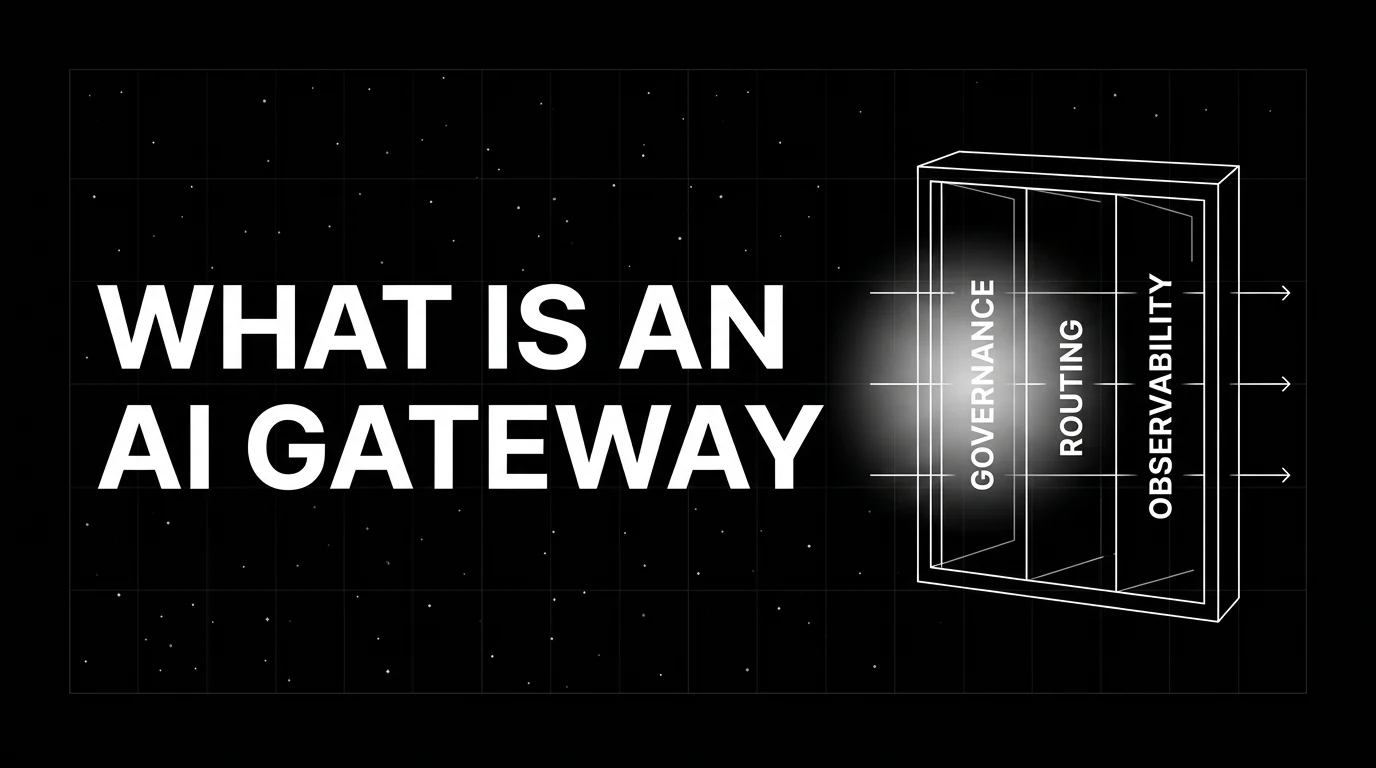
An AI gateway sits between apps and LLM providers for governance, routing, observability. What it is, how it differs from API gateways.