Best 7 AI Gateways for Agentic AI in 2026
Seven AI gateways for agentic AI in 2026 scored on MCP plus A2A depth, 18+ built-in guardrails, OTel-native cost telemetry, 2026 trust cohort with sources.
Table of Contents
Originally published May 13, 2026. Updated May 16, 2026.
A platform team shipped an agentic copilot on a single OpenAI key and a hand-wired MCP server in February, then watched a tool call leak a customer’s database snapshot to the wrong tenant in April after the OX Security MCP STDIO RCE class disclosure landed and the on-call thread spent four hours arguing about whether the gateway had logged the tool call at all. This guide ranks the seven AI gateways production teams should choose between in 2026 for agentic AI workloads across MCP tool surfaces, A2A peer traffic, and 20+ providers via six native adapters (OpenAI, Anthropic, Gemini, Bedrock, Cohere, Azure) plus OpenAI-compatible presets and self-hosted backends, scored on agent protocol depth, guardrail depth, OpenTelemetry observability, and the active 2026 trust cohort with primary sources.
TL;DR: 7 Agentic AI Gateways Scored Against the 2026 Trust Cohort
Future AGI Agent Command Center is the strongest pick for agentic AI in 2026 because it ships an OpenAI-compatible drop-in, MCP plus A2A at the gateway layer, 18+ built-in guardrails (including a dedicated MCP Security scanner) plus 15 third-party adapters, and OpenTelemetry-native cost telemetry in one Apache-2.0 platform you can self-host. Multi-provider routing alone no longer differentiates a gateway; the four axes that separate a 2026 agentic gateway from a 2024 LLM proxy are MCP plus A2A depth, tool-permission enforcement on the routed path, agent span emission to an OpenTelemetry collector, and acquisition independence inside the 2026 trust cohort.
| # | Platform | Best for | 2026 event you should know |
|---|---|---|---|
| 1 | Future AGI Agent Command Center | MCP + A2A + 18+ built-in guardrails + OTel-native cost telemetry in one Apache-2.0 platform | OpenTelemetry GenAI semantic conventions referenced as the canonical span schema |
| 2 | Kong Agent Gateway | A2A traffic governance + MCP gateway + full audit logging via Konnect | Released in Kong AI Gateway 3.14, announced April 14, 2026 |
| 3 | Portkey | Conditional metadata routing + multi-tier budgets + MCP | Palo Alto Networks announced intent to acquire on April 30, 2026; close pending |
| 4 | LiteLLM (post-incident pinned) | Python-first agent platforms pinning 1.82.6 or upgrading to 1.83.7+ | TeamPCP PyPI supply-chain compromise of versions 1.82.7 and 1.82.8 on March 24, 2026 |
| 5 | Databricks Unity AI Gateway | Unity Catalog-native MCP with on-behalf-of-user permissions + Databricks-native cost tracking | Agentic governance expansion announced April 15, 2026, features in Beta as of May 2026 |
| 6 | agentgateway.dev | Apache-2.0 Linux Foundation gateway with native MCP + A2A + OpenTelemetry by default | Sits inside the Linux Foundation Agentic AI portfolio (Solo.io plus AWS, Microsoft, Cisco, IBM, Red Hat contributors) |
| 7 | Maxim Bifrost | Native MCP Code Mode across STDIO, HTTP, SSE plus the lowest published gateway-overhead numbers | Vendor-published 92.8 percent input-token reduction at 508 tools across 16 MCP servers |
The 7 Agentic Gateways at a Glance
The seven cover every agentic shape teams ship in 2026: two Apache-2.0 open-source projects (Future AGI, Maxim Bifrost), a commercial agent gateway from API-management lineage (Kong), an MIT gateway with acquisition risk (Portkey), a Python proxy under remediation (LiteLLM), a managed enterprise control plane (Databricks Unity, Beta), and a Linux Foundation entrant (agentgateway.dev).
| Superlative | Tool |
|---|---|
| Best overall for agentic AI | Future AGI Agent Command Center: MCP + A2A + 18+ built-in guardrails + OTel telemetry in one Apache-2.0 platform |
| Best for agent-to-agent traffic governance | Kong Agent Gateway: A2A protocol with cross-agent permissions + audit logging on Konnect |
| Best for MCP Security scanner on the routed path | Future AGI Agent Command Center: dedicated MCP Security scanner inside 18+ built-in scanners |
| Best for Python-first agent platforms | LiteLLM (1.82.6 pin or 1.83.7+): 20+ providers via six native adapters (OpenAI, Anthropic, Gemini, Bedrock, Cohere, Azure) plus OpenAI-compatible presets and self-hosted backends in a Python proxy |
| Best for Databricks-native agent workloads | Databricks Unity AI Gateway: Unity Catalog on-behalf-of-user permissions + Databricks-native cost tracking (Beta) |
| Best for Linux Foundation OSS agent gateway | agentgateway.dev: Apache 2.0; native MCP + A2A; OTel by default |
| Best for self-hosted or air-gapped agent runtime | Future AGI Agent Command Center: Apache 2.0; Docker, Kubernetes, air-gapped |
| Best for raw gateway-overhead throughput | Maxim Bifrost: vendor-published ~11 µs gateway overhead at 5K RPS on t3.xlarge |
| # | Platform | Best for | License + deployment |
|---|---|---|---|
| 1 | Future AGI Agent Command Center | MCP + A2A + 18+ guardrails + OTel-native cost in one Apache-2.0 platform | Apache 2.0; cloud at gateway.futureagi.com/v1 or self-host |
| 2 | Kong Agent Gateway | A2A traffic governance + MCP gateway + full audit logging via Konnect | Apache 2.0 core; Konnect commercial |
| 3 | Portkey | Conditional metadata routing + multi-tier budgets + MCP | MIT (open-source gateway) + cloud control plane; PANW acquisition pending |
| 4 | LiteLLM (post-incident pinned) | Python-first agent platforms pinning a known-good commit | MIT (the enterprise dir is licensed separately); pip install |
| 5 | Databricks Unity AI Gateway | Unity Catalog-native MCP + on-behalf-of-user permissions (Beta) | Proprietary; Databricks-hosted |
| 6 | agentgateway.dev | Linux Foundation native MCP + A2A + OTel by default | Apache 2.0 |
| 7 | Maxim Bifrost | Native MCP Code Mode + lowest published gateway-overhead numbers | Apache 2.0; Docker, Helm, in-VPC |
Helicone and the Python proxy consumer-grade deploys are explicitly de-ranked. Helicone joined Mintlify on March 3, 2026 and is in maintenance mode. LiteLLM is on the list at #4 only for teams that can pin commits or upgrade to the rebuilt post-incident pipeline (1.83.7+) and hold their own upstream provider DPA.
How Did We Score AI Gateways for Agentic AI?
We used the Future AGI Production Gateway Scorecard, tuned for agentic AI procurement. Most 2026 agentic listicles score on MCP support and stop there.
The next-deepest matrix on the SERP (Lunar.dev’s April 6 open-source post) compares thirteen rows; Maxim’s MCP-5 caps at five; the May 14 MintMCP post stops at a one-step yes/no MCP coverage flag. The scorecard below runs seven dimensions across sixteen comparison columns, including the four that decide whether the gateway is actually agentic in production.
| # | Dimension | What we measure (agentic lens) |
|---|---|---|
| 1 | Provider + protocol breadth | Supported provider count; OpenAI-compat surface; MCP + A2A at the gateway layer |
| 2 | Agent protocol depth | MCP transports (STDIO, HTTP, SSE); A2A traffic policy; cross-agent permissions; tool catalog discovery |
| 3 | Latency overhead | Added P99 latency at production load; benchmark provenance and reproduction status |
| 4 | Guardrail depth on the routed path | Built-in scanner count; MCP Security; tool permission enforcement; sub-100 ms enforcement |
| 5 | Observability | OpenTelemetry GenAI semantic conventions conformance; per-request cost telemetry; span_id linking |
| 6 | Deployment flexibility | License; self-host; air-gapped; managed cloud |
| 7 | Total cost of ownership + acquisition independence | Markup vs raw model cost; SDK migration effort; pending acquisitions inside the 2026 trust cohort |
Dimensions 2, 4, 5, and 7 decide whether the gateway is actually agentic in production. The right priority depends on the buyer profile (platform engineering vs developer tools vs enterprise CISO).
What the 2026 Agentic Stack Actually Requires
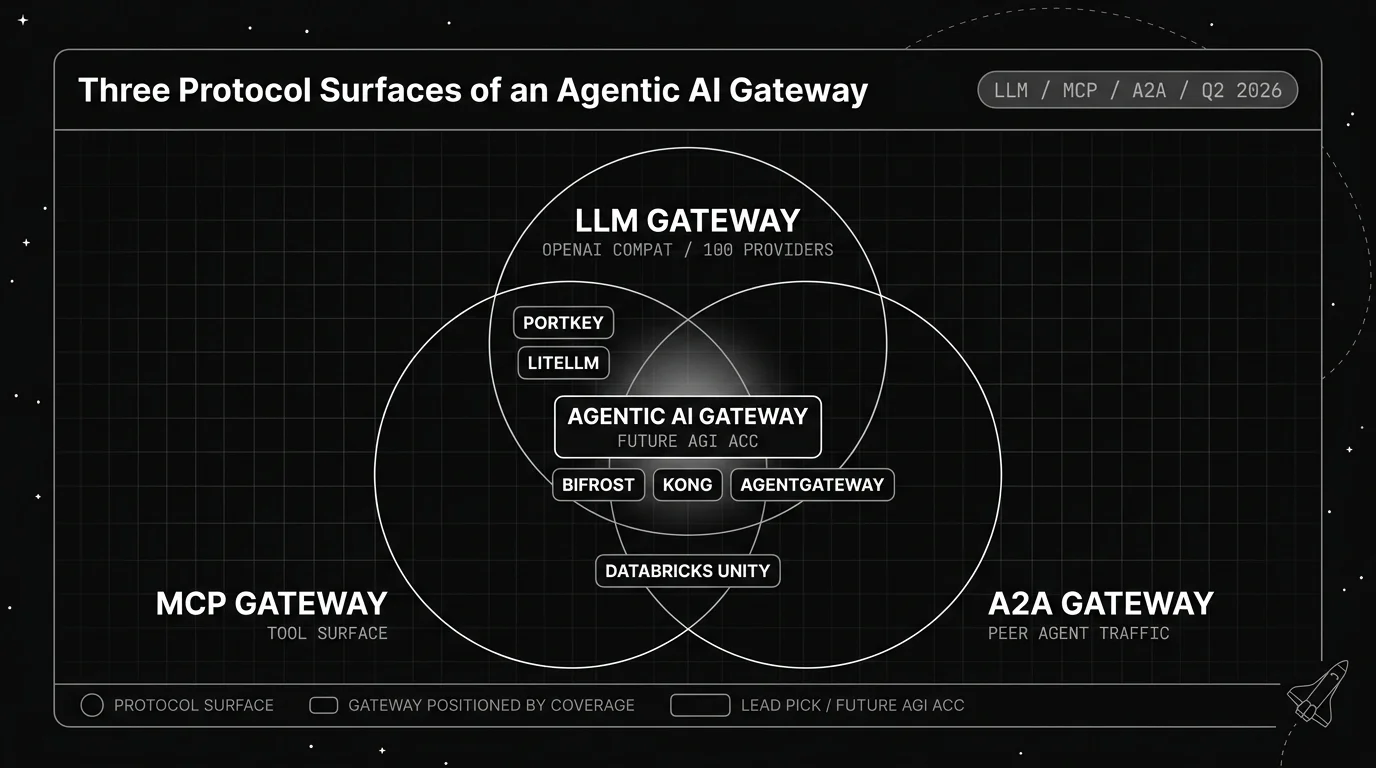
A 2026 agentic gateway has to ship four capabilities at the same network hop. A gateway that ships three is a 2025 LLM proxy with an agent skin.
- MCP termination at the gateway. Tool discovery, allowlists, OAuth 2.1 with PKCE-S256, and tool-description hash inspection before the agent sees the catalog, against the MCP Specification 2025-11-25.
- A2A protocol support. Per-agent identity and policy, cross-agent permissions, and audit logging across agent-to-agent calls under the A2A specification.
- Inline guardrails on the routed path. Prompt injection, MCP Security, tool poisoning detection, runaway-loop circuit breakers, and output injection scanning, all enforced at the gateway hop and not as a downstream library you have to wire in.
- OpenTelemetry-native span emission with
span_idlinking. Every gateway request emits a GenAI span; eval results link back to the trace byspan_idso a failed eval gates the next request through the same template.
Without all four, the agent is one community MCP server away from a billing incident or a credential leak. The seven gateways below are the production-grade options that ship at least three of the four; only the lead pick ships all four in one Apache-2.0 binary.
Future AGI Agent Command Center: Best Overall Agentic Gateway
Future AGI Agent Command Center tops the 2026 agentic list because it bundles every layer of the agentic stack at the same network hop in one Apache-2.0 platform.
The combined surface is the OpenAI-compatible drop-in across 20+ providers via six native adapters (OpenAI, Anthropic, Gemini, Bedrock, Cohere, Azure) plus OpenAI-compatible presets and self-hosted backends, MCP plus A2A protocol support at the gateway layer, 18+ built-in guardrail scanners (including a dedicated MCP Security scanner) plus 15 third-party adapters, per-virtual-key budgets, exact plus semantic caching, and OpenTelemetry-native cost telemetry.
The full surface is documented in the Agent Command Center docs and the source ships at the Future AGI GitHub repo.
Best for. Platform teams building agentic copilots and multi-agent systems that want MCP + A2A + 18+ inline guardrails + OTel telemetry in one Apache-2.0 platform, self-hosted or cloud, without operating four separate products.
Key strengths.
- OpenAI-compatible drop-in:
base_urlswap against the existing OpenAI SDK, no SDK rewrite. - 20+ providers via six native adapters (OpenAI, Anthropic, Gemini, Bedrock, Cohere, Azure) plus OpenAI-compatible presets and self-hosted backends behind a unified API; native MCP and A2A support at the gateway layer.
- The Future AGI Protect model family as the inline guardrail layer at ~65 ms p50 text and ~107 ms p50 image (arXiv 2510.13351). Protect is FAGI’s own fine-tuned model family built on Google’s Gemma 3n with specialized adapters across four safety dimensions (content moderation, bias detection, security/prompt-injection, data privacy/PII), natively multi-modal across text, image, and audio, a model family, not a plugin chain. A dedicated MCP Security scanner sits alongside and validates MCP tool descriptions at catalog import; the same dimensions are reusable as offline eval metrics so the prod policy and the eval rubric stay in sync.
- Per-key, per-virtual-key, per-model, per-time-window budgets, rate limits, quotas, and webhook alerts on threshold breach.
- OpenTelemetry-native observability with per-request cost telemetry and
span_idlinking from gateway trace to eval result.traceAIinstruments 50+ AI surfaces across Python, TypeScript, Java, and C# (including Spring Boot starter, Spring AI, LangChain4j, Semantic Kernel) OpenInference-natively, and Error Feed (the part of the eval stack, the clustering and what-to-fix layer that feeds the self-improving evaluators) sits alongside as the zero-config error monitor: auto-clusters related agent-tool failures into named issues (50 traces → 1 issue), auto-writes the root cause plus a quick fix plus a long-term recommendation per issue, and tracks rising/steady/falling trend per issue so emerging multi-agent regressions surface like exceptions rather than buried in trace search. - Apache 2.0; Go-based; Docker, Kubernetes, AWS, GCP, Azure, on-prem, air-gapped, cloud at
gateway.futureagi.com/v1.
Limitations.
- Full execution tracing for agents is currently an “In Progress” roadmap item on the public roadmap in the Future AGI GitHub repo and is rolling out alongside the existing gateway-side OpenTelemetry trace export.
from openai import OpenAI

client = OpenAI(
    api_key="$FAGI_API_KEY",
    base_url="https://gateway.futureagi.com/v1",
)

# MCP and A2A terminate at the gateway; MCP Security scanner inspects
# tool descriptions before the agent sees the catalog.
response = client.chat.completions.create(
    model="anthropic/claude-3-5-sonnet",
    messages=[{"role": "user", "content": "Run the repo audit against the project MCP server."}],
)
Verdict. The strongest single pick when the 2026 agentic brief is “MCP plus A2A plus 18+ inline guardrails plus OTel-native cost telemetry in one Apache-2.0 binary, self-hosted, no separate guardrail plane.”
Kong Agent Gateway: Best for A2A Traffic Governance
Kong Agent Gateway is the strongest pick when production agents need A2A traffic governance with cross-agent permissions and full audit logging through Kong Konnect. Kong inherits decades of API management lineage and applies it to the agent surface. The capability shipped inside Kong AI Gateway 3.14 on April 14, 2026.
Best for. Enterprises that already run Kong Gateway or Konnect and want to extend their existing API governance plane to agent-to-agent traffic.
Key strengths.
- A2A traffic governance with per-agent identity, cross-agent permissions, and Konnect-managed audit logs.
- MCP gateway support alongside A2A inside the same control plane.
- Inherits Kong’s plugin ecosystem and the Konnect commercial control plane for audit retention and policy distribution.
- Apache 2.0 core gateway; Konnect cloud control plane for managed operations.
Honest limitations.
- Operational footprint heavier than a single Go binary; teams that want “one process, one config” should evaluate Future AGI or Bifrost first.
- Guardrail depth on the agent path leans on plugin wiring rather than a named first-party scanner library on the scale of Future AGI’s 18+ built-in scanners.
- Konnect cloud control plane introduces a managed-control-plane dependency; air-gapped deployment is more involved than with an Apache-2.0 single-binary alternative.
Verdict. The right pick for teams already invested in Kong who want to extend API governance to agent traffic without buying a second control plane.
Portkey: Best for Conditional Metadata Routing With MCP
Portkey is the strongest pick for agentic workloads that need conditional metadata routing, a multi-tier budget hierarchy, and managed-dashboard polish on a mature cache. It’s the gateway most production agent teams reach for when “we need per-tenant cost attribution and policy routing next week” is the brief.
Best for. Multi-tenant agent platforms that need per-tenant or per-feature budgets, conditional routing on metadata, and a usable managed dashboard, with an acceptable risk appetite for the Palo Alto Networks integration timeline.
Key strengths.
- Conditional metadata routing for per-tenant, per-feature, per-customer routing decisions.
- Multi-tier budget hierarchy (Organization → Workspaces → API Keys) with optional per-user quotas.
- Exact plus semantic caching with TTL and threshold tuning.
- Large adapter library; the open-source gateway repo headline cites 1,600+ LLMs.
- MCP support, mature managed dashboard for cost attribution by tenant.
Honest limitations.
- Palo Alto Networks announced intent to acquire Portkey on April 30, 2026; close expected PANW fiscal Q4 2026; roadmap merges into Prisma AIRS.
- Observability is dashboard-first; OpenTelemetry export exists but is less first-class than the native dashboard.
- MIT-licensed gateway only; the control plane is hosted, so fully air-gapped deployment is heavier than a single Apache-2.0 binary.
Verdict. Strong mature managed gateway with conditional routing and budgets. Choose with eyes open on the PANW integration timeline.
LiteLLM: Best for Python-First Agent Platforms Post-Incident
LiteLLM is the Python-first proxy that broke open the multi-provider unified-API category and remains a common pick for Python-native agent platforms. After the March 24, 2026 supply-chain incident the agentic answer is “yes for self-hosted commit-pinned deployments where the team holds its own upstream DPA.”
Best for. Python-first agent platforms that already run FastAPI or uvicorn services, want broad provider coverage, and are willing to pin to 1.82.6 or upgrade to 1.83.7+ (the rebuilt post-incident release line).
Key strengths.
- Broadest provider coverage on the list (20+ providers via six native adapters (OpenAI, Anthropic, Gemini, Bedrock, Cohere, Azure) plus OpenAI-compatible presets and self-hosted backends in one Python proxy).
- MIT-licensed and trivial to fork or audit.
- Virtual keys with per-key budgets and budget alerts.
- Native Python observability fit through Prometheus exporter and OpenTelemetry middleware.
- Active maintainer community and frequent release cadence.
Honest limitations.
- March 24, 2026 PyPI supply-chain compromise of versions 1.82.7 and 1.82.8 (Datadog Security Labs writeup, also documented in the LiteLLM April 2026 advisory). Safe versions: 1.82.6 or earlier, or 1.83.7+.
- Python runtime; materially slower throughput than Go-binary alternatives at high concurrency.
- LiteLLM doesn’t sign a separate DPA on the OSS path; the team holds its own DPA direct to the upstream model provider.
Verdict. Still the broadest provider coverage. The March incident shifts it from “default pick” to “pin commits or upgrade past 1.83.7, audit dependencies, hold your own DPA.”
Databricks Unity AI Gateway: Best for Unity Catalog Agent Workloads
Databricks Unity AI Gateway is the strongest pick when agent workloads sit inside Databricks and need Unity Catalog-native MCP, on-behalf-of-user permissions, and Databricks-native cost attribution. The agentic governance expansion was announced April 15, 2026 and ships with the new capabilities marked Beta as of May 2026.
Best for. Data and ML platform teams that already run Databricks Unity Catalog and want agent governance to live inside the same permission and lineage layer.
Key strengths.
- Unity Catalog-native MCP with on-behalf-of-user permissions and lineage.
- Cost tracking integrated with Databricks billing and usage attribution.
- Routes to first-party Databricks models plus external providers under one control plane.
- OpenTelemetry export by default.
Honest limitations.
- Tightly coupled to Databricks; teams not already on Databricks should evaluate alternatives first.
- Inline guardrail depth is thinner than Future AGI’s 18+ scanner library; agent-specific guardrails rely on integrations.
- New agentic capabilities are in Beta as of May 2026 per the announcement; production teams should confirm SLA and support posture before committing.
Verdict. The right pick when the team is already deep in Databricks and Unity Catalog is the existing governance plane, with Beta status priced in.
agentgateway.dev: Best for Linux Foundation Native MCP + A2A
agentgateway.dev is the strongest pick when the procurement constraint is a vendor-neutral, Linux Foundation-governed gateway with native MCP plus A2A plus OpenTelemetry by default, under Apache 2.0. Solo.io is the primary maintainer and the project sits inside the Linux Foundation Agentic AI portfolio alongside MCP and AGENTS.md.
Best for. Open-source-first teams that want a vendor-neutral foundation-governed gateway and are comfortable with a younger maintainer base than Future AGI or Bifrost.
Key strengths.
- Apache 2.0 under Linux Foundation governance, with confirmed contributions from AWS, Microsoft, Cisco, IBM, and Red Hat per the LF announcement.
- Native MCP and A2A from day one; OpenTelemetry export by default.
- Vendor-neutral roadmap; no single-vendor capture risk.
- Active contributor community across multiple Foundation members.
Honest limitations.
- Younger and less battle-tested than Future AGI or Bifrost in production deployments.
- Guardrail depth depends on adapter wiring rather than a first-party scanner library on the scale of Future AGI’s 18+ scanners.
- Operational tooling (dashboards, alerting) is thinner than commercial alternatives with managed control planes.
Verdict. The right pick when “vendor-neutral, foundation-governed, Apache 2.0” is the binding procurement constraint.
Maxim Bifrost: Best for Go Throughput With MCP Code Mode
Maxim Bifrost is the Go-native gateway from Maxim, Apache 2.0, with vendor-published gateway overhead in the 11-microsecond range at 5K RPS on t3.xlarge and a separate MCP token-reduction product (“Code Mode”) aimed at large MCP-tool agent workloads.
Best for. Go shops that want MCP plus LLM routing in one Go binary and teams running large MCP tool catalogs that want to compress tool-call token usage.
Key strengths.
- Vendor-published benchmark measuring ~11 µs of gateway overhead at 5K RPS on
t3.xlarge(gateway overhead, not end-to-end P50). - Apache 2.0, single Go binary, Docker plus Helm plus in-VPC deployment.
- Code Mode for MCP token reduction: vendor-published 92.8 percent input-token reduction at 508 tools across 16 MCP servers.
- 1,000+ models from 10+ providers in the same binary that ships MCP.
Honest limitations.
- Maxim self-ranks Bifrost #1 across its own gateway listicles with no published limitations; treat the rank inside Maxim’s own posts as a soft signal, not a benchmark.
- MCP-specific guardrail depth (tool poisoning detection, MCP Security scanner) is thinner than Future AGI’s named scanner library.
- Throughput numbers are vendor-published in Maxim’s own benchmark harness; independent reproduction in the public literature is light.
Verdict. Strong throughput and active engineering velocity. Choose Bifrost when raw gateway-overhead throughput plus MCP Code Mode token reduction is the primary axis.
Which Agentic Gateway Is Right for You in 2026?
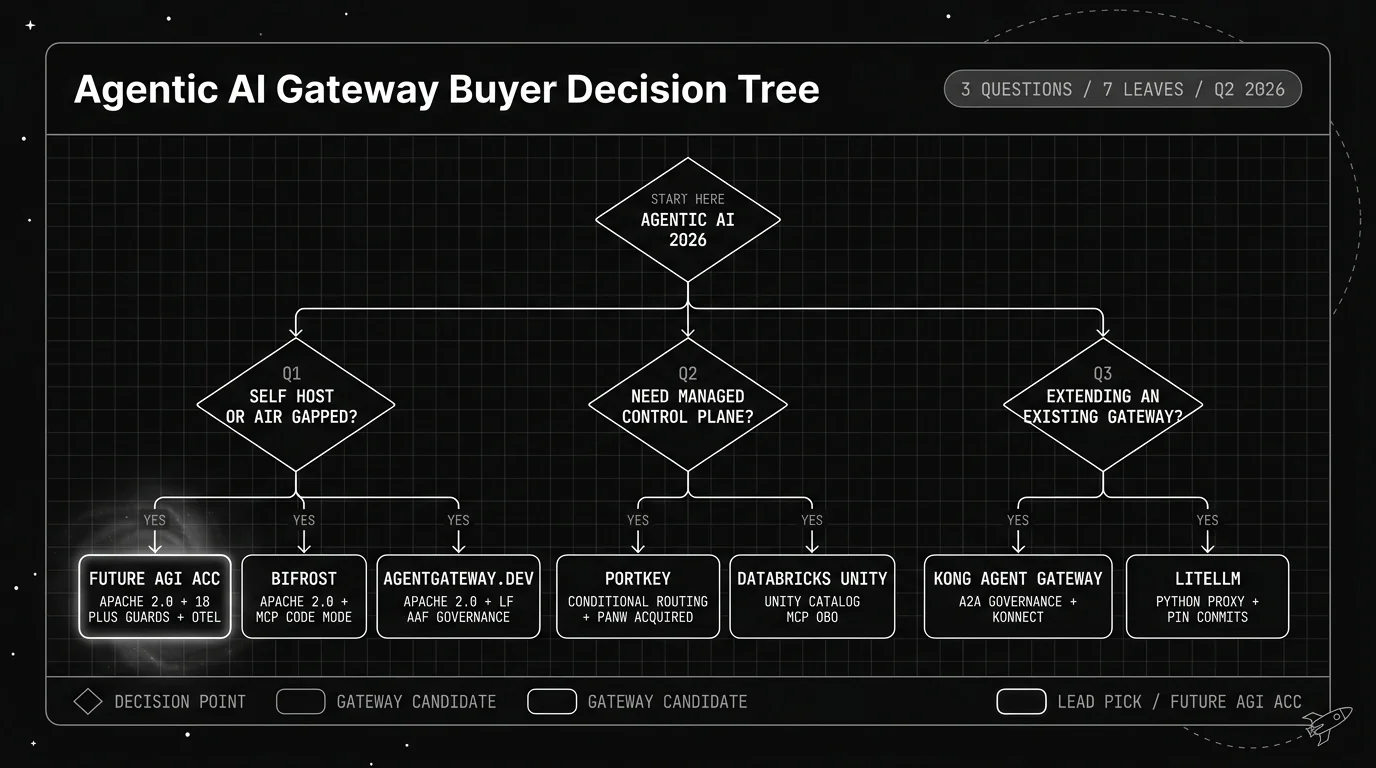
The buyer profile drives the pick more than the feature matrix does.
| If you are a… | Pick | Why |
|---|---|---|
| Platform team building agentic copilots that need MCP + A2A + guardrails + OTel in one binary | Future AGI Agent Command Center | All four layers at the same hop, Apache 2.0, self-host |
| Enterprise with Kong already deployed | Kong Agent Gateway | Extends existing API governance to agent traffic (Kong AI Gateway 3.14, April 14, 2026) |
| Multi-tenant SaaS that wants conditional metadata routing + managed dashboard | Portkey | Mature managed dashboard + budget hierarchy (verify PANW close timeline) |
| Python-first agent platform holding own upstream DPA | LiteLLM (1.82.6 pin or 1.83.7+) | Broadest provider list; pin or upgrade past the March 24 incident |
| Team already deep in Databricks + Unity Catalog | Databricks Unity AI Gateway (Beta) | Unity-native MCP + on-behalf-of-user permissions |
| Open-source-first team that wants Foundation governance | agentgateway.dev | Linux Foundation Apache 2.0; native MCP + A2A; OTel default |
| Go shop where MCP + LLM throughput is the binding constraint | Maxim Bifrost | Lowest published gateway-overhead numbers, plus MCP Code Mode |
Agentic AI in 2026 isn’t a single feature. It’s a stack: an OpenAI-compatible drop-in plus MCP plus A2A plus inline guardrails plus OpenTelemetry-native span emission, running at the same network hop, under a license that isn’t about to be re-platformed inside an acquirer.
Future AGI Agent Command Center is the strongest single pick when the buying constraint is one Apache-2.0 binary that ships every layer of the agentic stack self-hostable. Teams already on Kong should extend Kong; teams already on Databricks should evaluate the Beta agentic governance expansion; teams with a Go-throughput-first constraint should benchmark Bifrost.
For deeper reads: the Agent Command Center docs, the Future AGI GitHub repo, the MCP Specification 2025-11-25, the A2A specification, and the OpenTelemetry GenAI semantic conventions.
Try Future AGI Agent Command Center free: OpenAI-compatible routing, native MCP and A2A, 18+ inline guardrails including MCP Security, and OpenTelemetry-native cost telemetry in one Apache-2.0 binary.
Related reading
- Best 5 AI Gateways for Compliance Audit Trails in 2026, the compliance and audit-trail comparison
- Best 5 AI Gateways for LLM Cost Optimization in 2026, the five-layer cost stack and the 2026 trust cohort
- Best 5 AI Gateways for LLM Observability and Tracing in 2026, the OpenTelemetry-native observability ranking
- What is an AI Gateway? Governance, Routing, and Observability in 2026, the architectural primer for the category
Frequently Asked Questions
What Is an AI Gateway for Agentic AI in 2026?
How Is an Agent Gateway Different From an LLM Gateway?
Which AI Gateway Has the Deepest MCP Support in 2026?
Can an AI Gateway Defend Against the April 2026 MCP RCE Class?
How Do AI Gateways Score Agent Observability in 2026?
Does Future AGI Agent Command Center Work as an Agentic AI Gateway?
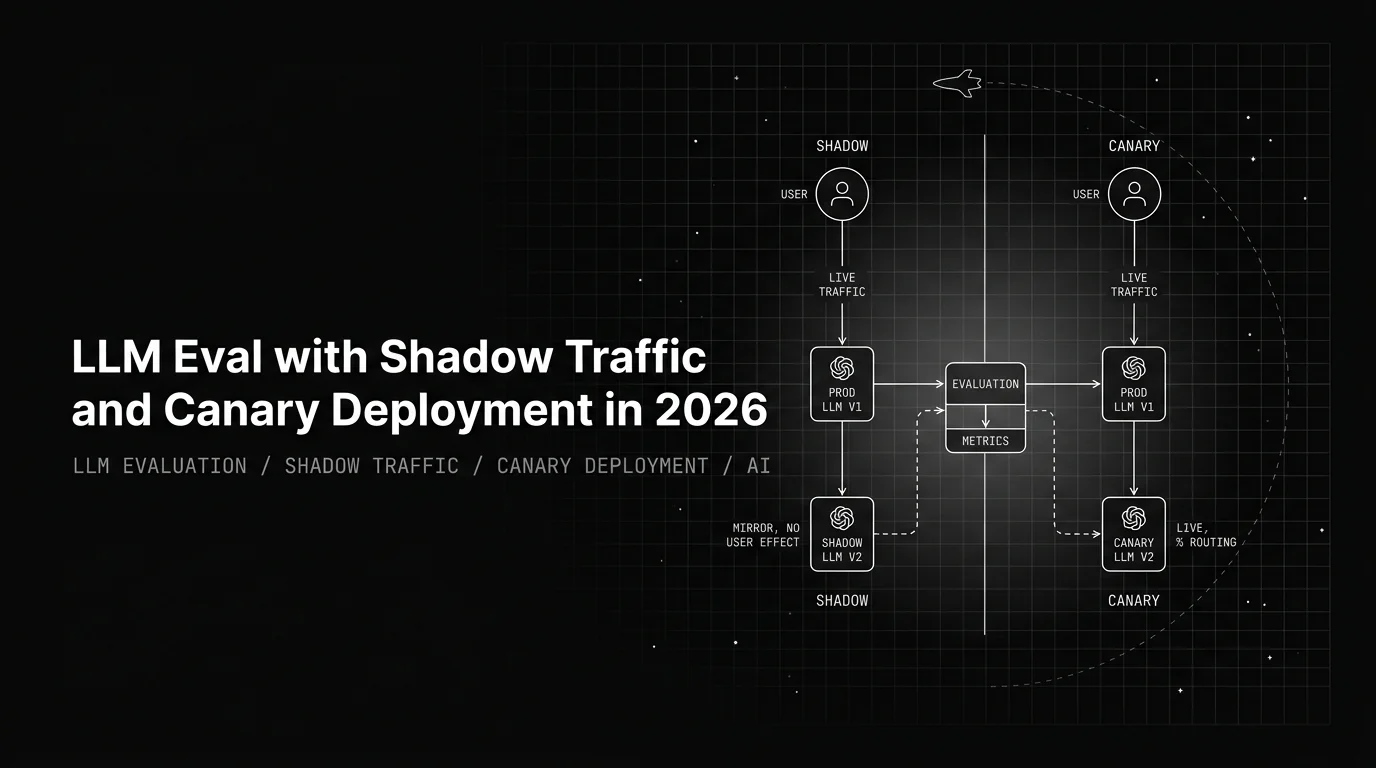
Shadow is not canary. Mirror routing with no user effect vs percentage routing with rollback. Score-attached traffic, ACC patterns, gotchas.

Azure OpenAI eval has three Azure-specific axes: deployment-name drift, region-pinning, and Content Safety precision on benign queries. Here's the pattern.

Bedrock's built-in eval is dev-loop only. Score action-group correctness, KB retrieval quality, and guardrail precision/recall on every release.