Eval SDK vs Eval Platform vs Build: The 2026 Build-vs-Buy Decision Framework
Build vs buy for LLM evaluation 2026. SDK vs hosted platform tradeoffs across seven axes, cost math, the hybrid pattern most production teams should run.
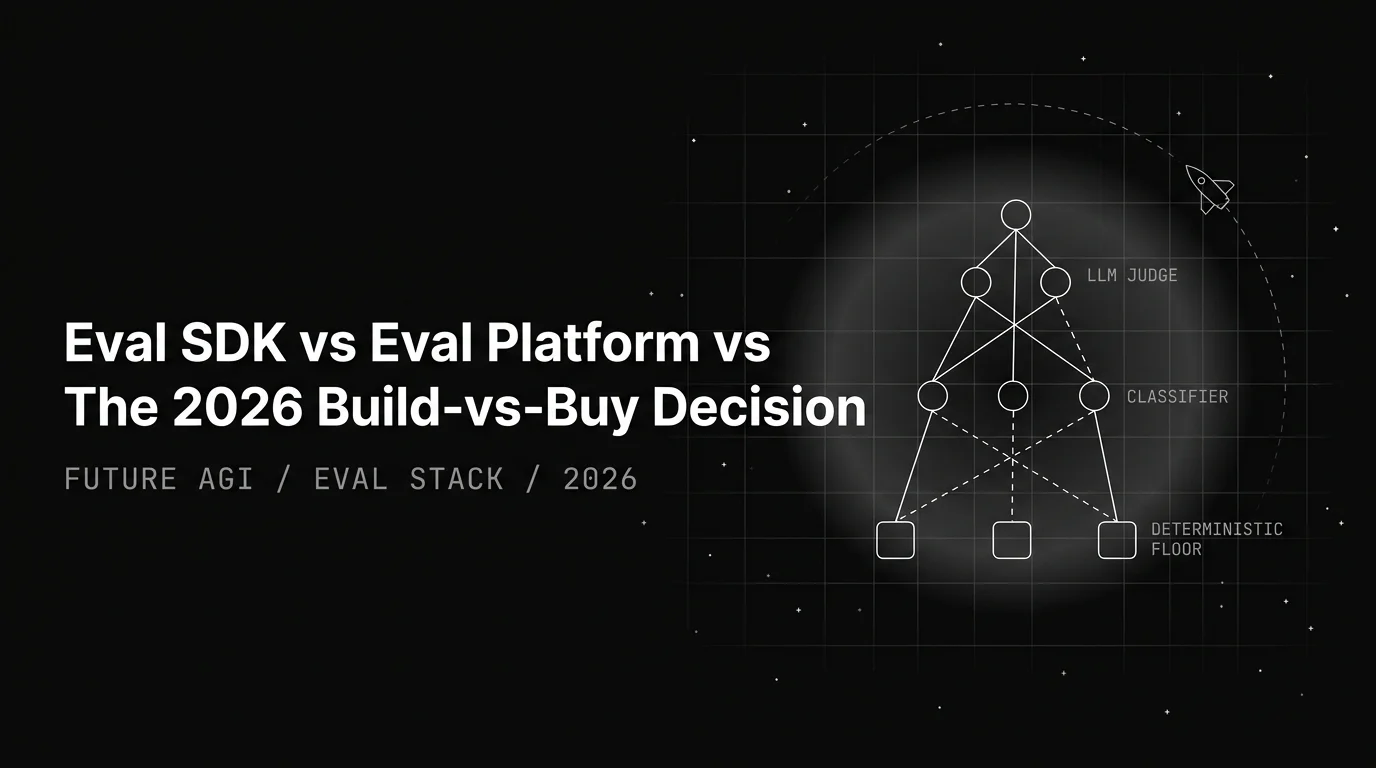
Table of Contents
Updated May 19, 2026. Every engineering team’s first reaction to a new infra category is the same. “We can build that.” For LLM evaluation in 2026 the build path is more expensive than people think, the buy path has more flexibility than people think, and the right answer for most production teams is neither pure build nor pure buy but a hybrid SDK plus platform stack. Here is the decision framework, the seven tradeoff axes, and the cost math.

The conversation usually starts the same way. A staff engineer pulls up a Notion doc, lists the eval requirements, looks at vendor pricing, and says “this is just a scoring function and a worker pool, we can ship it in a quarter.” Three quarters later the team has half the metrics they scoped, a growing OpenAI judge bill, and a Slack channel called #eval-platform-help that has become a full-time on-call.
This post is the framework most engineering leaders end up sharing when the “should we just build this” argument starts. It covers the seven tradeoff axes between building, adopting an open-source SDK, and subscribing to a hosted eval platform, the three-tier decision rule, and the cost math at typical production scale.
TL;DR: the three paths and when each one wins
| Path | Best for | Year 1 cost | Time to value |
|---|---|---|---|
| Build from scratch | Research labs, eval-stack vendors, 3+ FTE dedicated | 300K to 450K + ongoing 100K to 150K per year | 3 to 6 months |
| Open-source SDK (ai-evaluation, Apache 2.0) | Teams with moderate volume that want code control | ~25K initial + minimal ongoing | 1 to 2 weeks |
| Hosted platform (Future AGI) | Teams that want time-to-value and compliance posture | Subscription + ~0.5 FTE integration | Days |
| Hybrid (SDK + Platform) | Most production teams above 10k traces per day | Subscription + ~25K SDK integration | 1 to 2 weeks |
If you only read one row, take the hybrid. The Apache 2.0 SDK gives you the parts you want to own. The platform gives you the parts where vendor economies-of-scale win. Build from scratch is the rare edge case in 2026, not the default it used to be.
Why this decision keeps coming back
There are three reasons the build-vs-buy argument keeps replaying inside engineering orgs even though the answer has shifted.
The first reason is that LLM evaluation looks deceptively simple from the outside. Take a model output, run a scorer, get a number. What gets missed is the long tail. Hallucination scoring across structured outputs, RAG faithfulness with multi-hop retrieval, conversation-level metrics that track context across turns, classifier-backed safety checks that need GPU serving, judge-cascade routing per metric, distributed runners that can grade a hundred thousand rows in a CI run, drift detection. Each is a quarter of work. Six of them is a year.
The second reason is that the LLM-judge bill creeps. The first version of a custom stack uses GPT-4 class judges for everything because it is easy and volume is low. Then volume grows ten times and the eval bill is larger than the model bill. The team has to retrofit a cascade across local heuristics, local NLI, and judge calls, which is the part vendor SDKs ship out of the box.
The third reason is that compliance posture has gotten heavier. SOC 2 Type II, HIPAA, GDPR, and CCPA are required by the customers most teams sell to. A custom stack means owning every line of that audit. A hosted platform that already carries the posture means the boundary is the vendor contract. The build path used to be free on this axis and it is no longer free.
The combined effect is that the build path looks cheaper than it is, and the buy path looks more rigid than it is. Both perceptions are out of date.
The seven tradeoff axes
The build-vs-buy debate gets clearer when each axis is priced separately. Here are the seven that matter, with the realistic cost on each path.
1. Initial dev time
Build path is three to six months for a stack that covers the eval surface most production teams need. That is a team of two to four engineers working full-time, building scoring functions, runner infrastructure, judge integration, span schemas, and a UI to inspect results. SDK path is one to two weeks for the first working pipeline. pip install ai-evaluation, wire evaluate() into the agent loop, ship CI gates with AutoEvalPipeline.from_description(). Platform path is days. Sign up, drop in the trace exporter, run the default evaluator pack.
The build-path cost is not just calendar time. It is opportunity cost. Three engineers for six months is roughly 300K to 450K of engineering output that did not go into the product. The team that buys the SDK or platform ships the same eval coverage and keeps three engineers on the agent itself.
2. Maintenance burden
Build path is 0.5 to 1 FTE forever. Eval surface keeps moving. New agent frameworks ship and need span integrations. Models change and judge prompts drift. Customers ask for new metrics. The maintenance tail is the part that surprises every team that built their own. SDK path is light. The library upgrades carry most of the work. Platform path is zero on the team. Vendor handles classifier updates, judge prompts, runner ops.
The math here compounds. The team that built the stack in year one is the team that maintains it in year two and year three. By year three the maintenance cost is larger than what the team would have paid for a hosted subscription.
3. Customization
Build path is total. You wrote it, you can change every line. SDK path is very high. Apache 2.0 means you can fork the library, override scorers, write custom EvalTemplate classes, swap routers. The ceiling is the same as build because the source is open. Platform path is configurable. In-product agent authors unlimited custom evaluators inside Future AGI, rubrics are editable, judge prompts can be templated. The ceiling is lower than SDK or build, but for most teams the ceiling is high enough that they never hit it.
The naive read on this axis is that more customization is always better. The honest read is that most teams need 90 percent of what an SDK ships plus a few custom rubrics. The SDK path covers that comfortably. The build path pays full price for capability that goes unused.
4. Cost economics at scale
Build path means you pay the LLM-judge bill yourself with no cascade. Hallucination on every output via GPT-4 class judge at production volume is the headline expense. Teams that built their own usually discover this in month three and spend the next quarter retrofitting a cheaper local-model path. SDK path is the same judge bill by default plus an opt-in classifier backend that drops cost for the metrics that have a deterministic checker. The ai-evaluation library routes per-metric to the cheapest correct backend across local heuristics, local NLI like DeBERTa, and judge calls. Platform path ships the cascade out of the box and gets the additional optimization of running classifier serving on shared infrastructure, which is cheaper than every team running their own.
The cost gap on this axis can be five to ten times at production scale. The hosted platform is not just buying time. It is also buying the cascade engineering that the build path will eventually have to redo.
5. Compliance posture
Build path means you own the audit. SOC 2 Type II, HIPAA, GDPR, CCPA each require evidence collection, control mapping, annual audits, and an internal program. The realistic cost is 50K to 150K per year in audit fees plus internal time, and the auditors do not care that the stack is small. SDK path is lighter because the library itself is Apache 2.0 and audited as code, but the deployment is still yours. Platform path inherits SOC 2 Type II, HIPAA on the Scale tier, GDPR, and CCPA from the vendor. BYOC deployment moves the boundary inside your VPC for regulated workloads while keeping the platform features.
For regulated industries (healthcare, finance, regulated SaaS) the compliance posture alone is often the decisive factor. The build path is not just more expensive on this axis, it is slower to sell into the customer segments that matter.
6. Time-to-value
Build path is three to six months before the first useful score, six to twelve months before the stack is production quality. SDK path is weeks for a working pipeline, one to three months for full CI gates and production scoring. Platform path is days for a working pipeline, one to three weeks for calibrated evaluators.
This axis is the one engineering leaders should weight highest, because every month of delay is a month the agent is shipping with no eval coverage at all. The cheapest eval stack in the world is still expensive if it lands six months after the customer-facing incident that prompted it.
7. Vendor lock-in risk
Build path is zero lock-in. You wrote it, you own it. SDK path is low lock-in because the library is Apache 2.0 and can run standalone forever. Platform path is medium lock-in by default, low when paired with the SDK and BYOC deployment. The Future AGI platform reads SDK-emitted spans natively, so the exit path is to keep running the SDK and stop paying the subscription. The data and metric definitions stay yours.
The lock-in conversation is the one most often miscalibrated. Closed-source eval platforms with no open SDK are a real lock-in risk. An open-source SDK with a managed platform on top is roughly the same risk profile as any other infrastructure vendor that runs on top of an OSS foundation, which is to say acceptable for most teams.
The three-tier decision framework
The seven axes turn into a simple three-tier rule. Pick the path that matches your team and volume profile.
Build from scratch is right when: you are a research lab with novel evaluation methodologies that vendors do not ship; you have three plus FTE you can dedicate to the eval stack for the next year; you are already an eval-stack vendor and the eval surface is the product. Outside of these three cases, the build path is almost always the wrong call in 2026.
Open-source SDK is right when: you have moderate volume (ten thousand to one hundred thousand traces per day); your engineering team wants code-level control over scoring; you can manage classifier deployment and maintenance in-house; you have a strong preference for running everything inside your VPC. The ai-evaluation SDK is Apache 2.0 with 60+ EvalTemplate classes, 13 guardrail backends, 8 Scanners, and 4 distributed runners across Celery, Ray, Temporal, and Kubernetes. It is a complete eval foundation that you can run with no vendor in the loop.
Hosted platform is right when: time-to-value matters more than maximum customization; compliance posture (SOC 2, HIPAA, GDPR, CCPA) is required by your customers; you do not want to own classifier model serving; you want self-improving evaluators that learn from feedback without a research team building the feedback loop. The Future AGI platform covers this surface, with BYOC deployment for teams that need the compliance boundary inside their own cloud.
Hybrid SDK plus platform is right for most production teams. Run the SDK in-process for custom rubrics, CI gates, and streaming guardrails. Send traces and eval scores to the platform for the Error Feed clustering, self-improving evaluators, distributed runner ops at scale, and the compliance posture. The two halves share metric definitions, so a check that runs in a PR also runs in production. Above roughly ten thousand traces per day, this is the default.
The cost math at typical scale
The framework is clearer with numbers. Take a team at fifty thousand traces per day, which is a reasonable mid-size production scale.
Build path: three FTE for six months at a fully-loaded cost of roughly 25K per engineer per month works out to ~450K in year one. Ongoing maintenance is 0.5 FTE at ~150K per year. The LLM-judge bill on a no-cascade design runs another 50K to 150K per year at that volume. Compliance audit cost is 50K to 150K per year. Year-one all-in is 600K to 800K. Year two is 250K to 450K.
SDK path: one FTE for four weeks for integration is ~25K. Ongoing maintenance is minimal because the library upgrades carry the work. The LLM-judge bill is materially lower because the cascade ships in evaluate(), call it 20K to 60K per year. Year-one all-in is 45K to 85K. Year two is 20K to 60K.
Platform path: subscription at production scale plus ~0.5 FTE for integration and tuning. Subscription tiers vary by volume and feature set; at fifty thousand traces per day a typical team lands in the mid five figures to low six figures per year. Add 75K for the integration FTE. Year-one all-in is roughly in the same range as the SDK path. The compliance posture is inherited.
Hybrid path: SDK integration plus platform subscription. The marginal cost of running both is the subscription plus a few weeks of additional integration work. The capability is the union of the two. For a team above ten thousand traces per day the hybrid is the highest leverage option on the spend.
For most teams under one hundred thousand traces per day, the SDK plus platform combo is ten to fifty times cheaper than build over a two-year window and delivers more capability across compliance, classifier serving, and self-improving evaluators. The build path only wins on the three edge cases listed above.
Where Future AGI fits
The Future AGI stack is built around the SDK-plus-platform pattern. Two pieces sit on each side of the line, with a shared error-handling layer that crosses both.
ai-evaluation SDK (Apache 2.0) lives on the code-first side. 60 plus EvalTemplate classes covering deterministic checks, RAG faithfulness, conversation metrics, agent trajectory, function calling, and multimodal. 13 guardrail backends across nine open-weight models and four API models. 8 Scanners for jailbreak, code injection, secrets, and malicious URL detection that run sub-10ms locally. 4 distributed runners across Celery, Ray, Temporal, and Kubernetes for batch eval at scale. One evaluate() entry point that routes per-metric to the cheapest correct backend. The SDK is the open foundation, and it can run standalone forever.
Future AGI Platform lives on the managed side. Self-improving evaluators that learn from feedback so the eval definition drifts toward the team’s calibrated judgment over time. In-product agents that author unlimited custom evaluators without code. Lower per-eval cost than Galileo Luna-2 on equivalent metrics. The platform reads SDK-emitted spans natively, so the SDK and platform share metric definitions and trace schema. BYOC deployment moves the boundary inside the customer VPC for regulated workloads.
Error Feed is the integration layer that spans both. HDBSCAN clustering groups failing traces into recurring failure modes, and a Sonnet 4.5 judge writes an immediate_fix field per cluster with the concrete next action. The Error Feed is available across both SDK and platform paths, so a team that starts on the SDK alone keeps the failure-grouping layer when they add the platform later. Linear is the only Error Feed integration today; the trace-stream-to-agent-opt connector is on the roadmap and not shipped yet.
The path most teams end up on is: install ai-evaluation in week one, get CI gates and streaming guardrails working in week two, add the platform once trace volume hits a meaningful daily floor and self-improving evaluators plus compliance posture start to matter. The two halves are designed to compose, not to replace each other.
The anti-patterns to avoid
Four common failure modes show up when the framework is applied carelessly.
NIH syndrome is the first. “We can build it” is technically true and operationally wrong. Every team can build an eval scorer in a week. The thing that takes six months is the surrounding stack (cascade routing, classifier serving, distributed runners, compliance, drift detection, judge prompt management). Teams that build because they can usually rediscover this in month four and either abandon the stack or quietly migrate.
Over-rotating to platform without an SDK is the second. A closed-source eval platform with no Apache 2.0 SDK underneath is a real lock-in risk. The metric definitions live inside the vendor, the trace schema is proprietary, and the exit cost is rewriting every eval at the new vendor. The defensive move is to insist that the platform you adopt has an open SDK foundation, which makes the platform a managed layer on top of code you can keep running if you ever leave.
Single-vendor lock-in with no exit strategy is the third. Even with an open SDK, the deployment can be coupled tightly enough to a single vendor that migration is painful. The mitigation is to keep the eval definitions in code via the SDK, keep the trace schema in OpenTelemetry GenAI semantic conventions, and treat the platform as the runner and dashboard rather than the system of record.
Under-rotating on classifier-backed evals is the fourth. Teams that build their own usually default to LLM-as-judge for everything because it is easy to ship. The judge bill at scale is the headline cost. The mitigation is to route deterministic and semi-deterministic metrics to local heuristics and classifier backends, which is what the evaluate() router in ai-evaluation does by default. On a custom stack this is engineering work you have to schedule; on the SDK and platform it is the default.
The deeper point
Build-vs-buy is not binary. It is a portfolio call. The teams that ship the best eval stacks in 2026 are not the ones that built everything and are not the ones that bought everything. They are the ones that picked an Apache 2.0 SDK for the parts they wanted to control (custom rubrics, in-process scoring, CI gates, VPC deployment) and a hosted platform for the parts where vendor economies-of-scale win (self-improving evaluators, classifier serving, distributed runner ops, compliance posture).
The other framing that helps. The build path made sense when no good vendor existed. The buy path now covers the surface that the build path used to be the only way to get. The Apache 2.0 SDK option closes the lock-in gap that used to make buy feel risky. The remaining question is which axes you want to own and which you want to delegate, and that is a different conversation than the one most teams are having.
For more on the underlying components, see the ai-evaluation library introduction, the build-vs-buy framework for LLM observability, and the from-scratch eval framework guide. For evaluator selection in 2026, see the LLM evaluation tools roundup. For metric design once you have the stack in place, the custom metric best practices post is the starting point. For broader context on where evaluation fits next to observability and benchmarking, see agent observability vs evaluation vs benchmarking. The agent evaluation frameworks post covers the framework selection question. The agent passes evals fails production post covers the calibration loop that the platform’s self-improving evaluators automate.
Honest framing on what ships today
A few things worth being explicit about before the decision lands.
The trace-stream-to-agent-opt connector that closes the loop from production traces directly into prompt optimization is on the roadmap, not shipped today. Eval-driven optimization on prompts ships today via six optimizers that read scored eval data and propose prompt revisions. The piece in between is the connector that auto-streams new traces into the optimizer; that lands later in 2026.
Linear is the only Error Feed integration today. The clustering and immediate_fix generation work across SDK and platform, but the ticket creation lands in Linear. Jira and GitHub Issues connectors are on the roadmap.
Future AGI Protect, the runtime guardrails layer, has open-weight ML weights for several detection backends and closed weights for others. The gateway itself self-hosts; the ML hop routes to api.futureagi.com or to a private vLLM under the enterprise license. This is the right pattern for compliance-sensitive teams that want gateway latency under their control without taking on the model-serving cost themselves.
The build-vs-buy framework above is honest about all of this. The hybrid pattern is the right call for most teams in 2026 because it minimizes the surface where any single vendor (including Future AGI) can become a bottleneck, while still capturing the parts where managed infrastructure beats DIY. Pick the axes you want to own, delegate the rest, keep the SDK as the open foundation, and the next time the “should we just build this” conversation comes up the answer will be ready.
Frequently Asked Questions
Should I build, buy an SDK, or buy a hosted platform for LLM eval in 2026?
How much does building an LLM eval stack from scratch actually cost?
What does an Apache 2.0 SDK like ai-evaluation cover that a platform does not?
What is the realistic time-to-value for each path?
Does using a hosted platform create vendor lock-in?
What is the hybrid SDK plus platform pattern?
Which compliance certifications does a hosted eval platform inherit that I would otherwise own?
Introducing ai-evaluation, Future AGI's Apache 2.0 Python and TypeScript library for LLM evaluation. 50+ metrics, AutoEval, streaming, multimodal.


Build vs buy LLM observability in 2026: total cost of ownership, the OSS self-host path with traceAI Apache 2.0, right call by team size and compliance.

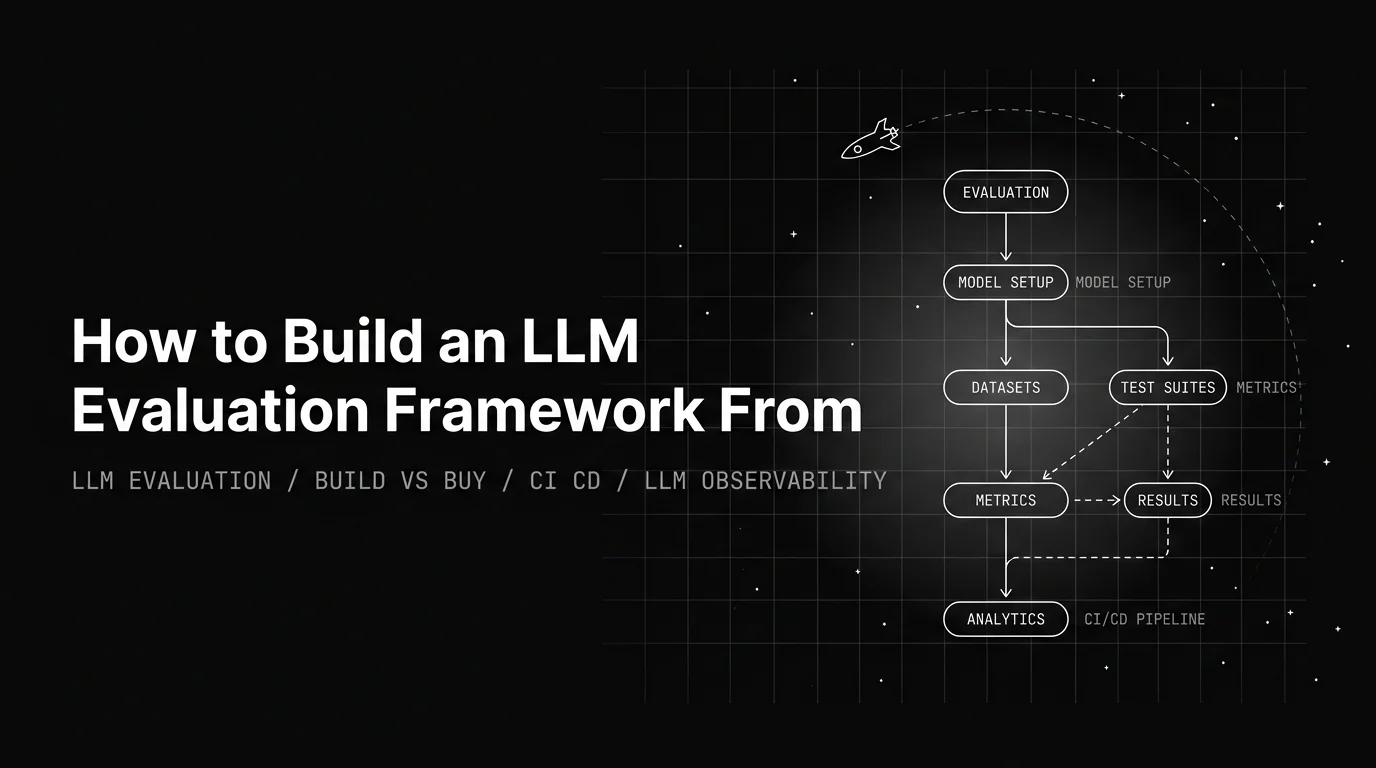
Building an LLM eval framework is a one-week project and a one-year maintenance burden. The eight components, honest cost map, build vs buy guidance.
