SLM vs LLM in 2026: Cost, Latency, and Quality Compared
SLM vs LLM in 2026: Gemma 4, Qwen3.5 Small, Phi-4 vs Claude Opus 5, GPT-5.6, Gemini 3.6. Cost, latency, and when to route between them for your stack.
Table of Contents
What Should You Know About SLM vs LLM in 2026?
| Question | SLM (Gemma 4 / Qwen3.5 Small) | LLM (Claude Fable 5 / Opus 5 / GPT-5.6 / Gemini 3.6) |
|---|---|---|
| Typical size | roughly 1B to 15B parameters | 100B and above, usually MoE activating a fraction per token |
| Cost per million tokens | Cents (self-hosted) to a few dollars | Single to low double-digit dollars |
| Latency on a single request | 20 to 250 ms | 500 ms to several seconds |
| MMLU (general knowledge) | 55 to 78 | 85 to 92 |
| Strongest fit | Classification, extraction, on-device, routing | Reasoning, long context, agents, frontier tasks |
| Where they fail | Open-ended reasoning, novel domains | Cost, privacy, p99 latency |
Use an SLM for the high-volume 80 percent, and route the hard tail to an LLM. Evaluate both with the same eval set before picking a default.
Why Did the Hybrid SLM-LLM Pattern Win?
For two years the SLM-versus-LLM question was treated as a budget compromise: use the small model if you cannot afford the big one. That framing is now outdated, and the reason is agents.
NVIDIA Research put the argument on paper in Small Language Models are the Future of Agentic AI (arXiv:2506.02153). Its claim is stronger than “SLMs are cheaper”. It is that SLMs are inherently more suitable for agentic systems, and it rests on an observation about what agents actually do: an agent is mostly a loop performing a small number of specialised tasks repetitively and with little variation. Parse this document. Return this JSON. Decide which of these six tools to call. Those are not tasks that need general intelligence, and a 70B-plus model spends most of its capability doing nothing useful on them.
The paper’s three pillars are that SLMs are “sufficiently powerful, inherently more suitable, and necessarily more economical for many invocations in agentic systems.” Where general conversational ability genuinely matters, it argues for heterogeneous systems that invoke several different models rather than standardising on one. Note that the paper argues the economics qualitatively; if you need a cost multiple, measure it on your own workload rather than borrowing a figure.
The practical consequence is a reversal of the default. The question stops being “can I get away with a small model here” and becomes “does this specific call actually need a frontier model”. In a well-built agent, most calls do not.
Two caveats worth stating, since the paper is a position paper rather than a benchmark study. It argues from the structure of agent workloads, not from a head-to-head evaluation of your workload, and the authors have an obvious interest in a world where inference is distributed across many small models. Neither weakens the core argument, but it does mean the section below on evaluation is where you settle it for your own system.
What Counts as a Small or Large Language Model in 2026?
There is no universal threshold, but in 2026 the working definitions are:
- SLM: roughly 1B to 15B parameters. Current examples: Gemma 4 E2B, E4B and 12B, and Qwen3.5 Small (0.8B, 2B, 4B, 9B). Phi-4 (14B, December 2024) and Llama 3.2 1B and 3B (September 2024) are the previous generation, still in wide use but shipping much shorter context windows.
- Mid-tier: 15B to 100B. Examples: Gemma 4 31B and 26B-A4B, Qwen3.5 27B and 35B-A3B, Llama 3.x 70B. These are sometimes called “mid-size” rather than SLM or LLM.
- LLM (frontier): 100B and above, often mixture-of-experts. Examples: Kimi K3, DeepSeek V4-Pro, Claude Opus 5, GPT-5.6, Gemini 3.x Pro. Parameter counts for closed-weight models are not publicly disclosed; the line between mid and frontier is closer to capability than to count.
Note how the small tier itself has stratified. Gemma 4 spans E2B up to 31B, and Qwen3.5 ships four sizes under 10B. “SLM” in 2026 is not one tier, it is a ladder, and picking the right rung matters more than the SLM-or-LLM decision that gives this article its title.
Parameter count alone does not predict capability. A well-trained 14B SLM can outperform an older 70B model on the tasks it was tuned for. The right question is not “how big” but “how does it score on my evals at my budget and latency target”.
What Architecture Differences Still Matter Between SLMs and LLMs?
Both SLMs and LLMs in 2026 are decoder-only transformers with a small set of variations:
- Context length: the gap here has narrowed more than most people expect. Gemma 4’s small tiers ship a 128K context window and its medium tiers 256K, which covers a large share of what teams reached for a frontier model to do. Frontier LLMs run 500K (Grok 4.5) to 1M (Claude Opus 5, Gemini 3.6 Flash). Long context is still an LLM strength, but it is no longer an LLM-only capability.
- Attention: SLMs use sliding-window, sparse, or local-global attention to keep latency low, and Gemma 4 is the clearest current example. It interleaves local sliding-window attention with full global attention and guarantees the final layer is global, which buys the memory profile of a small model while preserving whole-document awareness. LLMs typically use full attention with KV-cache optimizations.
- Mixture of Experts (MoE): most frontier LLMs in 2026 are MoE, which means only a fraction of parameters fire per token. This blurs the parameter-count discussion: a 200B MoE LLM may activate only 30B per token. MoE has also moved down into the small tier, as with Gemma 4’s 26B-A4B and Qwen3.5’s 35B-A3B, where a 26B model activates roughly 4B parameters per token.
- Quantization: SLMs are often deployed at 4-bit or 8-bit precision to fit on consumer hardware. The newer families are also designed around the on-device budget rather than merely shrunk to fit it: Gemma 4’s E2B and E4B sizes use Per-Layer Embeddings, giving each decoder layer its own small per-token embedding to maximise what each parameter contributes.
- Multimodality: this is the newest change to the small tier. Google states that every Gemma 4 model natively processes video and images, with variable resolution, and that native audio input is on the E2B and E4B sizes specifically. On-device multimodal is no longer a frontier-only feature.
The practical takeaway: when choosing a model, pay more attention to context length, deployment target, and license than to the raw parameter count. For the transformer fundamentals both tiers share (decoder-only blocks, positional encodings, MoE routing), see LLM vs GPT, which covers the shared architecture in more depth.
How Do SLM and LLM Cost, Latency, and Quality Compare?
The numbers below are illustrative directional estimates from public model cards and pricing pages (August 2026), each linked in the Sources section below the table. Verify against vendor pricing before relying on them for budgeting. Where a published figure did not survive a check against a primary source, the cell is left blank rather than filled with a plausible guess.
| Model | Tier | Params (total; active per token where MoE) | Context | Approx. cost (output per 1M tokens) | Typical p50 latency |
|---|---|---|---|---|---|
| Qwen3.5-0.8B | SLM | 0.8B | long | Self-host or cents | 20 to 80 ms |
| Gemma 4 E2B | SLM | 2B effective | 128K | Self-host or cents | 20 to 90 ms |
| Qwen3.5 4B | SLM | 4B | long | Self-host or cents | 40 to 120 ms |
| Gemma 4 E4B | SLM | 4B effective | 128K | Self-host or cents | 40 to 130 ms |
| Qwen3.5 9B | SLM | 9B | long | Self-host or low cents | 60 to 180 ms |
| Gemma 4 12B | SLM | 12B | 256K | Self-host or low cents | 70 to 200 ms |
| Phi-4 (14B) | SLM | 14B | 16K | Low single digit dollars | 80 to 250 ms |
| Gemma 4 26B-A4B | Mid | 26B (~4B active) | 256K | Self-host or low cents | 80 to 250 ms |
| Gemma 4 31B | Mid | 31B | 256K | Single digit dollars | 150 to 500 ms |
| Gemini 3.5 Flash-Lite | LLM | not disclosed | 1M | ~$2.50 | 200 to 600 ms |
| Gemini 3.6 Flash | LLM | not disclosed | 1M | ~$7.50 | 300 ms to 1 s |
| Claude Opus 5 | LLM | not disclosed | 1M | ~$25 | 700 ms to a few s |
| GPT-5.6 Sol | LLM | not disclosed | long | ~$30 | 500 ms to a few s |
| Kimi K3 | LLM | 2.8T total, ~104B active | 1M | ~$15 | 500 ms to a few s |
Treat the numbers as ranges, not as a leaderboard. Latency varies by region, batch size, and provider, and self-hosted SLM latency depends entirely on your hardware. For current frontier pricing see our best LLMs of July 2026 roundup, which tracks it month by month.
When Should You Choose an SLM vs an LLM?
Build the decision around four axes: task complexity, latency target, cost ceiling, and data sensitivity.
When Should You Pick an SLM?
- The task is narrow: classification, extraction, normalization, summarization of short documents, intent routing.
- You can fine-tune on 1k to 10k examples drawn from production traffic.
- You need predictable latency under 250 ms at p95 for small SLM tiers (and somewhat higher for 14B-class SLMs).
- You need to run on-device, offline, or inside a VPC with no outbound traffic.
- Cost per request must stay below a fraction of a cent at high QPS.
When Should You Pick an LLM?
- The task is open-ended: multi-step reasoning, agentic tool use, long-form writing, code generation across a large codebase.
- You need 100k+ tokens of context.
- The task surface changes frequently and you cannot afford to fine-tune.
- You need frontier reasoning capabilities like extended thinking or deep research mode.
- You can afford frontier-tier pricing per million tokens at the call volume you expect, and sub-second to multi-second latency.
When Should You Pick a Hybrid Approach?
- A router classifies each request and routes to an SLM by default.
- The router escalates to an LLM when classification confidence is low, when the task requires reasoning, or when the SLM refuses.
- All traffic is logged through a single observability layer so you can compare SLM and LLM accuracy on the same requests.
Why Does Evaluation Matter More Than Parameter Count?
The biggest mistake teams make in 2026 is picking a model by reading marketing claims instead of running their own evals. A 14B SLM that scores 85 on your task and a 405B LLM that scores 88 are not equivalent at scale: the SLM may cost a hundredth as much per call. Whether the 3-point accuracy gap is worth the cost depends on the business impact of each error.
The minimum eval bar before picking a default model: build a 200 to 500 example test set from real production traffic, run both models on it with the same evaluators, add a holdout of edge cases, and replay weekly to catch drift on provider updates. See LLM vs GPT for the full step-by-step methodology, including how to wire calls through traceAI and replay across multiple frontier vendors.
Future AGI’s evaluation suite runs evaluators including Context Adherence, Groundedness, Faithfulness, Completeness, and custom LLM-judge metrics. The same eval template runs against SLM and LLM outputs, so the comparison is apples-to-apples instead of vibes-based.
from fi.evals import evaluate

# Compare an SLM and an LLM on the same prompt + context
context = "The support SLA for Enterprise accounts is a four-hour first response."
slm_answer = "Four hours."                                        # from a fine-tuned SLM
llm_answer = "Enterprise accounts get a first response in 4 hrs."  # from a frontier LLM

slm_score = evaluate(
    "context_adherence",
    output=slm_answer,
    context=context,
)

llm_score = evaluate(
    "context_adherence",
    output=llm_answer,
    context=context,
)

print(slm_score.score, slm_score.passed)
print(llm_score.score, llm_score.passed)
Run the comparison across a few hundred examples and the answer is no longer “which one feels better”; it is which one passes the eval bar at the lower cost.
What Does a Reference Routing Pattern Look Like?
A common 2026 architecture:
- Classifier (SLM): a fine-tuned Llama 3.2 3B or Phi-4 routes each incoming request to one of N task categories. The intent-classification pipeline covers how to build and score this step.
- Workers (SLM by default): per-category SLMs handle classification, extraction, and structured tasks.
- Fallback (LLM): low-confidence or open-ended requests are escalated to Claude Opus 5, GPT-5.6, or Gemini 3.6 Flash.
- Guardrail layer: a gateway like the Future AGI Agent Command Center or NeMo Guardrails enforces safety, PII redaction, and content rules at the edge.
- Observability and evaluation: every call is traced through Future AGI’s traceAI and scored against evaluators in the dashboard. The router policy is retrained weekly against the eval set.
This pattern keeps the median request cheap and fast while making sure the long tail still gets a frontier-class answer.
Recommended Reading
- Best LLMs in July 2026 ranks frontier LLMs across reasoning, coding, and multimodal.
- Best open-source LLMs in 2026 covers self-hostable models including the SLM tier.
- LLM benchmarking compared walks through MMLU, GPQA, HumanEval, and other standard benchmarks.
- Top LLM evaluation tools in 2026 covers evaluation platforms.
- LLM vs GPT clarifies how LLM and GPT relate.
The short answer for 2026: SLMs do more than they used to, LLMs are smarter than they used to be, and the right architecture uses both. Pick by eval scores at your latency and cost target, not by parameter count.
Sources
- Belcak et al., “Small Language Models are the Future of Agentic AI”, NVIDIA Research (arXiv:2506.02153): https://arxiv.org/pdf/2506.02153
- Gemma 4 announcement, Google: https://blog.google/innovation-and-ai/technology/developers-tools/gemma-4/
- Gemma 4 model card and architecture details, Google AI for Developers: Gemma 4 model card
- Qwen3.5-0.8B model card, Hugging Face: https://huggingface.co/Qwen/Qwen3.5-0.8B
- Kimi K3 model card (2.8T total, 104B active per token), Hugging Face: https://huggingface.co/moonshotai/Kimi-K3
- Claude Opus 5 announcement and positioning relative to Fable 5, Anthropic: https://www.anthropic.com/news/claude-opus-5
- Grok 4.5 context window and pricing, xAI docs: https://docs.x.ai/docs/models
- Microsoft Phi-4 model card (14B, 16K context, MIT): https://huggingface.co/microsoft/phi-4
- Future AGI traceAI (Apache 2.0): https://github.com/future-agi/traceAI
Frequently Asked Questions About SLM vs LLM in 2026
What is the practical difference between an SLM and an LLM in 2026?
Are SLMs actually cheaper than LLMs at production scale?
When should I pick an SLM over an LLM?
Can SLMs match LLM accuracy after fine-tuning?
Do SLMs have the same hallucination rate as LLMs?
What is the right way to evaluate SLM vs LLM for my use case?
Can I run SLMs locally and LLMs in the cloud in the same application?
What is the cheapest SLM for production in 2026?
The 2026 SLM lineup for agentic AI (Phi-4, Llama 3.2, Ministral, Gemma 2, Qwen 2.5) plus a build pattern for modular multi-agent workflows.

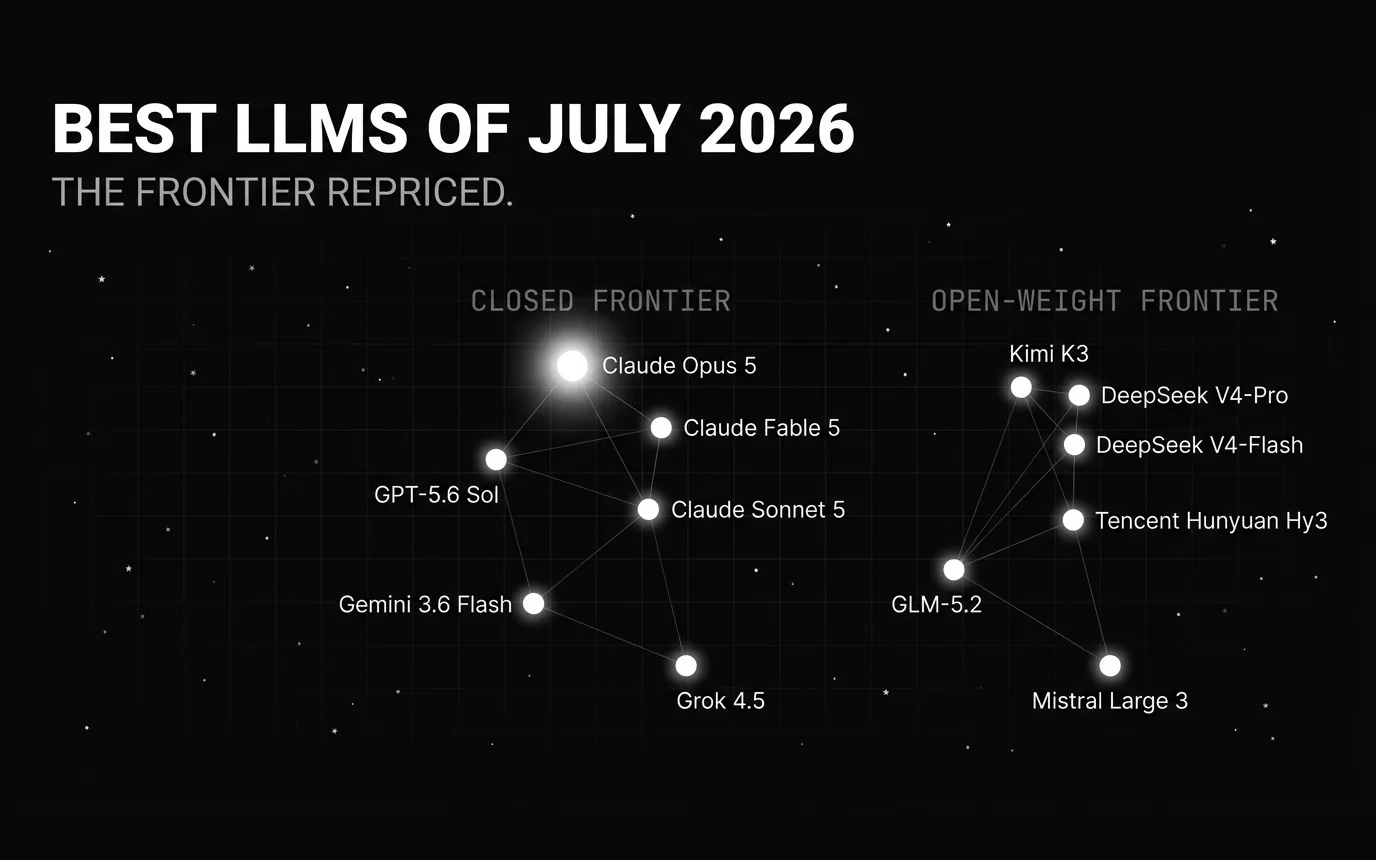
Best LLMs of July 2026 by use case: Claude Opus 5 for agentic coding, GPT-5.6 Sol for reasoning, Kimi K3 for open-weight scale, Gemini 3.6 Flash for speed.

Compare the top open-weight LLMs in 2026: Llama 4.x, DeepSeek R2, Qwen 3, Mistral, Phi family. Benchmarks, licensing, hardware, and how to evaluate yours.