LLM vs GPT in 2026: Key Differences, How Each Works, and When to Use Each for Your AI Applications
LLM vs GPT in 2026 explained: GPT is one family of LLM. Definitions, architecture, GPT-5.6 vs Claude Opus 5 vs Gemini 3.x, and how to evaluate any model.
Table of Contents
What Is the Difference Between LLM and GPT?
LLM is the category; GPT is one family inside it. Large Language Model describes any large neural network trained on broad text to handle language tasks. GPT, short for Generative Pre-trained Transformer, is OpenAI’s specific line of those models. So every GPT is an LLM, but not every LLM is a GPT: Claude, Gemini, Llama, Grok, DeepSeek and Kimi are all LLMs and none of them are GPTs.
The confusion exists because ChatGPT arrived first and its name stuck to the whole category, the way “Hoover” did for vacuum cleaners. It is a branding accident, not a technical distinction. Under the hood, GPT models and every other frontier LLM are the same architecture: decoder-only transformers trained to predict the next token.
How Do LLM and GPT Compare in One Table?
| Term | What it means | Examples in 2026 |
|---|---|---|
| LLM | Large Language Model. The category | GPT-5.6, Claude Opus 5, Gemini 3.x, Llama 4, Grok 4.5, Mistral Large 3, DeepSeek V4, Kimi K3 |
| GPT | A specific LLM family from OpenAI | GPT-3.5, GPT-4, GPT-4o, GPT-4.1, GPT-5, GPT-5.6 |
| Architecture | Decoder-only transformer | Same for both |
| When to pick GPT | Default for general-purpose work, broad tool ecosystem | GPT-5.6 Sol for reasoning, Luna for cheap volume |
| When to pick a non-GPT LLM | Agentic coding, long context, cost, on-prem | Claude Opus 5, Gemini 3.6 Flash, Kimi K3, DeepSeek V4 |
Quick answer for the impatient: every GPT is an LLM, but not every LLM is a GPT. In 2026 the right framing is “which model in which family”, not “LLM or GPT”.
Why Does Understanding LLM vs GPT Matter in 2026?
The terms Large Language Model (LLM) and Generative Pre-trained Transformer (GPT) keep getting used interchangeably, which leads to confused architecture decisions and confused vendor evaluations. The right framing is simple:
- LLM is the category. Any large neural language model trained on broad text to perform language tasks.
- GPT is a specific family of LLMs from OpenAI. It started with GPT-1 in 2018 and reached GPT-5 in August 2025.
Once you have that mental model the practical question becomes which model in which family for which workload, not “should I use an LLM or a GPT”. This guide walks through the architecture both share, the families that compete in 2026, how to choose between them, and how to evaluate any model against your real workload.
How Are LLMs and GPT Reshaping Industries?
Language models are the backbone of modern conversational AI, content generation, code assistants, research agents, and enterprise automation. They mimic human language processing, enabling step-changes in healthcare, education, customer support, and software development. Whether the task is summarizing a 200-page contract, generating an answer grounded in your knowledge base, or driving a multi-step research agent, large language models and GPT models are the default tools.
What Are Large Language Models and What Makes Them Versatile?
What Is the Definition of an LLM?
Large Language Models are deep learning systems trained on very large text corpora (often trillions of tokens) to perform language-related tasks. They use the transformer architecture and scale to hundreds of billions of parameters or, in MoE form, trillions. They generate, classify, summarize, translate, and reason over text. Modern LLMs also handle images, audio, and video natively.
How Do LLMs Work?
At their core, LLMs use the transformer’s multi-head attention mechanism, introduced in Vaswani et al., 2017, to model relationships between tokens in a sequence. Training proceeds in three stages:
- Pretraining. Predict the next token on a very large web-scale corpus. This is where most parameters get their general competence.
- Supervised fine-tuning (SFT). Train on curated instruction-response pairs so the model follows commands.
- Preference optimization. RLHF, DPO, or GRPO to align the model with human (or verifiable) preferences. See LLM Fine-Tuning Guide 2026 for the full taxonomy.
At inference time, the model receives a prompt, tokenizes it, runs the transformer forward, and samples the next token. Repeat until end-of-sequence. Modern LLMs add tool-calling, function calling, structured-output constraints, and multimodal inputs on top of this core loop.
What Is GPT and How Does It Work?
What Is the Definition of GPT?
GPT stands for Generative Pre-trained Transformer. It is OpenAI’s specific family of LLMs, named after the architecture in the original GPT-1 paper from 2018. Every public GPT model is an LLM produced by OpenAI under that brand. Other vendors’ models are LLMs but not GPTs.
How Does GPT Work?
GPT models follow the same three-stage training recipe described above. The OpenAI specifics that distinguish the GPT family:
- Decoder-only transformer. All GPT models are decoder-only (no separate encoder).
- Trained on a proprietary text and code mixture. OpenAI does not disclose dataset composition.
- Post-trained with RLHF (and increasingly with newer techniques). OpenAI’s exact GPT-5 post-training recipe is not publicly disclosed.
- Multimodality. GPT-4o introduced native audio in 2024; GPT-5 continues to support multimodal inputs per OpenAI’s published model card.
What Is the GPT Architecture?
The architecture is a stack of decoder blocks, each combining multi-head self-attention (with rotary or learned positional encodings), a feed-forward network, and layer normalization. The exact internals of modern GPT models (dense vs mixture-of-experts feed-forward layers, parameter count, dataset composition) are proprietary and not publicly disclosed by OpenAI.
What Are the Versions of GPT Through 2026?
| Version | Year | Headline change |
|---|---|---|
| GPT-1 | 2018 | First “Generative Pre-trained Transformer” paper |
| GPT-2 | 2019 | 1.5B params, “too dangerous to release” initially |
| GPT-3 | 2020 | 175B params, kicked off the API era |
| GPT-3.5 | 2022 | ChatGPT launch model |
| GPT-4 | 2023 | Multimodal text+image |
| GPT-4o | 2024 | Unified text+audio+image, real-time voice |
| GPT-4.1 | Apr 2025 | Coding and instruction-following gains |
| GPT-5 | Aug 7, 2025 | Reasoning, agentic tool use, long context |
| GPT-5.6 (Sol, Terra, Luna) | Jul 9, 2026 | Current flagship line; Sol for reasoning, Luna as the cheap tier |
The GPT-5.6 family is the current flagship line as of August 2026, and “GPT” is what most people still say when they mean any of it. Note that the family now splits by tier rather than shipping as one model: Sol is the reasoning tier, Luna the cheap high-volume one, which had an 80% price cut on 30 July 2026.
This table dates faster than anything else on this page. Check OpenAI’s release notes before pinning a version in production, and see our best LLMs of July 2026 roundup for the current cross-vendor picture.
What Does the 2026 LLM Landscape Look Like Beyond GPT?
Current flagships per vendor docs as of August 2026. Always check vendor release notes before pinning a model version in production.
| Family | Vendor | Current flagship | Where it wins |
|---|---|---|---|
| GPT | OpenAI | GPT-5.6 Sol (Jul 2026) | General-purpose default, broad tool ecosystem |
| Claude | Anthropic | Claude Fable 5 (top tier); Opus 5 at half the price | Agentic coding, tool use, long-horizon reasoning |
| Gemini | Gemini 3.x Pro, 3.6 Flash | 1M context, Google ecosystem, multimodal video | |
| Grok | xAI | Grok 4.5 (Jul 2026) | 500K context, real-time X grounding |
| Kimi | Moonshot | Kimi K3 (Jul 2026) | Largest open-weight model, self-hostable frontier |
| DeepSeek | DeepSeek | DeepSeek V4-Pro, V4-Flash | Open-weight reasoning, very low-cost API |
| Llama | Meta | Llama 4 Scout / Maverick | Open weights, self-host, OSS ecosystem |
| Mistral | Mistral | Mistral Large 3 | EU sovereignty, Apache-2.0 at frontier scale |
| Hunyuan | Tencent | Hunyuan Hy3 (Jul 2026) | Cheap Apache-licensed open coder |
Each family has its sweet spot. The honest read is that no single family wins on every dimension in 2026, which is exactly why production systems often route across providers (BYOK gateways) rather than committing to one.
What Are the Key Differences Between LLMs and GPT?
This section is the meat of the comparison readers came here for. Strictly speaking GPT is a sub-set of LLM, so the table compares “GPT family models” against “non-GPT LLMs” on the dimensions that matter in practice.
How Do Scope and Ecosystem Differ?
GPT models live inside OpenAI’s API, Assistants/Responses API, and a deep partner network (Microsoft Copilot, ChatGPT Enterprise, Azure OpenAI). The non-GPT LLM ecosystem is broader and more fragmented: Claude on Anthropic API + Bedrock + Vertex, Gemini on Google AI Studio + Vertex, Llama and Mistral as open weights you can self-host. If you want one vendor relationship and the deepest tool ecosystem, pick GPT. If you want vendor optionality, pick a router (FAGI gateway) over multiple LLM families.
How Does the Architecture Compare?
Both are predominantly decoder-only transformers built around multi-head attention with rotary or learned positional encodings and grouped-query or multi-query variants. Some open-weight families (Llama, DeepSeek, Mistral) publicly use mixture-of-experts feed-forward layers; whether closed-weight families (GPT, Claude, Gemini, Grok) use MoE is mostly inferred since exact internals are not publicly disclosed. The architectural differences between frontier families in 2026 are generally smaller than the post-training and data differences. This comparison is about frontier LLM families specifically. For how the same architectural choices (context length, attention pattern, MoE, quantization) play out between small and large models, see SLM vs LLM in 2026.
How Does the Training Recipe Differ?
The GPT post-training recipe is closed but believed to include heavy RLHF and reasoning RL (GRPO-style). Anthropic publishes more of its alignment recipe (Constitutional AI, RLAIF). Meta publishes the Llama recipes in detail. DeepSeek pioneered the open GRPO recipe with R1. If reproducibility matters, the open Llama and DeepSeek families are the right choice.
Which Applications and Workloads Fit Each?
- GPT models are the safe default for general-purpose chat, coding assistance, structured-output extraction, and broad tool ecosystems.
- Claude wins on agentic tool use, coding (especially long-horizon refactors), and writing quality.
- Gemini wins on long context (1M tokens on the current Flash tiers), native video understanding, and Google Workspace integration.
- Llama / Mistral win on on-prem deployment, EU sovereignty, and self-host cost control.
- Grok 4.5 pairs reasoning with real-time grounding in X data and a 500K context window. Check the xAI pricing page for current rates rather than trusting any figure quoted in an article.
- DeepSeek wins on cost and on open-source reasoning models.
The right pick depends on your workload. Public benchmarks help; running your real prompts through every option helps more.
What Are the Advantages and Disadvantages of Each?
What Are the Advantages of LLMs in General?
- Versatility. One model handles classification, generation, summarization, translation, RAG, code.
- Scaling story. Continued progress in 2024-2026 means today’s frontier is tomorrow’s commodity.
- Tool calling and structured outputs. Production LLMs in 2026 routinely call tools and emit JSON/Pydantic-typed outputs.
- Multimodality. Text, image, audio, video, and document inputs are first-class.
What Are the Disadvantages of LLMs in General?
- Hallucination. Confidence is decoupled from correctness.
- Compute and cost. Frontier reasoning is still expensive at scale.
- Latency. Long-context reasoning is slow even at low cost per token.
- Bias and safety. Training data biases propagate into outputs.
What Are the Advantages of GPT Specifically?
- Default trust. GPT-5 is the model most enterprise procurement teams accept without a long evaluation.
- Tool ecosystem. Function calling, Assistants/Responses API, and a deep partner network reduce integration time.
- Multimodal coverage. GPT-5 handles text, image, audio in one model.
What Are the Disadvantages of GPT Specifically?
- Vendor lock-in. Switching from OpenAI to Anthropic or Google later means re-instrumenting your prompts and tools.
- No open weights. You cannot self-host GPT.
- Pricing. GPT-5 sits at the high end of frontier pricing for the reasoning tier.
What Are the Real-World Use Cases for LLMs and GPT?
What Are LLM Use Cases Across Any Frontier Model?
- Knowledge management. Summarize lengthy documents, extract actionable insights, organize unstructured information.
- Chatbots and virtual assistants. Interactive customer-facing conversation agents with tool calls and grounded retrieval.
- Content generation. Articles, reports, product descriptions, marketing copy at scale, ideally with eval-driven QA.
- Data analysis. Summarize datasets, identify trends, generate human-readable insight reports.
- Agentic workflows. Multi-step research, code generation with execution, browsing, and tool orchestration.
What Are GPT-Specific Use Cases Today?
- General-purpose chat default. ChatGPT Enterprise, Microsoft Copilot, Azure OpenAI deployments.
- Code generation in Copilot, Codex CLI, and the Cursor / Windsurf IDE families.
- Structured-output extraction at scale thanks to mature JSON-mode and tool calling.
- Voice assistants via GPT-4o-style real-time audio.
Which Applications Do LLMs and GPT Share?
- RAG-enhanced search. Combine vector embeddings (the choice of embedding model is independent of the LLM choice) with any frontier LLM for grounded answers.
- Virtual training and simulation. Use a strong LLM with RLHF or RLAIF tuning to drive scripted training scenarios. fi.simulate is built for exactly this loop.
- Multi-agent research. Planner-executor patterns with mixed model families (e.g. Claude as planner, GPT as code generator).
What Is the Future Outlook for LLMs and GPT in 2026 to 2027?
Are Reasoning-First Models Becoming the Norm?
The 2025-2026 trend is reasoning RL on top of strong SFT bases. GPT-5.6 Sol, Claude Opus 5, and Grok 4.5 all reach reasoning levels that GPT-4 could not. Expect every frontier family to ship reasoning-tier and non-reasoning-tier SKUs for the next several years, with the gap closing on the non-reasoning side and widening on the reasoning side.
How Is Multimodal Capability Expanding?
Text + image + audio is now table stakes. The 2026-2027 expansion is into video understanding (Gemini 3.x leads), 3D scene understanding (early), and physical-world reasoning. Multimodal evaluation is harder than text-only evaluation, and the eval layer (Future AGI’s audio/image/PDF evaluators) becomes more important as modalities multiply.
Are Open-Weight Models Catching Up to Frontier Models?
This one arrived faster than the previous version of this article expected. Kimi K3, DeepSeek V4-Pro, and Mistral Large 3 have closed most of the benchmark gap to closed frontier models, and Kimi K3 is the largest open-weight model released to date. What remains is less about raw capability and more about the polish of agentic tool use and the operational cost of self-hosting something that large.
What Do Ethical AI and Safety Require Going Forward?
Bias detection, fairness frameworks, and transparent training data audits will move from research topics to procurement requirements. Guardrails (PII screening, prompt-injection screening, content moderation, data-leakage prevention) move from optional to mandatory in regulated industries. This is where Agent Command Center sits.
What Do Real-Time and Low-Latency Workloads Need?
Voice agents, autonomous vehicle stacks, and live coding assistants need sub-second p95. Distillation, quantization, and specialized inference hardware (Groq, Cerebras, SambaNova) are closing the latency gap. Expect 2026-2027 to be the year of production voice agents.
How Do You Evaluate Any LLM or GPT for Your Workload?
The single most useful thing this post can teach you: do not pick an LLM based on a vendor leaderboard. Pick it based on your workload. The same methodology applies when the candidates are a small model and a frontier model rather than two frontier families. See SLM vs LLM in 2026 for a worked example comparing a fine-tuned SLM against a frontier LLM on the same eval set.
- Capture 200-500 real prompts. With ground truth where you have it; synthesize the rest using a strong judge model.
- Wire every call through traceAI so every model swap is captured as an OTel span tree.
- Evaluate every output with fi.evals templates. Task completion, factuality, faithfulness, tool-selection accuracy, latency, cost, PII leakage.
- Replay the same prompts across GPT-5.6 Sol, Claude Opus 5, Gemini 3.6 Flash, Grok 4.5, and Kimi K3. Read the per-metric winners on the Prototype dashboard.
- Guardrail the winner in production with Agent Command Center policies.
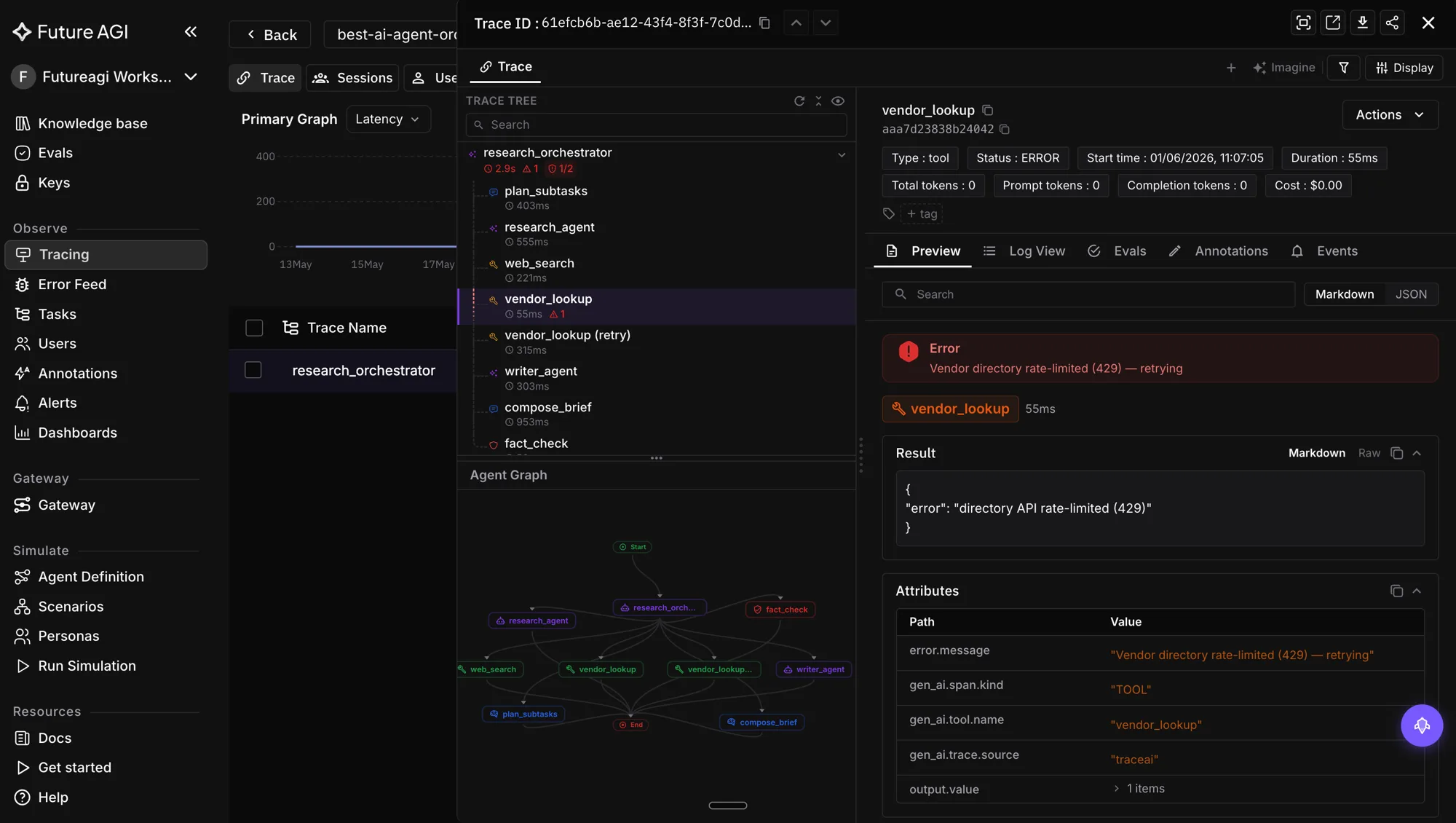
A minimal evaluation sketch in code (pseudocode; the FAGI SDK exposes fi.evals and fi.evals.metrics for production use):
# Pseudocode sketch for cross-model evaluation.
# In production, use fi.evals and fi.evals.metrics on prepared
# datasets of (input, output) pairs from each candidate model.

# 1. Collect prompts and outputs from each model offline:
#    prompts = [...]
#    outputs_gpt5    = call_openai_for_each(prompts)
#    outputs_claude  = call_anthropic_for_each(prompts)
#    outputs_grok    = call_xai_for_each(prompts)

# 2. For each model, score with fi.evals templates
#    (factuality, task completion, faithfulness, custom LLM judges)
#    and attach scores to OTel spans for inspection in the Prototype
#    dashboard. Then compare per-metric winners across models.
For deeper reads see LLM Benchmarking Compared in 2026, Best LLMs in May 2026, and Grok 4 vs Grok 3 in 2026.
Which Model Should You Pick: LLM or GPT?
Understanding LLM vs GPT is straightforward once you accept the category-instance relationship. LLM is the category; GPT is one specific lineage from OpenAI. In 2026 you choose between LLM families (GPT, Claude, Gemini, Llama, Grok, Mistral, DeepSeek) on cost, capability, context window, deployment model, and ecosystem fit, then evaluate the candidates against your actual workload before you ship.
Future AGI is the evaluation, simulation, and guardrail layer for whichever LLM or GPT model you pick. Try a free workspace at app.futureagi.com, or read Best LLM Monitoring Tools in 2026 and Best AI Agent Observability Tools in 2026 for the broader stack.
Frequently Asked Questions About LLM vs GPT
What is the difference between LLM and GPT in one line?
Is GPT-5 the same as an LLM?
When should I pick a non-OpenAI LLM over GPT?
What architecture do LLMs and GPT models share?
What about RAG, is it part of the LLM or GPT?
How do I evaluate which LLM is best for my workload?
Are LLMs and GPT both subject to hallucination?
Is Future AGI an LLM or a GPT?
Compare GPT-5, Claude Opus 4.7, Gemini 2.5 Pro, and Grok 4 on GPQA, SWE-bench, AIME, context, $/1M tokens, and latency. May 2026 leaderboard scores.

Best LLMs May 2026: compare GPT-5.5, Claude Opus 4.7, Gemini 3.1 Pro, and DeepSeek V4 across coding, agents, multimodal, cost, and open weights.
GPT-4.1 vs GPT-5 in 2026: SWE-bench scores, 1M token context, pricing, and the migration playbook. When to stay on 4.1 and when to switch.
